← Read the full article · Front Line Stories · Magazine editionDrag a corner · Click a page · Arrow keys
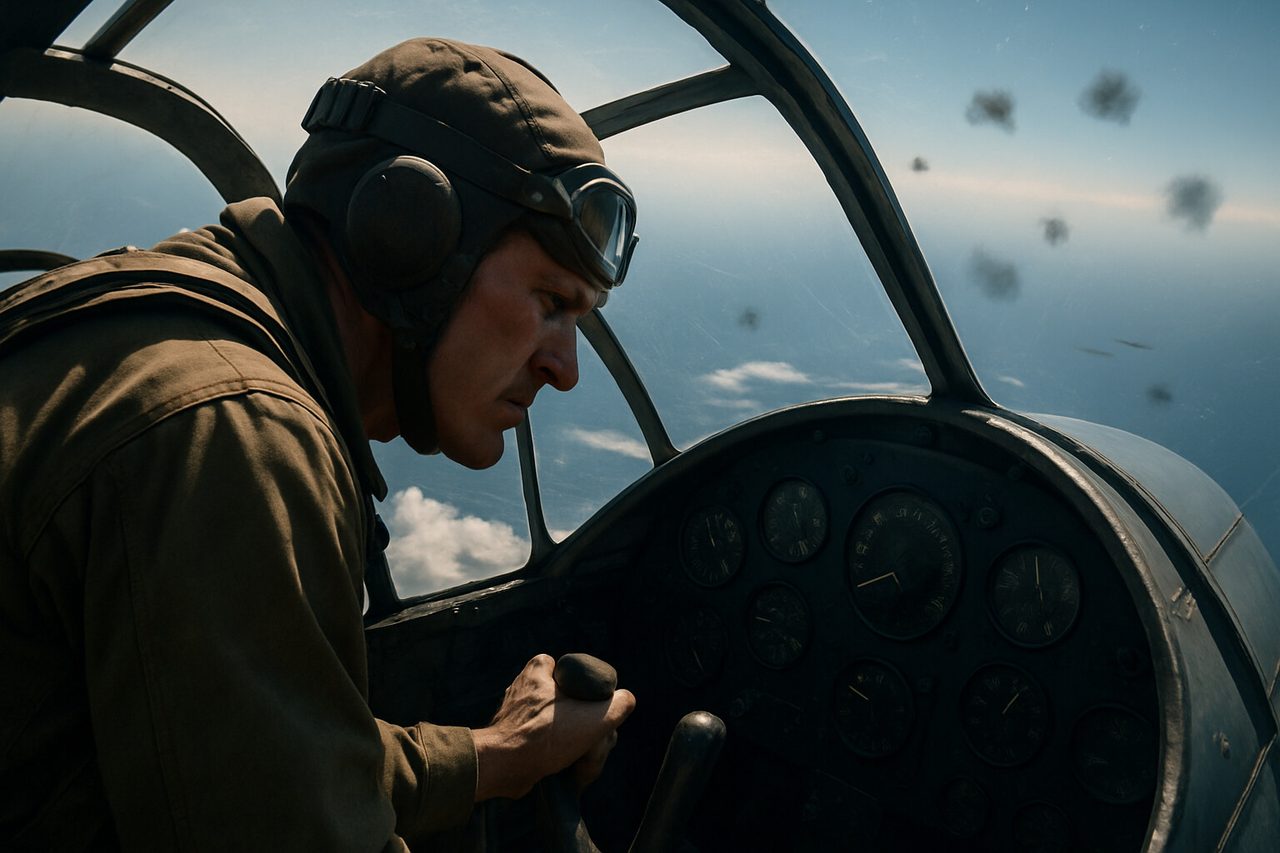
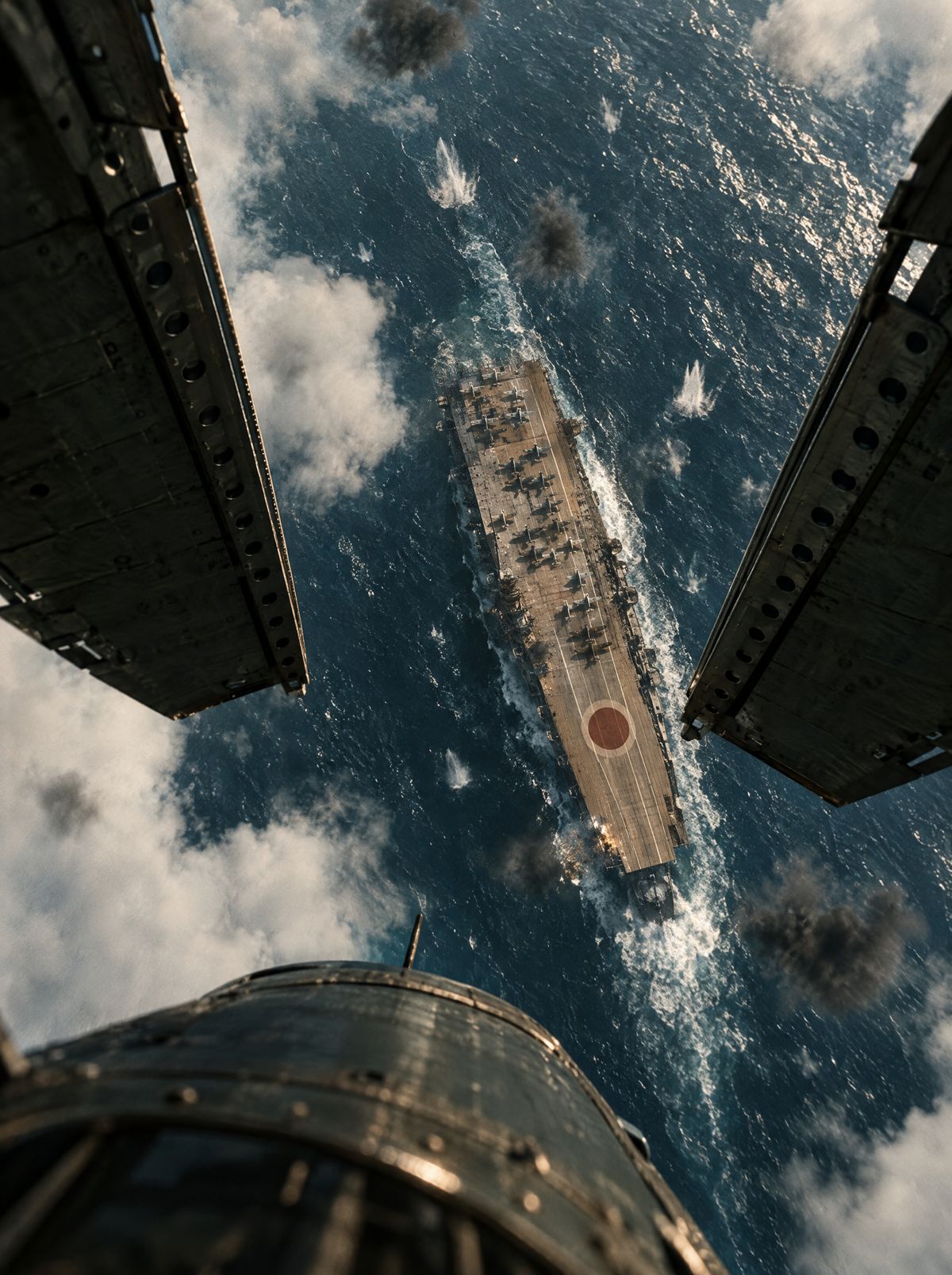
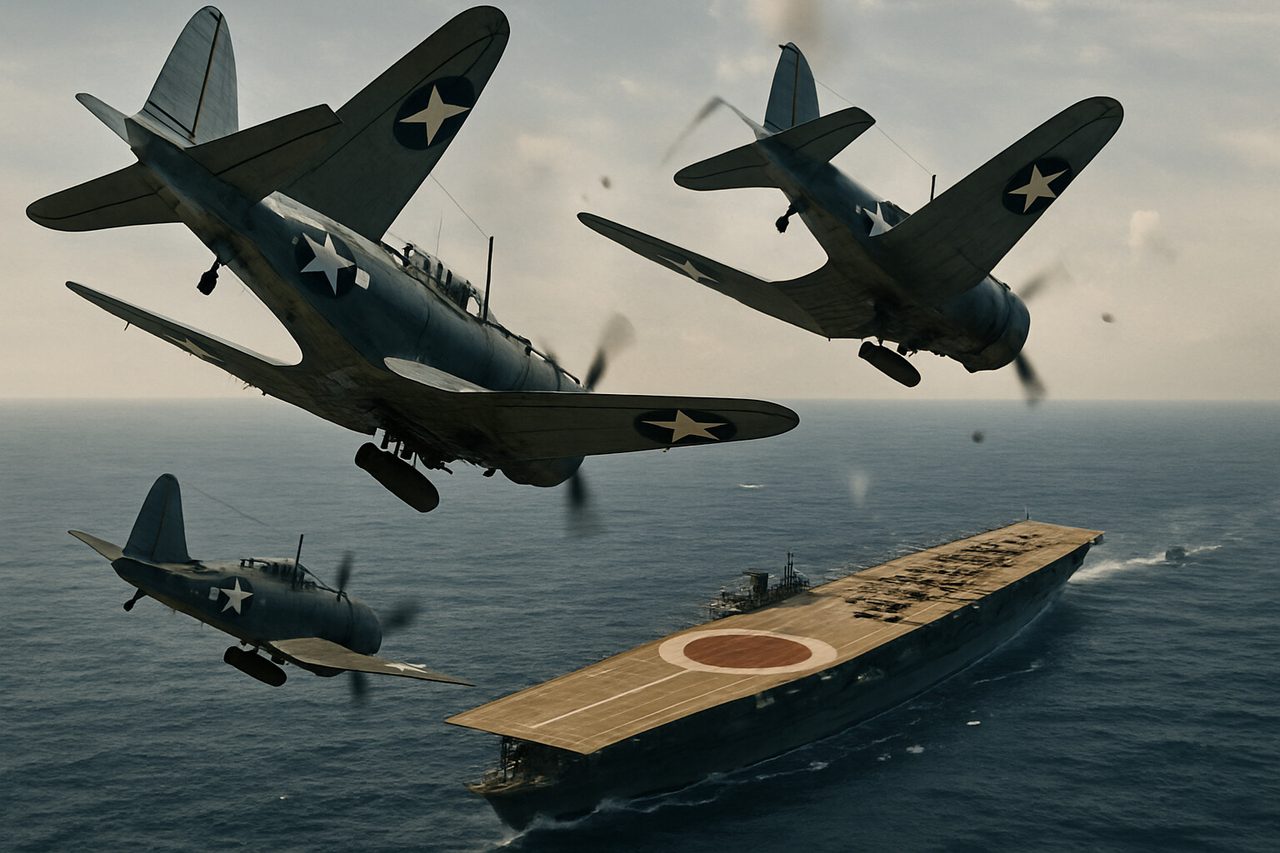
View from a diving SBD Dauntless, dive flaps open, plunging toward a Japanese carrier far below
StoriesIssue 01 · The Pacific · 36 pages
CodebreakersThe basement that read the enemy's mail
Torpedo 8Fifteen planes went in. One man came back.
Shattered SwordWhat really happened in Nagumo's hangars
Field manualAnatomy of a dive-bomb attack
June 4, 1942 · 10:20 a.m.

Five Minutes Over Midway

How Nimitz staked the Pacific Fleet on stolen intelligence and broke Japan's carrier force in a single morning.

Front Line · Issue 01June 1942
In this issue

Contents

Part one · The gamble
The Arithmetic of June 194204 Operation MI: the map07 The Basement08 Seventy-Two Hours11 Point Luck14
Part two · June 4
04:3016 The Admiral's Choice18 The Torpedo Run20 The Search24 10:20 a.m.25 Hiryu Strikes Back28
Part three · The reckoning
Field Manual: SBD Dauntless30 The Cast32 The Turning Point34 Midway Today35
02
Wade McClusky in the cockpit of his SBD at the moment of push-over, flak bursting ahead
14,000 feet over the Pacific. Lt. Cmdr. Wade McClusky pushes over.
The Gamble

He would go out to meet the Japanese fleet.

The dispatch arrived at Pacific Fleet headquarters in Pearl Harbor typed, decoded and laid on a desk. If the men in a basement signals room were reading the enemy's traffic correctly, they knew the blow's timing, its composition and its destination. Admiral Chester W. Nimitz read it and made a decision that carried the weight of a career, a fleet and a war.

03
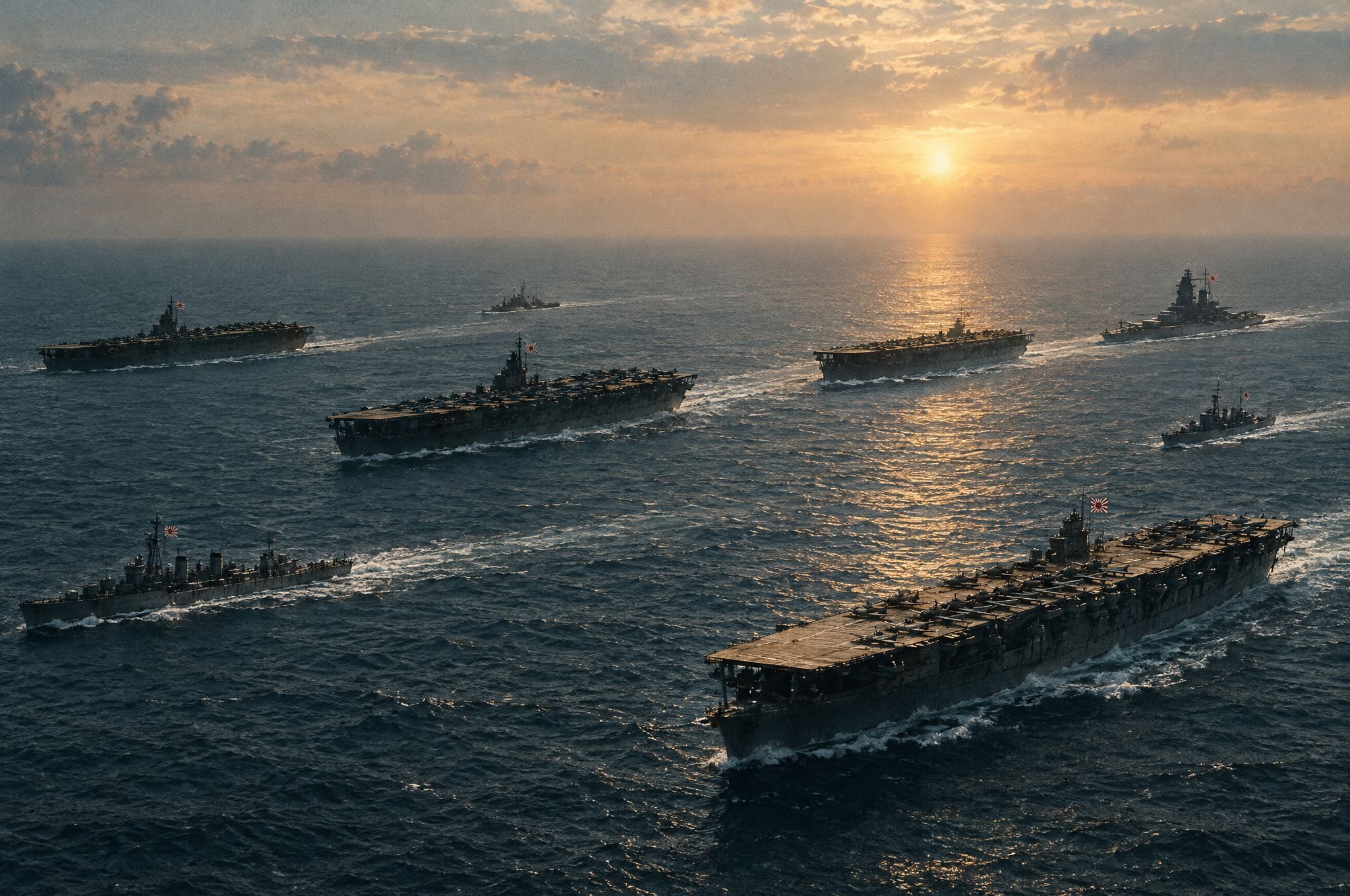
Four Japanese aircraft carriers steaming in formation across the Pacific at dawn
Order of battle

The arithmetic of June 1942

The Kido Butai. Akagi, Kaga, Soryu and Hiryu: four of the six carriers that struck Pearl Harbor six months earlier.
04
Imperial Japanese Navy
4fleet carriers
~248aircraft aboard them
200+ships committed to the operation

U.S. Pacific Fleet
3carriers, one badly damaged
0operational battleships
05
Part one · The gambleFront Line
Spring 1942

Victory disease

The Philippines fell. Wake Island fell. Guam fell. Singapore surrendered 80,000 troops to a force that had come down the Malay Peninsula largely on bicycles. Japan's carriers ran from the Indian Ocean to the central Pacific almost without serious opposition, and Japanese planners began to speak of a "victory disease": confidence so complete it was hardening into carelessness.

That overconfidence had a plan by May 1942. Operation MI would seize Midway Atoll, a tiny American-held island about 1,300 miles northwest of Pearl Harbor. Taking it would remove a forward air base and listening post. More important, it would force the last American carriers into a decisive battle that Admiral Isoroku Yamamoto expected to be quick and fatal.

With those carriers gone, Japan could hold its Pacific perimeter and negotiate from strength.

06
Operation MIMay–June 1942
45°N35°N25°N 170°E180°170°W ALEUTIAN ISLANDS diversion ← JAPAN Kido Butai approaches from the NW MIDWAY POINT LUCK ~350 mi NE of Midway PEARL HARBOR ~1,300 miles
Schematic. Positions approximate, based on published accounts.
Red Japanese moves: the carrier striking force from the northwest, a diversion against the Aleutians to draw American attention north, and Yamamoto's Main Body, led by the super-battleship Yamato, waiting in reserve.
Green American moves: three carriers out of Pearl Harbor to Point Luck, beyond the reach of Japanese search planes.
07
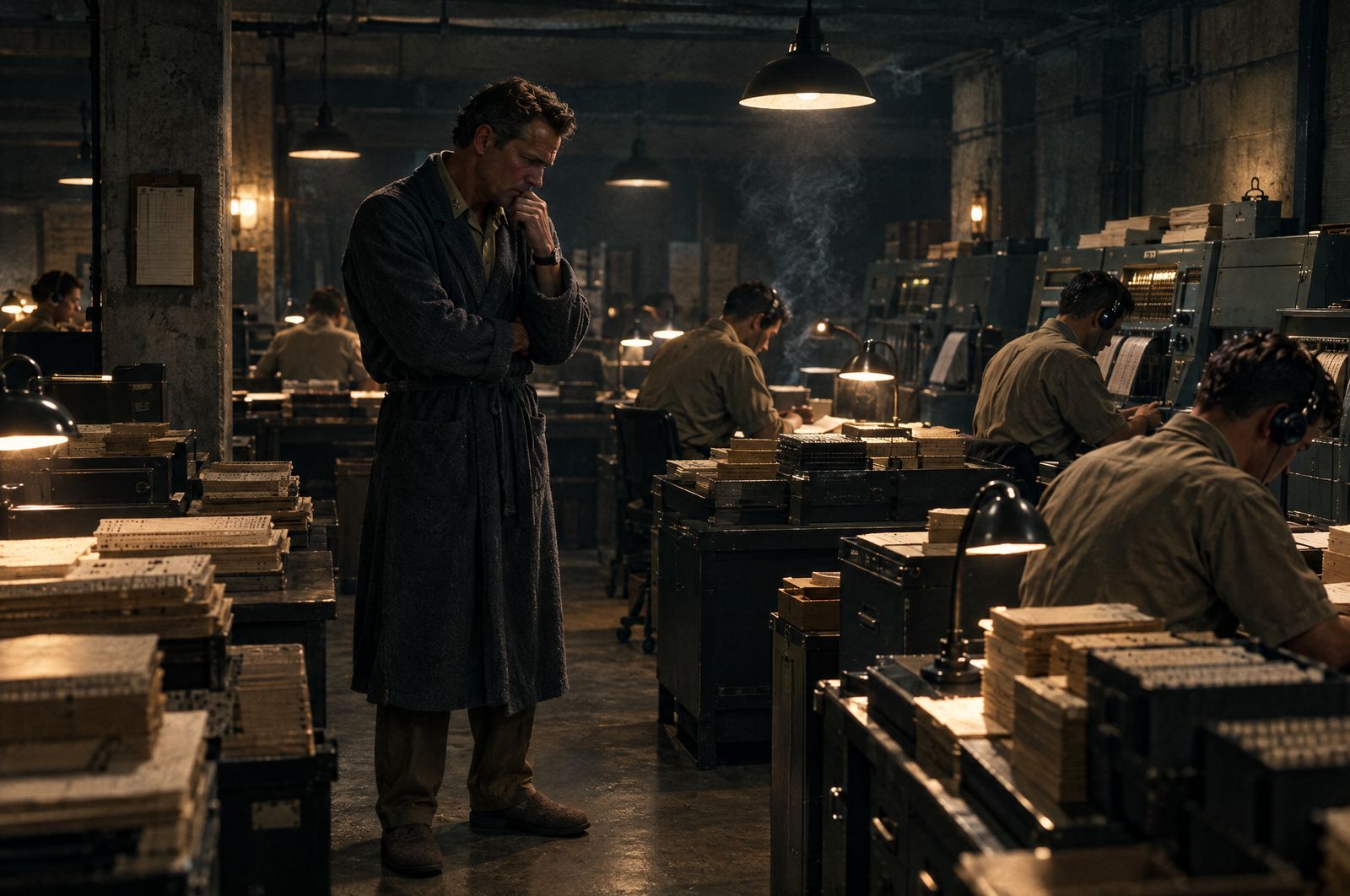
A commander in a bathrobe stands among cluttered desks and tabulating machines in a basement signals office

The Basement

Pearl Harbor Navy Yard
Fleet Radio Unit Pacific. Everyone calls it Station Hypo.
Cmdr. Joseph Rochefort is known to pace the floor in a bathrobe and carpet slippers during long sessions.
08

"AF"

Station Hypo · May 1942
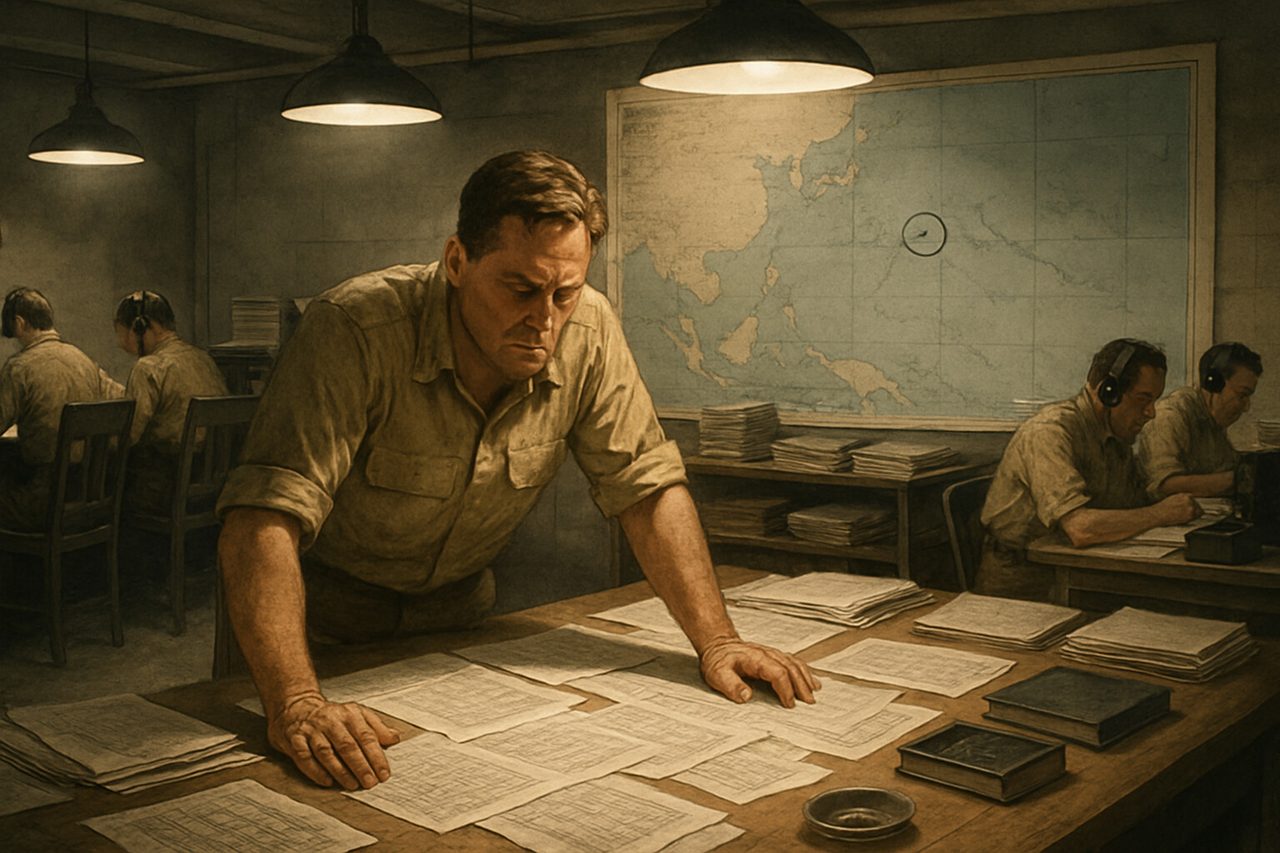
Rochefort leaning over decoded Japanese traffic in the Station Hypo basement
The team has attacked Japan's main naval code, JN-25, for months.
Enemy traffic keeps naming a target: "AF." Rochefort's team believes AF is Midway.
Detail: the Pacific wall map with Midway circled
To prove it, Midway is told to report, uncoded, that its freshwater plant has failed.
Detail: Rochefort's hands on the decrypted message sheets
Within days, Japanese traffic reports that AF is short of water.
AF is Midway.
09
Part one · The gambleFront Line
Signals intelligence

Accumulated inference

Station Hypo was not a glamorous place. Rochefort's linguists, mathematicians and communications analysts never read every word of JN-25. By spring they read enough to rebuild the outline of Japanese intentions even where gaps remained.

There was no single moment of revelation. There were route indicators, logistics messages and repeated references to AF. The water-shortage trick confirmed the target, and the analysis came with an estimated date and the order of battle for Nagumo's carriers.

Washington circulated more cautious assessments. Nimitz chose to trust Rochefort. He would place his carriers northwest of Midway, outside Japanese search range, and hit Nagumo while the enemy was busy with the island. The surprise Yamamoto counted on would belong to the Americans.
10
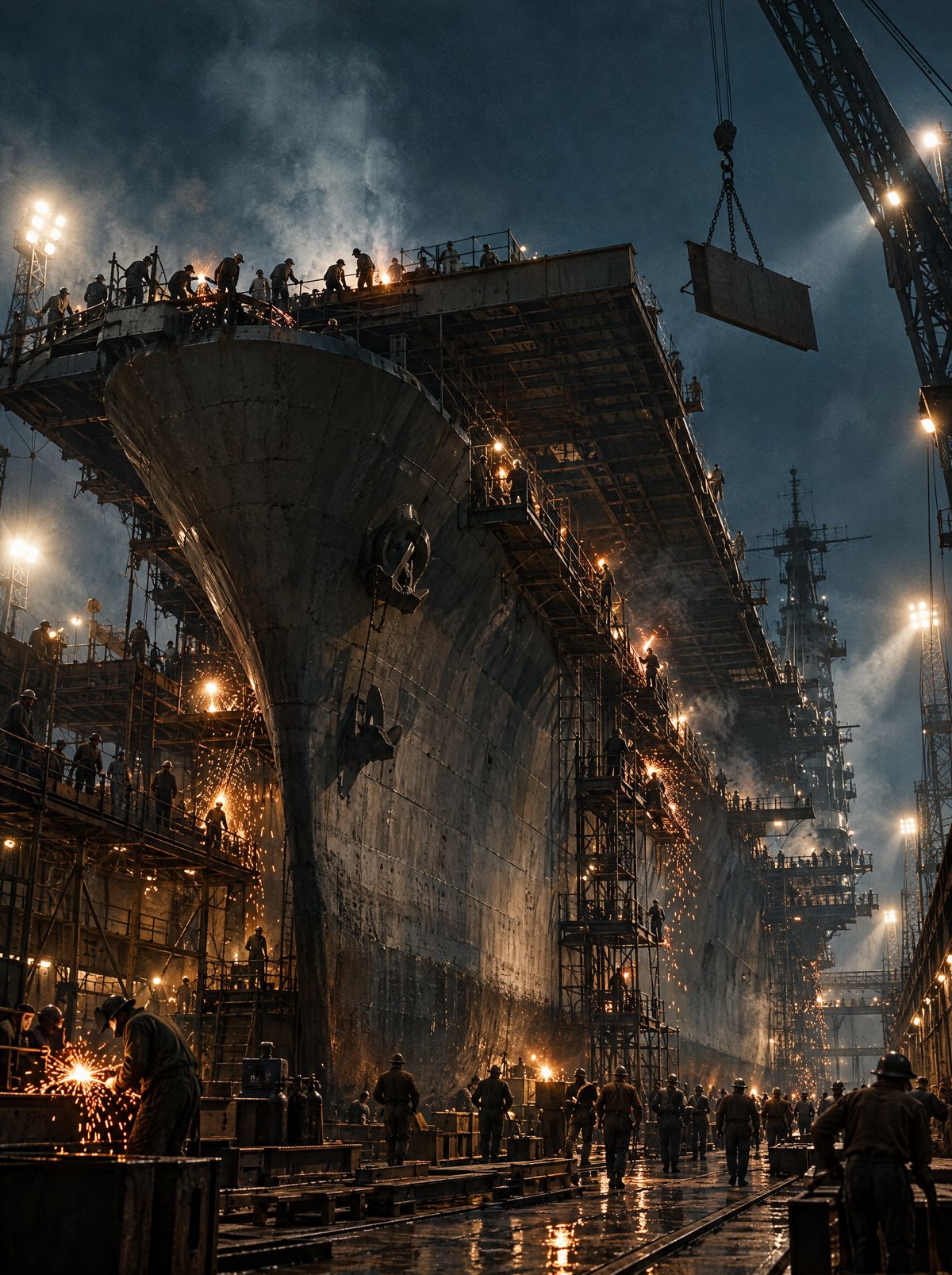
Yorktown in dry dock at night, workers on scaffolding, welding sparks under floodlights
Pearl Harbor · May 27–30

Seventy-two hours

May 27. Yorktown limps in with bomb damage from the Coral Sea.
Some engineers estimate months of repair.
Nimitz orders it done in 72 hours. About 1,400 workers go at it around the clock.
11

The Patch

Dry Dock No. 1
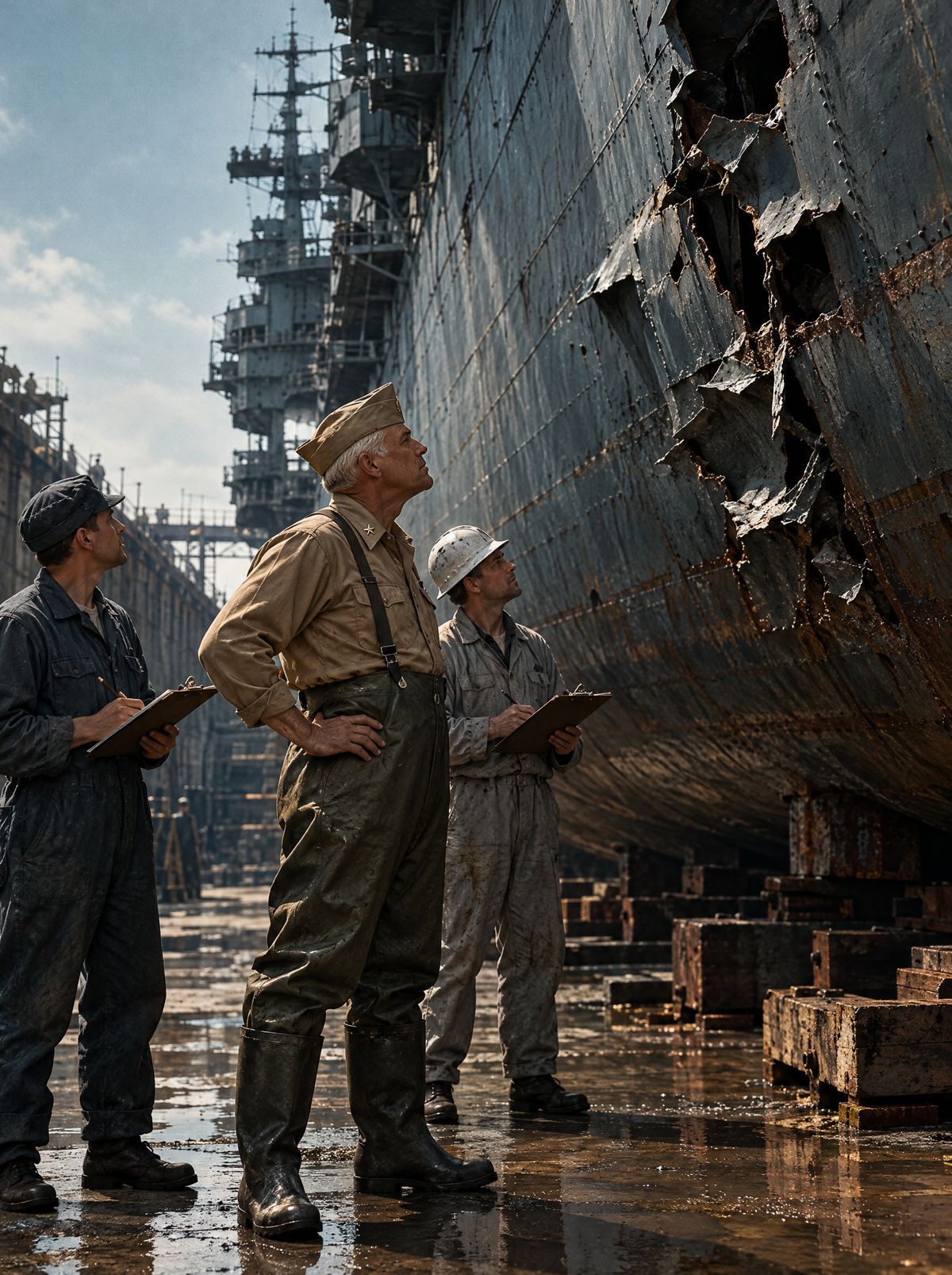
A white-haired admiral in khakis and waders studies torn hull plating with two engineers
By several accounts, Nimitz looks at the damage himself and talks with the repair teams.
Detail: welders at work under floodlights
Not a full repair. A battlefield patch that makes her fit to fight.
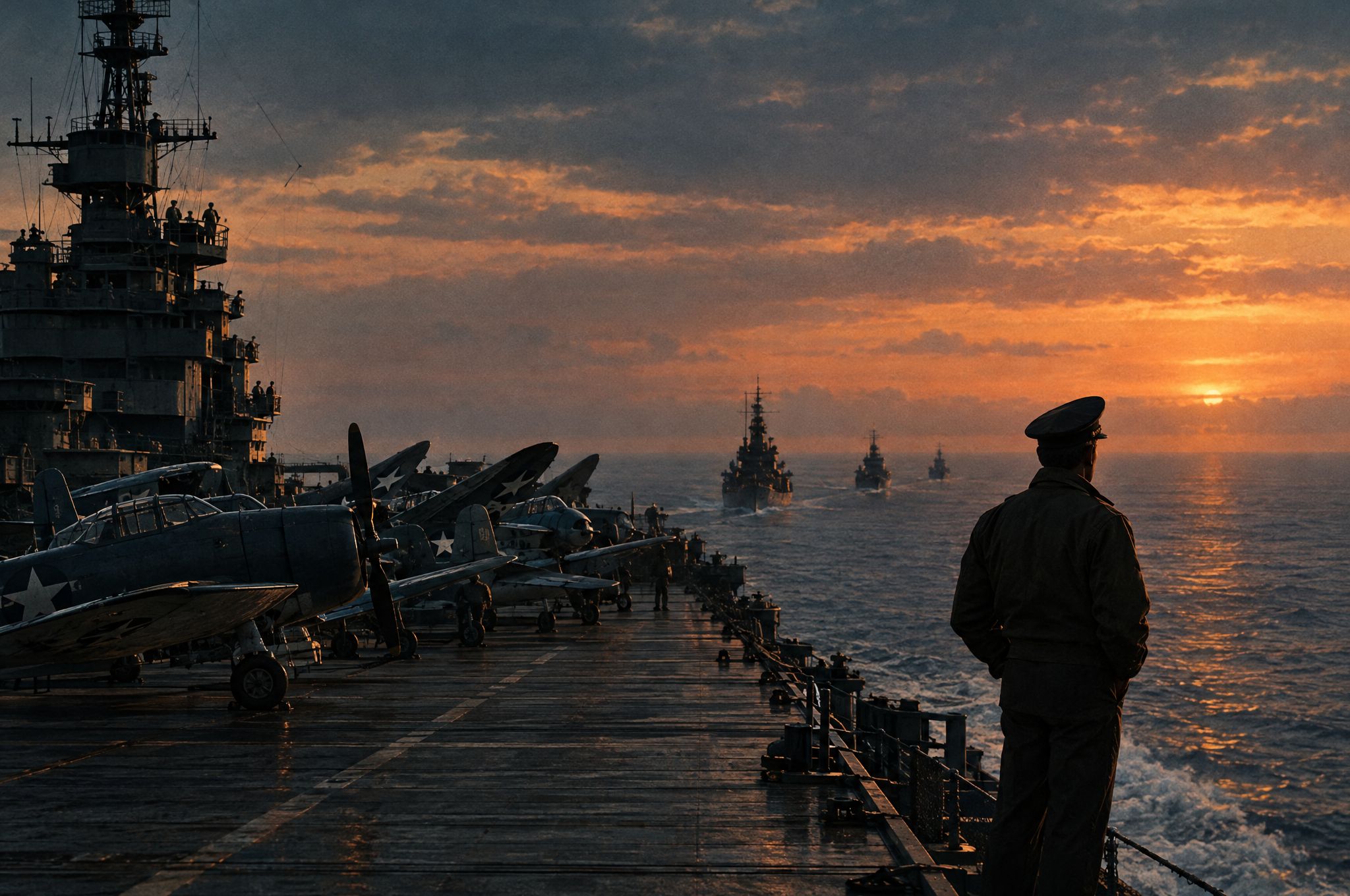
Detail: an officer on deck watching the sunset as the escorts steam ahead
May 30
Yorktown sorties.
12
Front LinePart one · The gamble
The orders

Calculated risk

Japanese intelligence, relying partly on its submarine picket line, calculated that the Americans had two operational carriers at most and that Yorktown had been sunk. They were wrong on both counts.

"You will be governed by the principle of calculated risk."Nimitz, letter of instruction to Fletcher and Spruance, May 1942

Vice Admiral William Halsey was in the hospital with a severe skin condition. In his place Nimitz gave Task Force 16 to Raymond Spruance, a precise cruiser admiral who had never led carriers in action. Frank Jack Fletcher, the senior officer afloat, took Task Force 17. Nimitz authorized both to strike when the Japanese carriers were found, and left the execution to them.
13
An American carrier with escorts at sea at dusk, aircraft on deck, an officer watching the horizon
June 2–3, 1942

Point Luck

About 350 miles northeast of Midway, beyond the range of Japanese search planes.
14
Task Force 16: Enterprise and Hornet, under Spruance. Task Force 17: Yorktown, under Fletcher.
They waited.
15

04:30

June 4 · Part two
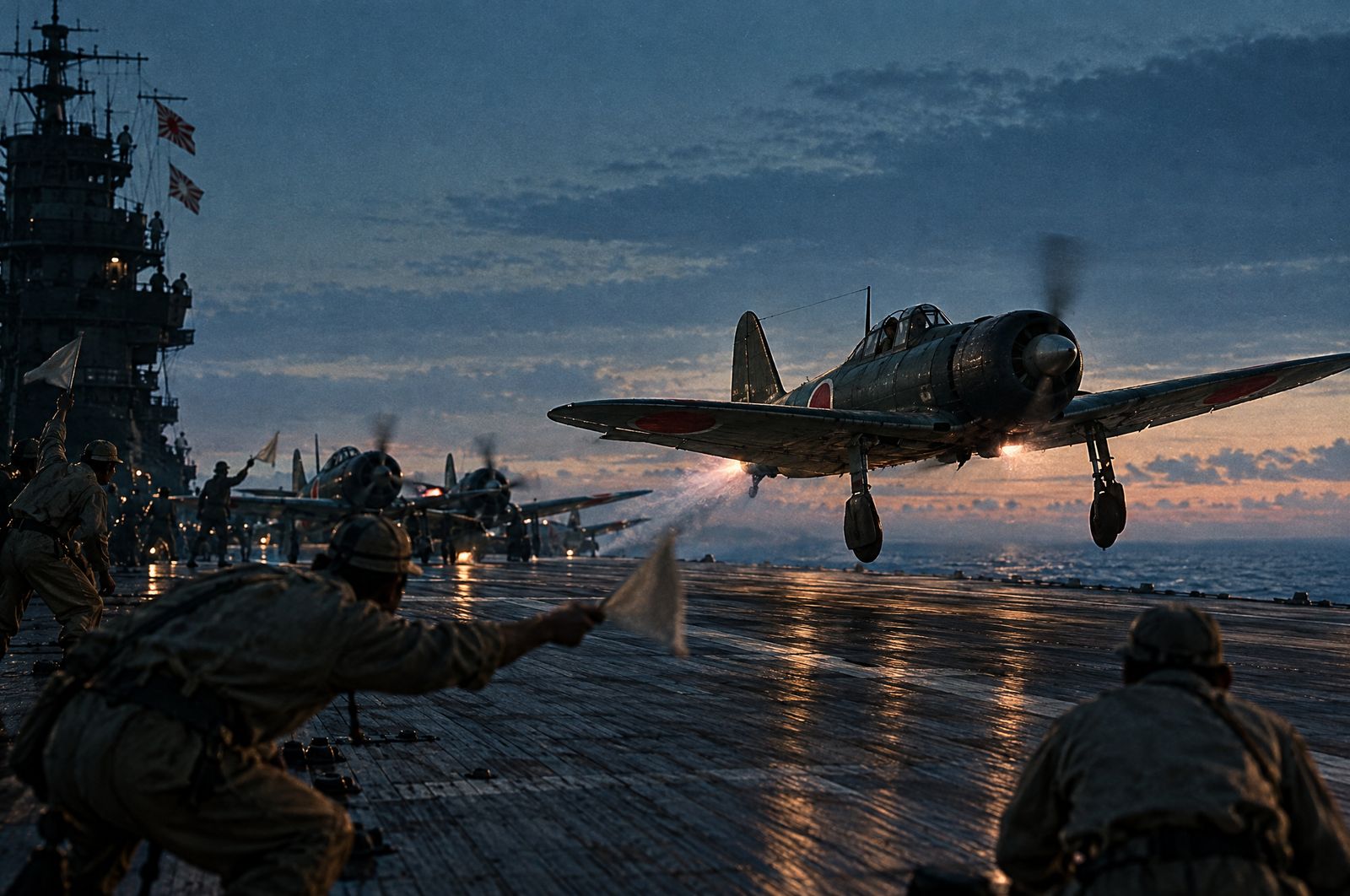
A Zero fighter lifts off a Japanese carrier deck at dawn as deck crew wave
Nagumo launches the first strike at Midway: 108 aircraft.
Kate torpedo planes armed as level bombers, Val dive-bombers, and Zeros as escort.
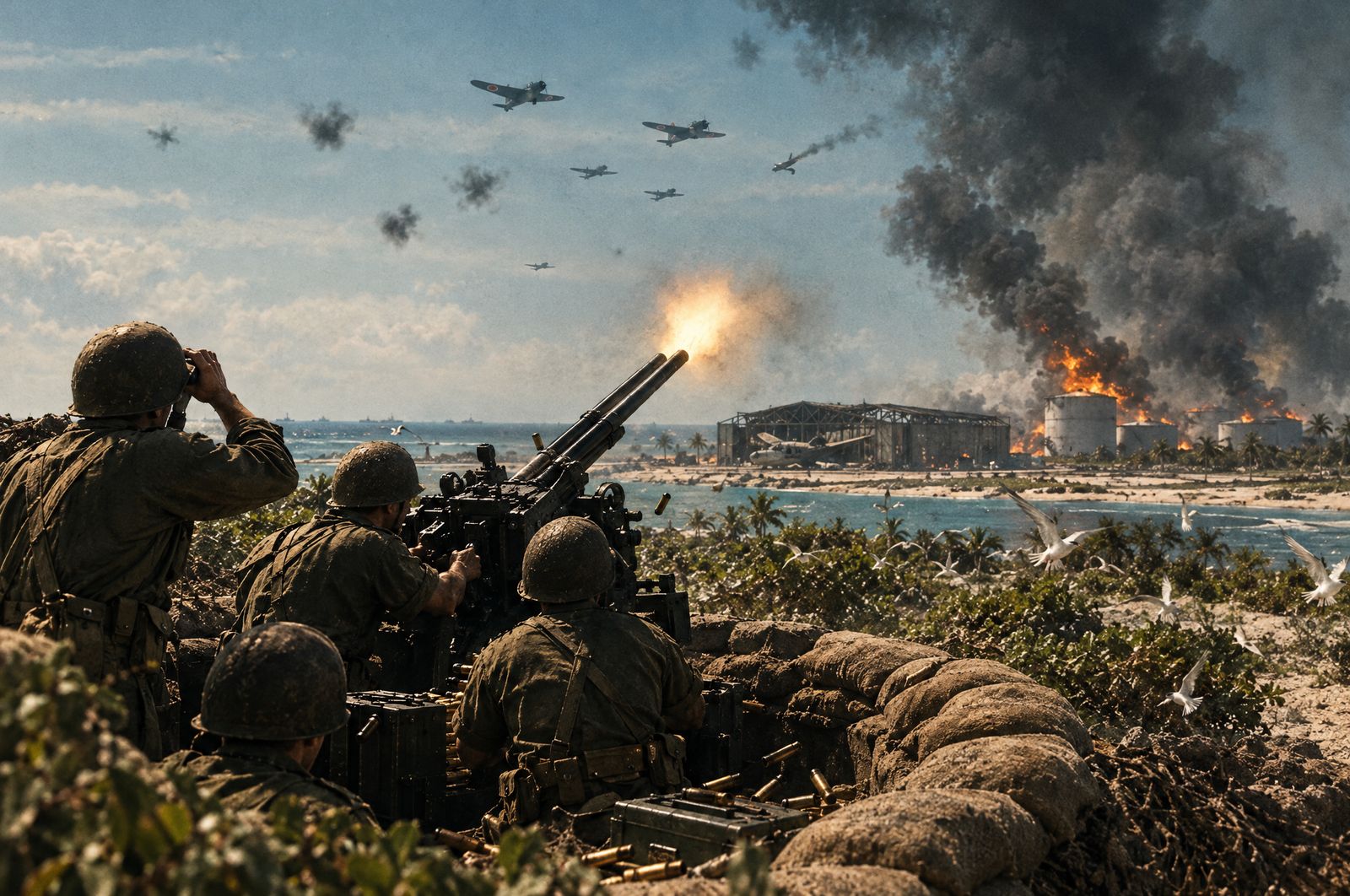
Marine anti-aircraft gunners fire as Midway's fuel tanks burn
The strike hits fuel storage and the seaplane hangar. The runways survive.
The strike leader signals Nagumo: a second attack is needed.
16
Front LinePart two · June 4
The morning

Midway strikes back

The island's aircraft went after Nagumo's carriers again and again through the morning. Most were shot down without scoring a hit. Zeros tore through the slower American planes, and the crews had no tactical answer to the fighter screens and coordinated anti-aircraft fire.

Flying from Midway
Marine CorpsBrewster Buffalo, Grumman Wildcat, SBD Dauntless, Vought SB2U Vindicator
Army Air ForcesB-17 Flying Fortress, B-26 Marauder
NavyPBY Catalina

The results were catastrophic for the attackers and negligible against the carriers. But they kept Nagumo's force busy, and they kept him thinking about the island.
17
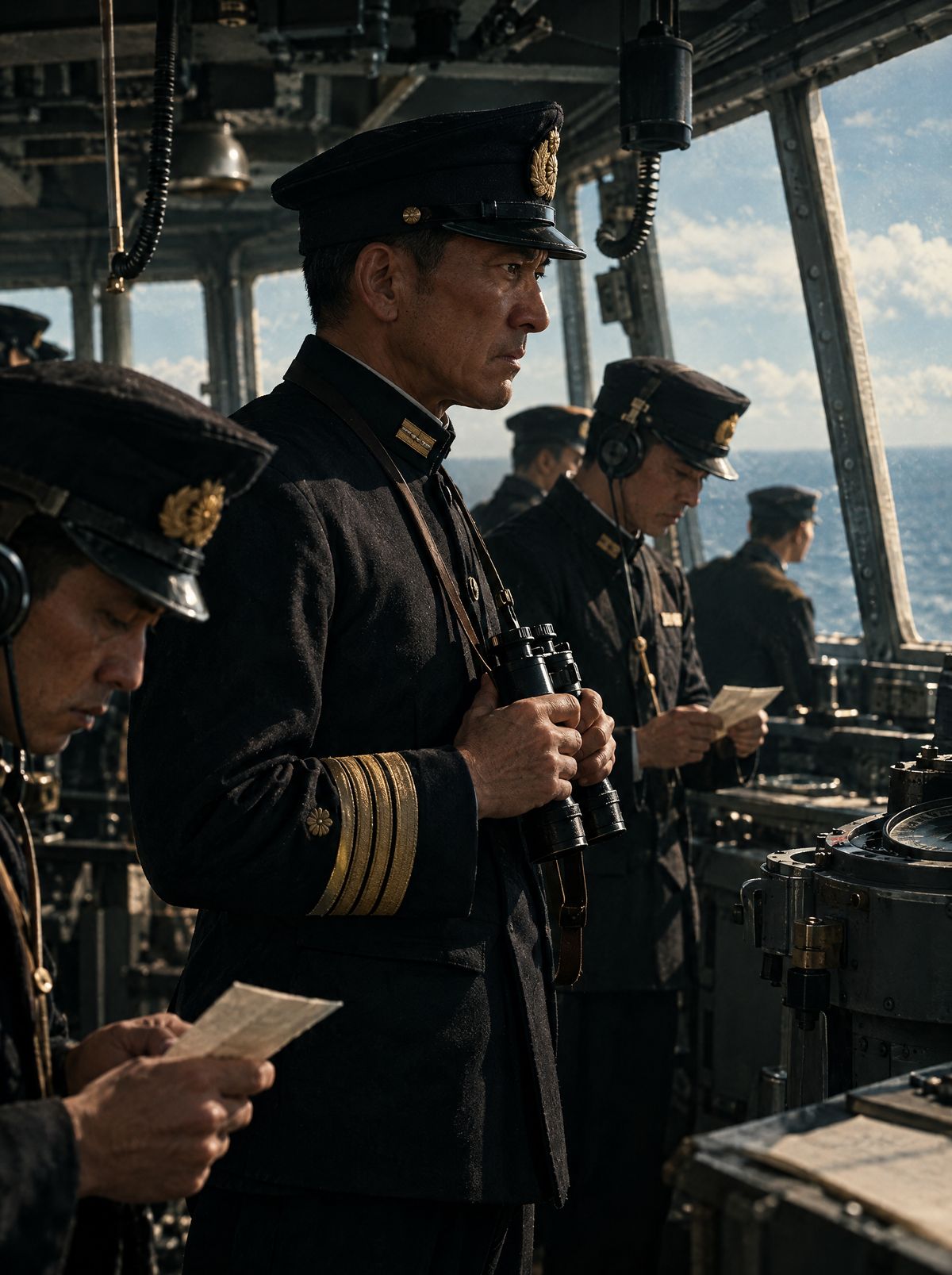
A Japanese vice admiral lowers his binoculars on a carrier bridge as staff officers read message slips

The Admiral's Choice

Aboard Akagi
Vice Admiral Chuichi Nagumo needs a second strike on Midway.
He orders his reserve planes rearmed: torpedoes and armor-piercing bombs off, land bombs on.
Then a scout reports American ships to the northeast. One of them is a carrier.
He orders them rearmed again.
18

Below Decks

The hangar
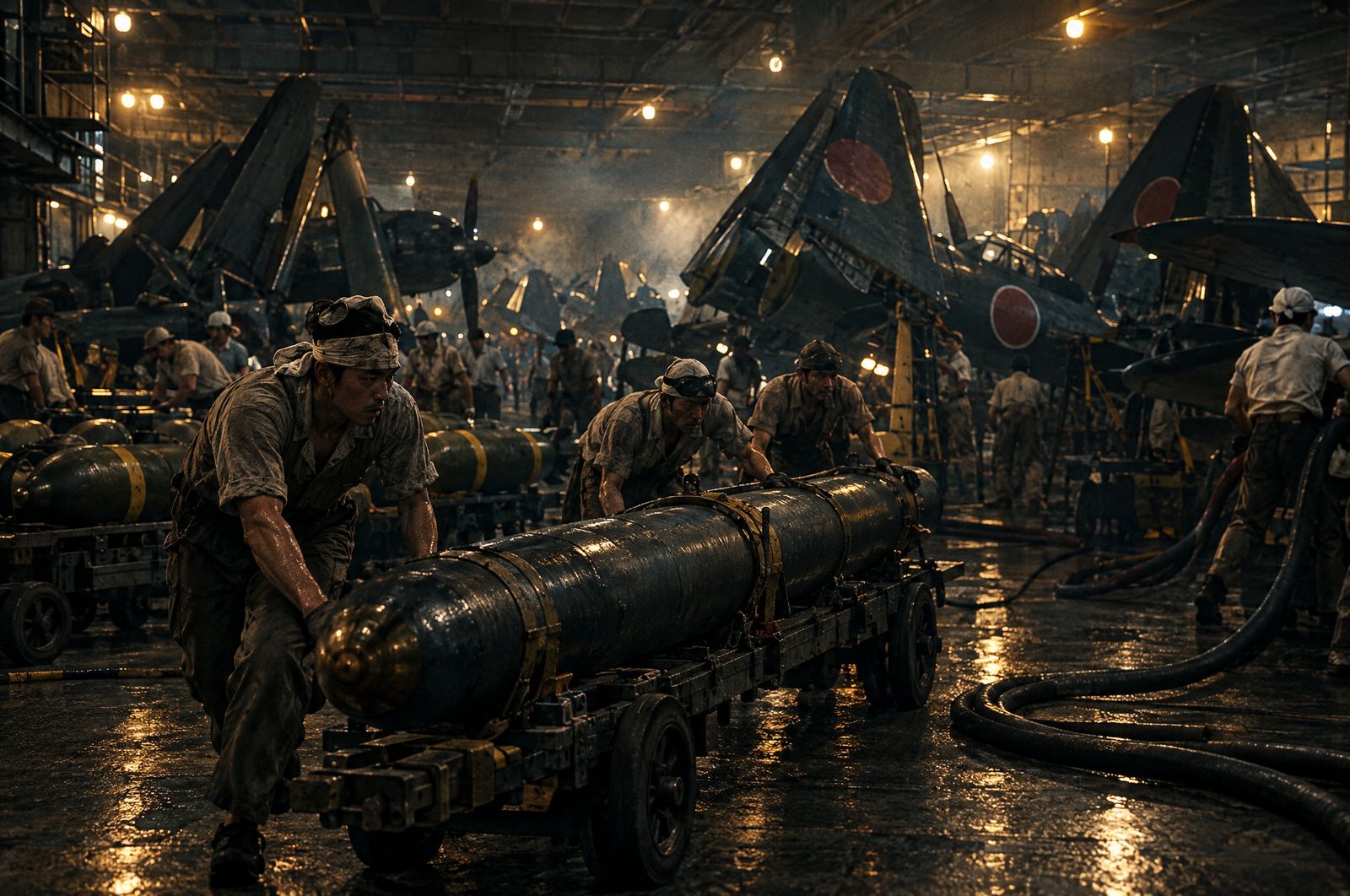
Ordnance crews wheel a torpedo past bombs and folded-wing aircraft in a crowded carrier hangar
Hangars crowded with aircraft, fuel lines and munitions half-swapped.
The first strike is coming back and must be recovered. The carriers turn into the wind.
What the records show

The older story has bombs catching a deck full of aircraft moments from launch. Parshall and Tully's Shattered Sword (2005), built on Japanese records, finds the rearming still under way and fewer planes ready than claimed. The fires were fed mostly by ordnance and fuel spread through the hangars by the rearming itself.

The outcome was the same. The mechanism was more complex.
19
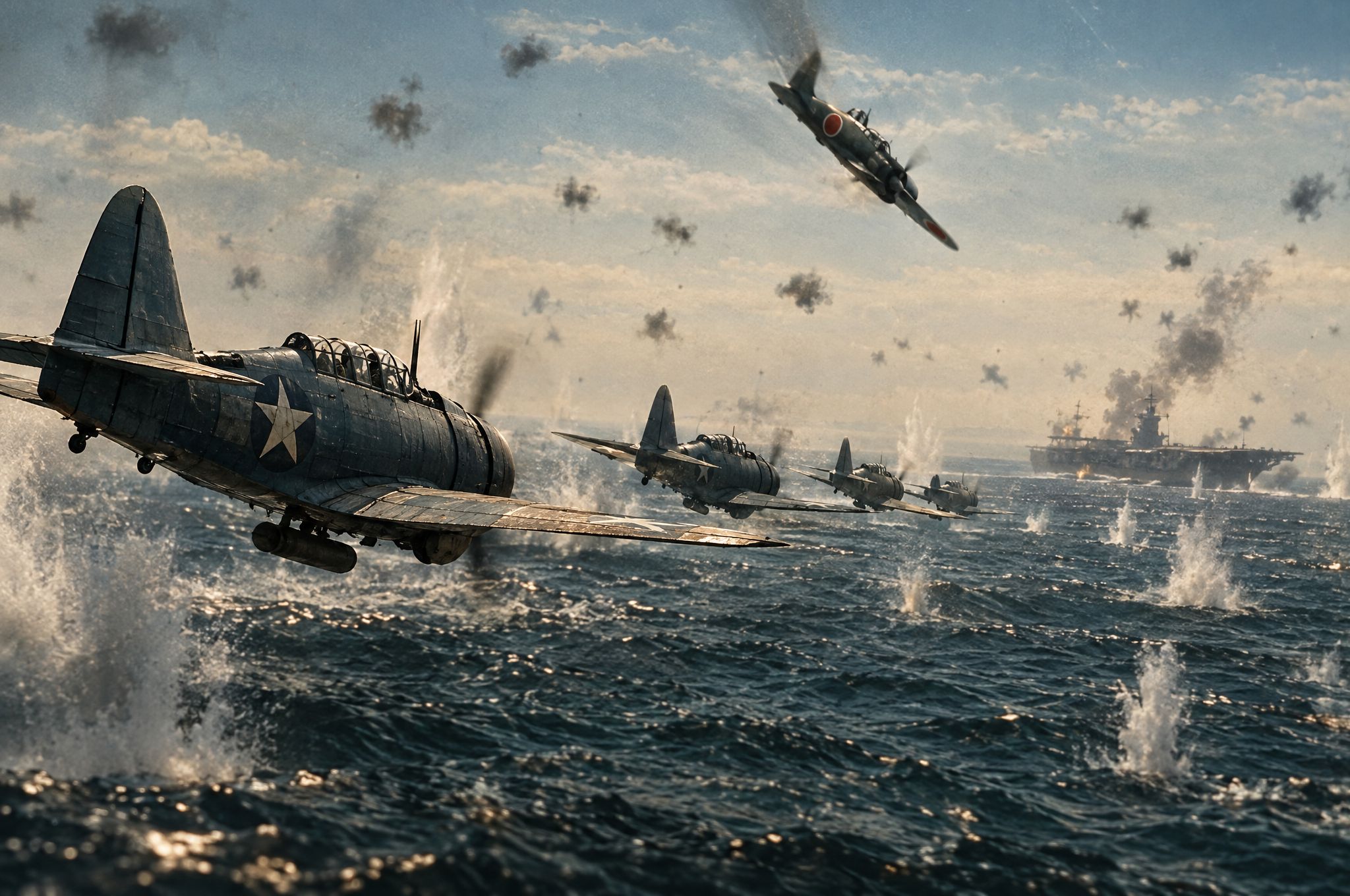
TBD Devastator torpedo bombers skim the waves through anti-aircraft splashes toward a Japanese carrier
Mid-morning

The torpedo run

Three torpedo squadrons attack separately, uncoordinated: VT-8 from Hornet, VT-6 from Enterprise, VT-3 from Yorktown.
20
The TBD Devastator was modern in 1937. By 1942 it was badly outclassed.
It has to fly slow and low to drop the Mark 13 torpedo, which often runs at the wrong depth or fails to explode.
Against the Zeros and the flak, it is slaughter.
21
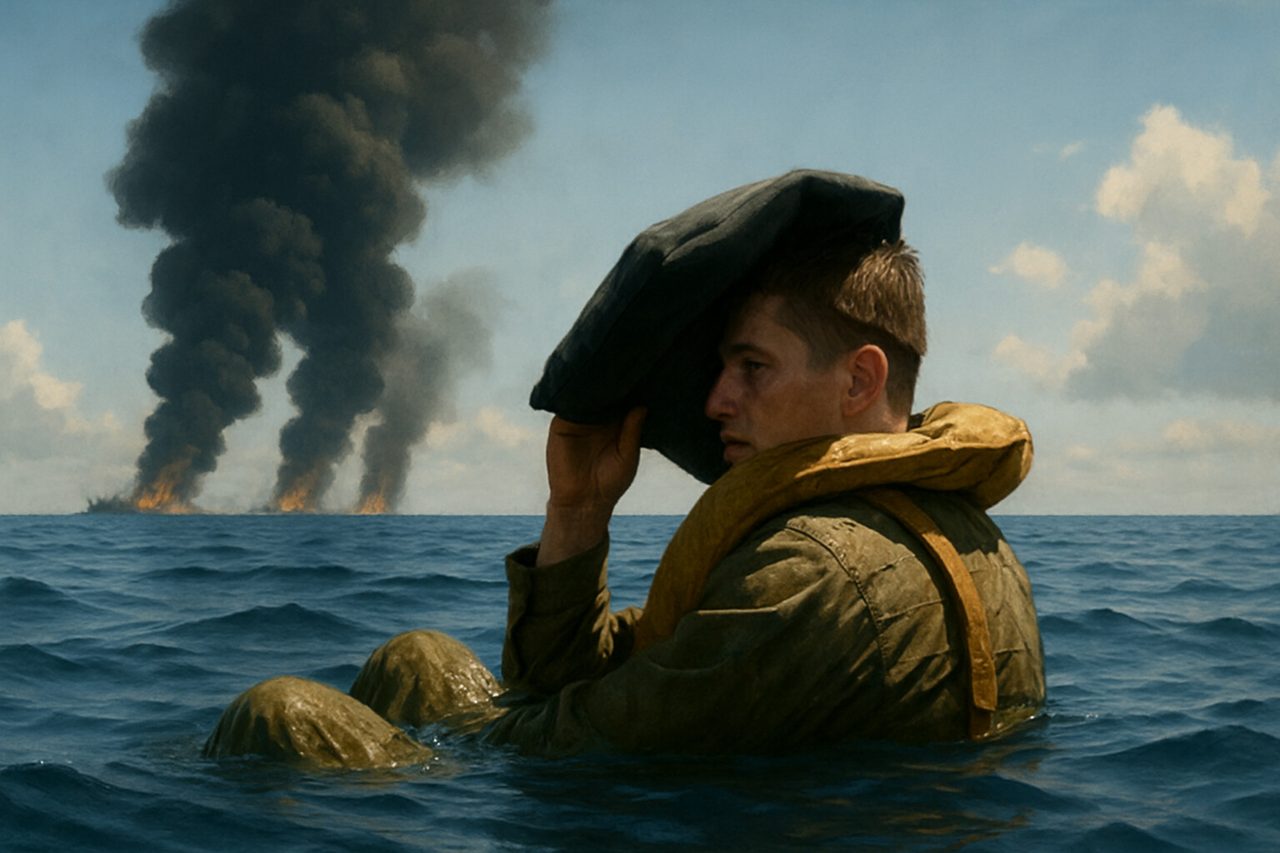
Ensign George Gay in the water under a seat cushion as Japanese carriers burn on the horizon
Torpedo Squadron 8. Fifteen aircraft. No fighter escort.
All fifteen are shot down.
One man survives.
15 / 15VT-8 lost
10 / 14VT-6 lost
10 / 12VT-3 lost
22
Front LinePart two · June 4
Torpedo 8

The men who drew the fighters down

Ensign George Gay spent hours in the water, hiding under a seat cushion from Japanese search planes and watching the battle unfold around him. His account is an important firsthand source, with the limits of any single memory under extreme stress.

In exchange for about 35 torpedo bombers and more than 40 aircrew killed or missing, the squadrons scored no confirmed torpedo hits. But the Zeros that destroyed them were pulled down to wave-top height, low on fuel and out of position, just as the carriers' decks and hangars reached their worst disorder.

Before launch, Lt. Cmdr. John Waldron wrote a message to his squadron about the fight ahead. The wording varies between sources, so we don't quote it here.

23

The Search

High above
McClusky in the cockpit scanning the sky
McClusky's dive-bombers have searched so long they are burning their fuel reserves.

Hornet's dive-bombers, VB-8 and VS-8, fly the wrong heading. They never find the Japanese carriers.
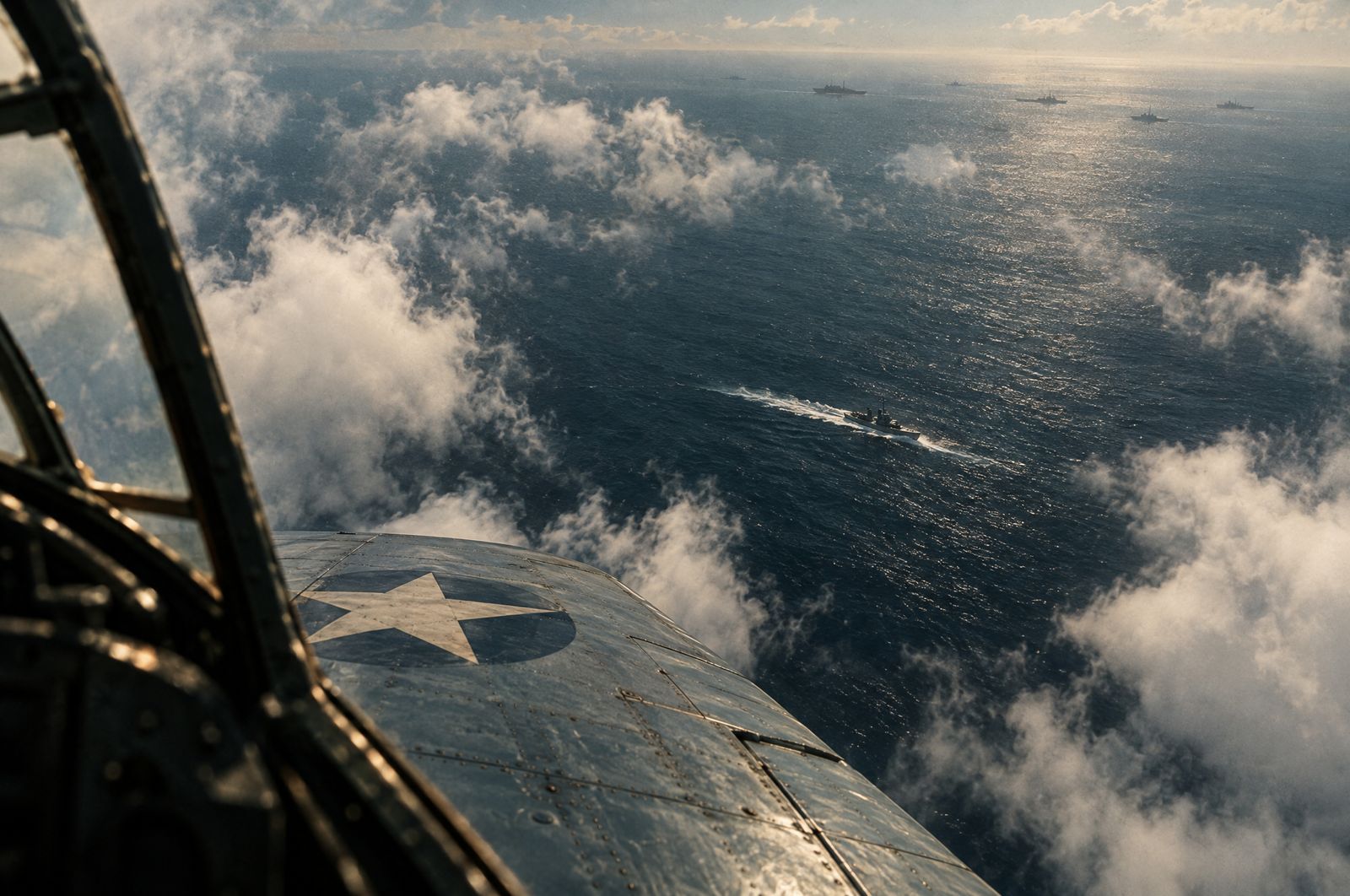
From high altitude, a destroyer's white wake cuts across the dark ocean below a dive-bomber's wing
McClusky extends the search instead of turning back. Then he sees a wake.
The destroyer Arashi, racing to rejoin the fleet after depth-charging an American submarine. He follows it northeast.
24
Three SBD Dauntlesses in a steep dive toward the carrier Akagi
10:20
McClusky's squadrons and Leslie's VB-3 from Yorktown arrive together.
From above 14,000 feet the SBDs roll into near-vertical dives. They release between 1,500 and 2,000 feet and pull out hard.
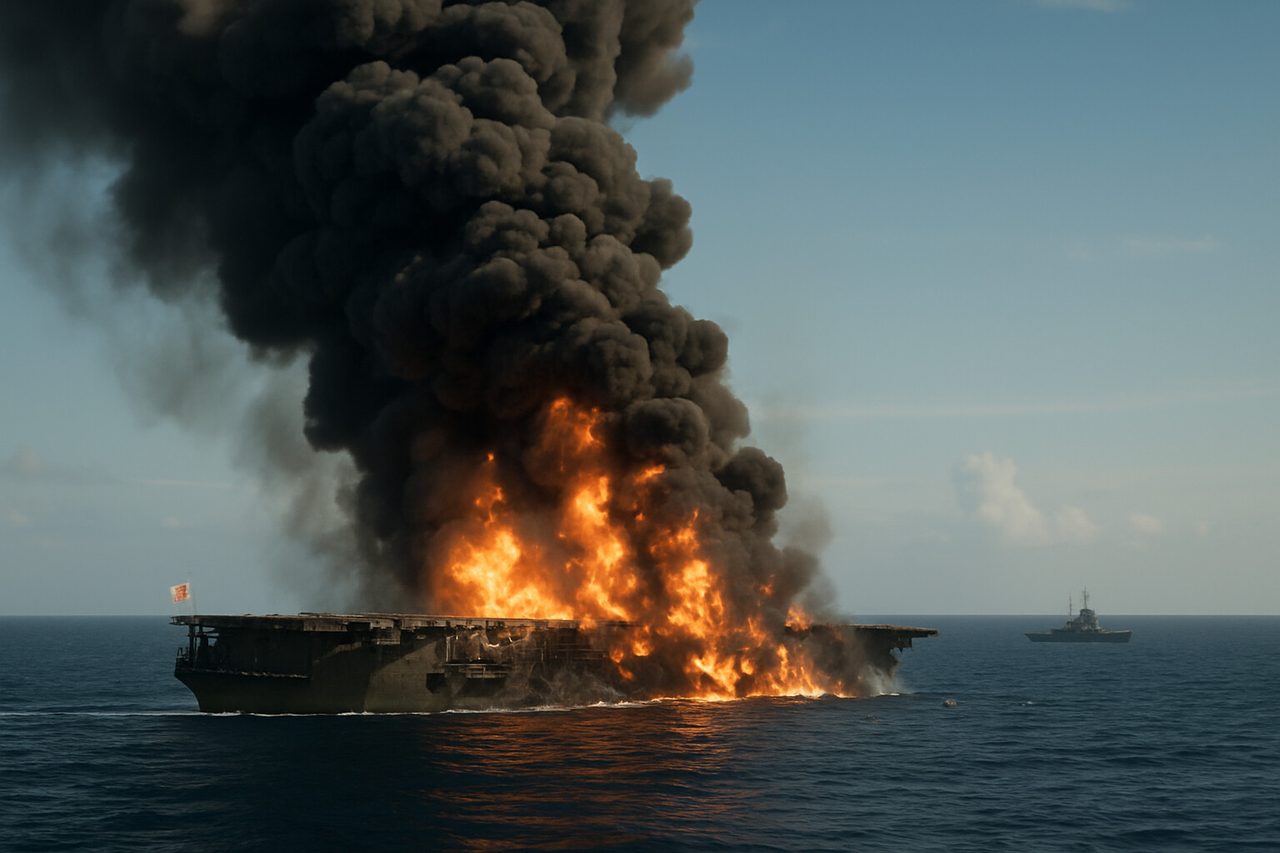
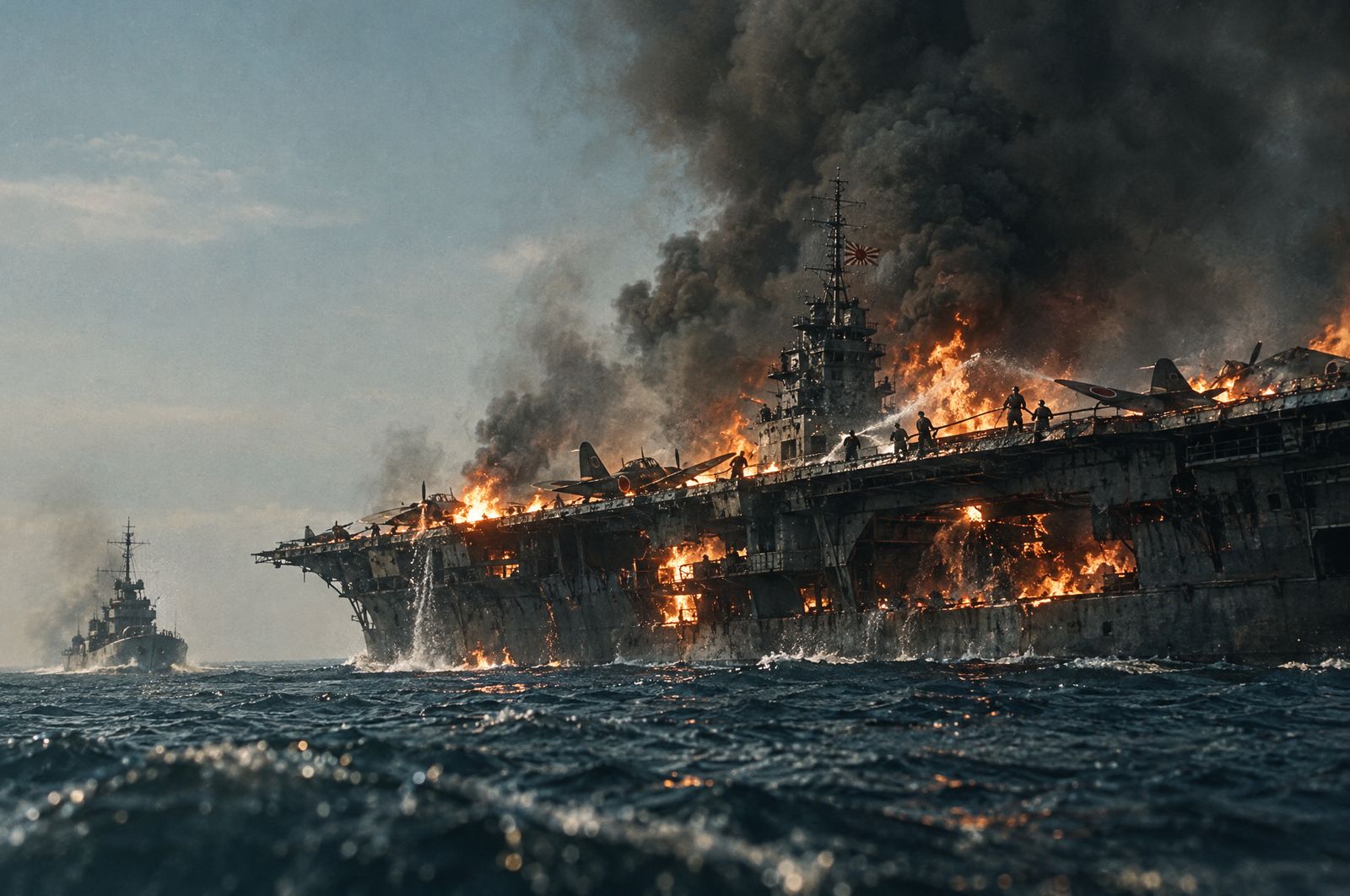
The carrier Kaga burning and listing, black smoke filling the sky
VB-6 takes Kaga. VS-6 takes Akagi. VB-3 takes Soryu.
Fires reach the fuel and bombs of the rearming.
25
Part two · June 4Front Line
The strike

Five minutes

The decisive hits on the first three carriers came in about five minutes, though the full sequence of attacks that morning ran longer. The Americans looked down on four carriers with disordered decks and fighter cover low and scattered.

Lt. Richard Best of VB-6 attacked Akagi after most of his squadron had gone for Kaga. Historical accounts credit him with a hit on the flight deck that exploded among armed and fueled aircraft near the center elevator. With ordnance and fuel piled below decks, one bomb in the right place started fires damage control could not stop.

Hit counts differ between American and Japanese sources. The figures most often cited are four on Kaga, two on Akagi and three on Soryu.
26
A Japanese carrier ablaze from bow to stern as a destroyer approaches
Kaga: secondary explosions cascade through the ship.
Akagi, Nagumo's flagship: one hit among the parked aircraft, one in the hangar.
Soryu takes three hits and is ablaze within minutes.
The fires cannot be contained.
27

Hiryu Strikes Back

June 4–7
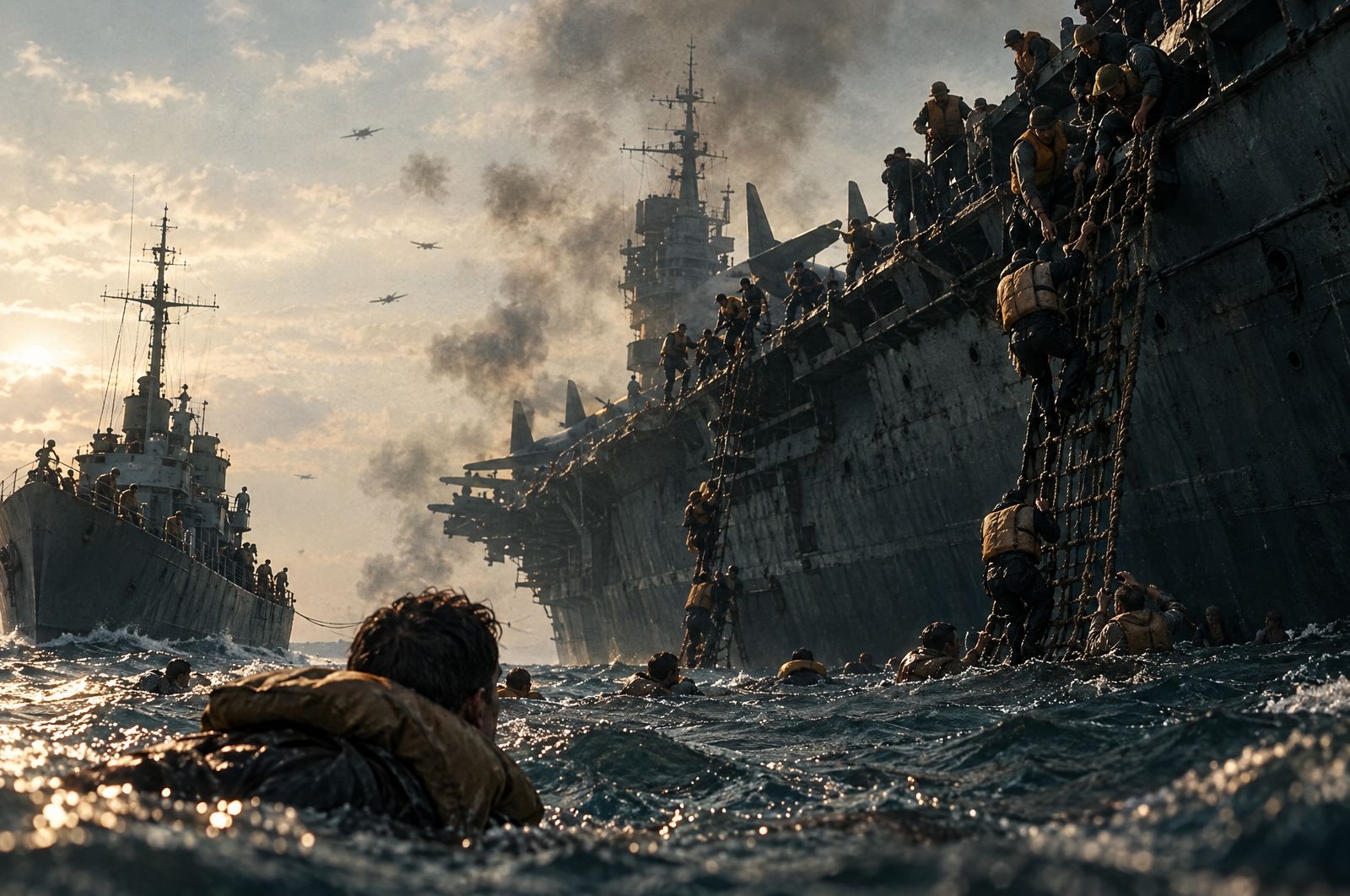
A listing American carrier as her crew climbs down lines into the sea, a destroyer alongside
Hiryu, farther from the others, escaped the morning attack. Her planes hit Yorktown twice that afternoon.
Burning and listing, Yorktown is abandoned.
Detail: a dive-bomber plunging toward a Japanese carrier
Enterprise's Dauntlesses find Hiryu and hit her too.

Taken under tow, Yorktown seems salvageable. On June 6 the submarine I-168 torpedoes her and sinks the destroyer Hammann alongside. She goes down June 7.

28
Front LinePart two · June 4
June 4–7

The reckoning in numbers

CarrierFate
KagaSank, afternoon of June 4 SoryuSank, afternoon of June 4 AkagiScuttled by Japanese destroyers, early June 5 HiryuSank before dawn, June 5 YorktownTorpedoed by I-168 June 6, sank June 7
United States
~307men
~147aircraft
Japan
~3,057men
~248aircraft · 4 carriers · 1 heavy cruiser

The heavy cruiser Mikuma was sunk on June 6 by carrier aircraft after colliding with Mogami. The deepest Japanese loss was trained aircrew; figures around 110 naval aviators appear in several histories, and the pilot pipeline could not replace them quickly.

29
Field ManualAircraft · No. 01
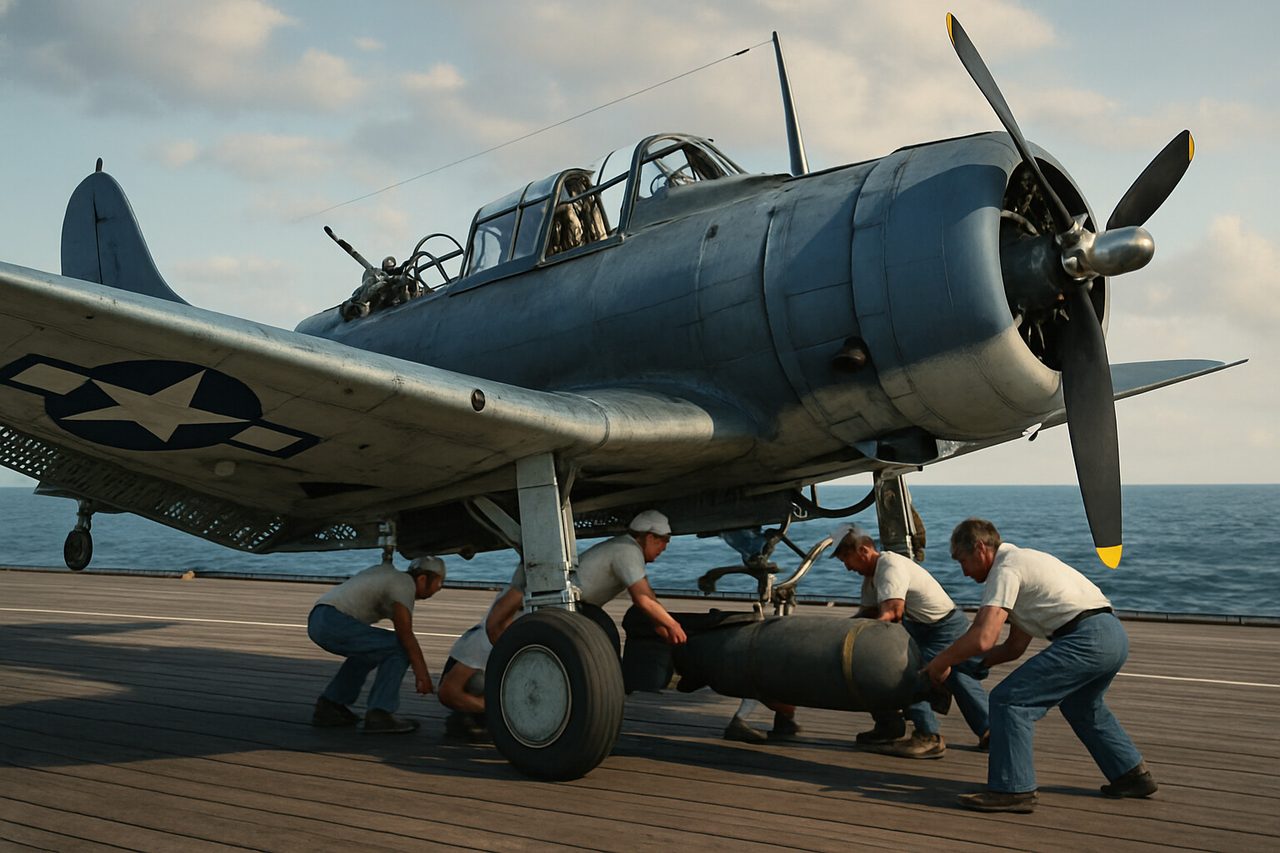
SBD Dauntless on a carrier deck with a bomb being fitted to the crutch under its fuselage
Bomb crutch: swings the bomb clear of the propeller at the bottom of the dive.

Douglas SBD Dauntless

TYPEScout Bomber Douglas · carrier dive-bomber IN FLEETSince 1940 CREW2 · pilot and rear gunner GUNS2 × .50 cal fixed in cowling · 2 × .30 cal flexible, rear LOAD1 bomb on a swing-out crutch SIGHTTelescopic

Slower than the fighters it met and vulnerable without altitude. It went on to sink more Japanese shipping than any other Allied aircraft type in the Pacific War.

30
Anatomy of a DiveField Manual
14,000+ ft ~2,000 ft sea level 1 2 3 4
  1. Push over. Above 14,000 feet, roll into the dive.
  2. Hold the dive. Near-vertical, target centered in the telescopic sight, through the anti-aircraft fire.
  3. Release. Between 1,500 and 2,000 feet. The crutch swings the bomb clear of the propeller.
  4. Pull out. Hard, before the water.
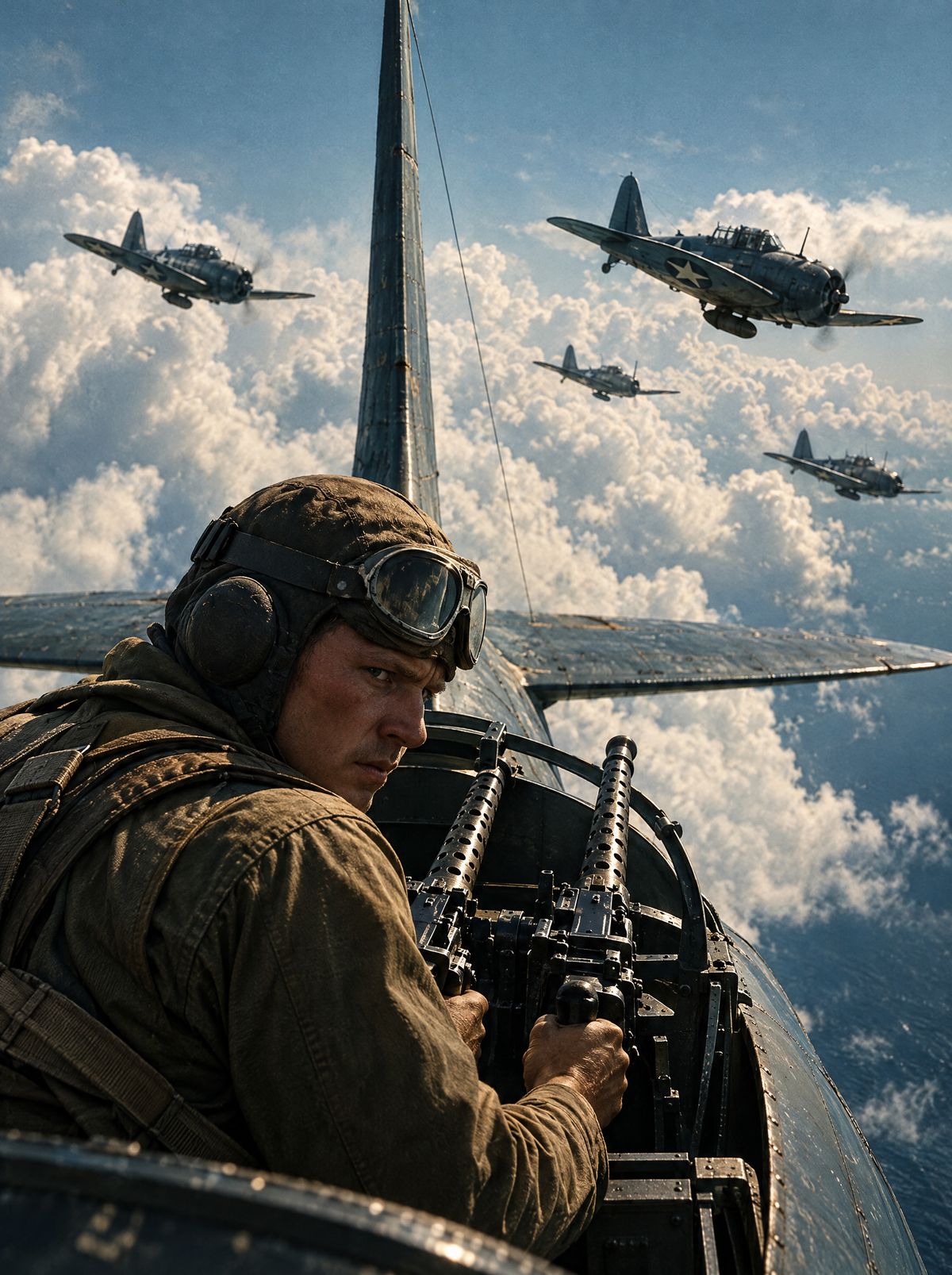
An SBD rear gunner at his twin .30-caliber guns, Dauntlesses in formation behind

The rear gunner rode backward behind twin .30-caliber guns. Against a carrier that could not maneuver freely because it was operating aircraft, the dive-bomber's geometry turned decisive.
31
Part three · The reckoningFront Line

The cast

Portraits: public domain, via Wikimedia Commons. Silhouette where no verified portrait is on file.
32
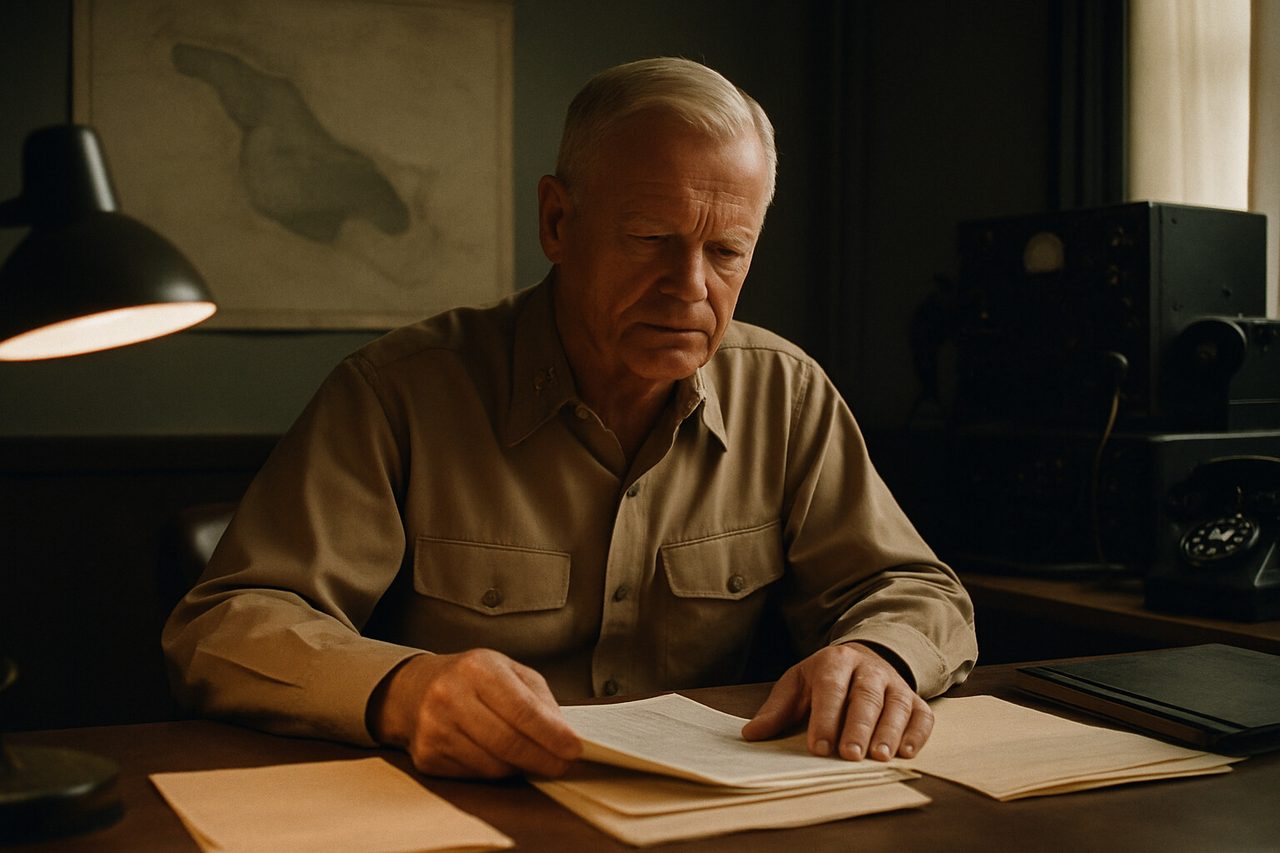
Admiral Nimitz at his desk at Pearl Harbor reading after-action reports
Pearl Harbor. Nimitz reads the reports.
Aftermath
Spruance Nimitz recommended him for promotion for his long-range launch on June 4. He rose to full admiral.
McClusky Hit by cannon fragments in the dive, he landed safely on Enterprise and received the Navy Cross.
Leslie Low on fuel after the attack, he ditched near Yorktown and was recovered.
Nagumo Survived, and commanded again. He died on Saipan in July 1944.
Yamamoto American codebreakers read his travel schedule. P-38s shot down his plane over Bougainville on April 18, 1943.
Rochefort Denied the Distinguished Service Medal amid Navy infighting, he received the lower Legion of Merit. The medal came posthumously on May 30, 1985.
33
Part three · The reckoningFront Line
What it meant

The turning point

Japan never again mounted a strategic offensive with carriers at its center. Within months the initiative passed to the United States and never returned. The island campaigns that brought bombers within range of Japan were built on Midway's outcome.

The outcome looked inevitable only in retrospect.

The American attack was poorly coordinated and partly lost. It won through a few minutes of directed effort in conditions created by the chaos before it. Behind those minutes were the codebreakers, the dry dock, years of carrier doctrine and training, and men like Waldron's crews who flew in knowing the odds.
34
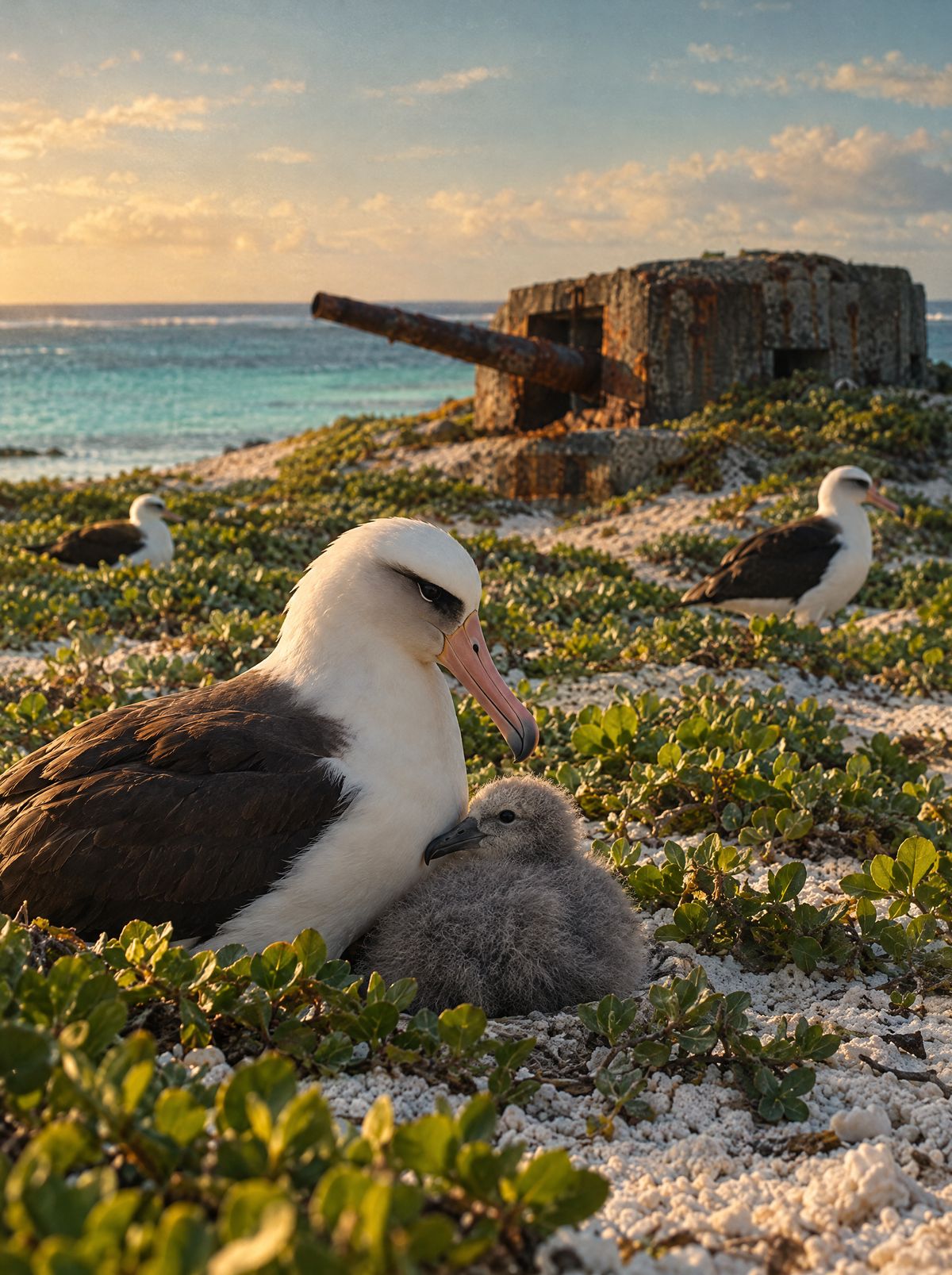
Laysan albatross with a chick on coral sand beside a rusting wartime gun emplacement
Midway Atoll today
A wildlife refuge and national monument.
Laysan albatross nest on the coral sand where Marines watched the attack come in.

Five minutes of dive-bombing. Months of work to make those five minutes possible.

The margin was that thin. The preparation was that deep.

35

Sources

  1. Prange, Goldstein & Dillon, Miracle at Midway (1982)
  2. Walter Lord, Incredible Victory (1967)
  3. Parshall & Tully, Shattered Sword (2005)
  4. Layton, Pineau & Costello, "And I Was There" (1985)
  5. John B. Lundstrom, The First Team
  6. Ian W. Toll, Pacific Crucible (2012)
  7. George Gay, Sole Survivor
  8. U.S. Navy after-action reports, June 1942; Naval History and Heritage Command

Read the full story, with every source and the battle map, at frontlinestories.com.

The full-color scenes in this issue are AI-generated reconstructions based on the historical record, not archival photographs. The map is schematic.
FRONT LINE STORIES
Cover