Home Stories The Edge Weapons Battles People Warbirds About
All Warbirds

B-17F-10-BO Flying Fortress

Memphis Belle

One of the first U.S. Army Air Forces B-17s to complete 25 combat missions over Nazi-occupied Europe, and the first heavy bomber to return to the United States after doing so. The Memphis Belle became the most famous B-17 of the Second World War — a symbol of the daylight bombing campaign and the men who flew it.

S/N 41-24485
TypeBomber
TheaterETO
ManufacturerBoeing Airplane Company
Victories★ 8 enemy fighters destroyed (claimed)
Memphis Belle

Memphis Belle — B-17F-10-BO Flying Fortress

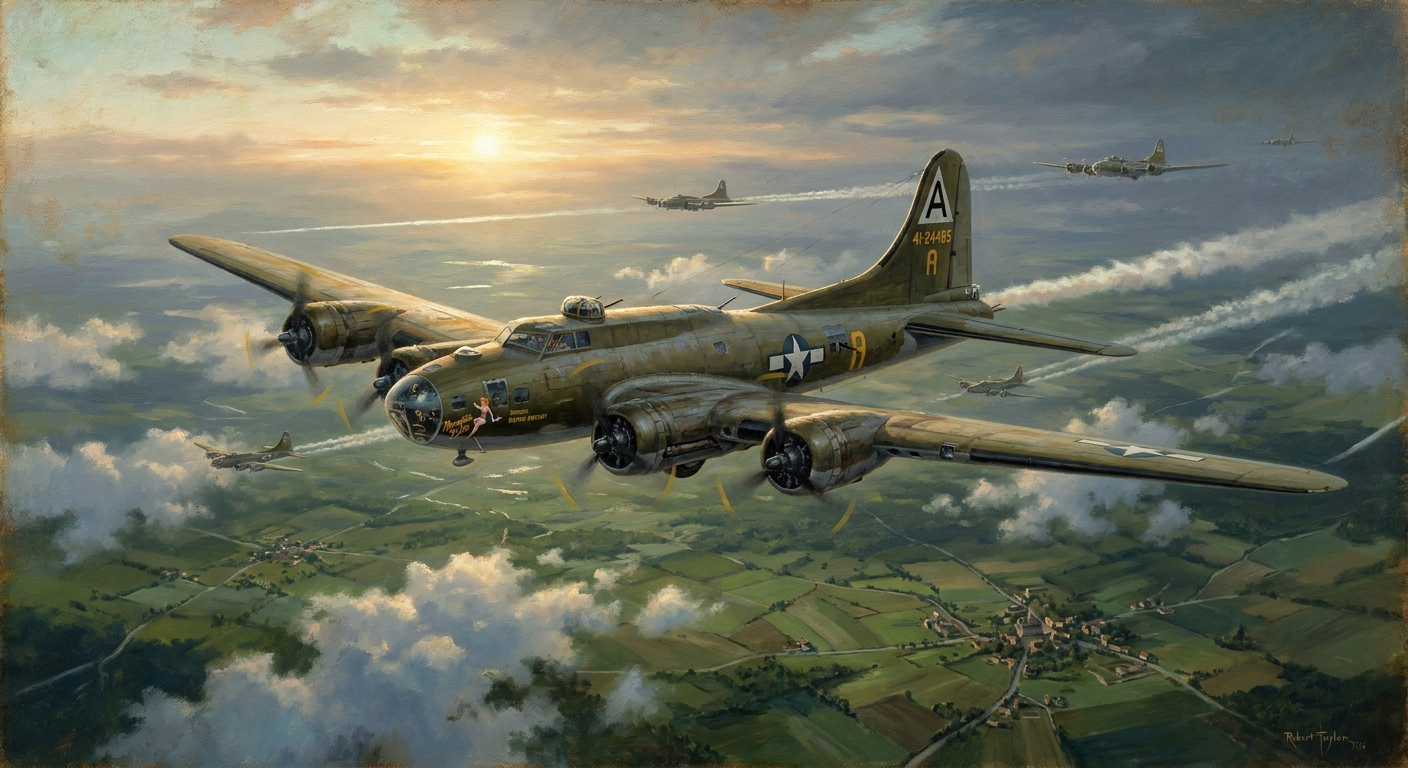
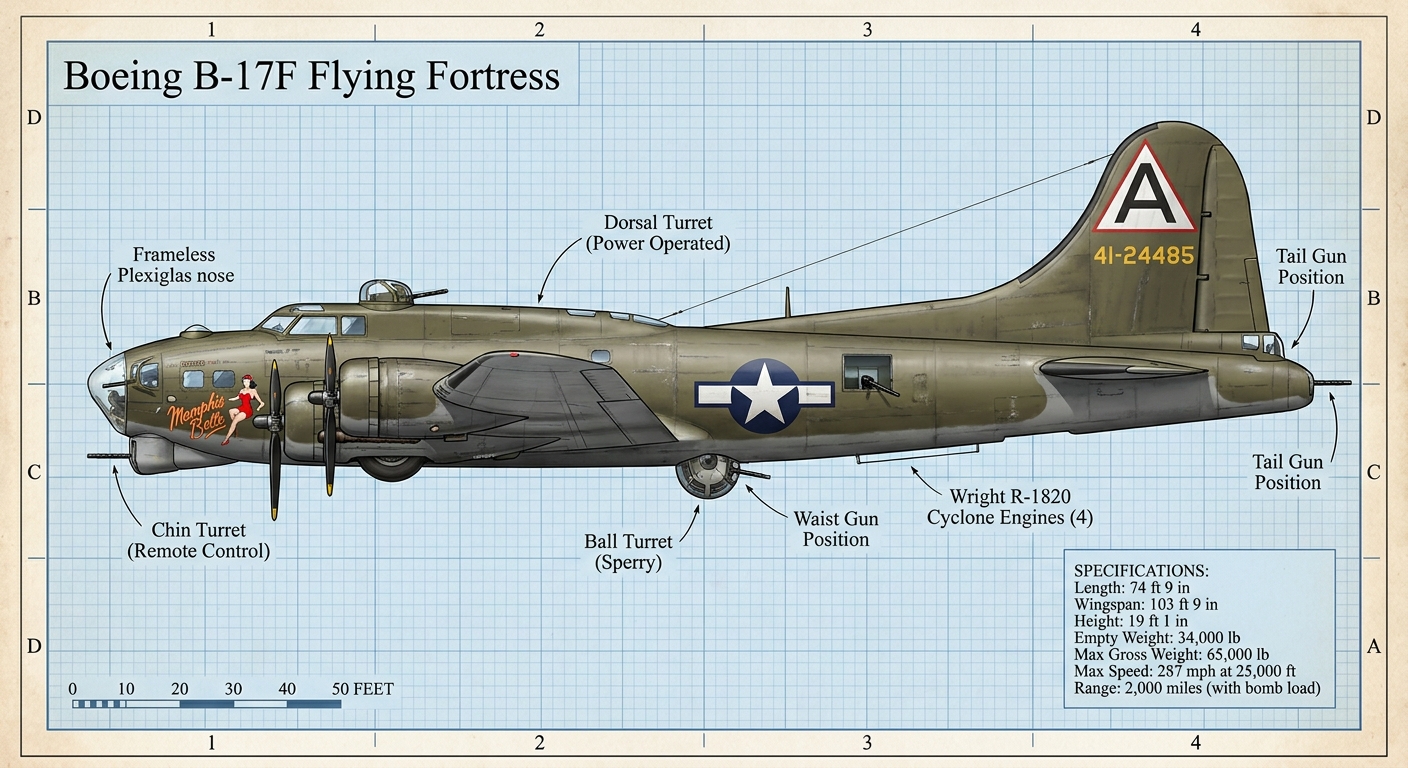
B-17F Memphis Belle side profile technical plate

B-17F-10-BO Flying Fortress

Performance

Engine4 × Wright R-1820-65 Cyclone radial engines
Horsepower1,200 HP each
Max Speed287 mph at 25,000 feet
Cruise Speed182 mph
Range2,000 miles with 6,000 lb bomb load
Service Ceiling35,600 feet
Rate of Climb900 feet per minute

Dimensions & Armament

Armament11 × .50 caliber Browning M2 machine guns; up to 8,000 lb internal bomb load
Wingspan103 feet 9 inches
Length74 feet 4 inches
Height19 feet 1 inch
Empty Weight36,135 pounds
Loaded Weight65,500 pounds
Crew10

Memphis Belle in Action

Air Victories8 enemy fighters destroyed (claimed)
ProbableMultiple
Missions25 combat missions completed
Active PeriodNovember 7, 1942 – May 17, 1943
FateSurvived the war. Flown back to the United States on June 8, 1943. Used briefly for training then placed in storage. After decades of outdoor display in Memphis and a thirteen-year restoration, today preserved on permanent indoor display at the National Museum of the U.S. Air Force, Dayton, Ohio.

Notable Actions

  • November 7, 1942 — First mission, Brest U-boat pens, France
  • January 27, 1943 — Wilhelmshaven, first 8th Air Force raid on Germany itself
  • May 13, 1943 — Saint-Nazaire, the 'Flak City' U-boat base
  • May 17, 1943 — Final 25th mission, Lorient, mission complete

The Story of Memphis Belle

On the assembly floor of Boeing's Plant 2 in Seattle, on a hot June day in 1942, B-17F serial 41-24485 rolled out the door alongside hundreds of others on the line. The B-17F was the first truly mass-produced Fortress — a frameless plexiglas nose, paddle-blade propellers, racks for external bombs, and the same four Wright Cyclone engines that gave the airplane its growl. By the war's end, Boeing, Douglas, and Lockheed-Vega together would produce 12,731 of them. This particular one was unremarkable. It became famous because of who flew her.

In September 1942 a young Asheville, North Carolina pilot named Robert K. Morgan accepted command of 41-24485 at Bangor, Maine, and named her for his fiancée, Margaret Polk of Memphis. The script lettering went onto both sides of the forward fuselage. The pin-up — a swimsuited brunette beside a yellow telephone, adapted from a George Petty gatefold in Esquire — followed. The crew flew her across the North Atlantic ferry route to England in October. Their assigned home was RAF Bassingbourn, a permanent prewar RAF station in Cambridgeshire — the most comfortable airfield in the 8th Air Force, with brick barracks and central heating, a small mercy that meant nothing once you were over the Channel at 25,000 feet in an unpressurized airplane at twenty below zero.

Morgan and his crew flew their first combat mission on November 7, 1942, against the U-boat pens at Brest, France. They were ten men strapped into a thin aluminum tube full of fuel and bombs. Pilot, copilot, bombardier in the nose, navigator at the chart table, flight engineer up in the top turret, radio operator in the radio room, ball turret gunner curled into a 38-inch sphere beneath the fuselage, two waist gunners shoulder to shoulder at the open windows, and a tail gunner crouched in the stinger at the back. They wore electrically heated suits that often failed. Frostbite was common. So were anoxia, flak, fighters, and fire.

Daylight precision bombing was an American doctrine the British had told them was impossible. The British had tried it at the start of the war, lost the bombers, and switched to night area bombing of cities. The Americans believed the Norden bombsight, the 11-gun Fortress, and tight defensive formations could put bombs on factories from four miles up in broad daylight. They were partly right and partly wrong. The bombs hit. So did the Luftwaffe. In the first eighteen months of the daylight campaign the 8th Air Force lost more men than the U.S. Marine Corps lost in the entire Pacific war.

The Belle's twenty-five missions ran from November 1942 to May 1943. Wilhelmshaven on January 27, 1943 — the first 8th Air Force raid on Germany itself, the moment the war came home. Bremen. Lorient. Saint-Nazaire — the U-boat base they called "Flak City," where the German antiaircraft guns were so heavy and so accurate that the standard joke was you could get out and walk on the bursts. Antwerp. Kiel. Lille. The Renault works at Le Havre. On most missions she came home with damage. Holes. Engines shot out. Hydraulics severed. The crew kept patching her, the ground crew kept welding her, and the Belle kept flying.

Twenty-five was the magic number. Crews who completed twenty-five combat missions were rotated home. Until somebody did it, statistically nobody was supposed to. The math was straightforward: average loss rate per mission times twenty-five equaled more than 100 percent. Twenty-five missions was the rotation point at which a heavy-bomber crewman, on paper, was already dead.

On May 17, 1943, after the run on Lorient, the Memphis Belle and Morgan's crew completed their twenty-five-mission tour. She was not the first B-17 to reach that number — Hell's Angels of the 303rd Bomb Group had done it four days earlier — but the Belle became the first heavy bomber returned to the United States after completing twenty-five combat missions over Europe. President Roosevelt had been watching. The crew, with the airplane, was sent home for a war-bond tour — thirty-two American cities, thousands of handshakes, paid speeches, parade routes, photographs in front of the nose art with mayors and movie stars and small children.

William Wyler, the Hollywood director who had volunteered for the Army Air Forces, had been filming the Belle and other 91st Bomb Group aircraft on combat missions through that spring with three handheld 16mm Technicolor cameras. Wyler flew the missions himself, twice losing cameramen to enemy fire. The film he edited together — *The Memphis Belle: A Story of a Flying Fortress*, released in April 1944 — was the first major American war documentary in color, narrated in plain straightforward English by an unseen voice. It is still in the Library of Congress National Film Registry. It made the Belle the most famous airplane of the war.

The Belle herself never went back to combat. After the bond tour she was used briefly for training, then sent into storage. After the war she was rescued from a salvage yard outside Memphis by city officials who recognized what she was, displayed outdoors for decades, slowly weathering, before being moved indoors in the late 1980s. The U.S. Air Force eventually took her back. After a thirteen-year restoration at the National Museum of the United States Air Force in Dayton, Ohio, she was unveiled to the public on May 17, 2018 — seventy-five years to the day after the twenty-fifth mission. She stands there now in a permanent climate-controlled display, the pin-up still on her nose, the twenty-five mission marks still stenciled below the cockpit, the Triangle-A still red on her tail.

Robert Morgan returned to combat in the Pacific in 1944, flying *Dauntless Dotty*, the lead B-29 on the first Tokyo raid of November 24, 1944. He flew commercial charter after the war, married four times, raised a family in Asheville, and remained close to the surviving members of his crew until his death in May 2004. He is buried in Asheville. The Memphis girl he had named the airplane for — Margaret Polk — never married him. The engagement ended quietly during the bond tour. He spoke about her warmly for the rest of his life.
The Men Who Flew Her

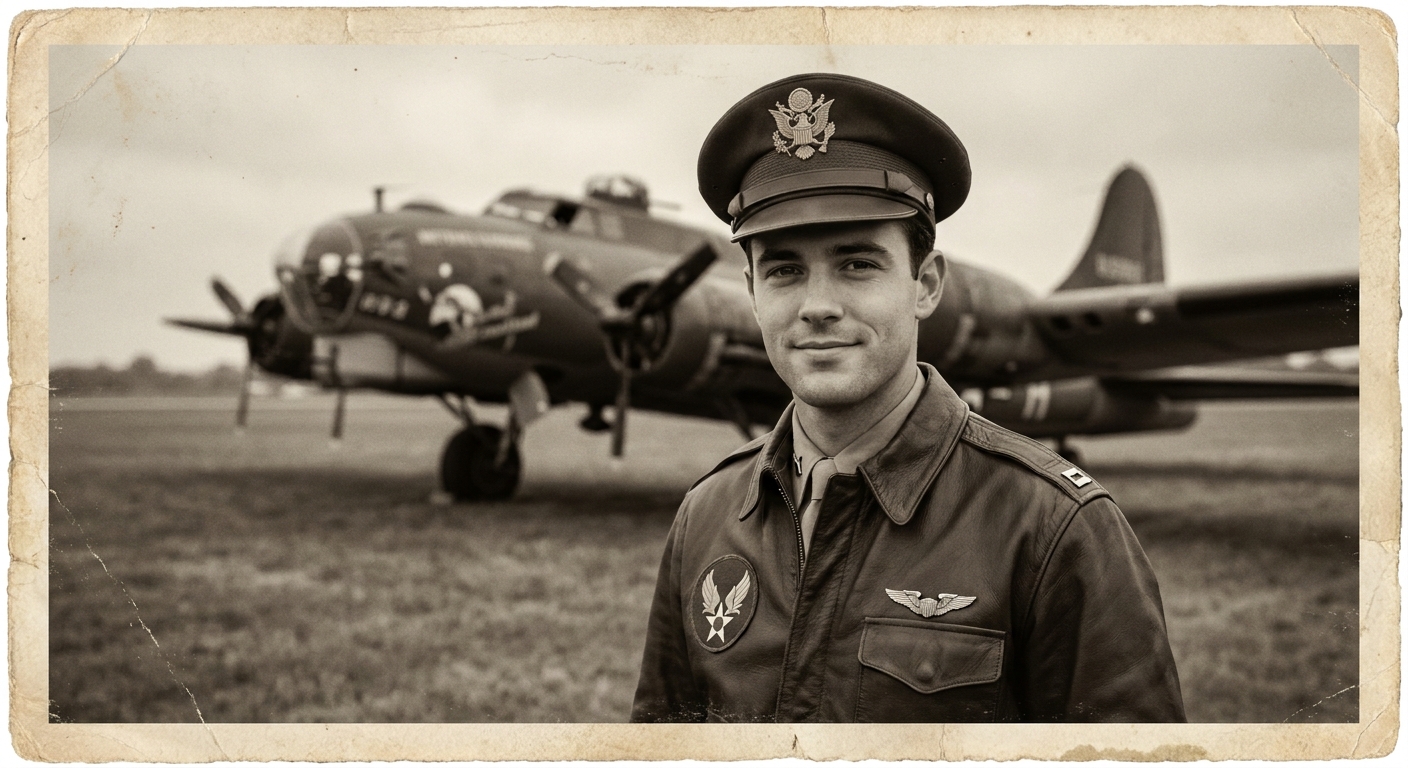
Robert Knight Morgan
Bomber pilot — 25 missions ETO, 26 missions PacificVictories

Robert Knight Morgan

Captain

324th Bomb Squadron, 91st Bomb Group

Distinguished Flying CrossAir Medal with four Oak Leaf ClustersSilver Star (later)

Robert Knight Morgan was born July 31, 1918, in Asheville, North Carolina, the son of a banker. He grew up in the Blue Ridge Mountains, attended the University of Pennsylvania for two years, and worked briefly at his father's furniture company before enlisting in the Army Air Corps in 1941. He was a charismatic and competitive young officer — a North Carolina mountain boy who liked airplanes, women, and a good time, in roughly that order. By 1942 he had completed B-17 transition training and shipped to England with the first wave of 8th Air Force heavy-bomber crews.

He named his airplane for Margaret Polk, the Memphis girl he had met on a blind date and become engaged to. The name 'Memphis Belle' came from a 1941 movie they had seen together — *Lady for a Night*, set on a Memphis riverboat called the Memphis Belle. The name went onto the airplane. So did the pin-up.

Morgan flew the Belle on every one of her twenty-five missions, completing a full combat tour with the same crew — an extraordinary statistical outcome. After the bond tour, he volunteered for B-29 training and returned to combat in the Pacific in 1944, flying *Dauntless Dotty*, the lead aircraft of the very first B-29 strike on Tokyo on November 24, 1944. He had flown more combat than almost any American pilot of the war by the time he came home.

After the war he flew commercial charter, opened a brief stint as a TV station owner, married four times, and raised a family back in Asheville. He never lost touch with his crew — the Belle reunions every few years drew them all in, the survivors steadily fewer each time. He published his memoir, *The Man Who Flew the Memphis Belle*, in 2001. He died in his hometown of Asheville on May 15, 2004, at the age of eighty-five. He is buried at Lewis Memorial Park.

The Squadron

Squadron324th Bomb Squadron
Group91st Bomb Group (Heavy)
Wing1st Bombardment Division
Air ForceU.S. 8th Air Force
BaseRAF Bassingbourn, Cambridgeshire, England

The 91st Bomb Group was activated April 15, 1942, at Harding Field, Louisiana, and shipped overseas to RAF Bassingbourn in October 1942 as one of the first four B-17 groups to deploy to the United Kingdom. Bassingbourn — a permanent pre-war RAF station with brick barracks rather than the more typical Nissen huts — became one of the most recognized 8th Air Force bases of the war.

The group flew its first combat mission November 7, 1942, against the U-boat pens at Brest, France — the same mission as the Memphis Belle's first sortie. From that day until the German surrender, the 91st flew over 9,500 sorties and dropped more than 22,000 tons of bombs on targets across occupied Europe and Germany itself.

The cost was brutal. The 91st Bomb Group suffered the highest combat losses of any heavy bomb group in the entire 8th Air Force — 197 B-17s lost in combat, more than any other Fortress unit. The group earned two Distinguished Unit Citations, including for the disastrous Schweinfurt-Regensburg raid of August 17, 1943, where the 8th Air Force lost sixty bombers in a single afternoon.

The 91st's four squadrons were the 322nd, 323rd, 324th (the Belle's), and 401st. The group's distinctive Triangle-A on the vertical stabilizer became one of the most photographed markings of the air war — appearing in newsreels, in propaganda posters, and at the center of William Wyler's documentary.

Paint Scheme & Identification

Standard 8th Air Force daylight bomber finish — Olive Drab 41 upper surfaces fading to Neutral Gray 43 undersides, with weathered exhaust streaks behind each engine cowling and the signature B-17F frameless plexiglas nose.

Nose Art

A pin-up adapted from artist George Petty's April 1941 Esquire gatefold — a swimsuited brunette posed beside a yellow telephone — painted on both sides of the forward fuselage. The script reads 'Memphis Belle' in flowing copperplate above the figure.

Markings

Triangle-A in red on the vertical stabilizer marking the 1st Bombardment Division. Squadron code DF-A in yellow on the fuselage. White star insignia on left waist and right upper wing. Twenty-five swastika-and-bomb mission marks stenciled below the cockpit by the time of her last sortie.

Camouflage

Standard USAAF medium bomber camouflage scheme

Aircraft Illustrations

B-17F Memphis Belle side-profile technical plate

Side-profile identification plate

B-17F-10-BO

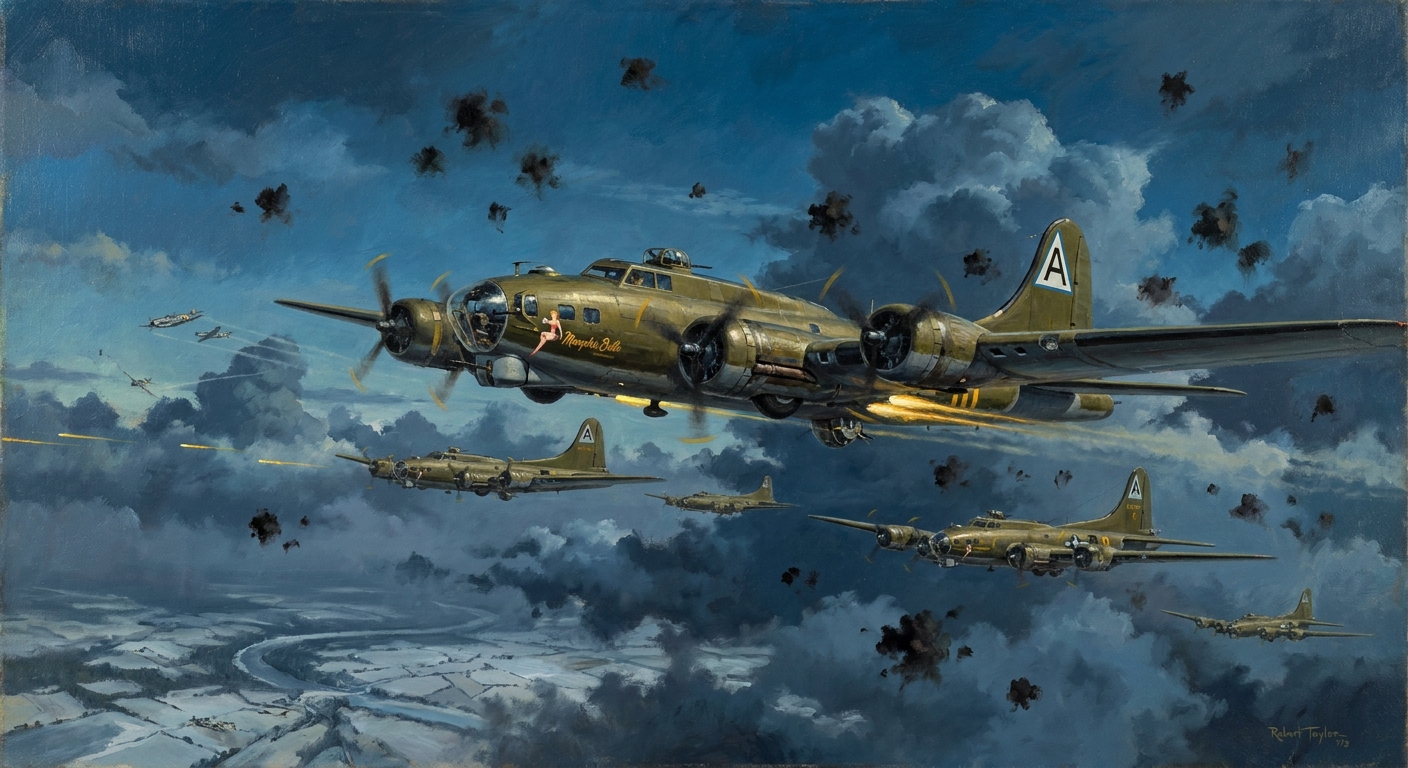
Memphis Belle formation under flak

Combat formation over Europe

Oil-painting study

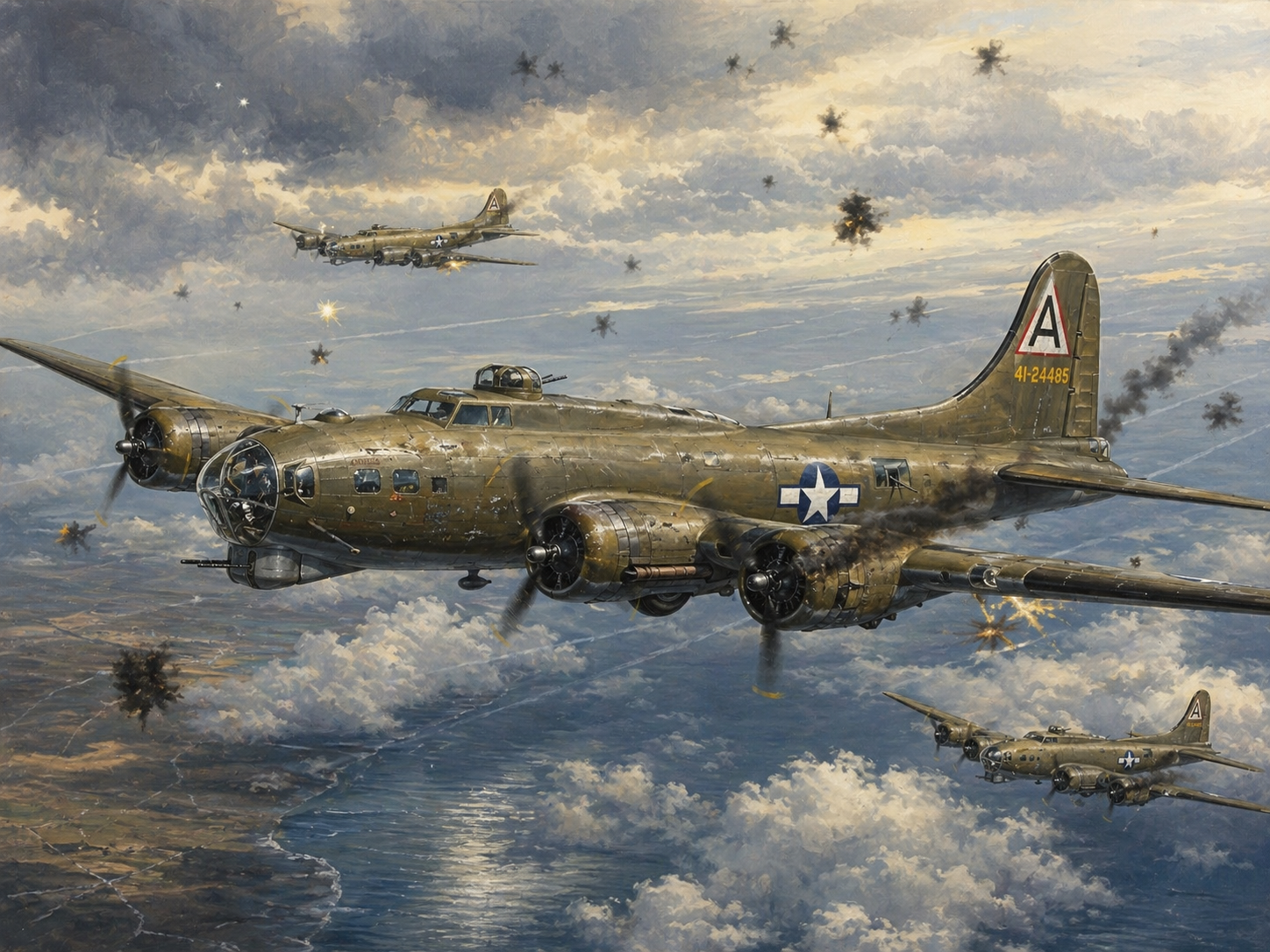
Memphis Belle returning through flak over the Channel

Return from a daylight raid

New painting

The B-17F-10-BO Flying Fortress

The Boeing B-17 Flying Fortress was a four-engined heavy bomber developed in the mid-1930s for the United States Army Air Corps. The original Model 299 first flew July 28, 1935 — and crashed two months later on a test flight, killing two of the five aboard, when the test crew forgot to release the gust locks. Boeing nearly went bankrupt. The Air Corps stuck with the design.

The B-17F variant introduced in mid-1942 was the first truly mass-produced model — a frameless plexiglas nose for better visibility, paddle-blade propellers, external bomb racks, and provisions for additional .50 caliber gun positions. By 1943 Boeing's Plant 2 in Seattle was rolling out a finished B-17F every two hours.

Together with the B-24 Liberator, the B-17 carried the weight of the U.S. strategic bombing campaign over Europe — a campaign that paid in blood. More than 26,000 American airmen died flying it. The Fortress earned its name. Crews routinely brought aircraft home with engines shot out, control surfaces shredded, holes the size of dinner plates through fuselage and wing.

The definitive variant — the B-17G — added a chin turret, more guns, and improved equipment, becoming the most common Fortress of the late war. By August 1945 the B-17 was already obsolescent, replaced by the longer-ranged B-29 in the Pacific and on its way to retirement. But the airplane had outlived its design specification by every measure that counted. It came home.

Sources & Further Reading

OFFICIAL

National Museum of the U.S. Air Force, Heavy Bomber Firsts — notes Hell's Angels completed 25 missions on May 13, 1943, four days before Memphis Belle, while Memphis Belle was the first heavy bomber returned to the United States after completing 25 missions over Europe.

BOOK

Morgan, Robert with Powers, Ron. The Man Who Flew the Memphis Belle: Memoir of a WWII Bomber Pilot. Dutton, 2001.

FILM

Wyler, William, dir. The Memphis Belle: A Story of a Flying Fortress. United States War Department, 1944.

ARCHIVE

National Museum of the U.S. Air Force — B-17F 'Memphis Belle' restoration archive, Dayton, OH.

RESEARCH

Bowman, Martin W. The B-17 Flying Fortress Story: Design, Production, History. Pen & Sword, 2014.

RESEARCH

Freeman, Roger A. The Mighty Eighth: A History of the Units, Men and Machines of the U.S. 8th Air Force. Cassell, 2000.

RESEARCH

Stout, Jay A. Fortress Ploesti: The Campaign to Destroy Hitler's Oil Supply. Casemate, 2003.