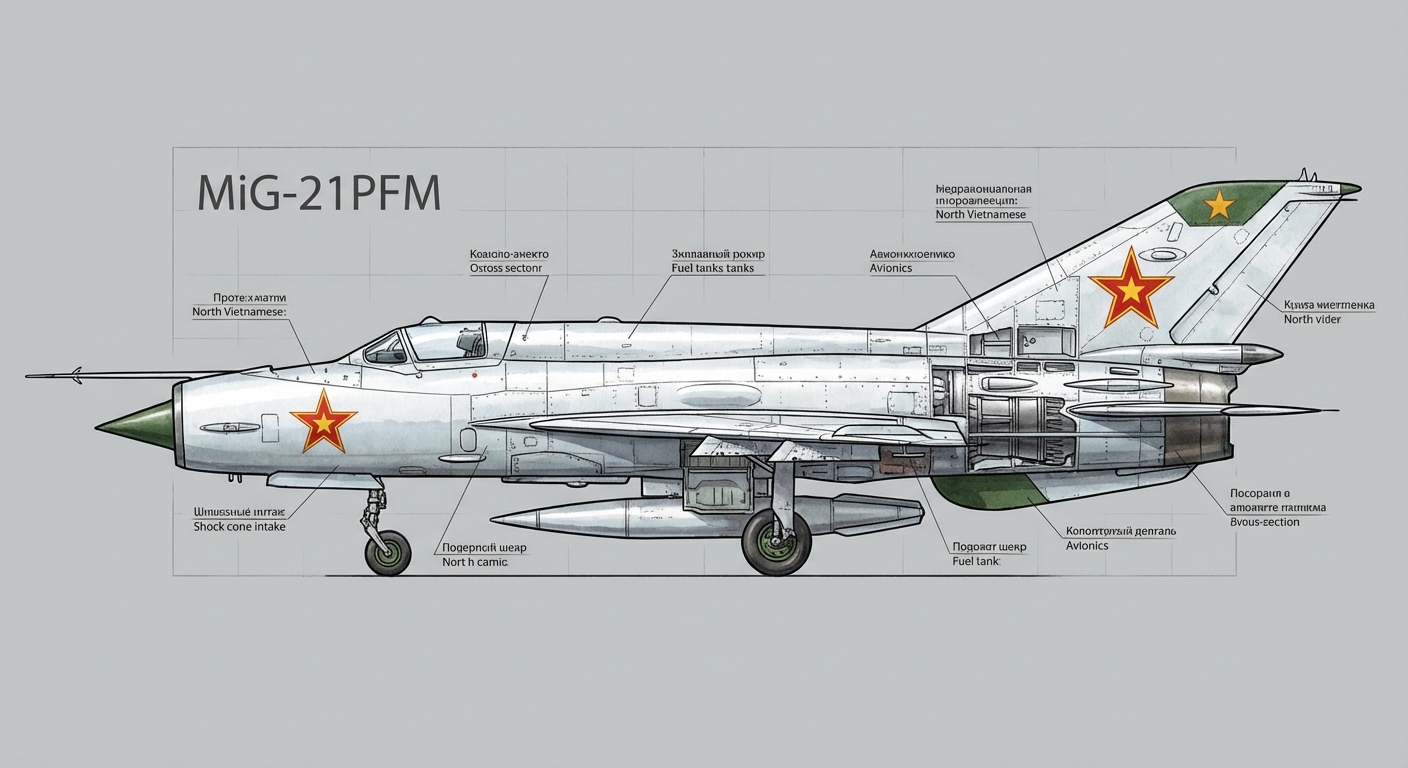
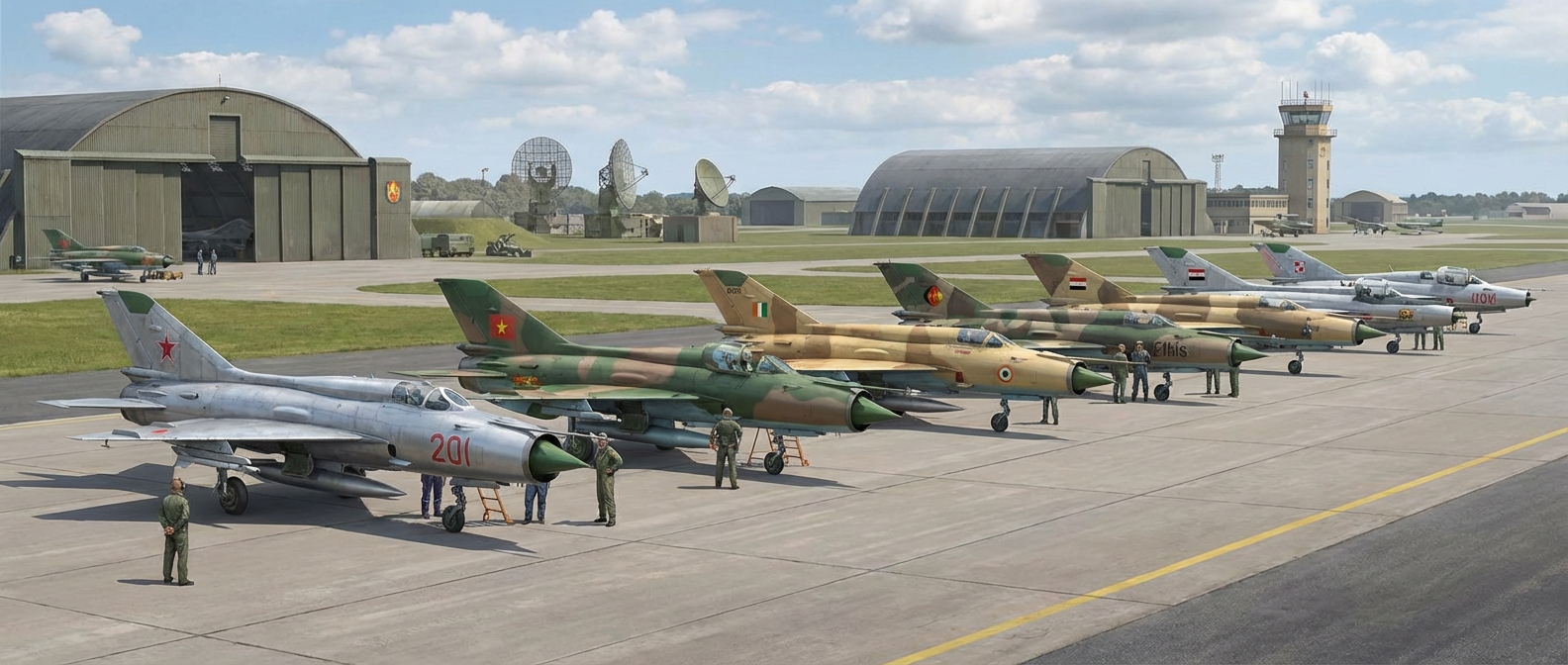
MiG-21PFM / VPAF-Operated MiG-21 Variant • Supersonic Interceptor
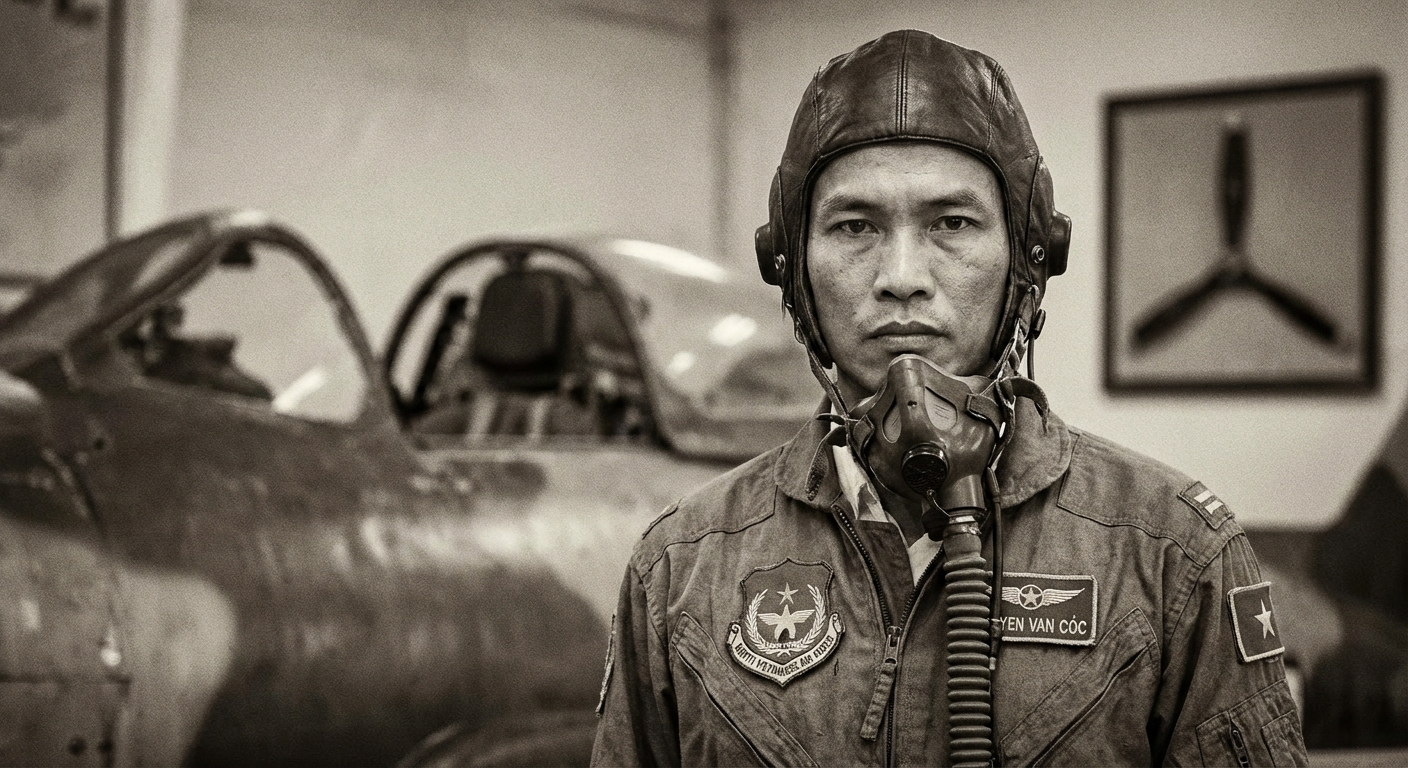
The MiG-21 was small, fast, and unforgiving, a delta-wing interceptor designed to climb hard, strike fast, and leave before larger opponents could settle the fight. In Vietnamese hands it became one of the defining fighters of the Cold War. Nguyễn Văn Cốc, flying MiG-21 variants with the VPAF, scored 11 confirmed victories and became North Vietnam’s highest-scoring ace of the war.
MiG-21PFM family variant • Vietnam People’s Air Force • Nội Bài / Kép network
Aircraft Profile
Mach 2+
Tailless delta
11,000+
11 confirmed kills
Technical Specifications
Performance
| Engine | One Tumansky R-11 or R-13 turbojet depending on subvariant |
| Max Speed | Around Mach 2.0 to 2.05 |
| Combat Radius | Generally short, often under 400 miles |
| Service Ceiling | Around 58,000 to 62,000 ft |
| Rate of Climb | Approximately 24,000 to 36,000 ft/min |
| Operational Style | Ground-controlled interception, quick hit-and-run engagements |
| First Flight | MiG-21 prototype family first flew in 1955 |
Dimensions & Armament
| Armament | At various times K-13 / AA-2 Atoll missiles, cannon gunpack or internal gun on later variants, rockets |
| Wingspan | 23 ft 6 in |
| Length | About 48 ft depending on version |
| Height | 13 ft 5 in |
| Empty Weight | Roughly 11,000 to 12,000 lbs |
| Max Takeoff | Roughly 19,000 to 21,000 lbs |
| Crew | 1 |
Combat Record
Aircraft History
The MiG-21 was not built to be comfortable. It was built to be effective inside a very specific vision of modern air war: radar warning, ground control, a fast climb, a missile shot, and a quick return home before the pilot ran out of fuel or luck. It was compact, simple by the standards of major Western fighters, and cheap enough to export on a vast scale.
That combination made it one of the most influential aircraft ever built. More than 11,000 were produced, which is a ridiculous number for a supersonic jet fighter and explains why the aircraft turned up everywhere from Warsaw Pact bases to Arab-Israeli battlefields to African civil wars. If you were studying Cold War aviation and needed one silhouette to represent Soviet export air power, this was the silhouette.
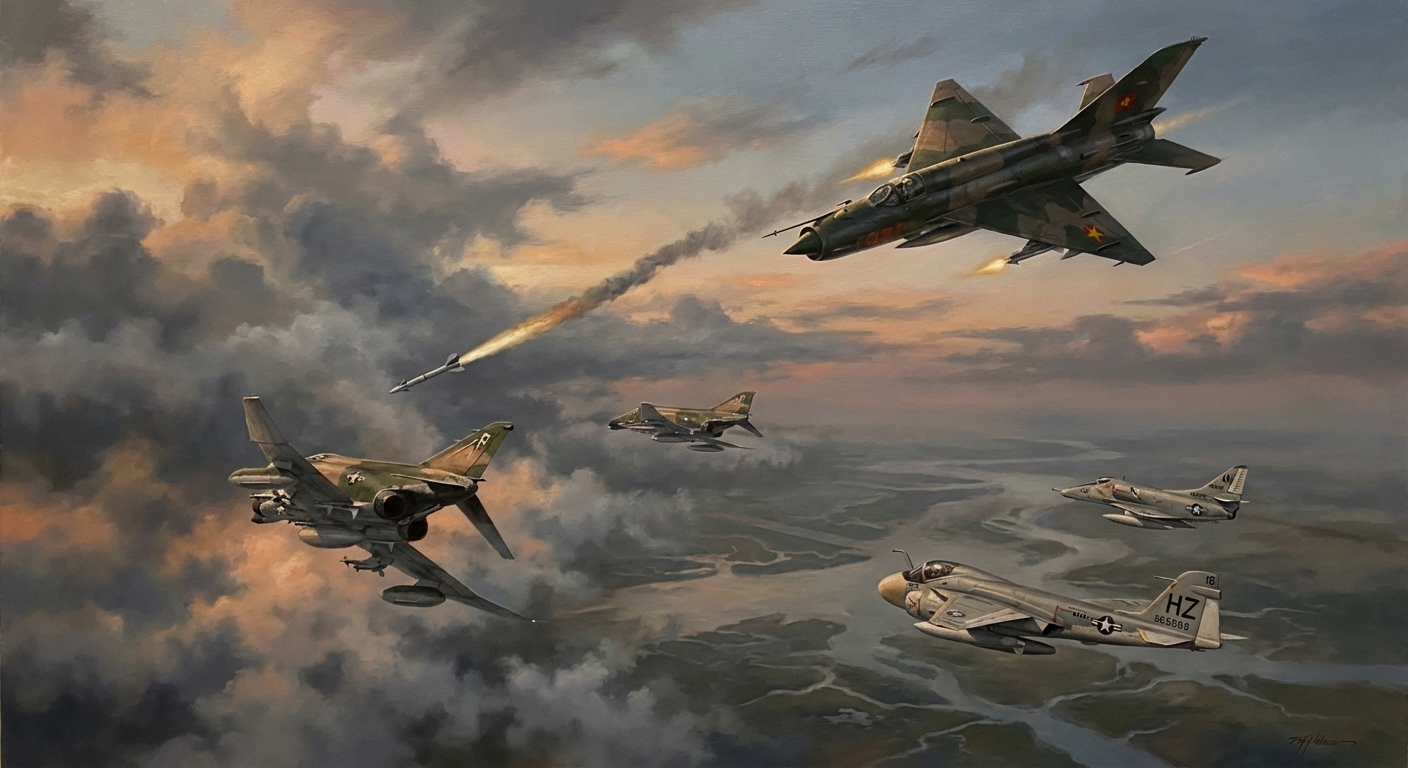
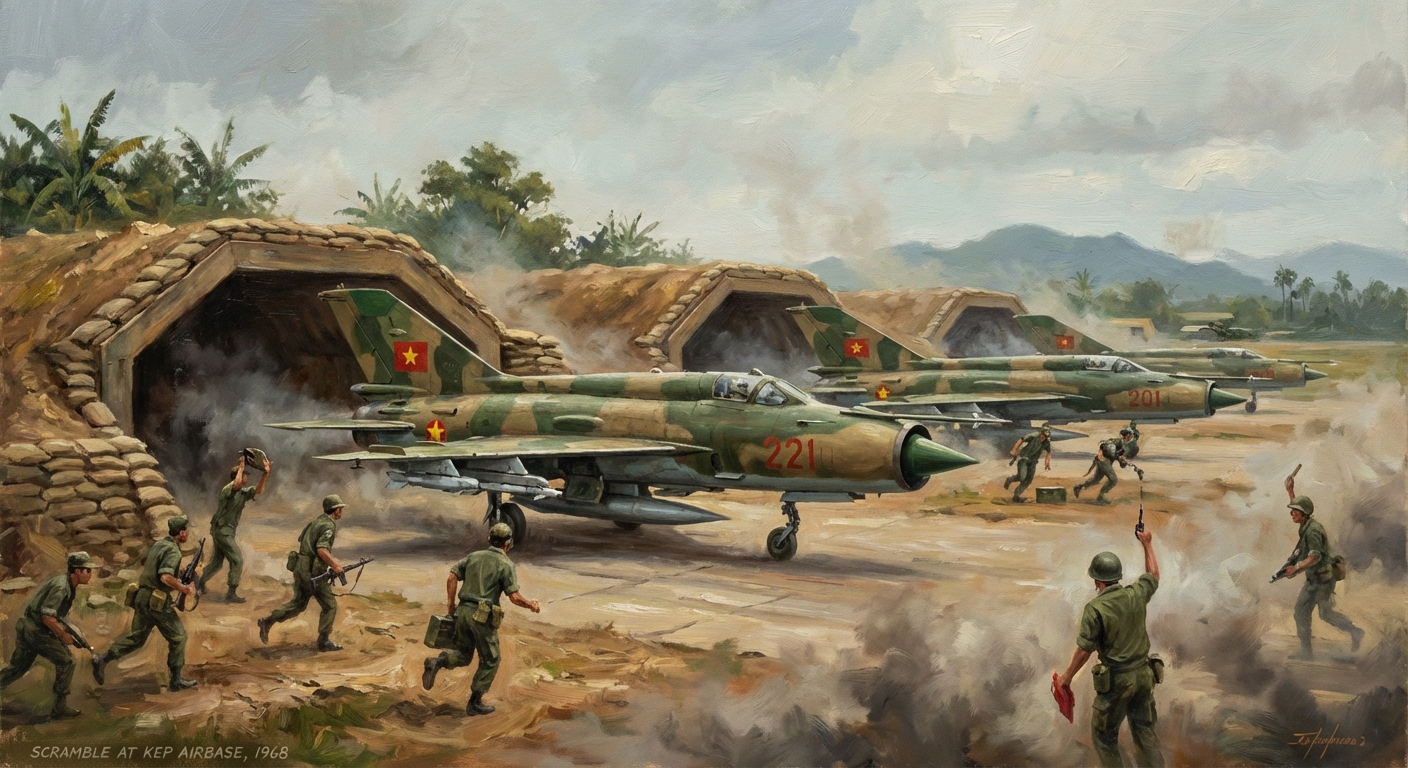
In Vietnam the MiG-21 served as part of an integrated system rather than as a lone duelist. Ground controllers tracked American strike packages, surface-to-air missile belts complicated ingress and egress, and smaller numbers of VPAF fighters were launched at moments chosen for maximum disruption. The jet’s speed and acceleration let it threaten heavier aircraft, while its small size made visual acquisition harder in the chaos of combat.
Its limits were real. Fuel endurance was poor. Early missiles were imperfect. The delta wing imposed penalties at low speed, and the cockpit workload could be savage. But limitations do not cancel significance. They shape tactics. The MiG-21 encouraged discipline, timing, and short violent attacks, which is precisely how the VPAF used it against far larger U.S. air formations.
The result is why the MiG-21 matters so much historically. It was not just another fighter. It was the mass-produced supersonic face of Soviet aviation, a machine that translated industrial policy and tactical doctrine into an object small enough to fit in a revetment and dangerous enough to alter an entire theater’s rhythm.

The Pilot
VPAF Fighter Ace
921st Fighter Regiment, Vietnam People’s Air Force
Nguyễn Văn Cốc became the highest-scoring ace of the Vietnam People’s Air Force, credited with 11 confirmed victories in one of the most closely watched air campaigns of the Cold War. Like many VPAF pilots, he operated inside a tightly controlled interception system in which timing, discipline, and fuel management mattered almost as much as gunnery or missile skill.
His opponents were often flying larger, longer-ranged, more sophisticated American aircraft with better support systems and enormous industrial backing. That disparity makes his record notable, but it does not make it mystical. Van Cốc and his fellow pilots succeeded by exploiting terrain, weather, ground-control vectors, and brief moments of numerical or positional advantage.
Accounts of his victories reflect the usual complexities of air war record-keeping, where both sides often claimed more than the other side concedes. Even allowing for the fog of war, Van Cốc’s combat reputation is secure. He was one of the VPAF’s most effective pilots and one of the best-known MiG-21 fliers of the conflict.
His story also matters because it forces Western readers to remember that the air war over Vietnam was not a one-sided technical demonstration. There were smart, disciplined, dangerous opponents in the sky, and some of them, like Nguyễn Văn Cốc, were very good at their jobs.
Unit History
The 921st Fighter Regiment was one of the core VPAF formations defending North Vietnam. Its pilots did not roam freely looking for targets. They were part of a coordinated air-defense web linked to radar, command posts, anti-aircraft artillery, and surface-to-air missile units.
That system let smaller VPAF forces challenge larger American formations by concentrating briefly at the right point. It also meant pilots often fought under strict tactical control, with limited fuel and little margin for improvisation once the intercept geometry broke down.
For historians, the regiment is a reminder that Vietnam’s air war was a systems fight as much as a pilot fight. Aircraft, controllers, SAM crews, doctrine, and timing all mattered. The MiG-21 simply gave that system a very sharp tip.
Artwork Gallery

Scramble to intercept
Generated

Camouflage and dispersal
Generated

The small supersonic knife
Generated
Toperczer, István. MiG-21 Units of the Vietnam War. Osprey Publishing.
Boyne, Walter J. and other Cold War air combat references on MiG-21 operations.
Vietnam War air campaign studies covering VPAF doctrine and fighter operations.
Gordon, Yefim. Mikoyan MiG-21. Midland / Hikoki reference editions.
Wikipedia: Mikoyan-Gurevich MiG-21, Nguyễn Văn Cốc, 921st Fighter Regiment.