Home Stories The Edge Weapons Battles People Warbirds About
All Warbirds

Republic P-47D Thunderbolt • 56th Fighter Group

Hun Hunter XVI

Francis "Gabby" Gabreski had already become America's top-scoring ace in Europe. One more low pass over a German airfield on July 20, 1944, turned the end of his combat tour into a crash landing, capture, and a long wait behind wire.

PilotLt. Col. Francis S. Gabreski
AircraftP-47D-25-RE, 42-26418
CodeHV-A, 61st Fighter Squadron
ResultCrash-landed, POW
28official World War II aerial victories, highest-scoring American ace over Europe
8 x .50Browning machine guns in the Thunderbolt's wings
2,000 hpPratt & Whitney R-2800 Double Wasp radial engine class
Stalag Luft IPOW camp near Barth, Germany, where Gabreski spent the rest of the war

One More Pass

The P-47 was not graceful in the way a Spitfire was graceful. It was huge, heavy, turbocharged, and hard to kill. Pilots called it the Jug. It could dive like a dropped anvil, carry punishment home in its cylinders and skin, and throw eight streams of .50-caliber fire into a target with terrifying weight.

Francis Stanley Gabreski understood that airplane. Born in Oil City, Pennsylvania, the son of Polish immigrants, he had gone to Britain, flown briefly with Polish fighter pilots, and come back to the U.S. 56th Fighter Group with a sharpened eye for air combat. By the summer of 1944 he was commanding the 61st Fighter Squadron and carrying 28 confirmed victories, all earned in the European theater.

His reputation had been built in a fighter group that did not fly politely. The 56th was an Eighth Air Force P-47 outfit to the bone: high-altitude escort one day, fighter sweep the next, and, after Normandy, the low work over airfields and rail lines. Gabreski was methodical rather than flashy. He stalked, closed, fired at short range, and broke away before the other pilot could use altitude or surprise against him.

On July 20, 1944, Gabreski was near the end of his combat tour. The 56th Fighter Group was working over German airfields in the Koblenz area. His P-47D, serial 42-26418 and squadron code HV-A, went down west of Koblenz after a strafing run. The Army Air Corps missing-aircrew record lists the aircraft as a P-47D of the 56th Fighter Group, 61st Fighter Squadron, with Gabreski as pilot and POW.

The story remembered by the Air Force is blunt: while strafing a German airfield, the propeller of Gabreski's P-47 struck the ground. He crash-landed, evaded briefly, and was captured. The war's top American ace over Europe would spend the remaining months of the war at Stalag Luft I rather than on a bond tour back home.

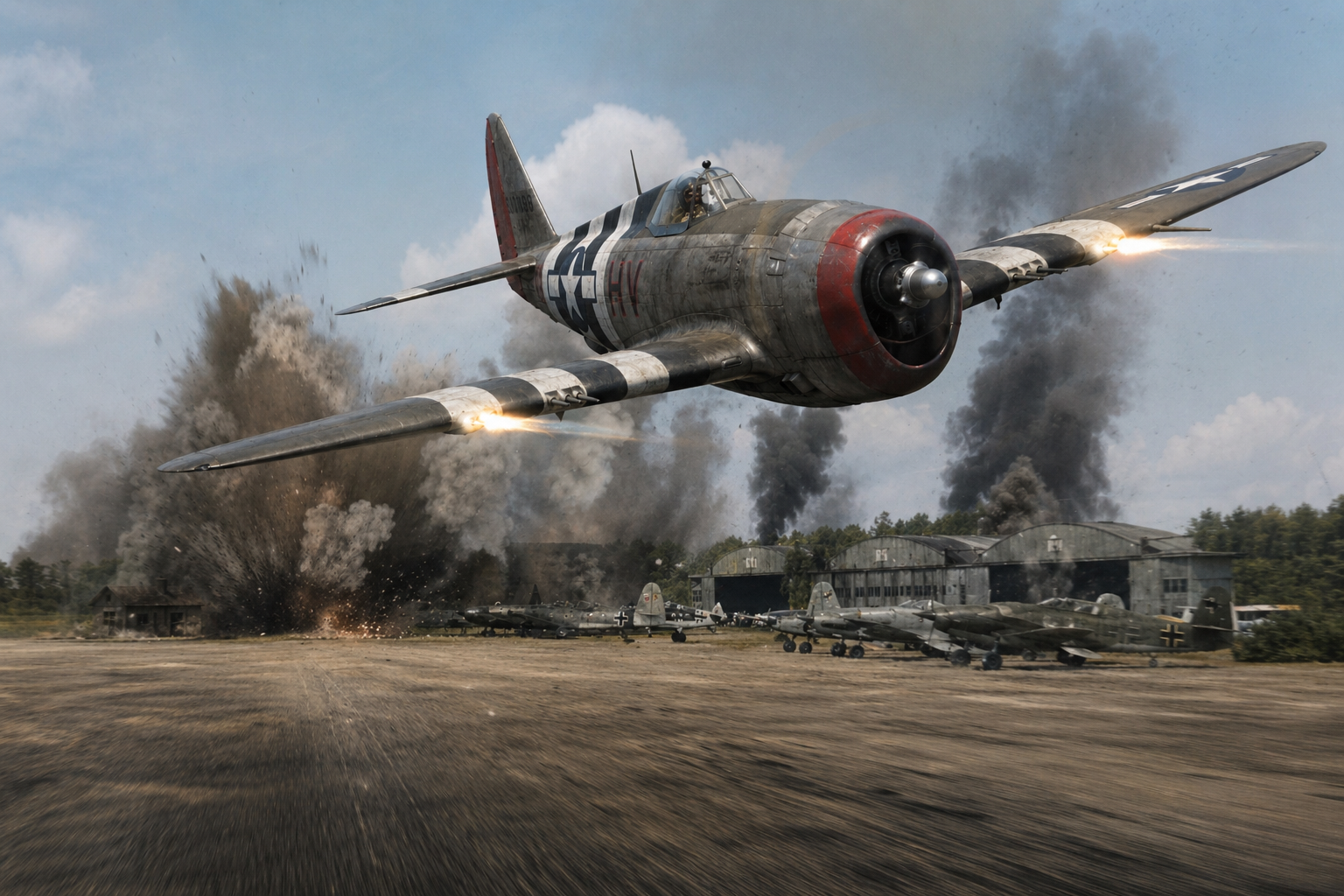
That is the hard edge of the story. Gabreski was not shot out of the sky in a clean duel. He was lost doing the dangerous, low, dirty work the Thunderbolt was built to survive: sweeping down over enemy airfields, trucks, parked aircraft, hangars, and flak positions. One more pass was enough.

After liberation in 1945, Gabreski stayed in uniform. He returned to combat in Korea, scored 6.5 more victories in jets, and became one of the rare American aces of two wars. But the P-47 remained the aircraft that made his name: big engine, big guns, red nose, HV-A on the fuselage, and the kind of survivability that could still put a pilot on the ground alive after everything had gone wrong.
Francis Stanley "Gabby" Gabreski

Gabreski was born January 28, 1919, in Oil City, Pennsylvania. His parents, Stanley and Josephine, were Polish immigrants who ran a market and expected work before romance. Aviation was not an obvious path. At Notre Dame he struggled academically, but a Civilian Pilot Training Program slot gave him the thing that changed the direction of his life.

He entered the Army Air Corps before Pearl Harbor and did not arrive in Europe as a finished ace. He made himself into one. Because he spoke Polish, he spent time with RAF Polish fighter squadrons and absorbed lessons from pilots who had already survived France, Britain, and years of war. The Polish influence mattered: close range, discipline, patience, and the refusal to waste ammunition at impossible angles.

With the 56th Fighter Group he found the right machine. The P-47 was not a knife fighter at low speed, but above Europe it was fast, rugged, heavily armed, and excellent in the dive. Gabreski's style fit it: climb for position, attack decisively, use the Thunderbolt's weight and speed, and leave before the fight became someone else's fight.

By mid-1944 he had become the leading American ace in the European Theater. The irony is that the airplane did not fail him in the end. He hit the ground with the propeller during a low attack and still lived through the landing. The Thunderbolt's bulk, often mocked by pilots coming from lighter fighters, gave him a second war story instead of a grave.

P-47D Thunderbolt

Performance

EnginePratt & Whitney R-2800 Double Wasp radial
PowerAbout 2,000 horsepower, variant dependent
Max SpeedAbout 426-433 mph, variant dependent
CeilingAbout 42,000 feet
RoleEscort fighter, interceptor, fighter-bomber, ground attack

Armament & Markings

Guns8 x .50 caliber Browning M2 machine guns
StoresBombs, drop tanks, and rockets depending on mission fit
FinishNatural metal with red 56th Fighter Group nose treatment
Invasion StripesApplied after D-Day; field modifications varied by date and aircraft
NicknameHun Hunter XVI, part of Gabreski's aircraft naming sequence

Aircraft And Cockpit Systems

R-2800 RadialThe eighteen-cylinder Double Wasp gave the P-47 its mass, speed, and survivability. It could take punishment that would cripple many liquid-cooled fighters.
Turbo-SuperchargerDucting and turbo controls let the Thunderbolt keep power at altitude, one reason the 56th Fighter Group could fight high above bomber formations.
Eight-Gun BatteryFour .50-caliber Brownings in each wing gave the P-47 a heavy, stable cone of fire for both air combat and strafing passes.
Bubble CanopyLate P-47D models gave the pilot a much cleaner rear-quarter view than the earlier razorback, valuable in escort work and after ground-attack pullouts.
Armor And StructureThe Thunderbolt's size was part of its protection: armored cockpit, rugged radial engine, and a strong airframe that often brought pilots home damaged.
Ground-Attack LoadDrop tanks, bombs, rockets, and gun ammunition varied by mission. By summer 1944, P-47 units were increasingly used against airfields, rail, and road targets.

From Razorback To Long-Range Escort

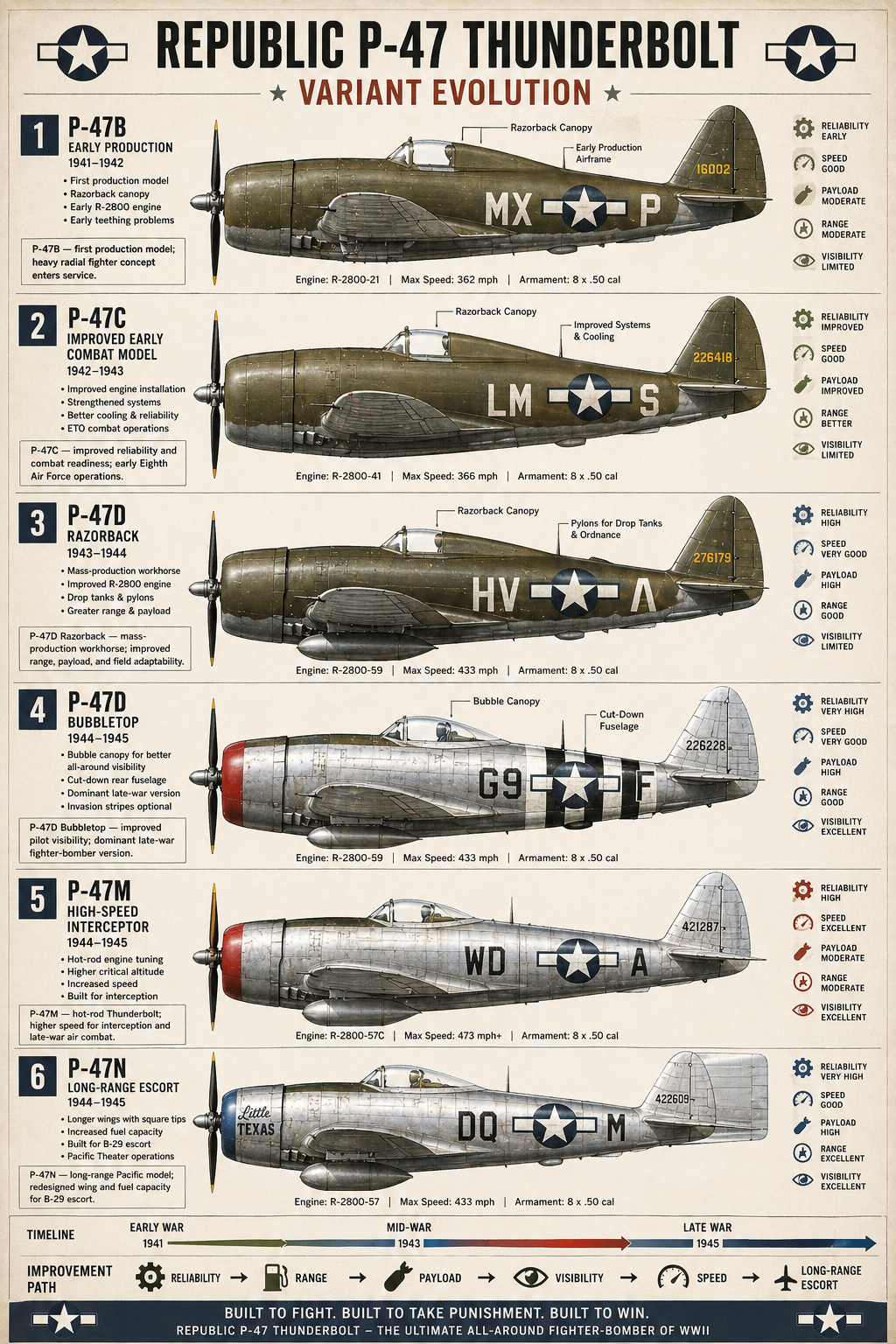
The Thunderbolt did not arrive as a finished answer. The early razorback P-47B and P-47C proved the heavy radial-fighter concept, the P-47D made it a mass-production weapon, the bubbletop improved the pilot's view, the P-47M chased more speed, and the P-47N stretched the design for Pacific range.

Republic P-47 Thunderbolt variant evolution reference plate
The P-47 family evolved through reliability fixes, range improvements, heavier fighter-bomber utility, better visibility, higher speed, and finally the long-range P-47N built with Pacific escort work in mind.
VisibilityThe bubble canopy and cut-down rear fuselage gave pilots a much cleaner rear-quarter view than the early razorback models.
RangeExternal tanks helped the P-47D reach farther into Europe; the P-47N pushed the airframe toward long-range Pacific operations.
RoleThe design moved from high-altitude escort fighter to rugged fighter-bomber, then into specialized high-speed and long-range variants.

Inside The Jug

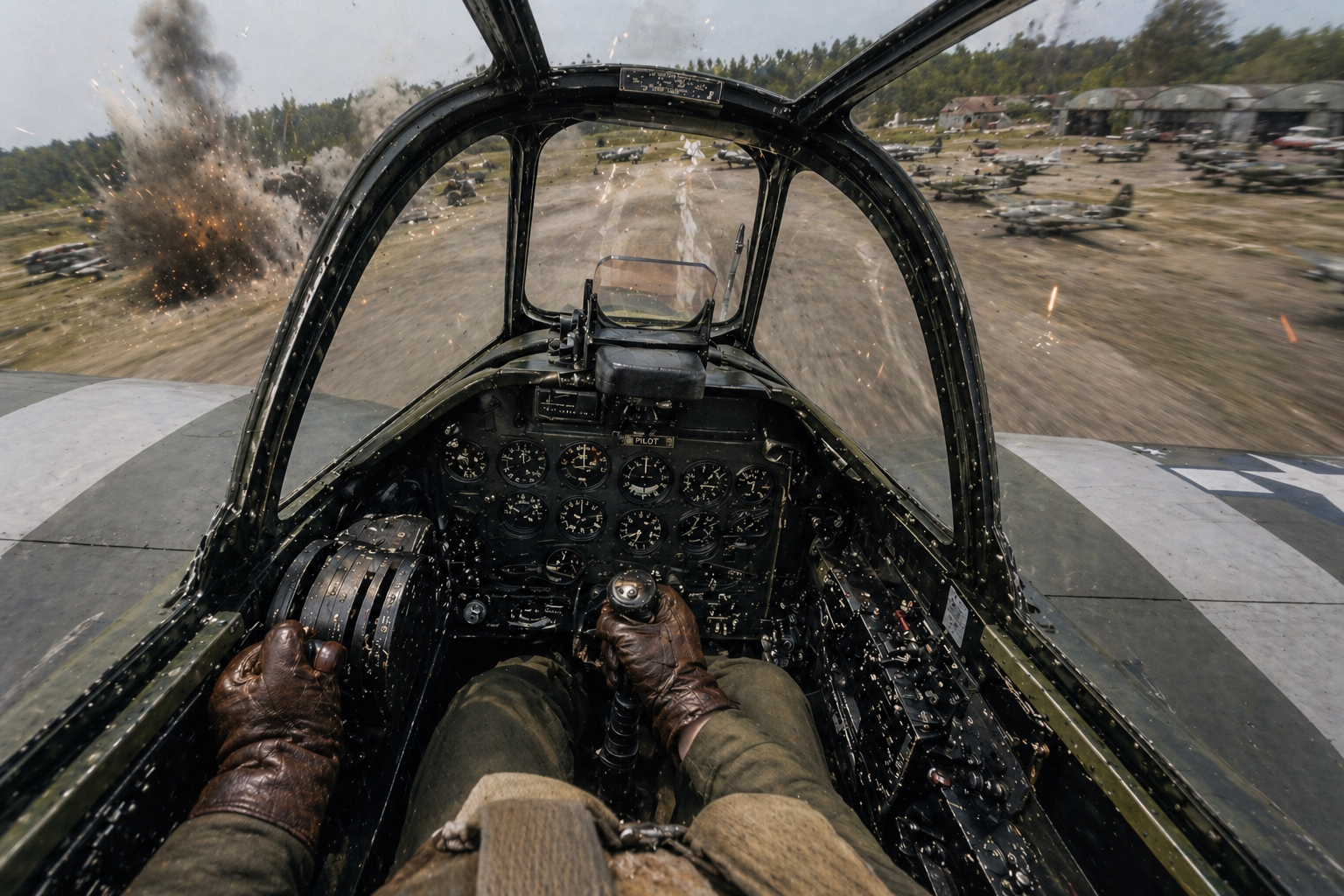
The P-47 cockpit was a fighter cockpit and an engine room at the same time. The pilot had to fly formation, watch the sky, manage fuel, trim a very heavy airplane, control the big R-2800 radial, and keep the turbo-supercharger working correctly at altitude. It rewarded pilots who could think ahead.

The bubble canopy gave later P-47Ds much better rearward visibility than the earlier razorback versions. That mattered for escort work, but it also mattered in the chaos after a strafing pass, when a pilot had to check the target, the flak, the wingmen, and the escape route in seconds.

For ground attack, the cockpit workload compressed. The pilot rolled in, picked the aim point through the reflector sight, held the big fighter steady as speed built, fired eight wing guns, then pulled away before the aircraft ate up the last few feet of altitude. The Thunderbolt could absorb punishment, but it could not forgive the ground.

The 56th Fighter Group

The 56th Fighter Group became one of the Eighth Air Force's premier P-47 units. Where later long-range Mustangs pushed deeper with the bombers, the Thunderbolt built its reputation on speed, dive performance, firepower, and punishment. The 56th used that toughness both in air-to-air fighting and in the increasingly violent low-level attacks that followed the Normandy landings.

Gabreski's aircraft carried the 61st Fighter Squadron code HV-A, the red cowl and tail group accents associated with the 56th, and the personal identity of a pilot whose score had made him famous before the loss. The crash did not diminish the record; it made the ending human. The best pilot in the group still only had inches between a successful pass and the ground.

Aircraft Illustrations

Hun Hunter XVI P-47D Thunderbolt in a low strafing pass
Photorealistic color reconstruction of a P-47D low-level strafing pass over a German airfield.
P-47 Thunderbolt cockpit during a low strafing pass
Cockpit-view reconstruction of the workload inside a P-47D during a low attack run.

Reference Notes

Primary story checks used the National Museum of the U.S. Air Force summary of Gabreski as an ace of two wars, the Army Air Corps Library and Museum missing-aircrew report for P-47D 42-26418, and Smithsonian coverage of the P-47's combat role and Gabreski's record.

National Museum of the U.S. Air ForceArmy Air Corps Library and Museum MACR 06843Smithsonian Magazine / National Air and Space Museum