The Fire That Made Him
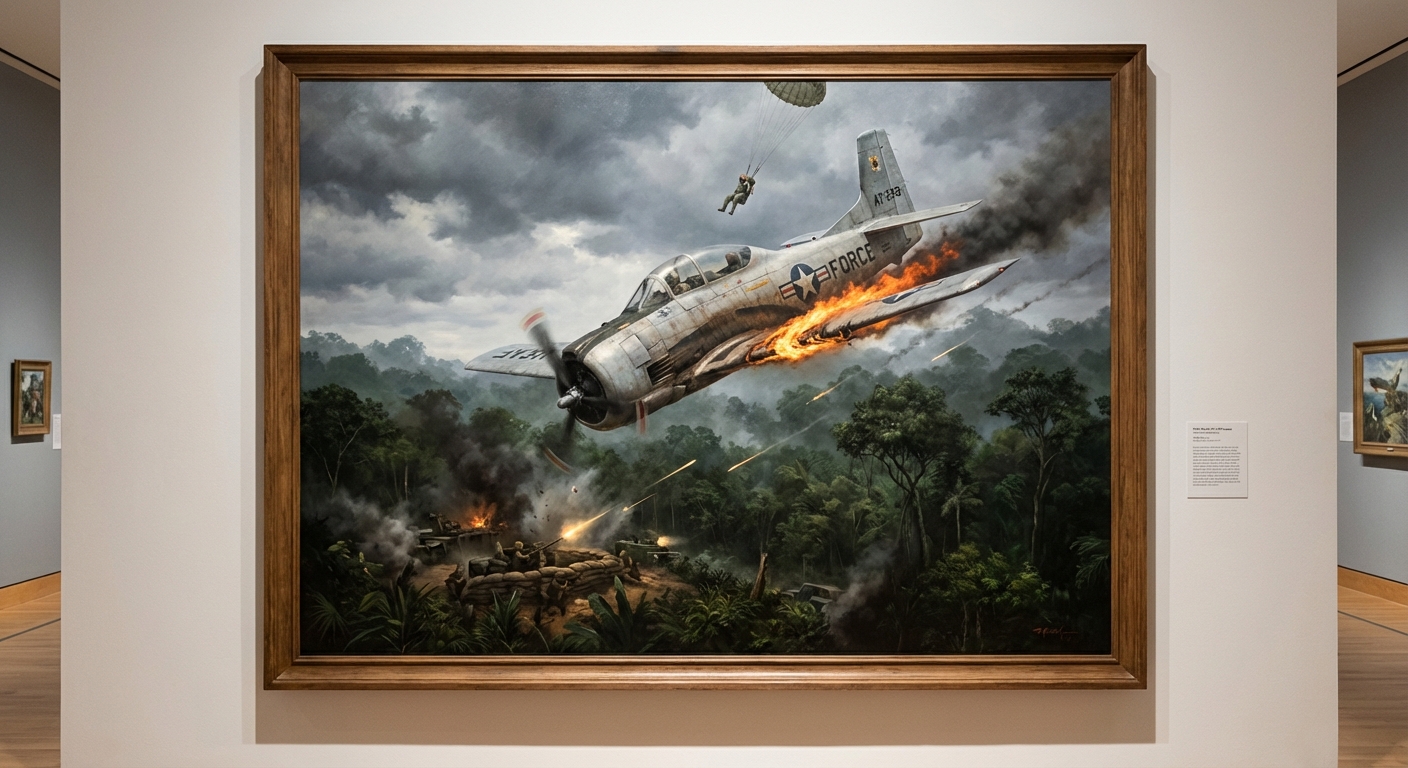
In 1972, during the Vietnam War, Brian Shul was shot down flying an AT-28 Trojan propeller-driven attack aircraft over Southeast Asia. The aircraft crashed and burned. Shul was pulled from the wreckage with burns covering more than 35 percent of his body — his face, hands, and arms bearing the worst of it. The medical team at the burn center told him clearly: he would survive, but he would never fly again. The damage was too severe. His flying career was over.
He spent months in a burn unit. He underwent fifteen reconstructive surgeries. He relearned how to use his hands. And when the doctors had done everything they could and discharged him, Brian Shul went directly to his commanding officer and argued for a return to flight status. The argument was simple: his hands worked, his eyes worked, and his mind worked. The rest was paperwork.
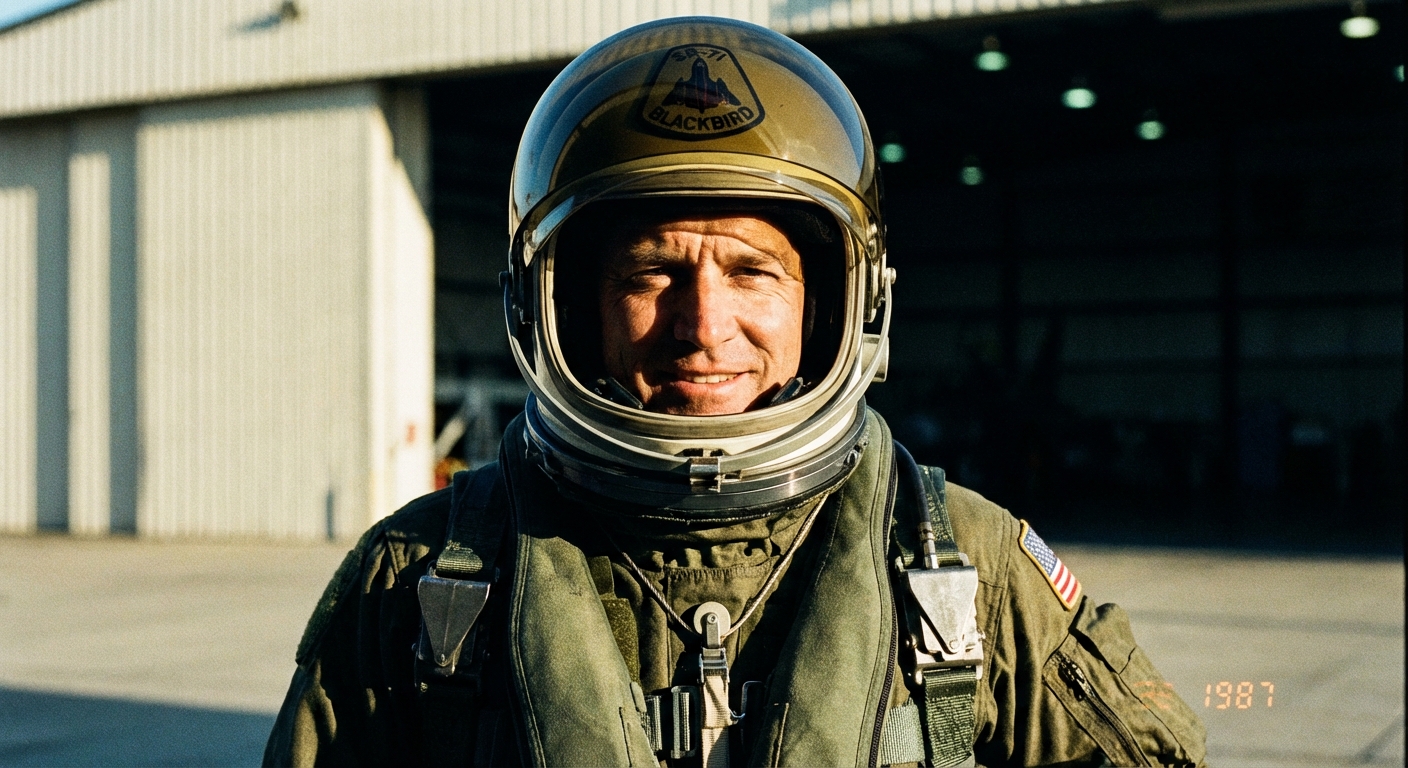
Somehow, against every expectation of the military medical system, he was returned to flying duty. And not just any flying. Brian Shul would eventually qualify for the most exclusive flying assignment in the United States Air Force: the SR-71A Blackbird.
Into the Blackbird — The Selection
The SR-71 program was intensely selective. Pilots were chosen not just for their flying ability but for their psychological profile, their judgment under pressure, and their ability to operate in an environment where virtually every instrument reading was unprecedented and every emergency procedure was improvised. The aircraft operated at speeds and altitudes that no other crew-operated vehicle had sustained. There was no ejection system that worked reliably at Mach 3. The pressure suits were a world of their own. The fuel — JP-7, with a flashpoint so high you couldn't ignite it with a match — required pyrophoric ignition fluid (triethylborane, which ignites on contact with air) just to start the engines.
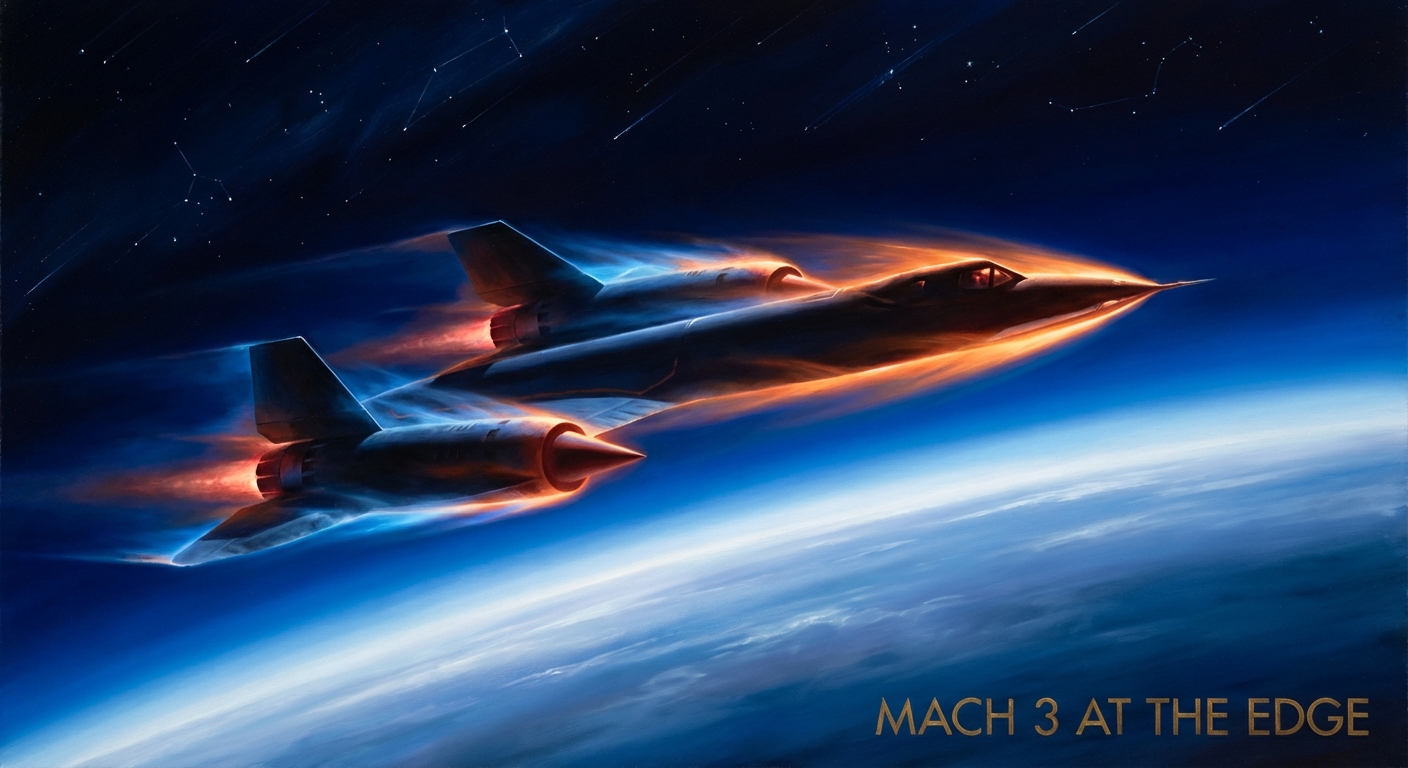
Shul qualified. He flew operational missions over denied territory — locations and details of which remain classified. What he could confirm was the experience of sitting in the front seat of the world's fastest aircraft, watching the curvature of the Earth from the edge of space, seeing the black of space above and the blue atmosphere below, and thinking about what extraordinary luck had put him there when every doctor who had treated him had told him it was impossible.
The Los Angeles Speed Check
The story that made Shul famous in aviation circles — first told in his book Sled Driver and later retold so many times it became legend — is the Los Angeles speed check. On a training flight in the late 1980s, Shul and his RSO (Reconnaissance Systems Officer) Walter Watson were flying back to Beale AFB over Southern California. The LA Center air traffic controller, who managed civilian traffic in the region, asked Shul for his current airspeed for spacing purposes.
Several other aircraft immediately announced their own airspeeds — a Cessna at 90 knots, a Beechcraft at 180, a military jet at 520. The controller asked the Blackbird. Shul keyed the radio and gave his speed: “Los Angeles Center, SR-71 is indicating 1,700 miles per hour.” The frequency went dead. No other pilot said a word for the rest of the time that SR-71 was in the airspace.
The story is almost certainly accurate in spirit, even if some details shift in different tellings. It captures something true about what the Blackbird was: not a faster version of other aircraft, but a completely different category of machine that shared airspace with conventional aircraft only incidentally.
The Machine Itself — Engineering at the Edge
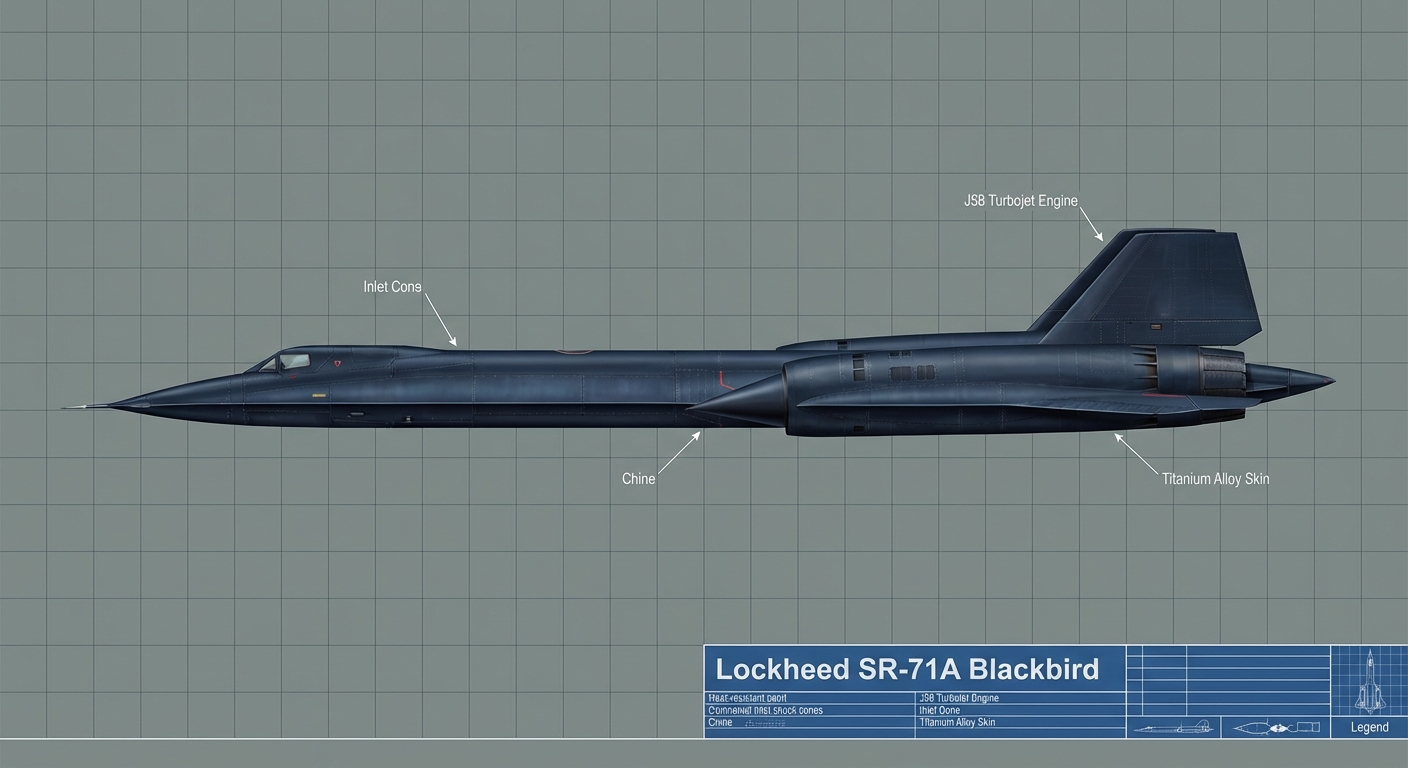
The SR-71 was built from titanium because aluminum would soften and fail at the skin temperatures generated by Mach 3 sustained flight. The titanium was procured from the Soviet Union through a network of CIA front companies — an extraordinary irony, since the primary mission of the aircraft it built was spying on the Soviet Union. The airframe was so precisely thermal-expansion-engineered that it leaked fuel on the ground. The panels and joints that would seal under the heat of supersonic flight were deliberately gapped when cold. Ground crews laid pans under the aircraft to catch the JP-7 pooling on the ramp before every flight.
Starting the J58 engines required a special cart that injected triethylborane — a substance that burns spontaneously in contact with air — into the intake. The pilot would watch for the characteristic greenish TEB ignition flash in his mirrors before throttling up. Each engine was allocated a specific number of TEB shots. If you miscounted, you couldn't restart the engine. You glided home.
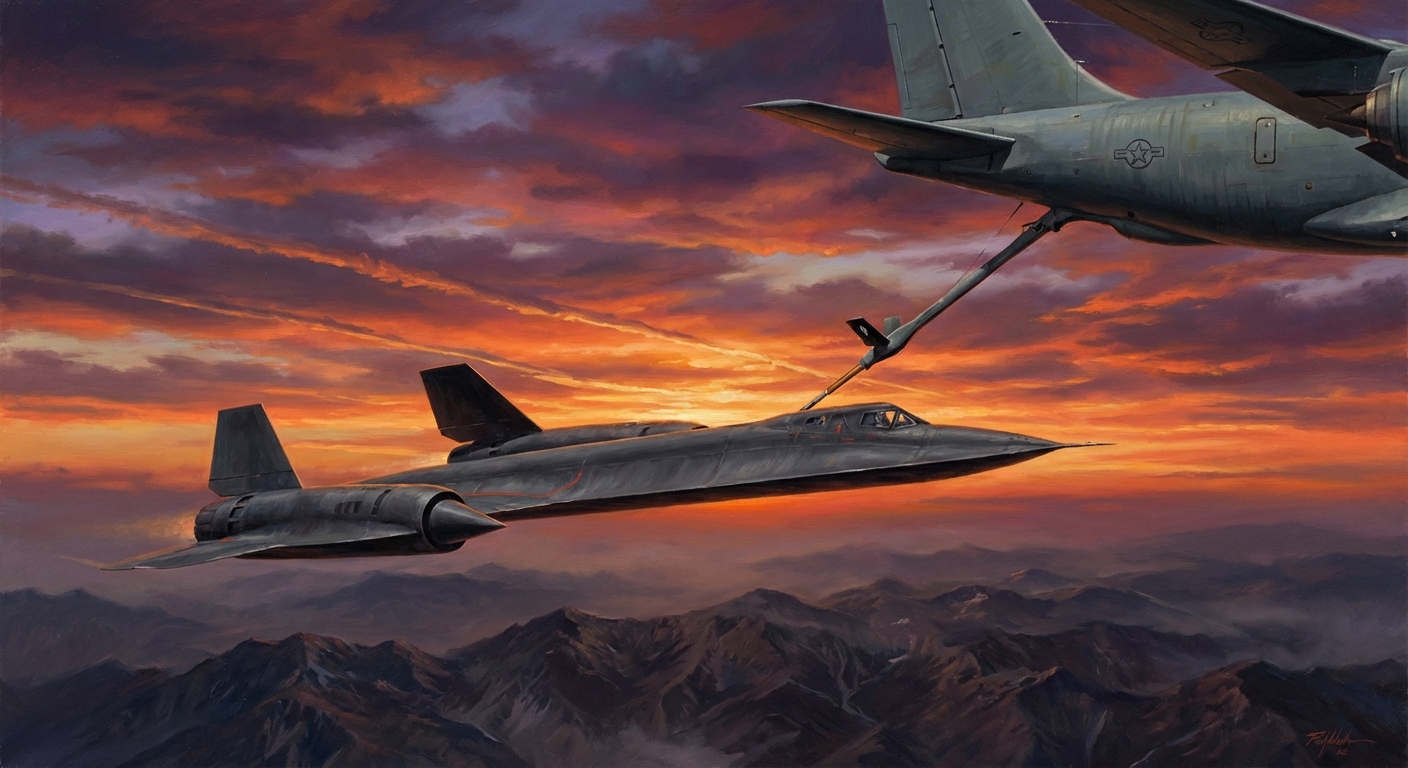
Every mission began with air refueling immediately after takeoff because the aircraft could only take on a partial fuel load at takeoff weight — the structure couldn't handle full fuel until it had burned down, and the sealant gaps made it impractical to fuel to the brim anyway. The Blackbird climbed to altitude, hit its refueling track, topped off from a KC-135Q tanker, and then accelerated to cruise speed. At Mach 3.2, the inlet system worked at the edge of what aerodynamics could contain. An inlet unstarts — a violent pressure wave reversal — could snap a pilot's head against the canopy at forces approaching 6G with no warning. RSOs and pilots both wore protective helmets not against ejection risk but against instrument panel impacts during unstarts.
Over 4,000 surface-to-air missiles were fired at SR-71s during the aircraft's operational career. Not one connected. The aircraft simply flew away from everything that was shot at it.
Legacy — Sled Driver
Brian Shul retired from the Air Force and published Sled Driver: Flying the World's Fastest Jet in 1991. The book combined Shul's narrative with extraordinary photography — much of it taken from the cockpit — and became one of the most sought-after aviation books ever published. Original editions now sell for hundreds to thousands of dollars. A follow-up, The Untouchables, continued the story. Shul went on to a career in motivational speaking, photography, and advocacy for burn survivors. He remained, by any measure, a living argument that the doctors who tell you what you cannot do are often simply wrong.