Home Stories The Edge Weapons Battles People Warbirds About
← The Edge

December 16, 1944 - January 25, 1945

Battle of the Bulge: Who Had The Edge?

Germany chose surprise, bad weather, narrow forest roads, and armored shock. The Allies absorbed the hit, held road junctions, called in artillery, rushed reserves, and turned the Ardennes into a trap for an army that could not afford to run out of fuel.

3German Edges
5Allied Edges
2Contested
1Decisive System

The Question

How did a surprise offensive become a German disaster?

The opening blow worked. Thin American lines were hit by veteran German formations in weather that grounded Allied air power. The problem was not the first day. The problem was everything after it: fuel, roads, bridges, traffic jams, artillery, reserves, and time.

The Bulge is a clean Edge study because it separates tactical shock from operational staying power. Germany could punch. The Allies could absorb, reroute, reinforce, and keep feeding the fight.

Graphic 01

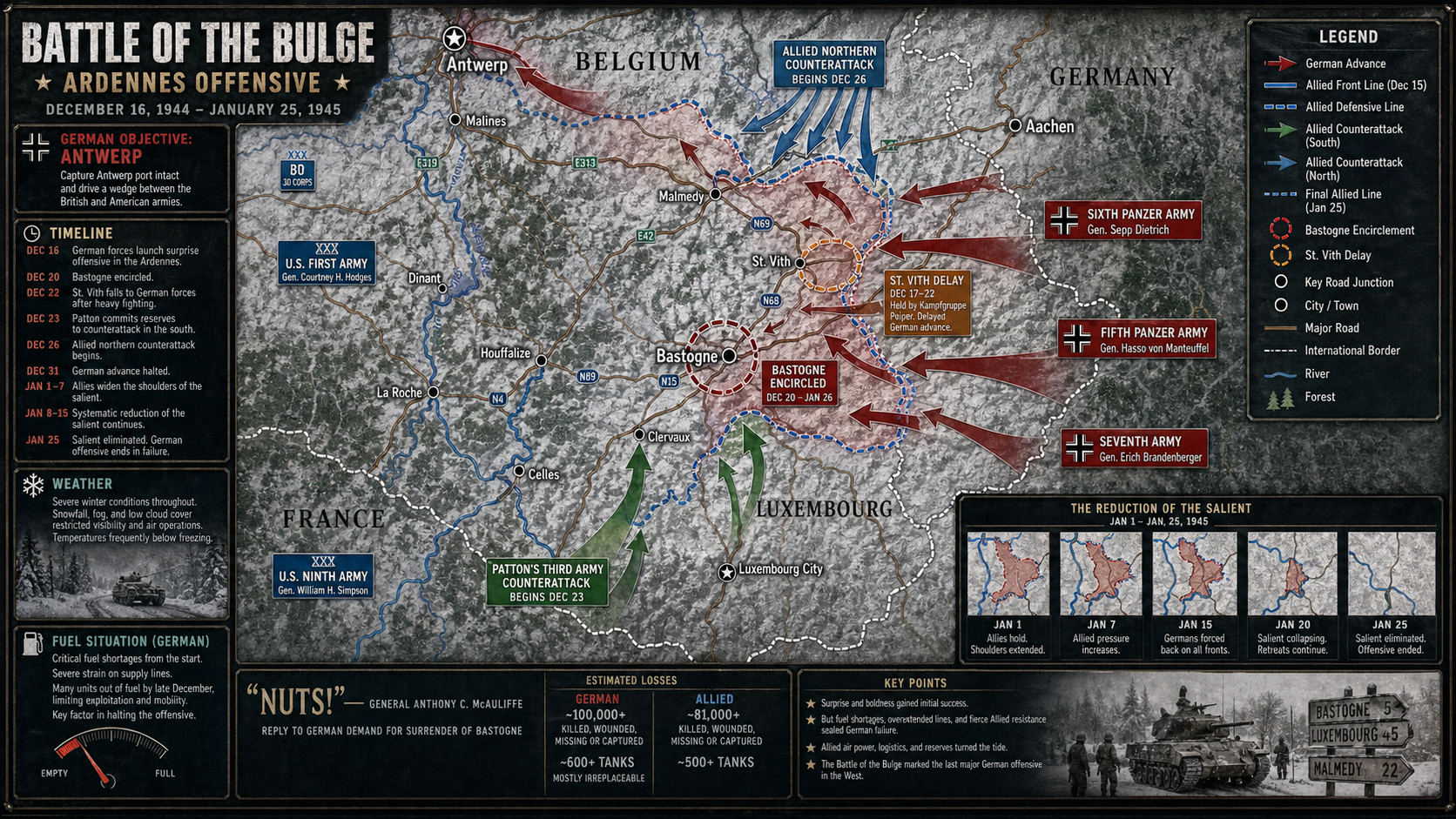
Operational Map

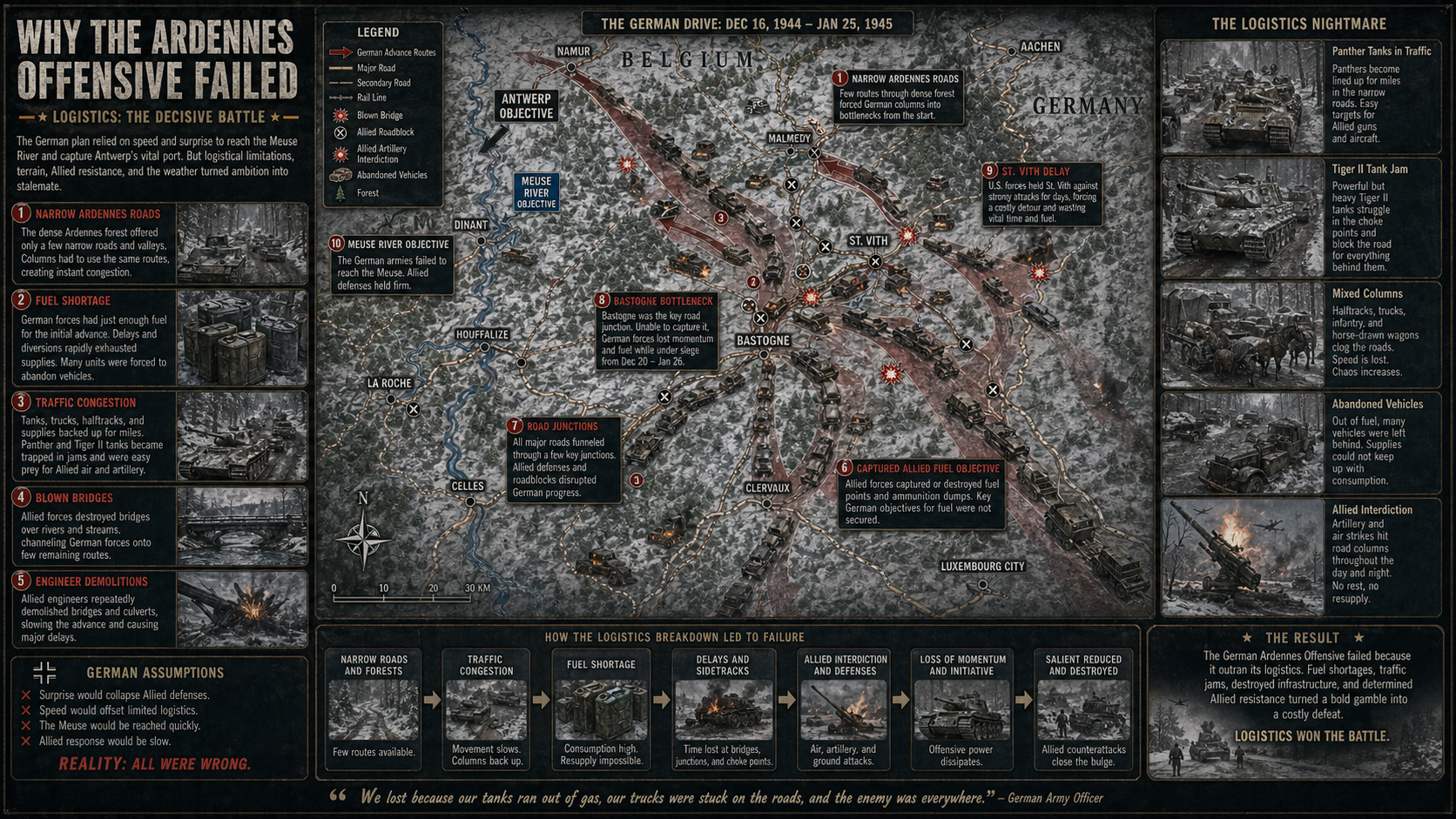
Battle of the Bulge operational map showing German attack routes, Allied defenses, roads, and fuel constraints
The battle as a system map. German armored columns had to move through forest roads, seize crossings, reach fuel, and keep momentum. Every blocked town, blown bridge, traffic jam, and delayed timetable narrowed the offensive's chance of success.
Dec. 16

German armies strike through the Ardennes under fog and snow, achieving surprise against thin U.S. lines.

Dec. 17-19

American roadblocks, engineers, and artillery slow the armored columns while reserves move toward the breach.

Dec. 20-26

Bastogne holds, Patton turns north, and the German timetable breaks under supply pressure.

Jan. 1945

Allied counterattacks erase the salient and destroy German reserves that could not be replaced.

Graphic 02

Why The Offensive Failed

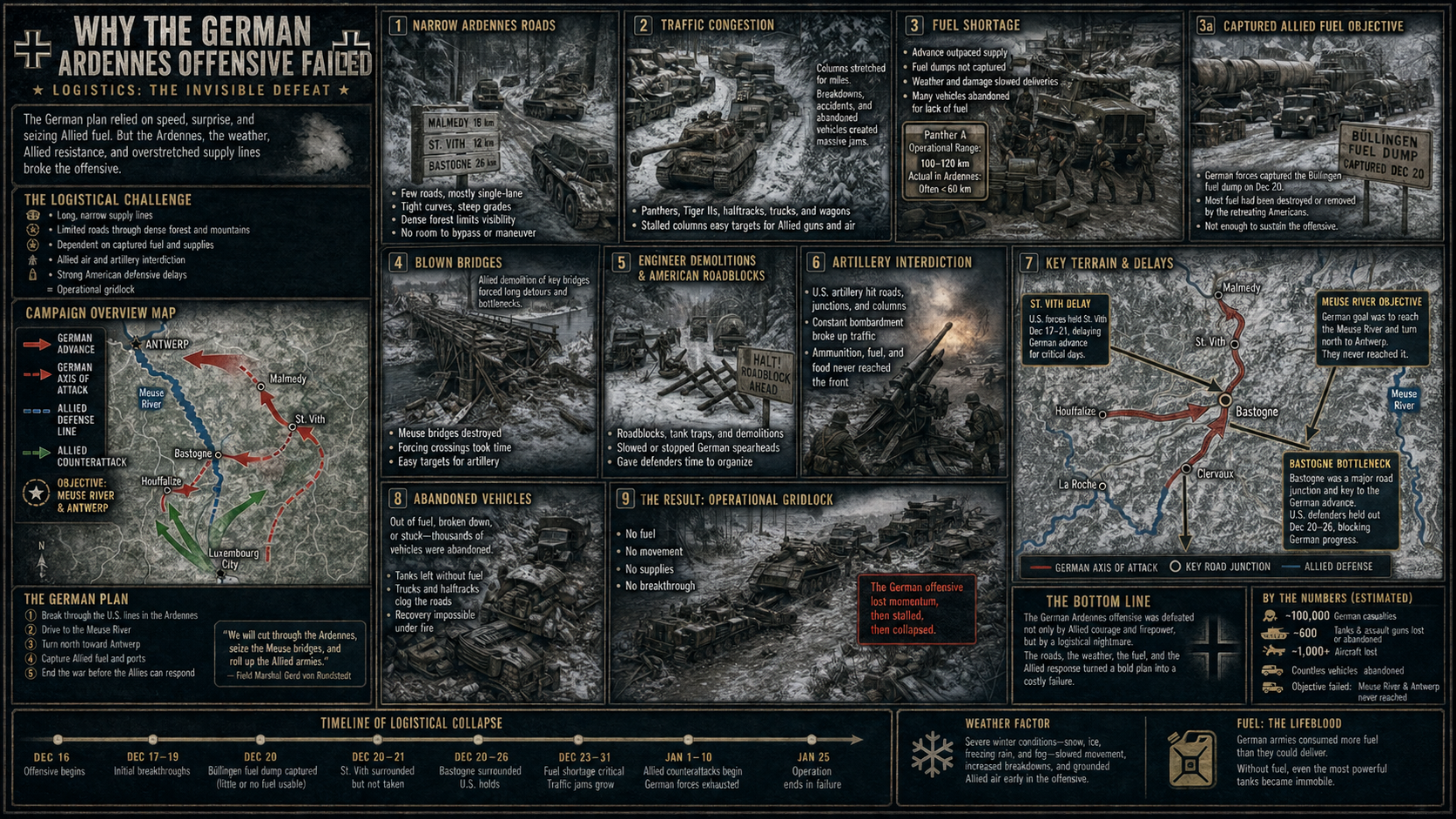
Diagram explaining why the German Ardennes offensive failed
Failure points. The plan depended on speed, secrecy, captured fuel, traffic control, bridge seizure, and Allied paralysis. Once any of those links failed, the offensive became a race against its own shortages.

Graphic 03

Why The Ardennes Defense Failed

Breakdown of why the American Ardennes defense was initially penetrated
The opening Allied problem. The sector was quiet on paper, but quiet sectors invite thin lines, tired units, poor readiness, and surprise. The initial failure was real. The recovery was the point.

Graphic 04

Armored Warfare

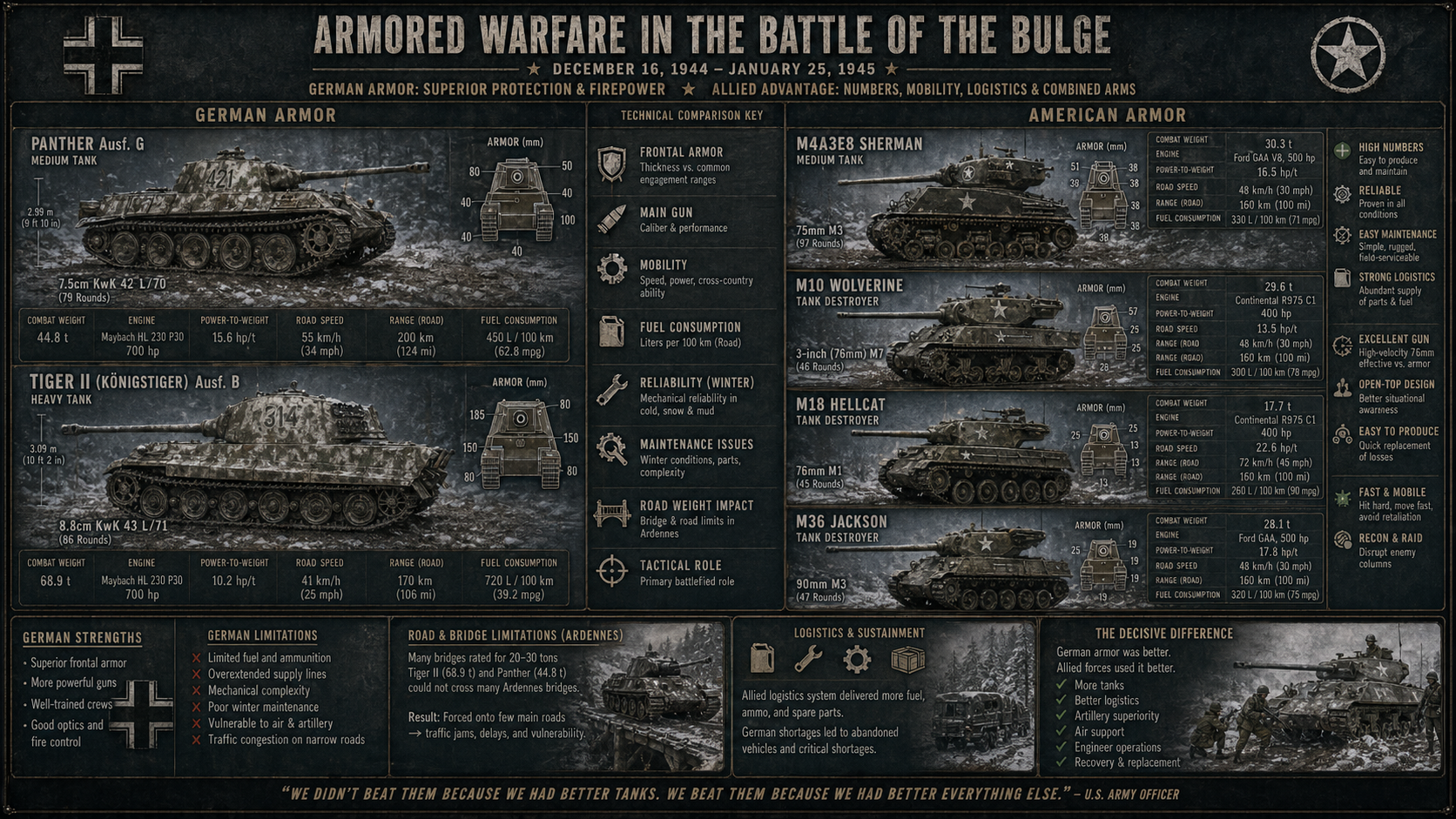
Armored warfare comparison in the Battle of the Bulge with German and Allied tanks
Tank advantage was not the same as battle advantage. Panthers and Tigers were dangerous, but the Bulge was not a tank duel in a clean field. Roads, fuel, recovery, maintenance, artillery, tank destroyers, infantry, and air attack shaped what armor could actually do.

Graphic 05

Allied Response System

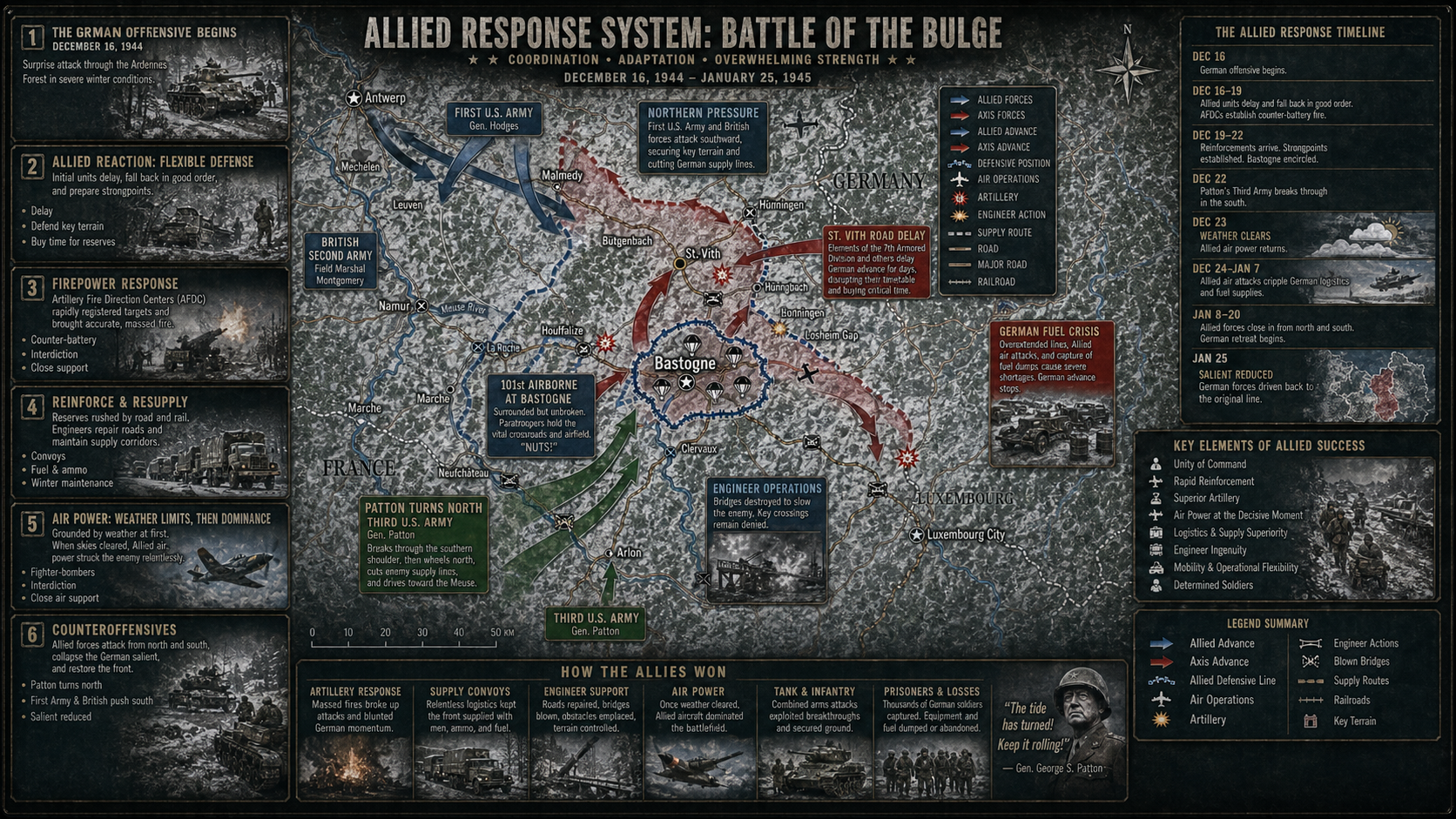
Allied response system diagram for the Battle of the Bulge showing reserves, artillery, air power, logistics, and command response
The extra image belongs here. This is the best summary of why the battle turned. The Allies did not need every first-line unit to win its local fight. They needed enough roadblocks, artillery, engineers, fuel, trucks, reserves, and command decisions to keep the German spearheads from moving as one.

Edge Board

Ten Things That Decided It

German Edge

Surprise and Weather

Fog, snow, and Allied assumptions gave Germany the opening it needed. Air power was mostly grounded during the first critical days, letting columns move without the usual Allied punishment.

Initial shockWeather cover

German Edge

Heavy Armor At The Point

Panthers, Tigers, assault guns, and experienced crews could overmatch many local defenders. In the right lane, against a thin line, German armor was still terrifying.

PantherTiger IIAssault guns

Allied Edge

Artillery and Fire Control

American artillery was fast, flexible, and heavy. Forward observers, telephone lines, radios, and massed fires could turn a road junction or forest edge into a killing zone.

Time on targetCorps artillery

Contested

Terrain

The Ardennes hid the German build-up and masked the attack. Then it punished the attacker with narrow roads, bottlenecks, poor visibility, steep grades, and bridge choke points.

Forest roadsBottlenecks

Allied Edge

Logistics and Fuel

Germany gambled on captured fuel because it did not have enough of its own. The Allies had fuel, trucks, depots, repair units, and replacement flow. That difference became decisive.

FuelTrucksRepair

Allied Edge

Roadblocks and Small Units

Small groups bought time out of proportion to their size. Engineers, tank destroyers, infantry, and scattered units blocked bridges, defended towns, and forced German columns to deploy.

St. VithBastogneEngineers

Allied Edge

Command Flexibility

Eisenhower, Bradley, Hodges, Patton, Ridgway, and others moved armies and corps under pressure. The German plan needed precision. The Allied response could improvise.

ReservesRerouting

German Edge

Infiltration and Confusion

Commandos, English-speaking teams, captured uniforms, and rumors amplified uncertainty. The material effect was limited, but the psychological effect was real.

SkorzenyConfusion

Allied Edge

Air Power Returned

When the weather cleared, Allied aircraft attacked roads, columns, bridges, rail movement, and supply points. German armor that had been protected by weather became exposed.

Fighter-bombersInterdiction

Decisive

The German Army Could Not Replace The Loss

The offensive spent men, tanks, fuel, and aircraft Germany needed for defense. Even before the salient was fully erased, the strategic result was ruinous.

Strategic exhaustionNo reserve depth
Sources

Reference checks used U.S. Army historical summaries, National WWII Museum material, U.S. Army Center of Military History context, and standard campaign histories of the Ardennes Offensive.

U.S. Army Center of Military HistoryThe National WWII Museum - Battle of the BulgeU.S. Army - Battle of the Bulge