Home Stories The Edge Weapons Battles People Warbirds About
← The Edge

June 6, 1944 • Operation Overlord

D-Day: Who Had The Edge?

The Germans held concrete, mines, machine guns, and prepared ground. The Allies brought deception, air supremacy, naval fire, radios, amphibious engineering, and an industrial logistics machine built to keep coming.

7Allied Edges
1Contested
2German Edges

The Question

Not who had the best weapon. Who had the best system?

D-Day was not decided by a single tank, bunker, rifle, or landing craft. It was a collision between a static defensive system and an Allied combined-arms system designed to coordinate sea, air, land, deception, and supply at enormous scale.

The German edge was real at the waterline. Omaha proved that. But every hour the beachhead survived, the Allied advantages became harder to stop.
Graphic 01

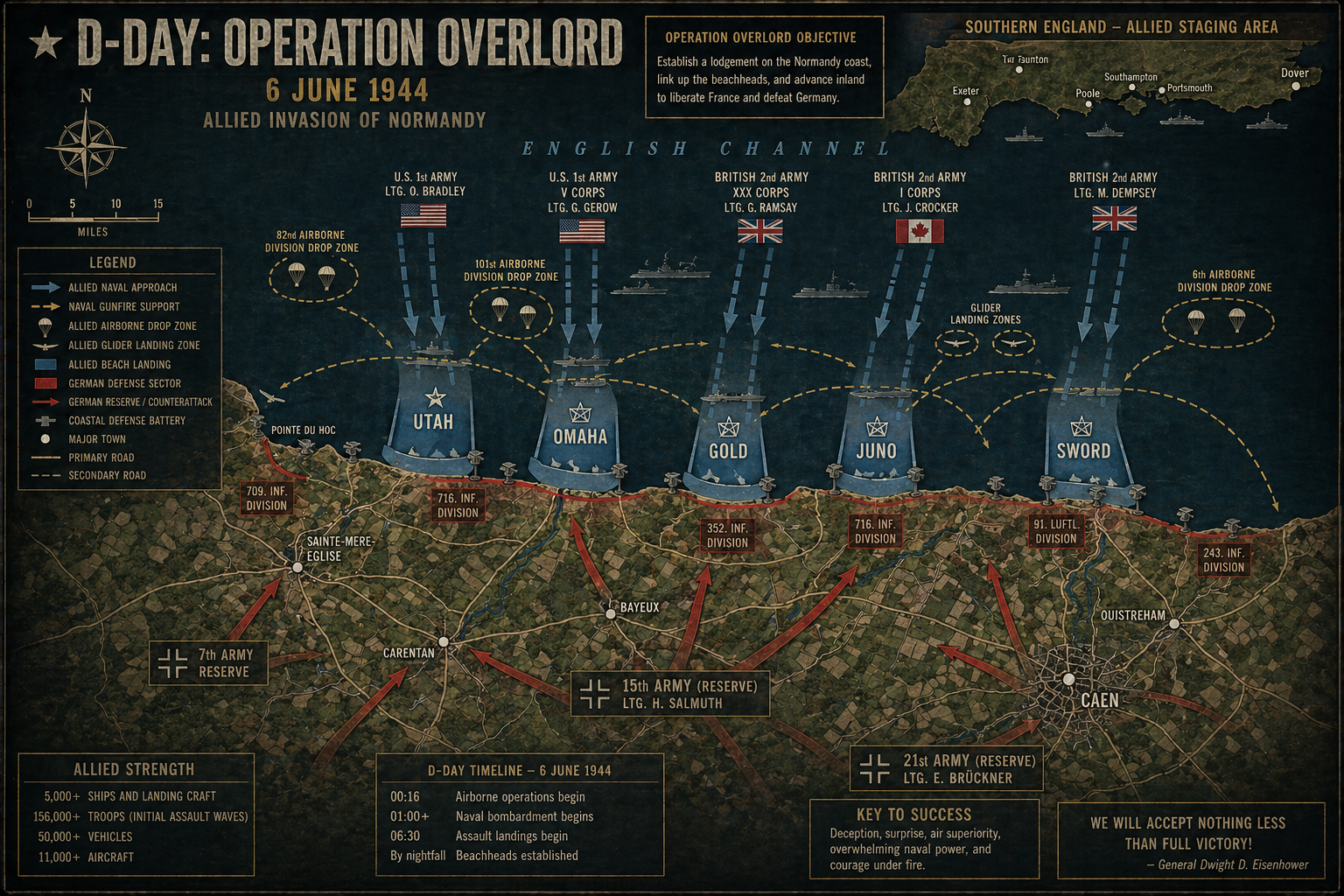
Operational Map

D-Day Operation Overlord tactical map showing beaches, airborne drops, naval lanes, and German reserves
Read the battle in one image. Five beaches, airborne drop zones, naval approach lanes, German reserve arrows, and the first-day objective are all visible together. This is the strategic problem: land across a defended coast, keep the exits open, and prevent German reserves from crushing the lodgment.
00:16

Airborne operations begin behind Utah and Sword, seizing bridges and confusing German response.

05:30

Naval bombardment and air attacks pound coastal positions before the first assault waves.

06:30

American landings begin at Utah and Omaha; British and Canadian beaches follow to the east.

Nightfall

The beachheads are not deep enough, but they exist. That is the decisive fact.

Graphic 02

Atlantic Wall

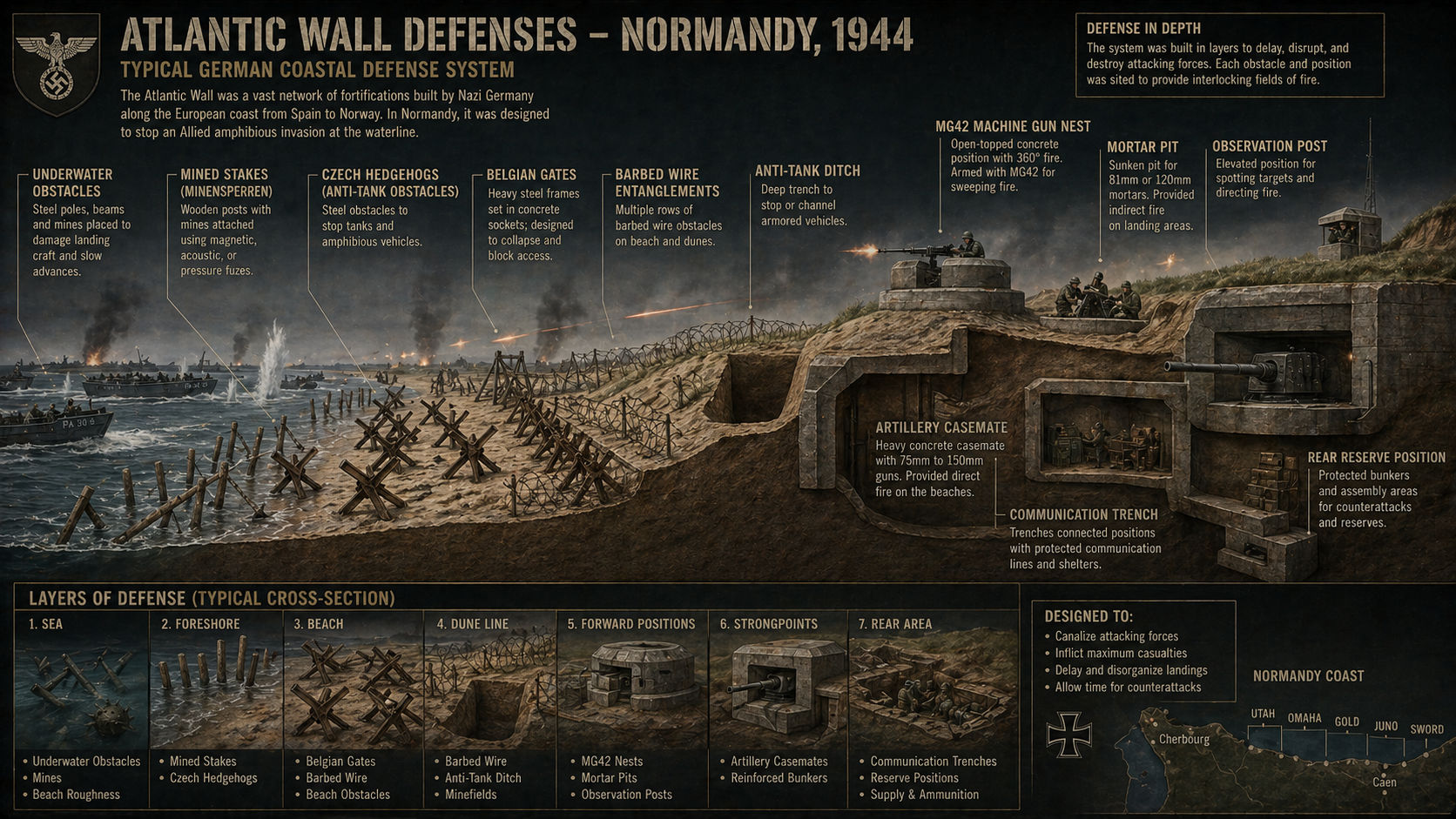
Atlantic Wall beach defense cutaway with obstacles, bunkers, MG nests, artillery, and trenches
German edge at the waterline. The Atlantic Wall layered obstacles, mines, wire, machine guns, mortars, observers, and artillery. Its purpose was not elegance. It was to slow men down long enough for interlocking fire to kill them.

Graphic 03

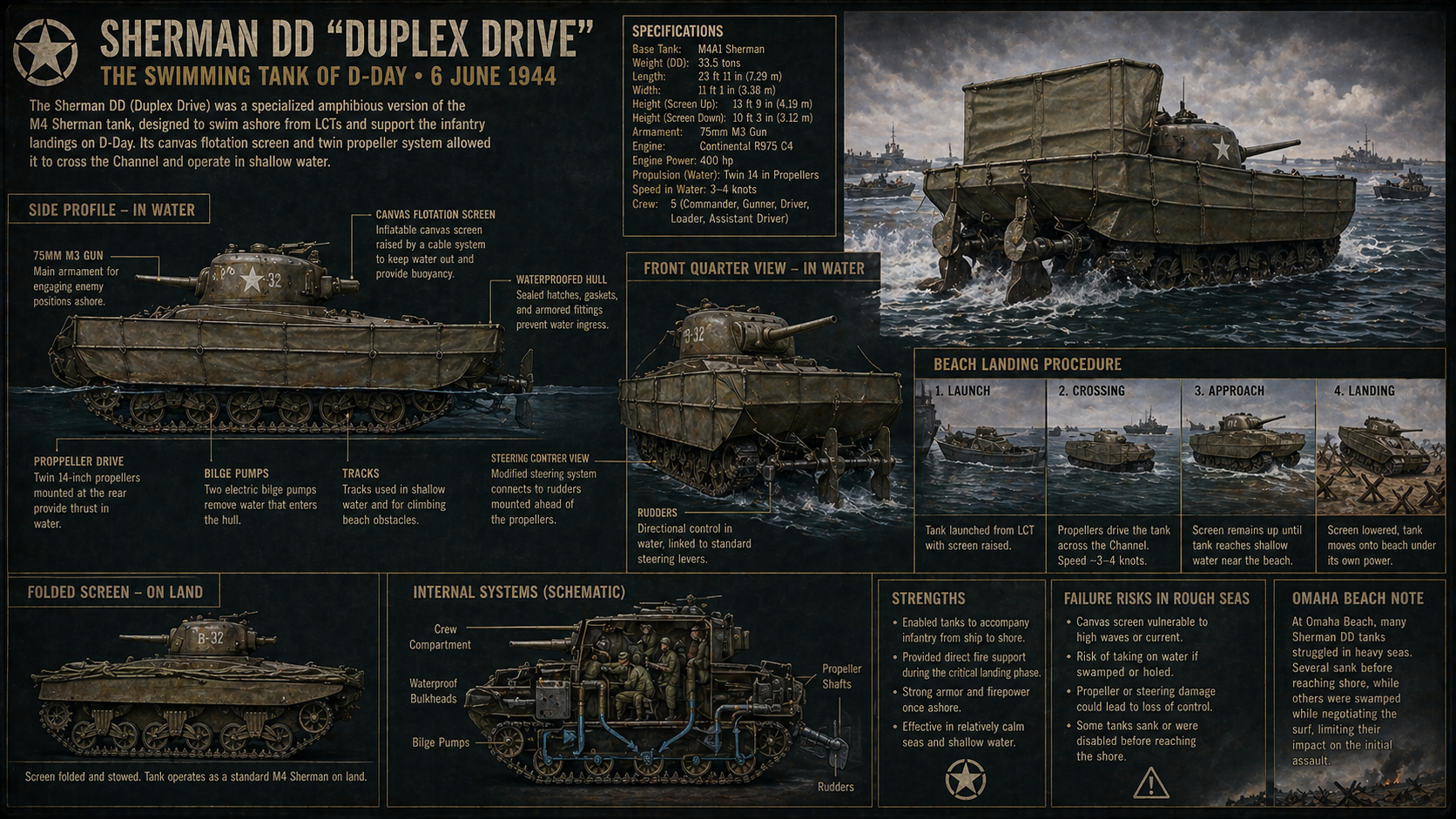
DD Sherman

Sherman DD Duplex Drive technical plate showing flotation screen, propellers, bilge pumps, and landing procedure
Ingenious, fragile, essential. The DD Sherman was a risky answer to a brutal problem: infantry needed armor in the first minutes ashore. Where the tanks arrived, the beach fight changed. Where they sank, the infantry paid.

Graphic 04

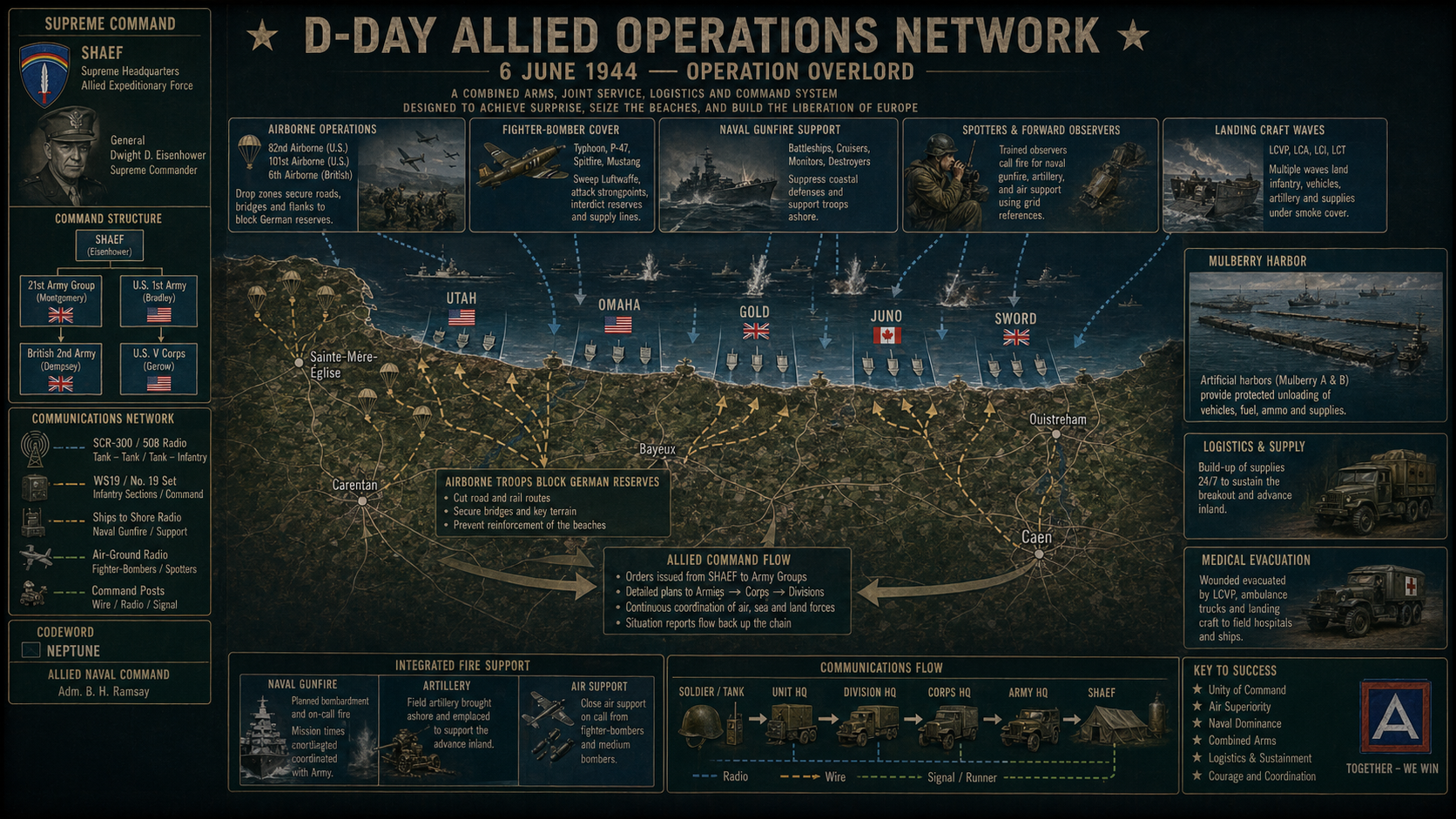
Allied Operations Network

Allied D-Day operations network showing command, communications, naval gunfire, air cover, landing craft, logistics, and medical evacuation
The real Allied edge. The invasion worked because the Allies connected many imperfect pieces: command, radios, naval fire, spotters, fighter-bombers, landing craft, supply, medical evacuation, and airborne blocking forces. Germany had strong points. The Allies had a network.

Ten Matchups

The Edge Board

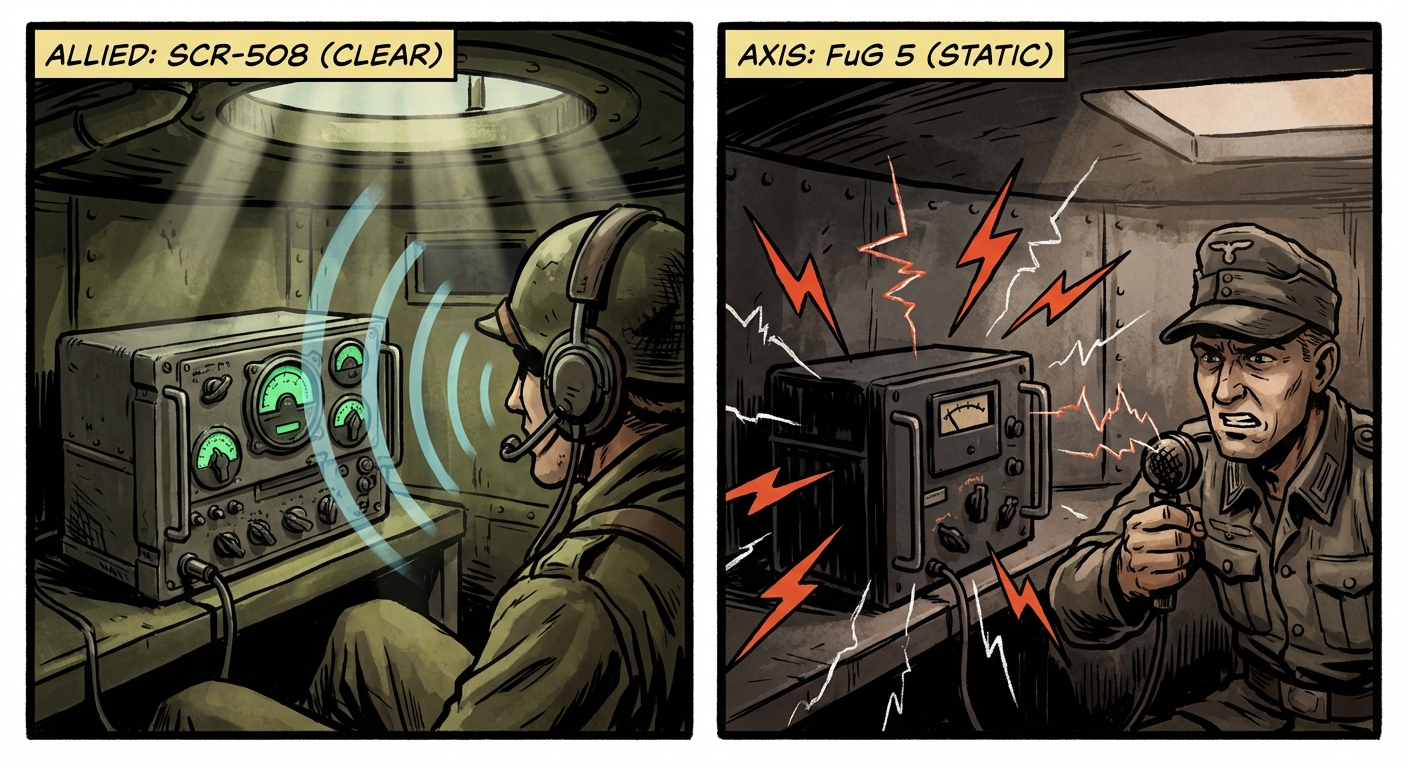
SCR-508 FM radio versus FuG 5 AM radio
#01Communications

FM radios vs static and flags

Allied

Tank and infantry coordination improved by clear tactical radio nets.

German

AM sets, line cuts, runners, and visual signals degraded under bombardment.

Allied edge. Radios did not win alone, but they let units react faster when the plan broke.

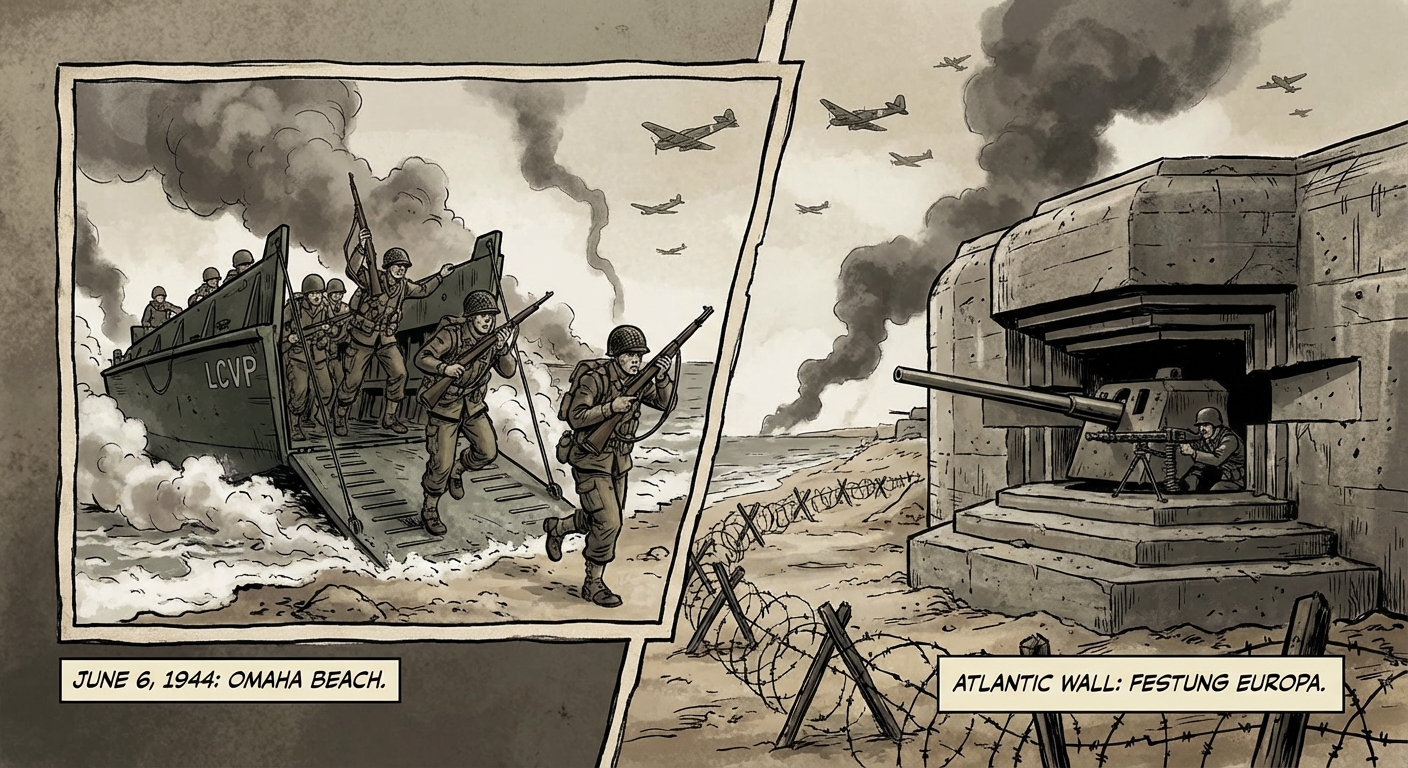
Higgins boats against Atlantic Wall defenses
#02Beach Assault

Higgins boats vs fixed defenses

Allied

Mass landing craft could shuttle men, engineers, weapons, and vehicles in waves.

German

Obstacles and bunkers were deadly when defenders had clear fields of fire.

German edge early, Allied edge over time. The Wall could murder the first wave; it could not replace losses or move.

DD Sherman technical diagram
#03Amphibious Armor

Swimming tanks vs no equivalent

Allied

DD Shermans brought direct fire support onto a beach before ports existed.

German

Defense assumed armor would arrive after the landing, not swim with it.

Allied edge. The idea was fragile, but the tactical payoff was enormous when it worked.

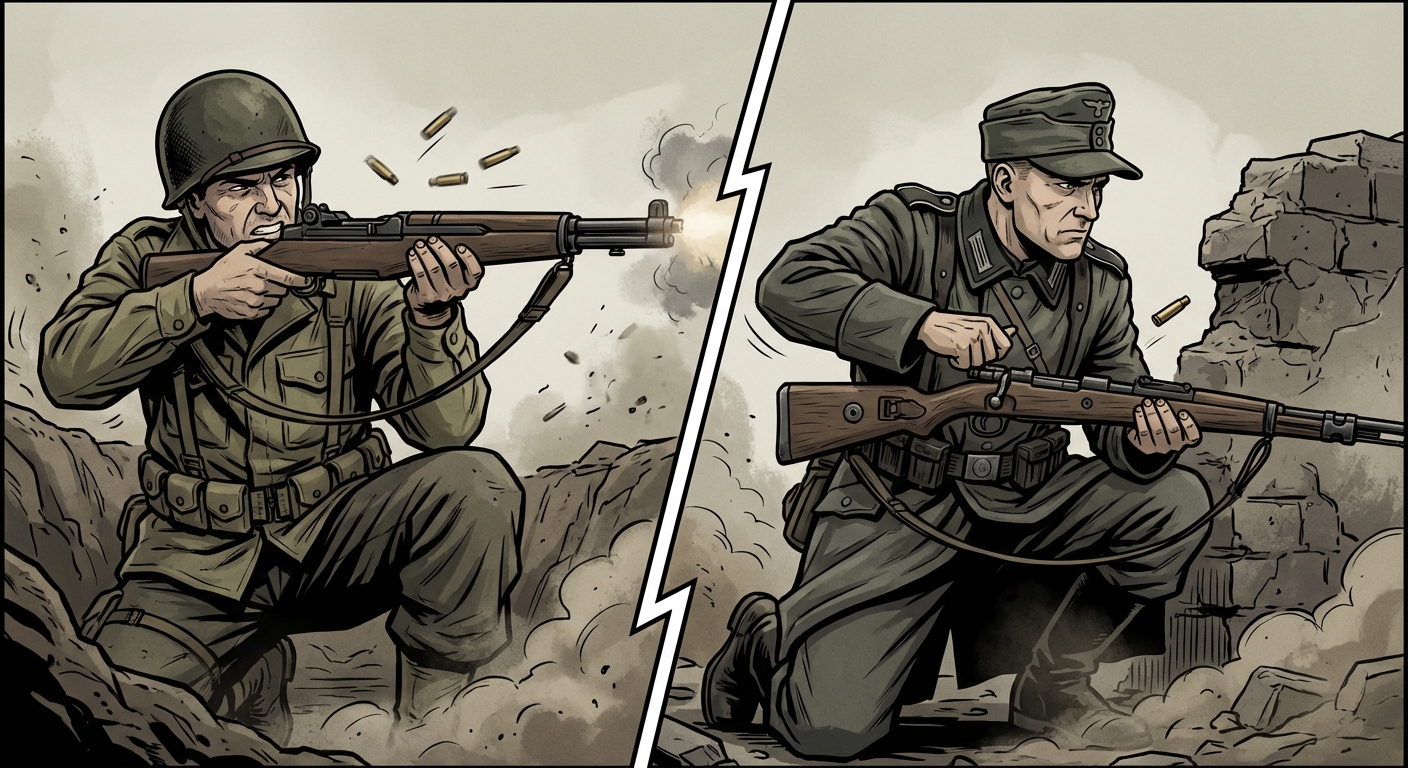
M1 Garand versus Karabiner 98k
#04Infantry Rifle

Garand fire tempo vs bolt action

Allied

Semi-automatic fire gave American riflemen faster follow-up shots.

German

The K98k remained accurate and rugged, but slower in close, chaotic fighting.

Allied edge. On broken ground, rate of aimed fire mattered more than parade-ground precision.

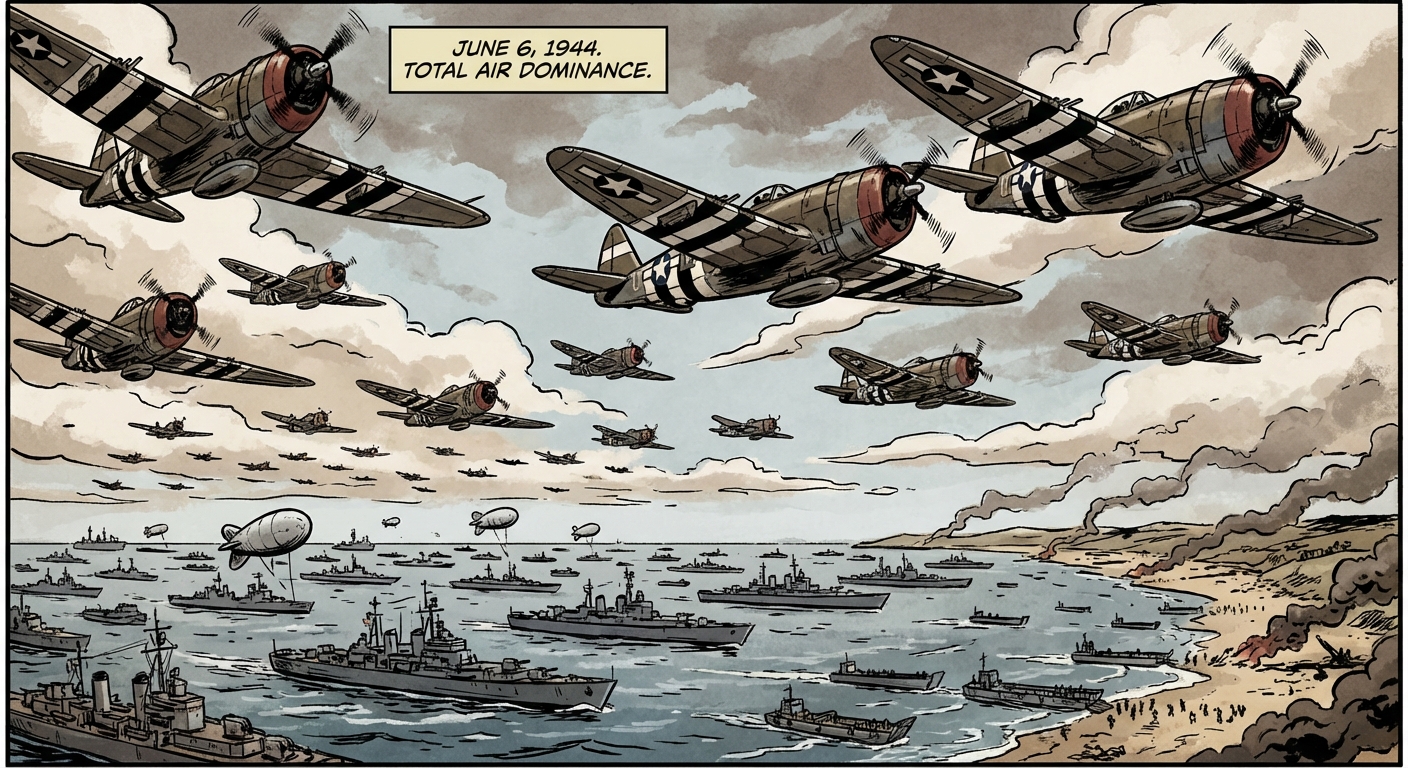
Allied air superiority over Normandy
#05Air Superiority

Air armada vs absent Luftwaffe

Allied

Thousands of aircraft protected the fleet and attacked roads, bridges, and reserves.

German

Few aircraft appeared over the beaches, and reserves moved under constant threat.

Overwhelming Allied edge. German counterattack plans had to move through an Allied sky.

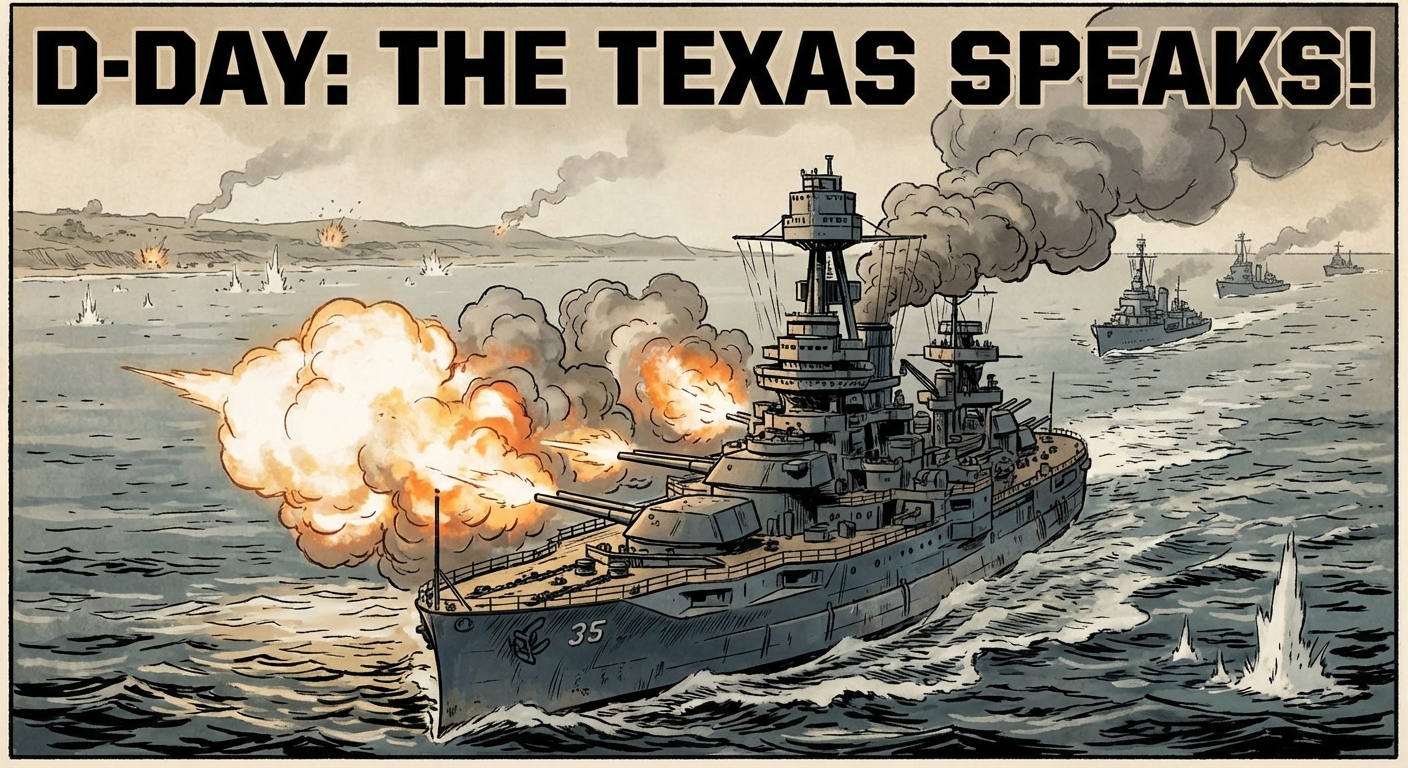
Allied naval bombardment at D-Day
#06Naval Firepower

Floating artillery vs fixed guns

Allied

Battleships, cruisers, and destroyers could shift fire as infantry reports came in.

German

Coastal batteries were dangerous, but known, fixed, and vulnerable to observation.

Allied edge. At Omaha, destroyers closing the beach became emergency artillery for pinned infantry.

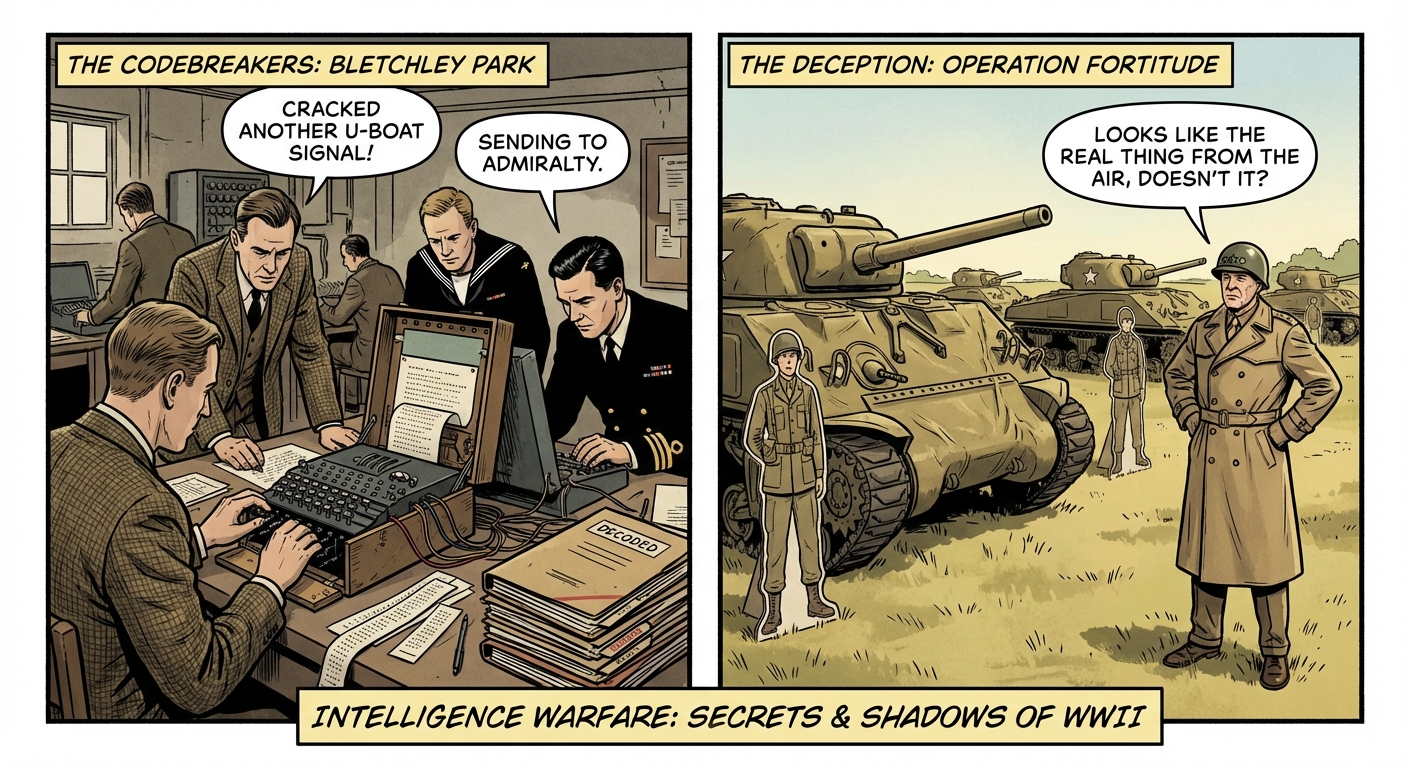
Ultra and Operation Fortitude deception
#07Intelligence

Fortitude vs compromised spies

Allied

Ultra, Double Cross, dummy formations, and fake radio traffic pointed German eyes at Calais.

German

Hitler and high command kept expecting the real blow somewhere else.

Allied edge. The deception campaign delayed the commitment of reserves when time mattered most.

Allied operations and logistics network
#08Logistics

Portable ports vs port denial

Allied

Mulberries, landing craft, beach groups, engineers, and trucks kept the lodgment alive.

German

The defense assumed the Allies needed a captured port quickly.

Allied edge. The Allies did not just land an army. They landed the machinery to feed one.

MG42 machine gun advantage
#09Machine Gun

MG42 vs Browning .30-cal

Allied

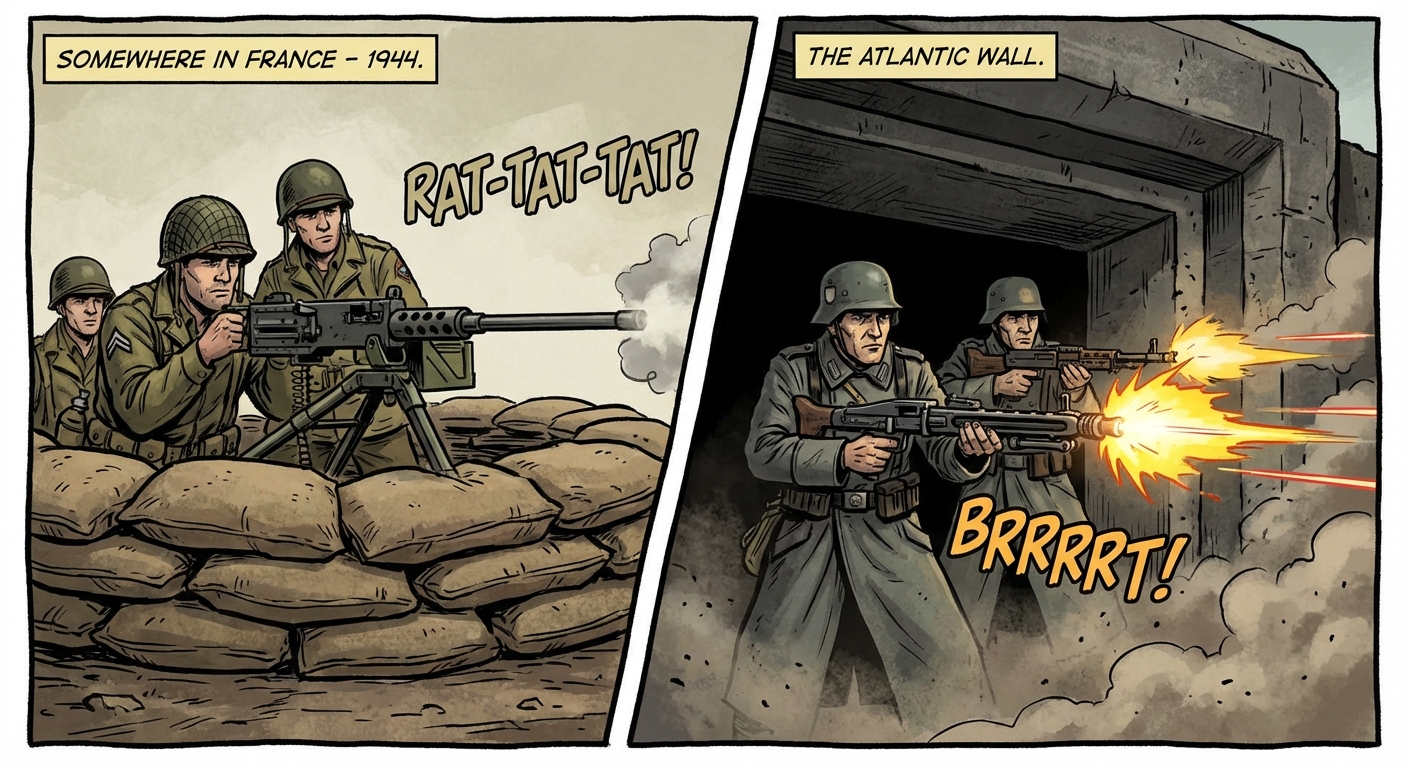
Reliable Brownings supported squads and vehicles with steady automatic fire.

German

The MG42 anchored German defensive positions with terrifying volume.

German edge. In bunkers and prepared fields of fire, the MG42 was one of the most lethal weapons on the beach.

Airborne assault and Rommel's asparagus defenses
#10Airborne

Airborne chaos vs anti-landing fields

Allied

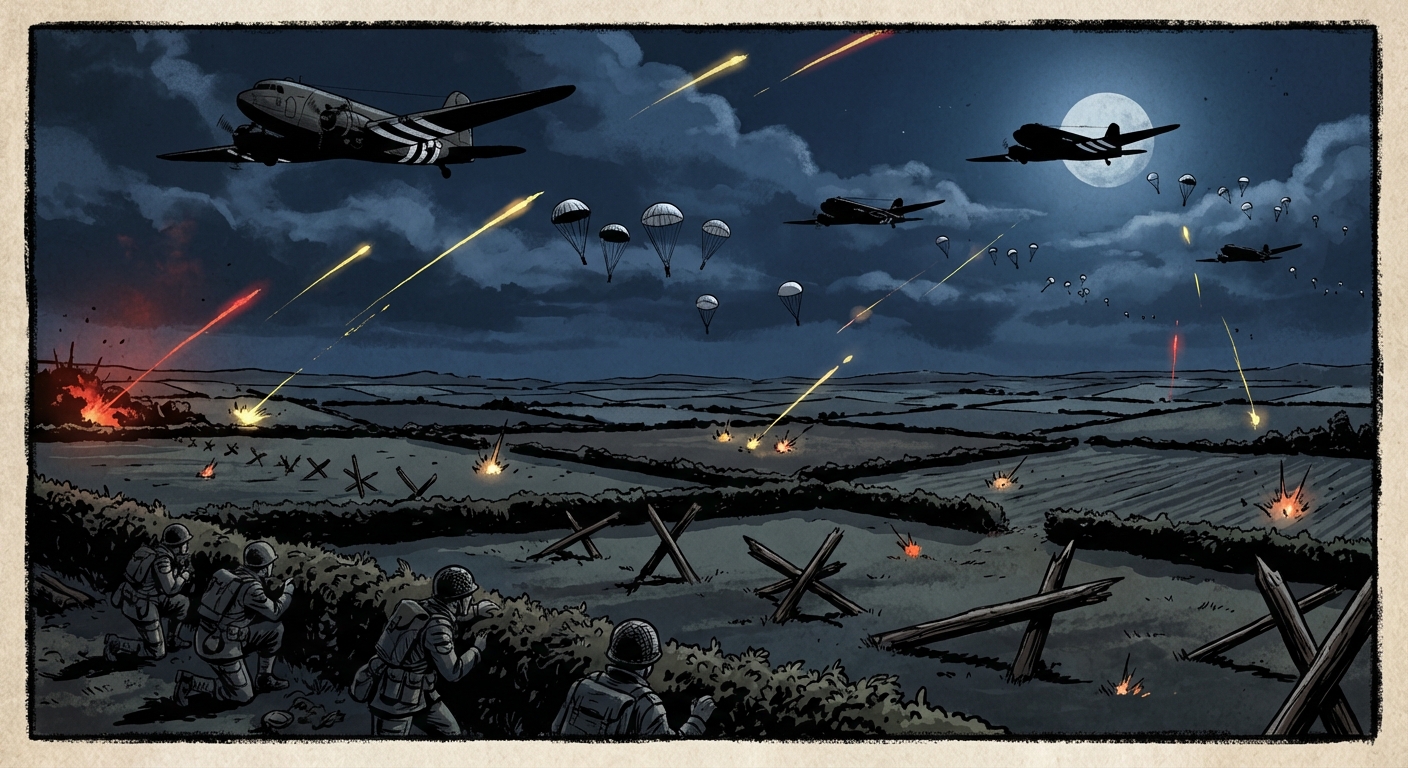
Paratroopers and gliders cut roads, seized crossings, and forced Germany to fight inland too.

German

Flooded fields, flak, and Rommelspargel made the drops costly and scattered.

Contested, Allied effect. The drops were messy, but the confusion helped paralyze the German response.

Final Assessment

The Germans had the killing ground. The Allies had the system that could survive it.

The Atlantic Wall, MG42s, mines, and artillery made the first hours brutal, especially at Omaha. But D-Day was designed so failure in one lane did not end the operation. Naval guns could shift. Engineers could clear. Aircraft could isolate roads. Airborne troops could hold crossings. Radios could move information. Landing craft could return with more men.

That was the edge: not one perfect weapon, but a connected force able to absorb chaos and keep pushing until the beachhead became irreversible.