GEORGE S. PATTON JR.
🌎 Origin Story
Cowabunga, dude. George Smith Patton Jr. was born in San Gabriel, California — a suburb of Los Angeles — on November 11, 1885. His family owned a 1,000-acre ranch in what's now San Marino. This wasn't some bootstrap story. The Pattons were loaded.
His maternal grandfather was the second Mayor of Los Angeles. His paternal grandfather was a Confederate colonel who got killed at the Battle of Winchester. His dad was the district attorney of LA County. His sister Nita was engaged to General John J. Pershing — the commander of all American forces in World War I.
Young George was tutored at home until age 11 because he had trouble reading and writing (likely dyslexia, though nobody called it that in 1896). But he devoured military history — Hannibal, Caesar, Napoleon, Joan of Arc. Family friend John Singleton Mosby, the legendary Confederate cavalry raider, used to stop by the house for dinner. That's the kind of childhood we're talking about.
🕶 The Look
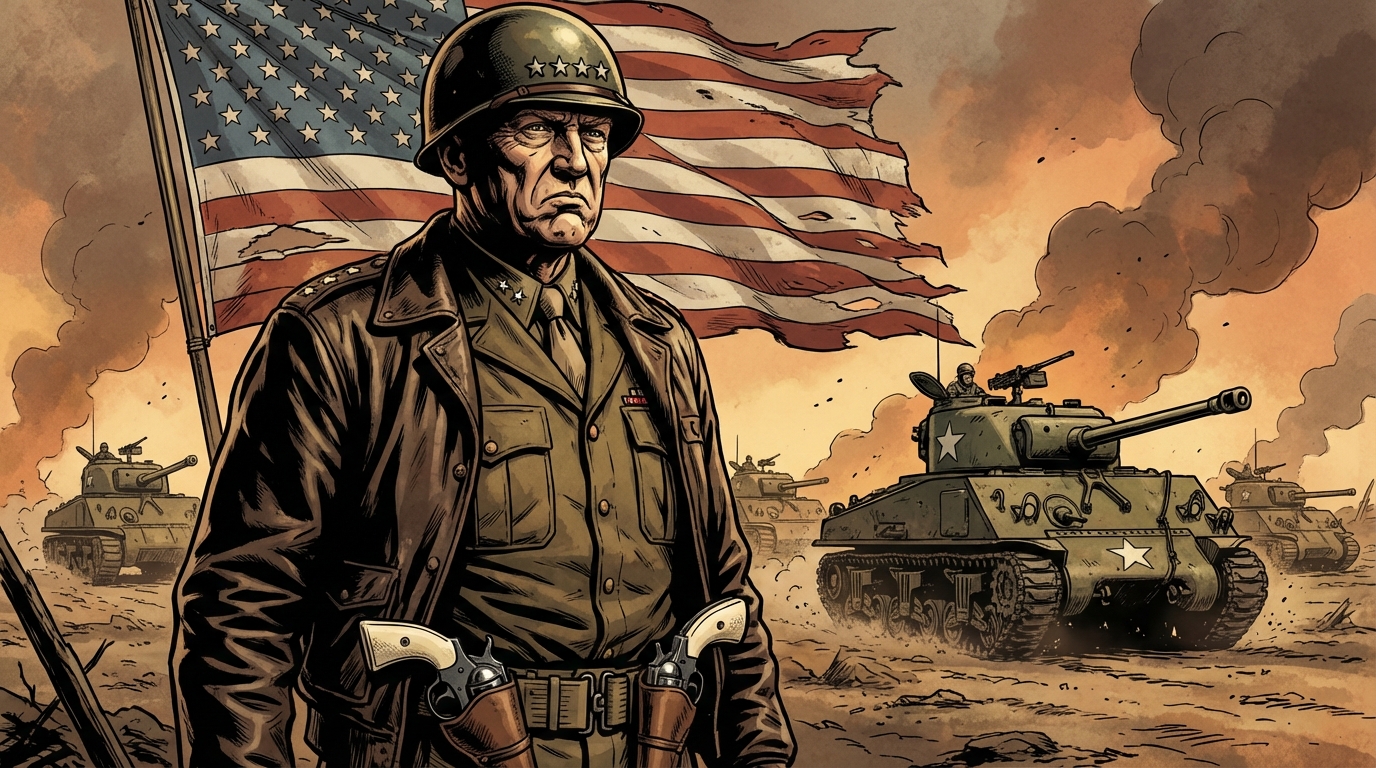
Let's talk about the pistols. Patton carried ivory-handled Colt Single Action Army revolvers. NOT pearl. He was very clear about this:
How'd he end up with ivory grips? Simple. Early in his career at Fort Bliss, he was carrying a standard-issue M1911 Colt .45 tucked in his belt (no holster, because Patton). One night in a saloon, it accidentally went off. After that, he switched to the ivory-handled single-action revolver. Fashion choice born from a negligent discharge. Classic Patton.
The rest of the look was just as deliberate: custom-tailored uniforms, riding boots and breeches, lacquered helmet liner with oversized stars, and a war face that could curdle milk at 50 yards. He also had a high-pitched voice and was self-conscious about it — which is why he developed that aggressive, profanity-laden speaking style. Overcompensation is a hell of a motivator.
⚔ Greatest Hit — The Bastogne Relief
December 1944. The Germans launch their last major offensive — the Battle of the Bulge. The 101st Airborne is surrounded at Bastogne. The situation is desperate.
Eisenhower calls a meeting. Everyone is somber. Patton walks in and says he can have three divisions attacking north within 48 hours. The room goes silent. What he's proposing — pivoting an entire army 90 degrees in the middle of winter while in contact with the enemy — is considered militarily impossible.
Patton does it in less than 48 hours. His Third Army, spearheaded by the 4th Armored Division, covers 100+ miles through a blizzard and attacks north. On December 26, they break through to Bastogne. The siege is over.
Military historians still study this maneuver. It required pre-planning three contingency plans before the meeting, switching corps-level supply lines overnight, and moving 133,000 men with their equipment in winter conditions. Patton had already anticipated the order and started planning days before Eisenhower called.
⚠ The Controversy
Where do we even start.
The Slapping Incidents (1943): During the Sicily campaign, Patton visited two evacuation hospitals and slapped soldiers suffering from battle fatigue (PTSD). He called them cowards, threatened to shoot one of them, and ordered both back to the front. Eisenhower privately lost his mind, forced Patton to apologize to every unit under his command, and benched him for 11 months. The press eventually found out and Congress nearly ended his career.
The Mule Incident: When two mules pulling a cart blocked a bridge during a German air attack, Patton shot both mules dead, then beat their Sicilian owner with a walking stick and had soldiers push the carcasses off the bridge. The column kept moving.
Task Force Baum: Patton secretly sent a task force behind enemy lines to liberate a POW camp — where his son-in-law happened to be imprisoned. The mission was a disaster. Most of the men were killed or captured. His superiors were furious.
He also held antisemitic views, made inflammatory statements about the Soviets while military governor of Bavaria, and was removed from command of the Third Army. He died in a car accident in Germany on December 21, 1945. He was 60.
📊 By The Numbers
💬 Legendary Quote
— Opening of his famous address to the Third Army, 1944
— Press conference, France, 1944 (when asked if he should slow the advance to reduce casualties)
🎉 Fun Facts
🏅 Olympic Athlete: Competed in the 1912 Stockholm Olympics in the modern pentathlon (shooting, swimming, fencing, riding, running). Finished 5th overall. He claimed the judges robbed him in the pistol event — said one of his .38 caliber shots went through a previous bullet hole and they scored it as a miss. Modern competitions now use moving backdrops to prevent exactly this.
⚔ Saber Designer: Designed the Model 1913 Cavalry Saber — officially known as the "Patton Saber." It's literally the U.S. Army's official sword. He was also the first officer designated "Master of the Sword" at Fort Riley.
🔀 Believed in Reincarnation: Patton was convinced he'd lived past lives as a soldier — a Roman legionnaire, a knight at the Battle of Crécy, a soldier under Napoleon. He wrote poems about it and would sometimes visit battlefields and claim to remember fighting there.
🐶 Willie the Bull Terrier: His dog Willie went everywhere with him in Europe. Willie reportedly outlived Patton and was sent home to the family after the general's death.
🚗 First Motorized Attack in US History: In 1916, hunting Pancho Villa in Mexico, Patton led 10 soldiers in three Dodge touring cars to attack a ranch. They killed three of Villa's men. It was the first time the US military used motor vehicles in combat. He was 30.
🎤 High-Pitched Voice: Patton had a surprisingly high voice and was deeply self-conscious about it. He developed his aggressive, profane speaking style specifically to compensate. It worked.
💔 His Sister's Fiancé: Patton's sister Nita was engaged to General John J. Pershing — the commander of all US forces in WWI. The engagement ended due to the war.
⚡ Failed Math at West Point: Had to repeat his entire first year after failing mathematics. Still graduated and became arguably the greatest combat commander in American history. Take that, math.
🏆 Legacy
The 1970 film "Patton" starring George C. Scott won 7 Academy Awards, including Best Picture. Scott famously refused the Oscar, calling the ceremony a "meat parade." Patton would have loved that.
His tactics are still taught at every military academy in the world. The Bastogne relief maneuver is considered one of the greatest feats of military logistics ever executed. His Third Army's insignia — a white "A" on a blue circle with red border — is still in active use.
Even his enemies respected him. The Germans considered Patton the most dangerous Allied commander. During Operation Fortitude (the D-Day deception), the Allies used Patton as a decoy — placing him in command of a fake army group in southeast England. The Germans were so convinced Patton would lead the real invasion that they held back reserves waiting for him even after Normandy had begun.
He's buried at the Luxembourg American Cemetery, among his soldiers. He once said he wanted to be buried with his men. He got his wish.
🔗 Connected Stories on This Site
All from the 4th Armored Division — Patton's spearhead in the Third Army:
The Mortar Man of Burnon TSgt Albertson, CCB — Dec 22, 1944 The Last Stand of Joe Sadowski Medal of Honor, 37th Tank Battalion — Sep 14, 1944 The Eyes of Patton Pvt DiBattista, 25th Cavalry Recon — Dec 22, 1944