A reluctant Tennessee soldier walked into a German machine-gun problem in the Argonne Forest and came out with one of the most famous Medal of Honor stories of the First World War.
DateOctober 8, 1918, during the Meuse-Argonne Offensive.
PlaceNear Chatel-Chehery in the Argonne Forest, France.
ResultYork's citation credits him with silencing machine guns and capturing 132 German soldiers.
Opening scene
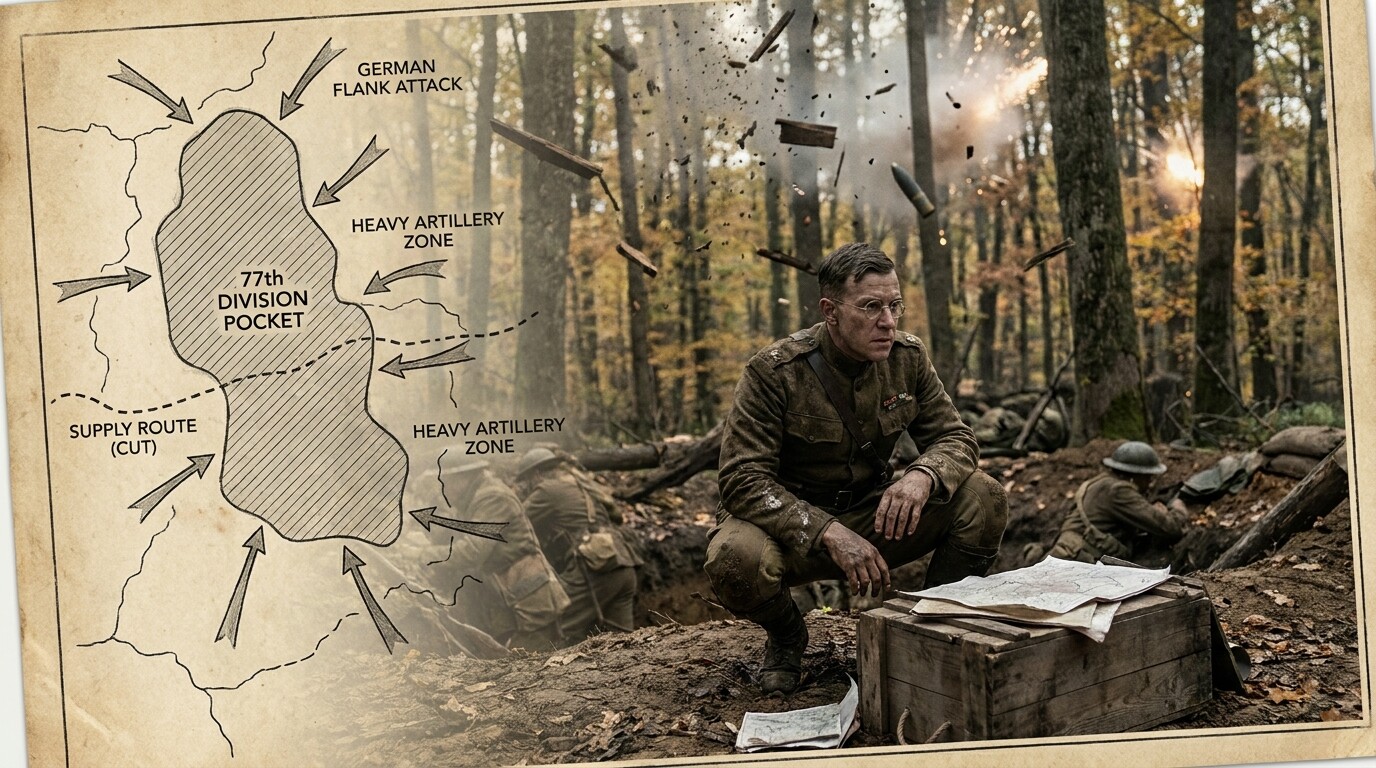
The Argonne was not a clean battlefield. It was hills, ravines, shattered woods, fog, machine-gun lanes, and units losing touch with one another inside terrain that swallowed maps.
Alvin C. York entered the war with a conscience shaped by rural Tennessee, church, hunting, poverty, and a serious struggle over whether he could kill at all. On October 8, 1918, that private struggle met a public crisis: a small American group behind German lines, officers and noncommissioned officers falling, machine guns firing from above, and prisoners who could turn back into enemies if the Americans lost control.
The popular version makes York look inevitable. The real story is better. He was one soldier in a broken tactical moment, using calm, marksmanship, judgment, and nerve while the situation kept getting worse.
Battlefield
A Ravine Under Machine Guns
The terrain problem. York's action was not a duel in an open field. It was broken movement through woods, slopes, and German machine-gun positions.
The larger offensive
America's Biggest Fight of the War
The York story sits inside the Meuse-Argonne Offensive, the largest American operation of the First World War. The offensive began on September 26, 1918, and pushed through a German defensive system that had been strengthened over years. It was not one clean charge. It was a grinding campaign of forest fighting, artillery, traffic jams, lost units, exhausted infantry, and machine-gun positions that could turn a small patch of ground into a killing zone.
The American Expeditionary Forces were still learning how to fight at this scale. Fresh divisions brought energy and numbers, but not always experience. Communications failed. Maps were imperfect. Units outran support or drifted sideways in wooded terrain. Men who had trained for open movement found themselves inside ravines and thickets where a machine gun could dominate an entire slope.
That matters because York's action was not isolated from the war around him. It was a miniature version of the Meuse-Argonne problem: Americans trying to advance through terrain organized by German firepower.
The man before the medal
Conscience, Hunting, and the Draft
Alvin York was born in Pall Mall, Tennessee, in 1887. His prewar life was rural, hard, and local. He hunted, worked, drank in his younger years, and then underwent a religious conversion that changed the way he understood violence. That is why his draft story matters. York did not enter the Army as a man eager to kill. He struggled with whether a Christian could take life in war.
He sought recognition as a conscientious objector, but his case did not remove him from service. Officers and chaplains talked with him. York studied scripture and wrestled with duty. Later memory can make this sound like a neat transformation, but the more honest version is slower and more human: he did not stop caring about the moral problem. He decided he could serve.
That decision gives the battlefield moment its tension. York's skill with firearms came from the hills of Tennessee. His reluctance came from faith. The Argonne forced both into the same minute.
The story
When the Attack Went Sideways
York's battalion was part of the huge American push in the Meuse-Argonne. The goal was to break through German defenses, but the forest and ridges made coordination brutal. Units drifted. Machine guns held angles. Men were pinned before they understood where the fire was coming from.
A group from York's unit worked around the German positions and captured prisoners, but then German machine guns opened fire from above. Several Americans were killed or wounded. Command in the little group collapsed toward York and the surviving men. They had prisoners in hand, enemy guns still firing, and no clean way out.
York's Medal of Honor citation describes him taking command after his platoon suffered heavy casualties, silencing machine guns, and capturing a large number of Germans. Later retellings add details about pistol shots, rifle fire, and York calling on German soldiers to surrender. The essential point is steady: a small American group was in grave danger and York's action broke the German position.
York did not beat the Argonne. He solved one deadly knot inside it.
That distinction matters. Hero stories can accidentally shrink war into one man. The better version keeps both truths alive: the Argonne was enormous and horrifying, and one soldier's decisions still mattered inside it.
Battle video
York Under the Guns
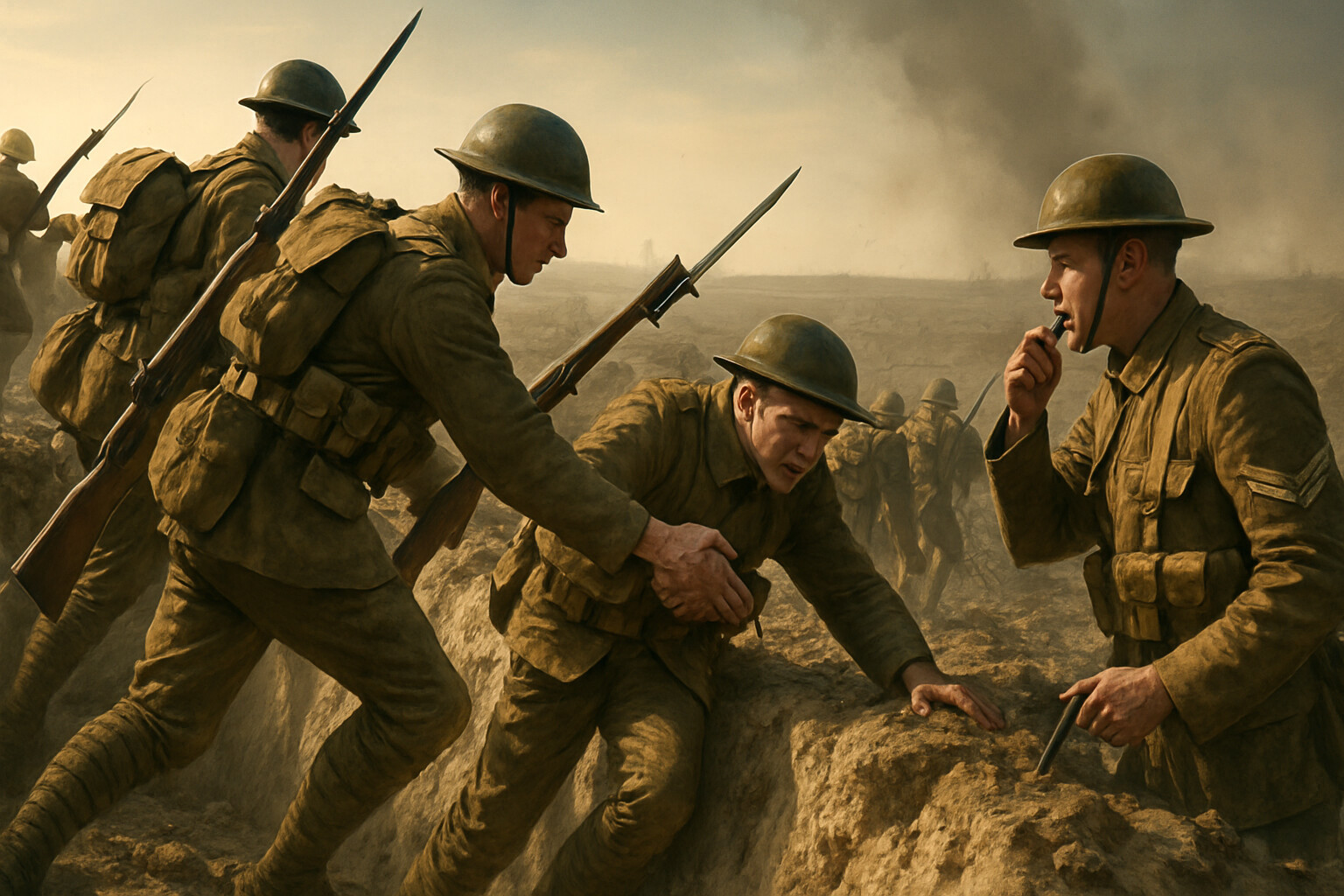
Control under pressure. York on the wooded slope, German machine guns above, American soldiers pinned behind him, and the fight balanced on seconds.
Inside the fight
The Prisoners Were Part of the Danger
One reason the York action is hard to picture is that the Americans were not simply shooting forward. They had already taken German prisoners. That created an unstable battlefield problem. Prisoners could be useful because they represented success and could be moved back to American lines. But prisoners also required control. If the Americans became pinned, scattered, or killed, those prisoners could run, resist, or rejoin the fight.
When the German machine guns opened from higher ground, York's group was exposed in two directions at once: enemy fire from the slope and enemy manpower already around them. Several Americans went down. The surviving group had to keep the prisoners under control while also stopping the guns that were cutting into them.
York later described working deliberately from cover, firing at exposed German gunners when they tried to swing weapons against him. The Medal of Honor citation is more compressed, but it captures the core: after heavy casualties among his platoon, York assumed command, attacked machine-gun positions, and forced the surrender of a large body of enemy soldiers.
The action was not a movie duel where everyone politely waited their turn. It was a collapsing tactical situation. York's calm mattered because panic would have broken the fragile control the Americans still had.
Why the machine guns mattered
A Weapon That Changed Infantry Courage
The German guns York faced were part of the reason World War I became a firepower war. A machine gun could cover a ravine, trail, field edge, or tree line with a density of fire that made traditional movement nearly impossible. Courage still mattered, but courage no longer solved the problem by itself.
To move against machine guns, soldiers needed artillery, smoke, flanking movement, terrain, suppressive fire, or luck. York's patrol had accidentally created a flanking opportunity by getting behind German lines, but that opportunity nearly collapsed when the guns found them. His marksmanship turned the accident into a tactical reversal.
That is why this page belongs with the site's weapons and battlefield stories as much as its people stories. York's heroism cannot be separated from the machine-gun age. He became famous because he survived, understood, and exploited a brief opening inside a weapon system designed to leave no opening at all.
Before the fight
The Reluctant Soldier
York's backstory is essential because it gives the action weight. He was a skilled marksman from the Tennessee mountains, but he also belonged to a religious world that forced him to wrestle with killing. He sought exemption as a conscientious objector, then went through a process of discussion and reflection that led him to serve.
That tension followed him into the story. The man who became famous for combat had not treated violence casually. His reputation later became almost mythic, but the conflict at the center of his life makes the story more human: obedience, conscience, country, and survival colliding in one morning in France.
After the action
How a Battlefield Event Became an American Legend
York's fame did not come only from the numbers in the citation. It came from the combination: a rural Tennessee marksman, a man of conscience, a terrible machine-gun fight, a large prisoner column, and a war-weary country looking for a story that could be understood at human scale.
The First World War was often too large to hold in the mind. Artillery barrages, casualty lists, trench maps, and offensives with unfamiliar French names did not easily become personal memory. York gave Americans a face and a story: one man in the Argonne who did what needed doing when the chain of command broke around him.
That fame also creates a responsibility for the page. The goal is not to sand off every heroic edge. York did something extraordinary. The goal is to keep the frame wide enough to see the other men, the terrain, the machine guns, the prisoners, and the larger offensive that made the moment possible.
Aftermath
The Long Walk Back
The result. York's citation credits the action with the capture of 132 German soldiers. The number matters less than the tactical shock: a collapsing patrol turned into a prisoner column.
Equipment plate
York's Infantry World
Tools, not magic. The story is often told around marksmanship, but the kit shows the world York fought inside: rifle, pistol, helmet, gas mask bag, belt, mud, and leaves.
Risk ledger
Why York's Action Stuck
Machine gunsThe action sits at the center of the WWI firepower problem.
Command shockCasualties forced surviving soldiers to make decisions without clean structure.
Prisoner controlCaptured Germans could become a danger if the Americans lost control.
MarksmanshipYork's hunting background helped, but calm mattered just as much.
ConscienceHis moral struggle made the action nationally compelling.
Myth pressureThe story became famous enough that careful framing matters.
Timeline
From Tennessee to the Argonne
1887Alvin Cullum York is born in Pall Mall, Tennessee.
1917After the United States enters World War I, York is drafted and wrestles with military service.
1918York serves with Company G, 328th Infantry, 82nd Division in France.
Oct 8Near Chatel-Chehery, York's action against German machine guns leads to a large prisoner capture.
1919York receives the Medal of Honor and becomes one of America's best-known WWI soldiers.
Careful history
What We Should Not Flatten
York's story is famous, and famous stories attract legend. The page keeps the core facts tied to the Medal of Honor citation and major public-history sources: date, unit, place, machine-gun action, and prisoner capture. It also avoids pretending York won the Argonne alone. He acted inside a larger offensive, with other American soldiers in the fight and a battlefield shaped by artillery, terrain, and machine guns.
Source basis
References Used
Built from public-source references on York's Medal of Honor action, the 82nd Division, the Meuse-Argonne Offensive, and the geography around Chatel-Chehery.