← All Stories

Battle off Samar - October 25, 1944

Against Battleships

USS Johnston was a destroyer. The force coming over the horizon had battleships, heavy cruisers, and the largest guns ever mounted at sea. Commander Ernest E. Evans turned toward them anyway.

DD-557USS Johnston, Fletcher-class destroyer, commissioned October 1943.
Taffy 3Escort carriers, destroyers, and destroyer escorts supporting the Leyte landings.
Center ForceJapanese battleships and cruisers, including Yamato, appeared off Samar.
Medal of HonorCommander Ernest E. Evans received the Medal of Honor posthumously.

USS Johnston DD-557

Johnston was a Fletcher-class destroyer: fast, aggressive, and useful for screening carriers, fighting aircraft, hunting submarines, laying smoke, and making torpedo attacks. She was not built to trade gunfire with battleships and heavy cruisers. At Samar, that was exactly the fight she entered.

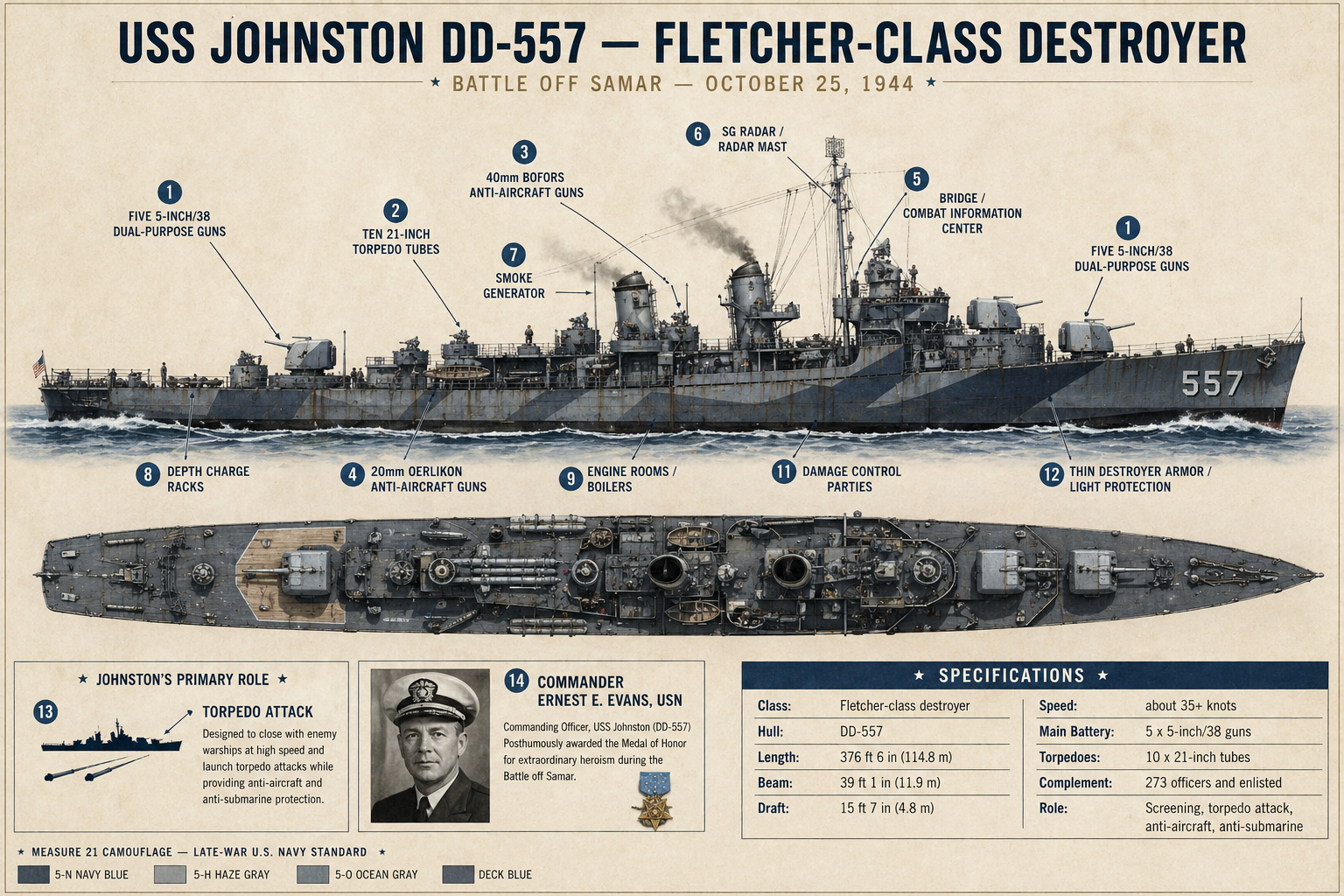
USS Johnston Fletcher-class destroyer technical diagram
USS Johnston as a Fletcher-class destroyer: five 5-inch guns, torpedo tubes, anti-aircraft weapons, radar, smoke gear, damage-control spaces, light protection, and Commander Ernest E. Evans as the human center of the story.

Taffy 3 Against The Japanese Center Force

The Battle off Samar was a collision of mismatched forces. Taffy 3's escort carriers were slow and lightly protected. Their escorts were small. The Japanese Center Force had battleships and cruisers that should have crushed them in a surface action. Smoke, rain, aircraft attacks, and suicidal aggression changed the geometry of the fight.

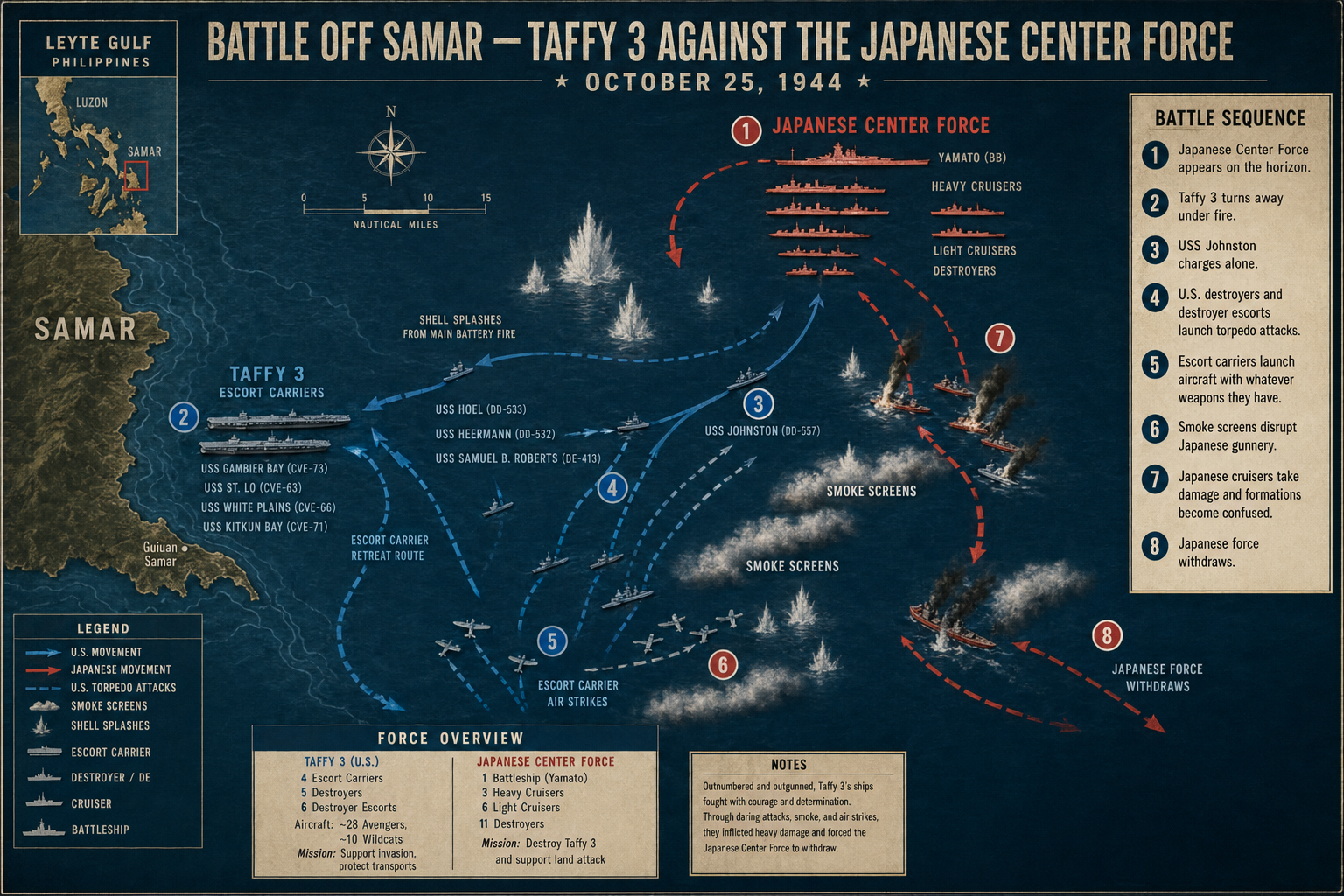
Battle off Samar tactical map
Tactical map of Taffy 3's retreat, Johnston's charge, destroyer torpedo attacks, smoke screens, escort carrier aircraft, damage to Japanese ships, and the Japanese withdrawal.

Turn Toward The Enemy

At dawn on October 25, 1944, the small escort carrier group known as Taffy 3 found itself staring at the Japanese Center Force. The larger U.S. fleet was elsewhere. The carriers were not fleet carriers; they were escort carriers supporting the Leyte invasion, with thin decks and limited speed.

Commander Ernest E. Evans did not wait for perfect orders. Johnston turned out of formation and attacked. The destroyer laid smoke, opened fire, and drove toward ships that outclassed her in armor, range, and shell weight. Her torpedoes helped force the Japanese line to maneuver. Her 5-inch guns kept firing into cruisers where they could hurt sensors, topside crews, and exposed equipment.

Other destroyers and destroyer escorts joined the attack. Aircraft from the escort carriers launched with whatever they had: bombs, depth charges, machine guns, or sometimes empty runs meant to distract. The fight became confusion: smoke screens, rain squalls, torpedo warnings, splashes, burning ships, and small American vessels closing where they had no right to survive.

Johnston was hit again and again. Evans was wounded. The ship lost speed, power, and eventually the ability to escape. Yet Johnston continued to fight until she was disabled and sinking. Survivors remembered Japanese sailors saluting as the destroyer went down.

The sacrifice helped buy Taffy 3 the one thing it needed: time. The Japanese force withdrew. Johnston did not win by destroying the enemy fleet. She helped disorder it, delay it, and convince it that the cost of pressing on was higher than it looked.
How Johnston Changed The Fight

1. SightedJapanese Center Force appears on the horizon off Samar.
2. Taffy 3 TurnsEscort carriers flee while launching aircraft and making smoke.
3. Johnston ChargesEvans attacks before the enemy can settle into an easy gunnery problem.
4. TorpedoesDestroyer attacks force Japanese ships to turn away and break formation.
5. ConfusionSmoke, weather, aircraft, and close attacks distort Japanese assessment of the force.
6. WithdrawalThe Japanese force turns away, sparing the Leyte invasion fleet from disaster.

Why Samar Was Insane

The surface comparison is almost absurd: destroyers and destroyer escorts against heavy cruisers and battleships. But naval combat is not only tonnage. Smoke, air attacks, torpedo tracks, rain, bad information, and aggressive timing can make a superior force hesitate.

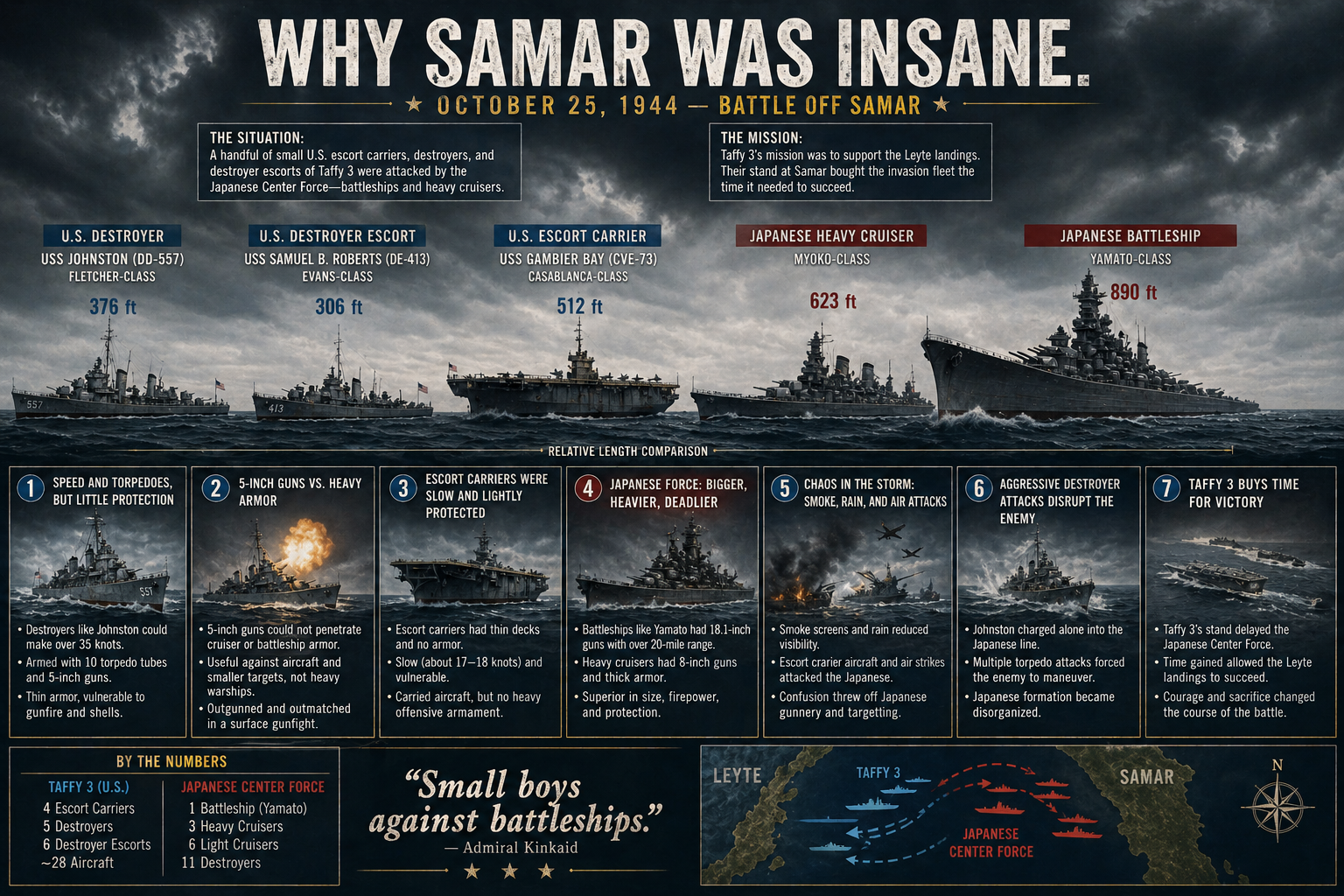
Why Samar was insane scale and tactical breakdown
Scale and tactical breakdown of the mismatch: Johnston and the other small escorts had speed, torpedoes, smoke, and courage, while the Japanese force had size, armor, and enormous guns.

Small Boys Against Battleships

Samar is remembered because it shows naval courage at an impossible scale. Johnston, Hoel, Heermann, Samuel B. Roberts, and the escort carriers did not have the ships they would have chosen for that fight. They had the ships they were on, and they used them with almost reckless clarity.

For USS Johnston, the story ends with the ship sinking and Evans missing. For Taffy 3, it ends with survival. For the Leyte invasion force, it ends with disaster avoided by men who attacked ships they had no business attacking.

Reference checks used Naval History and Heritage Command material on USS Johnston, Commander Ernest E. Evans, and the Battle off Samar, plus Navy and museum summaries of Taffy 3's action.

NHHC - USS JohnstonNHHC - Battle off SamarCongressional Medal of Honor Society - Ernest E. Evans