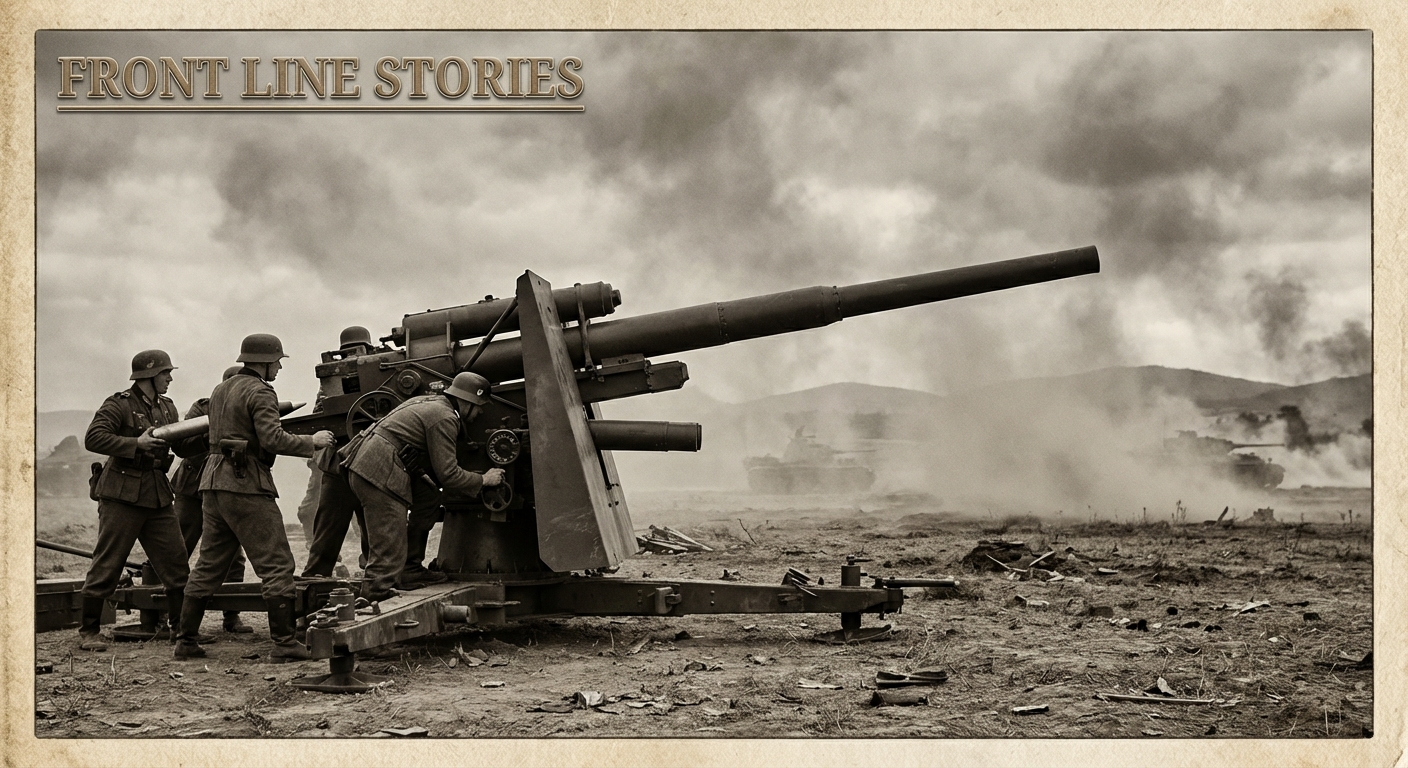
Part anti-aircraft gun, part anti-tank terror, part legend polished by propaganda and memory, the German 88 became one of the war's most feared heavy weapons.
Era
Interwar through Second World War
Origin
Germany
Role
Heavy anti-aircraft and anti-tank gun family
At a glance
The weapon in one hard look
The German 88 was never a single magical gun. It was a family of weapons and mountings, but the nickname became shorthand for a battlefield fact, if an 88 had line of sight and a prepared crew, it could ruin your day from very far away.
Its fame came first from anti-aircraft work, then from the shock of seeing a high-velocity Flak gun kill tanks that thought themselves safely outside the reach of ordinary anti-tank pieces. In North Africa, Russia, Italy, and Normandy, that combination made a lasting impression.
Core specs
Caliber88 mm
Key variantsFlak 18, 36, 37, 41 and related KwK guns
Primary rolesAnti-aircraft, anti-tank, field artillery
WeightSeveral tons depending on mount
Field details
Muzzle velocityHigh, especially with anti-tank ammunition
Effective AA altitudeSubstantial for its era
AT strengthExcellent long-range penetration
CrewLarge, trained detachments required
Design logic
Why an AA gun became a tank killer
High-altitude anti-aircraft work demanded velocity, reach, and strong optics, and those same traits translated uncannily well into anti-tank warfare. When German crews brought 88 mm Flak guns down to the horizontal, they possessed a weapon that could smash armor at ranges many tankers considered unreal.
This was especially dramatic early in the war, when Allied armor and doctrine were not prepared for such engagements. The gun's ballistic performance, combined with good fire control and disciplined crews, let it dominate open approaches.
But versatility always came with cost. Towing, emplacing, camouflaging, and supplying these guns was not trivial, and once spotted they drew enormous attention.
Battlefield use
From the sky over Germany to the sands of Africa
The 88 earned early anti-tank fame in the Western Desert, where wide open terrain let Flak guns engage British armor at long range. Erwin Rommel's forces used them aggressively, sometimes as part of improvised anti-tank screens that startled advancing tanks.
On the Eastern Front the story continued, though scale, weather, and Soviet firepower complicated the legend. In defensive belts and prepared positions, 88s could still be devastating, but moving and protecting them against artillery and air attack was harder than folklore suggests.
Later, dedicated anti-tank guns and tank-mounted 88 mm weapons, like those on the Tiger, expanded the legend further. By then the number itself had become a kind of warning label.
Myth and reality
The legend is true, but not simple
Popular history sometimes treats the 88 as if it alone won tank battles. It did not. Mines, maneuver, radios, optics, combined arms, and crew quality mattered just as much. The gun was formidable, but only as part of a broader tactical picture.
There also was no single universal 88 in every context. Flak variants, Pak variants, and tank guns differed in mounting, equipment, and tactical use. Lumping them all together is convenient storytelling, but it blurs how each actually fought.
Still, the reputation was earned. Against aircraft, armor, or distant strongpoints, the German 88 gave crews a sense that they could reach across the battlefield and strike first.
Legacy
A number that became a legend
The German 88 entered popular memory because it crossed categories. It was an air-defense gun, a tank killer, a confidence weapon, and eventually a propaganda asset. Soldiers remembered it because they could feel its reach before they ever saw the gun itself.
Its real historical importance lies in versatility. It showed how a weapon designed for one role could transform another, provided crews, optics, doctrine, and terrain all aligned.
The 88 mattered because it made range itself feel like a German weapon, turning distance into threat long before many enemies believed they were in danger.
Further reading
Where to go next
For readers who want to go beyond legend and into production files, after-action reports, training manuals, and soldier memoirs, these are the most rewarding paths.
Technical histories of the Flak 18/36/37/41 family and German fire-control systems.
North Africa campaign studies focusing on anti-tank gun employment.
Tank memoirs and after-action reports describing first contact with 88 mm fire.
Research separating towed Flak guns from dedicated Pak and tank-mounted 88 mm systems.