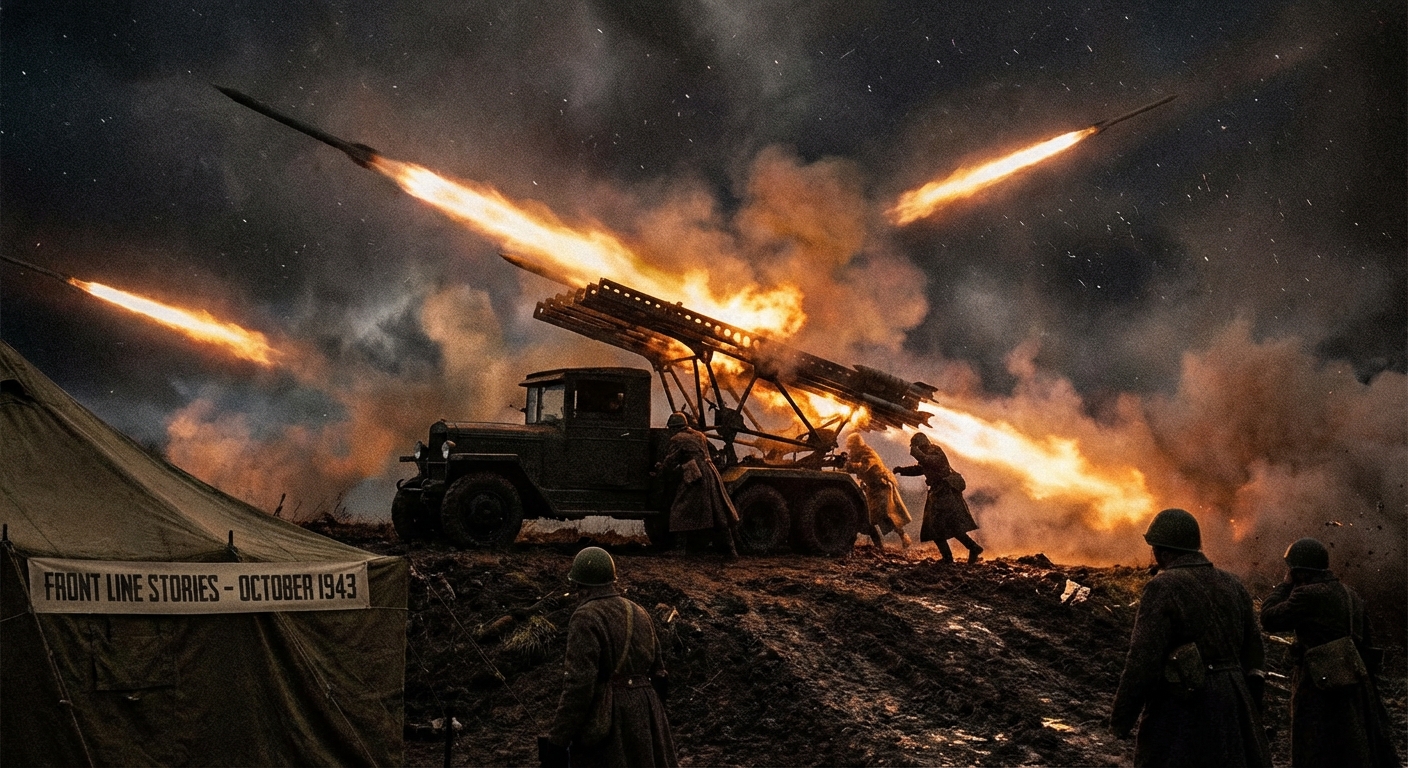
Crude in one sense and psychologically devastating in another, the Soviet Katyusha was less about pinpoint gunnery than about saturating an area with shock, noise, and sudden destruction.
Era
Second World War
Origin
Soviet Union
Role
Truck-mounted multiple rocket launcher
At a glance
The weapon in one hard look
The Katyusha was one of the war's great instruments of battlefield shock. A battery could arrive, unleash a screaming salvo in seconds, and vanish before counter-battery fire fully woke up. What it lacked in precision it compensated for with terror, tempo, and concentration.
Soviet commanders used it to smash assembly areas, suppress defenses, and open attacks with an overwhelming sense of momentum. Troops on the receiving end remembered the sound first, then the helplessness of being under an area weapon designed to make whole patches of ground unlivable.
Core specs
CaliberVaried by rocket family, commonly 82 mm, 132 mm, and larger
Launch platformTruck-mounted rails and frames
RoleArea saturation bombardment
RangeSeveral kilometers depending on rocket type
Field details
Reload timeSignificant compared with firing time
AccuracyPoor individually, effective in salvos
CrewSmall launch crew supported by logistics elements
SignatureExtreme noise and sudden massed blast effect
Design logic
Artillery by saturation instead of precision
The Katyusha reflected a very different theory of firepower from conventional tube artillery. Instead of placing a smaller number of shells precisely, rocket launchers hurled many warheads in a short burst across a broader area. That made them ideal for shocking concentrations of troops, disrupting movement, and battering morale.
Mounted on trucks, the launchers were mobile enough to practice shoot-and-scoot tactics before the phrase became fashionable. Crews could fire quickly and reposition, reducing vulnerability to return fire.
The tradeoff was obvious. Rockets were less accurate, reloads were laborious, and ammunition handling demanded planning. The Katyusha was a hammer, not a rapier.
Battlefield use
The Red Army's voice of thunder
Katyusha regiments were used to prepare offensives, support breakthroughs, and saturate suspected enemy concentrations. In the opening moments of an attack, the sudden arrival of dozens or hundreds of rockets could collapse nerve, sever communications, and scatter troops before infantry and armor moved in.
At Stalingrad, Kursk, Operation Bagration, and the final offensives into Germany, rocket artillery became part of the Soviet way of war, an expression of mass and tempo directed against defended depth.
The weapon also had practical operational value. Compared with heavy gun batteries, launchers could be dispersed, hidden, and redeployed with impressive speed, provided roads and fuel existed.
Myth and reality
A terror weapon, but not a miracle weapon
Katyushas are sometimes remembered as unstoppable super-weapons. In reality they were highly effective only within a system that could locate targets, stockpile rockets, synchronize salvos, and exploit the chaos they created. Without that, they were noisy waste.
They also did not replace tube artillery. Guns remained essential for sustained fire, counter-battery work, and precise support. Rockets were the violent opening chord, not the entire symphony.
Yet for morale and operational punch, few weapons matched them. A well-timed salvo could make an entire front section feel as if the sky had ripped open.
Legacy
The ancestor of modern rocket artillery shock
The Katyusha helped establish a template that still feels modern, massed rockets, brief exposure, rapid displacement, and an emphasis on saturating zones rather than threading individual rounds through tiny targets.
It also demonstrated that battlefield fear can be engineered. The shriek, flame, smoke, and suddenness were all part of the weapon's effect. Even when casualties were uneven, cohesion suffered.
The Katyusha mattered because it weaponized shock at operational scale, making time, noise, and area effect work together as one terrifying event.
Further reading
Where to go next
For readers who want to go beyond legend and into production files, after-action reports, training manuals, and soldier memoirs, these are the most rewarding paths.
Soviet artillery studies on Guards mortar units and rocket doctrine.
Operational histories of Stalingrad, Kursk, and Bagration that describe preparatory fires.
Comparative works on tube artillery versus rocket artillery in Second World War service.
Postwar doctrine tracing the line from Katyusha batteries to modern MLRS concepts.