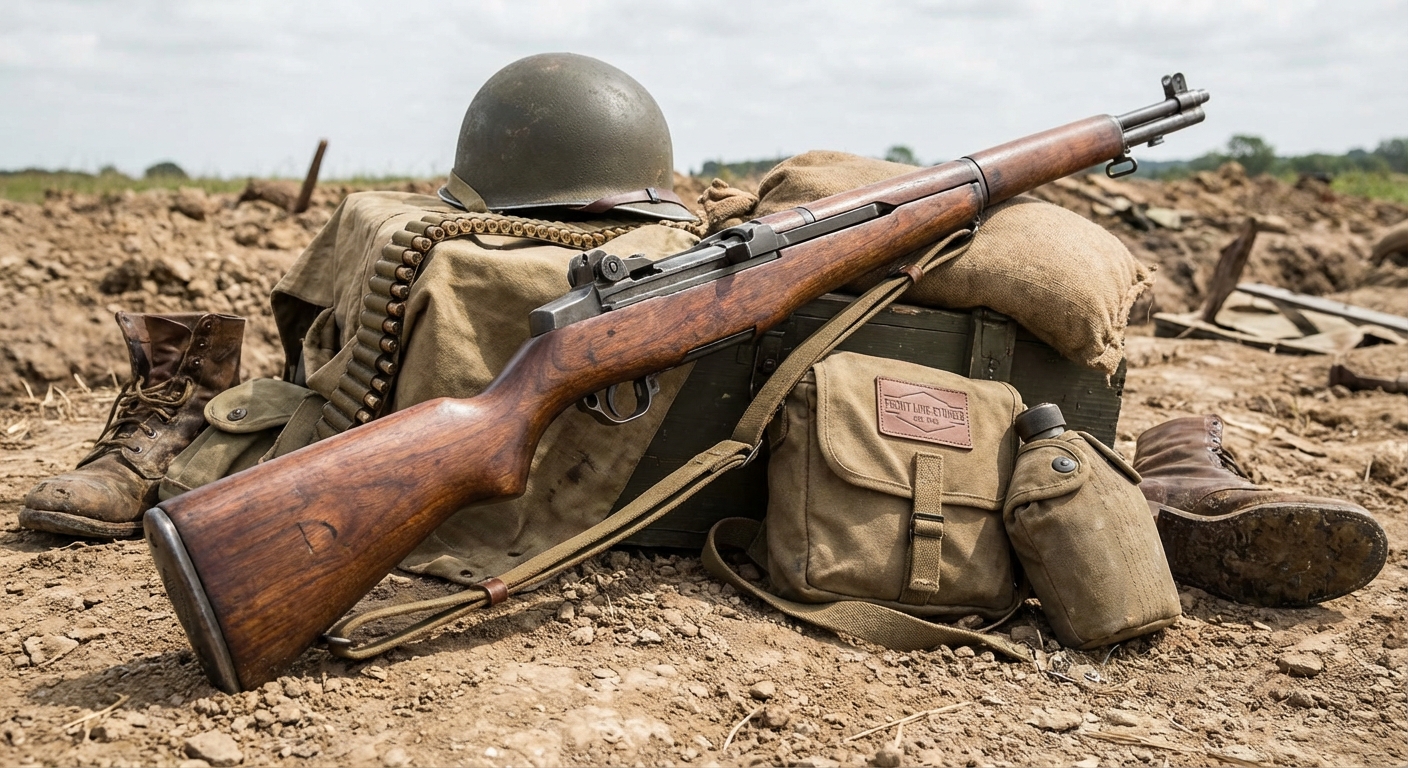
Reliable, heavy, and wonderfully decisive in practiced hands, the M1 Garand gave American infantry a level of self-loading firepower most enemies could not match.
Era
Second World War and Korea
Origin
United States
Role
Semi-automatic battle rifle
At a glance
The weapon in one hard look
The M1 Garand gave U.S. infantry something quietly revolutionary, a standard-issue semi-automatic rifle rugged enough for mud, cold, and hard marching. Against opponents still armed mostly with bolt-actions, that mattered every time a firefight became fast, confused, and close.
It was not a light carbine and it was not a spray weapon. The Garand rewarded deliberate marksmanship, confident handling, and squads trained to keep pressure on the enemy while moving. In Europe and the Pacific, that translated into tempo, and tempo saves lives.
Core specs
Caliber.30-06 Springfield
OperationGas-operated, rotating bolt
Feed8-round en bloc clip
WeightApprox. 4.3 kg unloaded
Field details
Barrel length24 in / 610 mm
Effective range500 m point targets, farther in skilled hands
SightsRobust aperture rear sight
ProductionMore than 5 million built
Design logic
A self-loader for a mass army
John C. Garand's rifle took a concept many armies still treated cautiously and made it standard. The U.S. Army wanted a rifle ordinary soldiers could maintain, shoot well, and trust under campaigning conditions. The answer was a gas-operated mechanism with a strong rotating bolt and superb peep sights.
The famous en bloc clip was a compromise. It simplified loading under field conditions and supported quick replenishment, but it also locked the rifle into eight-round increments. The system worked, yet every veteran understood its little inconveniences, from topping off limitations to the awkward timing of reloads under stress.
Still, once the rifle was in action, its strengths were obvious. A trained rifleman could fire accurate shots quickly enough to overwhelm opponents expecting the slower rhythm of bolt-action combat.
Battlefield use
The American rifle at squad level
In U.S. service the Garand was part of a combined small-arms ecosystem that included BARs, carbines, submachine guns, grenades, and machine guns. But the ordinary infantryman with a Garand still carried a serious share of the squad's lethality.
In hedgerow fighting, town assaults, or forest encounters, the ability to send accurate repeat shots without working a bolt kept Americans aggressive. The rifle was equally at home on Korean ridgelines, where disciplined fires and durable winterized kit mattered more than glamour.
Marine and Army veterans alike often remembered the Garand for its confidence factor. It kicked hard, yes, but it aimed naturally, held zero, and kept working when a lesser rifle would start feeling fragile.
Myth and reality
More than the famous ping
The so-called clip ping is one of the most repeated Garand stories. The sound is real, but the legend that enemies routinely used it to rush empty rifles is mostly campfire inflation. In actual combat, distance, noise, terrain, and multiple rifles made that far less deterministic than storytelling suggests.
The Garand also is sometimes portrayed as a perfect rifle. It was not. It was long for jungle or house fighting, heavy for exhausted troops, and less flexible to reload than detachable box-magazine rifles. Yet judged in the context of the 1940s, it was one of the most effective standard service rifles on earth.
That is why General Patton called it the greatest battle implement ever devised. Hyperbole, certainly, but not empty hyperbole. The rifle shifted the ordinary infantryman's odds in a meaningful way.
Legacy
The rifle that bridged eras
The M1 Garand stood at the hinge point between the old world of manually operated rifles and the later world of detachable-magazine battle rifles and assault rifles. It kept the reach and authority of a classic infantry arm while proving that self-loading service rifles could be produced and fielded at gigantic scale.
Its descendants did not copy it exactly, but they inherited its lesson. If the average rifleman can fire accurate shots faster without sacrificing reliability, doctrine changes, training changes, and the shape of a firefight changes with it.
The M1 Garand mattered because it gave a mass conscript army a marksman's cadence without asking every soldier to be a specialist.
Further reading
Where to go next
For readers who want to go beyond legend and into production files, after-action reports, training manuals, and soldier memoirs, these are the most rewarding paths.
U.S. Army technical manuals and ordnance reports on the M1 rifle.
Front-line memoirs from Europe, the Pacific, and Korea that discuss handling and trust in the field.
Comparative studies of Second World War service rifles and squad firepower.
Springfield Armory histories on Garand development and production.