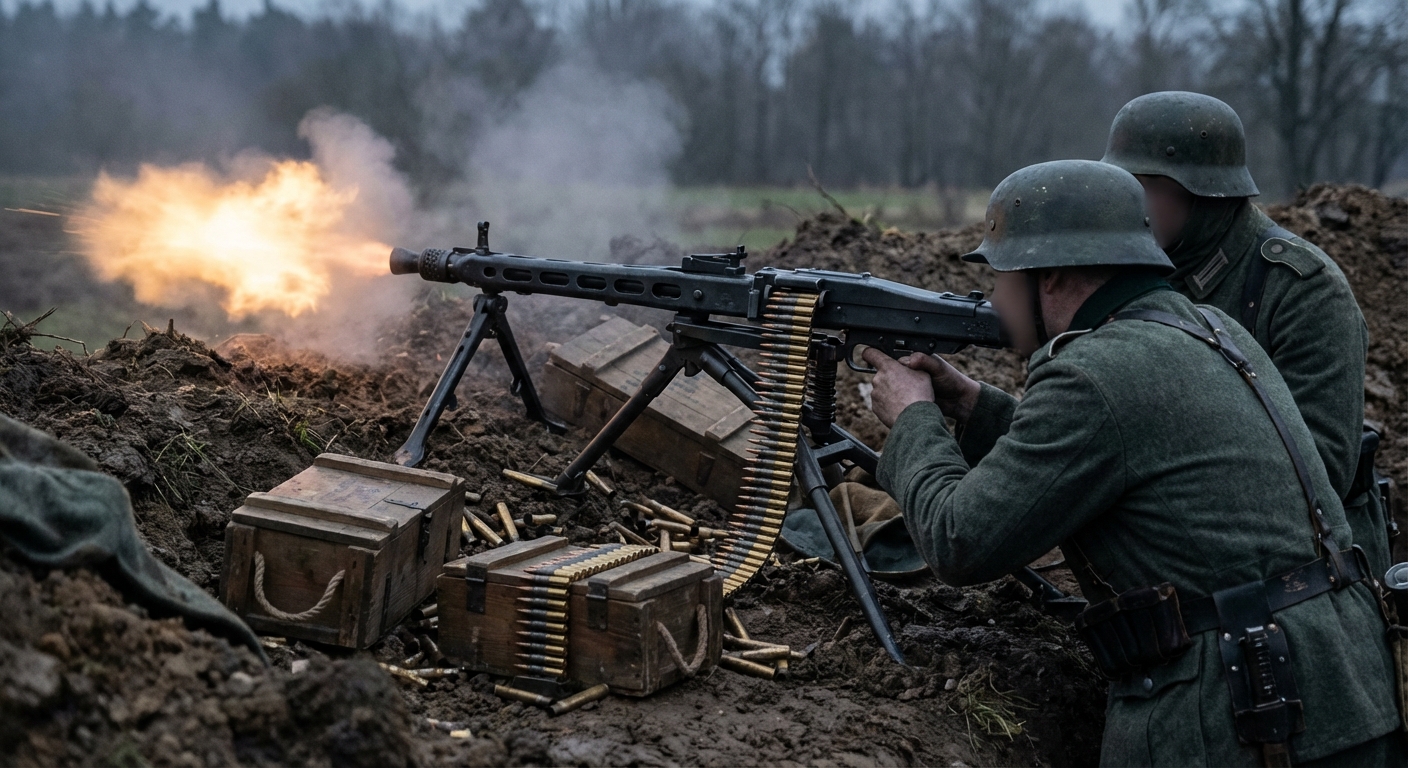
A gun that sounded like torn canvas and worked like an industrial machine, the MG 42 turned German infantry doctrine into a moving belt of fire.
Era
Second World War
Origin
Nazi Germany
Role
General-purpose machine gun
At a glance
The weapon in one hard look
The MG 42 was not simply a machine gun, it was the anchor of the German infantry squad. Riflemen maneuvered to support the gun, carried belts, changed barrels, and protected the position while the No. 1 gunner kept that famously violent rate of fire under control.
Its stamped construction made it faster to produce than the MG 34, but the real story was tactical, not merely industrial. In hedgerows, steppe grass, Italian ridgelines, and Normandy villages, the MG 42 could pin entire platoons because its bursts arrived so quickly that men often heard a ripping buzz rather than separate shots.
Core specs
Caliber7.92×57mm Mauser
OperationRecoil-operated, roller-locked
FeedNon-disintegrating metallic belt
WeightApprox. 11.6 kg gun only
Field details
Cyclic rate1,200 to 1,500 rpm
Effective range800 m bipod, 2,000 m tripod
CrewTypically 3 to 6 in full team
ProductionOver 400,000 built
Design logic
Built for war at factory speed
The MG 34 had shown what a true universal machine gun could be, but it demanded time, machining, and careful fitting. The MG 42 answered the same battlefield problem with stamped steel, welded assemblies, and a design that could be turned out faster under wartime pressure without giving up performance.
Its roller-locking system and short recoil action produced a very high cyclic rate. That made the gun harder to fire in neat single shots, but in real combat it delivered exactly what German doctrine wanted, a cone of fire so dense that crossing open ground became a nightmare.
The quick-change barrel mechanism mattered almost as much as the action itself. A disciplined crew could swap a glowing tube in seconds, keeping the gun alive during the sort of prolonged engagements that killed lesser designs.
Battlefield use
How it shaped the squad around it
German infantry units were organized so that the machine gun was the center of gravity. Ammunition bearers, assistant gunners, and riflemen existed in part to keep the MG 42 firing and to exploit the pause it created in the enemy line.
On defense, it was terrifying. Short traverses over likely avenues of approach could cut down attacks before they cohered. On offense, the gun gave advancing troops a curtain of suppression, especially when combined with mortars and aggressive small-unit maneuver.
American and British troops repeatedly commented on its psychological effect. The sound became part of the legend, but the deeper reason for its reputation was that well-served MG 42s were almost always positioned intelligently and fed hard.
Myth and reality
The buzzsaw legend, with the truth left in
The MG 42 is often remembered as if rate of fire alone won battles. That is too simple. A fast gun in untrained hands only wastes belts and overheats barrels. What made the MG 42 dangerous was the crew system around it, the doctrine behind it, and the tripod gear that let it do far more than hose at close range.
It also was not invincible. Mud, damaged belts, poor barrel management, and collapsing German logistics could reduce its edge. Allied artillery, armor, and sheer volume of return fire were still decisive. But as a squad and platoon weapon, it set a standard that outlived the Reich.
Its postwar descendants are the clearest verdict. The MG 3 is not a museum echo, it is proof that the core idea was sound enough to survive into the jet age.
Operators and campaigns
From Kursk to Normandy
MG 42s went wherever the Wehrmacht fought in the second half of the war. They backed grenadiers in the vast killing fields of the Eastern Front, fired from stone farmhouses in Italy, and snarled from hedgerow positions in Normandy where visibility was short and engagements were sudden.
They were especially effective in defensive fighting around prepared positions, road junctions, and reverse slopes. In those conditions the gun's high rate of fire amplified every tactical advantage. A few seconds of surprise could feel like an entire fire base.
The MG 42 mattered because it merged industrial pragmatism with tactical clarity. It was not just a fearsome weapon. It was a system for making one gun dominate the fight.
Further reading
Where to go next
For readers who want to go beyond legend and into production files, after-action reports, training manuals, and soldier memoirs, these are the most rewarding paths.
German wartime manuals on machine-gun employment and tripod fire control.
Allied after-action reports from Normandy and Italy describing German machine-gun defense.
Postwar Bundeswehr material on the MG 3 for continuity of doctrine and mechanism.
Soldier memoirs from both sides that separate the weapon's sound myth from its tactical reality.