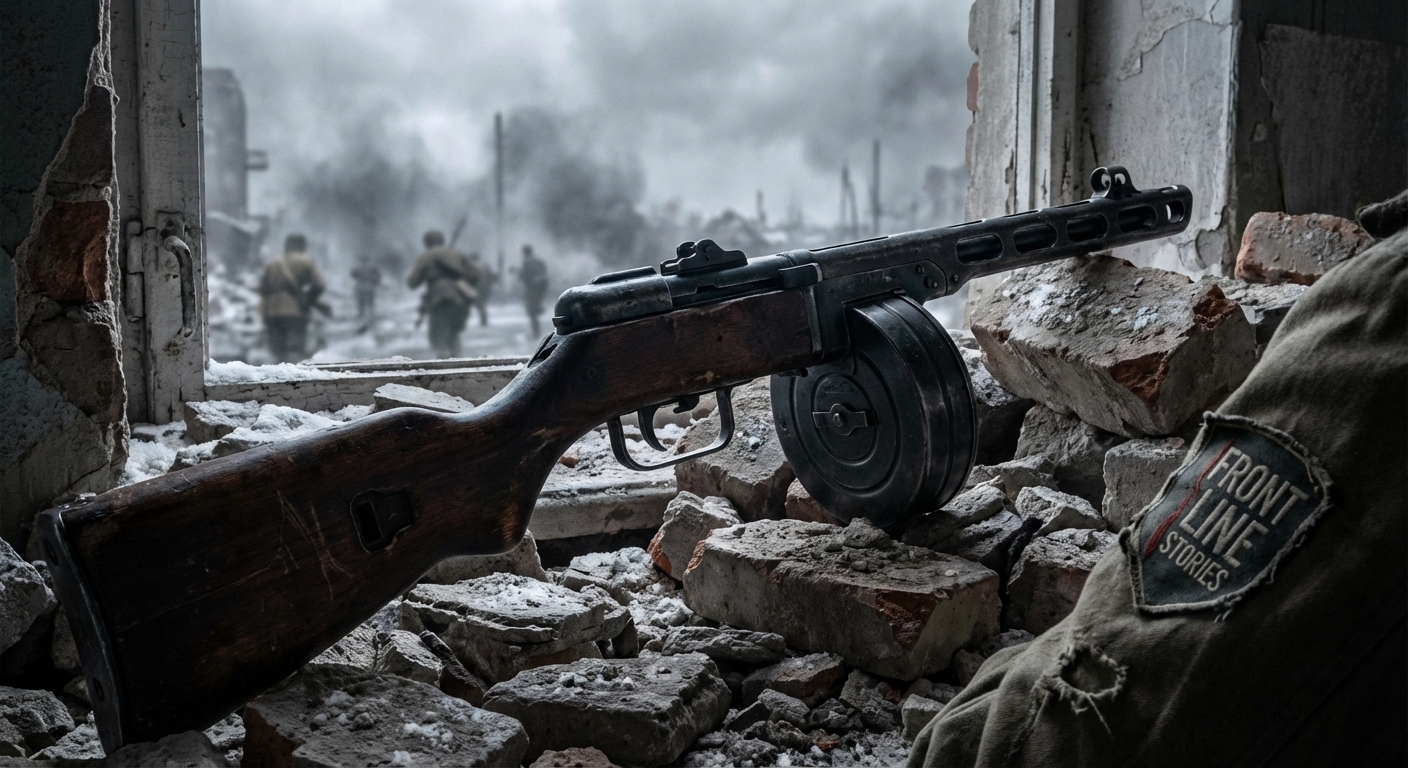
Cheap to build, savage at close range, and inseparable from Red Army assault tactics, the PPSh-41 was one of the defining submachine guns of the Eastern Front.
Era
Second World War
Origin
Soviet Union
Role
Submachine gun
At a glance
The weapon in one hard look
The PPSh-41 was the sound of Soviet close combat, a fast-barking weapon that fit winter coats, factory evacuations, and brutal house-to-house fighting. It was not elegant, but it was exactly the sort of gun a nation under existential pressure needed.
Its strengths were obvious in urban battle, forest ambushes, reconnaissance raids, and assault engineer work. Where ranges collapsed and the fight turned into seconds and doorways, the PPSh offered volume of fire, simple handling, and surprising resilience.
Core specs
Caliber7.62×25mm Tokarev
OperationBlowback, open bolt
Feed71-round drum or 35-round box magazine
WeightApprox. 3.6 kg unloaded
Field details
Cyclic rateAround 900 rpm
Effective rangeAbout 150 to 200 m practical
ConstructionStamped steel and simple machining
ProductionRoughly 6 million built
Design logic
Mass production with a purpose
Georgy Shpagin's design reflected Soviet wartime reality. It had to be made in huge numbers, often by dispersed industry under pressure, and issued to troops who needed fighting tools now, not years from now. Stamping and simplified manufacture were not side notes. They were the point.
The PPSh-41 fired the high-velocity Tokarev pistol cartridge, which gave it a flatter trajectory and better penetration than some Western submachine guns at modest ranges. That did not turn it into a rifle, but it did help Soviet troops stretch its usefulness across courtyards, roads, and factory floors.
Its iconic drum magazine became part of the silhouette, though box magazines later offered easier logistics and fewer headaches in service.
Battlefield use
The gun of storm groups and street fighters
By 1942 and 1943 the Red Army had learned hard lessons about urban assault, infiltration, and short-range violence. Submachine-gun companies and assault groups armed with PPSh-41s became central to clearing trenches, cellars, apartment blocks, and shattered industrial complexes.
At Stalingrad, Kursk, and in the advance back west, the weapon fit the Soviet preference for concentrated violence at decisive range. A burst into a room or trench was often more valuable than theoretical long-range finesse.
German troops respected it enough to reuse captured examples, sometimes rechambered for 9mm. That is usually the simplest compliment one army can pay another's weapon.
Myth and reality
Not a magic hose, but a close-range terror
The PPSh-41 is sometimes described as if it erased all tactical nuance with pure volume of fire. In truth, it was devastating only within the envelope where submachine guns belong. Beyond that, rifles and machine guns still ruled.
Its drum magazines also deserve a little demystifying. They looked fearsome and held a lot, but they could be bulky, heavy, and less convenient than people imagine. Many experienced troops preferred box magazines once supply improved.
Even so, in ruined cities and assault breaches the PPSh could dominate the human scale of combat. Few weapons better captured the brutal intimacy of the Eastern Front.
Legacy
A submachine gun that matched its war
The PPSh-41 endured because it solved a real wartime problem with clarity. It could be built by the millions, taught quickly, and pushed into the ugliest kinds of fighting without pretending to be something it was not.
Later assault rifles would eclipse the entire submachine-gun era for general infantry use, but the PPSh remains a vivid example of a weapon perfectly tuned to doctrine, production constraints, and terrain.
The PPSh-41 mattered because it put industrial simplicity and close-range violence in the same package, then handed that package to an army relearning how to attack.
Further reading
Where to go next
For readers who want to go beyond legend and into production files, after-action reports, training manuals, and soldier memoirs, these are the most rewarding paths.
Soviet wartime production studies on PPSh-41 manufacture and issue.
Memoirs from Stalingrad and Berlin that describe room-clearing and assault detachments.
Comparisons between Soviet, German, British, and American submachine guns.
Captured-weapon reports on German reuse of PPSh-41 variants.