HomeStoriesThe EdgeWeaponsBattlesPeopleWarbirdsAbout
← Weapons database

World War II - Soviet Medium Tank

T-34

The tank that shocked the Wehrmacht

The T-34 was not perfect. That is what makes it interesting. It was rough, cramped, hard on crews, and sometimes unreliable, but its combination of sloped armor, diesel power, mobility, gun, and mass production changed the Eastern Front.

Tank story - 20 minute read

Opening scene

German crews first meeting the T-34 were not looking at a beautiful tank. They were looking at a problem. Their familiar anti-tank assumptions suddenly felt smaller. The Soviet machine had angled armor that made shells glance, wide tracks that moved through bad ground, a diesel engine, and a gun that could threaten German armor of the early war.

It was not unbeatable. It broke down, burned, lost crews, and suffered from poor visibility and command problems. But it forced the enemy to react. In weapons history, that is one of the clearest signs of importance.

The T-34 became a battlefield argument: not the best tank in every category, but one of the best answers to the kind of war the Soviet Union had to survive.
Reading route

How to Read the Tank

Chapter 01

A Tank Built for the War the Soviets Actually Had

The T-34's strength was not one magic feature. It was the package. Sloped armor gave more effective protection without simply making the tank heavier. Wide tracks helped over soft ground. A diesel engine reduced some fire risk compared with gasoline and gave useful range. The 76.2 mm gun was formidable in the early war.

Those choices mattered because the Eastern Front was not a parade ground. It was snow, mud, poor roads, long distances, brutal attrition, rushed crews, and factories that had to keep producing under existential pressure.

The T-34 was less a luxury machine than a survival machine.

That is why the story should not be reduced to tank trivia. The T-34 was an industrial and tactical answer to an invasion that threatened to erase the state that built it.

Technical Drawing

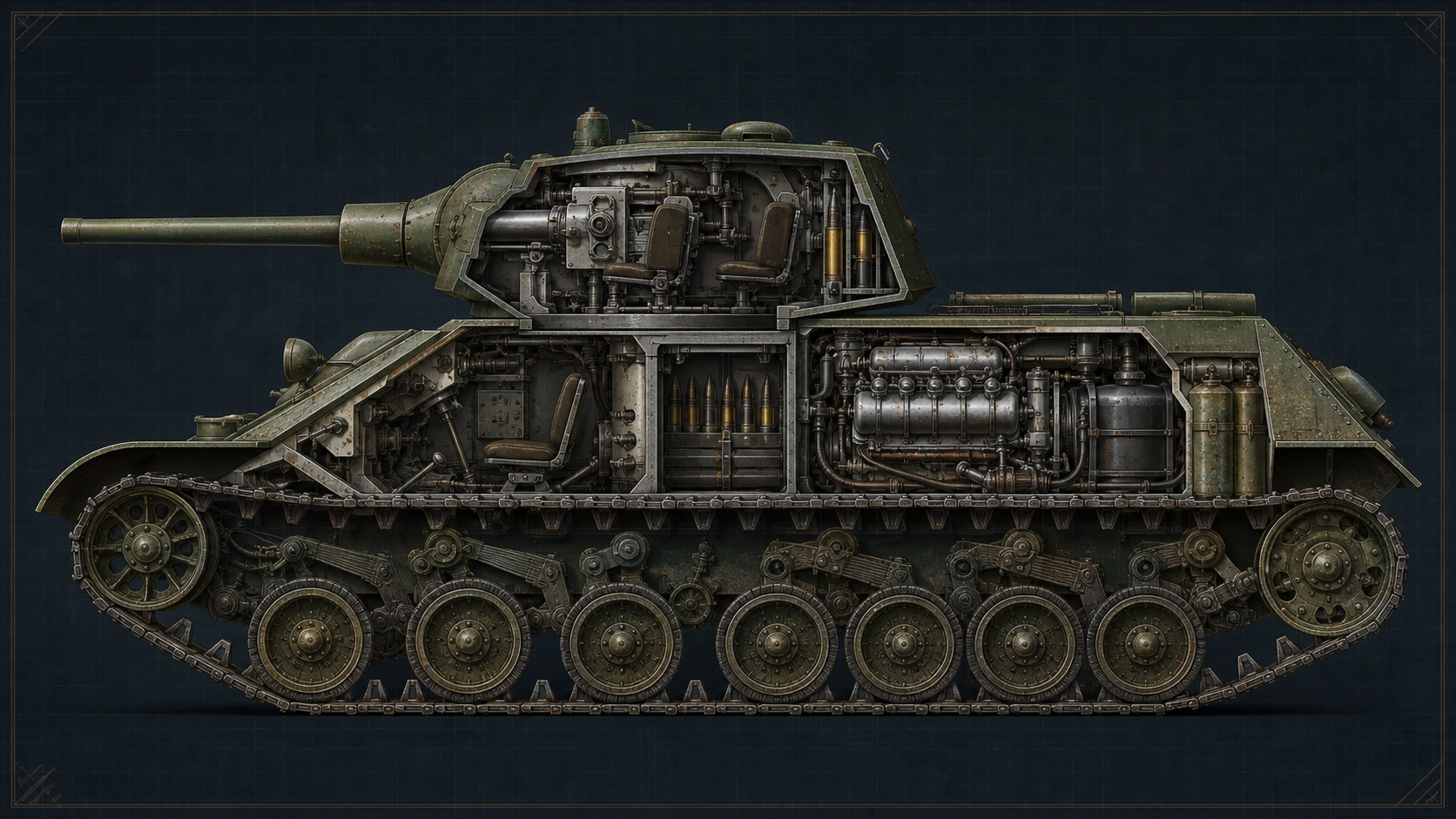
Inside the T-34/76

Technical cutaway of a Soviet T-34 medium tank
Compact and harsh. The tank's famous strengths lived beside crew problems: cramped spaces, limited visibility, and early command overload.

Strength Diagram

Why It Was Hard to Stop

Design pressure. Sloped armor, wide tracks, diesel mobility, and a useful gun created a tank that punished early German assumptions.T-34

Chapter 03

The Shock of 1941

When Germany invaded the Soviet Union in June 1941, many Soviet tank units were badly handled, poorly supplied, or thrown into chaotic counterattacks. The Red Army lost huge numbers of tanks. That can hide the fact that German soldiers still noticed the T-34.

The shock was practical. Anti-tank guns that had been adequate suddenly struggled against sloped armor. German tank crews found that some Soviet machines could survive hits, cross bad ground, and return dangerous fire. The T-34 did not save the Red Army from disaster in 1941, but it announced a problem Germany had to solve.

Germany answered with better anti-tank guns, improved Panzer models, and eventually heavier tanks. That reaction is part of the T-34's legacy. A weapon does not have to dominate every battle to reshape the enemy's design priorities.

Chapter 04

Factories Became Part of the Weapon

The T-34 was also a production story. Soviet industry moved east, simplified designs, accepted rough finishes, and pushed output under pressure. The tank that reached the front might be crude compared with a carefully finished museum machine, but the front did not need polish. It needed steel, guns, engines, tracks, and replacements.

That is the hard truth of armored war. A perfect tank that arrives too late or in too few numbers can lose to a rougher tank that appears again and again. The T-34's reputation belongs as much to Soviet industrial endurance as to its armor angles.

No myth version

What Was Wrong With It

VisibilityEarly crews often fought with poor situational awareness.
Turret workloadThe T-34/76's turret arrangement overloaded commanders compared with later three-man turret designs.
ReliabilityEarly wartime production could be rough, with transmission and mechanical problems.
RadiosRadio shortages and uneven crew training hurt coordination.
Crew comfortCramped interiors made fighting and commanding harder.
LossesGood design did not prevent enormous Soviet tank losses.

Chapter 06

The T-34-85 Answer

As German armor improved, the T-34 had to change. The T-34-85 added a larger turret and an 85 mm gun, improving firepower and crew arrangement. It did not make the tank invincible, but it kept the design relevant in the final years of the war.

The upgrade also shows the T-34's deeper value: it was adaptable enough to keep fighting while production continued at scale. The Soviet Union did not need a boutique masterpiece. It needed a tank family that could absorb battlefield lessons without collapsing the production system.

Timeline

From Shock to Workhorse

1939-40T-34 development and early production emerge from Soviet prewar tank design work.
1941Germany invades; T-34s appear in combat and expose limits in early German anti-tank capability.
1942Soviet production relocation and simplification make the tank part of a larger industrial survival story.
1943Kursk and the wider armored struggle show both the T-34's value and its heavy losses.
1944T-34-85 enters wide service with improved gun and turret layout.
PostwarThe T-34 remains one of the most recognizable and widely used tanks in history.

Careful history

What We Treat Carefully

The T-34 was not a flawless wonder weapon. Its legend gets stronger when the flaws are left in. The important claim is that it combined good battlefield design choices with Soviet production scale at a moment when the Red Army needed a tank it could build, lose, improve, and build again.

Source basis

References Used

Built from public museum and encyclopedia references on the T-34, Soviet armored warfare, and World War II tank development.