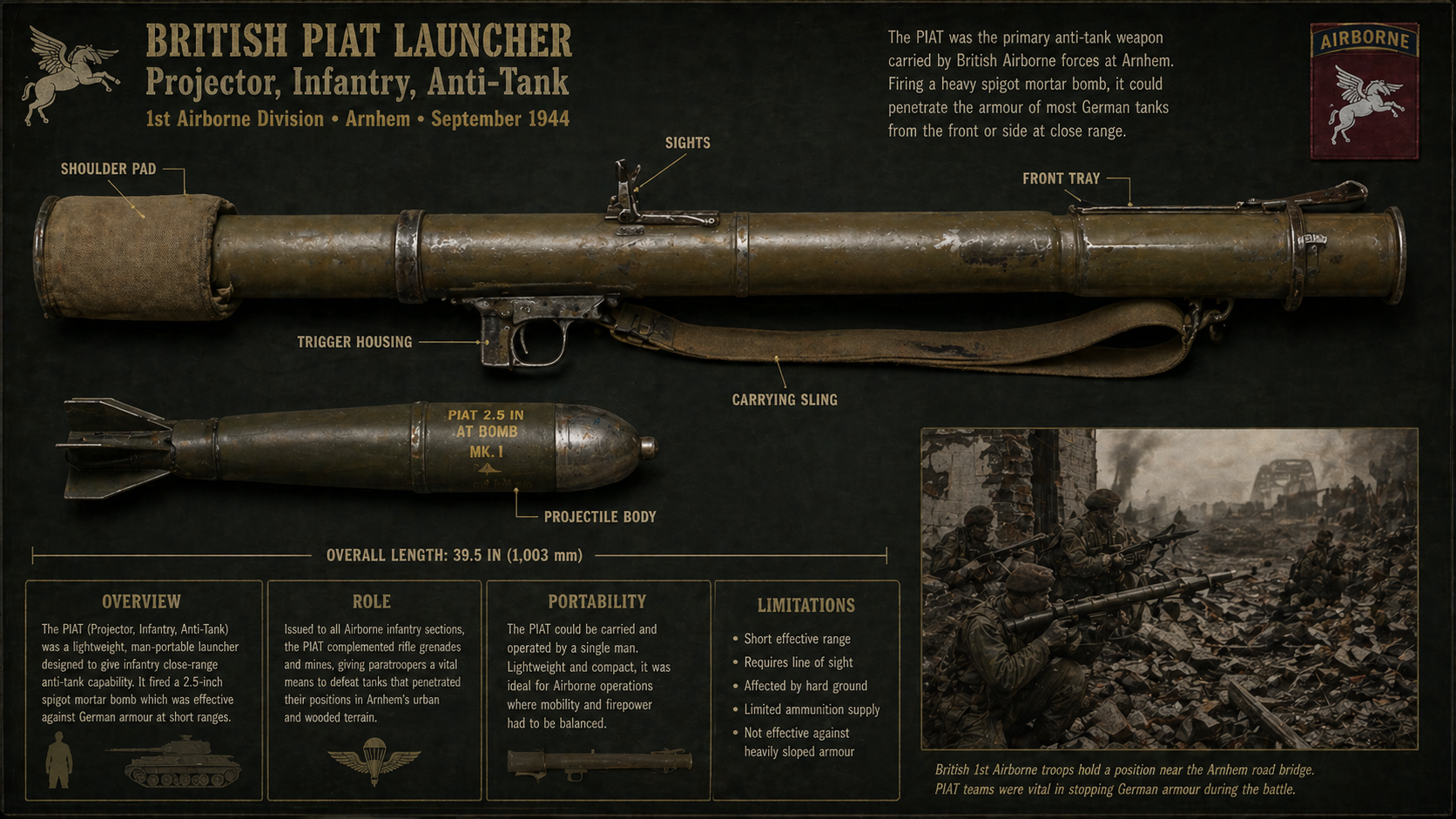
A strange, stubborn anti-armor weapon for troops who had to arrive by air, fight on foot, and stop vehicles from rubble, windows, and street corners.
Era
Second World War
Origin
United Kingdom
Role
Infantry anti-armor
At a glance
The airborne anti-tank answer
The PIAT, short for Projector, Infantry, Anti-Tank, was one of those weapons that makes more sense when the tactical problem is ugly. It was not sleek. It was not easy. But it gave British infantry a portable anti-armor option when heavier guns were absent or impossible to move.
At Arnhem, that mattered. British airborne troops were light by design, scattered by the operation, and forced to hold streets and houses against German infantry and armor. In that setting, a short-range weapon that could be carried into rubble was not a luxury. It was one of the few ways an isolated position could make an armored vehicle hesitate.
Core specs
TypeInfantry anti-tank projector
Projectile2.5-inch bomb
Launcher weightApprox. 14.1 lb
LengthApprox. 39.5 in
Field details
Best useClose-range ambush
Tactical nicheInfantry anti-armor
Key advantageNo obvious backblast
Key limitShort effective range
Technical plate
Click to enlarge - Museum-style PIAT reference plate showing the launcher, projectile, visible external features, limitations, and Arnhem battlefield context.
Design logic
Built around the problem of portability
Airborne troops needed weapons that could travel by parachute, glider, container, or hand. That requirement shaped everything. The PIAT was heavy enough to be disliked, but still portable enough to go where heavier anti-tank guns could not.
Its great practical benefit was not elegance. It was that it could be used from covered positions without the obvious backblast problems of rocket launchers. In ruined streets or from buildings, that gave a small team a chance to stay concealed until the shot mattered.
The tradeoff was severe. The weapon asked a lot from the user, worked best at short distances, and depended on men holding their nerve until armor was close. At Arnhem, those were exactly the conditions British paratroopers faced.
Battlefield use
Arnhem turned theory into street fighting
Operation Market Garden placed British airborne troops in a fight that became heavier by the hour. German armored units arrived faster than expected. The bridge force and the Oosterbeek perimeter had to improvise anti-armor defenses without the full weight of ground-force support.
In that environment, PIAT teams were not tank destroyers in the cinematic sense. They were local problem-solvers. They covered streets, waited in buildings, guarded approaches, and made armored vehicles pay for closing into the tight spaces around British positions.
The weapon's value was psychological as well as mechanical. If German crews knew a street or house line might contain a PIAT, they had to treat every close approach with more caution.
Myth and reality
Not a wonder weapon, but not a joke
The PIAT is easy to mock because it looks odd and had obvious handling problems. That misses the point. In airborne combat, the perfect anti-tank weapon is usually the one that actually made it to the battlefield with the troops.
It did not make lightly armed paratroopers equal to tanks. It did not solve the absence of artillery, armor, resupply, or reliable communication. But in the small geography of a street corner, a house, or a roadblock, it could turn one infantry team into a serious threat.
The PIAT mattered because it gave isolated airborne infantry a way to say no to armor at the last possible distance. It was not enough to save Arnhem, but it was enough to make some streets dangerous.
Further reading
Where to go next
To understand the PIAT properly, read it alongside airborne doctrine, Operation Market Garden accounts, and first-hand Arnhem narratives rather than treating it as a specification sheet alone.
British airborne accounts from Arnhem and Oosterbeek for how anti-armor teams were positioned.
Imperial War Museums and National Army Museum summaries of Market Garden and Arnhem.
British wartime weapon references for PIAT weight, role, and ammunition context.