HomeStoriesWeaponsBattlesPeopleWarbirdsAbout
All Stories

The Hinge of Fate: Montgomery and the Eighth Army at El Alamein

Date: 1942 Location: El Alamein, Egypt Unit: British Eighth Army
~21 minutes min read
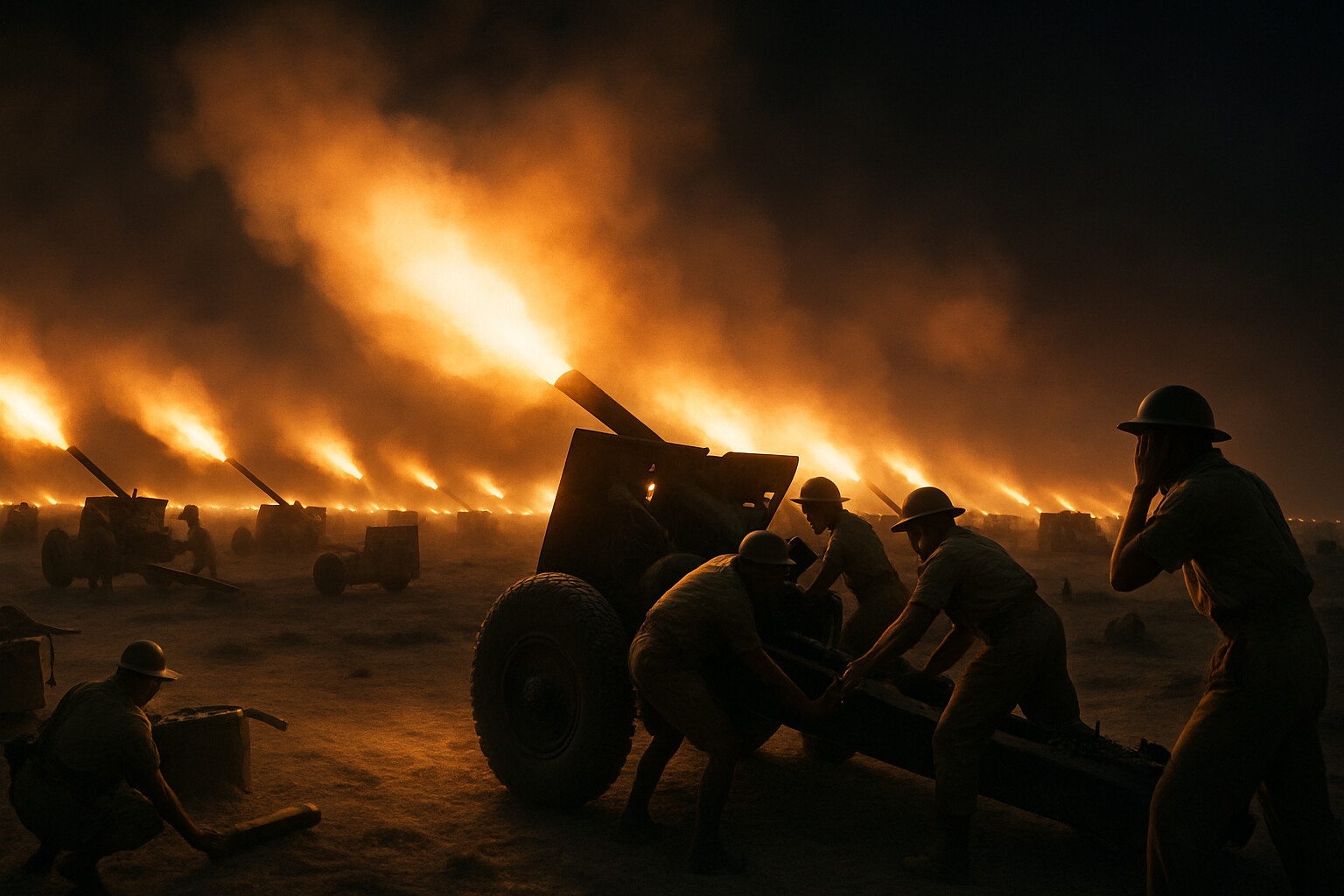
The opening barrage: 882 British and Commonwealth artillery pieces fire simultaneously across the Egyptian desert at 9:40 p.m. on 23 October 1942. A vast line of muzzle flashes lights the night horizon as the guns roar.

The guns opened on the night of 23 October 1942 at 9:40 p.m.

Across a front nearly forty miles wide, 882 artillery pieces fired simultaneously into the Egyptian darkness. The muzzle flashes strobed along the desert floor from the Mediterranean coast in the north to the impassable Qattara Depression in the south. Contemporary accounts and postwar memoirs report the sound reaching Alexandria, more than a hundred miles away, though the original sourcing for individual witnesses has not been fully traced. For fifteen minutes, nearly a thousand guns poured counter-battery rounds into Rommel's artillery positions. Then the barrage lifted and walked forward, and three British corps began to move.

The men who stepped into that barrage wall had been waiting for this moment for months — in some cases, for years. They were Australians, New Zealanders, South Africans, Indians, and men from across Britain and the Commonwealth. They were veterans of the desert's particular miseries: heat, sand, dysentery, flies, dust storms that could bury a vehicle to its axle in hours. They had fought Rommel before and been pushed back. Some had been at Tobruk. Some had survived the long retreat to the Alamein line itself in the summer of 1942 — a retreat so rapid and so demoralizing that the alarm had reached London and brought Churchill to Cairo in personal crisis. Now they were being asked to do something different. Not to maneuver cleverly or to rely on intuition. To stand in the open and grind.

The man who designed that grinding was Bernard Law Montgomery, newly appointed commander of the Eighth Army, at his headquarters near the Burg el Arab landing ground on the night the guns opened. He had been in command for ten weeks.

---

Montgomery arrived in Egypt in August 1942 to take command of an army that was exhausted, shaken, and, in the opinion of many observers, in danger of coming apart. He was fifty-four years old, slight, sharp-featured, and almost aggressively self-confident — a quality that some subordinates found galvanizing and others found insufferable. He had served in the First World War and been seriously wounded at Méteren in 1914, had spent the interwar years developing a reputation as a demanding and uncompromising trainer of troops, and had commanded III Corps during the fall of France in 1940, one of the few British commanders whose formations came back from Dunkirk in reasonable order.
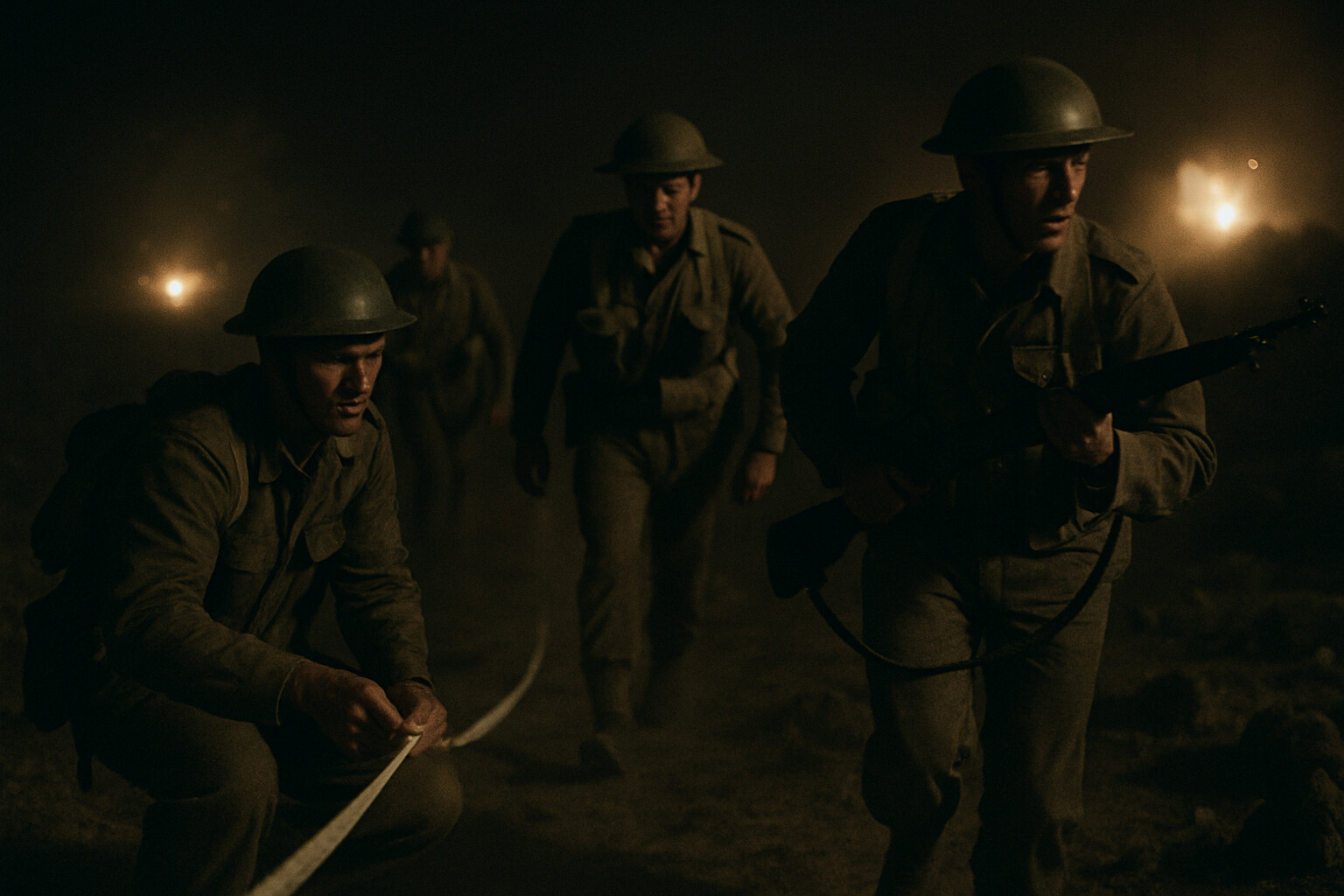
Royal Engineers and infantry moving through the minefield lanes at night, guided by white tape markers, in darkness broken only by artillery flashes and occasional enemy fire.

He was not selected for El Alamein because he was universally admired. He was selected because Churchill and General Harold Alexander, the new Commander-in-Chief Middle East, believed he would fight the battle that needed to be fought rather than the battle Rommel wanted to fight.

Rommel's genius was operational mobility. He had built his reputation in France and cemented it in North Africa by moving faster than his opponents could think, exploiting gaps, turning flanks, attacking when attacked, and keeping his opponent perpetually off-balance. He had done it at Gazala in May 1942. He had done it at the fall of Tobruk in June, when 33,000 Commonwealth troops surrendered in a single day — a disaster Churchill later described as one of the heaviest blows of the war. He had driven the Eighth Army four hundred miles east to the Alamein line, a bottleneck between the sea and the desert where the exposed flanks that Rommel preferred simply did not exist.

But Rommel in October 1942 was not the Rommel of Gazala. He was seriously ill — his published papers and postwar accounts describe low blood pressure, nasal catarrh, and stomach problems severe enough to require treatment in Germany — and he was still there when Montgomery's offensive began. His Panzerarmee Afrika was undersupplied. Fuel convoys were being destroyed by the Royal Air Force and the Royal Navy at an increasing rate. His logistical position was, by his own later account, critical. He had fewer than 200 operational tanks and was receiving a fraction of the fuel and ammunition he needed to sustain mobile operations.

Montgomery knew, or reasonably calculated, much of this. He had access to Ultra intelligence — the product of the codebreaking operation at Bletchley Park — which gave him a window into Axis supply problems and unit dispositions that Rommel could not imagine existed. The precise degree to which Ultra shaped Montgomery's specific operational timing remains a matter of scholarly discussion; the official intelligence history by Hinsley et al. is the authoritative source, and this account takes the broadly accepted position that Ultra was a significant factor without claiming it was determinative. Beyond intelligence, Montgomery had something Rommel did not: time, material, and a mind inclined toward methodical preparation rather than inspired improvisation.

The Eighth Army that Montgomery inherited and rebuilt over those ten weeks was not the broken formation of the summer. By the time Operation Lightfoot began on 23 October, he had assembled 195,000 men, approximately 1,000 operational tanks, 2,311 artillery pieces, and an air component — the Desert Air Force — that was prepared to fight as an integral part of the ground battle rather than as a parallel service. His logistical base was secure. His men had been trained and rehearsed. His plan had been explained to officers down to the unit level, which was unusual at the time and was a deliberate choice: Montgomery believed soldiers fought better when they understood what they were supposed to accomplish.

His plan was not subtle. It could not afford to be. The Alamein position was protected by a minefield belt of extraordinary density. British engineering assessments after the battle estimated between 445,000 and 500,000 mines had been laid across the front, backed by infantry in defended localities, artillery, and an armored reserve. There were no open flanks to exploit. The only way through was through.
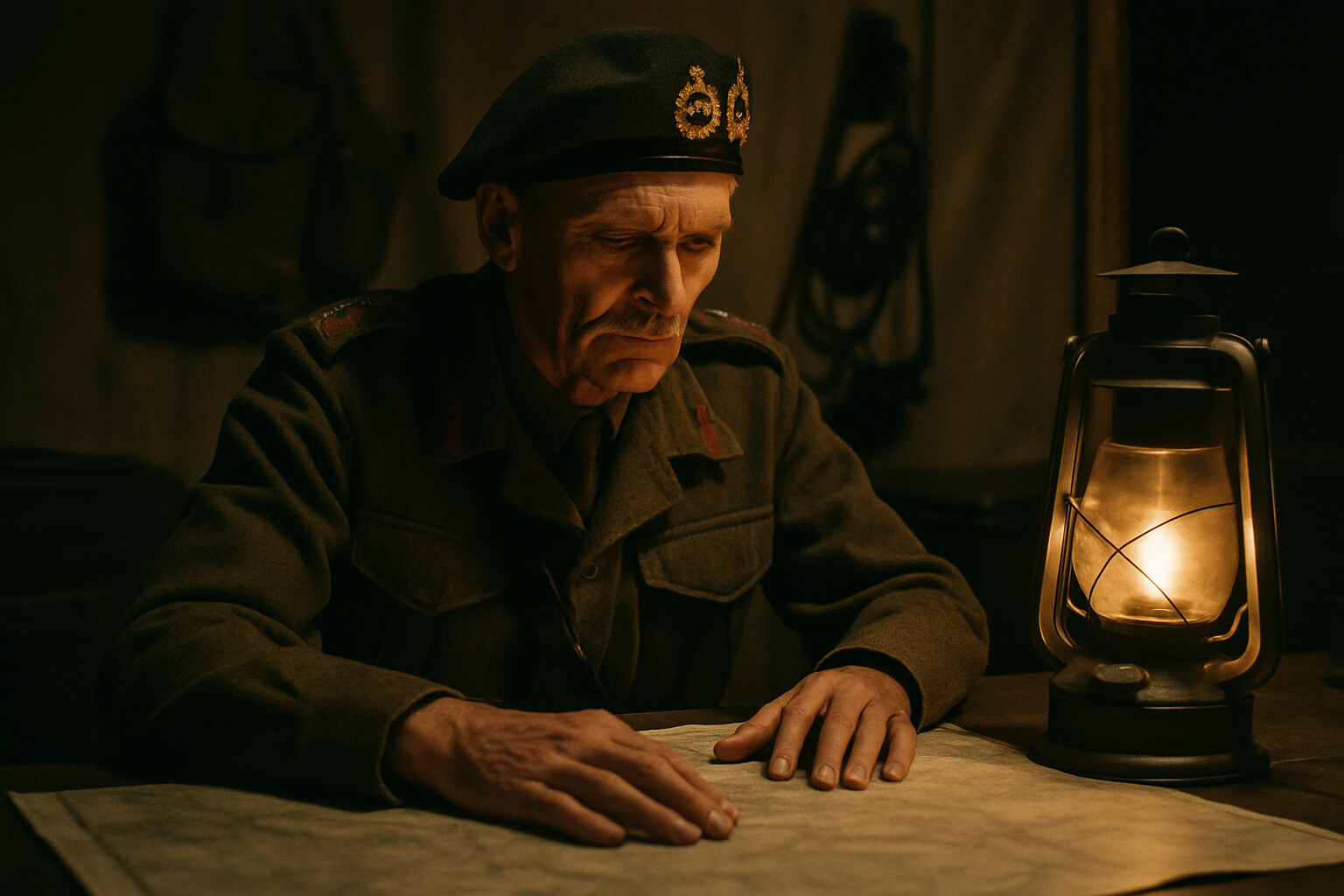
Bernard Montgomery in his command caravan at Burg el Arab, studying maps by lamplight on the night the battle opens — composed, precise, surrounded by the tools of meticulous preparation.

The plan had two main phases. The first, Operation Lightfoot, would use infantry divisions to breach the minefields along two corridors — one in the north near the coast, one to the south — clearing lanes through which the armored formations of X Corps could pass and deploy beyond the obstacles. Once the armor was through, it would hold its ground on the far side, a position Montgomery designated the Oxalic Line, and force the Axis armored reserves to attack British tanks rather than British infantry. The second phase, timed to the moment of maximum Axis attrition, would be a concentrated armored and infantry assault to finally rupture the Axis line.

It was a plan that accepted attrition. It was a plan that assumed casualties and built them into the arithmetic. It was, in that sense, very different from how the British Army had preferred to think about desert warfare — and very different from how Rommel thought.

---

The northern corridor was the main effort. It fell to XXX Corps, commanded by Lieutenant General Sir Oliver Leese, whose four infantry divisions — the 9th Australian, the 51st Highland, the 2nd New Zealand, and the 1st South African — were to breach the minefields on a front roughly six miles wide and create lanes for the armor of X Corps behind them.

The minefields were the first and most brutal obstacle. The Axis defensive system had been constructed with care. The mines were not laid in single belts but in two parallel bands, separated by a gap of varying width, which the Eighth Army's engineers had named the Devil's Gardens. Some areas contained three or four overlapping belts. Anti-personnel mines were interspersed with anti-tank mines to make clearing dangerous and slow. Booby traps were common. In the darkness, under fire, using metal detectors and prodding rods, Royal Engineers had to find, mark, and clear lanes wide enough for tanks to pass through in column.

The sappers who led the advance on the night of 23 October worked in conditions reconstructed from Royal Engineers after-action reports and published unit histories: artillery fire crossing in both directions, small arms from Axis positions that had survived the bombardment, and the constant threat of the ground itself. They marked the lanes with white tape and hessian markers. Tanks and infantry moved close behind them, because the pressure of the timetable was relentless.
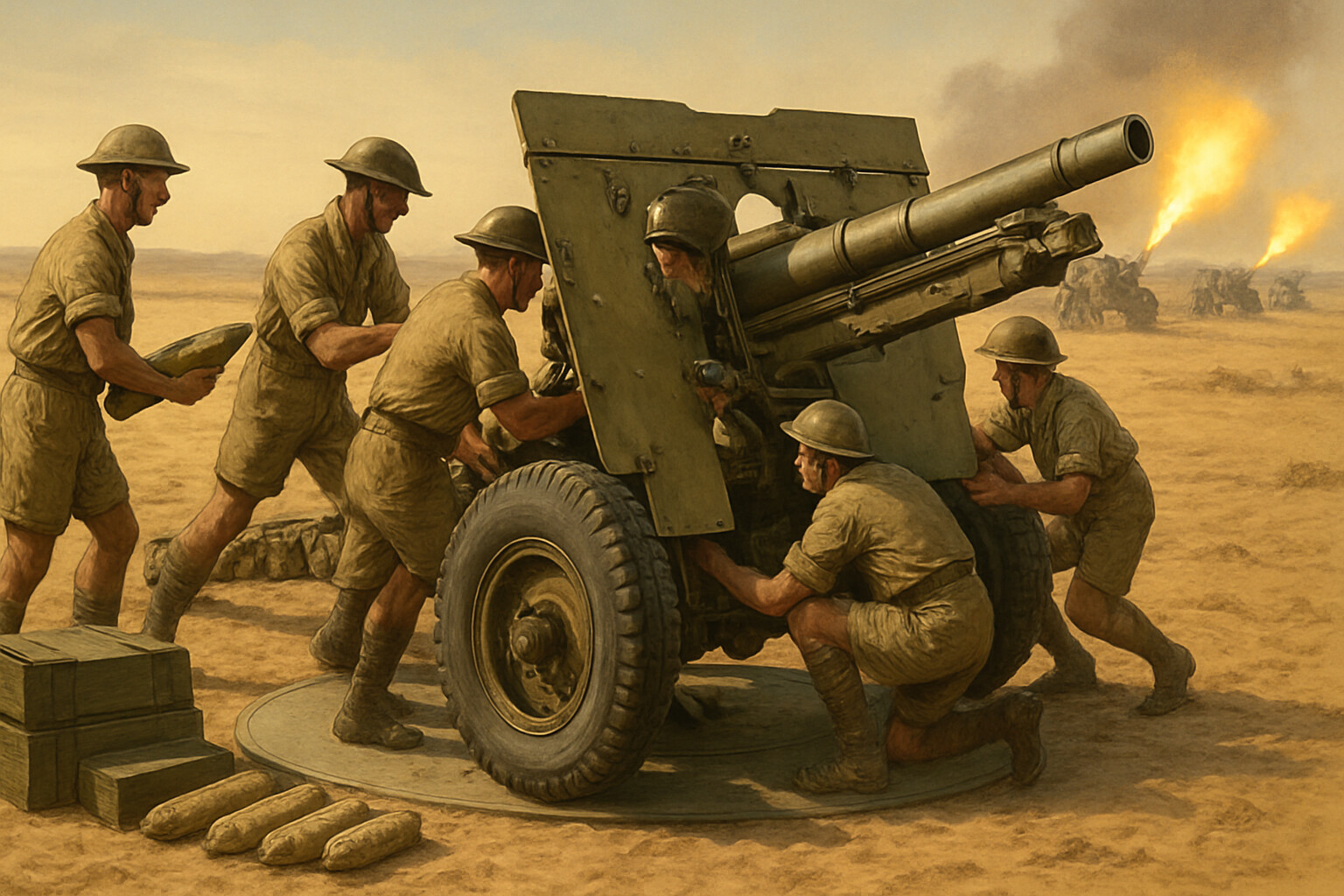
An annotated diagram-style breakdown of the QF 25-pounder field gun, showing its firing platform, separate-loading ammunition system, and crew positions, placed in the desert context of the El Alamein barrage.

Progress in the northern corridor slowed almost immediately. The infantry cleared significant portions of the minefield, but the lanes through the second belt were not complete by dawn. X Corps armor, which had been told it would be through the minefields and in position on the Oxalic Line by first light, found itself bunched in the lanes as the sky began to lighten — vehicles crowded together and vulnerable to any concentrated fire. This characterization of the armor being caught in the lanes at dawn is consistent across multiple published accounts and after-action reports cited in the official history, though the exact timing and extent of the delay vary somewhat across sources.

Montgomery did not alter his fundamental approach. He had anticipated that the first night might not go to plan. He had given his corps commanders a single overriding directive: maintain pressure. The weight of the attack, in his conception, mattered more than the precision of any timetable.

The fighting over the following days was some of the hardest of the entire North African campaign. The 9th Australian Division, under Lieutenant General Leslie Morshead, fought a grinding series of attacks along the northern coastal corridor that pinned and progressively consumed the German 164th Infantry Division and elements of the Italian XX Corps. The Australians attacked night after night — taking objectives, being counterattacked, holding, attacking again. Their role was partly to capture ground and partly to draw Axis reserves northward, away from the main breakout point Montgomery was planning.

In the south, XIII Corps — a secondary effort under Lieutenant General Brian Horrocks — made more limited progress and was ordered to avoid heavy casualties. The southern attack was intended to hold Axis forces in place and to threaten, not to break through.

Rommel flew back from Germany on the evening of approximately 25 October — the standard account in German records and his published papers, though the precise time of his return should be confirmed against Army Group Africa records — cutting short his convalescence when he learned the scale of the British attack. He found his line holding but under severe pressure. His fuel situation was critical: the tanker Proserpina had been sunk by British air and naval action before it reached Tobruk, worsening an already inadequate supply position. His anti-tank screen — the 88mm Flak guns and the PaK 38 and PaK 40 anti-tank guns that had proven devastating against British armor in earlier battles — was largely intact and was extracting a heavy toll on the tanks X Corps was trying to push forward.

The first week of the battle produced a grinding stalemate that alarmed Montgomery's superiors in London. Churchill pressed for updates. Alexander visited the front. The maps showed limited ground gained at significant cost. The Axis line had not broken. The armor had not broken through.
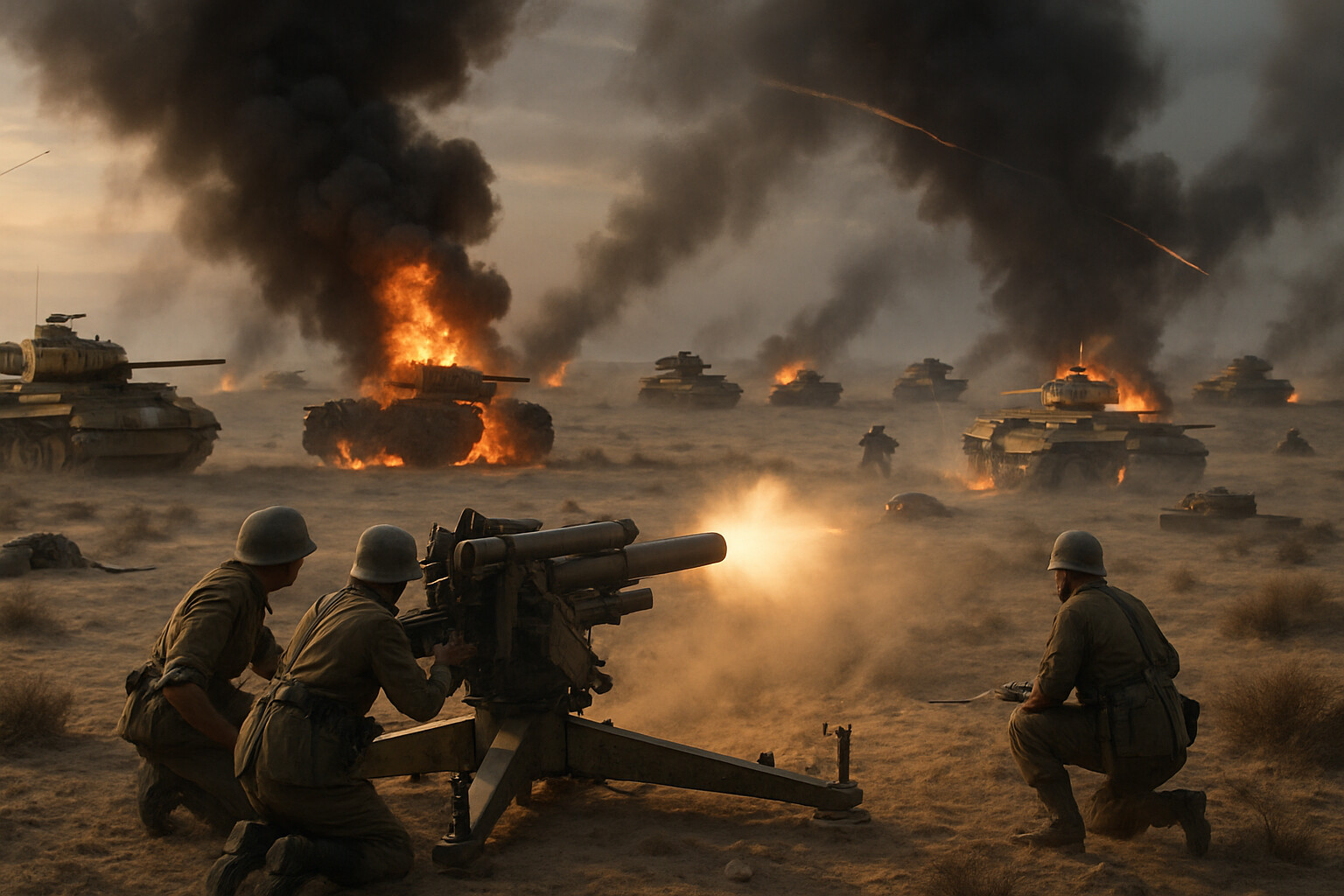
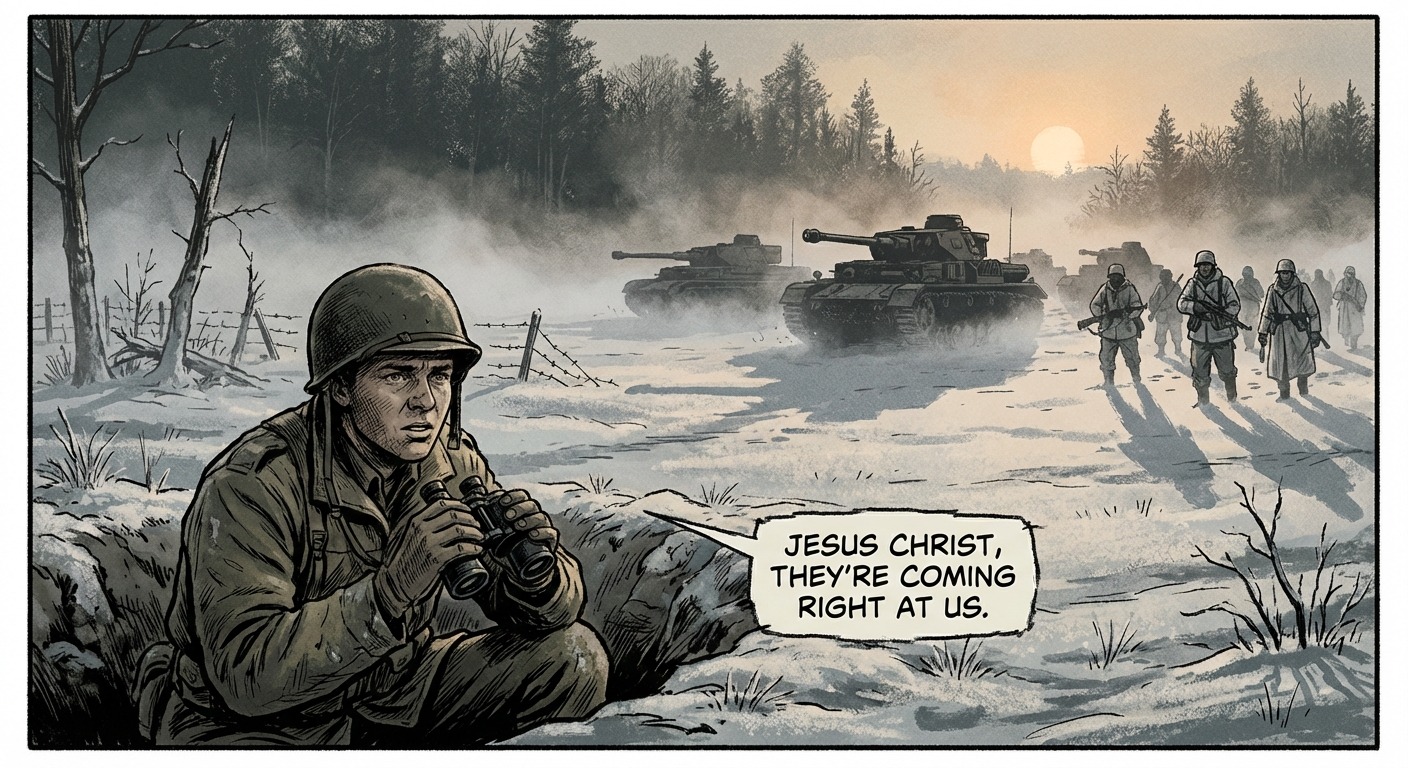
The 9th Armoured Brigade's assault at dawn on 2 November 1942 — British Sherman and Crusader tanks advancing into the German anti-tank screen, the 88mm Flak guns firing at point-blank range, tanks burning across the desert.

Montgomery's assessment, documented in his communications and accounts from the period, was that the battle was proceeding as he had expected. He was tracking rates of attrition on both sides. Axis formations were being consumed at a rate they could not replace. Rommel could not bring in meaningful reserves. Every tank destroyed, every infantry company shattered, every gun knocked out represented a permanent reduction in Rommel's combat power, because the supply lines were too thin to make it good. His private state of mind in those days cannot be directly known, but his outward conduct and his documented correspondence show no deviation from the attritional logic he had built into his plan from the start.

On 1 November, Montgomery issued new orders. He concentrated his strength. The Australians would maintain their pressure in the north. The main effort would shift slightly south of the Australian sector and would be delivered by the 2nd New Zealand Division — reinforced with the 9th Armoured Brigade and the 1st Armoured Division — in a new attack designated Operation Supercharge.

Supercharge was designed to punch through what remained of the Axis line, force the armored engagement Montgomery had been seeking from the start, and, by sustained attrition, destroy Rommel's armor entirely. The 9th Armoured Brigade, commanded by Brigadier John Currie, was given an explicit and brutal task: breach the Axis anti-tank screen even at the cost of the entire brigade. Currie's formation entered the battle on the morning of 2 November with approximately 94 tanks — the standard figure in published accounts, which should be verified against the brigade war diary before final publication — and emerged from the engagement with fewer than 20. They broke through the screen. They paid the price that had been asked.

Behind them came the 1st Armoured Division. The tank battle that followed, centered on the area around Tel el Aqqaqir, was the climactic armored engagement of the battle. Rommel committed his remaining armor. The German 15th Panzer Division and the 21st Panzer Division, along with Italian armored formations, struck at the British tanks. Guns fired over open sights. Tanks burned across a wide front. By the end of 2 November, Axis armored strength was effectively broken. Rommel had fewer than 35 serviceable tanks.

He requested permission to withdraw. Hitler's reply, received on 3 November and cited in multiple standard histories including Rommel's own published papers, ordered him to hold. Rommel attempted to comply. By 4 November the position was untenable. The Axis line had been pierced in multiple places. Infantry formations that had held their ground through eleven days were being outflanked. Rommel ordered the retreat that Hitler had forbidden.

The battle was over.

The aftermath: the desert west of El Alamein on 5-6 November 1942, littered with burned-out Axis and British tanks, abandoned guns, and equipment as the Eighth Army begins its westward advance.

---

The cost had been severe on both sides.

British Eighth Army casualties from 23 October to 4 November 1942 are documented in official records as approximately 13,500 killed, wounded, and missing, though minor variation exists across published sources and the figures in the official history should be cited specifically for any formal reference. Tank losses were significant: during the battle, roughly 500 British tanks were knocked out or disabled, though many were recovered and repaired. The human cost fell most heavily on the infantry and the armored crews who had led the night assaults and the Supercharge attack.

Axis casualties were higher, and a substantial portion became prisoners of war because the retreat turned chaotic. Figures from official and secondary histories place total Axis losses — killed, wounded, and captured — at approximately 30,000 men. Approximately 1,000 guns and 450 tanks were left behind in the desert or destroyed. The Afrika Korps as a coherent fighting force retreated roughly 1,500 miles over the following months, pursued by the Eighth Army, and never regained the strategic initiative.

The men who did not come back from eleven days of fighting are not easily summarized by arithmetic. The 9th Armoured Brigade's losses on the morning of 2 November alone represented, in proportional terms, a level of sacrifice rarely asked of armored formations. The infantry assaults at night, through minefields, against defenders who knew the ground — those were not bloodless technical operations. They were paid for in individual human cost that records compress into numbers but cannot fully convey.

---
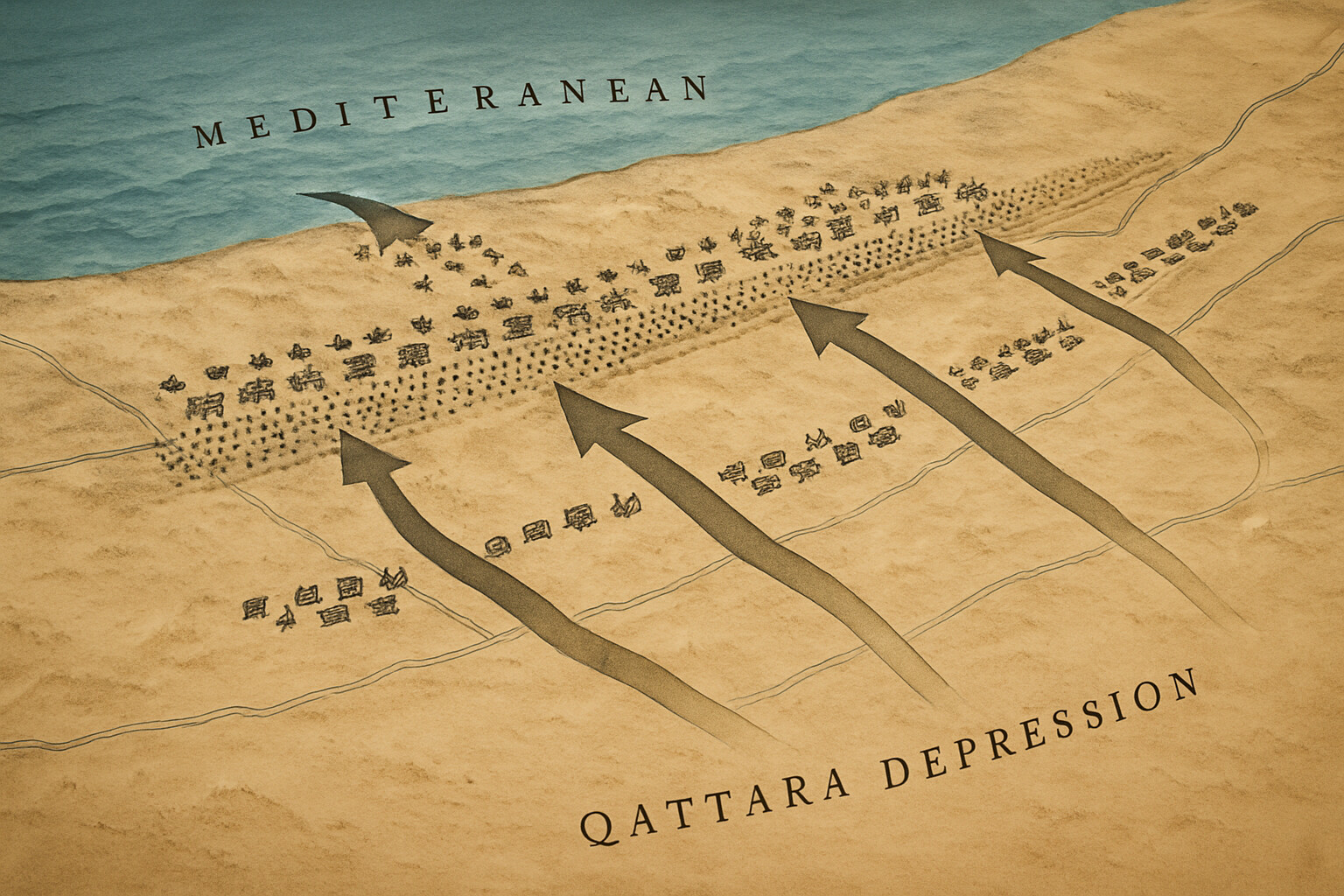
A map-view illustration of the El Alamein battlefield showing the forty-mile front between the Mediterranean and the Qattara Depression, the two main Allied attack corridors, the Axis defensive belt of minefields, and the westward direction of the eventual Axis retreat.

Montgomery's performance at El Alamein has been argued about by historians for eight decades, and those arguments are worth understanding because they illuminate what the battle actually was.

The case for his generalship is substantial. He inherited a demoralized army and rebuilt its confidence in ten weeks. He chose a plan suited to his resources and to the terrain, not a plan suited to abstract operational elegance or to his own reputation. He accepted that attritional battle was unavoidable and designed for it rather than hoping to avoid it. He used his intelligence advantage to understand Rommel's supply situation and to time his offensive at a moment of Axis weakness. He maintained his approach through the first week when progress was slow and pressure from London was intense. His integration of the Desert Air Force into the ground battle, rather than treating it as a parallel and separate service, was ahead of standard practice and contributed directly to interdicting Axis supply lines during the fighting.

The criticisms are also serious. Montgomery was slow to exploit the breakthrough. When the Axis line fractured on 4 November, the Eighth Army's pursuit was cautious — so cautious that Rommel's surviving forces, though severely reduced, were able to conduct a fighting retreat across Libya that lasted months. A more aggressive pursuit might have ended the Afrika Korps entirely in November 1942. Montgomery's defenders argue that the Eighth Army was exhausted, that the logistical situation made rapid pursuit genuinely difficult, and that caution was reasonable after eleven days of intense combat. His critics argue that the pursuit represented a missed opportunity of strategic proportion.

Both positions contain truth. The pursuit was slow. The battle was decisive. Those two things coexist in the record.

What is not seriously disputed is the strategic outcome. Before El Alamein, the only British land victories of the war had been against Italian forces in East Africa and briefly in Libya in 1940–41. The Axis had taken Singapore, Tobruk, and much of Southeast Asia. The Germans were at the gates of Stalingrad and deep in the Caucasus. The strategic picture was, for the Allies, one of managed crisis.

After El Alamein, it changed. The Eighth Army moved west. On 8 November 1942, Operation Torch — the American and British landings in northwest Africa — opened a second front. Rommel was caught between forces advancing from east and west. By May 1943, approximately 250,000 Axis troops in Tunisia had surrendered, a collapse comparable in its finality, if not in its scale of suffering, to the German defeat at Stalingrad. The southern flank of Europe was open. Sicily and Italy followed.

Churchill's assessment, delivered at the Lord Mayor's Luncheon on 10 November 1942, is one of the most cited summaries of El Alamein's significance. He described it as the end of the beginning. The phrase is worth reading in its original context rather than as a free-floating quotation. Churchill was calibrating carefully. He knew the war was far from over. He also knew that something had changed — that the pattern of British military reversal that had defined the first three years of the war had been interrupted in a fundamental way.

Bernard Montgomery went on to command Allied ground forces during the invasion of Sicily, the Italian campaign, and the Normandy invasion and subsequent campaign in Northwest Europe. His relationship with American commanders — particularly Eisenhower and Patton — was frequently fractious, and his conduct of Operation Market Garden in September 1944 produced one of the war's most costly Allied failures, though whether that outcome reflected a failure of judgment or a bold plan undone by circumstances remains contested. His postwar reputation has followed a trajectory common to complex commanders: initial elevation, then sharp revisionism, then a more measured assessment that acknowledges both genuine achievement and genuine limitation.

At El Alamein, in October and November of 1942, he did what he said he would do. He broke the Afrika Korps. He did it by bringing overwhelming material and firepower to bear in a grinding attritional battle that Rommel lacked the resources to sustain. The method was not elegant. It was expensive in lives. It worked.

The guns that fired on the night of 23 October fell silent on 4 November, eleven days later, across a battlefield strewn with burned vehicles, unexploded mines, and the dead of both sides. The desert resumed its particular silence. The Eighth Army moved west. They would not come back.
QF 25-pounder Field Gun-Howitzer

The standard British field artillery piece of the Second World War, the 25-pounder formed the backbone of the 882-gun barrage that opened the Second Battle of El Alamein.

Caliber
87.6mm (3.45 inches)
Weight
1,800 kg (3,968 lb) in action
Range
12,253 m (13,400 yards) maximum
Rate Of Fire
5 rounds per minute sustained; up to 8 rounds per minute for short periods
Crew
6
Ammunition
HE, AP, smoke, illuminating; shell weight approximately 11.3 kg (24.9 lb)
Manufacturer
Various British manufacturers including Vickers and Royal Ordnance Factories
Years Produced
1940–1945
Nickname
25-pounder

M4 Sherman Medium Tank

Supplied to the British Eighth Army under Lend-Lease, the Sherman was the most capable tank available to Montgomery at El Alamein and gave his armored formations a fighting chance against German armor.

Caliber
75mm M3 main gun (primary armament)
Weight
30.3 tonnes (M4A1 variant approximate)
Range
193 km (120 miles) operational range
Rate Of Fire
approximately 20 rounds per minute for the 75mm gun
Crew
5
Ammunition
AP, HE; 90 rounds carried (M4A1)
Manufacturer
Multiple US manufacturers including Lima Locomotive Works, Pressed Steel Car Company, Pacific Car and Foundry
Years Produced
1942–1945
Nickname
Sherman; British crews sometimes called it 'Ronson' after the lighter, due to its combustion risk, though this nickname's wartime prevalence has been contested by historians

88mm Flak 18/36/37 (used in anti-tank role)

Rommel's most feared anti-tank weapon, the 88mm Flak gun in its ground anti-tank role was capable of destroying any Allied tank in North Africa at ranges that Allied tank guns could not match.

Caliber
88mm
Weight
5,150 kg (11,355 lb) in firing position (Flak 36)
Range
14,813 m (16,200 yards) maximum anti-aircraft range; effective anti-tank range approximately 2,000 m (2,187 yards) or more against most targets
Rate Of Fire
15–20 rounds per minute
Crew
10–11 for full operation
Ammunition
AP, HE, APHE; AP round muzzle velocity approximately 820 m/s
Manufacturer
Krupp and Rheinmetall
Years Produced
Flak 18 from 1933; Flak 36 from 1936; Flak 37 from 1939
Nickname
Acht-Acht (Eight-Eight)

Valentine Infantry Tank Mk III

A reliable if undergunned British infantry tank used extensively at El Alamein, the Valentine formed part of the mixed tank force in multiple corps-level assaults.

Caliber
2-pounder (40mm) main gun (early marks); 6-pounder (57mm) in later marks
Weight
17 tonnes (approximate)
Range
145 km (90 miles) operational range
Rate Of Fire
Not specified for tank mounting; practical combat rate approximately 8–10 rounds per minute
Crew
3
Ammunition
AP, HE (limited HE capability with 2-pounder)
Manufacturer
Vickers-Armstrongs, Metropolitan-Cammell, Birmingham Railway Carriage and Wagon
Years Produced
1940–1944
Nickname
Valentine

Lee-Enfield No. 4 Rifle

The standard British and Commonwealth infantry rifle at El Alamein, carried by the men who walked through the minefields behind the artillery barrage.

Caliber
.303 British (7.7×56mmR)
Weight
4.1 kg (9.06 lb) unloaded
Range
550 m effective range; 1,829 m maximum range
Rate Of Fire
15 rounds per minute trained rate of fire
Crew
1
Ammunition
.303 British ball; 10-round detachable box magazine
Manufacturer
Royal Small Arms Factory Enfield, Savage Arms (US), Long Branch Arsenal (Canada), and others
Years Produced
No. 4 from 1941
Nickname
Lee-Enfield; the .303

Panzerkampfwagen IV Ausf. F2/G (Panzer IV)

The most capable German tank at El Alamein, the long-gunned Panzer IV was Rommel's primary armored fighting vehicle for the tank battles of late October and November 1942.

Caliber
75mm KwK 40 L/43 (Ausf. F2) or L/48 (Ausf. G)
Weight
23.6 tonnes (Ausf. F2)
Range
210 km (130 miles) on road
Rate Of Fire
approximately 10–15 rounds per minute
Crew
5
Ammunition
AP, APCR, HE; 87 rounds carried
Manufacturer
Krupp-Gruson
Years Produced
Ausf. F2 from early 1942; Ausf. G from 1942–1943
Nickname
Panzer IV; 'Pz.Kpfw. IV'
Photo
Pending

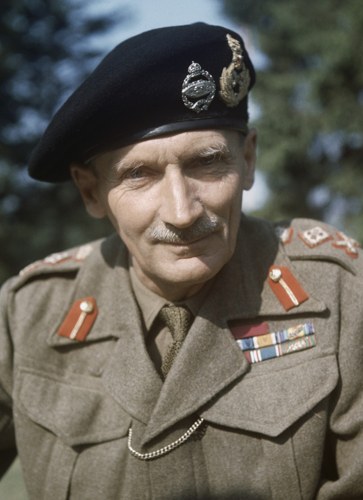
Bernard Law Montgomery

General (later Field Marshal)

Unit: British Eighth Army

Distinguished Service Order (WWI), Knight Grand Cross of the Order of the Bath (KGB), Viscount Montgomery of Alamein (peerage), Knight Grand Cross of the Order of the British Empire (GBE), numerous foreign decorations. Full decorations list is extensive; this entry lists selected major awards only. Verify complete list against official records.

Bernard Law Montgomery was born on 17 November 1887 in Kennington, London, and was educated at the Royal Military College, Sandhurst. He was commissioned into the Royal Warwickshire Regiment in 1908. In the First World War he served on the Western Front, was shot through the lung at the First Battle of Ypres in October 1914 (the wound that required his evacuation at Méteren), and was awarded the Distinguished Service Order. He served on the Western Front through 1918, ending the war as a Lieutenant Colonel with a strong reputation as a staff officer and trainer. In the interwar period Montgomery developed a reputation as a demanding and meticulous trainer of troops, sometimes abrasive to superiors and subordinates alike, but consistently focused on preparation and doctrine. He commanded the 3rd Infantry Division and III Corps during the 1940 campaign in France and Belgium, and his corps returned from Dunkirk in better order than most. He commanded various home defense formations before being appointed to the Eighth Army in August 1942, replacing General Neil Ritchie and then briefly General William Gott (who was killed when his aircraft was shot down before he could assume command). At El Alamein in October–November 1942, Montgomery commanded the offensive that broke the Afrika Korps. He subsequently commanded the Eighth Army through the North African campaign, the invasion of Sicily, and the opening phases of the Italian campaign. He commanded 21st Army Group during the Normandy invasion and the subsequent Northwest Europe campaign, including the controversial Operation Market Garden in September 1944. He was promoted to Field Marshal in September 1944. After the war he served as Chief of the Imperial General Staff and as Deputy Supreme Allied Commander Europe in NATO. He died on 24 March 1976 at Isington Mill, Hampshire. His character generated polarized accounts from contemporaries. American commanders, particularly Eisenhower and Patton, found his self-confidence difficult and his operational caution frustrating. Many of his own subordinates admired him intensely. Historical assessment has settled on a view of him as a first-rate set-piece battle commander with genuine limitations in the management of rapid exploitation and coalition relationships.

Photo
Pending

Erwin Johannes Eugen Rommel

Generalfeldmarschall

Unit: Panzerarmee Afrika

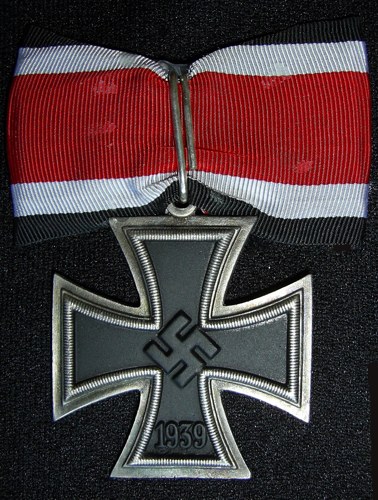
Pour le Mérite (WWI), Knight's Cross of the Iron Cross with Oak Leaves, Swords and Diamonds (Ritterkreuz), various other German military decorations. Verify full list against official records.

Erwin Rommel was born on 15 November 1891 in Heidenheim an der Brenz, Württemberg. He served with distinction in the First World War, receiving the Pour le Mérite (Germany's highest military decoration) for his actions at the Battle of Caporetto in 1917. In the Second World War he commanded the 7th Panzer Division during the 1940 France campaign with exceptional effectiveness and was promoted to command the Afrika Korps in February 1941, where his operational aggressiveness and intuitive grasp of mobile warfare earned him a considerable reputation among friends and enemies alike. By October 1942, Rommel was seriously ill and on medical leave in Germany when the El Alamein offensive began. He returned on approximately 25 October to find his line under severe pressure. His fuel and supply situation was critically inadequate, and the attrition of the following days removed his ability to mount the mobile counterattacks that had been his primary tactical instrument. He was promoted to Generalfeldmarschall in June 1942, the youngest person to hold that rank in the German Army at the time. After El Alamein, Rommel conducted a fighting retreat across Libya and Tunisia. He was evacuated from Africa in March 1943 before the final Axis collapse in Tunisia. He subsequently commanded Army Group B in France and was involved, at least peripherally, in the July 1944 plot against Hitler. Wounded by an air attack in July 1944, he was given the choice of suicide or trial and died by his own hand on 14 October 1944. His military record, particularly in North Africa, has been subject to significant reassessment by historians who have examined his conduct in a broader ethical context.

Photo
Pending

Oliver William Hargreaves Leese

Lieutenant General

Unit: XXX Corps, British Eighth Army

Knight Commander of the Order of the Bath (KCB), Commander of the Order of the British Empire (CBE), various campaign awards. Verify full list against official records.

Oliver Leese was born on 27 October 1894 and was educated at Eton and the Royal Military College. He served in the First World War and was wounded three times. By 1942 he was a Lieutenant General commanding XXX Corps, the formation given the primary task at El Alamein: breaching the Axis minefields in the northern corridor with four infantry divisions and creating the lanes for X Corps armor. He went on to command the Eighth Army after Montgomery moved to command 21st Army Group for the Normandy invasion, leading the Eighth Army in Italy in 1944. His record at El Alamein is documented in the official history. He died in January 1978.

Photo
Pending

Leslie James Morshead

Lieutenant General

Unit: 9th Australian Division

Knight Commander of the Order of the Bath (KCB), Commander of the Order of the British Empire (CBE), Distinguished Service Order (DSO), various other awards. Verify full list against official records.

Leslie Morshead was born on 18 September 1889 in Ballarat, Victoria, Australia. He served in the First World War at Gallipoli and on the Western Front. In civilian life he was a shipping executive. In the Second World War he commanded the 9th Australian Division at the Siege of Tobruk in 1941, where his stubborn defensive leadership became a significant chapter in Australian military history. At El Alamein in 1942 he commanded the same division in the offensive role, leading the attritional northern coastal attacks that were designed to pin and consume Axis reserves. His division's sustained pressure on the German 164th Infantry Division was a significant factor in stripping Rommel's options. He died on 26 September 1959.

Photo
Pending

John Currie

Brigadier

Unit: 9th Armoured Brigade

Research needed; specific decorations for Currie at El Alamein should be verified against London Gazette announcements and official records.

Brigadier John Currie commanded the 9th Armoured Brigade, which was tasked on 2 November 1942 with the most explicitly costly single assignment of the battle: to break through the Axis anti-tank screen at the opening of Operation Supercharge, even at the cost of the entire brigade. Currie was reportedly told by Montgomery and the 2nd New Zealand Division commander Bernard Freyberg that the brigade's losses could be as high as 100 percent. The brigade entered the attack with approximately 94 tanks and suffered losses of approximately 75 percent in achieving its objective. The assault broke the screen and allowed the 1st Armoured Division to engage the Axis armored reserve beyond it. Further biographical detail on Currie is available in regimental and brigade histories; verify against those sources before expanding this entry.

Photo
Pending

Harold Rupert Leofric George Alexander

General (later Field Marshal)

Unit: Commander-in-Chief, Middle East (from August 1942)

Knight Grand Cross of the Order of the Bath (GCB), Order of Merit, numerous other British and foreign decorations. Verify full list against official records.

Harold Alexander was born on 10 December 1891 and was educated at Harrow and Sandhurst. He served in the First World War with distinction and received multiple decorations. In the Second World War he commanded I Corps during the Dunkirk evacuation, where he was the last British officer to leave the beaches. He served in Burma in early 1942. As Commander-in-Chief Middle East from August 1942, he oversaw the appointment of Montgomery to the Eighth Army and gave Montgomery the operational latitude to prepare and execute the El Alamein offensive. Alexander went on to command 18th Army Group in Tunisia, 15th Army Group in Sicily and Italy, and commanded Allied forces in Italy until the end of the war. He was promoted to Field Marshal and later became Governor-General of Canada and Minister of Defence. He died on 16 June 1969.

Second Battle of El Alamein

23 October 1942 – 4 November 1942

The Second Battle of El Alamein was the decisive engagement of the North African campaign and, more broadly, a strategic turning point in the Second World War. It was fought between the British Eighth Army under General Bernard Montgomery and the Axis Panzerarmee Afrika under Generalfeldmarschall Erwin Rommel across a compressed front where the impassable Qattara Depression to the south and the Mediterranean to the north denied both sides the flanking room that had characterized earlier desert fighting.

Montgomery's offensive was built on material superiority, careful preparation, and an attritional plan that accepted high casualties in exchange for the systematic destruction of Axis combat power that could not be replaced. The battle proceeded in three broadly recognized phases: Operation Lightfoot, the initial infantry breach of the Axis minefields beginning 23 October; a grinding attritional phase from approximately 25 October to 1 November in which Axis reserves were progressively consumed, particularly by the 9th Australian Division's attacks in the north; and Operation Supercharge from 2 November, the concentrated assault that finally ruptured the Axis line and forced the armored engagement that destroyed Rommel's tank force.

Rommel, ill and absent at the battle's opening, returned to find his fuel critically short, his reserves being consumed faster than they could be replaced, and his defensive line under pressure he could not relieve by the mobile counterattacks that had been his primary tactical instrument. After eleven days, his armored strength was effectively destroyed. He ordered withdrawal on 4 November against Hitler's explicit orders to hold, and the Afrika Korps began the 1,500-mile retreat that ended in the final Axis defeat in Tunisia in May 1943.

Positions are approximate, based on published accounts.

Sources & Further Reading

BOOK

Barr, Niall. Pendulum of War: The Three Battles of El Alamein. London: Jonathan Cape, 2004. A major scholarly reassessment of all three El Alamein battles drawing on primary sources from multiple national archives.

BOOK

Playfair, I.S.O., and C.J.C. Molony. History of the Second World War: The Mediterranean and Middle East, Volume IV: The Destruction of the Axis Forces in Africa. London: HMSO, 1966. The British official history; primary reference for order of battle, casualty figures, and operational chronology.

BOOK

Hamilton, Nigel. Monty: The Making of a General 1887–1942. London: Hamish Hamilton, 1981. First volume of the authorized biography; covers Montgomery's career through El Alamein with access to personal papers.

BOOK

Heckmann, Wolf. Rommel's War in Africa. Translated by Stephen Seago. New York: Doubleday, 1981. German-perspective account drawing on Axis sources.

BOOK

Rommel, Erwin. The Rommel Papers. Edited by Basil Liddell Hart. London: Collins, 1953. Rommel's own accounts and diaries, edited posthumously; primary source for Axis perspective and fuel/supply situation.

BOOK

Bungay, Stephen. Alamein. London: Aurum Press, 2002. Accessible single-volume history integrating Allied and Axis perspectives.

BOOK

Lewin, Ronald. Montgomery as Military Commander. London: Batsford, 1971. Critical assessment of Montgomery's generalship including El Alamein and the pursuit phase.

BOOK

Montgomery, Bernard L. El Alamein to the River Sangro. London: Hutchinson, 1948. Montgomery's own account of the campaign; first-person perspective with the limitations of personal memoir.

OFFICIAL

Churchill, Winston S. The Second World War, Volume IV: The Hinge of Fate. London: Cassell, 1951. Churchill's account including his Cairo visit, appointment of Montgomery, and assessment of the battle's significance. Primary source for Churchill's 'end of the beginning' speech context.

BOOK

Hinsley, F.H., et al. British Intelligence in the Second World War, Volume II. London: HMSO, 1981. Official history of British intelligence; covers Ultra and its role in the North African campaign.

BOOK

Macksey, Kenneth. Tank Warfare: A History of Tanks in Battle. London: Rupert Hart-Davis, 1971. Technical and tactical reference for armored operations.

ARCHIVE

The National Archives, Kew: War Office files WO 169 (War Diaries, Middle East Forces) and WO 201 (Middle East Forces: Military HQ Papers). Primary archival source for operational orders, after-action reports, and casualty returns. Specific file references for this story should be verified by a researcher with direct archive access.