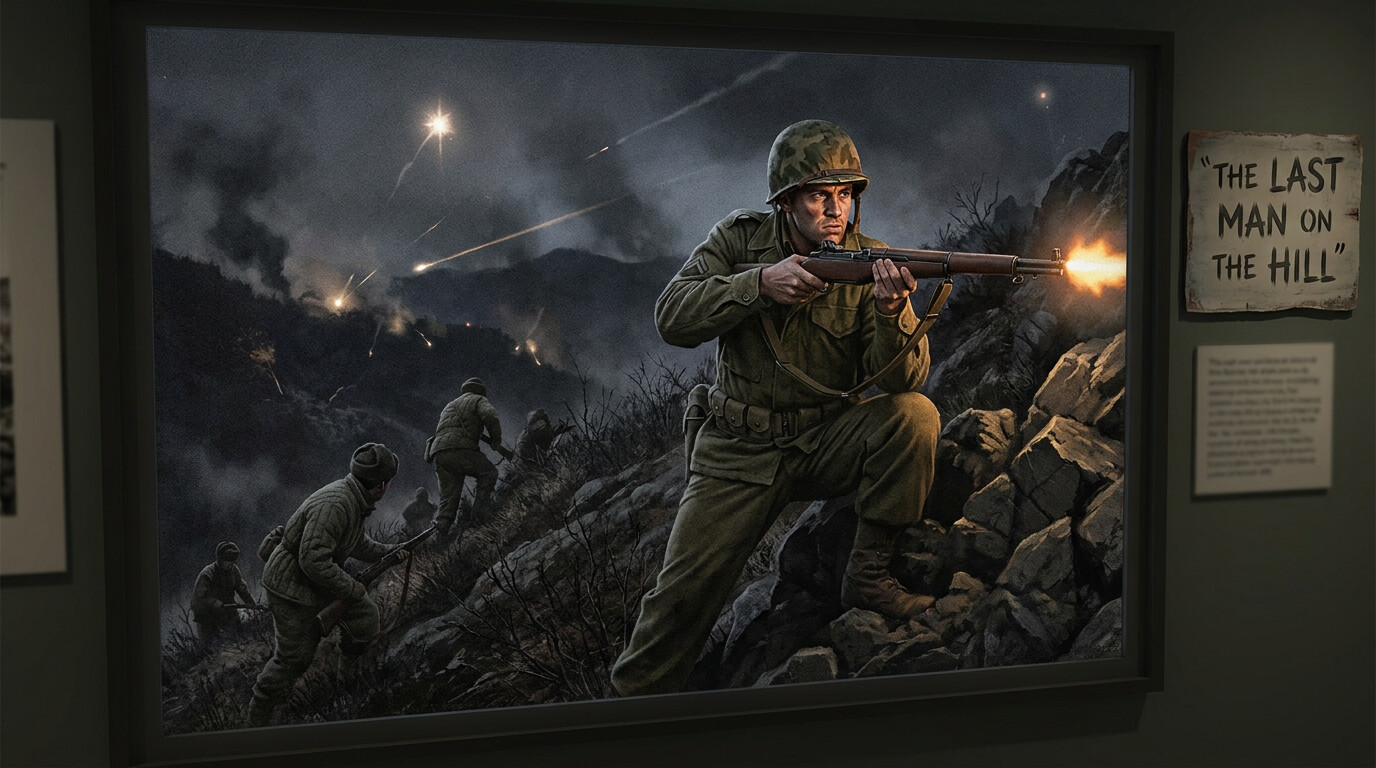
The Chinese came in waves across the frozen Korean ridgeline, their bugles screaming through the darkness. Corporal Hiroshi Miyamura pressed his cheek against the cold metal of his .30-caliber machine gun, watching muzzle flashes bloom like deadly flowers in the valley below. It was 0200 hours on April 25, 1951, and the 7th Infantry Regiment's forward positions near Taejon-ni were about to be overrun.
Miyamura had been in Korea for eight months, long enough to know the sound of a Chinese human wave attack building momentum. The bugles meant they were coming in force—maybe a full battalion hitting his company's thin line. His machine gun crew huddled in their fighting position, steam rising from their breath in the sub-freezing air. The war had been grinding on for nearly a year, and everyone knew the Chinese preferred night attacks, massing infantry to overwhelm UN positions through sheer numbers.
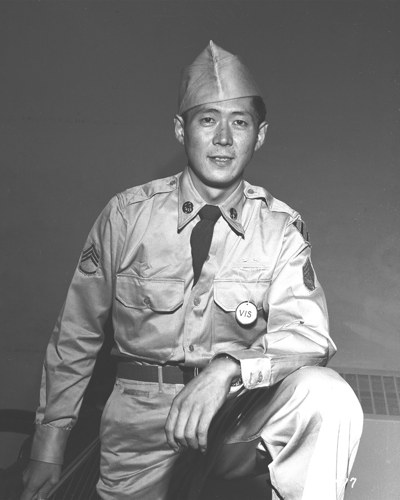
Hiroshi Harry Miyamura was 25 years old, a Nisei soldier from Gallup, New Mexico. He had volunteered for the Army in 1944, serving in the final months of World War II, then returned to civilian life before being recalled to active duty for Korea. Now he found himself squad leader for a machine gun crew in Company H, 7th Infantry Regiment, 3rd Infantry Division—'The Rock of the Marne'—holding a critical position on the approaches to Seoul.
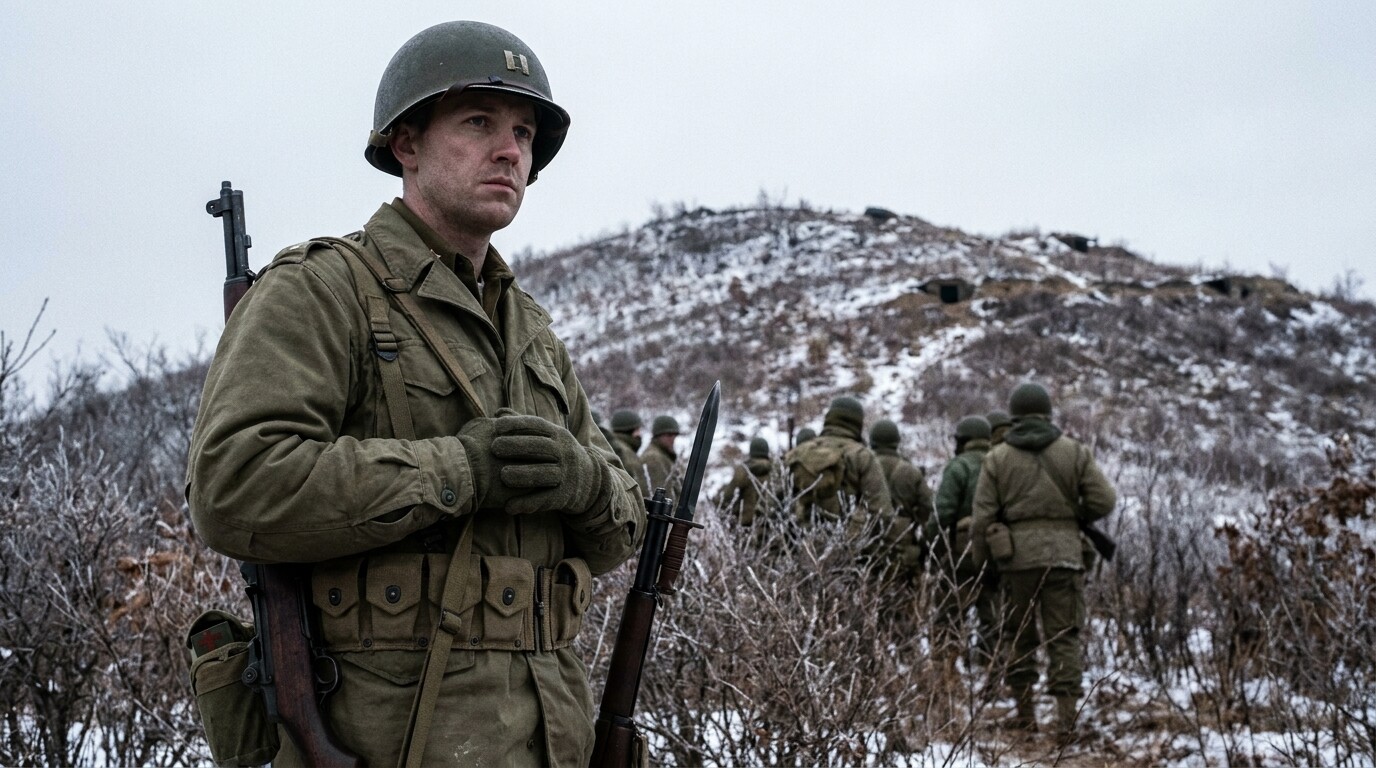
The 7th Infantry had arrived in Korea in September 1950, just after the Inchon landing, and had been in almost continuous contact with Chinese and North Korean forces since December. By April 1951, the war had settled into a grinding campaign of hills and ridgelines, with both sides fighting for tactical advantage in terrain that seemed designed to break armies. The Chinese Spring Offensive was building toward its climax, and intelligence reports indicated massive enemy forces concentrating for a push toward Seoul.

The position Miyamura's squad defended was tactically critical—a forward observation post and machine gun nest that controlled the approaches to the main defensive line. The terrain around Taejon-ni consisted of steep hills divided by narrow valleys, perfect for channeling attacking forces into killing zones. His .30-caliber M1919A6 machine gun could deliver sustained fire across an 800-yard front, but only if the crew could hold their position.
The M1919A6 was a proven weapon, developed from the original M1919 design that had served in World War I. Weighing 32 pounds with its bipod mount, it fired .30-06 Springfield ammunition at 400-500 rounds per minute from 250-round belts. The gun required a crew of two—gunner and assistant gunner—though experienced crews could operate it with one man if necessary. In Korea's harsh conditions, the weapon's reliability had proven invaluable, though the bitter cold could cause feeding problems if the crew wasn't careful.
Miyamura's position also included several M1 Garand rifles, the standard infantry weapon that had proven itself throughout World War II and was now seeing its final major conflict. The eight-round en-bloc clip system and .30-06 cartridge gave American infantry significant firepower advantages over Chinese forces armed primarily with bolt-action rifles and submachine guns. Each rifleman carried 80 rounds of ammunition in clips, along with fragmentation grenades.
The first probe came at 0230 hours—a squad-sized element moving up the valley floor, testing the American positions. Miyamura held his fire, watching through the darkness as the Chinese soldiers picked their way through the broken ground. Company H had been reinforced with additional ammunition and told to hold at all costs; intelligence indicated this sector would face the main Chinese effort.

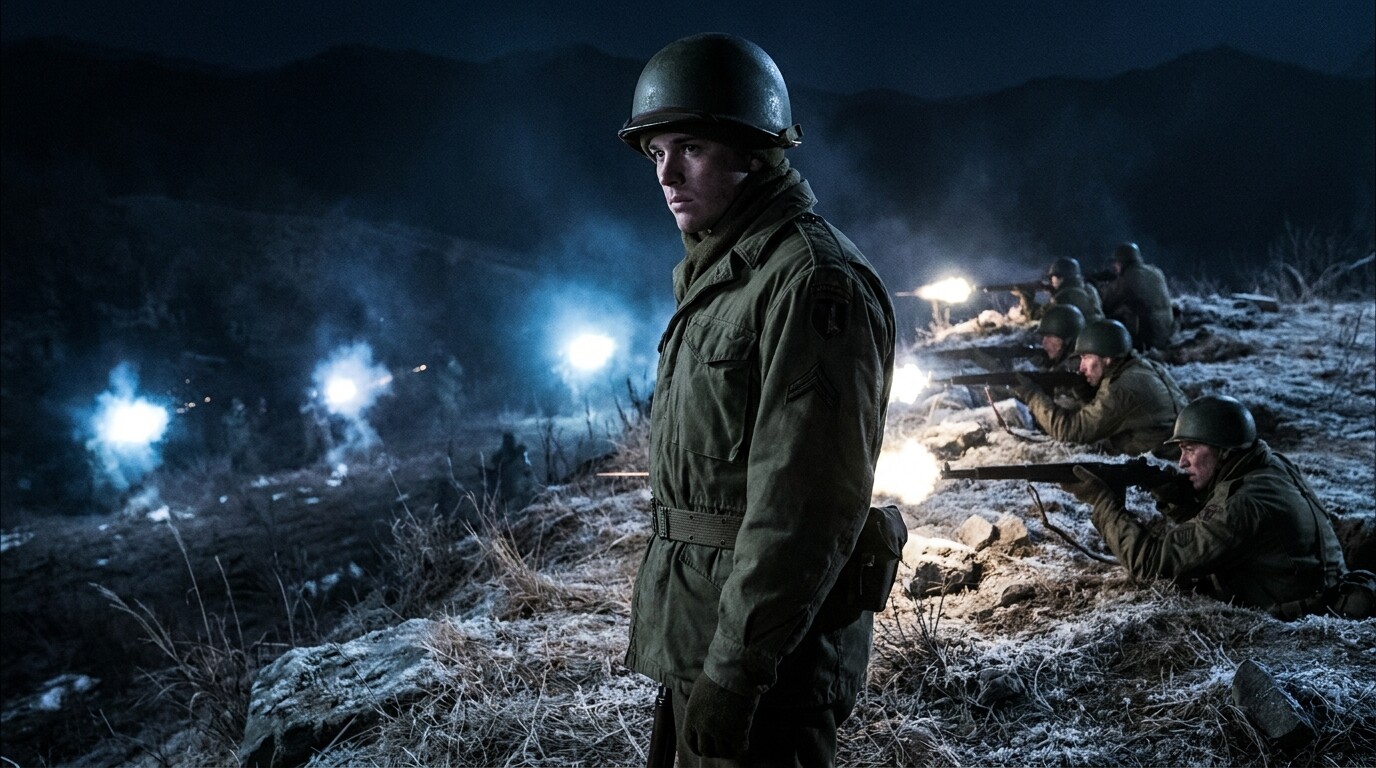
At 0245, the real attack began. Bugles blared from multiple directions as Chinese infantry emerged from covered positions all along the valley. Miyamura could see them in the starlight—hundreds of soldiers in quilted uniforms moving in disciplined formations toward the American line. The distinctive crack of Chinese burp guns echoed off the hillsides, answered by the deeper bark of American M1 rifles.
Miyamura opened fire with the machine gun, his tracers arcing across the valley in deadly streams. The weapon's sustained fire capability allowed him to sweep entire sections of the attacking force, but the Chinese kept coming. This was their standard tactic—accept heavy casualties to close with American positions, then use superior numbers in close combat.
The Chinese attackers were primarily equipped with Soviet-supplied weapons. Many carried the PPSh-41 submachine gun, nicknamed the 'burp gun' by American troops for its distinctive high rate of fire. The weapon's 71-round drum magazine and 900 rounds per minute cyclic rate made it formidable in close combat, though its effective range was limited. Chinese riflemen used the Mosin-Nagant bolt-action rifle, a proven design but significantly slower than the American M1 Garand's semi-automatic capability.
For three hours, Miyamura's gun crew held their position against repeated assaults. The machine gun barrel grew red-hot from continuous firing, forcing brief pauses to change barrels and allow cooling. His assistant gunner fed ammunition belts while Miyamura adjusted fire to meet each new threat. Chinese casualties mounted in front of their position, but the attacks kept intensifying.

By 0545 hours, the tactical situation had become desperate. Chinese forces had penetrated the company's flanks, threatening to surround the forward positions. Company H received orders to withdraw to the secondary defensive line, but someone had to provide covering fire for the movement. Miyamura volunteered his crew to remain in position and cover the withdrawal.
The withdrawal began at first light, with American squads bounding back by sections while Miyamura's machine gun provided suppressive fire. His position was now completely exposed, with Chinese forces moving to encircle the gun crew from multiple directions. The tactical doctrine was clear—machine gun crews were expected to hold their positions until the last possible moment to ensure successful infantry withdrawals.
As daylight grew stronger, Miyamura could see the full scope of the Chinese assault. At least two battalions were attacking Company H's sector, with additional forces moving to exploit any breakthrough. His machine gun had become the primary obstacle to Chinese success, forcing them to concentrate their efforts on eliminating his position.
The Chinese brought up what appeared to be a Type 24 heavy machine gun, a copy of the German MG08 that fired 7.92mm ammunition. The weapon's sustained fire capability matched Miyamura's gun, but its crew had better tactical position and supporting infantry. Return fire began impacting around the American position with increasing accuracy.

Miyamura continued firing until his ammunition ran critically low and Chinese infantry had closed to within grenade range. His assistant gunner had been wounded by mortar fragments, leaving him to operate the weapon alone. The withdrawal was nearly complete—he could see the last American squads reaching the secondary line—but Chinese forces were now attacking his position from three sides.
Rather than abandon the machine gun and attempt to escape, Miyamura remained at his post until the weapon was completely out of ammunition. He then used his M1 rifle and grenades to continue the defense, buying additional time for any stragglers to reach safety. When Chinese infantry finally overran his position around 0630 hours, Miyamura was found unconscious from combat exhaustion and multiple minor wounds.
The Chinese captured Miyamura and several other wounded Americans from the forward positions. For the next 28 months, he would endure harsh conditions in prisoner-of-war camps in North Korea—inadequate food, brutal interrogation methods, forced labor, and continuous political indoctrination attempts.
The action at Taejon-ni was part of the larger Chinese Spring Offensive of 1951, which ultimately failed to achieve its strategic objectives. Company H's successful withdrawal allowed the 7th Infantry Regiment to maintain its defensive positions and contribute to stopping the Chinese advance toward Seoul. The tactical delay achieved by Miyamura's machine gun crew helped prevent a potential breakthrough that could have compromised the entire sector.

Miyamura's Medal of Honor recommendation was processed through normal channels, but the award was kept classified while he remained a prisoner of war. The Army feared that publicizing his decoration might subject him to additional harsh treatment or execution by his captors—a precaution taken for other captured soldiers who had been recommended for high decorations.
Operation Big Switch, the prisoner exchange conducted between August and December 1953, returned over 12,000 UN prisoners of war, including Miyamura and approximately 4,000 other Americans. Upon his repatriation in August 1953, Miyamura learned that he had been awarded the Medal of Honor for his actions at Taejon-ni. President Eisenhower personally presented the decoration in a White House ceremony on October 27, 1953.
The Medal of Honor is America's highest military decoration, awarded for conspicuous gallantry and intrepidity at the risk of life above and beyond the call of duty. During the Korean War, 131 Medals of Honor were awarded, with 94 going posthumously. Miyamura was one of only 37 Korean War recipients to survive and receive the decoration in person.
Miyamura's story reflects the broader experience of Nisei soldiers in America's military. Despite facing discrimination and internment during World War II, Japanese Americans served with distinction in both conflicts. The 442nd Regimental Combat Team became the most decorated unit in U.S. military history during World War II, while individual Nisei soldiers like Miyamura continued serving in Korea and later conflicts.

After leaving the Army, Miyamura returned to New Mexico, where he operated a gas station and became active in veterans' affairs. He rarely spoke publicly about his combat experience, preferring to focus on his post-war life and family—a reticence common among Korean War veterans, whose service often went unrecognized due to the conflict's unpopular status and inconclusive ending.
The tactical lessons from Taejon-ni reinforced several principles of defensive warfare demonstrated throughout the Korean conflict. Machine gun crews positioned on commanding terrain could inflict severe casualties on attacking infantry, but only if they had adequate ammunition and supporting fires. The Chinese human wave tactics, while costly, could overwhelm isolated positions through sheer persistence and numbers.
Korean War combat demonstrated the continued relevance of individual courage in modern warfare. Despite advances in military technology, critical moments still came down to individual soldiers making life-or-death decisions under extreme pressure. Miyamura's choice to remain at his post exemplified the warrior ethos that sustained American forces throughout the conflict.
The delayed announcement of Miyamura's Medal of Honor highlighted the complex relationship between military recognition and operational security. While the Army wanted to honor exceptional courage, it also had to protect soldiers still in enemy hands—a tension between public recognition and tactical security that would become increasingly relevant in later conflicts involving prisoners of war.
Miyamura's legacy extends beyond his individual heroism to represent the sacrifice of all Korean War veterans. The conflict's 54,000 American casualties often received less recognition than those from World War II or Vietnam, despite facing equally difficult conditions and determined enemies. Korean War veterans fought in harsh weather, difficult terrain, and complex political circumstances that made victory definitions ambiguous.
The machine gun position at Taejon-ni, like thousands of similar actions throughout Korea, demonstrated how tactical decisions by individual soldiers could influence strategic outcomes. Miyamura's successful covering action allowed Company H to maintain unit integrity and continue fighting, contributing to the larger defensive success that stopped the Chinese Spring Offensive.
Today, Miyamura's Medal of Honor serves as a reminder that courage manifests in many forms—not just in dramatic charges or spectacular victories, but in quiet determination to do one's duty regardless of personal cost. His willingness to sacrifice his freedom to ensure his comrades' safety reflects the fundamental bond between soldiers that sustains military units under extreme pressure. The night at Taejon-ni stands as testament to the individual courage that ultimately determines the outcome of battles, campaigns, and wars.