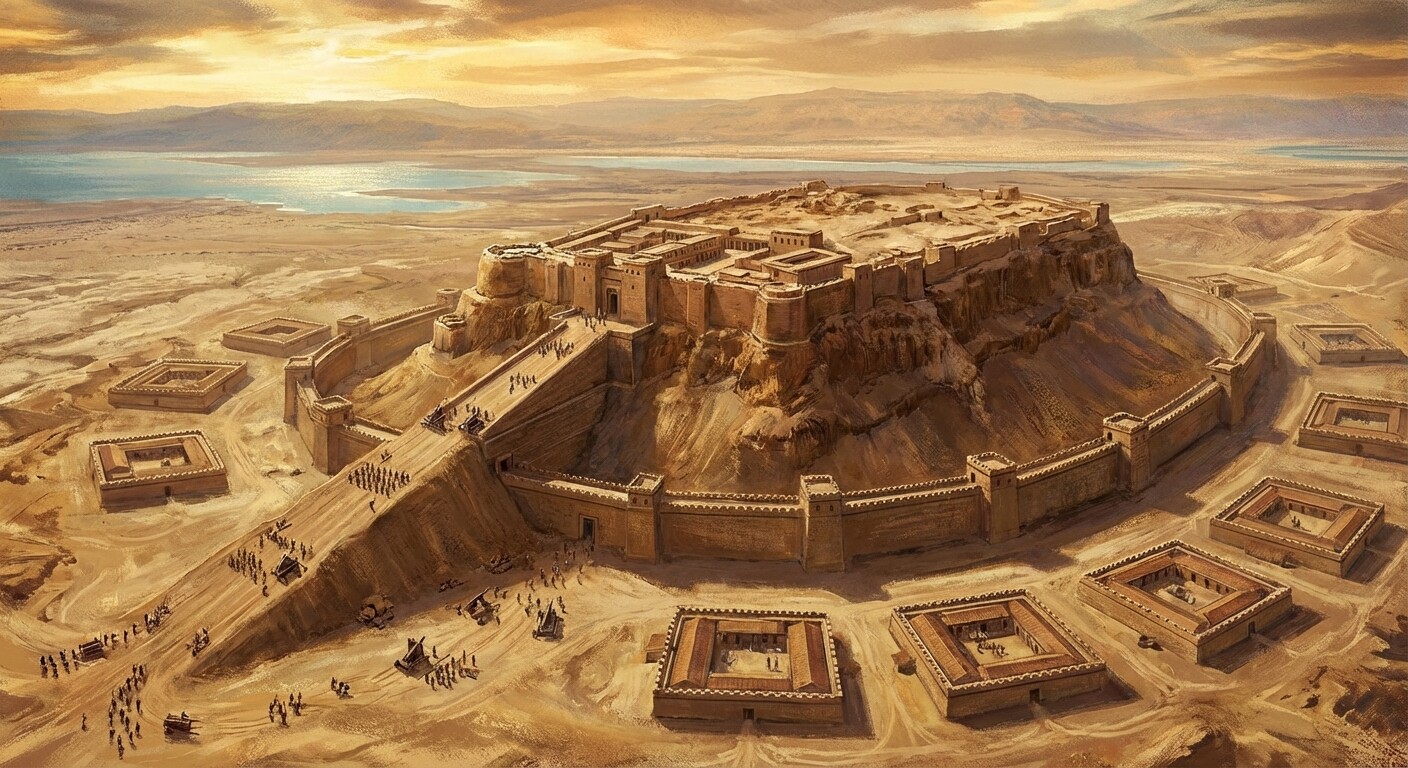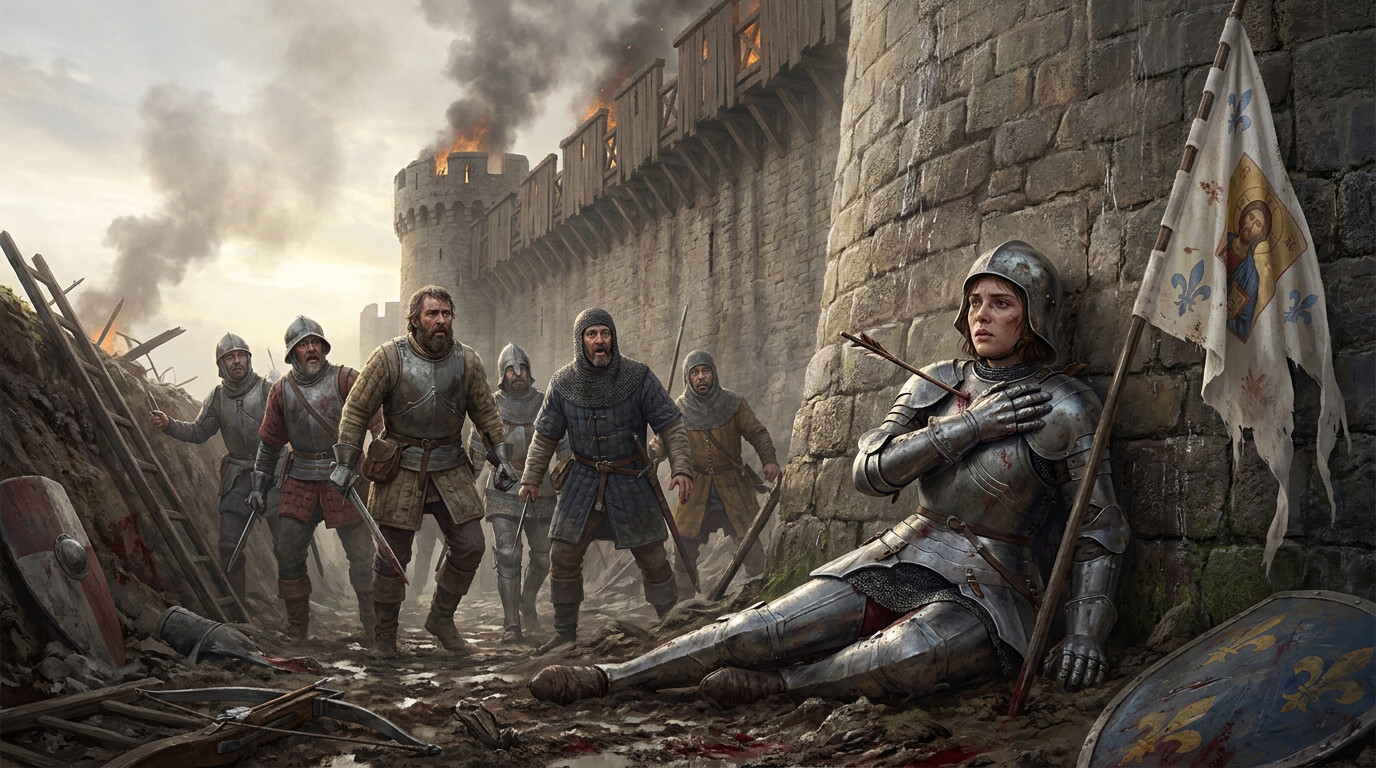
The bolt struck her between the neck and shoulder.
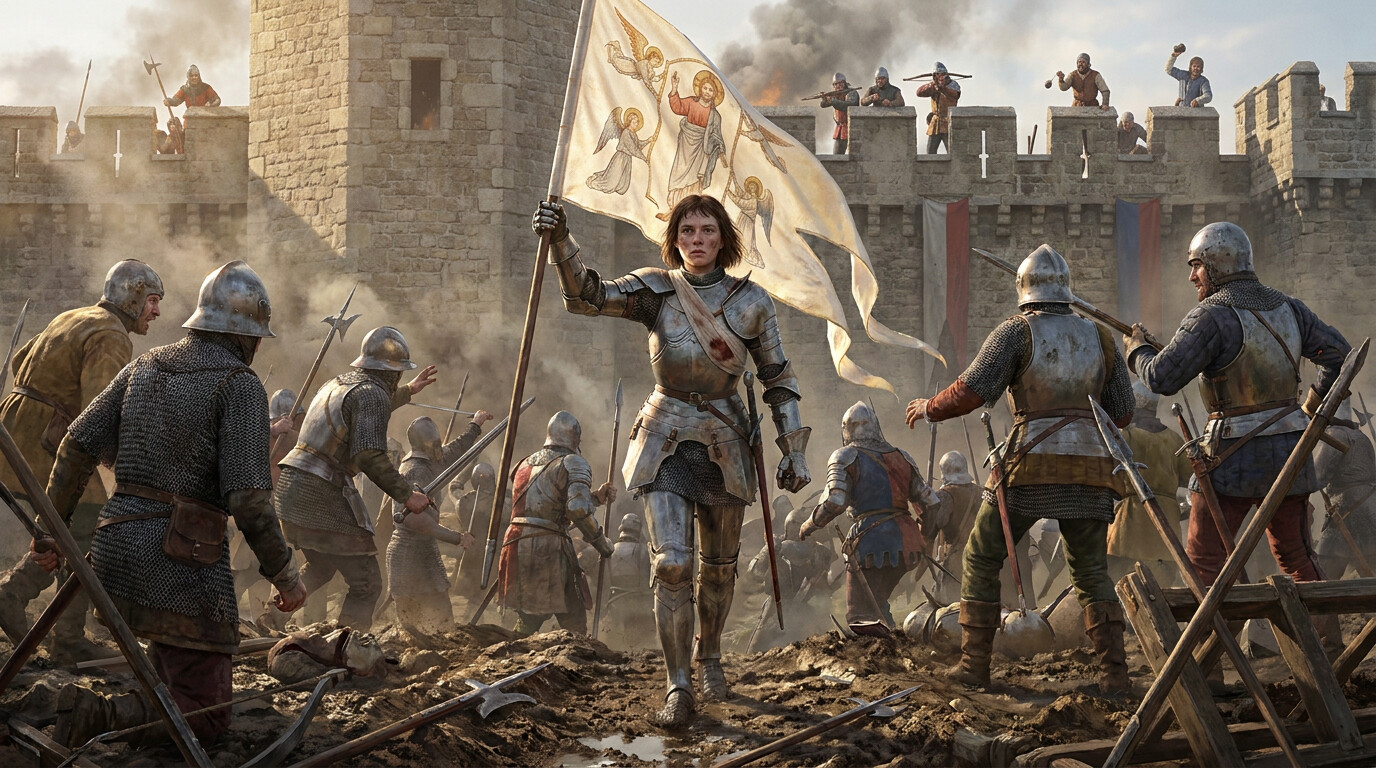
She had been in the ditch below the English stronghold of Les Tourelles for most of the afternoon of May 7, 1429, holding a scaling ladder against the outer wall of the fortified bridge gatehouse while crossbow bolts, stones, and burning pitch fell from above. When the quarrel found the gap between her gorget and pauldron and drove into her, her men dragged her back. She wept. The bolt was removed—the sources disagree on whether she drew it herself or allowed attendants to do it, and on the precise sequence of treatment. She prayed. Then she came back.
Her return to the assault was the moment that broke the English defense of Orléans.
That is the documented core of it. Everything around that core—what she thought, what she felt, how her presence translated into military effect—requires careful reconstruction from the surviving trial records and chronicles, and an honest acknowledgment of what cannot be known. Joan of Arc is among the most documented individuals of the medieval period, and almost all of that documentation comes from people who were either trying to burn her or trying to save her. The picture that emerges is still extraordinary.
---
**France in 1429: A Kingdom Coming Apart**
To understand what happened at Orléans, it is necessary to understand how desperate the French position was by the time Joan arrived.
The Hundred Years War had been underway, with interruptions, since 1337. By 1429 it had reached a state of catastrophic French disadvantage. At Agincourt in 1415, Henry V had destroyed a French field army with such thoroughness that the military aristocracy of northern France was shattered. The Treaty of Troyes in 1420 formalized the catastrophe: the English crown was to inherit the French throne. Henry V died in 1422, as did Charles VI of France, leaving the infant Henry VI as nominal ruler of a unified Anglo-French kingdom under the regency of John, Duke of Bedford.
Charles VII, the Dauphin and rightful claimant by French succession, controlled only the lands south of the Loire. He had never been formally crowned. His government at Chinon was demoralized, fractious, and chronically short of money. His commanders had failed to stop the English advance. The city of Orléans, on the Loire, was the last significant fortress blocking the English from pushing south and effectively ending organized French resistance.
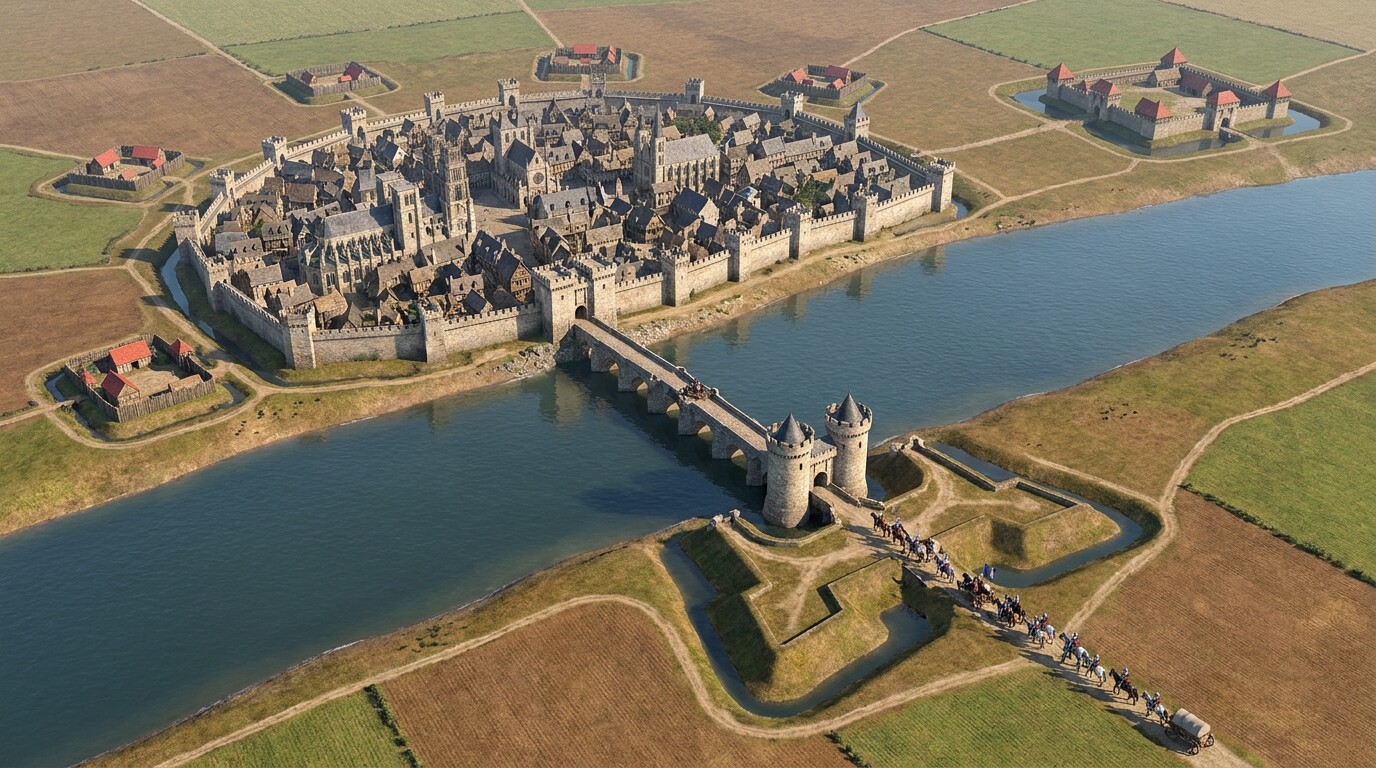
In October 1428, an English force under Thomas Montacute, Earl of Salisbury, began the siege. Salisbury was killed almost immediately—struck by a stone ball or fragment from the city's artillery, though whether it was a direct hit, a ricochet, or a deflected shot the sources do not fully resolve—and command passed to William de la Pole, Earl of Suffolk, and came under the broader strategic direction of John Talbot, one of the most feared English commanders of the era. Unable to fully invest a city of Orléans's size, the English built a network of fortified strongpoints called bastilles around the city's perimeter. The most significant was the fortified bridgehead at Les Tourelles, on the south bank of the Loire, captured in late October 1428 after fierce fighting.
The French garrison, under Jean de Dunois—the Bastard of Orléans, an experienced and capable commander who would remain Joan's most reliable military partner—held the city but could not break out. A relief attempt under the Count of Clermont was routed at the so-called Battle of the Herrings in February 1429, a failed effort to intercept an English supply convoy that cost the French another field engagement and further crushed morale. By March 1429, the English had not yet fully closed their ring around the city, but food was being managed carefully and the garrison's will was eroding.
This was the military situation when a teenage girl from Domrémy arrived at Chinon and asked to see the Dauphin.
---
**The Person: Jeanne d'Arc**
Joan of Arc was born, by the most widely accepted scholarly estimate, around January 6, 1412, in the village of Domrémy in the Duchy of Bar, in the region now known as Lorraine. Her father, Jacques d'Arc, was a peasant farmer of modest but stable means who served as a local village official. Her mother, Isabelle Romée, was by all accounts a devout woman who taught Joan her prayers.
Joan was illiterate. This is documented and should be understood not as a marker of intelligence but of social position—she was a peasant woman in the early fifteenth century. She was physically capable: examination records from Poitiers and her own trial testimony describe someone accustomed to hard outdoor work. She could ride a horse, a skill she reportedly developed quickly once in military service.
Beginning around age thirteen, Joan reported hearing voices and experiencing visions she identified as Saint Michael, Saint Catherine, and Saint Margaret. She believed these saints commanded her to travel to the Dauphin, secure his coronation as king of France, and drive the English from the kingdom. This account comes from her own testimony at her trial in Rouen in 1431—given under extreme duress, with execution explicitly threatened, which adds a complicated layer to any assessment of the record. She was consistent in these claims across repeated hostile interrogations. Whether the visions were supernatural, psychological, neurological, or constructed for strategic purposes is a question historians and medical writers have pursued for six centuries without resolution. What is documented is that she believed them and acted on them without deviation.
In the spring of 1429, after being turned away once and travelling to Vaucouleurs where the garrison captain Robert de Baudricourt eventually agreed to provide her an escort, Joan reached Chinon. She met Charles VII. The precise nature of that meeting is partly obscured by later tradition—the story that she identified him among his court when he was in disguise appears in some chronicles but scholars note it may be embellishment, and it should be treated as such. What is documented is that Charles agreed, after her examination at Poitiers by a commission of theologians, to allow her to join the relief expedition to Orléans. She was provided with armor, a horse, a standard, and a military household. She held no formal rank in any modern military sense, but she was given a position of enormous symbolic and, it would prove, practical authority.
She was, by the best estimates, seventeen years old.
---
**The Army and Its Commanders**
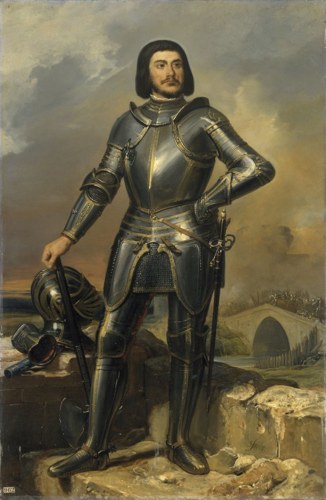
The French force assembled to relieve Orléans was not a rabble. It included experienced captains: Dunois, who had already been defending the city for months; Gilles de Rais, a Breton lord and veteran commander who would later become notorious for crimes entirely separate from his military service; La Hire (Étienne de Vignolles), a mercenary captain of considerable tactical skill and famously rough character; and Poton de Xaintrailles, another experienced soldier.
The problem was not the quality of the officers. The problem was morale, coordination, and the deep strategic pessimism that had settled over the French command after years of defeat. The professional captains had their own views about how to fight the English, shaped by bitter experience. Joan would frequently disagree with them, sometimes openly.
The army assembled at Blois in late April 1429 and rode toward Orléans.
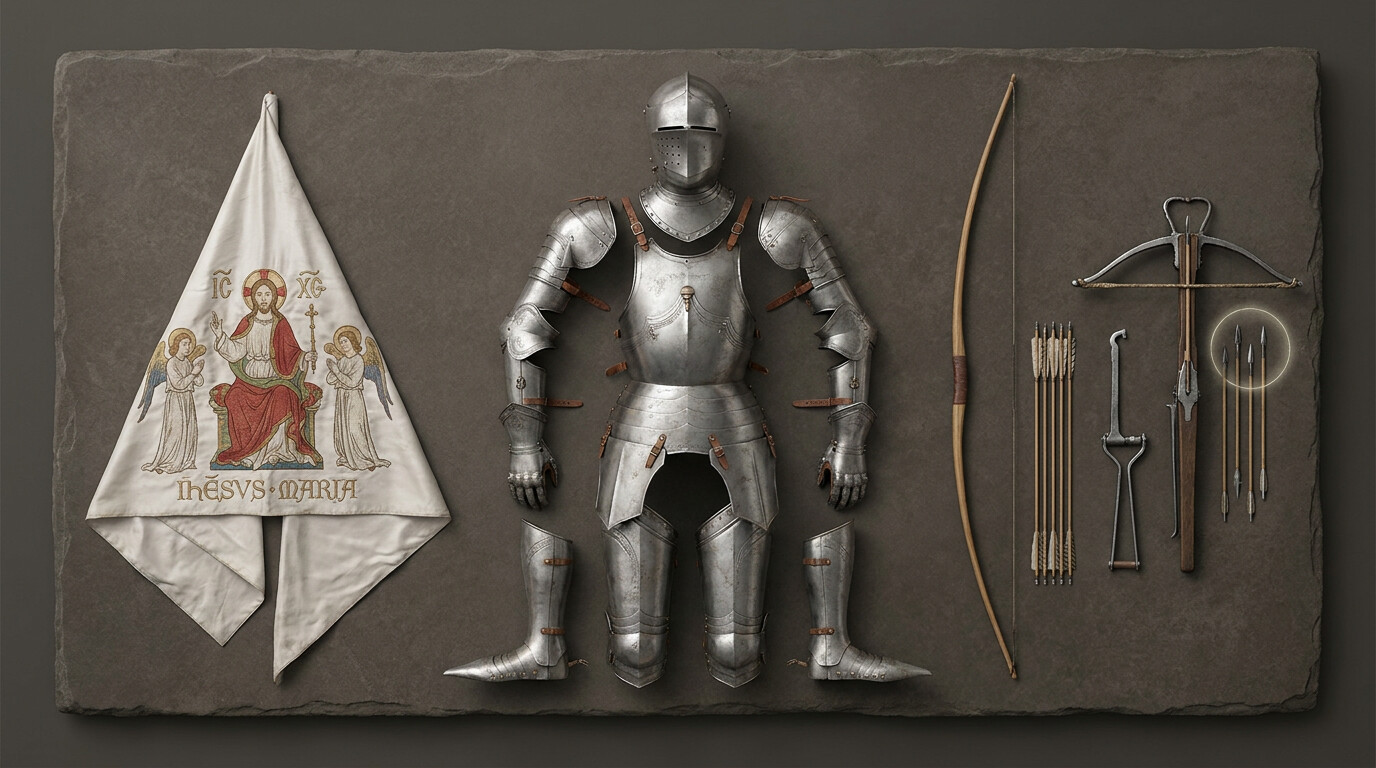
Her equipment, as documented in period accounts and partially from surviving purchase records: she wore full plate armor, fitted to her body. This was standard heavy cavalry equipment—not a symbolic gesture but a practical battlefield necessity if she was going to be in close proximity to combat. She carried a lance and a sword. A tradition flourishing from roughly the sixteenth century onward attached particular significance to a sword said to have been found behind the altar at the church of Sainte-Catherine-de-Fierbois, which she reportedly identified by her voices. The sword was mentioned at her trial. Whether it was genuinely of historical significance or an ordinary weapon given symbolic meaning in the retelling cannot be established from surviving evidence, and it should be treated as traditional.
What is documented clearly is her standard: a white banner bearing a representation of Christ in majesty, with angels at his sides, and the names Jesus and Maria. She said at her trial that she loved her standard forty times more than her sword. In medieval warfare, a commander's standard was a battle management tool as much as a symbol—it told soldiers where the commander was and whether they were advancing or holding. Joan carried it into direct assault.
---
**Arrival at Orléans**
The French command debated how to introduce the relief army to the besieged city. The English bastilles blocked the direct road on the north bank. Dunois and the captains decided to bring supplies in by river, on the south bank, and transfer Joan and a small contingent into the city while the main army returned to Blois to escort a second supply convoy.
On April 29, 1429, Joan entered Orléans. The time is traditionally given as eight in the evening, with some contemporary accounts describing crowds lining the streets by torchlight. Whether the reception was precisely as jubilant as later accounts insist is worth holding with some caution—chronicles written with the benefit of hindsight have a tendency to amplify what became historically decisive—but the consistent thread across multiple sources, including Dunois's own deposition at the Rehabilitation Trial of 1456, is that her arrival visibly changed the spirit of the garrison and the city's population.
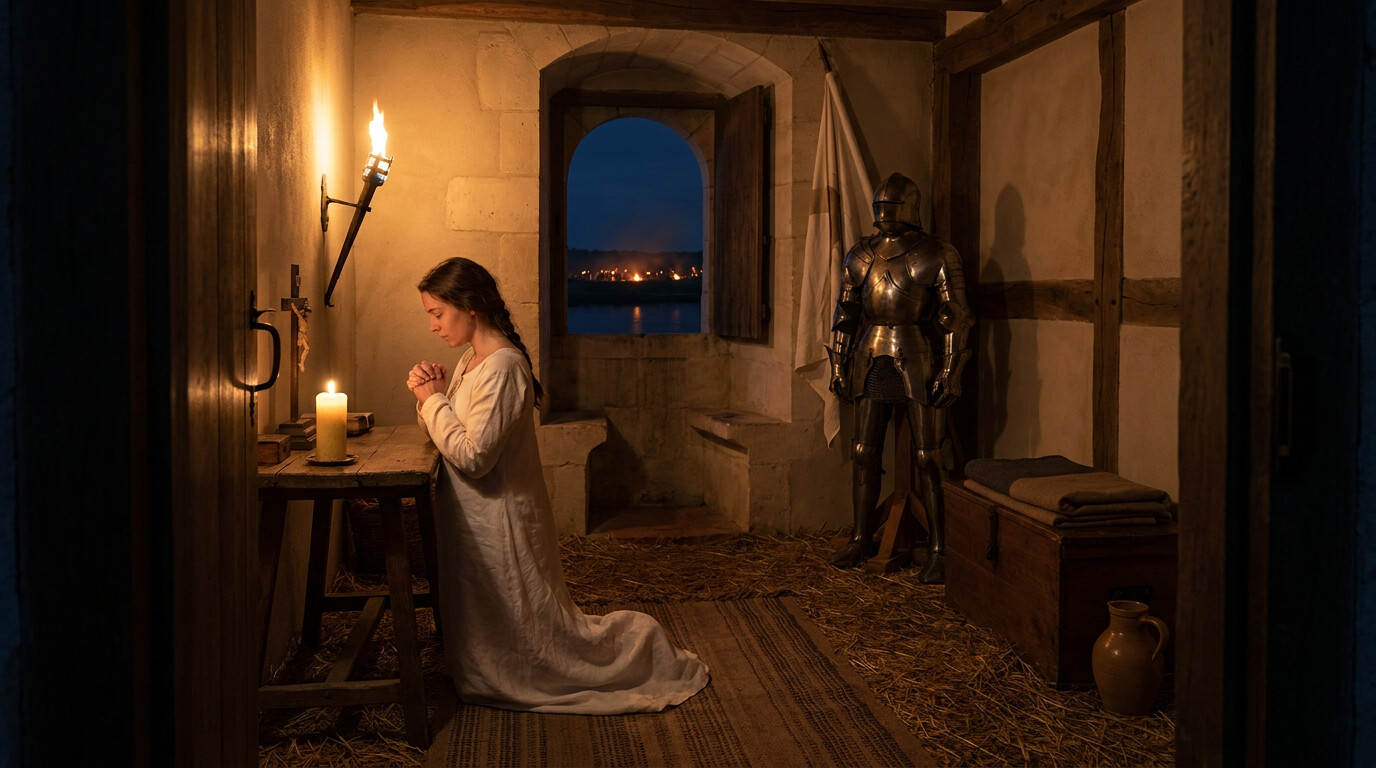
She stayed in the house of Jacques Boucher, treasurer of the Duke of Orléans. She slept. She prayed. She sent demands to the English commanders in the bastilles ordering them to withdraw. The English response was contemptuous. Exchanges between the two sides—including rough insults directed at her specifically, referencing her gender and her claimed divine authority—appear consistently enough across sources to treat as substantially documented, though the precise wording of those exchanges survives only in French accounts and cannot be fully verified.
For several days there was frustration. The main army with the second supply convoy had not yet returned. The garrison captains were cautious. According to Dunois's later account, Joan was not always informed of attacks in advance—the commanders made operational decisions without her, partly because they were uncertain of her military role and partly because they had not found a way to integrate someone with her unusual authority into conventional planning.
The friction was real. It resolved itself, decisively, once the fighting started.
---
**The Bastilles Fall: May 1–6**
The English fortified positions ringing Orléans were individually substantial but collectively undermanned. The English besieging force numbered somewhere in the range of five thousand men—scholarly estimates vary—stretched around a perimeter they could not fully close. The bastilles were strong points, not a continuous wall. Each was a fortified earthwork capable of defending itself but relying on mutual support to remain effective.
On May 1, the second French supply convoy arrived safely. The mood in the city shifted.
On May 4, without Joan's foreknowledge according to her own statements and Dunois's account, French forces attacked and captured the bastille of Saint-Loup on the east side of the city. Joan reportedly was roused from rest by the noise and rode to the action. The bastille fell. Its garrison was largely killed, though some sources indicate prisoners were taken. The loss of Saint-Loup broke the eastern sector of the English cordon and opened communication in that direction.
On May 6, French forces crossed to the south bank of the Loire and attacked the outer fortifications protecting the Les Tourelles bridgehead complex. The Augustinian monastery and its associated earthworks fell after fighting. The English pulled back into the main fortifications of Les Tourelles itself and the boulevard—a fortified earthwork on the south bank linking the towers to the bank.
The stage was set for May 7.
---
**May 7: Les Tourelles**
Les Tourelles was the keystone of the English position. The fortified gatehouse of the Orléans bridge, substantially strengthened with earthworks, ditches, and the wooden boulevard on the south bank approach, controlled the crossing and anchored the siege. Taking it would reopen the bridge, restore the city's southern communications, and effectively end the viability of the remaining English bastilles on the north bank.
The assault began in the early morning. The French attacked across the ditch and up against the walls of the boulevard and the towers. The English garrison, under William Glasdale—rendered in French sources as Glacidas—was small but occupying prepared fortifications with clear fields of fire.
The weapons on both sides defined the tactical problem.
The English longbow remained the primary English infantry firepower system throughout the Hundred Years War. A trained archer could release approximately ten to twelve arrows per minute at effective ranges of up to two hundred yards or somewhat more against massed targets. At shorter ranges, against men in armor climbing siege equipment, the bow's flatter arc could find gaps in plate or drive through less-protected areas of the body. The longbow had won Crécy, Poitiers, and Agincourt. At Agincourt fourteen years earlier, French cavalry had been destroyed attempting to advance across open ground against prepared English archers. The tactical memory of that destruction was still shaping French behavior in 1429.
But siege assault changed the equation. Men climbing scaling ladders or crossing a ditch are partially obscured by the wall above them. The angle of fire from defenders is awkward at close range. The longbow's decisive advantage—stand-off firepower against a massed approach across open ground—is reduced when the attackers are already at the wall. The assault on Les Tourelles forced closer-range fighting where English firepower advantage was diminished, though their defensive position advantage remained.
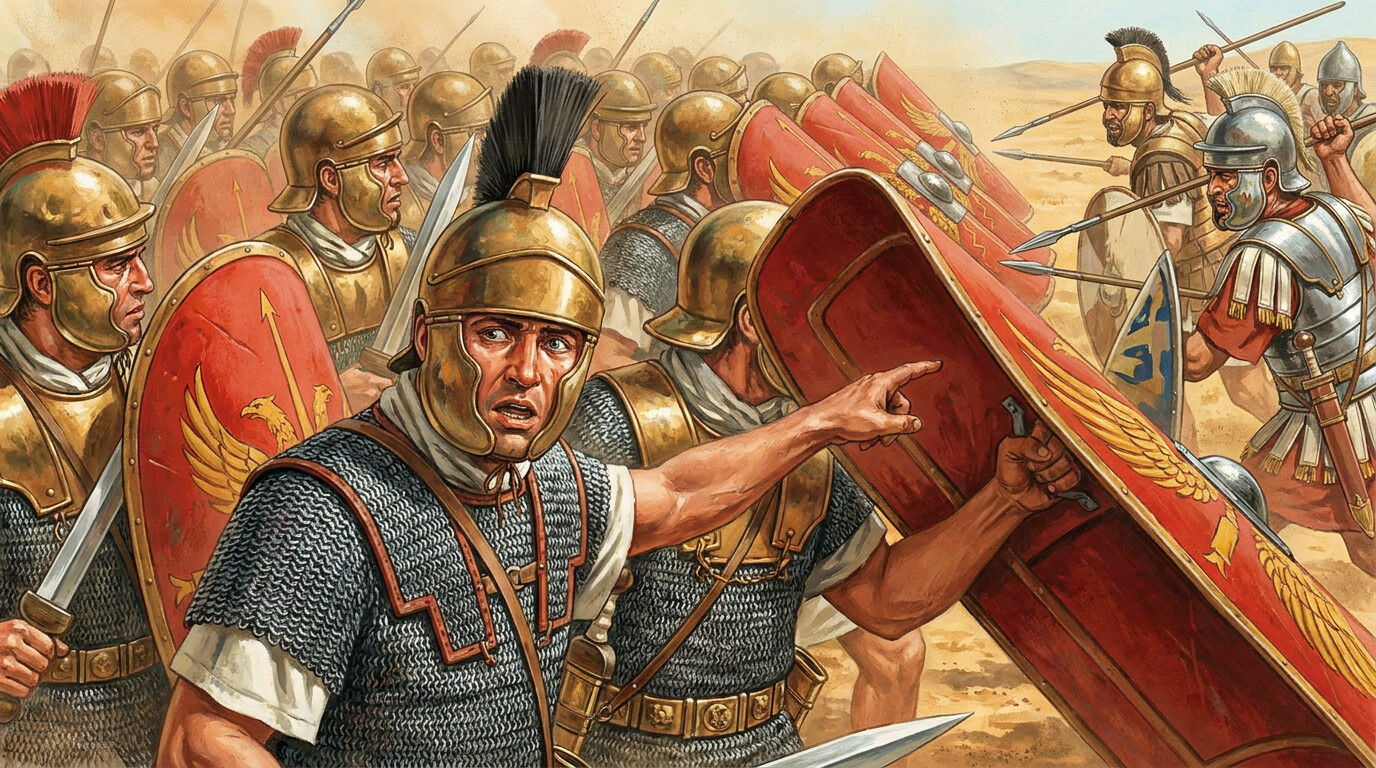
The crossbow was the standard ranged weapon of French and allied infantry at Orléans. Its rate of fire was much slower than the longbow—perhaps two bolts per minute for a skilled operator—but it required less physical training to use effectively and delivered a heavy quarrel at considerable velocity. The bolt that struck Joan was almost certainly a crossbow quarrel, though whether it was fired by an English or Burgundian crossbowman cannot be established with certainty from the sources. The wound was serious enough to require her withdrawal from the fighting.
French artillery was present throughout the campaign. Both the city's fixed defenses and the relief army fielded pieces ranging from heavy bombards—capable of throwing stone balls weighing hundreds of pounds and the likely type that killed Salisbury in October 1428—to smaller serpentines and veuglaires firing at higher rates. French royal artillery was in a period of rapid development in this era; the systematic improvements under the Bureau brothers in the 1440s and 1450s were still in the future, but the weapon class was already proving its battlefield value. At Les Tourelles on May 7, however, artillery's role in the assault itself was limited by proximity and the nature of the close-quarters fighting. The primary work was being done by infantry.
The assault lasted most of the day. Contemporary accounts describe repeated French attempts to scale the walls, with ladders being pushed off and men falling back into the ditch. Joan was in the ditch with them, carrying her standard. Multiple witnesses at the Rehabilitation Trial described her presence in the assault, carrying her banner rather than a weapon. This was consistent with her own trial testimony, in which she acknowledged not killing anyone in battle, though she was present in close-range fighting multiple times.
The bolt struck her in the mid-afternoon—the timing in medieval battle accounts is inherently imprecise, and some sources place it earlier. It entered above the armor's gorget line, at the gap between neck and shoulder protection. The wound forced her out of the assault. She withdrew, received treatment, and prayed.
Then she returned.
Her return is documented across multiple witness accounts at the Rehabilitation Trial. Dunois described the moment. Others who were present gave depositions indicating that her reappearance in the assault, carrying her standard, was the signal for the French troops to renew the attack. Whether this account is fully accurate or involves the retrospective inflation that attaches to any witnessed moment of obvious historical significance cannot be definitively determined. What is documented is the result: the French assault resumed, the English defense of the boulevard collapsed, and Glasdale—attempting to withdraw across the bridge into the towers—fell into the Loire when the bridge gave way. He drowned. The exact mechanism by which the bridge failed—artillery damage, fire, or structural collapse under the weight of the retreat—is not established in contemporary sources. The English survivors of the boulevard garrison surrendered or were killed. Les Tourelles fell to the French before nightfall.
Later accounts report that Joan wept for the English soldiers who died. This detail is consistent with other surviving characterizations of her conduct, but it cannot be fully verified and should be treated as tradition.
---
**May 8: The English Withdraw**
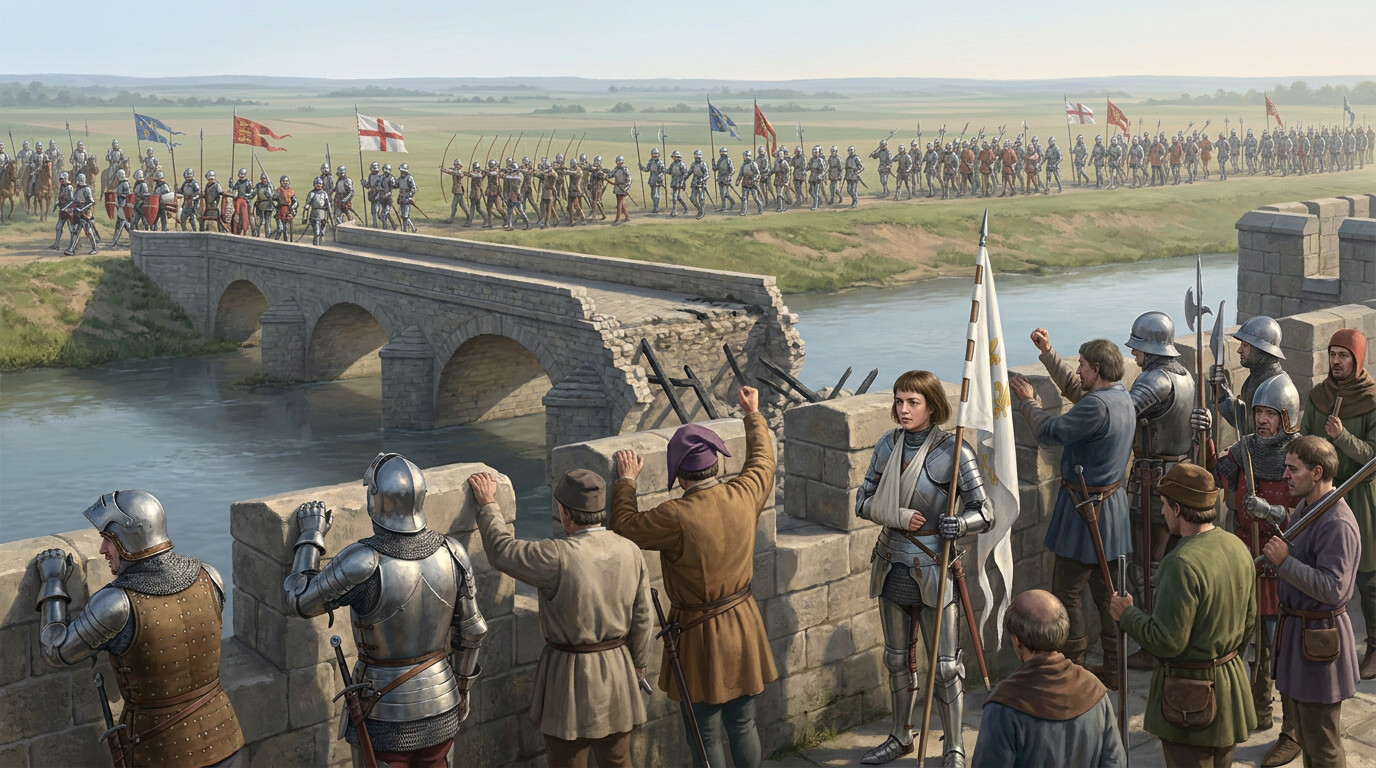
The following morning, the English forces remaining in the northern bastilles—John Talbot among them—drew up in battle formation outside the city walls. They were prepared to fight if the French came out. The garrison and Joan's forces came out and formed up opposite them.
For a period measured in hours, the two armies faced each other across the ground north of Orléans. Then the English turned and marched away.
They left behind their siege equipment, their supplies, and their dead. The siege of Orléans, underway since October 1428—approximately seven months—was over.
Why Talbot chose not to fight that morning is one of the genuinely interesting tactical questions of the campaign. He was an experienced and aggressive commander who would go on fighting in France for another two decades. The explanation most historians find persuasive combines several factors: the loss of Les Tourelles had broken the coherence of the siege and demonstrated that the English lacked sufficient force to hold their remaining positions against a re-energized garrison and relief army; a pitched battle in the open against French forces that had just taken a major fortification would have been at roughly even odds at best; and the English strategic position, while weakened, was not immediately catastrophic if the army was preserved intact. Talbot judged that fighting was not worth the risk. No primary document recording his reasoning survives; this assessment is inferred from the strategic situation and his documented pattern of behavior across his career.
He was correct about preserving his army. He was wrong about the strategic effect of the withdrawal.
---
**The Cost**
French casualties over the nine days of active assault operations are not precisely documented in surviving records. The fighting at Saint-Loup, at the Augustinian monastery, and at Les Tourelles was close and brutal by the standards of any era—men in armor in ditches and on scaling ladders under missile fire, with stones and improvised missiles dropped from above. The French losses at Les Tourelles included several captains and an unknown number of soldiers. Whether boiling water or oil was used by the defenders, as some later sources suggest, cannot be confirmed from contemporary documentation.
Joan's wound was serious but not disabling. She was present and active on May 8. She had also sustained a minor foot injury earlier in the campaign when she stepped on a caltrop—a scattered iron spike used as an obstacle—though this was trivial by comparison.
English losses at Les Tourelles were severe. The destruction of the boulevard garrison and the death of Glasdale meant the primary fighting force at the bridgehead was gone. The remaining bastille garrisons withdrew largely intact, which is why Talbot had a formed field force to march away on May 8.
---
**Anchoring the Account in the Record**
Joan of Arc is, paradoxically, both the most documented and the most contested individual of the medieval period. The primary sources are substantial but require careful handling.
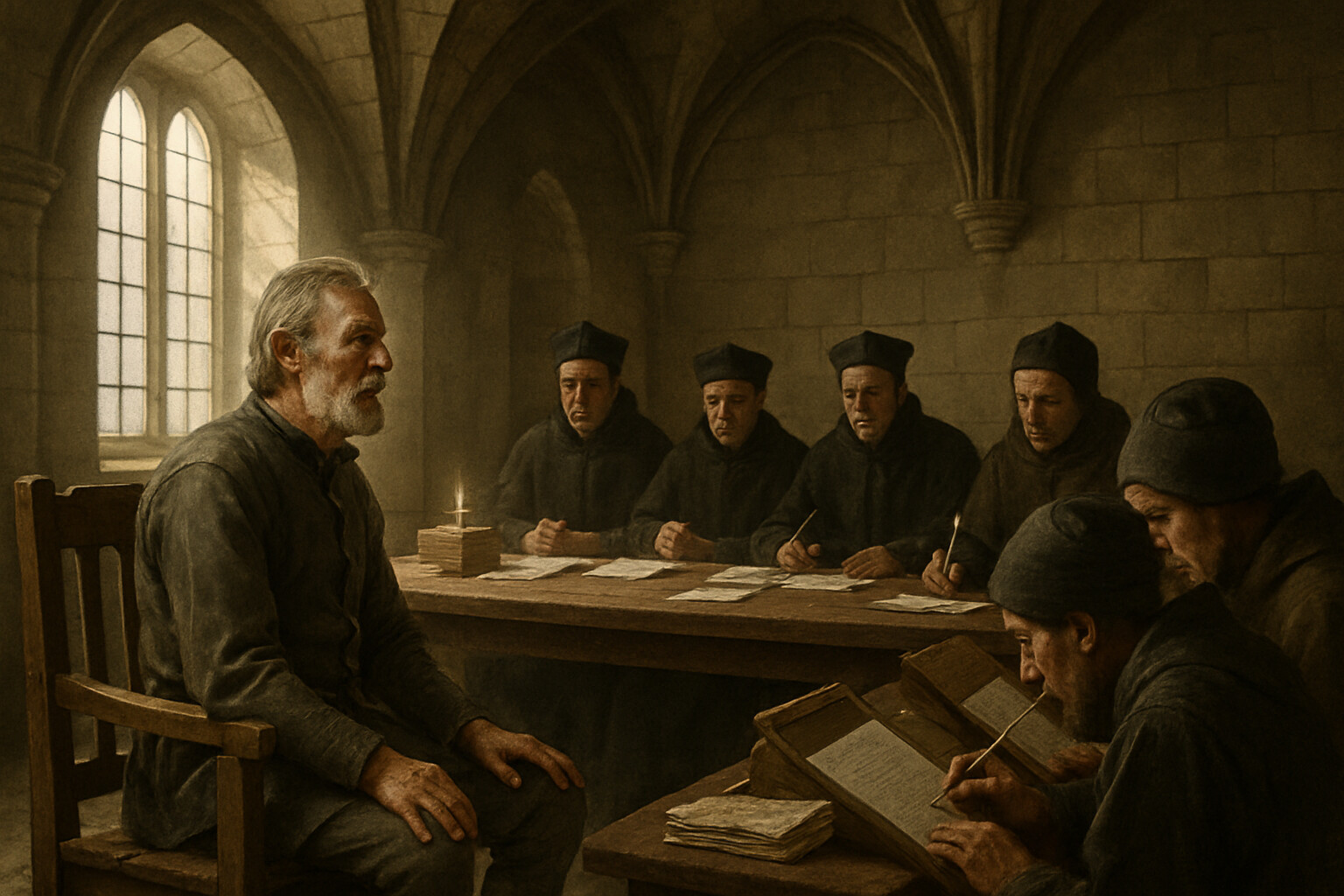
The Trial of Condemnation at Rouen in 1431 produced detailed transcripts of Joan's interrogations across several months. She was questioned intensively about her childhood, her visions, her military actions, and her theology. The transcript is the closest thing to her own voice that survives—but the questions were shaped by a court determined to convict her of heresy, and her answers were given under the extreme psychological pressure of imprisonment, examination by multiple hostile theologians, and the explicit threat of death. Historians use this source extensively and carefully.
The Rehabilitation Trial of 1455–1456, initiated by Charles VII after the French had retaken Rouen and the political landscape had shifted, produced depositions from dozens of witnesses who had known Joan during her campaigns. Jean de Dunois testified. La Hire had died in 1443 and could not, but others who had served with her gave accounts. These depositions are invaluable precisely because they come from people with direct experience of her—and they require careful reading precisely because they were given twenty-five years after the events, with obvious retrospective shaping by knowledge of what she had become.
The contemporary chronicles—including the Journal du Siège d'Orléans, a near-contemporary account existing in multiple manuscript versions—provide tactical and logistical detail. These too require scrutiny: they were written with varying levels of access to events and varying degrees of partisanship.
The detail about her standard, her wound, and her return at Les Tourelles is consistent across multiple independent sources and is among the more reliably documented moments of the campaign. The specific wording of her demands to the English, the content of her conversations with the captains, and the precise sequence of events within individual engagements are reconstructed from sources with varying reliability and should be understood as such.
---
**Legacy**
The relief of Orléans was not the end of the Hundred Years War. It was not even the end of the campaign—in the weeks that followed, Joan and the French army swept through the Loire valley, defeating English forces at Jargeau, Meung-sur-Loire, Beaugency, and most significantly at Patay on June 18, 1429, where French cavalry caught the English longbowmen before they could establish their prepared position and routed them, capturing Talbot himself. These operations opened the road north, and on July 17, 1429, Charles VII was crowned King of France at Reims Cathedral, with Joan standing beside him bearing her standard.
Joan's trajectory after the coronation grew more difficult. The political and military situation became more complicated. She was captured by Burgundian forces at Compiègne on May 23, 1430, sold to the English, tried for heresy by a French ecclesiastical court operating under English influence, and burned at the stake at Rouen on May 30, 1431. She was nineteen years old.
The trial verdict was formally overturned by the Church in 1456 at the conclusion of the Rehabilitation Trial. Pope Calixtus III had authorized the inquiry, and the conclusion was that the original proceedings had been conducted with procedural violations and political bias. Joan was declared innocent.
She was canonized by the Catholic Church on May 16, 1920, by Pope Benedict XV. She is the patron saint of France.
The question that military historians return to is not theological. It is operational: what did she actually do at Orléans?
The most persuasive answer is not that she conducted the siege operations alone or devised the tactical plan—experienced captains like Dunois were managing those decisions, and they frequently disagreed with her about timing and aggressiveness. What she did was alter the psychological state of an army at a moment when that psychological state was the limiting factor on what the French forces could achieve.
The French had the men, the supplies, and the fortification to sustain a defense of Orléans indefinitely. What they had lost was the willingness to take offensive risks against an English army that had consistently punished French offensive operations for fifteen years. Joan's presence—her absolute certainty, her physical courage in the assaults, her apparent disregard for her own safety, and the interpretive frame her claimed divine commission provided to the men around her—gave the French forces a reason to attack that professional military calculation alone had not supplied.
The bolt that struck her on May 7 was, in that context, almost perfectly placed to reveal that dynamic. Her withdrawal could have ended the assault. Her return renewed it. The English garrison at Les Tourelles was not overwhelmed by superior numbers or broken by artillery. It was worn down by an assault that refused to stop.
She was seventeen years old, illiterate, and standing in a ditch below a fortified wall with a crossbow bolt wound above her shoulder.
She went back in.
That is the documented center of what happened at Orléans.