HomeStoriesWeaponsBattlesPeopleWarbirdsAbout
All Stories

The High-Water Mark: Pickett's Charge at Gettysburg, July 3, 1863

Date: 1863 Location: Gettysburg, Pennsylvania Unit: Confederate infantry divisions
~21 minutes min read
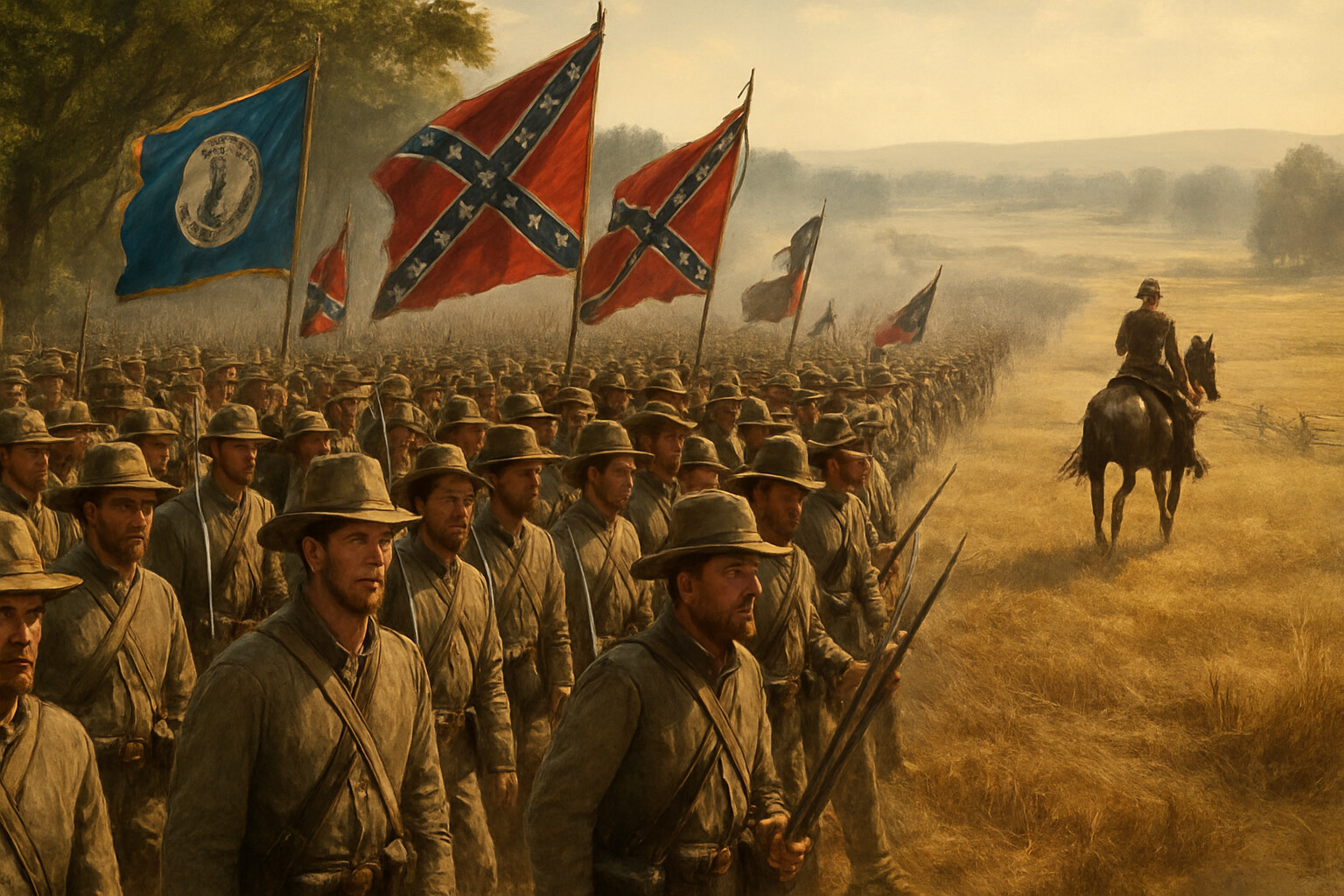
The Confederate infantry stepping out of the tree line on Seminary Ridge — the opening moment of the charge, lines dressed, flags unfurled, facing open ground and the distant Union positions on Cemetery Ridge.

The cannons went quiet at last. After nearly two hours of Confederate artillery fire—the longest sustained bombardment of the entire war to that point—the guns fell silent across Seminary Ridge. A strange, thick stillness settled over the Pennsylvania farmland. The smoke from hundreds of cannon had not yet cleared when the tree line along the Confederate position began to move.

Lines of men emerged. Regiments, then brigades, then a full division front. They stepped out of the woods in dressed ranks, battle flags unfurling, and began to walk east across a shallow valley toward Cemetery Ridge, roughly three-quarters of a mile away. The Union soldiers watching from behind their stone walls and earthworks had a few seconds to understand what they were seeing. Then the Federal artillery opened again.

What followed in the next fifty minutes would be recorded as the most consequential infantry assault in American military history—not because it succeeded, but because of the scale of what it attempted and the finality of what it proved.

---

To understand why twelve thousand men were ordered to walk across that field, you have to understand how Robert E. Lee read the first two days of the battle, and what he believed was still possible on the morning of July 3.

Lee had brought the Army of Northern Virginia north into Pennsylvania for a constellation of reasons, all of them pressing. The Confederate war effort in the summer of 1863 was under severe strain. Vicksburg was under siege. Southern armies needed a major victory on Northern soil to revive the prospect of European recognition, to relieve pressure on Virginia, and to demonstrate to a Northern public already wearied by two years of war that the conflict could not be won at acceptable cost. A significant Confederate triumph in Pennsylvania might force a negotiated peace.

The Battle of Gettysburg had begun accidentally on July 1, 1863, when Confederate infantry under General Henry Heth moved toward the town looking for shoes and made contact with Union cavalry under Brigadier General John Buford. What started as a skirmish escalated through the morning as both sides fed troops into the fight. By afternoon, the Confederate First and Third Corps had driven Union forces through the town and back to Cemetery Hill south of Gettysburg. It was a tactical success—but the retreating Union soldiers occupied strong ground.
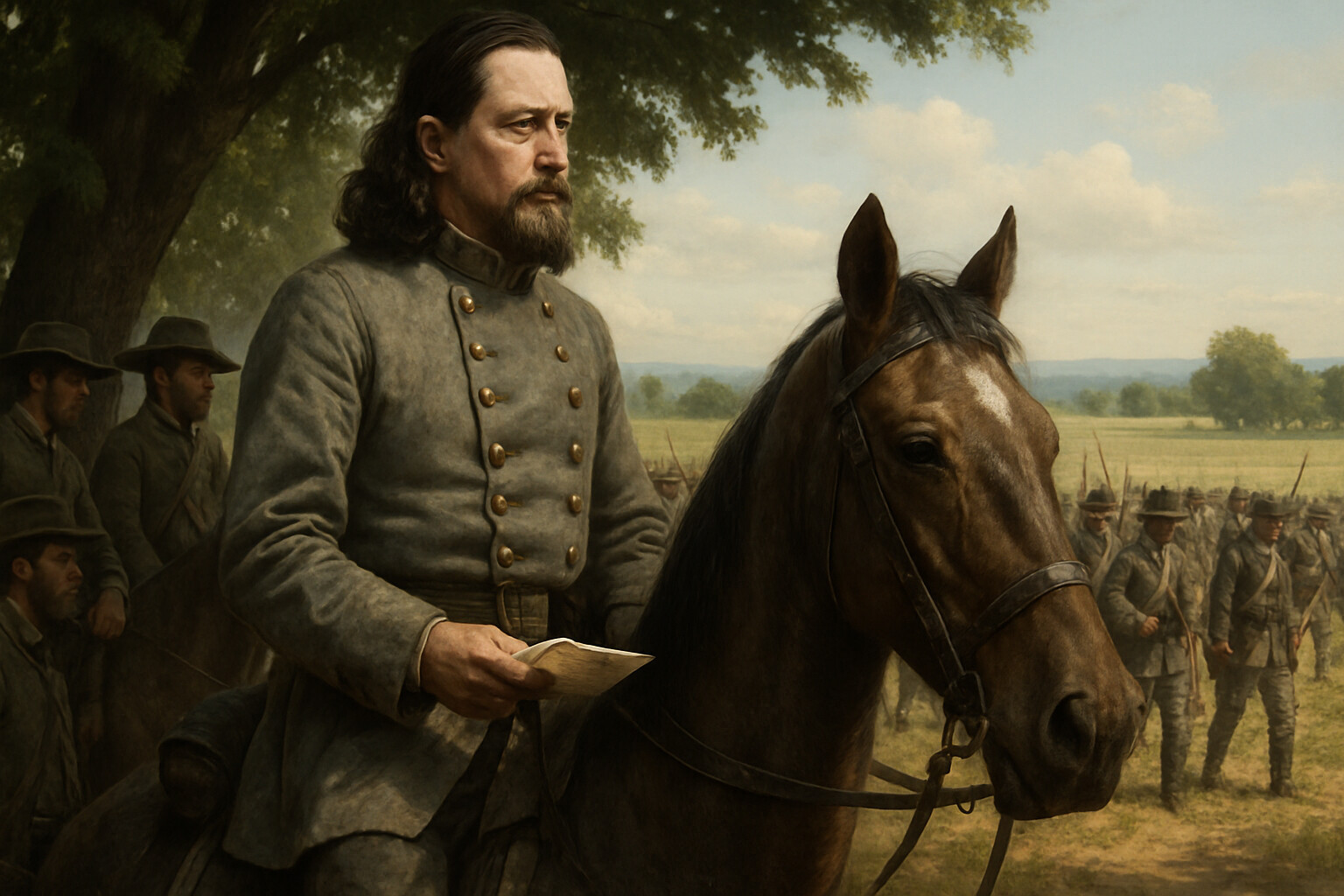
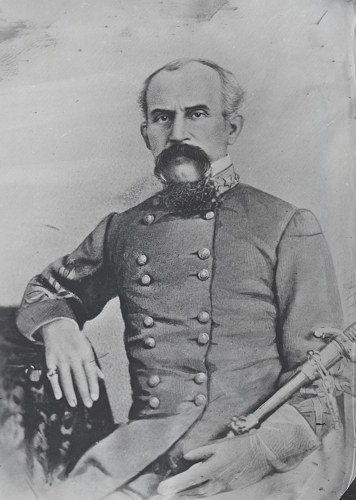
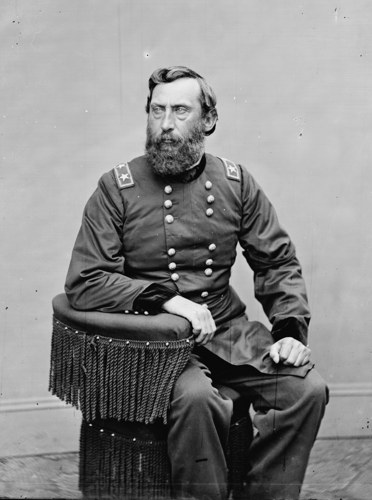
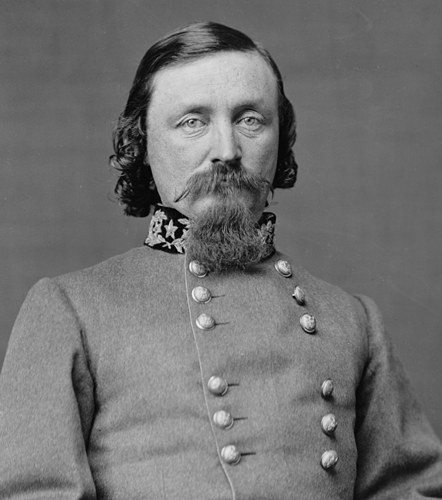
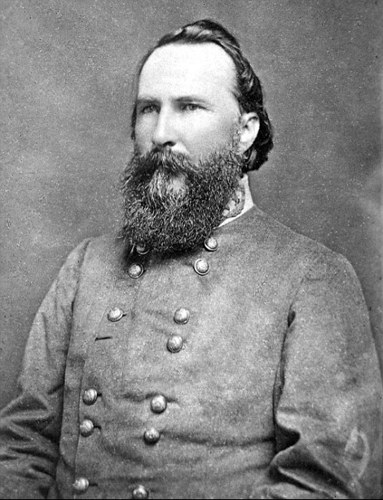
Portrait of George Pickett at Gettysburg — the commander before the assault, watching his division prepare to advance from a position behind the line.

On July 2, Lee pressed the attack on both flanks. Lieutenant General James Longstreet's First Corps hammered the Union left at Little Round Top, Devil's Den, the Wheat Field, and the Peach Orchard in bitter fighting that lasted through the late afternoon. Lieutenant General Richard Ewell's Second Corps assaulted Culp's Hill and Cemetery Hill to the north. Both attacks made local gains but did not break the Union line. The Army of the Potomac, now under Major General George G. Meade, held its positions.

On the morning of July 3, Lee convened with Longstreet. The Confederate commander's assessment was that two days of flank attacks had stressed the Union line enough that a concentrated blow at the center might break it. The Union flanks had been heavily engaged; perhaps the center had been stripped to reinforce them. Lee ordered a massed infantry assault against the Union center on Cemetery Ridge, to be preceded by a grand artillery preparation intended to silence the Federal guns and disorder the defenders.

Longstreet opposed the plan. He argued that it was tactically unsound to send infantry across nearly a mile of open ground against entrenched positions supported by artillery. By his own later account, he considered the attack doomed before it started. Lee overruled him. The assault would proceed.

---

George Edward Pickett was thirty-eight years old in the summer of 1863. A Virginian born in Richmond in 1825, he had graduated last in his West Point class of 1846—a distinction that would follow him through history. What his academic record obscured was a record of genuine personal courage in combat. He had served in the Mexican-American War, where he famously carried the flag over the parapet at the storming of Chapultepec in 1847, a feat that earned him a brevet promotion. He had served on the frontier afterward, including a tense confrontation with British forces during the Pig War on San Juan Island in 1859.

When Virginia seceded, Pickett resigned his U.S. Army commission and accepted a Confederate commission. He was promoted to Major General in October 1862 and given command of a division in Longstreet's First Corps. His division had not been heavily engaged at Chancellorsville because Longstreet had been detached with part of the First Corps on operations in southern Virginia during that battle. By the time the army marched north into Pennsylvania in June 1863, Pickett's three brigades were among the freshest infantry formations Lee possessed.

This is why the division became the centerpiece of the July 3 assault. Pickett's men—the brigades of Brigadier Generals Richard B. Garnett, Lewis A. Armistead, and James L. Kemper—were relatively fresh. They would form the right and center of the assault column. To their left, two divisions under Major General Henry Heth (now commanded by Brigadier General J. Johnston Pettigrew, Heth having been wounded on July 1) and two brigades under Major General Isaac Trimble would extend the line northward. Additional brigades under Brigadier General Cadmus Wilcox and Colonel David Lang were assigned to protect Pickett's right flank.
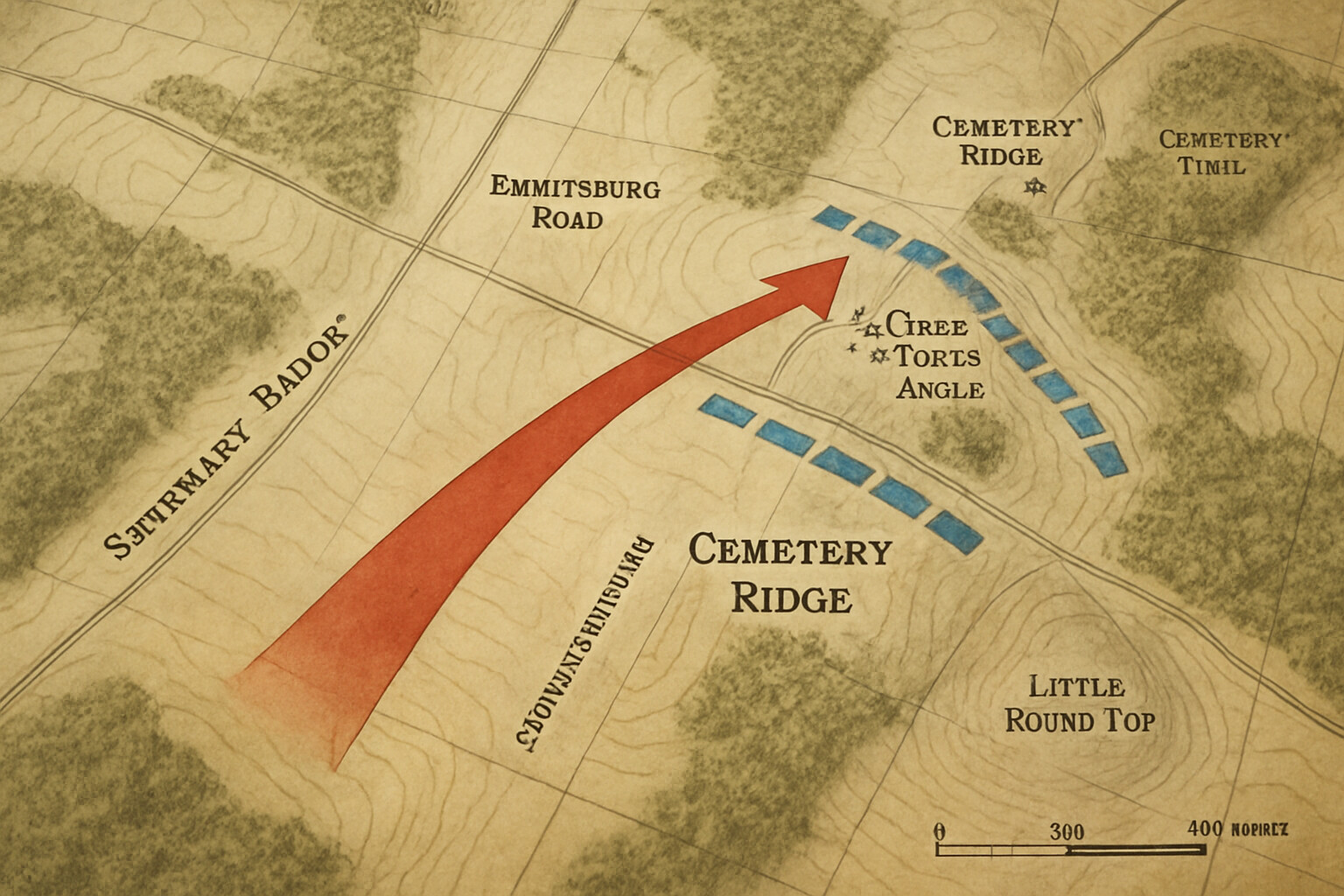
Tactical diagram / map panel showing the assault route across the valley from Seminary Ridge to Cemetery Ridge, with key terrain features labeled.

The full assault force is commonly cited at approximately 12,500 men, though estimates range from roughly 10,500 to 13,500 in different scholarly accounts. The variation reflects genuine uncertainty about exactly which units were committed and how many effectives each contained at that point in the battle.

Lee's tactical conception was for the force to converge as it crossed the valley, compressing toward a focal point on Cemetery Ridge at a small stand of trees called the Copse of Trees—sometimes called the Angle—where a low stone wall formed a corner in the Union defensive line. If the artillery preparation did its work, if the infantry crossed the ground with enough cohesion, and if the flanking brigades provided adequate protection, the assault might punch through and split Meade's army.

All three conditions would need to hold. None of them did.

---

The artillery preparation began around 1:00 p.m. on July 3. Confederate Colonel Edward Porter Alexander, commanding the artillery batteries supporting the assault, massed approximately 150 to 170 cannon along Seminary Ridge—another figure that varies somewhat across sources—and opened a sustained bombardment on the Union positions. The noise was audible across much of southern Pennsylvania. Residents reported hearing the guns as far as Philadelphia.

The bombardment lasted roughly an hour and a half to two hours. It was spectacular in scale and ultimately insufficient in effect. Confederate guns, firing at extreme ranges with ammunition of uneven quality, tended to overshoot the Union infantry waiting behind the ridge. Many shells struck behind the Federal lines, hitting supply wagons and reserve artillery, but leaving the front-line defenders largely intact. Meade's chief of artillery, Brigadier General Henry J. Hunt, initially returned fire with the Union guns and then deliberately ordered many of them to cease firing—a calculated decision intended to conserve ammunition for the infantry assault he knew was coming and to encourage the Confederates to believe the bombardment had been more effective than it was.

Alexander, watching from Seminary Ridge, was deceived. When the Union fire slackened, he concluded that the Federal guns had been suppressed. He sent a message to Pickett urging him to advance. Pickett carried the note to Longstreet and asked whether he should go forward. Longstreet, unable to verbally order an attack he believed was wrong, reportedly only nodded. Pickett took the nod as his orders.
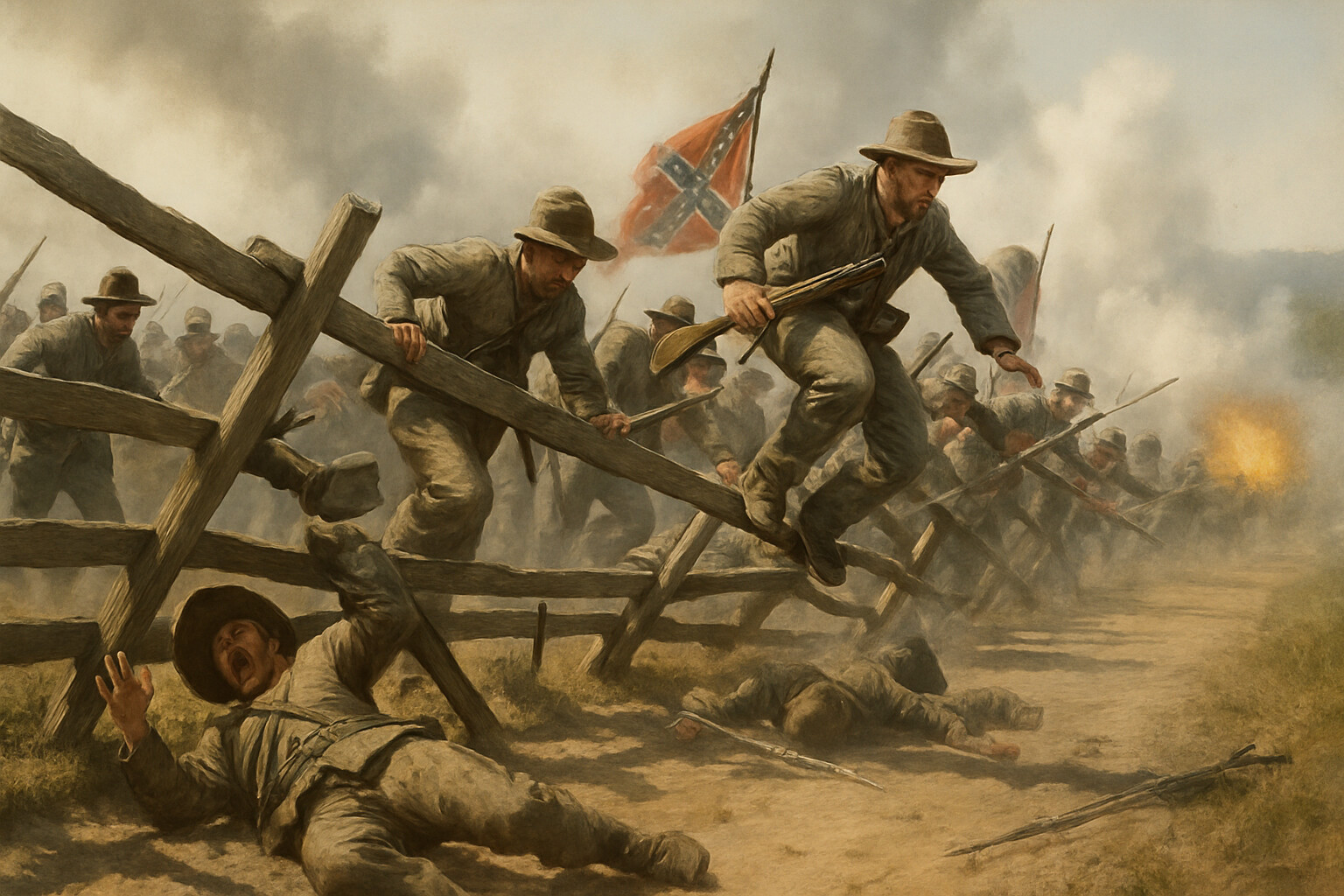
Confederate infantry crossing the Emmitsburg Road — men climbing over post-and-rail fences under fire, ranks breaking and bunching while artillery and rifle fire strikes around them.

The Confederate infantry stepped out of the tree line shortly after 3:00 p.m.—the precise time varies by a few minutes depending on the source.

---

The sight that confronted the Union defenders on Cemetery Ridge as the Confederate lines emerged from the woods has been described in scores of first-person accounts. The assault force, nearly a mile wide at the start, advanced in multiple waves and dressed lines across fields that had been recently harvested, leaving relatively open ground. Battle flags of dozens of regiments punctuated the gray and butternut mass. To witnesses on both sides, it was simultaneously one of the most impressive and most terrible sights of the war.

The Confederate force began encountering serious fire almost immediately. Union artillery on Cemetery Hill, Little Round Top, and along Cemetery Ridge had not been suppressed; it had been conserved. As the Confederate lines moved into range, Federal guns opened with solid shot to knock down ranks at distance, then switched to shell, and finally to canister—tin canisters packed with iron balls that turned each cannon into an enormous shotgun—as the range closed. The effect on the attacking formations was severe and continuous.

The geography of the assault compounded the problem. Between Seminary Ridge and Cemetery Ridge lay not simply open ground but a series of obstacles. The Emmitsburg Road ran north-south across the valley with wooden post-and-rail fences on both sides. Crossing these fences forced the attacking infantry to slow, bunch, and climb over, presenting stationary targets to Union riflemen and artillery. The road itself was slightly elevated, briefly exposing the attackers to enfilading fire from Federal positions on both flanks.

Pettigrew's division on the left flank encountered its own difficulties almost from the start. A Union brigade under Brigadier General George Stannard—three Vermont regiments that had arrived with the army only weeks earlier—occupied a position on the south end of the Union line that allowed them to swing out and fire directly into the right flank and then the left flank of the Confederate assault as it compressed toward the Angle. These troops had nearly obsolete smoothbore muskets in some accounts, though others note they were armed with Springfield rifle-muskets; the specific armament of Stannard's regiments is documented in regimental histories but bears checking against specific primary records for complete accuracy. Regardless of armament, their flanking fire was devastating.

Longstreet's concern about exposed flanks proved precisely correct. Cadmus Wilcox's and David Lang's brigades, assigned to protect Pickett's right, advanced late and were struck by Union counterfire before they could connect properly with the main assault. They were stopped and driven back without materially affecting the outcome.
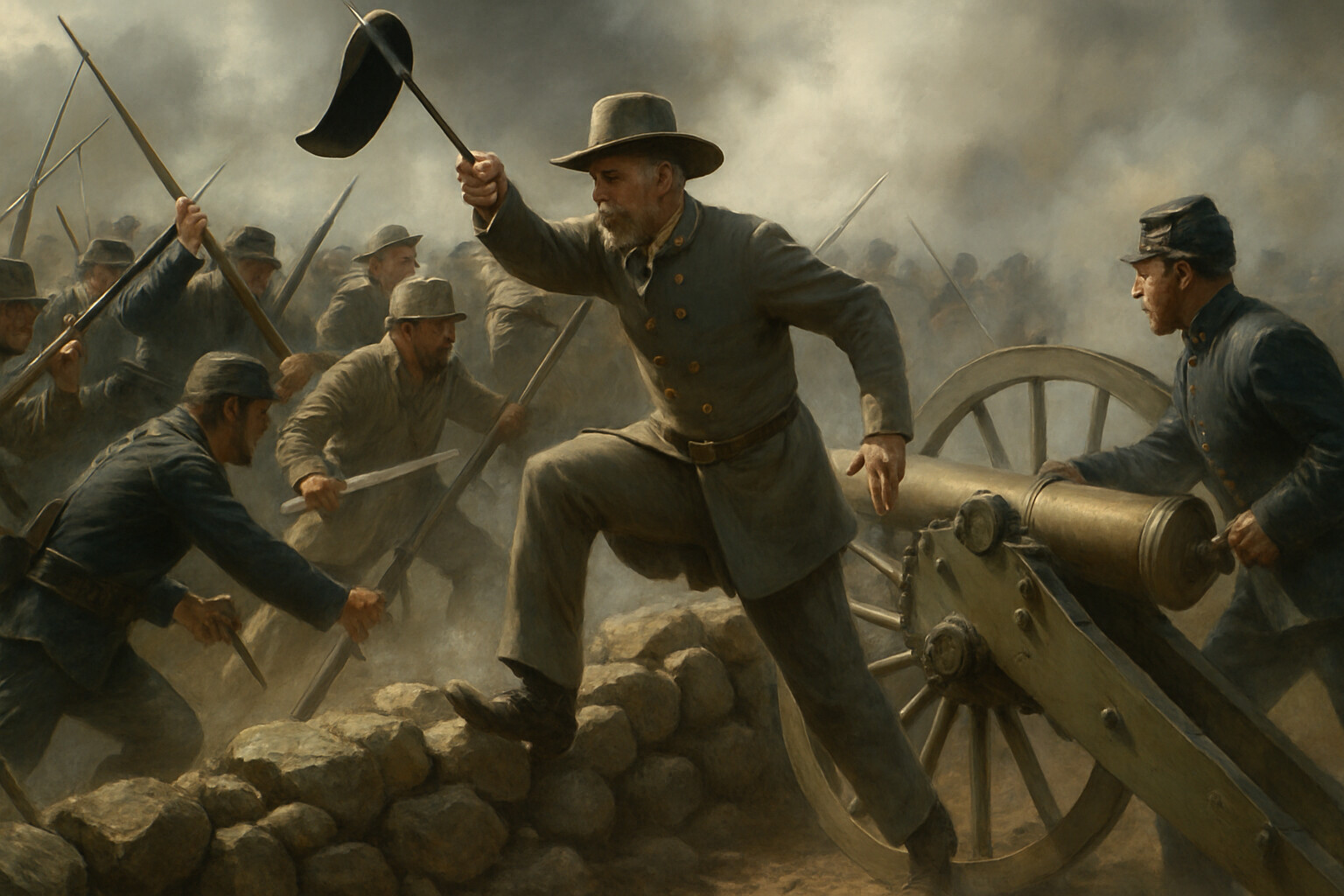
Brigadier General Lewis Armistead leading the final breakthrough at the Angle — hat on sword tip, crossing the stone wall, reaching a Union cannon.

Despite everything, some of the Confederate infantry kept moving.

---

The moments near the stone wall at the Angle are the most documented, most debated, and most studied minutes of the entire battle. What can be said with reasonable confidence is this:

Brigadier General Richard Garnett, who had been publicly censured by Stonewall Jackson after Kernstown in 1862 and was desperately attempting to restore his reputation, rode forward on horseback in defiance of orders for officers to go on foot—a decision that made him conspicuous to Union sharpshooters. He was killed near the stone wall. His body was never positively identified after the battle, and the controversy over his death and the disposition of his remains persisted for decades.

Brigadier General Lewis Armistead, commanding a brigade in the second wave of Pickett's division, placed his hat on the tip of his sword to mark himself visible to his men—a detail recorded in multiple accounts—and led the deepest Confederate penetration of the assault. He crossed the stone wall at the Angle and reached the Union cannon, placing his hand on one of the Federal guns. He was struck by multiple bullets almost immediately after crossing the wall and died of his wounds within two days.

Brigadier General James Kemper was seriously wounded during the assault, shot through the groin or lower abdomen by accounts that vary slightly in specifics. He survived but was permanently disabled.

The penetration Armistead led was real but limited in time and force. Perhaps 300 to 400 men crossed the wall at the Angle with him. Union infantry from the Philadelphia Brigade and other units converged from both sides. Brigadier General Alexander Webb's brigade held the wall itself. Within minutes of Armistead's fall, the Confederates who had crossed the wall were killed, captured, or driven back.
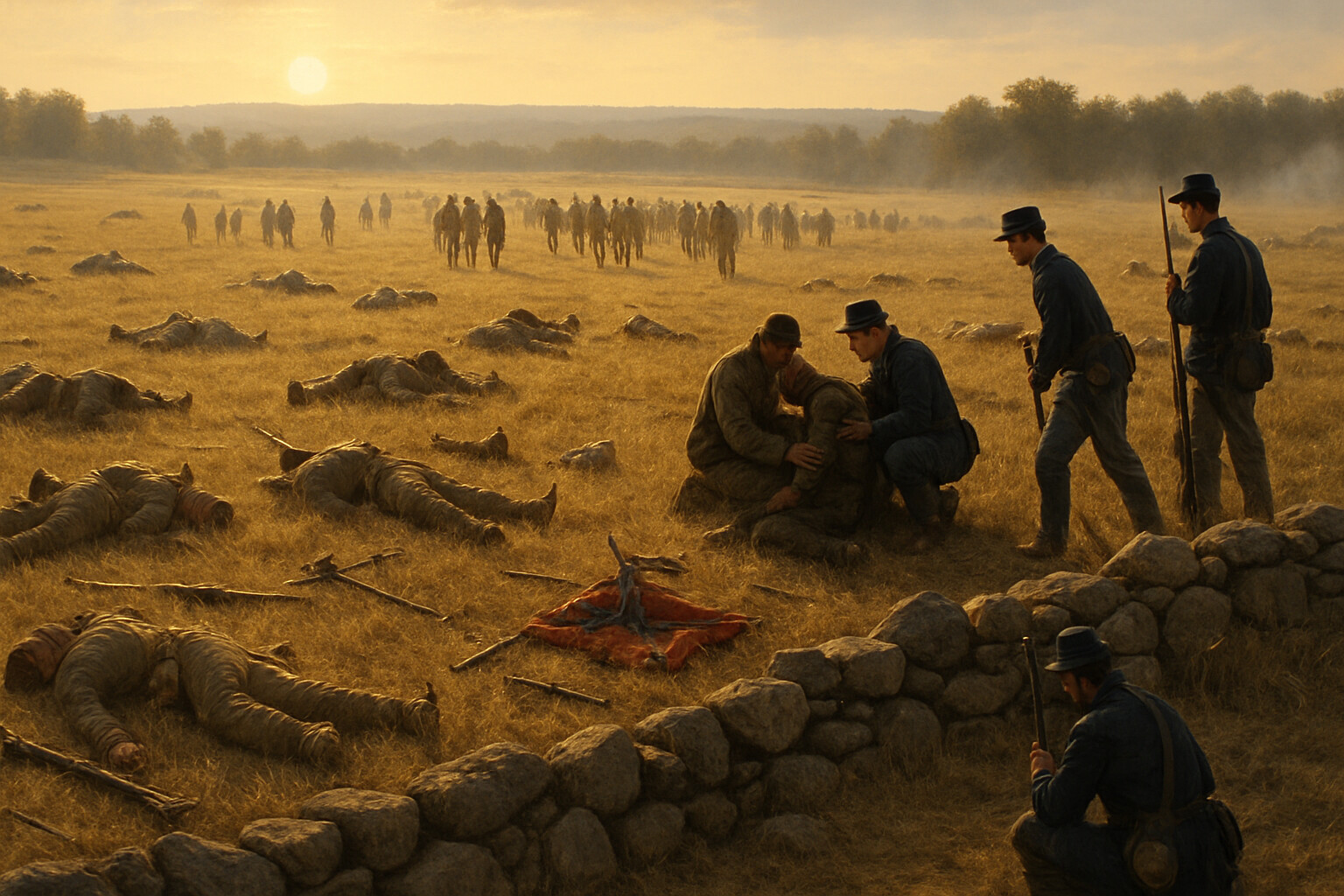
The aftermath on the battlefield — Confederate wounded and dead across the open fields between the ridges in the late afternoon, survivors making their way back toward Seminary Ridge.

South and north of the Angle, the attack had already stalled. Pettigrew's division had been badly cut up crossing the Emmitsburg Road and never reached the wall in significant numbers. Trimble's two brigades fared somewhat better but were halted and bloodied before making contact. The assault, which had taken perhaps forty-five minutes to cross the valley, collapsed in a matter of minutes at the wall itself.

The survivors turned and walked back across the same ground they had crossed going forward. Union artillery followed them with fire. The return was, in many accounts, as difficult as the advance.

---

George Pickett, commanding from a position behind the main assault, survived the charge. What he witnessed was the near-total destruction of his division. When Lee rode to find him afterward and asked him to reform his division to meet a possible Union counterattack, Pickett reportedly responded that he had no division left to reform. The exchange has been recorded in multiple accounts but with enough variation in exact wording that it should be treated as tradition rather than verbatim record.

The losses in Pickett's three brigades were catastrophic. Official Confederate casualty figures for the charge as a whole are incomplete and disputed, reflecting the chaos of the retreat and the army's record-keeping difficulties. Estimates for total Confederate casualties in the assault—killed, wounded, and captured—range from approximately 5,000 to 6,500 men, though some scholarly accounts place the figure higher. Pickett's own division suffered particularly severe losses; the three brigade commanders were all casualties, and regimental officers were hit at rates that left some units nearly leaderless.

The Union side suffered significant casualties as well, particularly in the units holding the Angle, but held its position throughout.

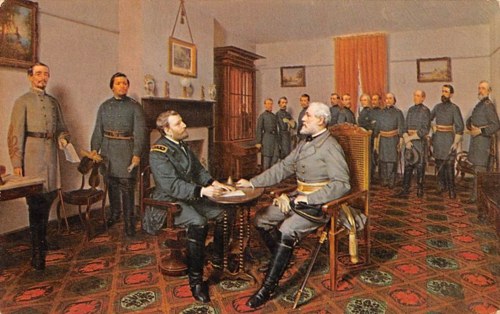
Lee rode among the returning survivors telling them that the fault was his, not theirs—a statement recorded in enough contemporaneous accounts to be treated as historically credible even if the exact words vary. It was one of the few moments of explicit self-reproach in his documented record as a commander.
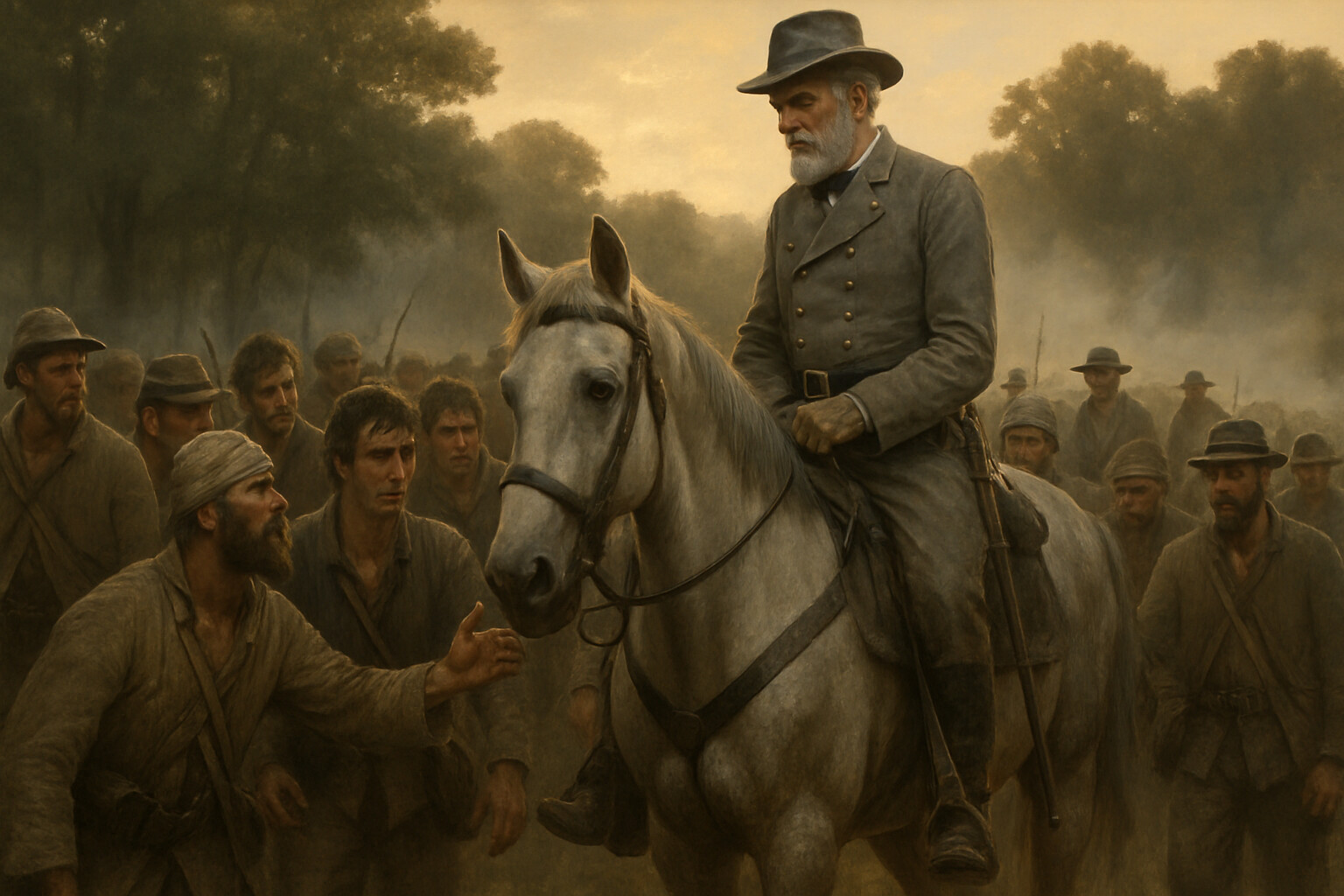
Robert E. Lee riding among the returning Confederate survivors, his posture and bearing conveying the acknowledgment of responsibility — a documented and historically significant moment.

---

The Battle of Gettysburg ended on July 4, 1863, when Lee began withdrawing the Army of Northern Virginia southward. Meade did not pursue aggressively, a decision that would draw criticism both contemporary and historical. Lee's army escaped back to Virginia, battered but intact as an organized force.

The battle's aggregate casualties are among the highest of the war. Estimates for the three-day battle typically place total losses—Union and Confederate combined—between 46,000 and 51,000 killed, wounded, or missing. The figures vary by source and methodology; they should be approached as orders of magnitude rather than precise counts.

Pickett himself lived until 1875. He never forgave Lee for ordering the charge. Whether that sentiment was articulated in his lifetime in exactly those terms or was constructed partly from later accounts and family memory is a matter that historians continue to examine. He never received further significant military command after Gettysburg, though he continued to serve through the end of the war, including a disastrous performance at the Battle of Five Forks in April 1865 where he was absent from his command during a Union assault that destroyed his division—a controversy that trailed him to his grave.

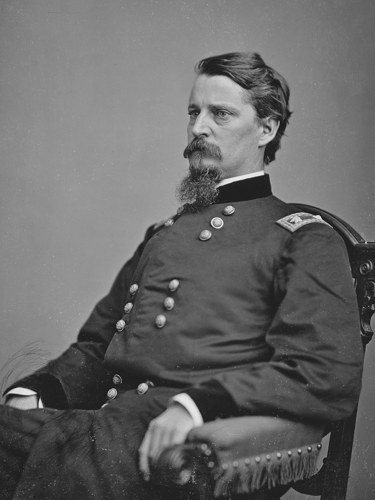
Armistead's death at the Angle carried a particular resonance that was noted even at the time. His close friend before the war, Union Major General Winfield Scott Hancock, was commanding the Union Second Corps on Cemetery Ridge that afternoon and was himself seriously wounded. The two men, separated by uniform color since 1861, were both struck within a short distance of each other on the same afternoon. The friendship between Armistead and Hancock became one of the most retold human stories of the battle, though some of the more elaborate details of their final communication have been romanticized in later retellings and should be treated cautiously.

---

The term "high-water mark" entered the language of the Civil War to describe the Angle at Gettysburg—the farthest point of the Confederate advance, the spot where Armistead fell. The phrase reflects a genuine historical judgment, not merely sentiment: after Gettysburg, the Confederacy never again launched a major offensive operation into Northern territory. Vicksburg fell to Grant on July 4, the day after the charge. The strategic arc of the war began bending irreversibly against the South.

This does not mean Gettysburg alone determined the outcome. The war would continue for nearly two more years, at enormous additional cost. But the charge of July 3 stands as a measurable limit—a moment when the Confederacy applied its remaining offensive strength in a single concentrated blow, and the blow failed.

The field itself is preserved today as part of Gettysburg National Military Park. The stone wall at the Angle remains. A marker identifies the High Water Mark. The distance from the Confederate start line to the wall can be walked in roughly fifteen minutes at a normal pace—the same ground that twelve thousand men crossed under fire, in the knowledge of what was arrayed against them, and kept moving anyway until they could not move anymore.

That is the fact at the center of the story. Whatever one thinks of the cause for which they fought, the infantry who crossed that ground on the afternoon of July 3, 1863, did something that is difficult to comprehend even in retrospect. The historical record does not require embellishment to make it remarkable. It requires only accuracy.
Springfield Model 1861 Rifle-Musket

The primary infantry arm of Union soldiers at Gettysburg, capable of accurate fire at ranges that turned the open ground of the charge into a killing field.

Caliber
.58 caliber
Weight
9 lbs (approximately)
Range
Effective to approximately 300 yards; maximum range approximately 500 yards with Minié ball
Rate Of Fire
2-3 aimed rounds per minute for trained infantry
Crew
1
Ammunition
Minié ball (conical lead projectile)
Manufacturer
Springfield Armory and numerous contract manufacturers
Years Produced
1861-1865
Nickname
Springfield

Confederate Ordnance Rifle (3-inch Ordnance Rifle)

One of the primary Confederate rifled field artillery pieces used in the July 3 bombardment, capable of reaching Union positions on Cemetery Ridge but plagued by ammunition quality problems during the charge.

Caliber
3 inches (approximately 76mm)
Weight
Approximately 820 lbs (tube alone)
Range
Effective to approximately 1,830 yards with shell; maximum range approximately 4,000 yards
Rate Of Fire
Approximately 2-3 rounds per minute with a trained crew
Crew
Typically 6-8 gunners
Ammunition
Shell, solid shot, case shot (spherical case/shrapnel), canister
Manufacturer
Various Confederate foundries; also captured Union examples
Years Produced
1861-1865 (Confederate production and captured stock)

Napoleon 12-Pounder Smoothbore Field Gun (Model 1857)

The workhorse smoothbore field gun on both sides, devastating at close range with canister against the advancing Confederate infantry.

Caliber
4.62 inches (smoothbore)
Weight
Approximately 1,227 lbs (tube alone)
Range
Effective to approximately 1,700 yards with solid shot; canister effective to approximately 400 yards
Rate Of Fire
2-3 rounds per minute with a trained crew
Crew
Typically 8 gunners
Ammunition
Solid shot, shell, spherical case (shrapnel), canister
Manufacturer
Multiple foundries, Union and Confederate
Years Produced
1857-1865 and beyond
Nickname
Napoleon

Enfield Pattern 1853 Rifle-Musket

Widely used by Confederate infantry at Gettysburg, imported from Britain and comparable in performance to the Union Springfield.

Caliber
.577 caliber
Weight
Approximately 9 lbs
Range
Effective to approximately 300 yards; maximum range approximately 500-600 yards
Rate Of Fire
2-3 aimed rounds per minute
Crew
1
Ammunition
Minié-style conical ball
Manufacturer
British government factories; Enfield Lock; numerous private contractors
Years Produced
1853 onward; major Civil War import quantities 1861-1865
Nickname
Enfield
Photo
Pending

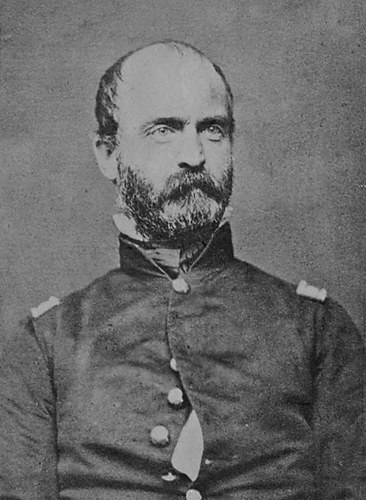
George Edward Pickett

Major General, Confederate States Army

Unit: Pickett's Division, First Corps, Army of Northern Virginia

Born January 25, 1825, in Richmond, Virginia. Graduated last (59th of 59) in the West Point Class of 1846. Served in the Mexican-American War and distinguished himself at the storming of Chapultepec in September 1847, carrying the regimental flag over the parapet and receiving a brevet promotion. Served on the frontier and was involved in the Pig War on San Juan Island (1859). Resigned his U.S. Army commission upon Virginia's secession and accepted a Confederate commission. Promoted to Major General in October 1862. His division was relatively fresh at Gettysburg, having missed the Battle of Chancellorsville due to Longstreet's detachment. Led his division in the July 3 assault from a position behind the main advance. All three of his brigade commanders became casualties. Survived the war but his military reputation was permanently complicated by the charge's failure and later by his conduct at the Battle of Five Forks (April 1, 1865), where he was absent from his command during a Union assault. Died July 30, 1875, in Norfolk, Virginia. Post-battle attitude toward Lee: reported by family and some contemporaries as deeply bitter; specific statements attributed to Pickett vary in different accounts and should not be treated as verbatim.

Photo
Pending

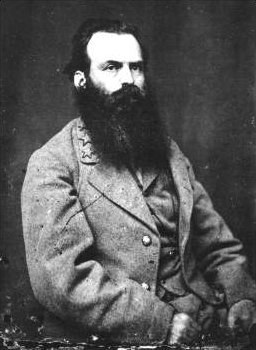
James Longstreet

Lieutenant General, Confederate States Army

Unit: First Corps, Army of Northern Virginia

Born January 8, 1821, in Edgefield District, South Carolina. West Point Class of 1842. Mexican-American War veteran. One of Lee's most trusted corps commanders, known for skilled defensive and offensive operations. His opposition to the July 3 assault is documented in his own postwar memoirs and in some contemporaneous accounts, though his memoirs were written in the context of postwar controversies and should be read critically. The claim that he merely nodded rather than verbally ordering the advance is drawn primarily from his own account. After the war, Longstreet became a Republican, accepted a position in the Grant administration, and was vilified by Lost Cause writers who blamed him for the Confederate defeat at Gettysburg—a characterization most modern historians reject as unjust. Died January 2, 1904.

Photo
Pending

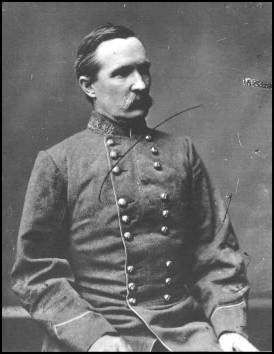
Lewis Addison Armistead

Brigadier General, Confederate States Army

Unit: Armistead's Brigade, Pickett's Division

Born February 18, 1817, in New Bern, North Carolina. Attended West Point but did not graduate. Commissioned through other means and served in the Mexican-American War and on the frontier. Close prewar friend of Union Major General Winfield Scott Hancock. Resigned U.S. Army commission upon the outbreak of war. Commanded one of Pickett's three brigades. On July 3, 1863, he reportedly placed his hat on the point of his sword to mark himself visible to his troops during the advance—this detail appears in multiple accounts. He crossed the stone wall at the Angle and was shot almost immediately; he died on July 5, 1863, of his wounds. His friendship with Hancock and their near-simultaneous wounding on the same afternoon became one of the most extensively documented human stories of the battle. Some of the more dramatic specific details of their final interactions have been amplified in later retellings; the core fact of their friendship and both being wounded on July 3 is well-documented.

Photo
Pending

Richard Brooke Garnett

Brigadier General, Confederate States Army

Unit: Garnett's Brigade, Pickett's Division

Born November 21, 1817, in Essex County, Virginia. West Point Class of 1841. Had been publicly censured by Stonewall Jackson after the Battle of Kernstown (1862) for ordering a retreat without Jackson's permission—a censure that Garnett considered unjust and that was never formally resolved because Jackson was killed before a court-martial could be completed. Garnett reportedly rode on horseback during the assault rather than advancing on foot, making himself conspicuous; some accounts suggest this was a deliberate effort to demonstrate his courage in the context of the Kernstown controversy. Killed near the stone wall on July 3, 1863. His body was never positively identified after the battle, a fact that generated persistent post-battle controversy and has been the subject of ongoing historical research.

Photo
Pending

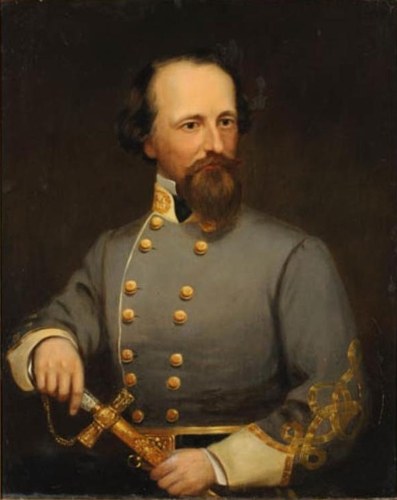
James Lawson Kemper

Brigadier General, Confederate States Army

Unit: Kemper's Brigade, Pickett's Division

Born June 11, 1823, in Madison County, Virginia. Attended Washington College. Virginia militia officer before the war; served in Virginia politics. Commanded a brigade in Pickett's division. Was seriously wounded during the July 3 assault—shot through the lower body; the precise location of the wound varies slightly in different accounts. Survived his wounds but was permanently disabled. Was briefly captured by Union troops after being wounded but was recovered by Confederate forces during the withdrawal. Continued in a limited military capacity after recovery. Served as Governor of Virginia from 1874 to 1878. Died April 7, 1895.

Photo
Pending

Henry Heth

Major General, Confederate States Army

Unit: Heth's Division, Third Corps, Army of Northern Virginia

Born December 16, 1825, in Chesterfield County, Virginia. West Point Class of 1847. Famously moved his division toward Gettysburg on July 1, 1863, reportedly in search of supplies (including shoes—a claim that has been questioned by some historians as a post-battle explanation). The resulting contact with Buford's cavalry initiated the battle. Wounded on July 1 and unable to command on July 3; his division was led by Brigadier General J. Johnston Pettigrew during the charge. The shoe story is a well-known piece of Gettysburg tradition; its accuracy as the primary motivation for the July 1 movement is questioned by some scholars.

Photo
Pending

James Johnston Pettigrew

Brigadier General, Confederate States Army

Unit: Commanding Heth's Division (acting) during the July 3 assault

Born July 4, 1828, in Tyrrell County, North Carolina. A scholar and lawyer before the war; attended the University of North Carolina and later studied abroad. One of the most intellectually distinguished officers of the Confederate Army. Commanded a brigade at Gettysburg on July 1 and was given command of Heth's division for the July 3 assault. Was wounded in the hand during the charge. Survived the assault but was mortally wounded during the Confederate retreat at Falling Waters, Maryland, on July 14, 1863, and died on July 17, 1863—making him one of the last general officers to die as a direct result of the Gettysburg campaign.

Photo
Pending

Isaac Ridgeway Trimble

Major General, Confederate States Army

Unit: Two brigades (Lane's and Scales's, from Pender's division) attached for the July 3 assault

Born May 15, 1802, in Culpeper County, Virginia. West Point Class of 1822. Had an early career as a civil engineer after leaving the army. Returned to military service at the outbreak of the war. At sixty-one, was one of the oldest general officers in the assault. Was given command of two brigades for the July 3 attack. Was wounded and captured during the assault; his leg was subsequently amputated. Remained a prisoner until 1865. Died January 2, 1888.

Photo
Pending

Edward Porter Alexander

Colonel, Confederate States Army (later Brigadier General)

Unit: Artillery, First Corps, Army of Northern Virginia

Born May 26, 1835, in Washington, Georgia. West Point Class of 1857. Before the war served in the Signal Corps. One of the most capable artillery officers in the Confederate Army. At Gettysburg, he commanded the artillery preparation for the July 3 assault. His assessment that Union fire had been suppressed, communicated to Pickett shortly before the advance, was a key moment in the assault's initiation. He later acknowledged in his memoirs that he had advised Longstreet he could not fully guarantee the effectiveness of the bombardment. His postwar memoir, Military Memoirs of a Confederate (1907), is considered one of the most candid and analytically valuable Confederate officer memoirs. Was promoted to Brigadier General in February 1864. Died April 28, 1910.

Photo
Pending

Winfield Scott Hancock

Major General, U.S. Volunteers

Unit: Second Corps, Army of the Potomac

Born February 14, 1824, in Montgomery Square, Pennsylvania. West Point Class of 1844. Mexican-American War veteran. One of the most respected combat commanders in the Union Army; known for his calm personal presence under fire. Close prewar friend of Lewis Armistead. Commanded the Second Corps at Gettysburg and was centrally responsible for the defense of Cemetery Ridge during the July 3 assault. Was struck by a bullet that drove a nail from his saddle into his thigh, creating a serious wound from which he recovered but which caused him recurring pain for the rest of his life. His friendship with Armistead and their near-simultaneous wounding on July 3 is one of the most documented personal stories of the battle. Ran for President in 1880, losing narrowly to James Garfield. Died February 9, 1886.

Photo
Pending

George Jerrison Stannard

Brigadier General, U.S. Volunteers

Unit: Third Brigade, Third Division, First Corps, Army of the Potomac (Vermont Brigade)

Born October 20, 1820, in Georgia, Vermont. A businessman before the war with no formal military training. Commanded three Vermont nine-month regiments—the 13th, 14th, and 16th Vermont—at Gettysburg. These units had enlisted for nine months and were near the end of their service terms; they had arrived with the army only weeks before the battle and had seen limited prior combat. On July 3, Stannard directed his regiments to swing out from the Union line and fire into the flank of the Confederate assault, a maneuver that caused significant disruption. Was wounded later in the assault. The effectiveness of his flanking maneuver is documented in multiple accounts from both sides. Continued in service after Gettysburg and lost his arm in combat in 1864. Died June 1, 1886.

Photo
Pending

Robert Edward Lee

General, Confederate States Army

Unit: Army of Northern Virginia (Commanding)

Born January 19, 1807, in Stratford Hall, Virginia. West Point Class of 1829 (graduated second in his class). Distinguished Mexican-American War record. Resigned U.S. Army commission upon Virginia's secession. Commanded the Army of Northern Virginia from June 1862. His decision to order the July 3 assault after two days of failed flank attacks remains one of the most analyzed command decisions of the Civil War; historians continue to debate whether it reflected overconfidence, a genuine reading of tactical opportunity, or both. Died October 12, 1870.

Photo
Pending

Henry Jackson Hunt

Brigadier General, U.S. Volunteers; Chief of Artillery, Army of the Potomac

Unit: Artillery Reserve, Army of the Potomac

Born September 14, 1819, in Detroit, Michigan. West Point Class of 1839. One of the foremost artillerists in the U.S. Army. His decision to order much of the Union artillery to cease fire during the Confederate bombardment was tactically significant: it conserved ammunition, deceived the Confederates into believing their bombardment had been more effective than it was, and ensured that Federal guns were loaded and ready when the infantry assault began. His management of Union artillery at Gettysburg is considered one of the key factors in the assault's failure. There was some tension between Hunt and Hancock over Hunt's authority to order certain batteries to cease fire; this command relationship dispute is documented in postwar accounts. Died February 11, 1889.

Battle of Gettysburg — Pickett's Charge, July 3, 1863

July 1, 1863 - July 3, 1863 (Pickett's Charge specifically: afternoon of July 3, 1863)

The Battle of Gettysburg was fought July 1-3, 1863, between General Robert E. Lee's Army of Northern Virginia (approximately 75,000 men) and the Army of the Potomac under Major General George G. Meade (approximately 83,000-85,000 men), near the small town of Gettysburg in south-central Pennsylvania. The battle began accidentally when Confederate infantry seeking supplies made contact with Union cavalry on July 1. Over three days of fighting across a front stretching from Oak Hill north of town to Little Round Top south of it, both armies suffered enormous casualties. Lee's flank attacks on July 1 and 2 achieved local gains but failed to break the Union line, which occupied the high ground south and east of the town along Cemetery Ridge, Culp's Hill, and Cemetery Hill.

On the morning of July 3, Lee ordered a concentrated assault on the Union center at Cemetery Ridge, preceded by the largest Confederate artillery bombardment of the war. The assault—commanded in aggregate by Longstreet, with Pickett leading the right wing and Pettigrew and Trimble commanding the left—sent approximately 12,500 men across nearly a mile of open ground. Union artillery and infantry fire inflicted severe losses throughout the advance. A small number of Confederate soldiers, led by Brigadier General Armistead, briefly penetrated the Union line at the stone wall called the Angle before being repulsed. The assault collapsed within roughly an hour of beginning.

Lee withdrew from Gettysburg on July 4, 1863, the same day Vicksburg fell to Grant in the west. The Battle of Gettysburg is regarded by most historians as the turning point of the Eastern theater and, in combination with Vicksburg, as the strategic turning point of the war as a whole. Aggregate casualties for the three-day battle are typically estimated between 46,000 and 51,000 for both sides combined, making it the deadliest battle of the American Civil War.

Positions are approximate, based on published accounts.

Sources & Further Reading

BOOK

Coddington, Edwin B. The Gettysburg Campaign: A Study in Command. New York: Charles Scribner's Sons, 1968. The standard full-length scholarly account of the campaign; used as primary reference for command decisions, unit movements, and casualty estimates.

BOOK

Sears, Stephen W. Gettysburg. Boston: Houghton Mifflin, 2003. Comprehensive one-volume narrative account with extensive primary source citations; used for event chronology, officer accounts, and casualty discussion.

BOOK

Trudeau, Noah Andre. Gettysburg: A Testing of Courage. New York: HarperCollins, 2002. Detailed narrative account with strong tactical and unit-level detail.

BOOK

Alexander, Edward Porter. Military Memoirs of a Confederate: A Critical Narrative. New York: Charles Scribner's Sons, 1907. Primary source memoir by the Confederate First Corps artillery commander; essential for the artillery preparation and the decision to initiate the assault. Read critically given postwar context of composition.

BOOK

Longstreet, James. From Manassas to Appomattox: Memoirs of the Civil War in America. Philadelphia: J.B. Lippincott, 1896. Primary source memoir by the First Corps commander; documents Longstreet's opposition to the July 3 assault. Read critically given postwar Lost Cause controversy context.

BOOK

Hess, Earl J. Pickett's Charge — The Last Attack at Gettysburg. Chapel Hill: University of North Carolina Press, 2001. Scholarly monograph specifically on the assault; most detailed modern account of the charge itself.

BOOK

Pfanz, Harry W. Gettysburg: The Second Day. Chapel Hill: University of North Carolina Press, 1987. Standard scholarly account of July 2 fighting; provides context for the July 3 decision.

BOOK

Pfanz, Harry W. Gettysburg: Culp's Hill and Cemetery Hill. Chapel Hill: University of North Carolina Press, 1993. Covers July 2-3 fighting on the Union right and center.

BOOK

Wert, Jeffry D. Gettysburg: Day Three. New York: Simon & Schuster, 2001. Full account of July 3 operations across the entire battlefield, including Pickett's Charge.

OFFICIAL

U.S. War Department. The War of the Rebellion: A Compilation of the Official Records of the Union and Confederate Armies. Series I, Volume 27, Parts 1 and 2. Washington: Government Printing Office, 1889. Primary official source for unit reports, orders, and casualty figures from both sides.

MUSEUM

Gettysburg National Military Park, National Park Service. Park documentation, interpretive materials, and battlefield surveys have been used for terrain description and monument locations. The park's historical research staff maintains ongoing scholarly review of the battle's documentation.

BOOK

Tucker, Glenn. High Tide at Gettysburg: The Campaign in Pennsylvania. Indianapolis: Bobbs-Merrill, 1958. Earlier scholarly narrative; useful for officer accounts and the human dimension of the battle.

BOOK

Catton, Bruce. Glory Road: The Bloody Route from Fredericksburg to Gettysburg. Garden City: Doubleday, 1952. Narrative history of the Army of the Potomac; important for Union command context.

BOOK

Foote, Shelby. The Civil War: A Narrative, Vol. 2 — Fredericksburg to Meridian. New York: Random House, 1963. Major narrative history; useful for context and narrative texture but not a scholarly monograph; factual claims cross-checked against scholarly sources.