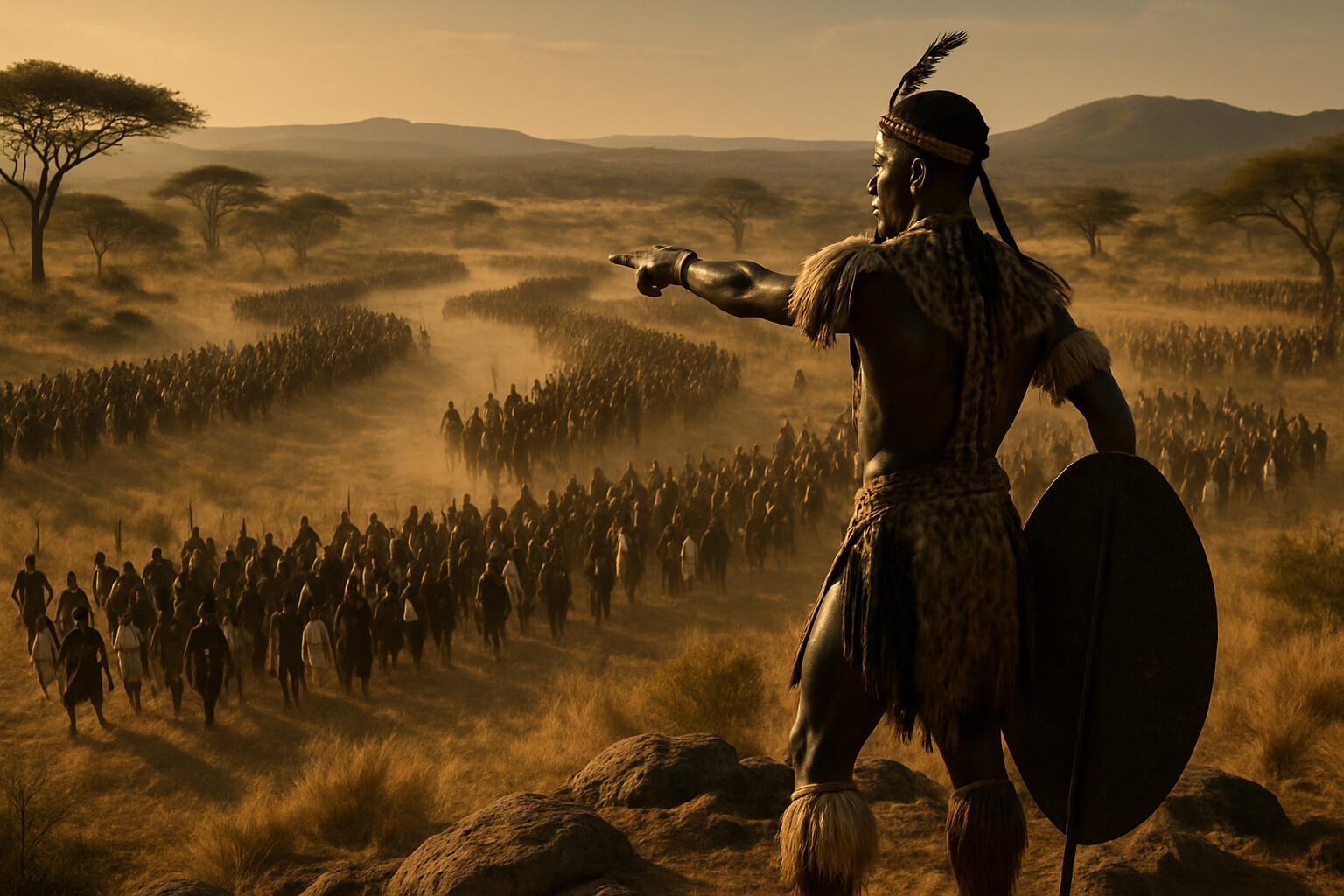
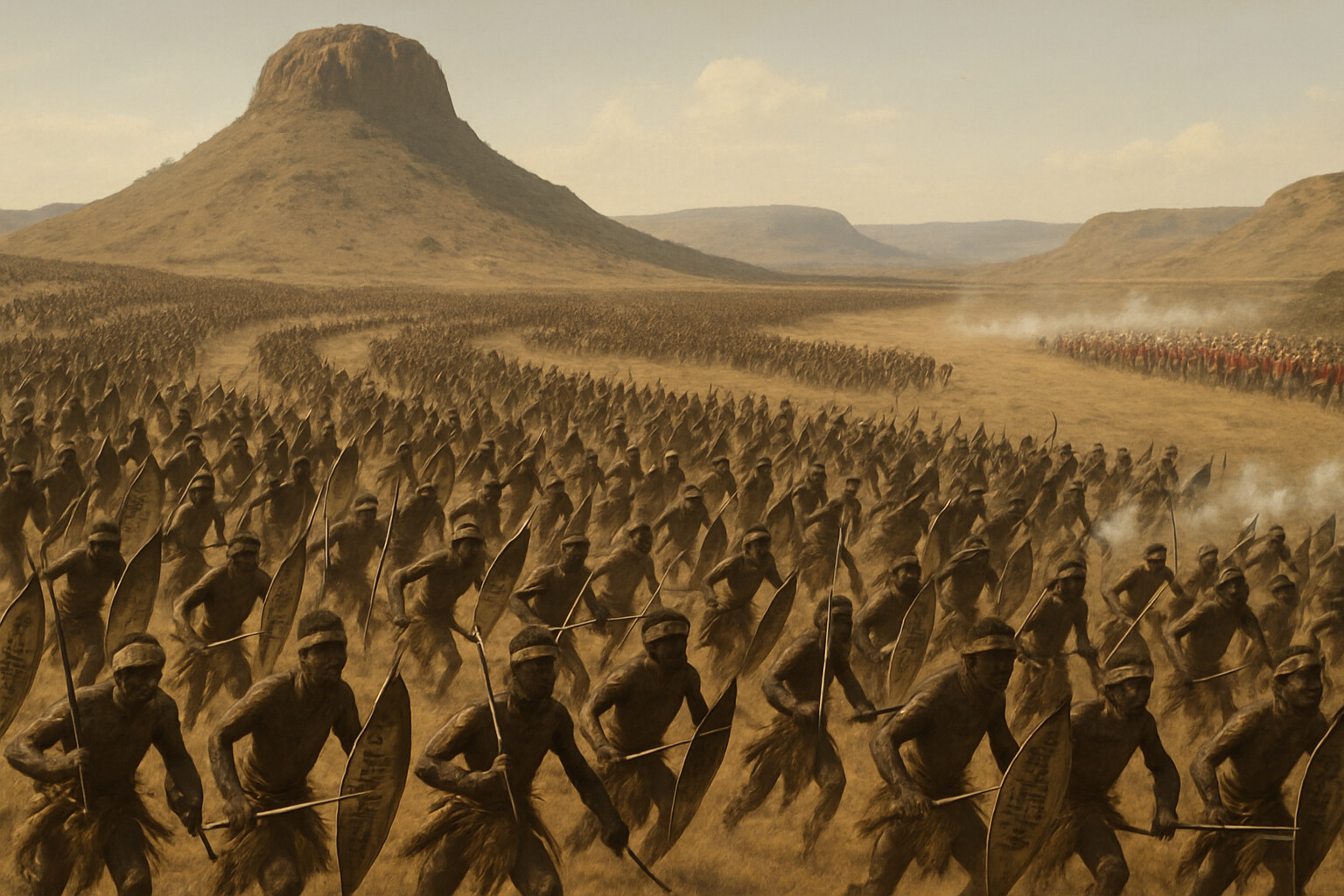
The regiment came out of the grass moving fast, not shouting yet, shields forward and feet raising a percussion from the red earth that witnesses would describe long afterward. Ahead of the advancing column, the enemy's position was defined by a ridge that offered ground advantage and by numbers that, on paper, favored the defense. None of it would matter. Before the enemy could consolidate, the two flanking columns—the horns—were already curling wide, moving to enclose, to cut off retreat, to fix and destroy. The chest of the formation struck the center. The horns closed behind. What followed was not a battle in the extended sense. It was a transformation of what a battle on the southeastern African plateau could be.
To understand what Shaka kaSenzangakhona accomplished between approximately 1816 and his assassination in 1828, it is necessary to first understand the world he inherited—and how completely he intended to break it.
---
**The World Before Shaka**
In the late eighteenth and early nineteenth centuries, the region between the Drakensberg escarpment to the west and the Indian Ocean to the east—the territory that would become Zululand and the broader Natal region—was occupied by dozens of Nguni-speaking chieftaincies. These groups shared language, cattle-herding culture, ancestral religion, and a tradition of armed conflict that was, by regional convention, remarkably restrained. Warfare among the Nguni clans of this period was governed by understood limits. Men fought with long-hafted throwing spears called izijula, with additional light javelins, and with ox-hide shields. Combat typically opened at a distance with an exchange of thrown weapons. When casualties mounted to a point where one side lost confidence, the engagement usually broke off. Decisive annihilation of an enemy force was not the goal. Cattle raiding, the display of force, and the negotiation of status were the outcomes most often sought.
This was not timidity. It was the logic of a pastoral society where every fighting man represented irreplaceable labor, kinship, and wealth on the hoof. Killing too many enemies left fields untended, cattle unguarded, and alliances shattered. The system had its own brutal efficiency.
Shaka understood this logic precisely—and decided to replace it with something different.
Born around 1787—a date derived from oral tradition gathered decades after his death and treated by historians as an estimate rather than a documented fact—Shaka was the son of Senzangakhona, chief of the small Zulu clan, and Nandi of the Langeni people. He spent much of his childhood outside his father's homestead under circumstances that the oral record describes as disputed and sometimes hostile. The early biographical details, reconstructed from traditions recorded generations later, portray a physically imposing young man of strategic intuition and social marginality. Historians treat these accounts with significant caution; the primary oral traditions show clear signs of retrospective heroization, and specific details cannot be independently confirmed. What is better grounded is what Shaka did once he had access to military command.
Around 1816, following the death of Senzangakhona, Shaka—supported by Dingiswayo, the influential chief of the Mthethwa confederacy under whom Shaka had served as a military commander—secured control of the Zulu chieftaincy. The Zulu at this moment were a minor group, a subordinate member of the Mthethwa's wider network, with a population and fighting strength that no neighboring chief would have considered a serious independent threat. Within fifteen years, the Zulu would be the dominant power in the region, commanding tens of thousands of warriors and controlling territory stretching hundreds of miles.
The speed of that transformation depended on two interconnected innovations: a new weapon doctrine and a new organizational system. Together they did not merely improve the Zulu way of war. They changed what war meant.
---
**The Iklwa: A New Philosophy in Steel and Wood**
The throwing spear—the assegai in its traditional long-hafted form—was the defining weapon of pre-Shakan Nguni conflict. It was a distance weapon for a distance-based tactical culture. Shaka's core insight was that the distance culture was its own vulnerability. A warrior who threw his spear gave up his offensive weapon. A warrior who threw several spears was left with a club and a shield while the enemy, who might not have thrown yet, still held iron points.
The weapon Shaka is credited with systematically developing and issuing as the primary arm of his regiments was the iklwa—sometimes also transliterated as ikwa. The name is said to derive from the sucking sound the blade made when withdrawn from a wound, though this etymology, like many weapons-origin stories, belongs to tradition rather than documented linguistic history and should be understood as such.
The iklwa was a short-hafted stabbing spear. Compared to the traditional throwing assegai, it had a significantly shorter shaft—estimated by scholars at roughly 75 to 90 centimeters (approximately 30 to 36 inches) across various accounts—and a broad, heavy, long-bladed iron head that was poorly suited for throwing but effective at close quarters. The blade itself was substantial; surviving examples and scholarly descriptions indicate heads of 45 centimeters or more in length, wide enough to cause large traumatic wounds. These dimensions are scholarly estimates drawn from archaeological and later observational evidence; precise specifications from Shaka's own era are not documented.
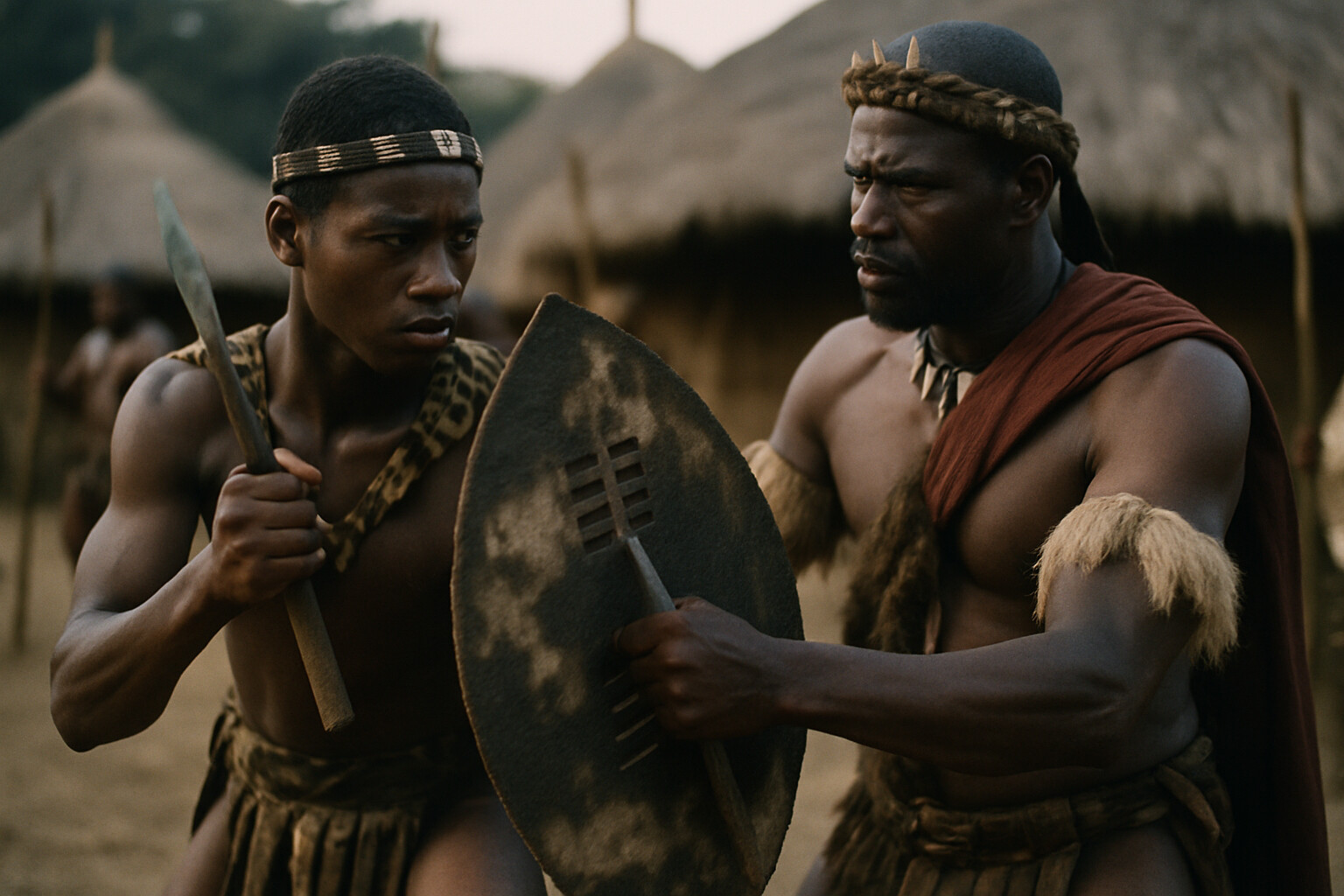
The tactical logic was direct. A warrior armed with the iklwa could not throw his primary weapon away. He was required to close with the enemy. Closing required courage, discipline, and training—all of which Shaka's regimental system was specifically designed to produce. Once in close contact, the iklwa was more lethal than the long assegai: in a body-to-body press, a man with a stabbing spear had the advantage over one wielding a long shaft that cannot be maneuvered. The warrior would use his large cowhide shield—the isihlangu—to hook the enemy's shield aside with an inward pull that exposed the left side of the opponent's torso, then drive the iklwa home with the right hand. This was not improvised. It was drilled.
Shaka did not entirely abandon ranged weaponry. Warriors typically retained one or two lighter throwing spears, the izijula, to cast before closing. But the iklwa was the primary instrument, and the expectation was contact combat. A warrior who threw the iklwa faced punishment. The weapon was not to be given up at range.
The metallurgy of the iklwa blades was the work of Zulu and regional African smiths who had worked iron for generations. Quality varied, but the doctrine mattered more than the material: the primary weapon was for killing at arm's reach, not for hoping an enemy would fall at forty yards.
---
**The Shield: The Isihlangu and Its Tactical Function**

The Zulu war shield—the isihlangu in its full fighting size—was a large oval structure typically constructed from a single cowhide stretched over a central wooden stick. In its largest form, used by senior regiments, the isihlangu could stand nearly as tall as a man, roughly 150 to 180 centimeters (approximately five to six feet), and wide enough to cover the body from shoulder to knee. Smaller shields were carried by younger or less senior regiments. These dimensions are drawn from later observational accounts and scholarly analysis; no precise records from Shaka's era document the specifications.
The shield was not merely defensive in Shaka's system. It was an offensive tool. The trained technique involved hooking the edge of the fighter's shield behind the opponent's shield and rotating the body sharply inward—pulling the enemy's shield to the right across his own body and opening his left side. This motion, which depended on both fighters facing each other at close range, required physical engagement and created the moment the iklwa needed. A soldier who understood the technique could defeat a heavier or stronger opponent through mechanical leverage rather than brute force. Whether this technique was as fully standardized as a drill in Shaka's time—or was codified more explicitly in the following decades—is inferred from later accounts and scholarly analysis rather than from any contemporary written record.
The color and pattern of cowhide on a warrior's shield served as unit identification—a visible system that allowed commanders and fighters to distinguish regiments in the confusion of battle at a distance. Older, senior regiments typically carried shields predominantly white; younger regiments carried darker hides. This was a practical identification system in a force that could number tens of thousands of men without written orders or signal communication.
---
**The Impondo Zankomo: The Bull Horn and the Chest**
Weapons and training alone do not explain the Zulu military's battlefield dominance. The formation—the impondo zankomo, or the horns of the buffalo (sometimes rendered as horns of the bull)—was the tactical architecture that made the close-combat doctrine catastrophically effective against enemies who did not understand it until it was too late.
The formation divided the army into four distinct groups. The chest—the isifuba—was the main body and struck the enemy frontally. The two horns—the izimpondo—were fast-moving flanking columns that swung outward and around the enemy's flanks simultaneously with the chest's frontal engagement, racing to meet behind the enemy force and seal off retreat. The loins—the umuva—were a reserve held behind the chest, often seated with backs to the fighting so they would not grow prematurely excited and commit before the commander ordered it.
The mechanics of the formation required speed. The horns had to move fast enough to encircle the enemy before he could recognize what was happening and withdraw to a defensible position or simply flee. Zulu armies trained for speed across open terrain. Contemporary accounts and later military observers noted consistently that Zulu impis could cover extraordinary distances in a single day barefoot across rough country—some accounts cite figures of forty or fifty miles. These figures should be understood as estimates from external observers rather than measured data, but the pattern they describe is consistent across independent sources. The logistical system, which sustained warriors partly through accompanying herders and cattle rather than complex supply wagons, was optimized for fast movement.
The intelligence supporting the formation was an inbuilt reconnaissance culture. Scouts—izinhloli—operated ahead of an advancing impi to locate the enemy, assess terrain, and report back to the commander. The formation was then adapted to the specific ground. The horns were sent wider when terrain allowed, tighter when valleys or ridgelines constrained movement. The objective was always the same: envelopment, encirclement, and destruction of the enemy's ability to disengage.
For enemies accustomed to the traditional Nguni pattern of fight-and-break-off, the impondo zankomo was a lethal surprise. The enemy would engage the chest, feel the pressure, begin to consider withdrawal—and find the horns already behind them. The psychological effect of that realization, documented in various accounts of Zulu-era battles, was frequently decisive before the physical fighting was finished.
---
**The Regimental System: Army as Institution**
Perhaps Shaka's most durable military innovation was not the iklwa or the bull-horn formation but the regimental system—the ibutho (plural: amabutho)—as a total social institution.
Prior to Shaka's consolidation, age-grade regiments existed among the Nguni-speaking peoples as a form of social organization, not a permanent standing military. Young men of similar age were grouped together for initiation and could be called on for labor or war, but the system was decentralized and regiments dispersed back to their home communities when a crisis passed. Historians note that Dingiswayo of the Mthethwa had already experimented with developing the amabutho more systematically; the degree to which Shaka built on Dingiswayo's foundation versus transforming the system independently remains a point of scholarly discussion that is not fully resolved.
Shaka made the amabutho permanent and centralized them at royal military towns—amakhanda—scattered across the Zulu kingdom. Each ibutho was defined by an age cohort of young men drawn from across the kingdom, not from a single clan or district. This design was deliberate: it severed primary loyalty from kinship group and transferred it to the regiment and, through the regiment, to the king. A warrior's identity became his ibutho, his shield color, his battle honors, and his relationship to the royal house—not his home village.
Warriors could not marry or wear the isicoco—the head ring that marked adult male status—without royal permission. That permission was granted only when the ibutho had satisfied the king in war. This deferred adulthood created a powerful motivational structure. The young men of a regiment had every reason to fight hard, and fight as a unit, because their social maturity depended on collective military performance. A regiment that performed with distinction was rewarded with the right to marry. A regiment that showed poorly faced the king's displeasure—which in Shaka's kingdom was not a minor inconvenience. The specifics of how consistently and precisely this system was enforced are documented in oral tradition and scholarly analysis, but enforcement details likely varied.
The amakhanda—the royal military towns—were also centers of political administration and royal power projection. Each was commanded by a female royal relative as its nominal head (an indlunkulu), with a military commander responsible for the regiment's readiness. The system created a network of military bases distributed across the kingdom, capable of rapid mobilization without a centralized march-to-assembly that would telegraph the direction of a campaign. In the language of modern military analysis, it functioned as a distributed forward basing system managed through a hierarchical command connected to a single source of authority: the king.
---
**Campaigns: The Making of an Empire**
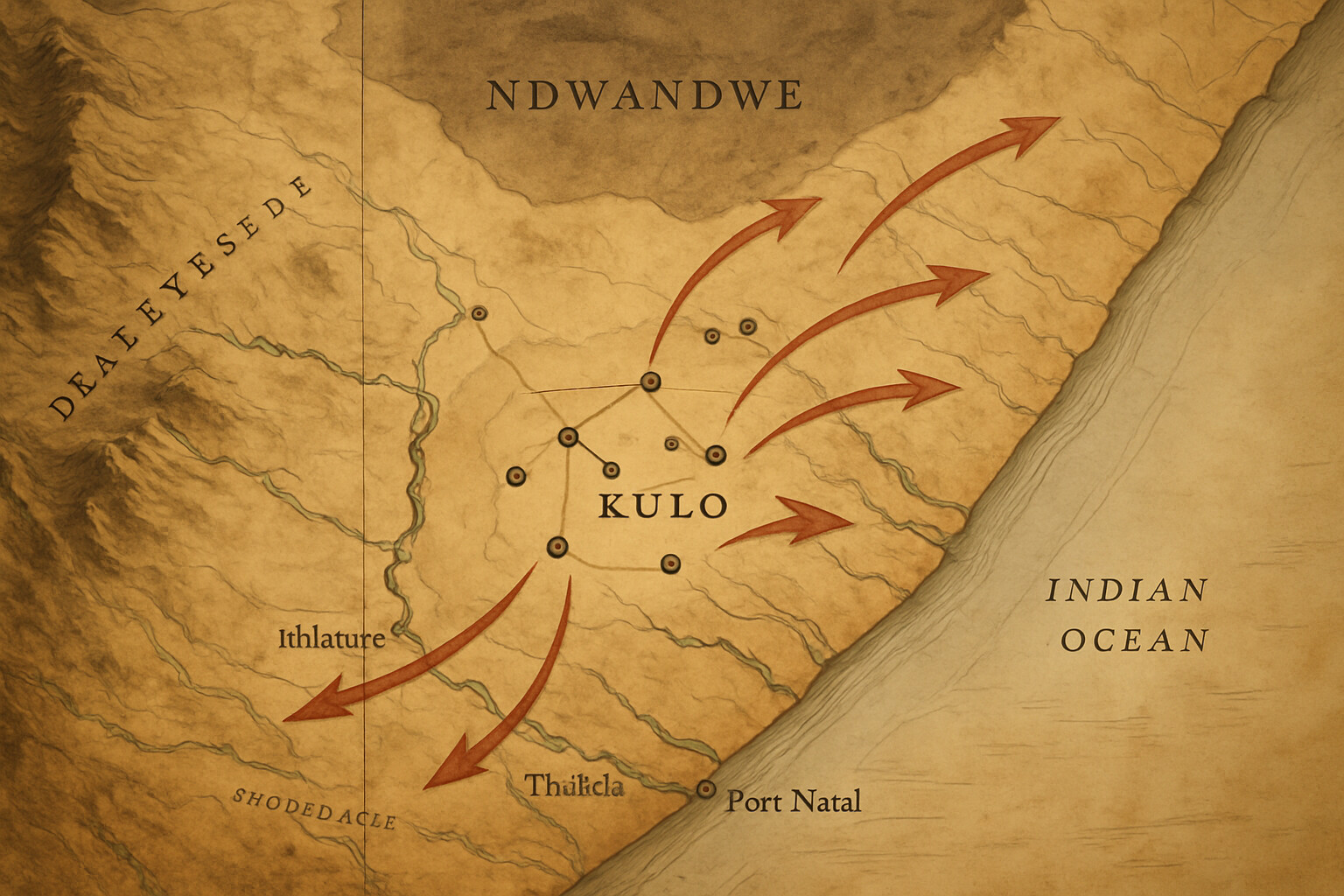
Between 1816 and 1828, Shaka's armies campaigned continuously, incorporating defeated chieftaincies, absorbing their populations, and expanding the Zulu kingdom in all directions. The broad outlines of this expansion are documented in regional oral traditions, in the accounts of early European traders and visitors to the Zulu kingdom, and in the work of subsequent historians who cross-referenced these sources.
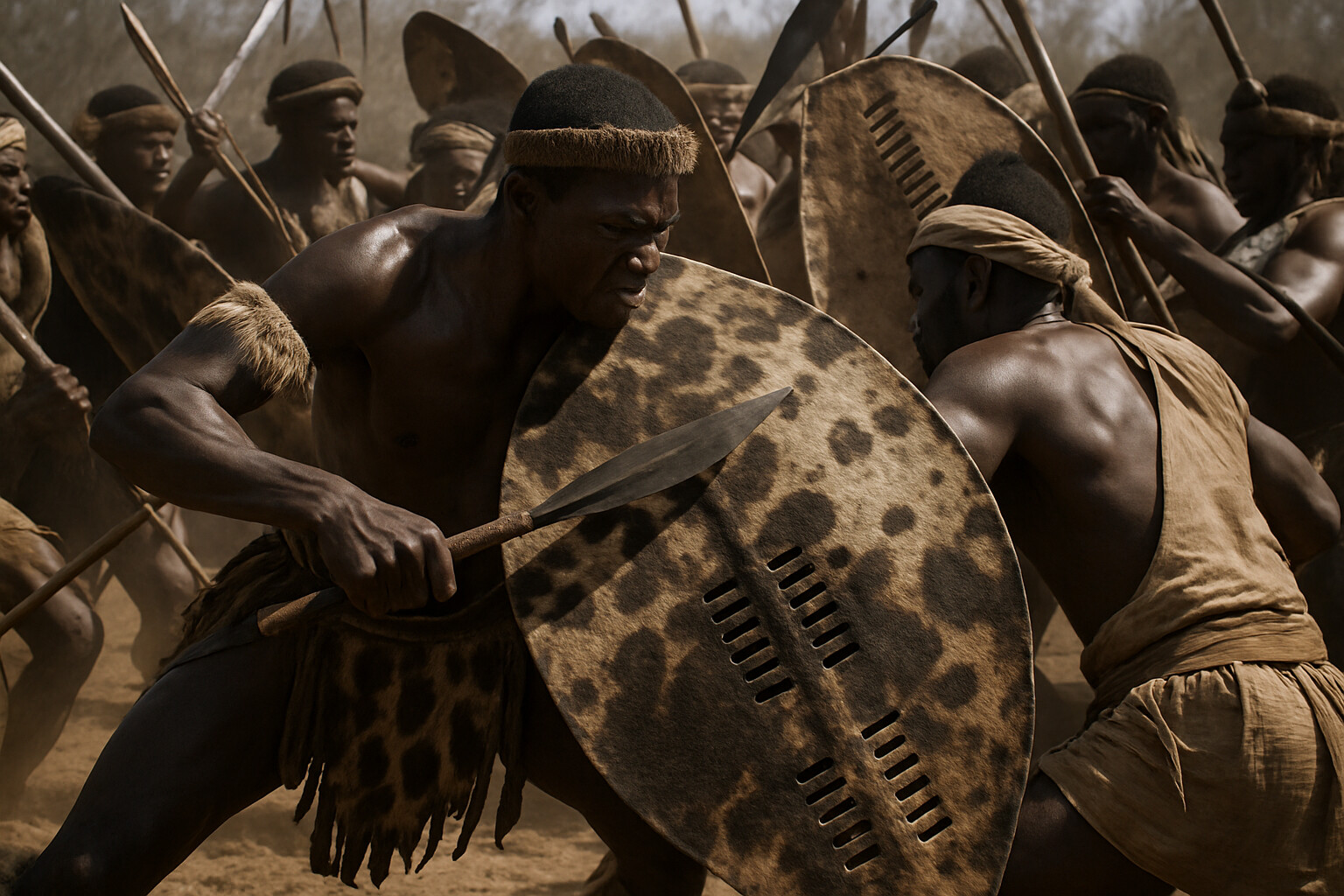
The defeat of the Ndwandwe confederacy under Zwide kaMlaba stands as one of the pivotal engagements of this period. The Ndwandwe were the most formidable rival power in the region, and the wars between Shaka and Zwide were extended and hard-fought. Scholarly accounts—drawing on the work of historians including John Laband, John Wright, and Carolyn Hamilton, among others—describe multiple engagements between approximately 1818 and 1820 in which Zulu forces defeated Ndwandwe armies. The engagement at or near the Mhlatuze River, dated approximately to 1820 and sometimes called the Battle of the Mhlatuze, is often cited as particularly significant: Ndwandwe forces attempting to cross the river were caught in a vulnerable position and defeated with severe casualties, effectively breaking the confederacy as a regional power. The specific date, location, and casualty figures for this engagement are derived primarily from oral tradition and should be treated as approximate. Zwide fled north; many of his followers were absorbed into the Zulu system. The date and circumstances of Zwide's death in the northern territories to which he retreated are not firmly established in scholarly sources.
These victories were not simply the result of tactical superiority in any single engagement. They reflected the cumulative advantages of a more disciplined, better-organized, and more consistently supplied military system. Shaka's impis could campaign longer, move faster, and absorb the reversal of individual engagements more effectively than opponents whose armies dispersed at the end of a season.
The Zulu king also used his military power as an instrument of political leverage rather than pure destruction. Chieftaincies that submitted promptly could be incorporated with their leadership partially intact. Those that resisted faced the full application of the impondo zankomo and its aftermath. The threat, visible in the treatment of those who resisted, made submission a rational calculation for many smaller groups. The kingdom grew as much by the logic of demonstrated threat as by the arithmetic of battles won.
---
**The Cost of the Machine**
The political geography Shaka's expansion created did not exist on an empty stage. The Zulu kingdom's rapid growth destabilized the entire southeastern African interior. Chieftaincies displaced by Zulu expansion displaced others in turn, setting off cascading population movements that scholars later termed the Mfecane—a Nguni word often translated as the crushing or the scattering—or, in Sotho-Tswana languages, the Difaqane.
The Mfecane remains one of the most debated historical processes in southern African historiography. Historians including John Omer-Cooper initially attributed virtually all of the regional disruption to Shaka's expansion. Later scholarship—including the revisionist work of Julian Cobbing in the 1980s, which argued that the Mfecane concept itself was partly a colonial historiographic construction designed to deflect attention from the slave trade and colonial violence—complicated this picture significantly. The current scholarly consensus, shaped by subsequent work from historians including Carolyn Hamilton, John Wright, and Elizabeth Eldredge, holds that Shaka's campaigns were a genuine and significant cause of regional disruption but not the only cause; the destabilizing effects of the early colonial economy, including raiding connected to slave-trade networks at Delagoa Bay, also played a role.
What is not in serious dispute is that the violence of this period—from whatever combination of causes—produced massive displacement, significant mortality, and the collapse of numerous chieftaincies across the interior plateau. Populations moved hundreds of miles. New political formations emerged. The map of the region was fundamentally different in 1830 from what it had been in 1800, and Shaka's campaigns were a central mechanism of that transformation.
This is not a story that can be told as simple triumph. The regiments that marched so efficiently, that enveloped and destroyed enemy forces with such effective tactical precision, also killed people—many people. The cattle taken from defeated communities sustained the Zulu military economy and stripped the defeated of the wealth that sustained life in a pastoral society. The efficiency of the bull-horn formation was as indifferent to its human cost as the efficiency of any weapons system in any era.
Shaka's defenders, then and since, argued that the creation of a stable, powerful, centralized kingdom under Zulu authority was preferable to the preceding fragmented system of chronic small-scale conflict—that the order imposed, however violently, was durable. His critics, including many of the communities displaced and absorbed, experienced the same process differently. The historical record does not resolve this tension; it contains both realities.
---
**The European Dimension: First Contact and Its Implications**
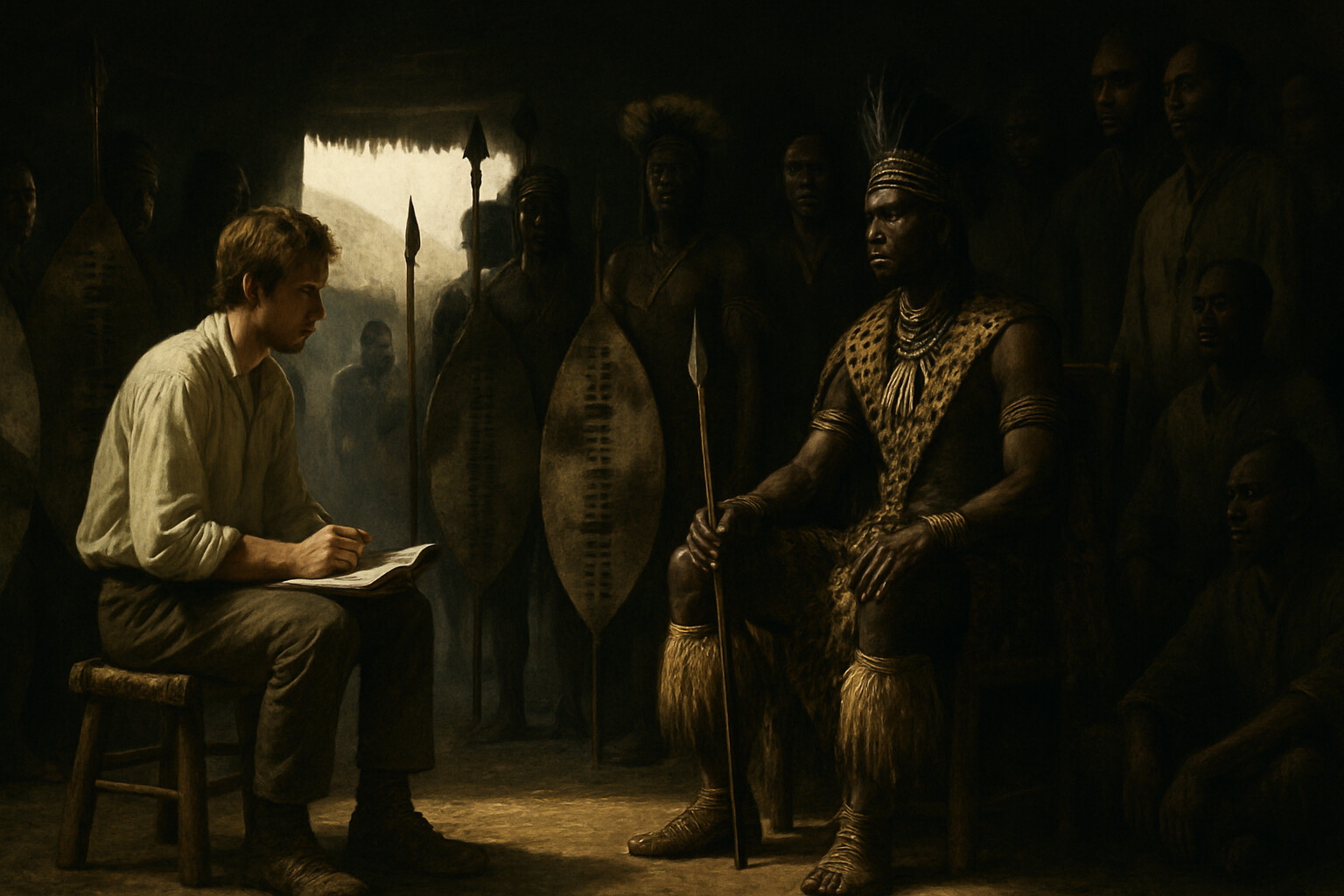
Shaka was not conducting his military revolution in complete isolation from the wider world. The British colonial presence at Port Natal (the future Durban) brought small parties of European traders and adventurers into contact with the Zulu kingdom during the 1820s. Figures including Henry Fynn and Nathaniel Isaacs visited the Zulu court and left written accounts—accounts that are invaluable as near-contemporary documents and deeply problematic as objective records, since both men had commercial and political interests in how they portrayed Shaka and the Zulu kingdom.
Fynn's journals and Isaacs's later published memoirs describe court ceremonies, military displays, battles observed from a distance, and personal interactions with Shaka. Historians treat these sources carefully. Isaacs in particular has been shown to have exaggerated and fabricated details for a European audience with an appetite for accounts of African savagery and spectacle. Fynn's observations, while less sensationalized, still carry the biases of a man operating within the colonial world of the early nineteenth century. His journals as published were also edited posthumously, which complicates their use as raw primary sources. Both accounts are used in this narrative only for the broad picture they provide, not for specific figures, personal descriptions, or direct claims about Shaka's conduct or character.
What these accounts confirm, broadly and despite their limitations, is the organizational and military sophistication of the Zulu state by the mid-1820s. European visitors—men from a continent that had been at war almost continuously for a generation—recognized what they were seeing as a serious military system.
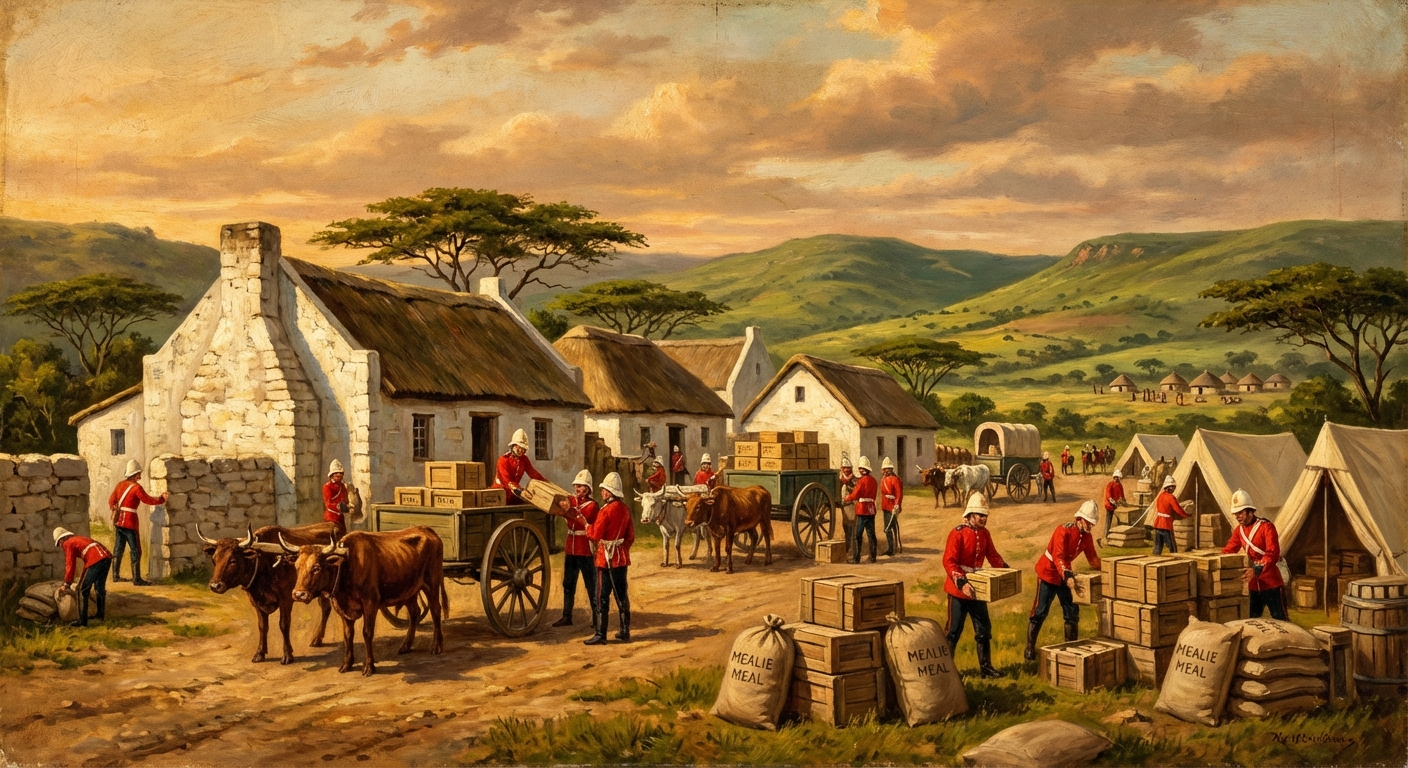
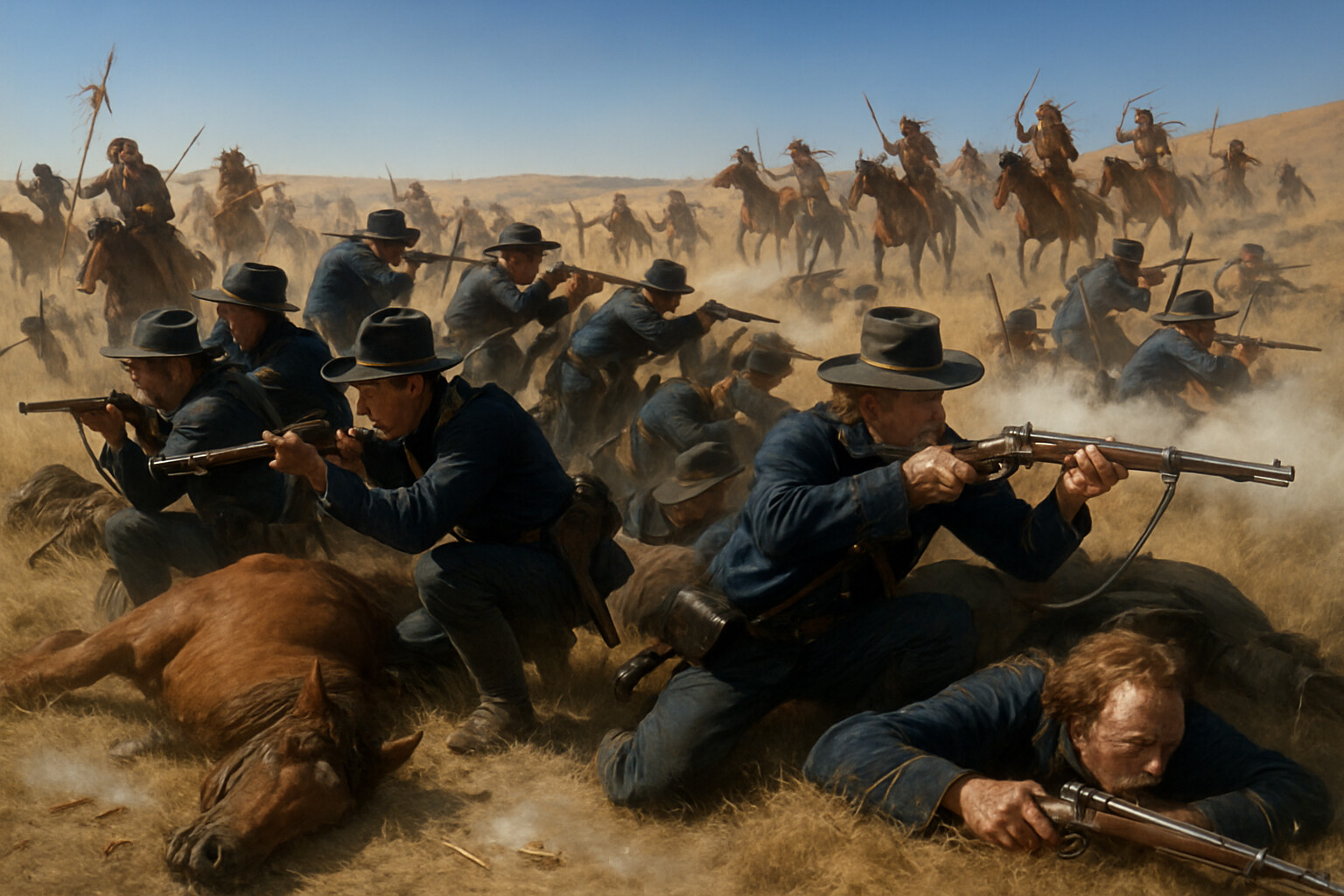
The longer-term implication of this contact was not apparent in Shaka's lifetime. The British would not formally fight the Zulu kingdom until 1879, more than fifty years after Shaka's death. When they did, at Isandlwana and throughout the subsequent Anglo-Zulu War, they encountered a military system whose core principles Shaka had established. At Isandlwana on 22 January 1879, the impondo zankomo formation destroyed a British regular infantry column—approximately 1,700 British and allied troops were killed—in one of the most consequential defeats of a European force in the colonial era. The chest-and-horns formation, the close-combat doctrine, the regimental discipline: all descended in a direct institutional line from what Shaka had built.
---
**The Assassination and Its Aftermath**
On 22 September 1828, Shaka kaSenzangakhona was killed at his homestead at Dukuza—near present-day Stanger on the KwaZulu-Natal coast—by his half-brothers Dingane and Mhlangana, assisted by an attendant named Mbopa. This is one of the best-documented events of Shaka's reign, corroborated by multiple oral traditions and the accounts of European traders present in the region at the time.
The killing took place against a background of significant political strain. Shaka had dispatched a large impi on an extended campaign into territory north of Delagoa Bay—an operation that had kept much of the army away from the kingdom's center for months and generated resentment among commanders and fighters. His grief at the death of his mother Nandi in 1827, and the coercive mourning practices enforced across the kingdom during that period—sources describe prohibitions on planting crops and restrictions on normal daily life lasting months—had strained the patience of the political and military establishment. Dingane and Mhlangana moved when opportunity presented itself.
Shaka was approximately forty years old at the time of his death, based on a birth year of approximately 1787 that is itself an estimate from later tradition. He had ruled the Zulu kingdom for roughly twelve years. The kingdom he left was, by any historical measure, a different entity from the small chieftaincy he had inherited. Dingane ruled after him, continued Zulu military power into the era of expanding Boer settlement, and eventually fell to his own half-brother Mpande in 1840, with Boer assistance. The kingdom persisted until the Anglo-Zulu War of 1879 destroyed its independence.
Shaka left no recorded written documents. His voice reaches us only through the filters of oral tradition gathered after his death and through the accounts of European visitors who observed him at a distance, through translators, and with their own purposes in mind. The person behind the military system is, in this sense, only partially visible. What is fully visible is the system itself, and what it did.
---
**The Record and Its Limits**
Any narrative of Shaka's campaigns operates within constraints that should be stated directly. The oral traditions that form the backbone of Zulu historical memory are rich, specific, and culturally authoritative—and they were recorded primarily in the later nineteenth and early twentieth centuries, decades after the events they describe. James Stuart's monumental collection of oral testimonies, the James Stuart Archive, now published in multiple volumes by the University of Natal Press, is the single most important primary source for Zulu history. It is indispensable and imperfect: memory over generations reshapes events, and Stuart himself was a colonial official with his own interpretive frameworks.
The European documentary record—Fynn, Isaacs, and subsequent colonial accounts—provides external corroboration for the broad outlines of the Zulu military system but is limited in its accuracy about specific battles, numbers, and internal Zulu decision-making. Casualty figures for Shaka-era campaigns are not reliably documented; estimates in early sources vary widely and should not be treated as precise counts. No figures of this kind are asserted in this narrative.
Scholarly historians including John Laband, whose work on the Zulu military system is particularly detailed, John Wright, Carolyn Hamilton, whose book Terrific Majesty examined the construction of the Shaka image over time, Dan Wylie, and others have done the careful cross-referencing work that distinguishes what the sources actually support from what has accumulated through later telling. The result is a historical picture that is broadly clear in outline—Shaka built a powerful kingdom through military innovation and organizational transformation in a compressed timeframe, with major regional consequences—and genuinely uncertain in many of its specifics.
This narrative has followed the broad scholarly consensus on the major facts and has tried to signal where the evidence becomes thinner. Readers interested in the sources should begin with Laband's work on the Zulu army, Hamilton's Terrific Majesty, the published volumes of the James Stuart Archive, and the collected essays in the volume The Mfecane Aftermath, edited by Hamilton.
---
**Legacy**
Shaka kaSenzangakhona died at approximately forty years old, killed by family members rather than by any enemy his regiments had failed to defeat. He had built something that outlasted him by half a century, survived several dynastic changes, and forced one of the most powerful colonial militaries of the nineteenth century to confront its assumptions about the limits of African military capability.
The iklwa and the bull-horn formation were not merely African answers to African problems. They were solutions to universal tactical problems: how to close with an enemy before he can withdraw, how to prevent an enemy from choosing the terms of disengagement, how to translate disciplined training into battlefield decision speed. That these solutions were developed by an African commander from an African military tradition, with iron-age weapons and foot soldiers who wore no armor and traveled difficult terrain without wheeled transport, does not diminish their sophistication. It underscores it.
The Zulu military system that fought at Isandlwana in 1879 was operating from institutional memory that went back to drills conducted under Shaka's personal command. The warriors who closed inside the range of British Martini-Henry rifles and destroyed the column with spear and shield were, in a direct institutional sense, the inheritors of what he had built.
He did not simply make a kingdom. He made an army that could teach it to survive.
In the red soil of southeastern Africa, in the remembered names of regiments and the oral traditions of families that still know which ibutho their ancestors served, the machine he built is still audible—if you listen in the right way.