The fog thinned just before noon on May 27, 1905, and the sea between Japan and Korea opened up gray and flat under a low, overcast sky. Somewhere in that water, thirty-eight Russian warships were making their last ordered run. They had sailed from the Baltic Sea nearly eight months earlier, covering over eighteen thousand miles, and now they were trying to reach Vladivostok. The only thing standing between them and that port was the Imperial Japanese Combined Fleet, and its commander had been waiting for exactly this moment.
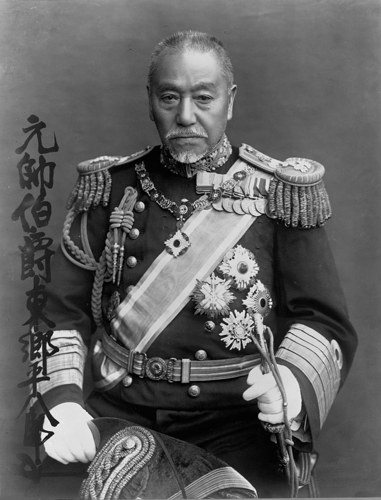
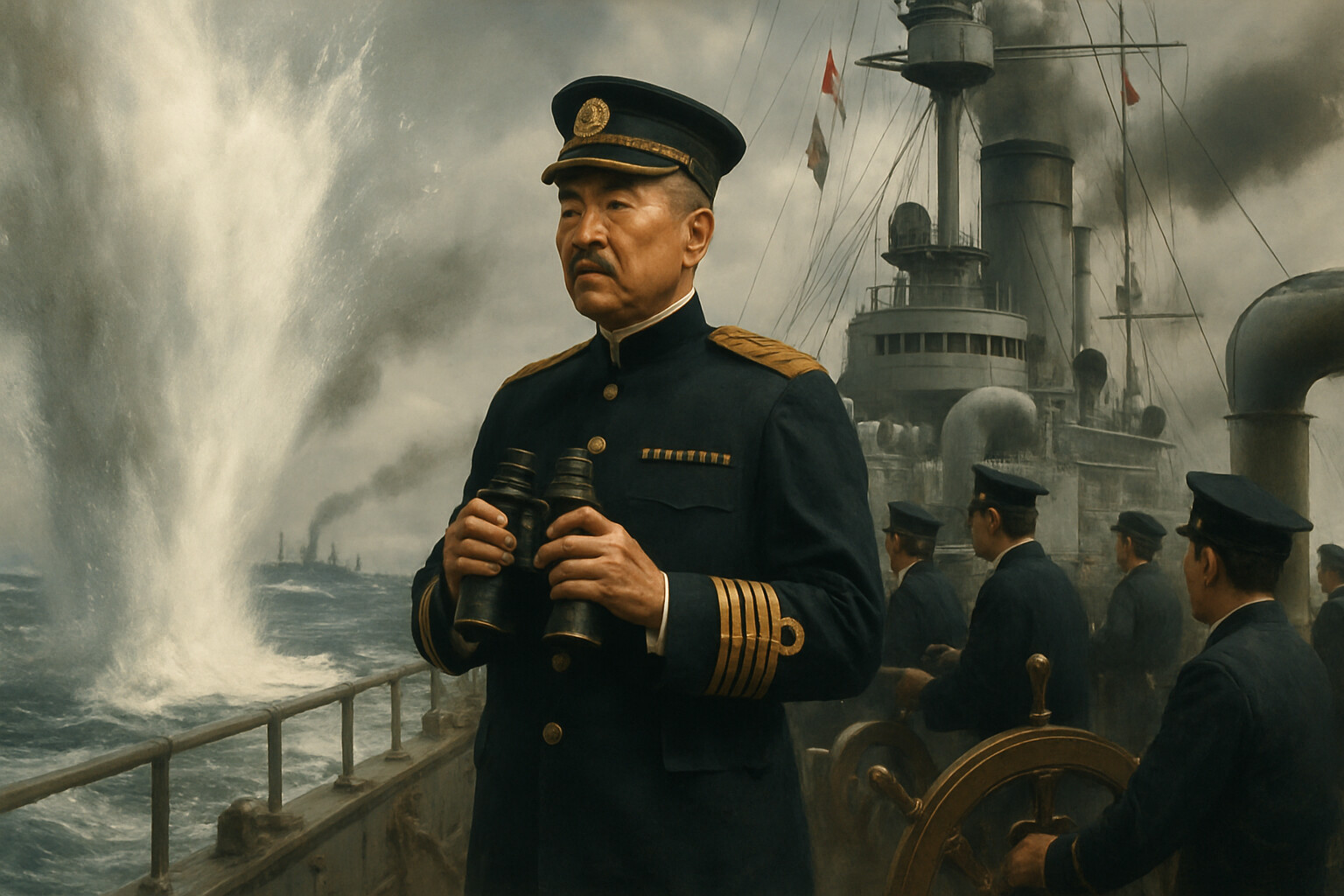
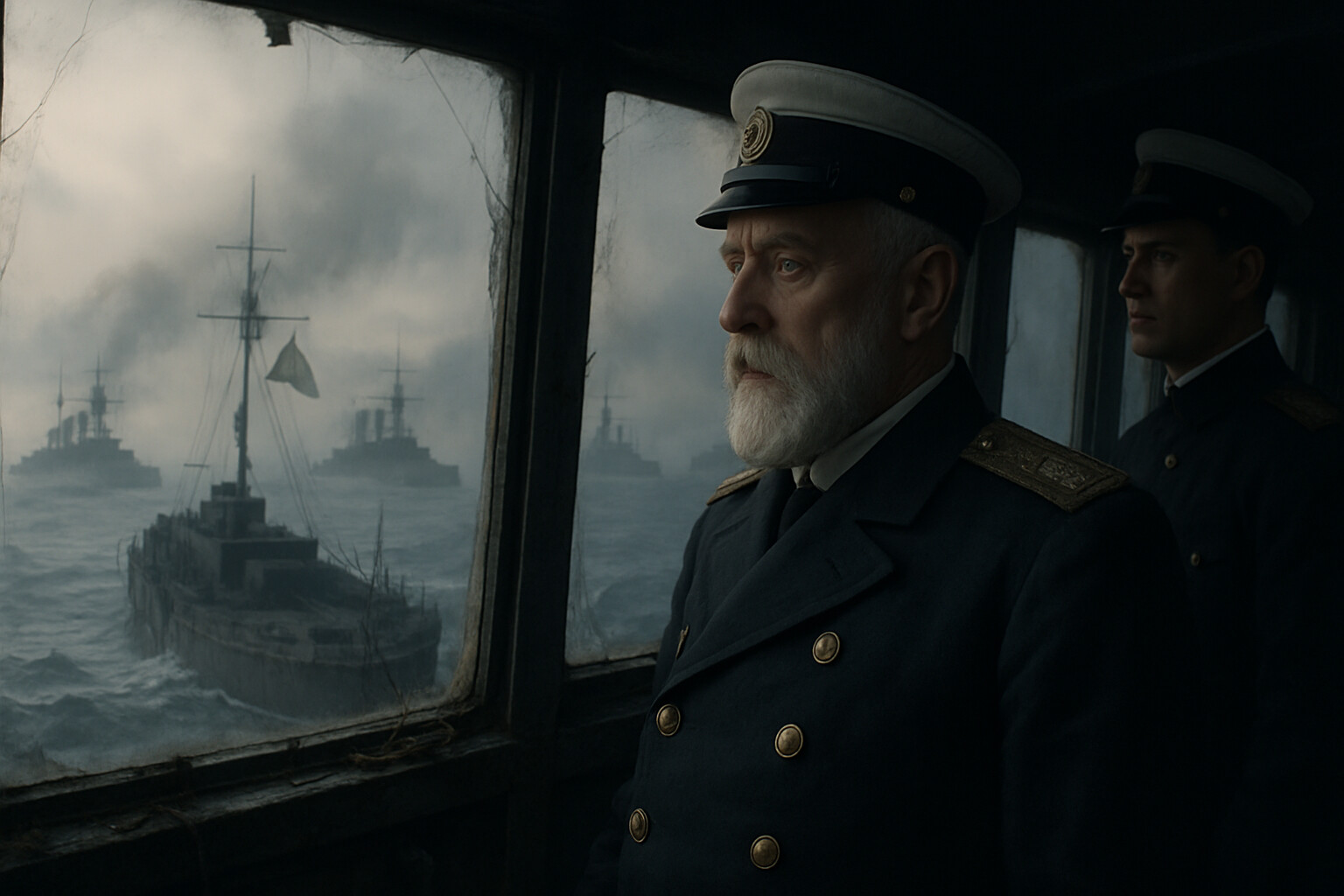
Admiral Heihachiro Togo stood on the bridge of his flagship, the battleship Mikasa, as his lookouts confirmed the contact. The Russians were in a double column formation, steaming northeast. They were tired. Their hulls were fouled from seven months at sea. Their crews had buried men along the route. Their coal was running low. And they were sailing directly into an interception that Togo had been preparing since the first signals of their approach.
What followed over the next two days would become one of the most studied naval engagements in military history and among the most lopsided fleet-on-fleet battles ever fought. The Russians lost twenty-one warships sunk, six captured, and six interned. Japan lost three torpedo boats. The ratio of casualties was so extreme that it reads, even now, more like a training exercise than a contested battle. But nothing about Tsushima was easy or inevitable. It was the product of years of preparation, a coherent strategic plan, and one of the most audacious fleet maneuvers any commander had attempted in the presence of the enemy.
---
**The Man on the Bridge**
Heihachiro Togo was born in 1848 in the Satsuma domain of feudal Japan, the son of a samurai family. His early life coincided almost exactly with Japan's violent transition from isolation to modernity. As a teenager, he witnessed the 1863 bombardment of Kagoshima by a British naval squadron. The British did not destroy Kagoshima because their gunnery was uniquely superior; they did so because their ships were structurally modern and their tactics were coherent. Japan had neither. The lesson registered early.
He trained in Britain between 1871 and 1878, studying seamanship and naval engineering at Thames Nautical Training College and serving time aboard merchant vessels. He returned to a Japan that was rebuilding its navy almost from scratch and rose steadily through a service that was selecting officers on competence rather than birth alone. By the time the First Sino-Japanese War of 1894–1895 placed him in command of a cruiser, he was already regarded as methodical, calm under pressure, and technically precise.
His reputation was established but not yet exceptional when the Russo-Japanese War opened in February 1904. His first major act—a surprise torpedo attack on the Russian Pacific Squadron at Port Arthur before a formal declaration of war—damaged two Russian battleships and set the opening terms of the naval contest. Over the following months he maintained a difficult blockade, lost two of his own battleships to mines, and endured a cautious Russian strategy of keeping their fleet sheltered behind Port Arthur's defenses while Japanese land forces tightened the siege from the landward side.
When the Port Arthur squadron finally sortied in August 1904 at the Battle of the Yellow Sea, Togo engaged and drove it back. Shortly afterward, Japanese siege artillery firing from recently captured high ground above the harbor sank the remaining Russian warships at their moorings. The Pacific Squadron was effectively finished. But Russia had another fleet.
---
**The Fleet That Sailed Around the World**
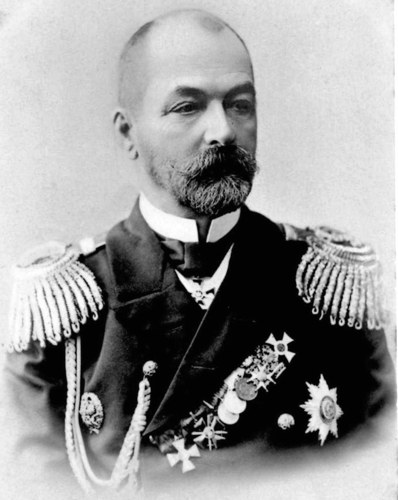
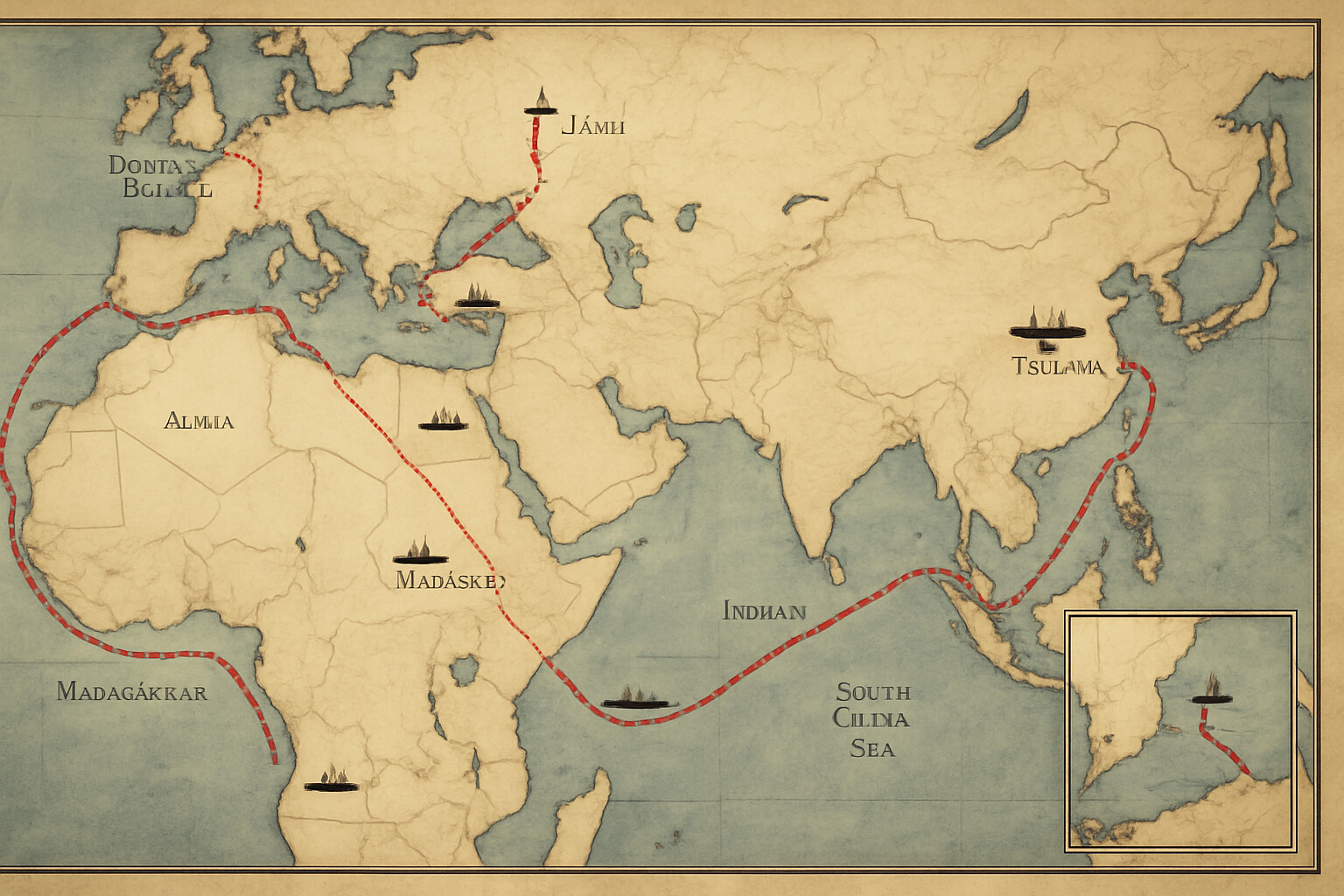
The Russian Second Pacific Squadron, commanded by Vice Admiral Zinovy Rozhestvensky, was assembled in the Baltic and ordered to reinforce the Far East. What followed was one of the most extraordinary and ill-fated naval deployments in modern history. The fleet departed Libau in October 1904, sailing south around Europe, down the length of Africa, across the Indian Ocean, and through the South China Sea. The voyage took nearly eight months. Along the way, Rozhestvensky managed a fleet with a significant number of obsolete or poorly maintained ships, inadequate coaling arrangements, and crews who had not experienced sustained operational service.
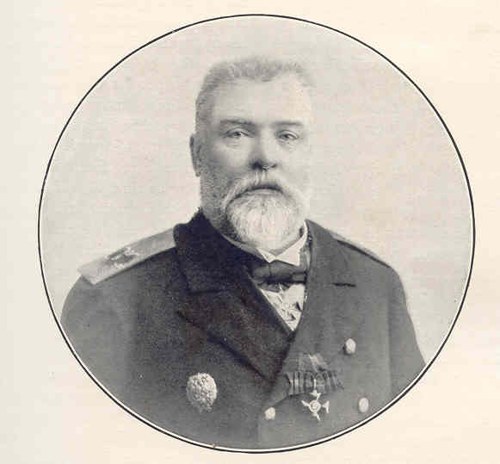
The Dogger Bank Incident in October 1904, in which the Russian fleet opened fire on British fishing trawlers it had mistaken for Japanese torpedo boats, nearly brought Britain into the war on Japan's side and forced a diplomatic crisis that consumed weeks of Rozhestvensky's attention. By the time his fleet reached the waters of Southeast Asia, the slower, older ships were visibly degraded. He had also acquired a reinforcement squadron of older vessels commanded by Rear Admiral Nikolai Nebogatov, which extended his total force but added ships of even more questionable fighting value.
Rozhestvensky had three possible routes to Vladivostok: through the La Pérouse Strait north of Japan, through the Tsugaru Strait between Honshu and Hokkaido, or through the Tsushima Strait between Korea and Japan. The Tsushima route was the most direct. The others required longer sailing in waters where detection and interdiction were also possible. His decision to take the Tsushima route was not unreasonable given the constraints of a fleet short on coal and sea endurance, but Togo anticipated it and was already in position.
The Japanese Combined Fleet had been based at Masan on the Korean coast and at Sasebo on Kyushu. Togo's intelligence network, supplemented by an auxiliary cruiser screen, was watching the likely approach corridors. When the armed merchant cruiser Shinano Maru located the Russian fleet in the early hours of May 27 and signaled its position, course, and speed, the information reached Togo in time to bring his main force to sea and intercept.
---
**The Strait and the Stakes**
The Tsushima Strait is roughly one hundred miles wide at its broadest, compressed between the Korean peninsula to the west and the Tsushima Islands and Kyushu to the east. In May, the weather in those waters can shift rapidly, and visibility is variable. There is enough sea room for fleet maneuver, but not enough to avoid a determined adversary with accurate intelligence.
For Japan, this battle was existential in a specific, practical sense. The war had already cost the country enormous sums and significant casualties. Japanese land forces had driven Russian armies back across Manchuria in grinding set-piece battles at Liaoyang, the Sha-Ho River, and Mukden, but Russia had not been knocked out of the war. St. Petersburg's strategic calculus still included the possibility that naval reinforcement might shift the balance—that a prolonged conflict might exhaust Japan before it exhausted Russia. If Rozhestvensky's fleet reached Vladivostok intact and in fighting condition, Japan's ability to sustain operations in Korea and Manchuria would be directly threatened. A Russian fleet operating from Vladivostok could interdict Japanese supply lines to the continent.
Conversely, if the Russian fleet were destroyed, Russia's capacity to continue the war at sea was effectively finished. With no credible naval threat, Japan controlled the sea lanes it needed. The pressure on the Russian government—already shaken by the fall of Port Arthur, the defeat at Mukden, and the revolution that had begun in January 1905—would become overwhelming. The stakes on May 27 were not merely tactical. The shape of the peace, and Japan's future strategic position in East Asia, depended on what happened in the Tsushima Strait.
Togo's force at Tsushima was built around four battleships: Mikasa, Shikishima, Fuji, and Asahi. These were modern pre-dreadnought vessels, most of them completed in British shipyards in the late 1890s and early 1900s, armed with large-caliber guns in twin turrets fore and aft and a secondary armament belt along the beam. Supporting them were eight armored cruisers, including Kasuga and Nisshin, also recently built or acquired in British yards. Additional light cruisers, destroyers, and torpedo boats extended the fleet to a total of roughly eighty-nine vessels of all types.
Rozhestvensky's battle fleet comprised eight battleships and several armored and protected cruisers at its core, but the condition of that force was the critical variable. The four newest Russian battleships—Knyaz Suvorov, Imperator Aleksandr III, Borodino, and Oryol—were capable ships of roughly comparable design to Togo's battleships, but months at sea had reduced their efficiency. The older battleships and Nebogatov's reinforcement vessels were of considerably less fighting power. The fleet was encumbered with colliers, supply ships, and hospital ships. It was configured to arrive at a destination, not to fight its way through a determined enemy.
---
**The Maneuver**
When Togo's scouts confirmed the Russian position and course on the morning of May 27, the Japanese fleet was at sea northeast of the Russian line of advance. Togo's tactical problem was to bring his entire battle line to bear in a way that concentrated his firepower while limiting the Russians' ability to reply effectively.
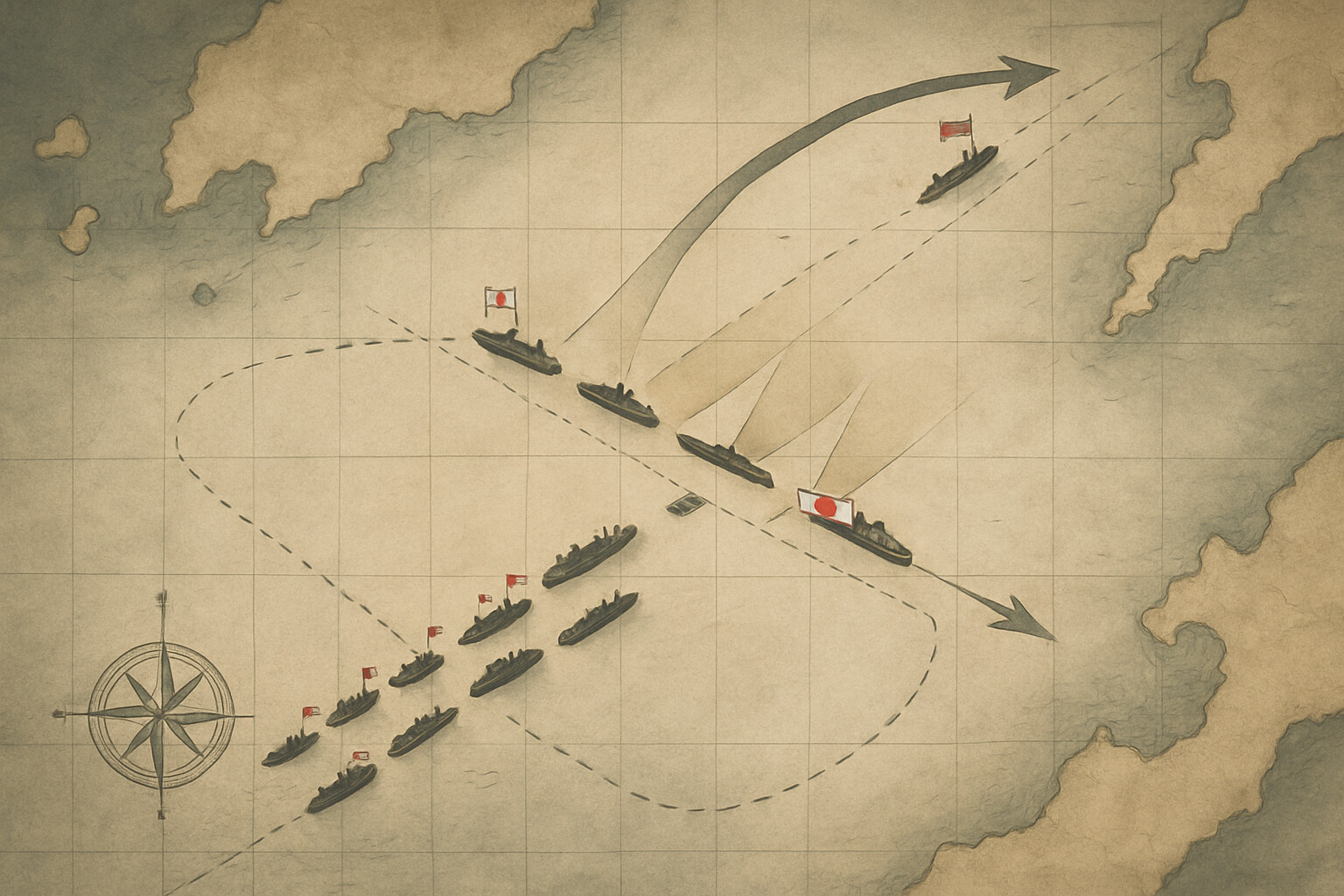
The concept that would define the battle was the naval maneuver known as crossing the T. In fleet engagements of this era, warships fought in line-ahead formation—a single column, each ship following the one ahead—presenting their broadside guns to the enemy, the maximum number of weapons that could fire simultaneously. If one fleet could position itself perpendicular to the head of the enemy column, it could direct the full broadside fire of every ship in its line against only the leading enemy ships. The ships at the rear of the enemy column could not fire without risk of hitting their own vessels ahead of them. The tactical advantage was potentially decisive.
The challenge was achieving it. The T-crossing maneuver required accurate knowledge of the enemy's course and speed, the ability to position one's fleet ahead of the enemy, and—critically—the nerve to execute a course change in the presence of the enemy that temporarily reduced one's own ability to return fire.
At approximately 1:39 PM on May 27, with the two fleets converging, Togo signaled his fleet to execute a 180-degree turn in sequence—a maneuver that would reverse the Japanese line and place it across the head of the Russian advance. Each Japanese ship in turn came to the same point in the water and swung hard over. During those minutes, the turning ships were presenting their bows and sterns rather than their broadsides, reducing the weapons they could bring to bear and making them temporarily more exposed.
Rozhestvensky recognized what was happening. The Russians opened fire. The range was long—standard accounts place it between six and seven thousand meters at the opening of the main engagement, though sources vary slightly—and the initial salvos from both sides were not consistently accurate. Mikasa was struck several times in the early exchanges, and Russian gunnery in the opening phase was not negligible. But the Russians had only minutes to exploit the vulnerability before the Japanese turn was complete, and their fire was not concentrated or accurate enough to break the maneuver.
As the last Japanese ships completed the turn, the geometry of the battle locked into place. Togo's line ran roughly perpendicular to the Russian column. His battle fleet, with its broadsides bearing on the leading Russian ships, concentrated its fire. The Russian column could reply with forward guns and the broadsides of its leading ships, but the rear of the column was largely out of effective action.
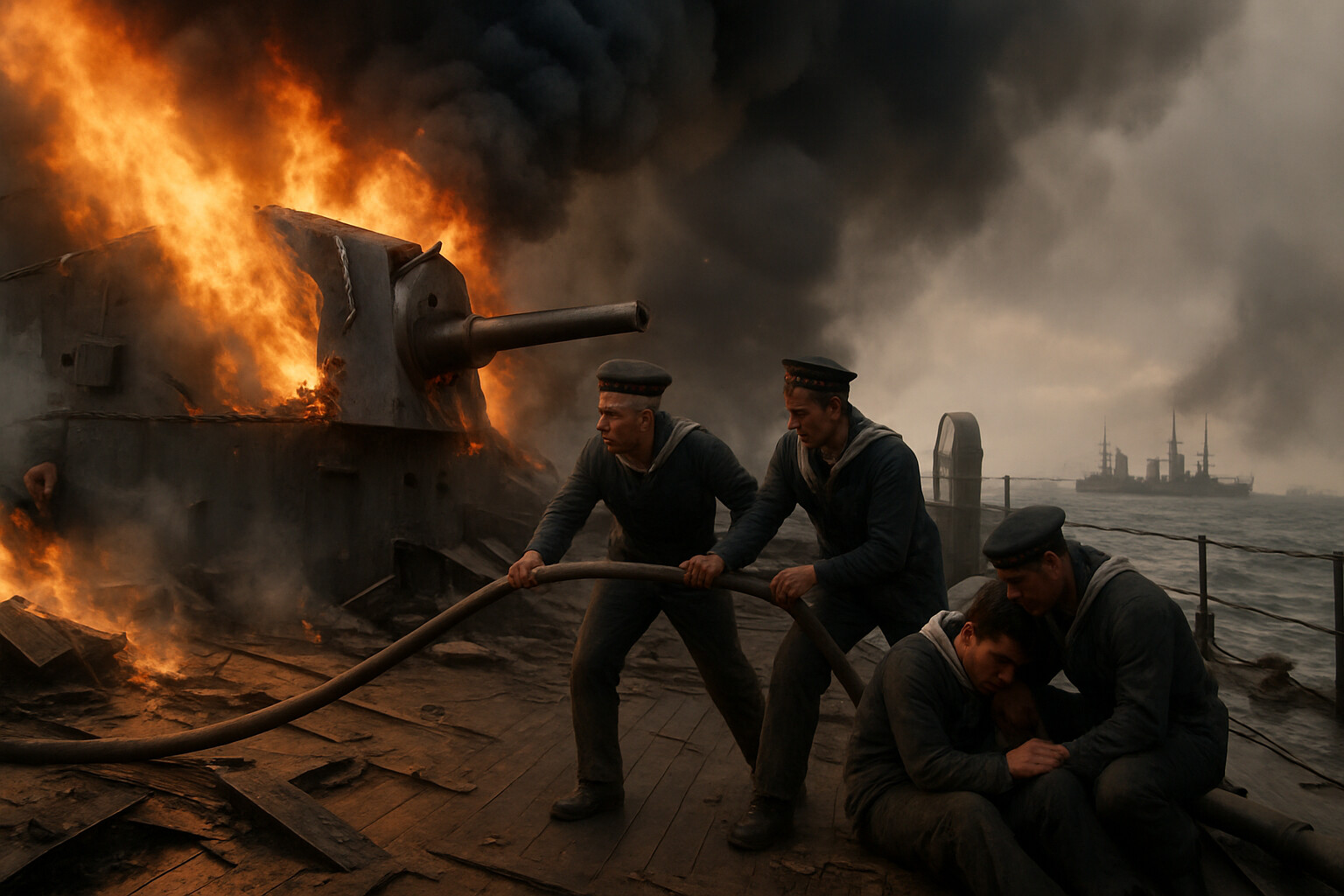
The flagship Knyaz Suvorov, leading the Russian line, came under concentrated fire from multiple Japanese battleships and armored cruisers simultaneously. She was struck repeatedly by large-caliber shells. Her superstructure was destroyed, her steering gear disabled, and Rozhestvensky himself was severely wounded. She fell out of the line, burning. Imperator Aleksandr III, which took over the lead of the Russian column, was also targeted and sank later in the afternoon. Borodino exploded and sank. By nightfall on May 27, the core of the Russian battle fleet had been broken.
The night phase involved Japanese torpedo boat and destroyer flotillas attacking the dispersed and damaged Russian ships in the darkness. These attacks were difficult to coordinate and carried significant risk of confusion, but they added further losses to a fleet already shattered in the afternoon. [Note: the night torpedo attack phase remains only partially reconstructed in English-language sources; individual attack outcomes and ship attribution are not fully established.] When dawn came on May 28, surviving Russian ships were scattered across a wide area—some attempting to escape north toward Vladivostok, others trying to reach neutral ports.
Nebogatov, commanding the remaining functional Russian vessels, assessed the situation and struck his flag. He surrendered a force that included the battleship Oryol and several other ships. A small number of Russian vessels escaped to neutral ports, where they were interned. Only a few destroyers and the cruiser Almaz actually reached Vladivostok.
The accounting was stark. Russia lost approximately twenty-one ships sunk, six captured, and six interned. Over five thousand Russian sailors and officers were killed, and more than six thousand were taken prisoner, including Rozhestvensky himself, who was captured after being removed from his sinking flagship. Japan lost three torpedo boats and approximately one hundred seventeen men killed, with several hundred more wounded.
---
**The Ships and Their Guns**
To understand why the outcome was so extreme, it helps to understand what the warships of 1905 actually were and what their weapons could do at the ranges fought at Tsushima.
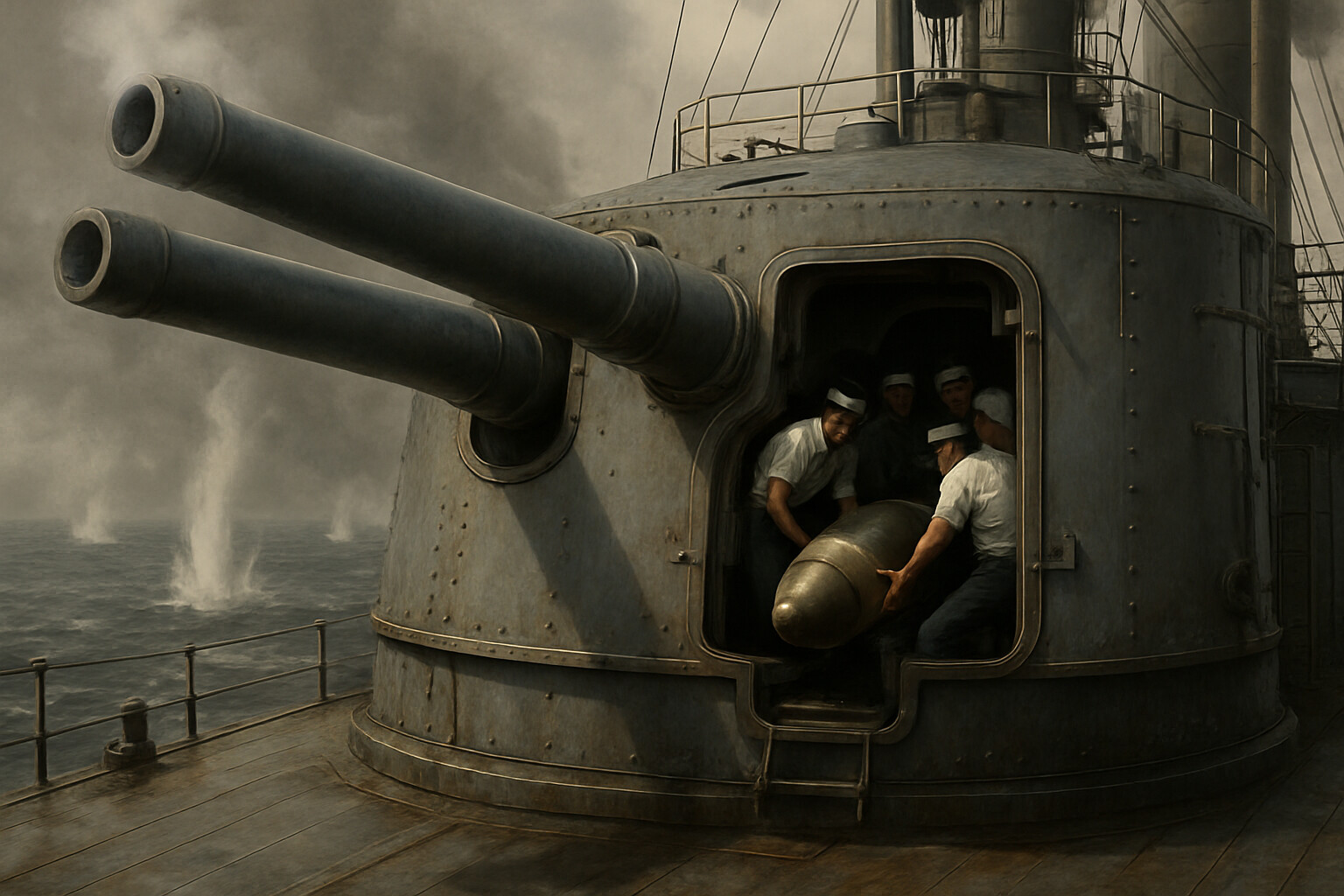
Togo's flagship Mikasa was a British-built pre-dreadnought, completed at Vickers Barrow in 1902, displacing approximately fifteen thousand one hundred forty tons fully loaded. Her main battery consisted of four 12-inch guns in two twin turrets, capable of firing a shell weighing roughly 850 pounds at approximately one to two rounds per minute per gun under combat conditions. At the ranges fought at Tsushima, a 12-inch shell striking an unarmored or lightly armored portion of a warship could detonate inside the hull with devastating effect. Japan used Shimose powder—a picric acid compound, known in British service as lyddite—as the bursting charge in its shells. This highly brisant explosive generated intense fires and fragmentation damage that was particularly difficult to contain once penetration occurred.
The Russian Borodino-class battleships—Suvorov, Aleksandr III, Borodino, and Oryol—were similarly armed with 12-inch guns and were nominally competitive on paper. But the months at sea had affected maintenance, and the concentrated Japanese fire at the head of the Russian line meant that those ships absorbed punishment from multiple directions simultaneously, overwhelming their damage control capacity.
Japanese fire control benefited from years of focused training and from optical rangefinding equipment largely derived from British practice. The deliberate concentration of fire on single targets amplified the effect of Japanese gunnery beyond what raw gun numbers alone would suggest. Multiple capital ships engaging the same target simultaneously meant that damage accumulated faster than any crew could manage it.
Torpedo weapons also played a role in the night phase. Japanese torpedo boats and destroyers were armed with Whitehead-pattern torpedoes—self-propelled underwater weapons that had matured significantly since their introduction in the 1860s. At Tsushima, the night torpedo attacks contributed to finishing off ships already damaged but still afloat after the afternoon gunnery action. The cumulative effect on Russian crews, exhausted and operating in darkness and confusion, was also a significant tactical factor.
---
**The Human Weight of the Battle**
The numbers conceal the experience of the men inside those ships. Inside the Russian battleships during the afternoon of May 27, the damage was not abstract. Shells tore through steel and timber and bodies without warning. Fires started in compartments and spread when damage control parties were killed or driven away. The noise inside a targeted warship under heavy shellfire—the impacts, the structural concussion, the sound of one's own guns firing in reply—was continuous and disorienting. Rozhestvensky was wounded in the head by shell fragments and was eventually transferred from Suvorov to a destroyer. His flagship, still flying his flag, continued to be engaged by Japanese ships uncertain whether she had been abandoned.
On the Japanese side, Mikasa was struck repeatedly during the battle. [The precise number of hits on Mikasa varies across sources; the figure in the official Japanese record has not been confirmed against the original gunnery reports for this story and should be treated as approximate.] The men working the secondary battery guns in open or semi-open positions were exposed to splinter damage from every near miss. Togo remained on the bridge throughout the engagement in a position where he could be observed by his crews and could assess the battle as it evolved over hours. The weight of fleet command required continuous judgment and signal, not a single order and a watched result.
Rozhestvensky was captured after the action, received medical treatment for his wounds, and was eventually repatriated to Russia. He faced a court-martial over the conduct of the campaign, was convicted of abandoning his post by transferring his flag while wounded, but was pardoned by the Tsar. His argument—that the outcome was structurally determined by the condition of his fleet before the battle began—is recorded in post-war accounts, but represents his perspective as recorded in those accounts, not a settled historical verdict.
Nebogatov, who surrendered the remaining ships, was also court-martialed. He was sentenced to death, a sentence later commuted to imprisonment. His calculation—that further resistance would cost lives without any realistic prospect of escape—remained controversial. Some of his officers refused to accept the surrender and were separately prosecuted.
---
**After the Guns**
The consequences of Tsushima moved at diplomatic speed. President Theodore Roosevelt, who had been monitoring the Russo-Japanese War closely, moved to broker peace talks. The Treaty of Portsmouth, signed in September 1905, ended the war and formalized Japan's gains: the transfer of Russia's lease on the Liaodong Peninsula including Port Arthur, the southern half of Sakhalin Island, and Russian recognition of Japan's paramount interest in Korea.
For Japan, Tsushima's meaning extended beyond the specific territorial concessions. The battle was understood both domestically and internationally as proof of Japan's emergence as a major naval power. No Asian nation had defeated a European great power in a major naval engagement in the modern industrial era. The strategic and psychological significance of that fact reverberated through the calculations of every major power in the following decades.
For Russia, Tsushima was a catastrophe that fed directly into the political crisis already underway. The revolution of 1905, which had begun before the battle, was intensified by the news of the naval disaster. The assumptions underlying the construction and deployment of the Second Pacific Squadron—that mass and determination could overcome distance, logistics, and the operational advantages of a prepared defender—had been shown to be dangerously wrong.
Togo returned to Japan to public ceremonies of a scale the country had not previously conducted for a naval officer. He was promoted to Fleet Admiral and spent the following decades as a senior figure in the naval establishment. He lived until 1934, long enough to observe the transformation of naval warfare by aviation and to see the navy he had helped build begin preparations for a new generation of conflict.
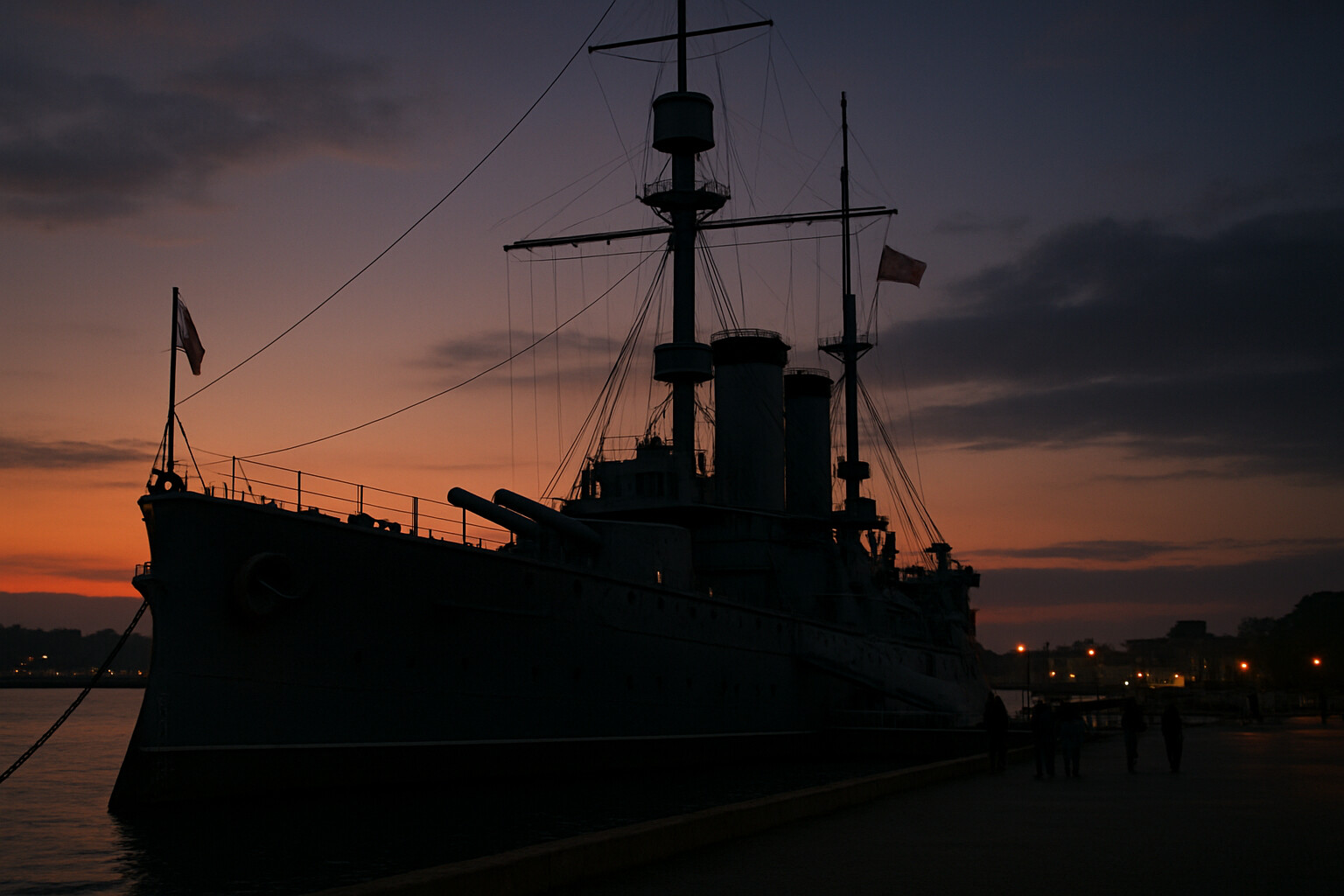
Mikasa survived the battle and a subsequent accidental magazine explosion in September 1905 that sank her in Sasebo harbor, killing a significant number of her crew. She was raised, repaired, and kept in service until decommissioned in 1923. Preserved in 1926 as a national memorial, she was encased in concrete at Yokosuka. Post-war restoration efforts recovered much of her superstructure and original fittings. She remains today the sole surviving pre-dreadnought battleship in the world.
---
**The Record and Its Limits**
The Battle of Tsushima is among the most extensively documented naval engagements of the pre-dreadnought era. Japanese official records, Russian naval archives, the post-battle courts-martial proceedings, Rozhestvensky's own accounts, and a substantial body of Western naval literature—from Julian Corbett's contemporaneous analysis to later scholarly studies—provide a detailed picture of the engagement's sequence, losses, and tactical decisions.
Certain details remain areas of ongoing historical discussion. The precise sequence of the afternoon's gunnery exchanges is reconstructed from multiple accounts that do not entirely agree on the timing and target selection of specific salvos. The condition and morale of Russian crews before the battle is documented through official records and personal accounts, but individual experience varied significantly across different ships and crew positions. The night torpedo attacks were confused affairs in which coordination was imperfect and results were recorded only partially in real time.
The signal Togo is reported to have hoisted before the battle—drawing an explicit parallel to Nelson's signal at Trafalgar—is documented in Japanese naval records as having been flown on Mikasa. The text of the signal, as recorded in those records and rendered in English translation, reads in substance: 'The fate of the Empire rests upon this one battle. Let every man do his utmost.' The parallel with Nelson's Trafalgar signal was noted at the time and has been repeated extensively since. Scholars have generally accepted the signal as authentic, while noting that the conscious echo of Trafalgar may have been deliberate. [The precise wording in English translation varies across secondary sources; the authoritative Japanese-language source text and its official rendering have not been confirmed for this story and should be verified before publication.]
The comparison of Togo to Nelson, which became a standard feature of popular literature on Tsushima almost immediately after the battle, was a construction of contemporary naval culture and should not be treated as a neutral technical assessment. Both commanders won decisive battles through aggressive maneuver and concentration of fire, and both became symbolic figures for their respective naval establishments. The differences in era, context, and technology are substantial.
---
**Why Tsushima Endures**
The Battle of Tsushima is studied in naval war colleges because it represents, in nearly complete form, the decisive naval engagement that naval theorists of the late nineteenth century had spent decades arguing was possible and necessary. The ideas of Alfred Thayer Mahan—that naval power was the foundation of national power, that sea control was achieved through fleet engagement, and that decisive battle was the proper object of naval strategy—found what appeared to be their most complete practical illustration in the waters between Korea and Japan on May 27–28, 1905.
The battle also marks a specific historical threshold: the first major naval victory by a non-Western power over a Western power in the modern industrial era. That fact did not go unnoticed in the colonial world, where Russia's defeat was read as evidence that European military dominance was not structural or permanent. The political reverberations of that reading would not be fully visible for decades, but they were real.
For the study of tactics, Tsushima is both an example and a warning. The T-crossing maneuver was executed with near-perfection, but it required conditions that would not often recur: variable but workable visibility, accurate intelligence, a predictable enemy course, and an opponent whose fighting capacity was already compromised enough that the vulnerability of the turning ships did not result in decisive counter-damage. Subsequent naval theorists and historians have argued that the conditions at Tsushima were in some respects unique, and that the lessons drawn from it—particularly the belief that decisive fleet action would be similarly achievable in future conflicts—contributed to doctrinal rigidities that would cost lives in later wars.
The strait itself is quiet now, its surface carrying the ordinary traffic of the Korea-Japan shipping lanes. Below the surface, the wrecks of Russian warships remain where they went down, occasionally the subject of salvage speculation or archaeological interest. The depth of the water and the condition of century-old steel mean that most of them will remain undisturbed for the foreseeable future.
Togo's Mikasa sits in a concrete cradle at Yokosuka, her guns trained toward the sea. Her armor is original. Her bridge, where Togo stood through the hours of May 27, is preserved and open to visitors. She is the physical remainder of a moment that very briefly made the ocean between Japan and Korea the most consequential stretch of water in the world.