The grass on the hillside was high enough to hide a man crawling on hands and knees, but no one was crawling. They were standing, or trying to stand, in a lane of fire that had already dropped dozens of men along the Camino Real and the low ground near the San Juan River. The men of the 1st U.S. Volunteer Cavalry—called the Rough Riders almost from the day they mustered—were bunched in a sunken trail and in the grass at the base of a hill called Kettle Hill, named for the large iron sugar-processing kettles sitting near its crest. The Spanish riflemen above them, invisible inside blockhouses and trenches cut into the ridgeline, were firing Mauser rifles loaded with smokeless powder. The Americans below could not see where the fire was coming from. They could only watch men fall.
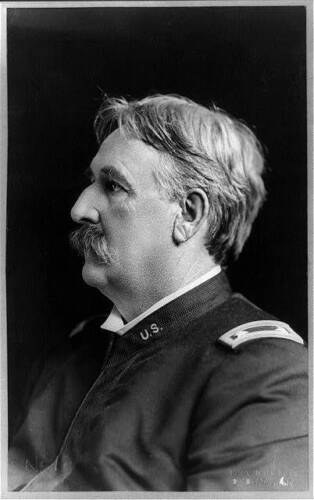
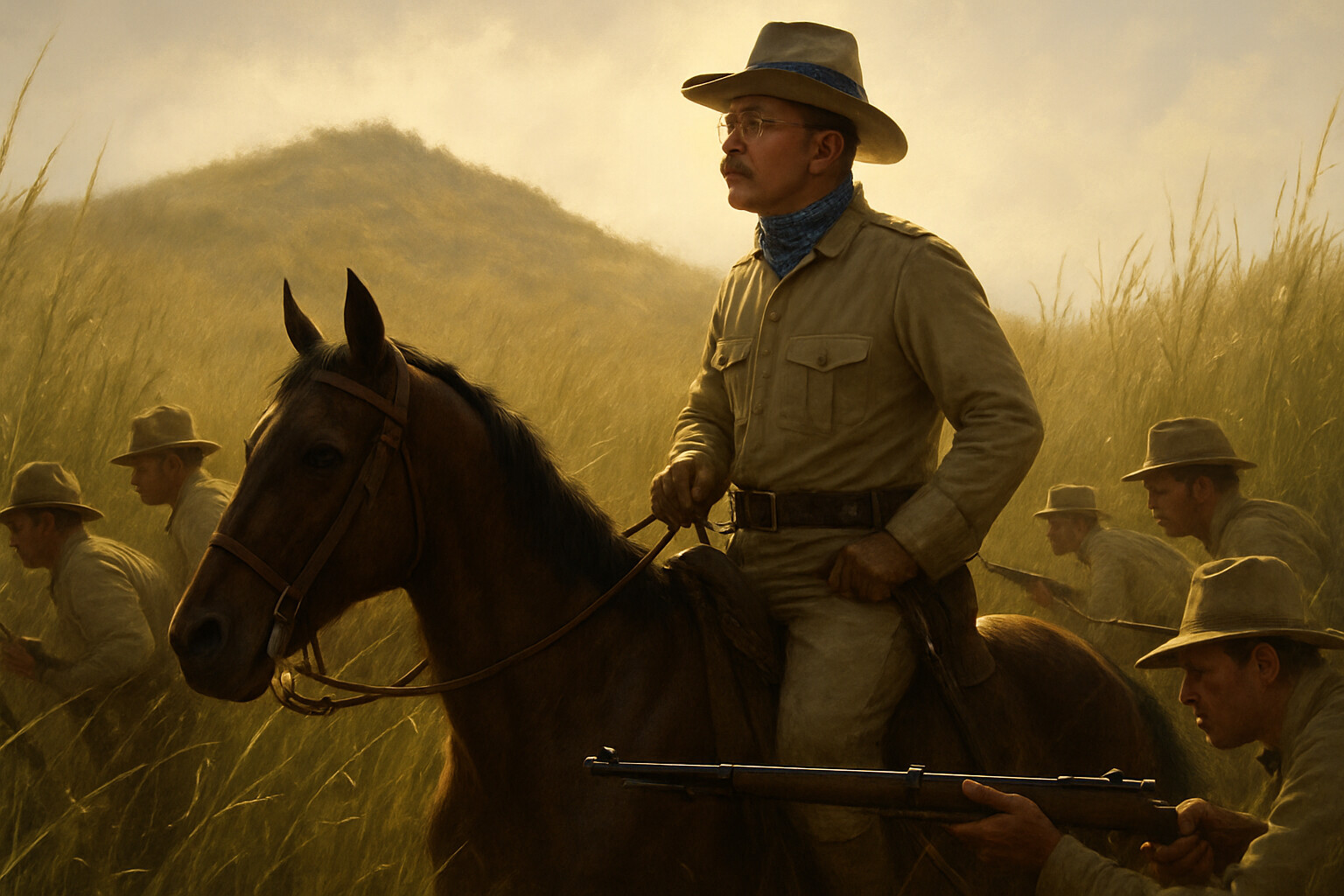
Somewhere in that compressed, overheated ground, Lieutenant Colonel Theodore Roosevelt sat on his horse. He was the second-in-command of the Rough Riders, technically subordinate to Colonel Leonard Wood, who had that morning been given command of a brigade and left Roosevelt in charge of the regiment. Roosevelt was thirty-nine years old, a former New York City police commissioner, a Harvard man, a published historian, a cattle rancher who had spent years in the Dakota Badlands, and a politician who had already served in the New York State Assembly and as a U.S. Civil Service Commissioner. He had lobbied for this war with an intensity that alarmed some of his colleagues. When war came in April 1898, he left the desk of the Assistant Secretary of the Navy—a post he held under President McKinley—to take a commission in the volunteer force being assembled. He had never commanded troops in combat. He was about to.
The war that brought him to that hillside had been building for years. Cuba had been a Spanish colony since the fifteenth century, and by the 1890s, a grinding independence movement had turned into open insurrection. Spanish authorities responded with a reconcentration policy—forcing rural Cubans into garrisoned towns under brutal conditions—that produced mass civilian suffering and death. American newspapers, particularly the competing New York papers of William Randolph Hearst and Joseph Pulitzer, covered the atrocities with a vividness that was sometimes accurate and sometimes embellished. American business interests in Cuba were substantial. The destruction of the U.S. battleship Maine in Havana harbor in February 1898—a cause still debated by historians—brought public and congressional pressure to a head. Congress declared war on Spain in April 1898.
The U.S. Army that went to war in Cuba was small, underequipped for a major campaign, and hampered by supply failures that would prove nearly as dangerous as Spanish bullets. The Regular Army numbered fewer than 30,000 men before the war began. It was supplemented by state volunteers and by new volunteer regiments created specifically for the conflict, among them cavalry organized from frontiersmen, hunters, athletes, and Native Americans under the authority given to Leonard Wood and Theodore Roosevelt. The regiment that became the 1st U.S. Volunteer Cavalry trained at San Antonio, Texas, before shipping to Tampa, Florida, and then to Cuba. By the time they reached the island, the enlisted men had been forced to leave their horses behind for lack of transport capacity. The Rough Riders—the most famous cavalry regiment in American popular memory—fought the Battle of San Juan Heights on foot.
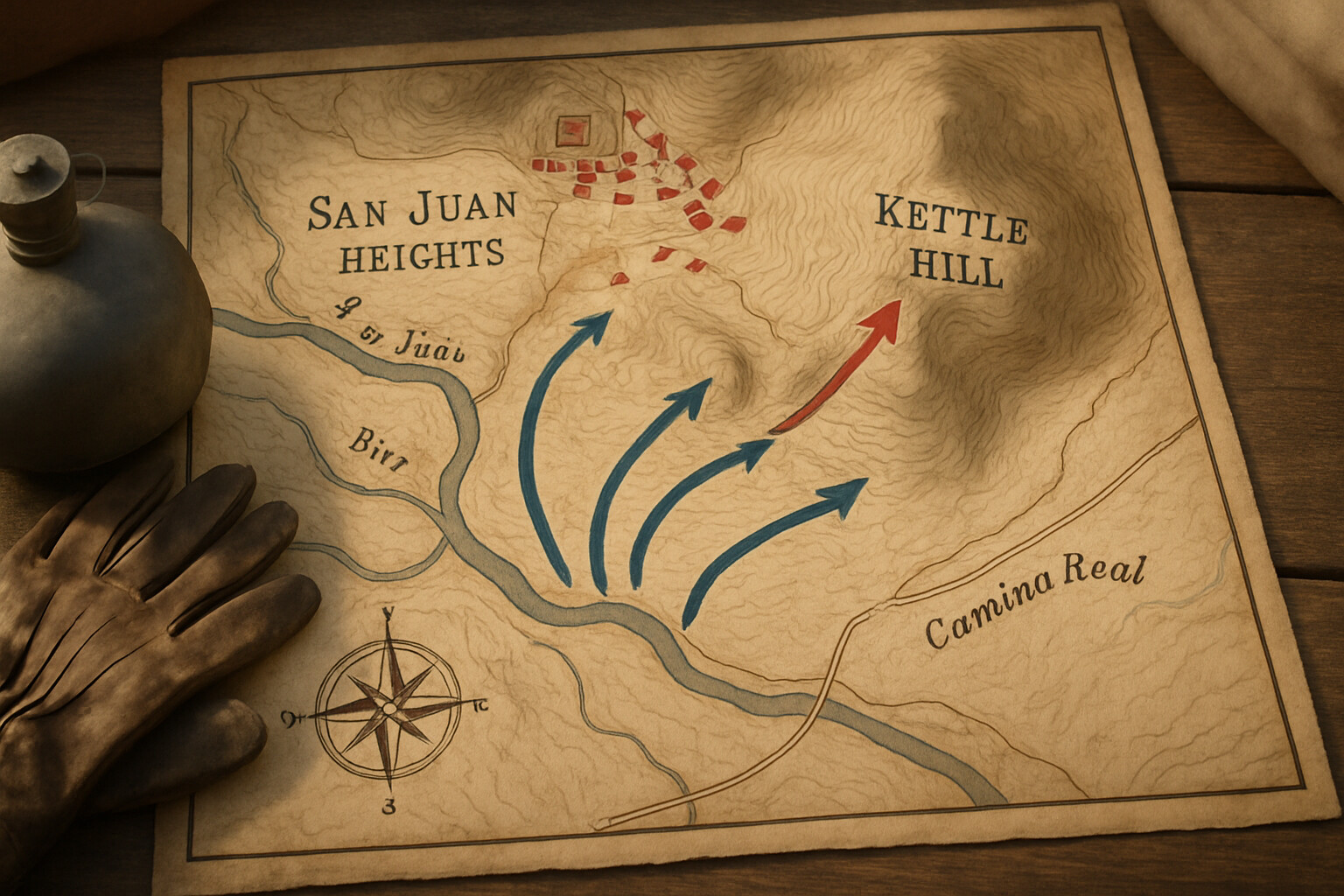
The strategic situation in Cuba by late June 1898 was this: a Spanish garrison held the city of Santiago de Cuba, a major port on the island's southeastern coast. A U.S. naval squadron under Rear Admiral William T. Sampson had trapped the Spanish Caribbean fleet inside Santiago harbor. To force a naval battle or compel the city's surrender, the Army needed to take the high ground east of the city—a ridge called the San Juan Heights—which commanded both the city and the harbor approaches. The V Corps, commanded by Major General William R. Shafter, landed at Daiquirí and Siboney in late June with approximately 15,000 men and began moving inland over roads that were little more than jungle tracks in the rainy season.
The advance on July 1 involved two simultaneous attacks. To the north, Brigadier General Henry Lawton's division was sent against the fortified village of El Caney, expected to fall within a few hours and then swing south to support the main effort. El Caney resisted far longer than anticipated. The Spanish garrison of a few hundred men under General Vara del Rey held out most of the day against a much larger American force, and Lawton's division never arrived in time to assist at San Juan. The main attack fell on the San Juan Heights proper, where Spanish fieldworks topped a long ridge, with blockhouses at the crest and well-dug trenches giving defenders clear fields of fire across hundreds of yards of open and partially open ground.
The approach on the morning of July 1 was a study in the dangers of poor preparation meeting determined defense. American troops moved along the Camino Real—the main road from Siboney toward Santiago—through jungle that compressed entire brigades into narrow columns. A U.S. Army observation balloon, tethered and floating above the tree line, was intended to spot Spanish positions but instead served as a conspicuous marker for the column below. Spanish artillery and rifle fire began falling on the compressed troops in the trail. The balloon was eventually shot down, but not before it had drawn fire onto men who had almost nowhere to move.
The troops waiting to advance on Kettle Hill and the San Juan ridge included the Regular Army's 1st, 3rd, 6th, and 10th Cavalry regiments, along with the Rough Riders. The 9th and 10th Cavalry were the Buffalo Soldiers—Black regiments with white officers, veterans of the Indian Wars, with a record of service stretching back to the post-Civil War frontier. Their presence at San Juan Heights placed them alongside white volunteer and regular units in one of the most significant combined engagements of the era. The 10th Cavalry in particular would fight through the same ground as the Rough Riders on July 1, and accounts from multiple witnesses make clear that the assault on Kettle Hill was a joint effort.
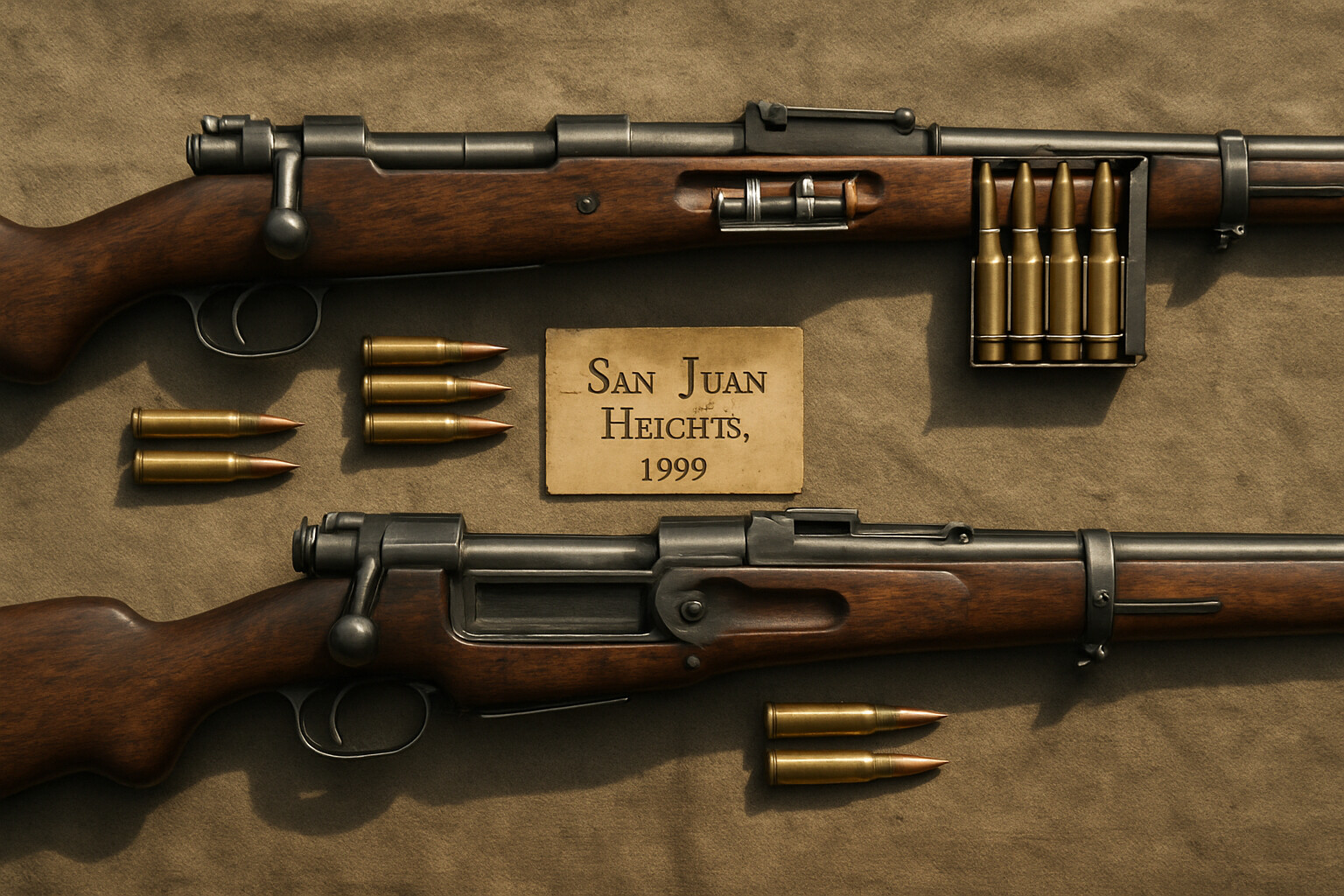
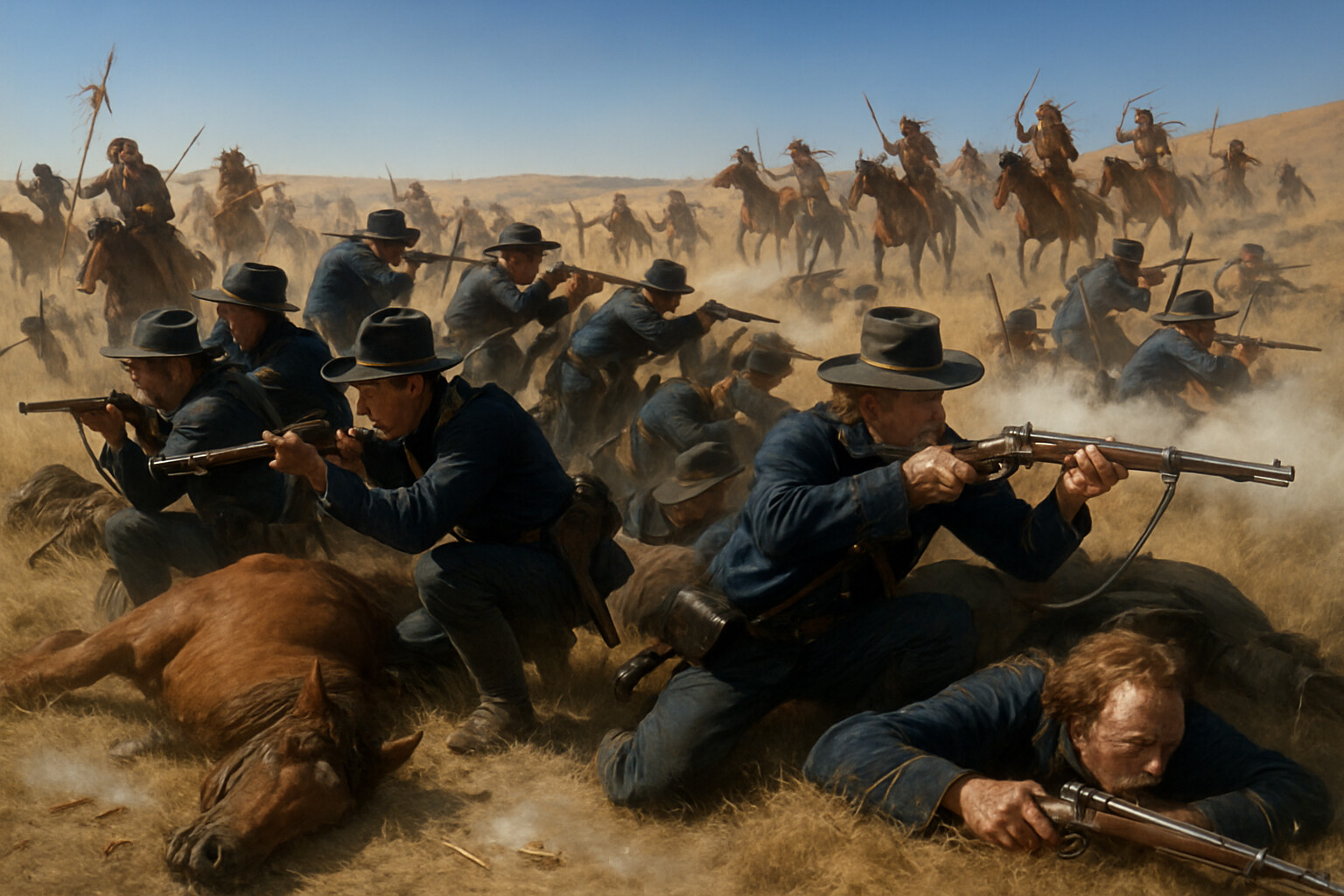
The weapons on both sides shaped what was possible. The Spanish defenders carried primarily the Mauser Model 1893 rifle, chambered for the 7x57mm cartridge and loaded with smokeless powder. Smokeless powder was a critical tactical advantage for the defense: each rifle produced almost no visible discharge, making individual shooters nearly impossible to spot from below. The Mauser also fed from five-round stripper clips that allowed trained riflemen to reload quickly and sustain a high rate of fire. Men in the low ground often could not determine where the shots were coming from. They heard the crack of the round, watched someone fall, and kept searching for a target that left no smoke.
The American infantry and cavalry carried the Krag-Jørgensen rifle, adopted by the U.S. Army in 1892 and chambered for the .30-40 Krag cartridge—also a smokeless-powder weapon, bolt-action, with a rotary magazine holding five rounds. The Krag was accurate and reliable, but its magazine loaded one round at a time rather than accepting stripper clips, which made reloading slower under pressure. Some American units in the war still carried the older Springfield Model 1873 in .45-70 caliber—a black-powder cartridge that produced a visible smoke cloud with every shot, advertising the shooter's position to anyone watching from the ridge. The Rough Riders carried the Krag. American fire support came from field guns and, critically, a battery of Gatling guns—multi-barrel, hand-cranked rapid-fire weapons that would prove decisive in the afternoon.
For the first hours of the morning, the American troops in the low ground near the San Juan River and along the trails leading to Kettle Hill absorbed fire and waited for orders that were slow in coming. The command structure under General Shafter was strained: Shafter himself was suffering badly from heat and gout and could not be present on the battlefield. Orders moved slowly through a chain of staff officers trying to sort out who was supposed to do what and when.
Roosevelt, conspicuous on his horse—one of the very few horses that had made it ashore in usable condition—rode along the trail and low ground trying to organize his regiment and understand what was happening. His horse, a small brown gelding named Texas, kept him visible above the grass line in a way that drew fire and also allowed him to see and be seen by his men. He wore a blue polka-dot bandanna around his hat as a recognition signal—a detail he recorded in his own post-war account. He also carried a revolver that had been salvaged from the wreck of the Maine, a weapon whose personal significance he found fitting for the occasion.
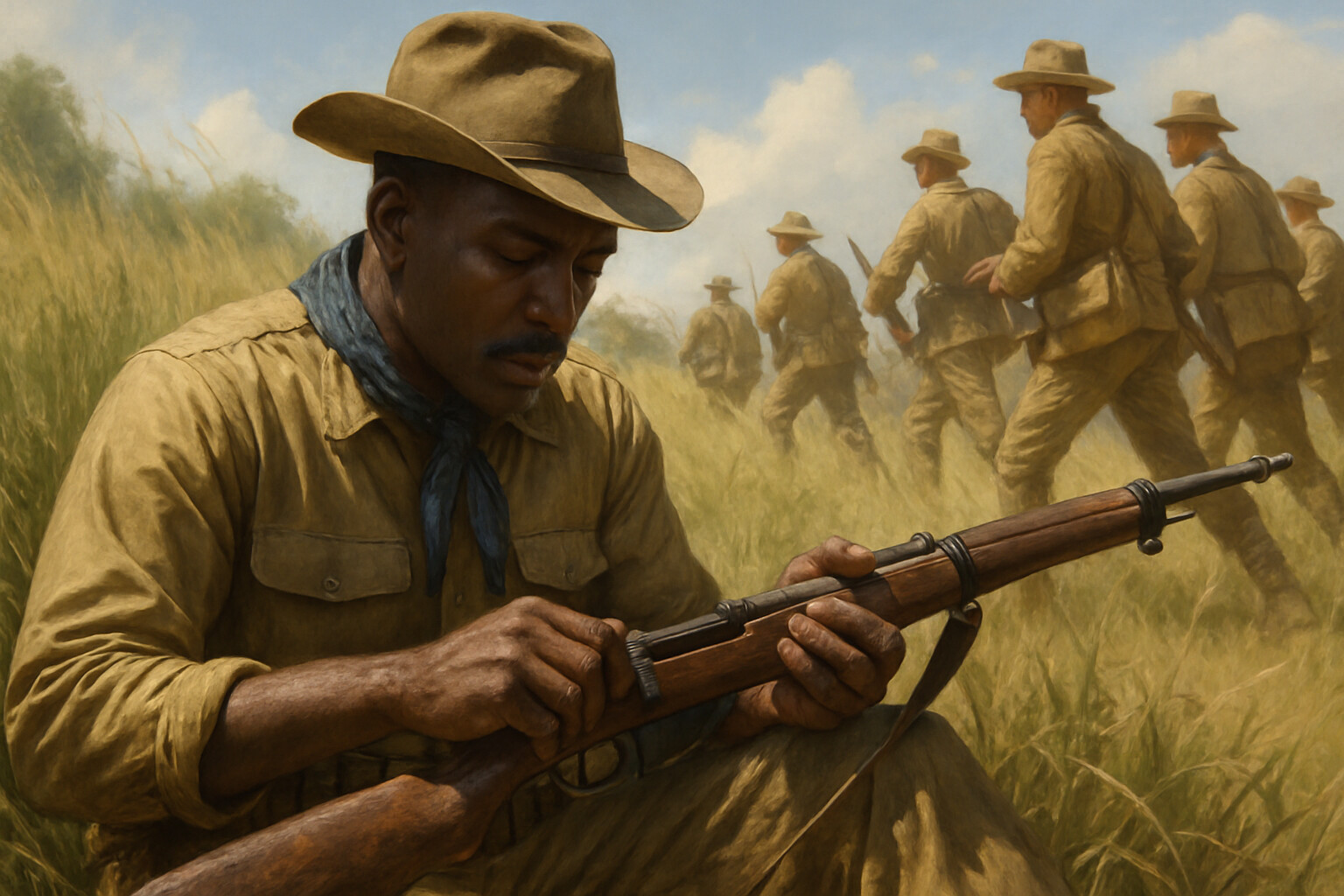
The orders to advance, when they came, arrived with some ambiguity about which units were supposed to move and when. Accounts differ on who authorized the advance and in what sequence. What is documented is that by early afternoon, American troops on the right of the line began moving up Kettle Hill, and the advance became general along a broad front. Roosevelt, still mounted, led his regiment forward through the grass and up the slope. The 9th and 10th Cavalry were moving on the left and toward the hill as well. Men from multiple regiments mingled in the advance—the kind of battlefield mixing that often happens when a stalled attack finally begins to move and momentum carries everything forward together.
The climb up Kettle Hill was under continuous fire. Spanish defenders in the trenches above fired down the slope. Some accounts describe men stopping to return fire; others pressed forward without pausing. The hill's grass and scattered brush gave partial concealment but made coordinated movement difficult. Officers had to move physically along the line, since verbal commands were largely drowned out. Roosevelt, on horseback, could be seen by more of his men than most officers on foot could manage, and he used that visibility to push the advance forward at several points where the line began to slow—or so multiple accounts of the assault suggest. The exact sequence of his movements cannot be reconstructed minute by minute from the surviving record.
Near the crest, the advance accelerated. The Spanish defenders, outnumbered and under fire from troops now close enough to engage effectively, began falling back from the first set of trenches. The Americans reached the crest of Kettle Hill. The iron sugar kettles that gave the hill its name were there—a detail confirmed by multiple eyewitness accounts. From the crest, the men could see the main San Juan ridge to the west, still defended, still under fire, with American troops from other units pressing up its slope.
A battery of Gatling guns, brought forward by Lieutenant John Parker, had opened fire on the Spanish trenches on the main San Juan ridge during the assault's final phase. Parker's three Gatling guns fired at a rate that witnesses described as a sustained roar against the intermittent crack that had dominated the morning. The psychological and physical effect on the defenders on the ridge was significant. The guns were a tactically decisive element of the afternoon—a point that later accounts sometimes underemphasize in favor of the individual charge narrative. Roosevelt himself, in his post-war writing, credited Parker's Gatlings with materially assisting the assault.
From the crest of Kettle Hill, Roosevelt could see men of other regiments pinned and struggling on the slope of the main San Juan ridge. He organized troops from his own regiment and from units that had mixed in during the Kettle Hill advance, and led them across the open ground between the hills and up toward the San Juan ridge. The men who followed in this second push were a composite force—Rough Riders, Regular Army cavalry troopers, and others—of the kind that a fluid battle produces. The crossing was under fire, and there were casualties in the open ground between the hills.
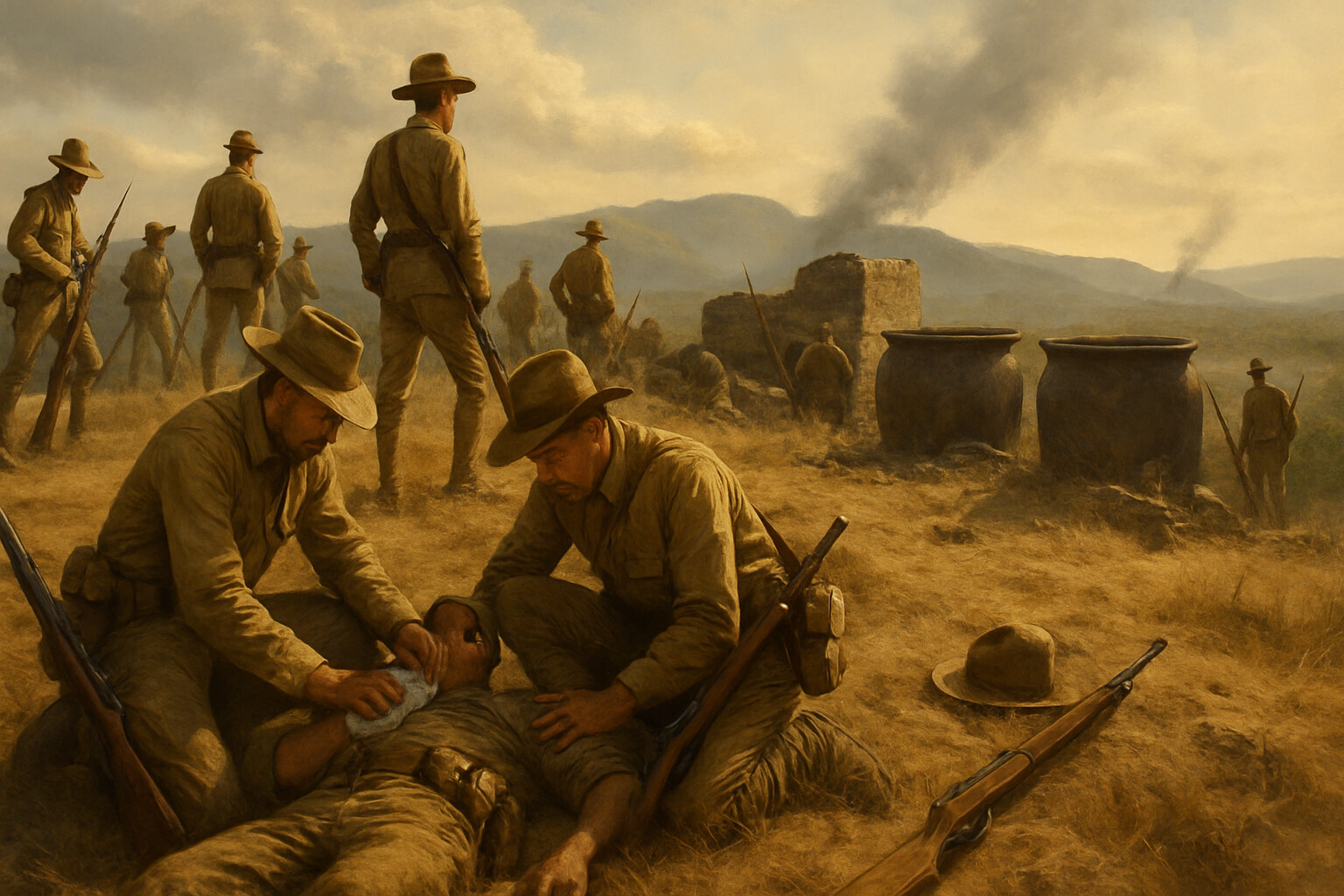
The San Juan ridge fell in the afternoon. Spanish forces withdrew from the heights, and American troops occupied the ridgeline with clear observation over Santiago and its harbor below. It was not a clean or celebratory moment. Men had been killed and wounded across hours of fighting, medical support was overwhelmed, the troops on the ridge were exhausted and low on water, and the status of the Spanish forces in the city remained uncertain. Whatever relief the men on the crest felt was muted by the immediate demands of holding the position under continued fire and attending to the dead and wounded.
The human cost of July 1, 1898, was real and not small relative to the forces engaged. The Rough Riders suffered roughly 86 casualties—killed and wounded combined—out of approximately 490 officers and men engaged, according to the regiment's own records and subsequent historical accounts. The Regular Army regiments fighting alongside them suffered heavily as well. Total American casualties for the San Juan Heights and El Caney fighting on July 1 have been estimated by historians at approximately 1,400 killed and wounded, though exact figures vary by source and by how the count is drawn. The Spanish defenders also took serious losses, including the death of General Vara del Rey at El Caney.
In the days that followed, the military situation around Santiago moved quickly. The Spanish Atlantic Squadron attempted to break out of Santiago harbor on July 3 and was destroyed by the waiting American naval force in a one-sided engagement. The Spanish garrison in Santiago, cut off and without hope of naval relief, surrendered on July 17, 1898. The war in Cuba was effectively over. A peace protocol was signed in August, and the formal Treaty of Paris in December transferred Cuba, Puerto Rico, Guam, and the Philippines from Spanish control to American influence or sovereignty. The Spanish-American War lasted roughly four months and transformed the United States into a power with overseas territories and responsibilities it had not previously held.
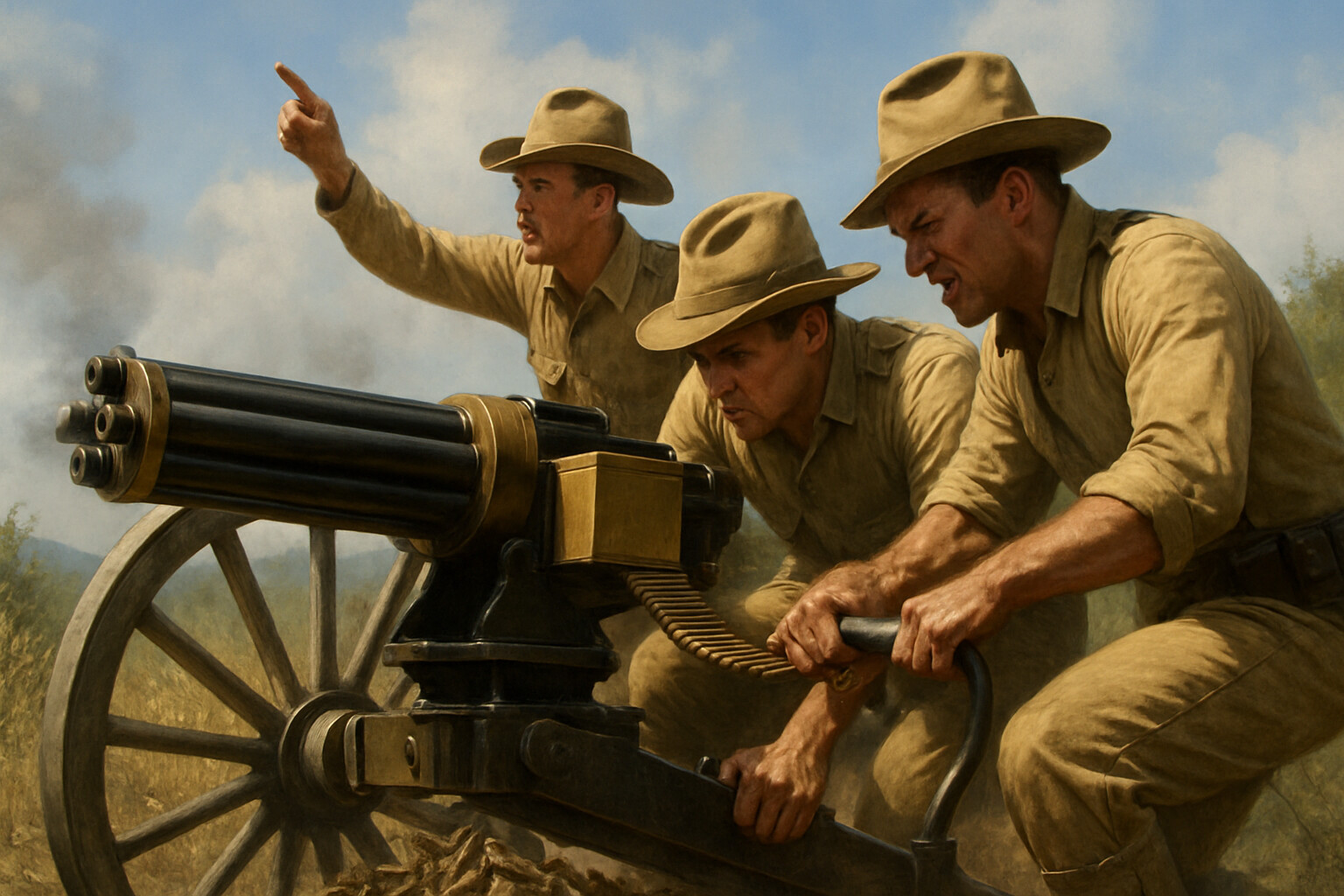
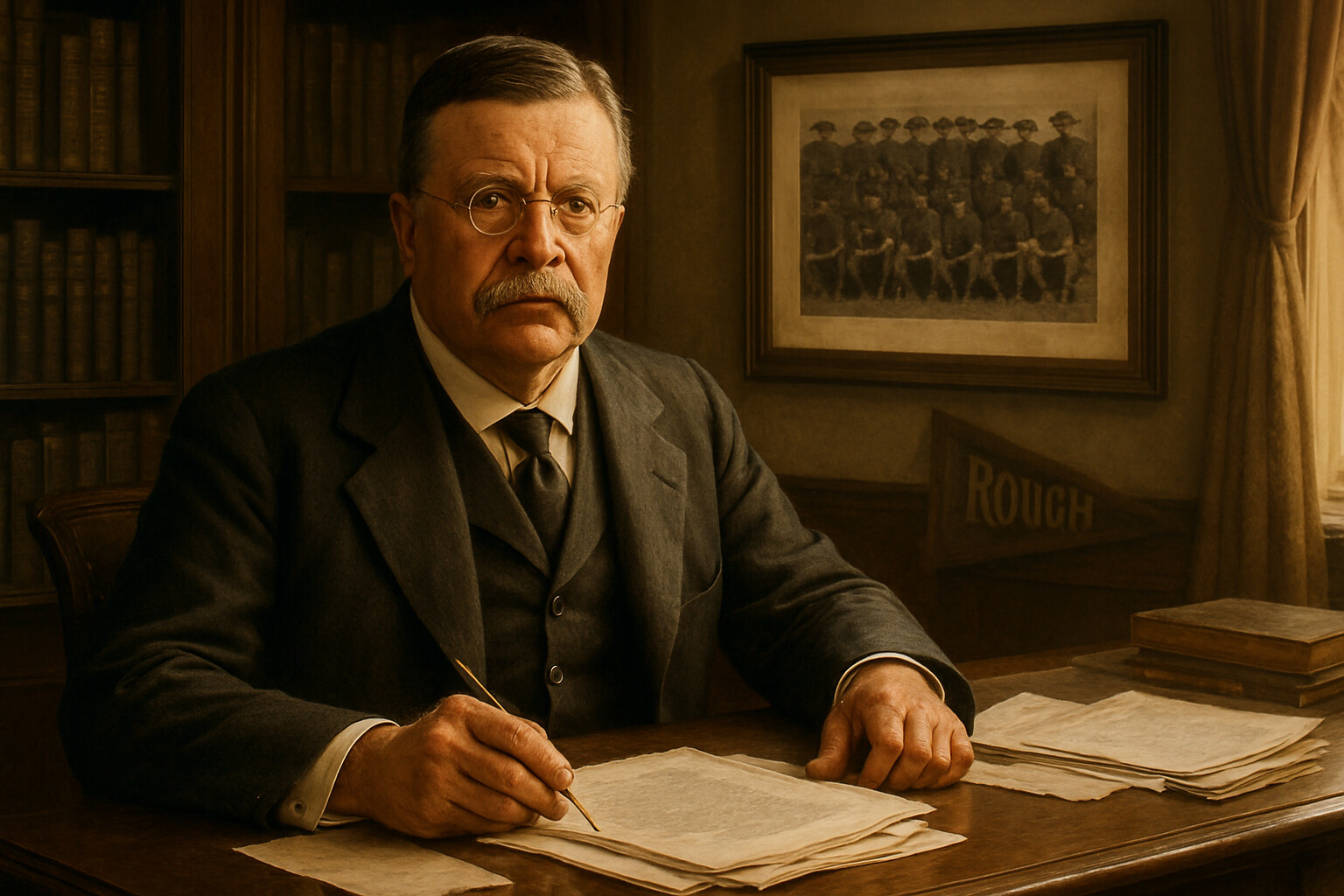
For Theodore Roosevelt, the battle was personally defining in a way that few single days are for anyone. He had gone to Cuba seeking the validation that he believed combat service provided, and he found it in a direct form. He returned to the United States a celebrated figure, rode the fame of San Juan Hill to the governorship of New York in 1898, was placed on the McKinley ticket as Vice President in 1900, and became President of the United States upon McKinley's assassination in September 1901. He spent the rest of his life writing and speaking about the Rough Riders and about July 1, 1898.
His book about the campaign, The Rough Riders, published in 1899, is a primary source for many details of the battle and also a document that must be read critically. Roosevelt was the author, the subject, and an interested party, and historians have long noted that his account emphasizes his own role and the Rough Riders' contribution while giving less credit to the Regular Army regiments—including the Buffalo Soldiers—who fought alongside and in some cases ahead of them. Accounts from officers and enlisted men of the 9th and 10th Cavalry, along with later scholarship, have worked to restore a fuller picture of the composite nature of the assault. The charge up Kettle Hill was not a solo act; it was a regimental and multi-unit action involving thousands of men.
The Buffalo Soldiers who fought at San Juan Heights brought to that battle a record of service extending back to the post-Civil War period, when Congress established the 9th and 10th Cavalry regiments as permanent Black units in the Regular Army. They had fought in the Indian Wars across the Southwest and the Great Plains, in campaigns complicated by the racial politics of the era. At San Juan, they were present as Regular Army soldiers doing what Regular Army soldiers did, and their performance under fire was documented by officers and soldiers of other units. Sergeant Major Edward Baker of the 10th Cavalry received the Medal of Honor for his actions near Santiago—one of several Black soldiers recognized, though the recognition was unevenly applied and the historical record of their contributions was for decades shaped by the same racial inequities that governed American society at large.
The question of Theodore Roosevelt's Medal of Honor is among the more carefully documented award controversies of the era. Roosevelt was recommended for the Medal of Honor after the battle by officers who witnessed his conduct on July 1. The recommendation was not approved during his lifetime, a decision that involved bureaucratic and possibly political factors that historians have examined but not fully resolved. In 2001—more than a century after the battle—the Medal of Honor was posthumously awarded to Roosevelt by President Bill Clinton, following a review ordered by Congress. The award was presented to his descendants. Because it was awarded a century after the action and after Roosevelt's death, it occupies a different historical category than awards made during or immediately after the engagement itself.
The terrain of the San Juan Heights is today preserved as a Cuban national park. The blockhouse on San Juan Hill—the ridge, not Kettle Hill, though the names are often conflated in popular memory—still stands, as does a large bronze sphere memorial. The site contains monuments from both the American and Spanish perspectives on the battle. The sugar kettles that gave Kettle Hill its name are gone, but the hill itself remains identifiable from contemporary photographs and maps. The landscape has changed in the century-plus since 1898—vegetation grown, structures built and demolished—but the basic topography that made the heights defensible and the climb costly is unchanged.
What the battle of July 1, 1898, demonstrated tactically was the degree to which smokeless powder and magazine-fed bolt-action rifles had shifted the calculus of assault. A defending force in prepared positions with clear fields of fire and smokeless-powder weapons could exact a serious toll on attacking troops even when outnumbered. The American assault succeeded because of numerical superiority, because of the fire support provided by Parker's Gatlings, because of the cumulative pressure of a broad attack that could not all be stopped at once, and because of the willingness of men at multiple points along the line to keep moving forward when stopping in the open was its own kind of danger. It was not a clean tactical solution. It was a human solution to a tactical problem, at human cost.
The Rough Riders were mustered out of service in September 1898, a few weeks after their return to the United States. They held reunions for years afterward, and the regiment became one of the most mythologized military units in American popular culture—celebrated in books, paintings, films, and political speeches across the following decades. The mythology sometimes obscured the reality: that the regiment was one of several engaged, that Regular Army units bore an equal or greater share of the fighting and dying, that the Buffalo Soldiers fought with distinction that was systematically underrewarded, and that the campaign as a whole was marked by logistical failure, disease, and command confusion as much as by individual acts of courage.
The men who climbed the San Juan Heights on July 1, 1898, did so in the heat of a Cuban summer afternoon, under fire from positions they could not clearly see, carrying rifles and not enough water, in a war declared less than three months earlier. Most of them were not famous. Most of their names do not appear in the books that made the battle celebrated. They climbed because they were ordered to, and because the men beside them were climbing, and because stopping in the open was its own kind of danger. They took the hill. The city below surrendered within weeks. The war ended before summer was out. The country they fought for emerged from it a different kind of nation—with territories in the Caribbean and the Pacific, with a newly enlarged sense of its own global role, and with the complicated inheritance of an imperial project that its founders had never quite intended and its people had never quite agreed upon.
That inheritance is part of what the battle of San Juan Heights produced, alongside the casualties, alongside the fame, alongside the career of a man who became president. The heights above Santiago were taken on a July afternoon by soldiers whose names history has handled unequally. Getting that record straight is its own kind of obligation.