The river was wrong for a battle. That much was clear by the morning of October 28, 312 AD.
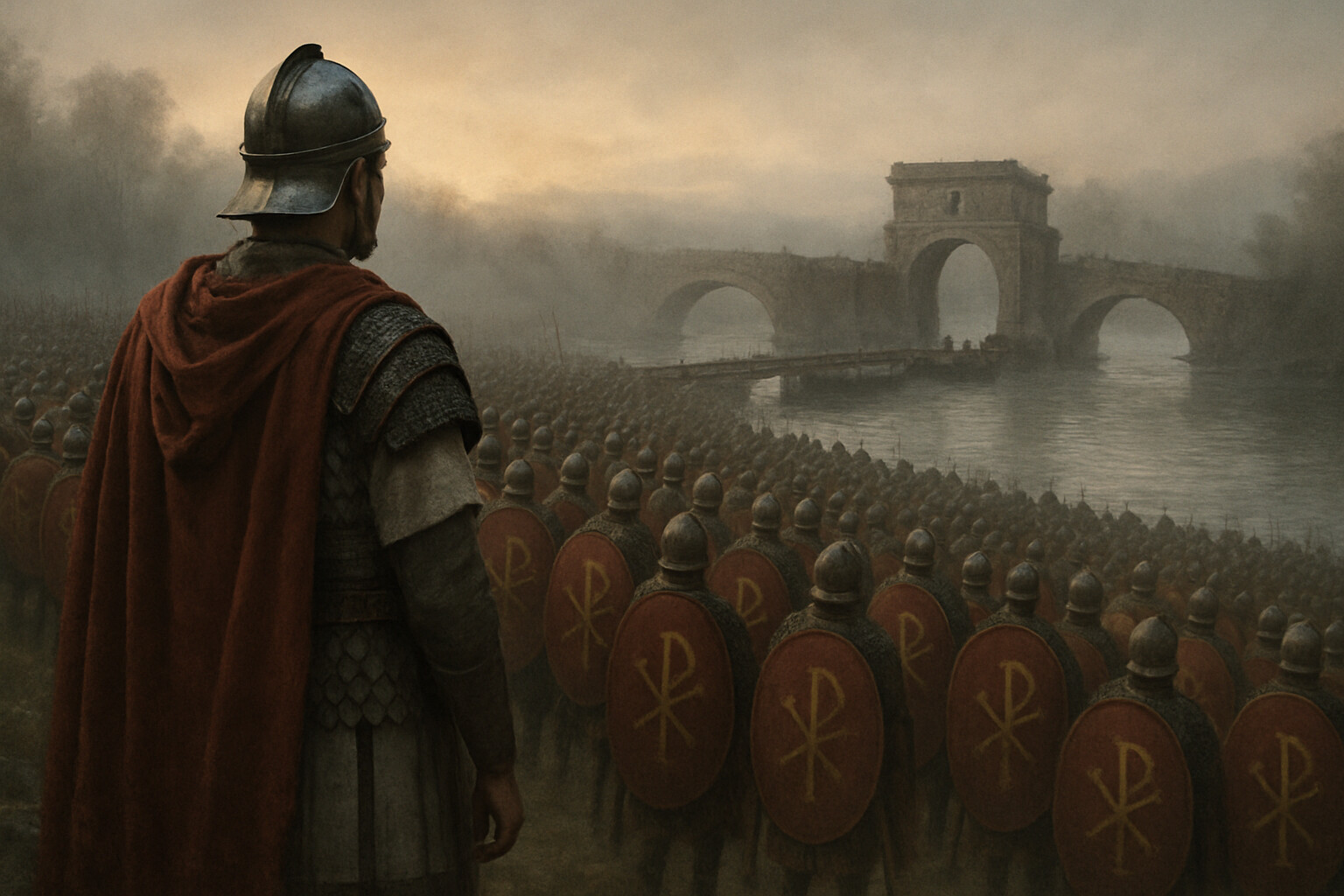
The Tiber runs fast and cold at the Milvian Bridge, about three kilometers north of Rome's Aurelian Walls. At that season, autumn rains had already swollen the banks. The bridge itself — the Pons Milvius, a stone arch structure that had carried the Via Flaminia into the capital for more than three centuries — was partially dismantled. Maxentius, the man who held Rome and the title of Augustus, had ordered part of the span broken up and replaced with a temporary pontoon crossing built on moored boats. He intended the measure to slow Constantine's approach. Instead, the pontoon became a trap.
On that morning, somewhere north of the bridge along the narrow strip of ground between the Tiber's bend and the rising hills, two Roman armies faced each other under the autumn sky. One would fight with its back to a river it could not easily cross. The army that lost would find the water behind it.
Maxentius had made that army his own.
---
To understand what happened at the Milvian Bridge, it is necessary to understand how Rome had arrived at a moment when Romans killed Romans for control of the city that bore the empire's name.
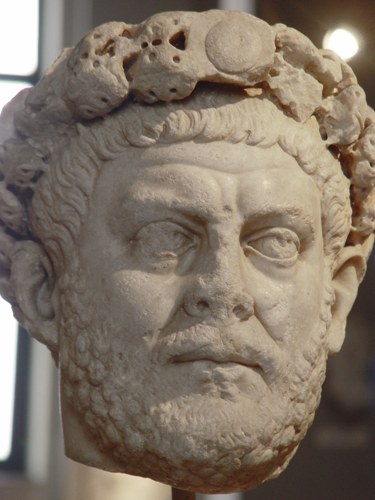
The system called the Tetrarchy — literally, rule by four — had been devised by the Emperor Diocletian in 293 AD as a structural answer to the empire's chronic instability. Rather than one emperor attempting to govern a territory stretching from Britain to Mesopotamia, Diocletian arranged power among four rulers: two senior Augusti and two junior Caesars, each assigned regions, each backed by armies, and each theoretically prepared to succeed upward in an orderly hierarchy. For roughly a decade, the system held. Then Diocletian abdicated in 305 AD, and the machinery of succession broke down almost immediately.
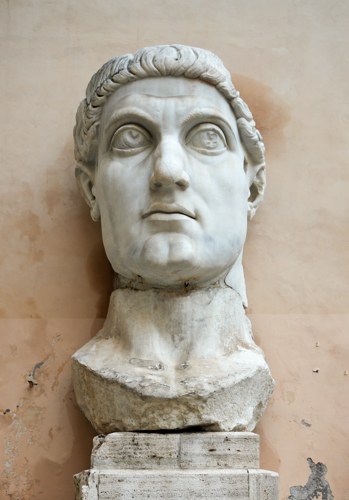
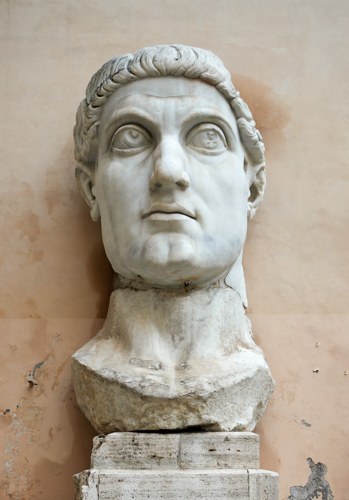
By 312 AD the Tetrarchy had collapsed into civil war. Six men had claimed the title of Augustus at various points in the preceding seven years. Some were dead. Others had been deposed. Two now stood at the center of the final contest for the Western empire: Maxentius, son of the former emperor Maximian, who had seized Rome in 306 AD and held it against multiple challengers; and Constantine, son of the former western emperor Constantius Chlorus, who had been proclaimed Augustus by his troops in Britain in 306 AD and had since consolidated control of Gaul, Britain, and the Rhine frontier.
Constantine was approximately thirty-eight years old in 312 AD — though his precise birth year is disputed in scholarship, with estimates ranging from roughly 272 to 285 AD. He had spent the preceding decade campaigning against Germanic tribes along the Rhine and navigating the fractures of the Tetrarchy. He was an experienced field commander who understood logistics, supply, and the psychology of armies. He had not previously moved against Rome by force. In the spring and summer of 312 AD, he decided the moment had come.
Maxentius, for his part, held a formidable position. He controlled Rome — the symbolic and psychological center of the empire — along with the grain supplies of Africa and the treasury Rome's tax base provided. He fielded a large army that included the Praetorian Guard, the elite formation that had served as the emperors' personal soldiers for three centuries, and the equites singulares Augusti, Rome's imperial horse guard. Contemporary sources, primarily the panegyrist Nazarius and the later ecclesiastical historian Eusebius of Caesarea, suggest Maxentius could field significantly larger forces than Constantine. Modern scholarship treats those numbers with caution: ancient sources routinely inflated enemy strength, and independent verification is impossible. What is not disputed is that Maxentius held interior lines, a fortified capital, and a professional army.
Constantine chose to move anyway.
---
The campaign of 312 AD was fast and aggressive by the standards of ancient warfare. Constantine crossed the Alps through the Cottian passes in the late spring or early summer — the Mont Genèvre area is the most widely accepted scholarly reconstruction, though not definitively confirmed — at the head of a force that modern historians estimate at between 40,000 and 90,000 men. The range is wide because the sources disagree and independent verification is not possible. He moved down the Italian peninsula at a pace that denied Maxentius time to concentrate his forces.
Northern Italy fell in a sequence of engagements. At Segusio (modern Susa), Constantine's forces breached the city. At Turin, his army defeated a force of Maxentian heavy armored cavalry — the formations called clibanarii or cataphractarii, whose iron scale or mail armor covered both rider and horse — through a maneuver that opened lanes in the Roman line, allowed the armored horsemen to pass through, and then closed around them, trapping the cavalry and cutting them down before they could bring their shock effect to bear. At Verona, a more serious engagement followed: Constantine besieged the city, defeated a Maxentian relief force in a night battle outside the walls, and eventually forced the city's surrender. The Maxentian commander at Verona, Ruricius Pompeianus, was killed in the fighting. These northern victories mattered operationally — they cleared the route south and demonstrated that Maxentius's field forces could be beaten.
Maxentius remained in Rome throughout these engagements. Ancient sources hostile to him, particularly Lactantius and Eusebius, present this as hesitation or reliance on oracles and omens. Those characterizations must be read carefully: both authors were Christian writers with strong interests in how Maxentius was remembered, and their portrait of him as superstitious and incompetent served a narrative purpose. A more neutral reading is simply that Maxentius chose to hold his main force in reserve, which was a defensible strategic option — until it wasn't.
As Constantine's army approached Rome, Maxentius made the decision to come out and fight.
The ancient sources offer slightly different explanations for that choice. Zosimus, writing in the late fifth or early sixth century from a pagan perspective, suggests Maxentius was pushed by unfavorable omens and by the approaching anniversary of his own accession — October 28 — which coincided with the battle date. Eusebius and Lactantius frame the decision as divinely arranged. Modern historians have offered a simpler operational case: that holding Rome in a siege while Constantine's army sat outside the walls was politically dangerous; that Maxentius could not rely on his troops to sustain that pressure indefinitely; and that his numerical advantage, if the sources are credited at all, gave him a genuine chance in an open engagement.
The decision to position his army with the Tiber immediately at its back, dependent on a partially demolished bridge and a temporary pontoon, remains one of the most analyzed tactical choices in ancient military history.
---
The soldiers on both sides in October 312 AD were equipped in the style of the late Roman army — a force that had changed substantially from the legions of the early empire.
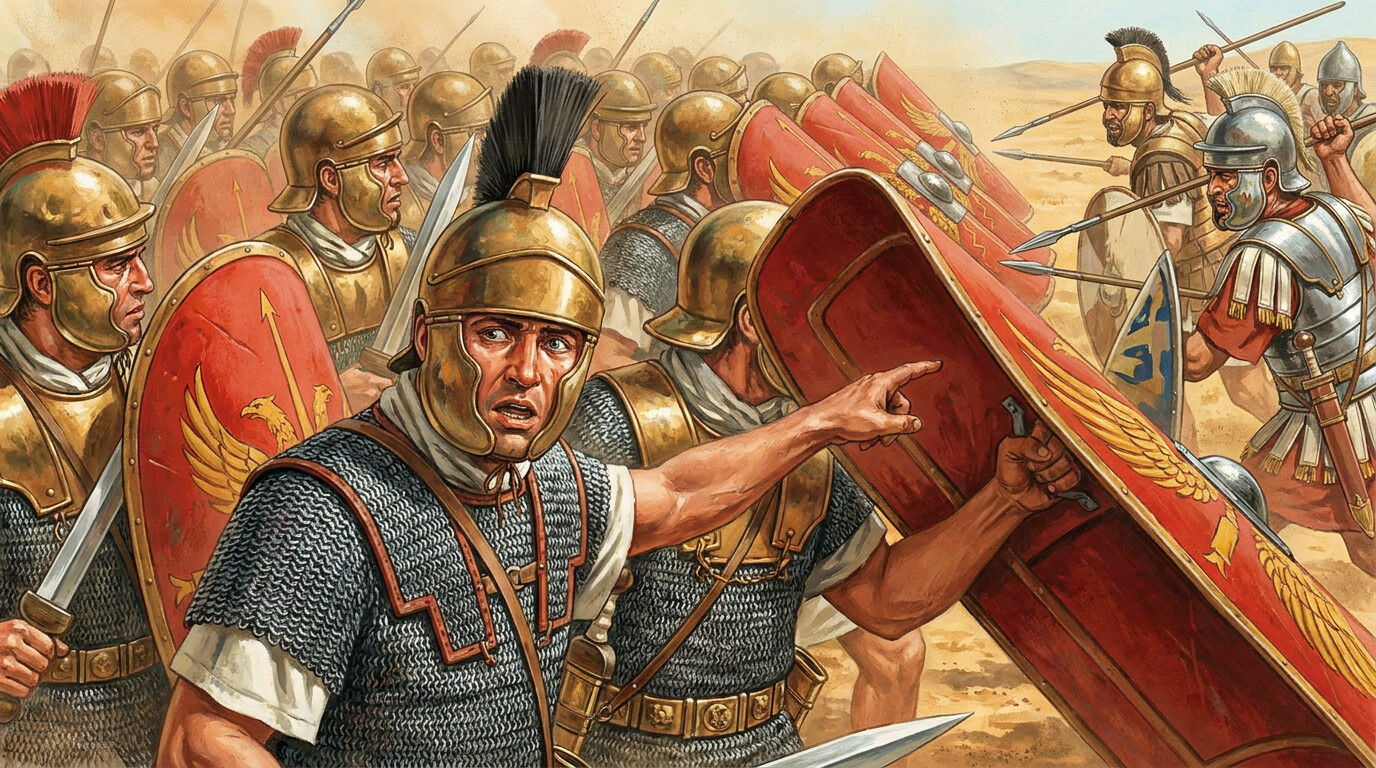
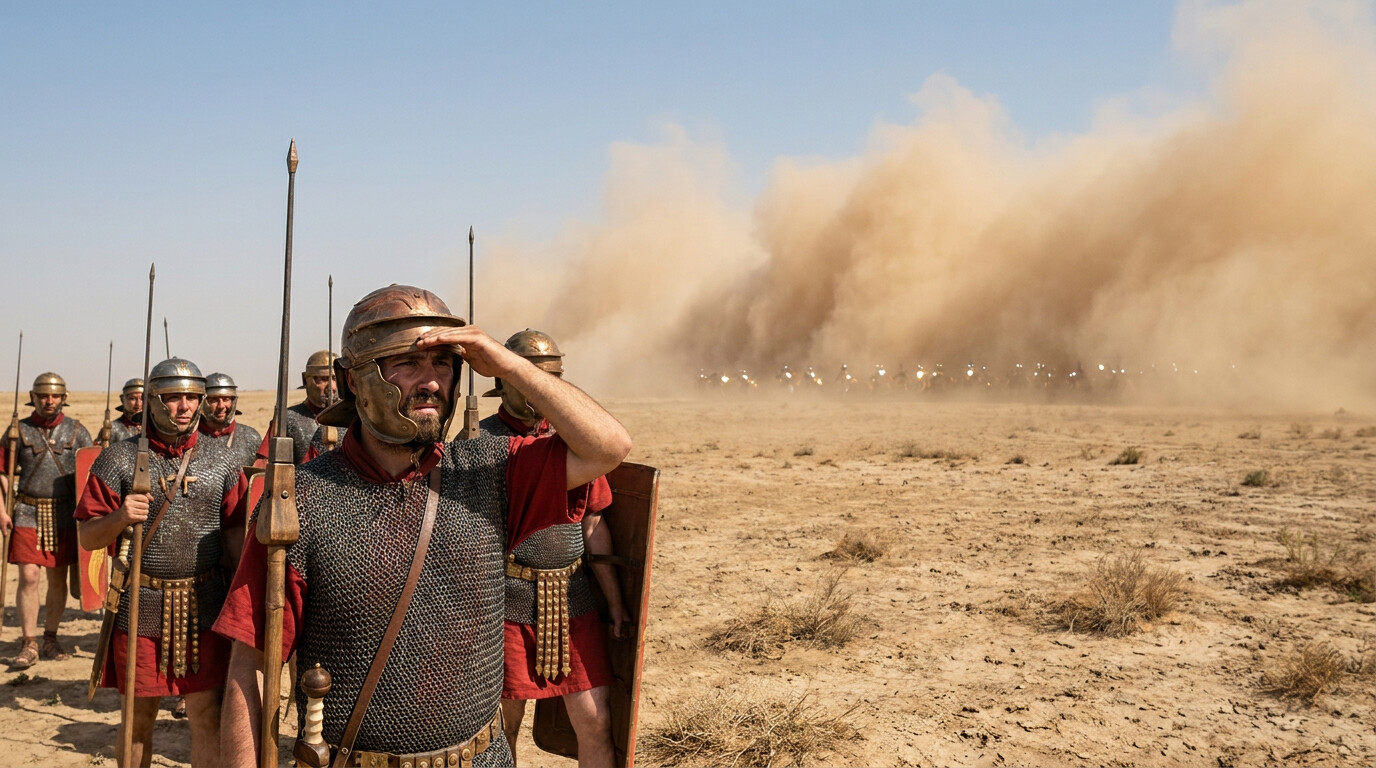
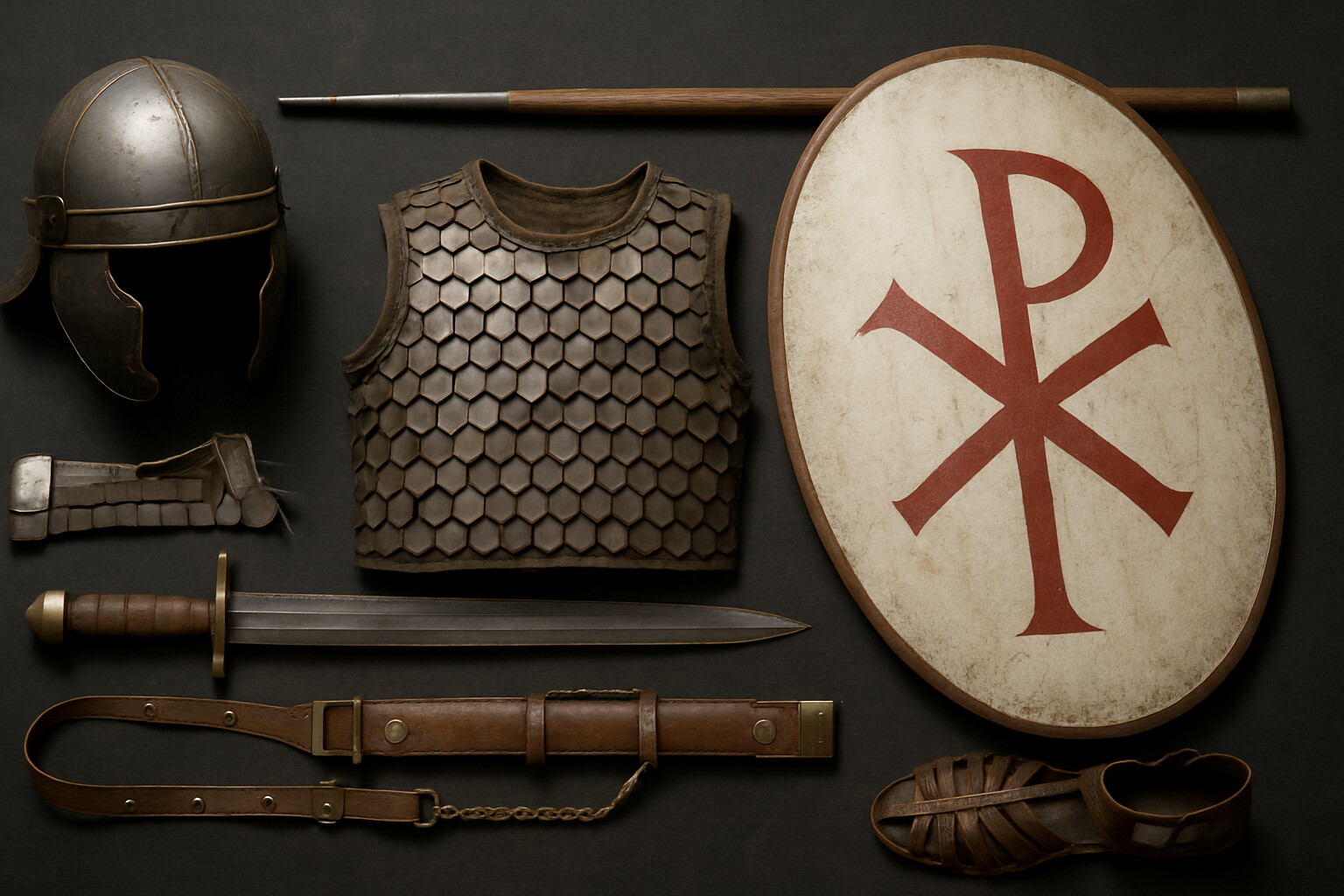
The heavy infantryman of the early fourth century carried a spear, the hasta or lancea, rather than the earlier pilum, which had largely fallen out of use by this period. He wore an iron ridge helmet with cheek guards and a neck guard, and a coat of mail (lorica hamata) or scale armor (lorica squamata). He carried a large oval or circular shield in place of the rectangular scutum of earlier centuries. His sword was the spatha — a cutting and thrusting blade approximately 60 to 80 centimeters long that had replaced the shorter gladius across most of the Roman army by the third century. The gladius had been optimized for thrusting in the tight formations of the early imperial legions; the spatha's greater reach suited the looser, more grinding close combat of the later imperial period.
Cavalry on both sides included lighter horsemen for screening and reconnaissance and heavier armored formations. The clibanarii and cataphractarii — Rome's heavy shock cavalry, influenced by Parthian and Persian models — wore iron or bronze scale armor covering rider and horse and carried the contus, a lance long enough to require two hands, which meant the rider guided his horse with his knees. These formations delivered devastating effect at the charge but were expensive, slow, and vulnerable once stopped or flanked. Constantine's forces had already neutralized Maxentius's armored cavalry at Turin. Their absence as an effective arm at the Milvian Bridge likely shaped the course of the final engagement, though ancient sources do not address the point directly.
The Praetorian Guard, Maxentius's elite heavy infantry, carried an institutional memory stretching back to Augustus. By 312 AD they were among the best-equipped and most experienced infantry formations in the Western empire, stationed in their camp on the northeastern edge of Rome. Their presence in Maxentius's order of battle gave him a hard core of professionals.
Both armies also included auxiliary units and specialist archers, and the late Roman artillery — ballistae and onagri, torsion-powered engines capable of projecting bolts or stones at fortifications and dense formations — was available to forces of this scale. Whether artillery played a significant role at the Milvian Bridge specifically is not described in any surviving source.
---
And then there was the symbol.
The accounts of what Constantine did in the days before the battle are among the most discussed passages in late antique historiography. Two principal sources describe a religious or visionary experience that led Constantine to mark his soldiers with a new sign.
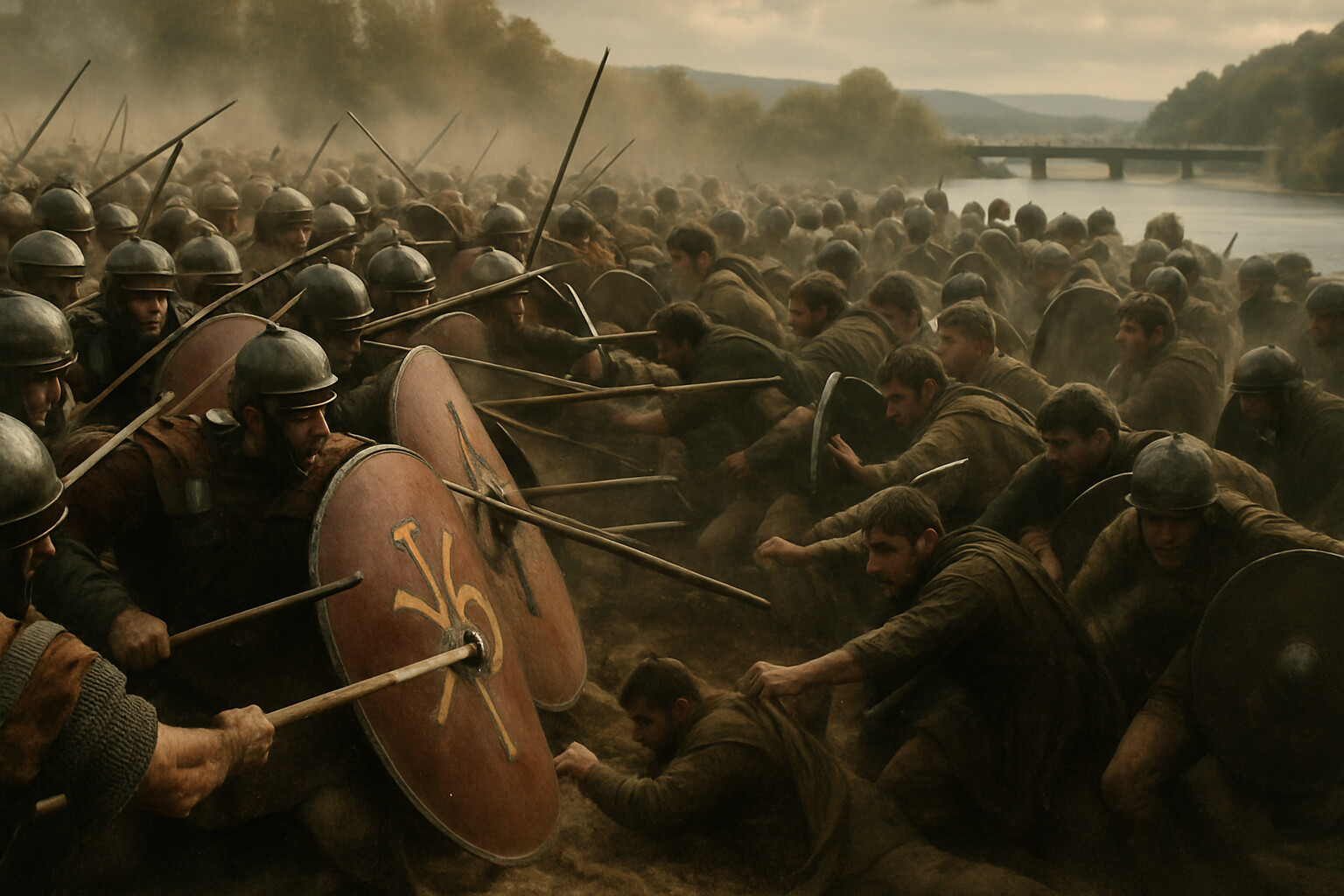
Lactantius, writing in approximately 314–315 AD in his work De Mortibus Persecutorum — within a few years of the battle and from inside the Constantinian court environment — describes a dream in which Constantine was commanded to mark his soldiers' shields with the heavenly sign of God (caeleste signum Dei). Lactantius describes this sign as the letter X with its top curved: the standard scholarly reading of this description is the Chi-Rho monogram, formed by superimposing the first two letters of the Greek word Christos. This is the account closest in time to the events and carries the greatest evidential weight on the specific question of the shield marking.
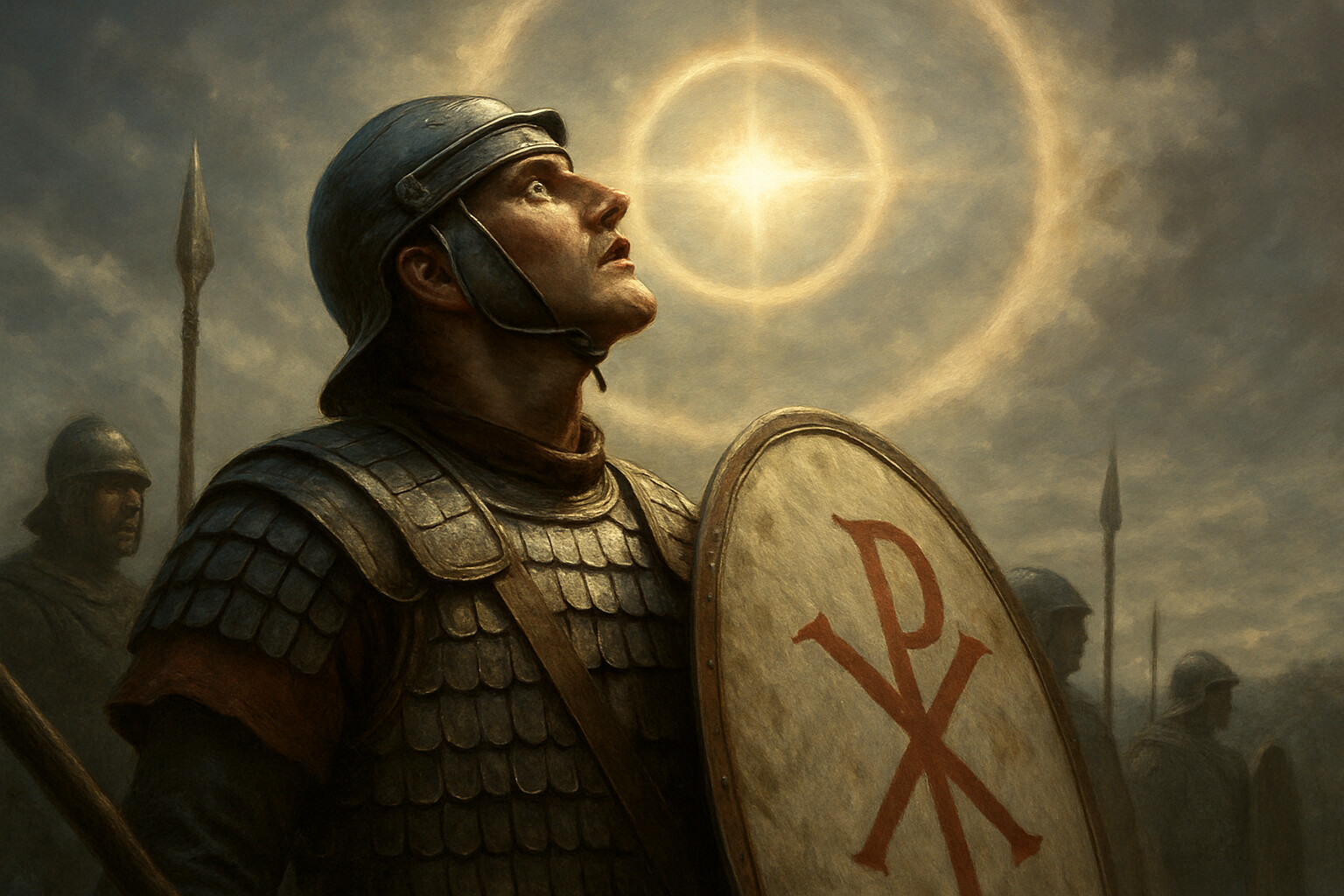
Eusebius of Caesarea, writing his Life of Constantine after Constantine's death in 337 AD — decades later, and based in part on what Eusebius describes as a personal account from Constantine himself — gives a more elaborate version: a vision seen while marching, showing a cross of light above the sun with words meaning "In this, conquer" (the Greek phrase rendered in Latin tradition as In hoc signo vinces), followed by a dream the following night in which Christ appeared and instructed Constantine to make a military standard in the form he had seen. This standard, the labarum — a long gold-draped lance with a crossbar and the Chi-Rho at its top — later became one of the most recognizable military-religious symbols in Roman history. Whether the labarum existed in the form Eusebius describes at the time of the Milvian Bridge, or was a later development of Constantine's reign, is disputed in scholarship.
The two accounts do not fully agree on what was seen, when, or precisely how the symbol was applied. Historians have offered various readings. Some have proposed that the vision may have had a meteorological basis: atmospheric optical phenomena, including solar halos, can produce cross or ring shapes around the sun under certain conditions. Others have argued that Constantine's experience was genuine by his own account but that its form and meaning were shaped by the theological framework of his Christian advisors and, later, his biographers. Still others have noted that Constantine's religious convictions in 312 AD are not fully established: his patronage of the church and his explicit identification as a Christian emperor developed and deepened over the years that followed, and the numismatic record — coins from after the battle that continue to carry solar and Herculean imagery alongside Christian symbols — suggests the transition was not instantaneous.
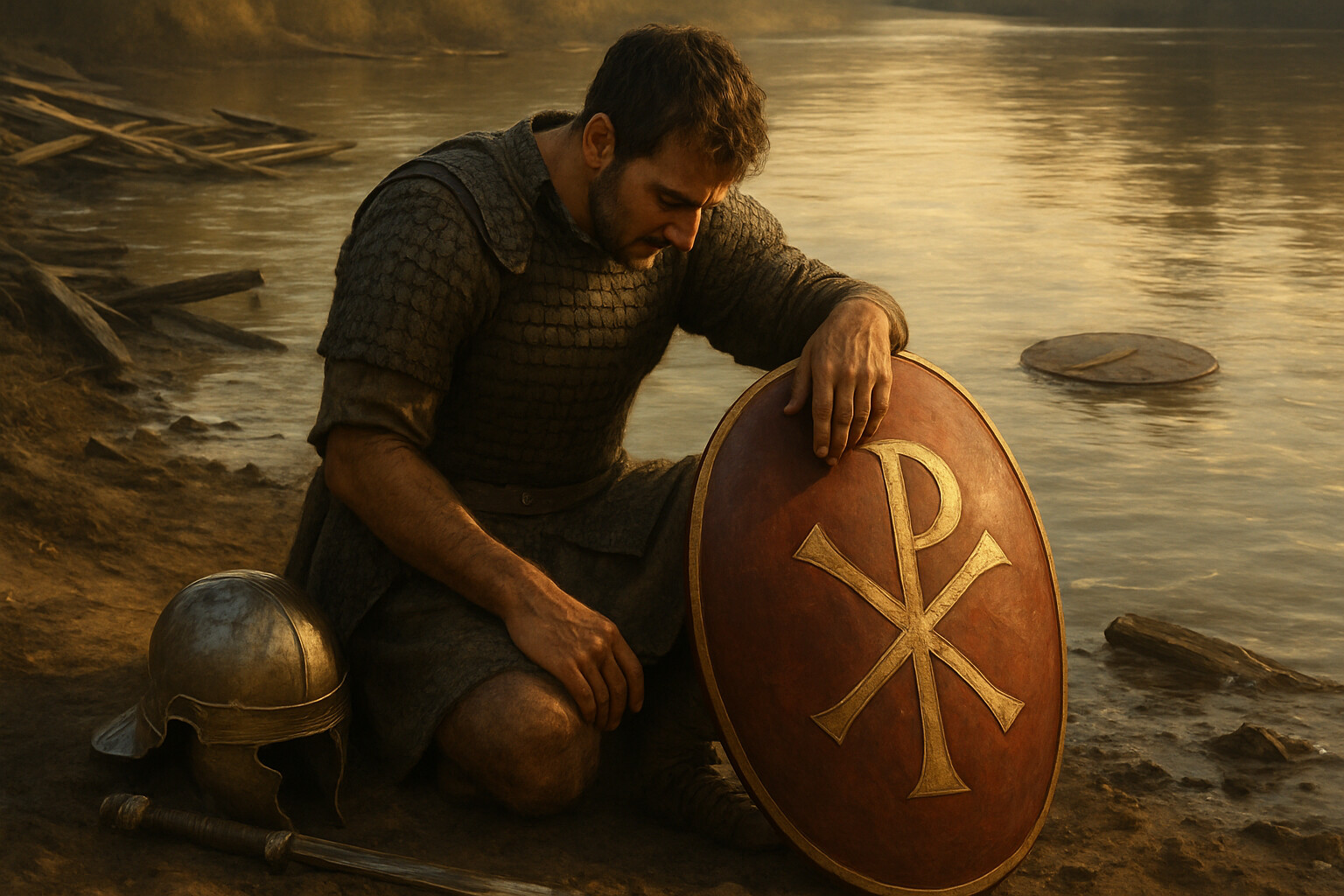
What the sources, taken together, support with reasonable confidence is this: before the battle, Constantine had some form of the Chi-Rho symbol marked on his soldiers' shields, and he associated that marking with a claimed divine directive or sanction. Whether he understood this as a conversion, a practical appeal to divine protection, or a political gesture toward Rome's growing Christian community — or some combination of all three — cannot be resolved from the surviving record.
The soldiers who carried that symbol into battle did not know how history would interpret their painted shields. They knew only that they were about to fight.
---
The battle unfolded north of Rome on the morning of October 28, 312 AD, in the area between the Tiber's bend and the hills that rise to the east of the Via Flaminia.
The terrain mattered. The ground immediately north of the Milvian Bridge is constrained: the river curves, and the corridor between the water and the rising ground of the Monti Parioli and adjacent ridges narrows as it approaches the crossing. An army positioned south-facing across this corridor, with the river at its back, had no room to retreat and limited room to work its flanks. If it broke, it had nowhere to go but into the water. This reconstruction of the tactical ground is inferred from the area's topography and from the general character of ancient accounts; no surviving source maps the formation in detail.
How the engagement opened is not described in precise tactical sequence by any ancient source. The battle is narrated in terms of outcome rather than maneuver. What the sources indicate, collectively, is this: Constantine's cavalry drove back Maxentius's cavalry on the flanks; his infantry pressed forward against Maxentius's center, including the Praetorian Guard; and the Maxentian formations began to give way under that pressure, driven toward the river.
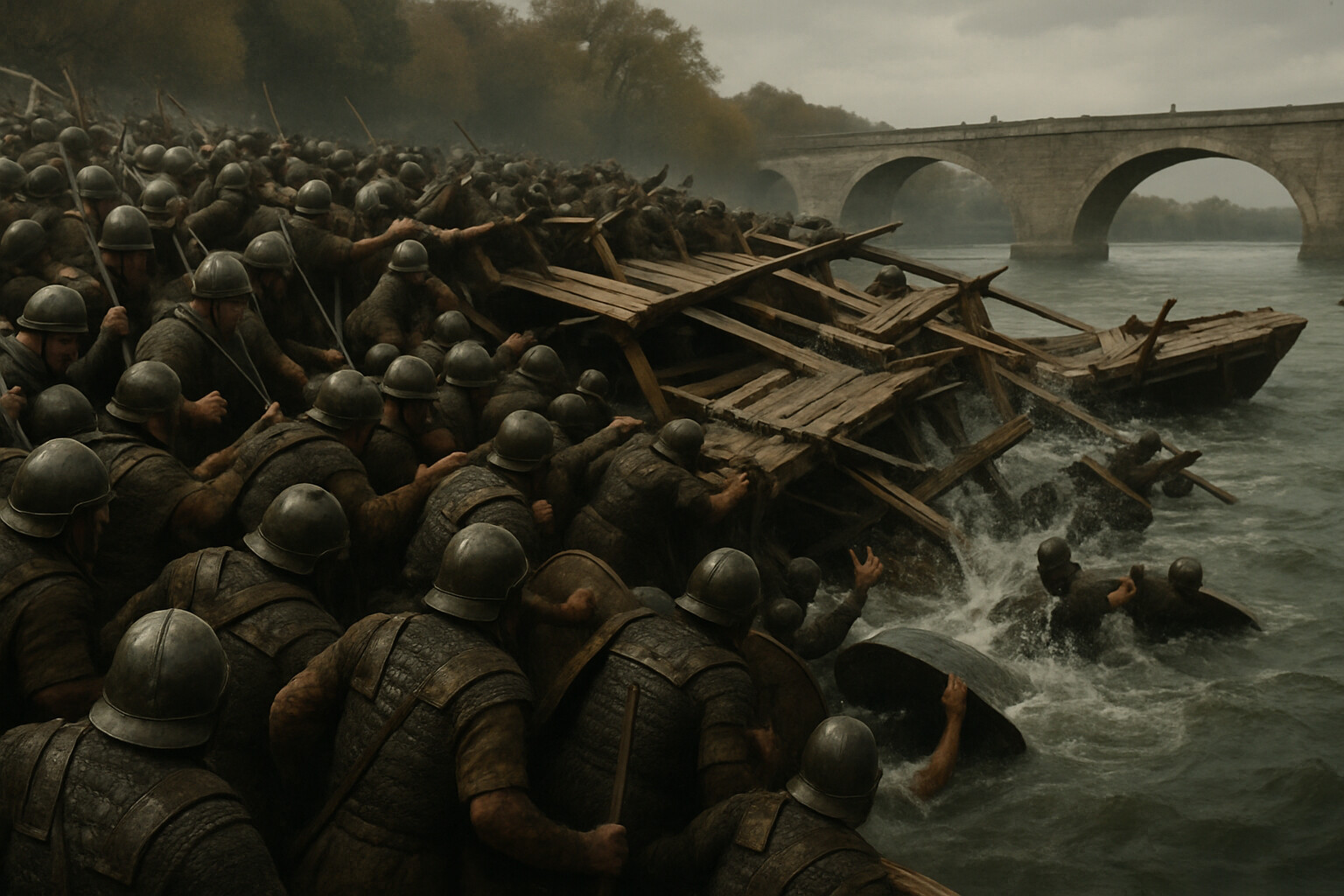
The breaking point, when it came, was catastrophic. A Roman army in close formation, pressed from the front and with no room to fall back, does not retreat in order. It collapses. Men at the rear, pushed by the front rank being driven backward, find themselves at the water's edge with a single crossing behind them. The pontoon bridge — the temporary structure of moored boats — was the only route available for any large movement, and it could not absorb the weight and panic of a disintegrating army. Lactantius and the panegyrist who addressed Constantine shortly after the battle describe the pontoon collapsing or being overwhelmed as Maxentius's troops attempted to cross. The precise mechanism — structural failure under overloading, mooring lines parting, boats shifting — is not specified in any source; the physical sequence is inferred from the general description and from what is known of late Roman pontoon engineering.
Maxentius went into the Tiber. The ancient sources are consistent on this point: he drowned. His body was recovered from the river. His head was cut off and carried through Rome on a spear — the traditional announcement of a civil war's end, documented in Lactantius, Eusebius, Zosimus, and the visual record of the Arch of Constantine. On the question of how the battle ended, the sources, for once, agree.
The Praetorian Guard was destroyed as a fighting formation at the Milvian Bridge. Constantine disbanded the Guard after the battle. Their camp in Rome was demolished. An institution that had served, manipulated, and occasionally murdered emperors since the reign of Augustus ceased to exist. Men who survived the battle were presumably absorbed into other units or discharged; the surviving record does not say.
The equites singulares Augusti, the imperial horse guard, was similarly disbanded. The Lateran palace and grounds — their former barracks, later given by Constantine to the Bishop of Rome and the eventual site of the Lateran Basilica — carried a symbolic charge that contemporaries would not have missed.
---
Constantine entered Rome on October 29, 312 AD, the day after the battle.
The city did not resist. Maxentius was dead, his body identified, his head displayed. His army had been broken at the river. The Senate, which had maintained a difficult relationship with Maxentius throughout his six-year hold on the city, moved quickly to recognize the new order. Within weeks, Constantine was acknowledged as senior Augustus in the West.
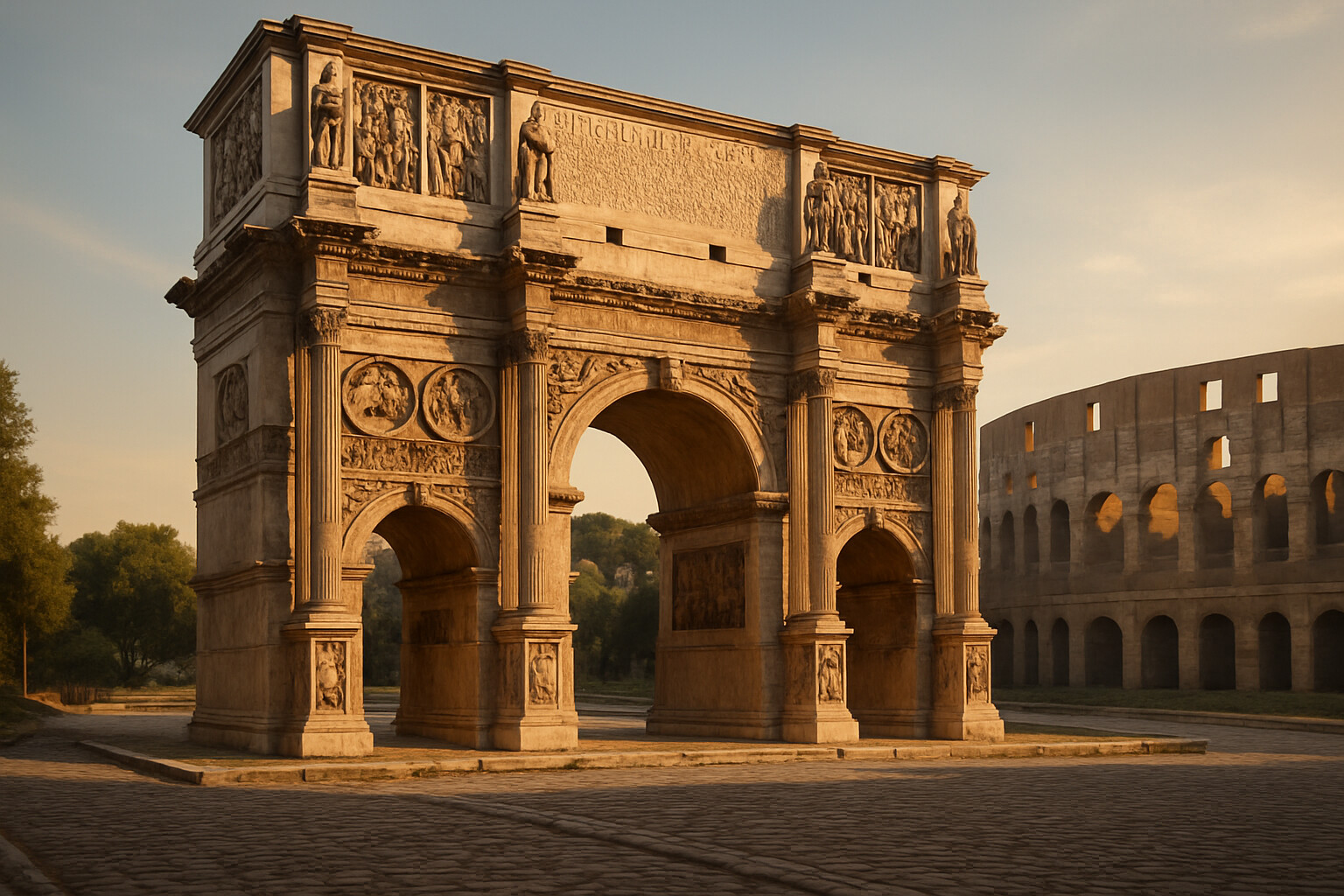
He commissioned what would become the Arch of Constantine — still standing today near the Colosseum — a massive triumphal monument recording his victory. The arch's dedicatory inscription records that Constantine had saved the state from tyranny through "the instigation of the divinity" (instinctu divinitatis). The phrase is carefully ambiguous: it accommodates multiple religious interpretations and reflects the pluralistic religious politics of the moment. It does not name a god.
In February 313 AD, Constantine met with Licinius, Augustus of the East, in Milan. The two men issued what later tradition calls the Edict of Milan — in reality a series of letters directing provincial authorities to restore religious freedom and return confiscated property to Christians. The document did not make Christianity the empire's official religion: that came later, under Theodosius, at the end of the century. But the Milan agreement formally ended the systematic persecution of Christians that had marked the Diocletianic period and granted Christianity legal standing alongside the empire's other religions.
The Milvian Bridge was not the end of the civil wars. Constantine and Licinius eventually turned against each other. Licinius was defeated and executed in 324 AD, making Constantine sole ruler of a reunited Roman empire. He founded Constantinople on the Bosporus in 330 AD, shifting the empire's strategic center of gravity eastward. He was baptized on his deathbed in 337 AD — a practice not uncommon among fourth-century Christians who wished to receive baptism late in life — and was buried in Constantinople in the Church of the Holy Apostles. The Eastern Orthodox Church numbers him among the saints.
But October 28, 312 AD, at the Milvian Bridge, was the moment when all of that became possible.
---
The sources for the battle are a mixture of near-contemporary and later accounts, each carrying specific biases and gaps that require careful handling.
Lactantius wrote De Mortibus Persecutorum within a few years of the battle. He was a Christian rhetorician who served at Constantine's court in Gaul and had direct access to the court environment. His account of the symbol on the shields is the most proximate written source on that specific question and carries the greatest weight for it.
Eusebius of Caesarea wrote two relevant works: his Ecclesiastical History, completed in stages through the early fourth century and updated after the battle, and the Vita Constantini, written after Constantine's death in 337 AD. The Vita Constantini is a hagiographical work — written to honor and elevate its subject — and must be read accordingly. Eusebius claims to have heard Constantine's own account of the vision, but that claim cannot be independently verified, and the work's theological agenda is explicit. His version of the pre-battle sign diverges from Lactantius's in significant ways.
The Latin Panegyrics — formal orations delivered before Constantine at various points in his reign — include one delivered shortly after the Milvian Bridge victory. This oration provides evidence for how Constantine's court wanted the victory framed publicly, but the genre is encomiastic by design: panegyrists were paid to praise, not to report neutrally.
Zosimus, the pagan historian writing in the late fifth or early sixth century, provides a counter-narrative hostile to Constantine and sympathetic to the traditional Roman religious order. His account is later and tendentious in the direction opposite to Eusebius, but he preserves details and perspectives not found in the Christian sources.
The Arch of Constantine, dedicated in 315 AD, is a primary visual and epigraphic source. Its reliefs record the campaign, the battle, Constantine's entry into Rome, and his address to the Roman people from the Rostra. The arch was constructed partly from spolia — sculpture and reliefs removed from earlier monuments — and its original fourth-century carvings can be distinguished from the repurposed material. The inscription, with its phrase instinctu divinitatis, is a primary document for Constantine's publicly expressed religious position in the immediate aftermath of victory.
Numismatic evidence — coins minted under Constantine from 312 onward — shows a gradual shift in religious imagery but does not show a sudden complete break with traditional solar and Herculean symbolism immediately after the battle. Some scholars have used this evidence to argue that Constantine's shift in 312 was more ambiguous and incremental than the literary sources suggest.
For the tactical details of the battle itself — the sequence of engagement, the behavior of specific units, the mechanism of the pontoon's failure — the sources are thin. No Roman equivalent of a commander's after-action report survives. The battle's tactical narrative must be reconstructed from scattered references and the physical logic of the terrain.
---
Standing at the Milvian Bridge today — the Ponte Milvio, still its Roman name — it is possible to look north along the Tiber and try to picture the ground as it was in October 312 AD. The river still runs. The hills are still there. The bridge has been rebuilt and widened across seventeen subsequent centuries, and the city of Rome long ago swallowed the fields where the armies formed.
The Chi-Rho symbol that Constantine ordered marked on his soldiers' shields — whatever its precise form and whatever the nature of the experience that prompted it — became one of the most widespread monograms in human history. It appeared on military standards, on coins, on churches, on royal regalia, and on manuscript pages across the European Middle Ages and beyond. The connection between military victory and divine favor that it embodied at the Milvian Bridge shaped the self-understanding of Christian rulers for more than a thousand years.
The Praetorian Guard, whose institutional history stretched back nearly three and a half centuries to the armies of Augustus, ceased to exist within days of the battle. Three hundred and forty years of organizational continuity — soldiers who had guarded, served, and occasionally murdered emperors from Tiberius to Maxentius — ended in the water and mud north of Rome on a late October morning.
Maxentius, treated harshly by nearly every ancient source because those sources were written in the aftermath of his defeat and under the patronage of his conqueror, has been the subject of modern historical reassessment. Some scholars have argued that his reputation as a tyrant was largely constructed by Constantinian propaganda and that his actual governance record was more complex. That reassessment does not change what happened at the Milvian Bridge, but it adds a necessary layer of caution to how the battle's meaning is interpreted.
Constantine lived until 337 AD, ruling for twenty-five more years as the dominant figure in the Roman world. The Rome he entered on October 29, 312 AD, was still, in most visible respects, the pagan city of the Caesars. Within a century of his victory, the empire would be officially and legally Christian. The pagan temples would be closed. The religious order that had sustained Roman civilization for nearly a thousand years would be dismantled or transformed.
All of that was downstream of a battle on a river, under a painted sign, on a day when an army's back was to the water and there was no place left to run.