The smoke came first.
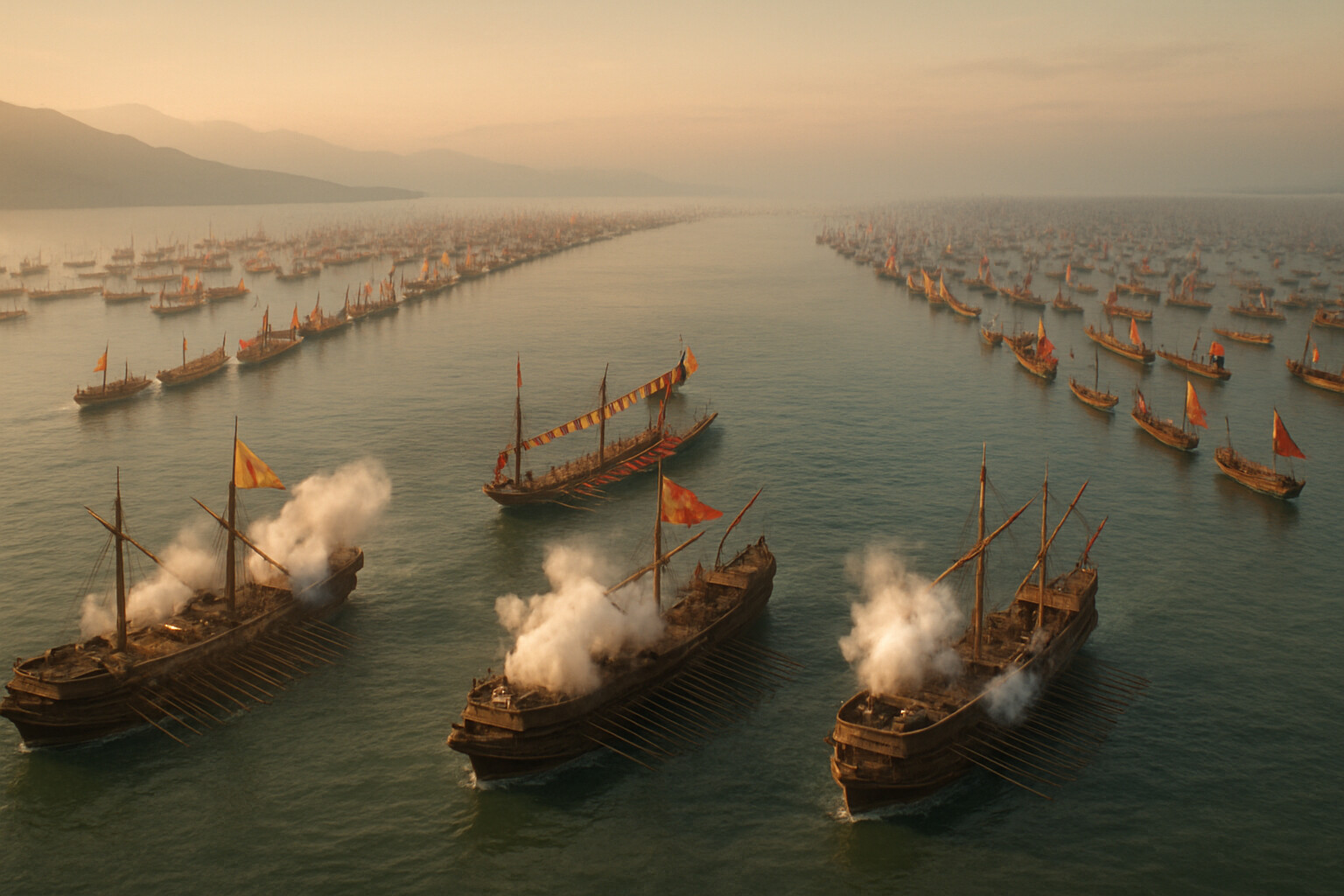
Before the first ram drove home, before the arquebusiers opened fire, before the janissaries crossed from one deck to another, there was a wall of white gun smoke drifting east across the Gulf of Patras on the morning of October 7, 1571. The Holy League's six Venetian galleasses had been rowed out ahead of the Christian line at dawn, and their heavy bronze artillery opened the battle while the two fleets were still closing. Cannonballs punched through Ottoman oar banks and hulls. Men died before they could reach the enemy. The galleasses were something the Ottomans had not planned for, and the surprise cost them formation and momentum in the opening minutes of the largest sea battle the Mediterranean world would see for centuries.
By midday it was over. Perhaps two hundred and ten Ottoman galleys had entered the gulf that morning. Fewer than fifty escaped it.
---
To understand what happened at Lepanto, you have to understand what both sides believed was at stake. By 1571, the Ottoman Empire was the dominant naval power in the eastern Mediterranean. Under Suleiman the Magnificent and his successors, Ottoman fleets had taken Rhodes in 1522, ravaged the coasts of Italy and Spain, and had come dangerously close to seizing Malta in 1565. The Ottoman admiral Hayreddin Barbarossa had defeated a Habsburg fleet at Preveza in 1538, and the lesson of that defeat had not been forgotten in Madrid, Rome, or Venice. The Ottomans controlled the sea lanes connecting Venice's trading empire to its eastern markets. They controlled the approaches to Christian pilgrimage routes. And in 1570, they had invaded Cyprus — a Venetian possession — with an army that overwhelmed the island's defenders after a brutal siege.
The fall of Famagusta in August 1571, the last Christian stronghold on Cyprus, came with a particular horror. The Venetian commander Marcantonio Bragadin, who had negotiated what he believed was an honorable surrender, was instead tortured and executed by the Ottoman commander Lala Mustafa Pasha. According to multiple contemporary accounts, his skin was stuffed with straw and displayed as a trophy. News of the atrocity reached the Holy League fleet as it assembled. It was not an abstraction. Men in that fleet knew what defeat meant.
The Holy League itself was a diplomatic achievement of considerable difficulty. Pope Pius V had worked for years to forge a coalition among parties who frequently despised one another. Venice and Spain had conflicting commercial and territorial interests. Genoa supplied galleys but kept an uneasy eye on Spanish power. The papacy contributed money and moral authority. What made it work, at least long enough to fight one battle, was the threat: if the Ottomans took Cyprus and pressed west, the whole eastern Mediterranean trading system, Christian pilgrimage routes, and eventually the Italian coastline were at risk. The League was signed in May 1571. It gave the coalition barely five months to assemble, organize, and fight before the sailing season closed.
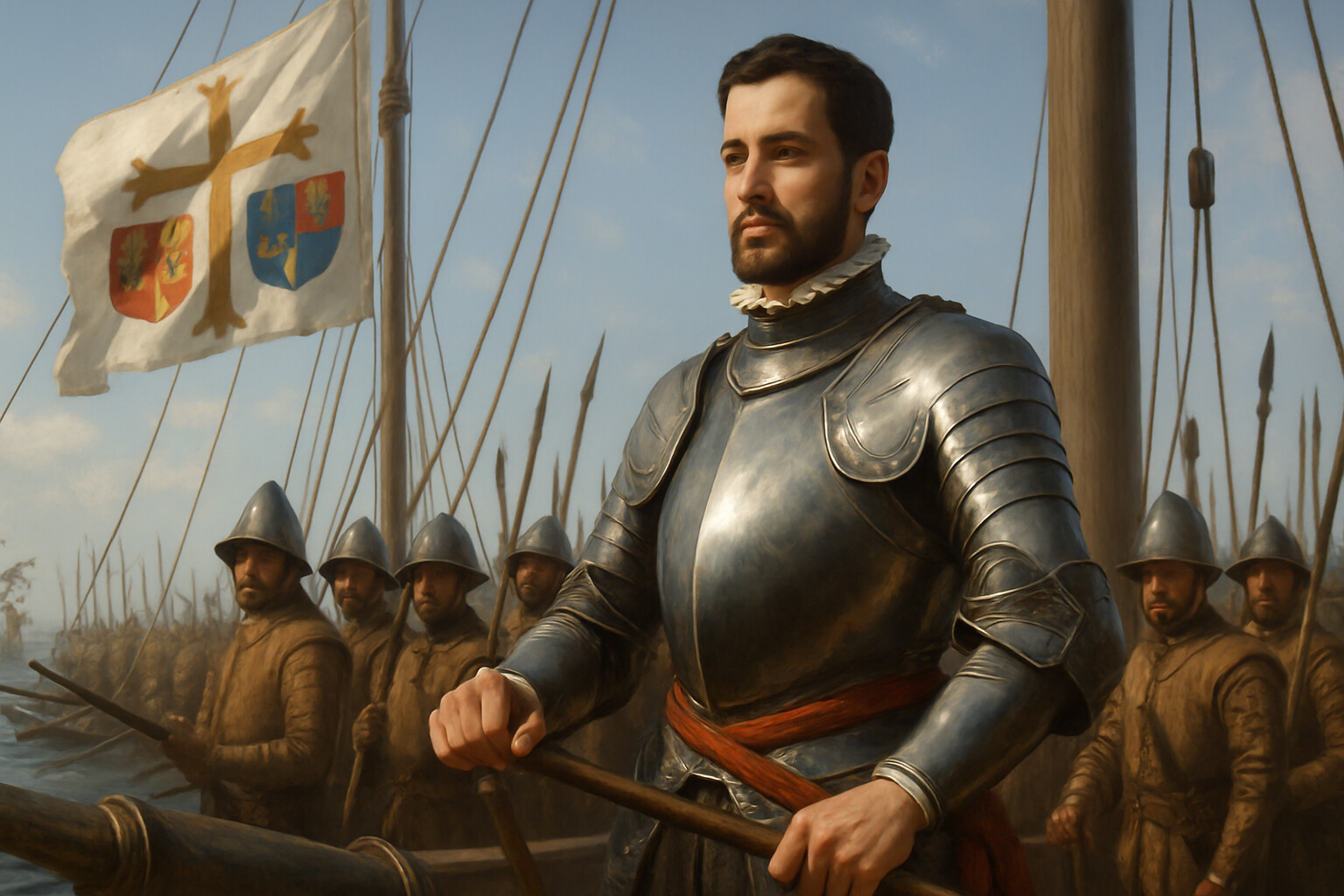
The man chosen to command the combined fleet was twenty-four years old.
---
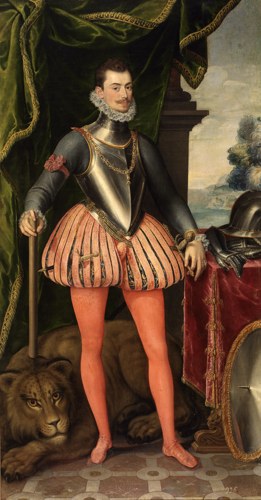
Don Juan of Austria — Juan de Austria in Spanish — was the illegitimate son of Holy Roman Emperor Charles V. His mother was Barbara Blomberg, a German woman from Regensburg. Charles acknowledged the child before his death, and the boy was raised in the Spanish royal household under Philip II, his half-brother. Don Juan grew up knowing exactly what he was: royal blood, but not the heir; talented, but dependent on Philip's approval; ambitious in an era when the only theater large enough for his ambitions was war.
He had commanded Spanish forces against the Morisco revolt in Granada from 1568 to 1571 — a brutal suppression of the Muslim population of southern Spain — and had demonstrated real military competence and personal courage in difficult irregular fighting. But Lepanto would be something different. Commanding a coalition fleet of roughly two hundred galleys, six galleasses, and tens of thousands of soldiers and sailors drawn from a dozen nations required not just courage but organizational ability, diplomatic patience, and the authority to override experienced subordinates who often had more sea time than he did.
He had the authority partly by blood, partly by papal endorsement, and partly, the record suggests, by a personal quality that impressed even skeptical veterans. When the League's commanders quarreled — and they quarreled constantly, about anchorage rights, about strategic priorities, about who should hold which position in the line — Don Juan moved between them. He was not a peacemaker by temperament; he was a competitor who understood that the coalition would fall apart if it never fought. He pressed for engagement when Venetian commanders wanted to wait and when some Spanish advisors counseled caution. On the eve of battle, according to well-sourced accounts, he was rowed from ship to ship to address the men.
What he said in those exchanges is not preserved in any single authoritative text, and specific words attributed to him in later retellings should be treated with caution. What is documented is that he was visible, physically present at the front of the fleet, and that his flagship — the Real — was positioned at the center of the Christian line, where the fighting would be hardest.
---
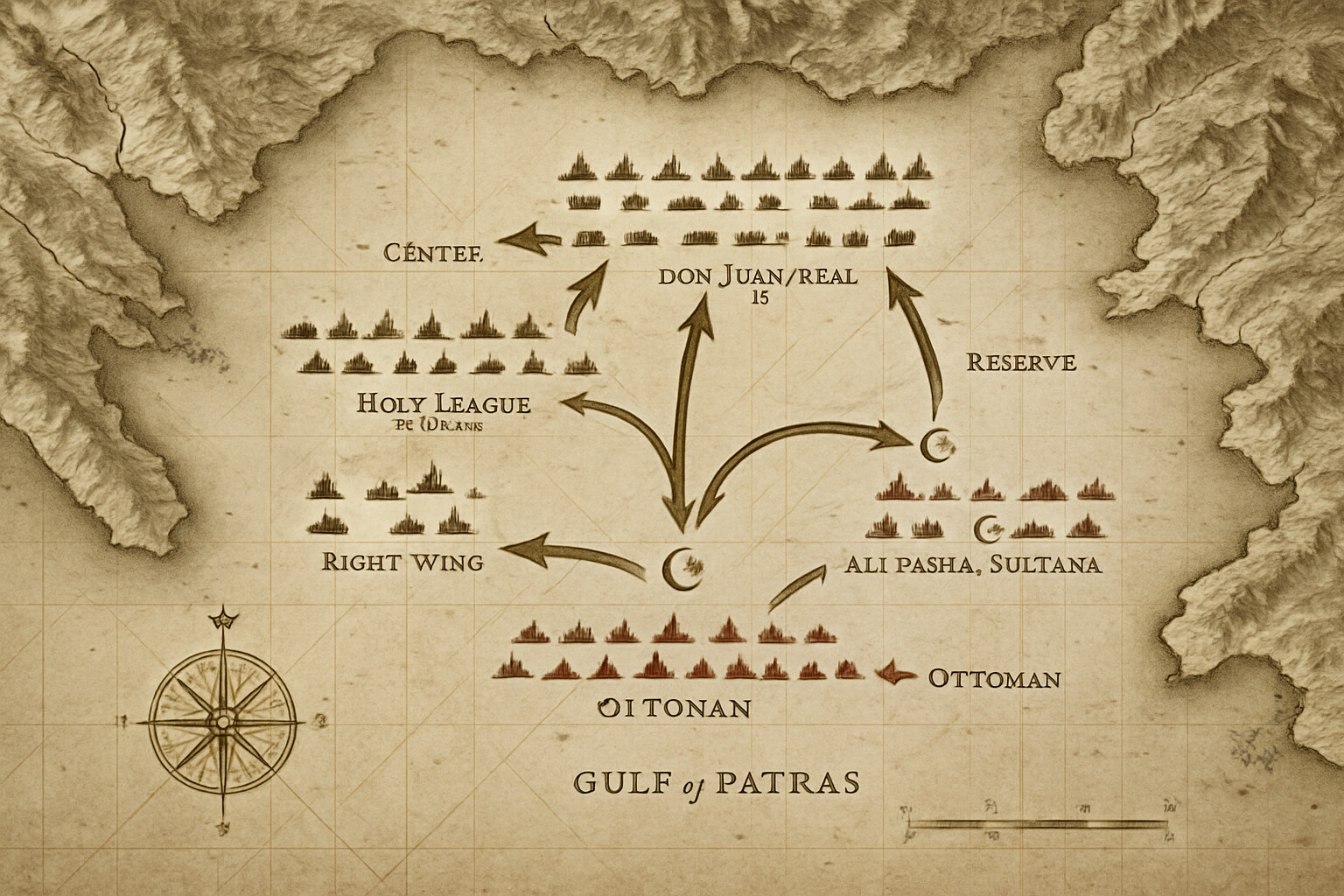
The geography of the battle matters. The Gulf of Patras opens from the Ionian Sea between the Peloponnese to the south and the coast of central Greece to the north, narrowing as it approaches the town of Lepanto — modern Nafpaktos — at its eastern end. The battle was fought near the western mouth of the gulf, roughly between the Curzolaris islands on the north side and the shallows off Point Scropha to the south. The channel was wide enough to permit large fleet maneuvers but narrow enough that neither side could easily disengage once the lines closed. Fighting in such a space was almost certainly going to be decisive. There was no room for a managed withdrawal.
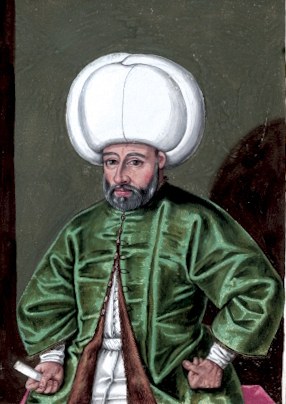
The Ottoman fleet, commanded by Ali Pasha — whose full honorific was Müezzinzade Ali Pasha — had assembled at Lepanto harbor and moved west to meet the Christian fleet. Ottoman strength on the day is estimated by modern historians at roughly 230 to 250 galleys and galliots, with perhaps 25,000 to 30,000 fighting men, including experienced janissary infantry embarked as marines. The Christian fleet numbered approximately 206 war galleys, six galleasses, and around thirty smaller support vessels, carrying an estimated 28,000 fighting men, a significant portion of them Spanish and Italian infantry with firearms.
Both fleets organized in a conventional galley-battle formation: a long line of squadrons arrayed across the channel. On the Christian side, the left wing was commanded by the Venetian Agostino Barbarigo; the center by Don Juan aboard the Real, with the Venetian commander Sebastiano Venier and papal commander Marcantonio Colonna alongside; and the right wing by the Genoese admiral Gianandrea Doria. A reserve force of thirty galleys followed behind the center under the Spanish nobleman Álvaro de Bazán, Marquis of Santa Cruz — a figure whose practical judgment would matter before the morning was out.
On the Ottoman side, Ali Pasha commanded the center. The left wing — which would face the Christian right — was led by Uluj Ali, a Calabrian-born renegade who had converted to Islam and risen through the Ottoman naval system on merit. He was arguably the most capable fleet commander on either side that day, and his conduct in the battle would be the one significant Ottoman tactical success. The Ottoman right, facing the Christian left under Barbarigo, was commanded by Mehmed Sirocco.
---
The opening moves set the terms for everything that followed. Don Juan's decision to send the galleasses forward before the fleets closed was the critical preparatory action of the battle. Each galleass was a heavy, oar-assisted vessel mounting artillery on multiple sides — far more guns per vessel than a standard war galley, which relied primarily on a forward-mounted heavy cannon and the ram. The galleasses could not maneuver quickly enough to fight in the galley-battle style of ramming and boarding, but positioned or moved slowly across the Ottoman line of advance, they were floating gun platforms that could not be easily ignored.
When the Ottoman galleys advanced and encountered the galleasses, the effect was disruptive. Ottoman accounts acknowledge losses and disorder. Exactly how severe the damage was in the opening minutes is debated by historians, but the evidence suggests the galleasses broke up the Ottoman formation before contact and inflicted casualties that reduced the cohesion of the attack. The Ottomans had expected to close quickly and use their numerical advantage in a boarding melee. The galleasses complicated that plan.
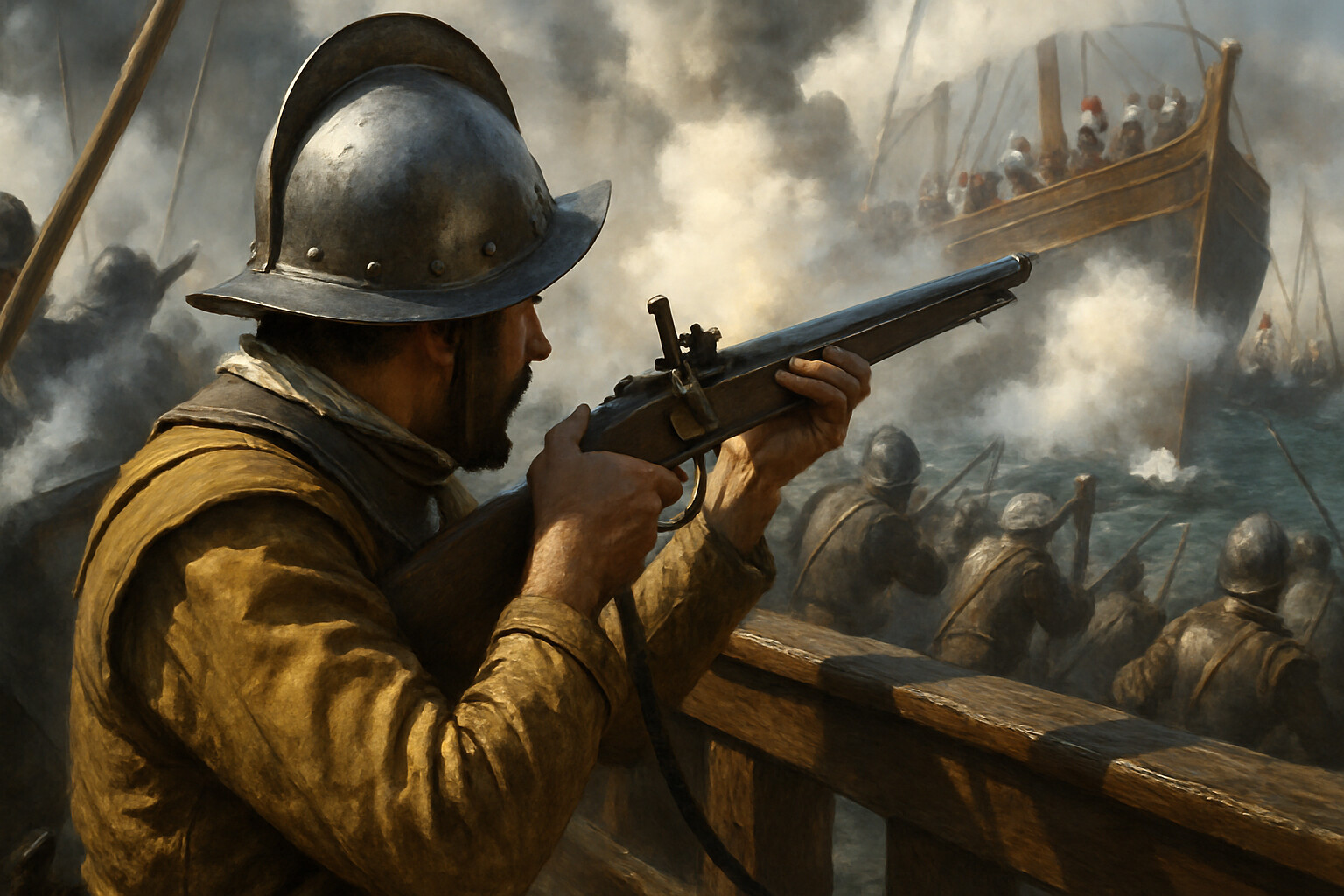
Both fleets had also made a specific tactical adjustment on the morning of the battle. The standard war galley of the period mounted a heavy iron ram — technically a spur — at the bow, projecting forward at the waterline to break enemy oars and allow boarders to cross onto the enemy ship. In preparation for Lepanto, Don Juan ordered the rams on the Holy League galleys cut down. The reason was practical: the forward-projecting rams made it difficult to depress the galleys' bow guns to fire at close range. By removing them, the League gunners could bring their artillery to bear more effectively as the fleets closed. This detail is documented in multiple accounts and reflects the importance the League placed on firepower over the traditional ramming tactic.
The Ottomans came into the battle with significant firepower of their own, but the Christian fleet had an advantage in overall gun weight. Estimates vary, but historians generally credit the Holy League with a substantial superiority in shipboard artillery and, more importantly, in the number of arquebusiers — firearms infantry embarked on the galleys. Spanish tercio soldiers in particular were among the most experienced firearms infantry in Europe by 1571, and their concentrated fire at close range would prove devastating when the hulls came together.
---
Contact came sometime around midmorning. The timing is approximate; contemporary accounts differ, and the smoke, noise, and confusion of a battle involving more than four hundred vessels across a wide front made precise coordination impossible. What the sources agree on is the general sequence.
On the Christian left, Barbarigo's Venetian wing met the Ottoman right under Mehmed Sirocco in hard fighting near the shallows. Sirocco, knowing the ground, attempted to turn the Christian flank by moving through shallow water close to the northern shore, where Barbarigo could not easily follow. Barbarigo moved to block him, pressing north himself, and the two lines came together in brutal close action. The fighting on the northern flank was among the bloodiest of the battle. Barbarigo was struck by an arrow through the eye and died of the wound that evening. His squadron faced a serious crisis before reserve galleys arrived to stabilize the line. Eventually the Christian left prevailed: Sirocco's squadron was broken and Sirocco himself killed.
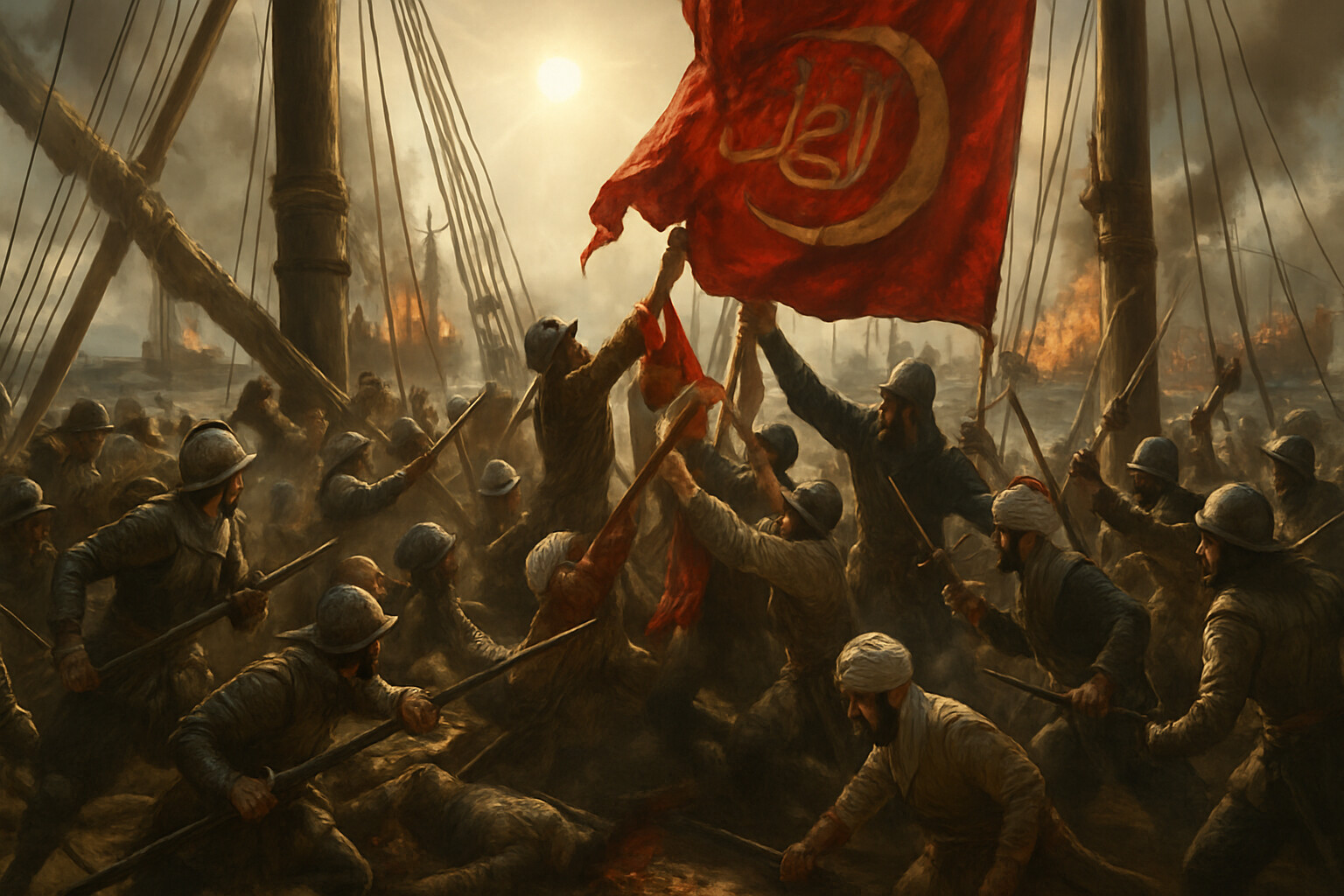
In the center, the decisive engagement was a direct collision between Don Juan's flagship Real and Ali Pasha's flagship Sultana. The two vessels rammed each other — or drew alongside — and the battle became a series of boarding actions fought and refought as each side reinforced its foredeck. Spanish and Italian infantry pushed across onto the Sultana, were driven back, pushed forward again. Ali Pasha was killed during this fighting — sources indicate he was struck by a gunshot or arrow wound, though no single account specifies the exact moment unambiguously — and multiple contemporary sources report that his head was displayed on a pike at the bow of the Real, though this account cannot be confirmed from one unambiguous primary document. What is not in dispute is that the Sultana's battle flag came down, and when it did, the center of the Ottoman line began to collapse. The Real had been boarded and counter-boarded multiple times before the issue was resolved; the evidence of that close fighting was plain on the hull and deck when it was over.
Álvaro de Bazán and the reserve squadron played a crucial role. Rather than holding as a static reserve, Bazán moved his thirty galleys where they were needed, reinforcing both the center and the southern wing as pressure shifted. His flexibility is credited in multiple accounts with preventing local reverses from becoming catastrophic breaks in the line. Bazán is one of the underrated figures of the battle — he would go on to become one of the greatest Spanish naval commanders of the sixteenth century, and Lepanto was an early demonstration of why.
The southern wing — Don Juan's right, under Gianandrea Doria — was the one part of the battle where the Ottomans found something approaching success. Uluj Ali recognized that Doria's wing was moving south. Whether that movement was intended to extend the line against a flanking threat or reflected a misreading of Ottoman intentions is debated by historians and not definitively resolved. The gap it created between Doria's wing and the center was an opportunity, and Uluj Ali took it. He drove through the gap, attacked the flank of the Christian center, and at one point threatened to unravel what Don Juan had built. Doria failed to close the gap in time, and the fighting in this zone was confused and dangerous.
But Uluj Ali could not exploit the opening fully. The center had already broken the Ottoman flagship and was turning forces southward. The reserve under Bazán reinforced the threatened flank. Uluj Ali — commanding perhaps thirty galleys at this point, his force reduced by the battle — recognized the battle was lost. He disengaged with between thirty and forty galleys and escaped westward into the Ionian Sea. It was a skilled tactical extraction from a catastrophic strategic defeat. He was not punished for it in Constantinople; the sultan recognized what Uluj Ali had salvaged and would later make him grand admiral.
By early afternoon, the battle was effectively over. The Ottoman center and right had been destroyed. Uluj Ali's escape with a fraction of the fleet was the only Ottoman formation to reach safety intact.
---
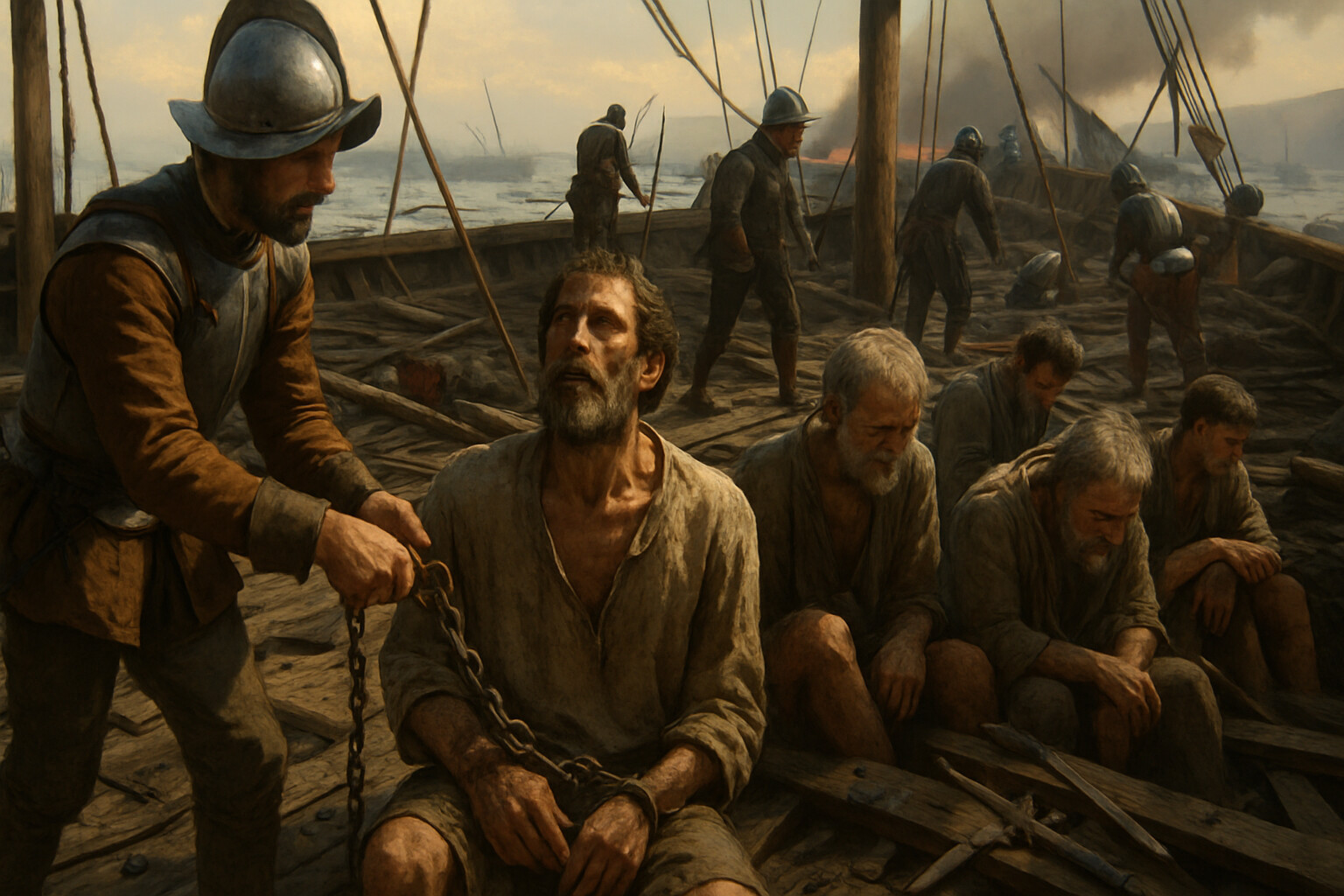
The numbers that came out of the battle are staggering, and historians debate the precise figures, but the general scale is not seriously disputed. Ottoman losses have been estimated at approximately 210 to 240 galleys sunk, burned, or captured, with perhaps 20,000 to 30,000 men killed or captured. The Holy League captured an estimated 117 Ottoman galleys intact — a prize fleet of extraordinary military and economic value. Somewhere between 10,000 and 15,000 Christian galley slaves, chained to Ottoman oars at the start of the battle, were liberated when their ships were taken. That last fact appears in multiple contemporary accounts and carries its own weight.
Christian losses were severe. Somewhere around 7,500 to 8,000 men killed, including Barbarigo and many senior officers. Approximately fifteen galleys were lost. No galleass was sunk. The disparity in losses reflected partly the tactical advantages the League had built — the arquebusiers, the artillery, the galleasses — and partly the nature of the final phase, when the collapse of the Ottoman center allowed the League to concentrate against isolated enemy vessels.
Don Juan of Austria was twenty-four years old when it ended. He had done what almost no one his age had done: commanded a coalition of sovereign states in a major engagement and won decisively.
---
The cost should not be set aside quickly. Battles of this scale in the sixteenth century were personal. Galleys fought at rowing distance. The boarding actions that decided the engagement in the center were fought with swords, pikes, axes, and firearms at ranges measured in feet. Men who had rowed for hours to close with the enemy then fought on heaving, damaged decks. The noise — artillery, thousands of firearms, the sound of wounded men, the percussion of hulls colliding — was of a character that no one who experienced it could afterward describe neutrally.
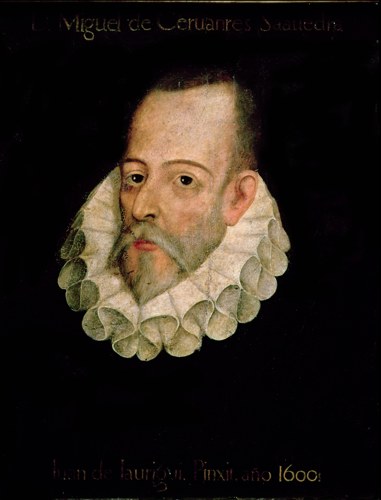
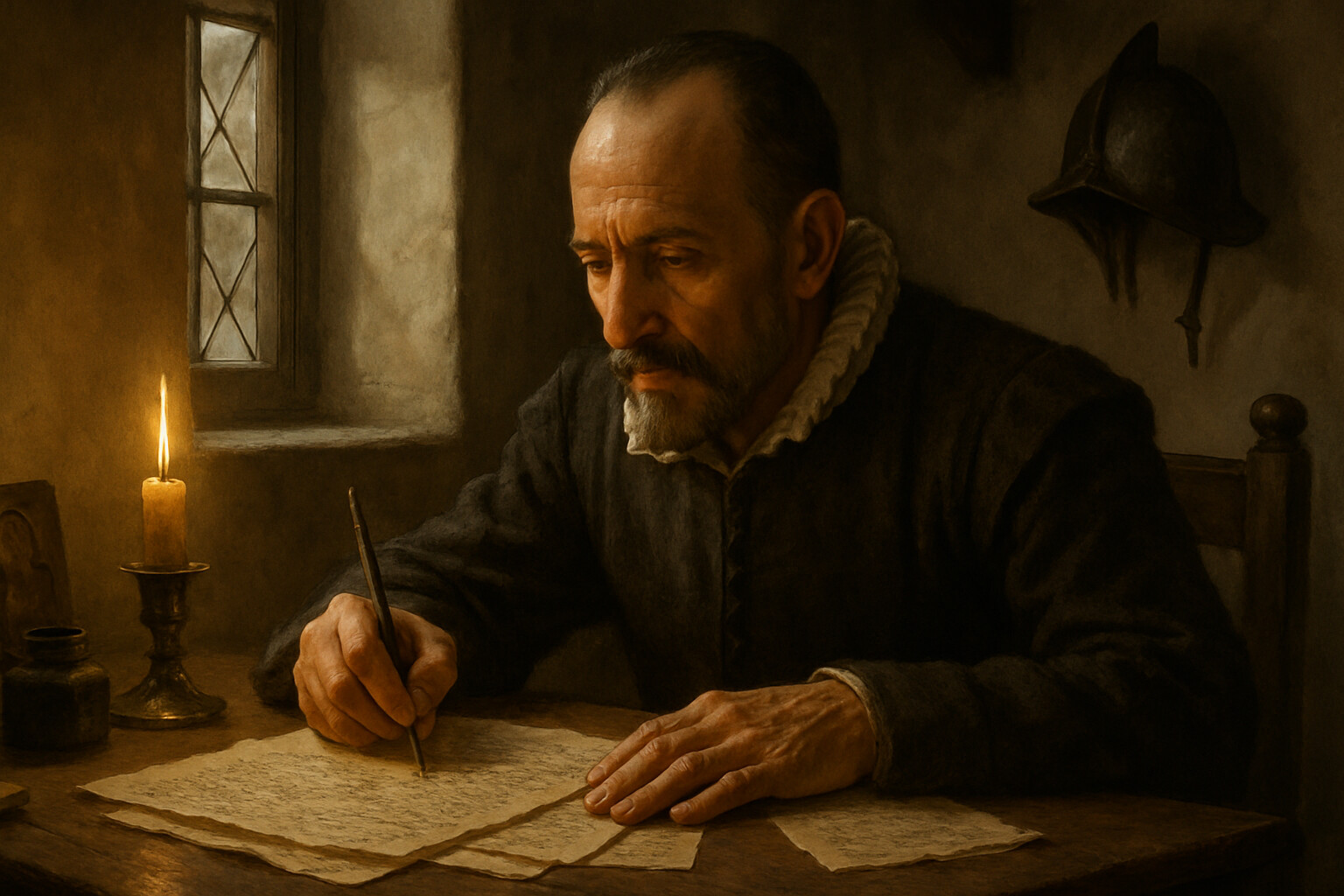
Among the survivors was a Spanish soldier named Miguel de Cervantes, serving as an arquebusier aboard the Marquesa. He was ill with fever on the morning of the battle but, according to his own later account, refused to stay below. He was wounded twice in the chest and once in the left hand, which was permanently damaged. He would spend the rest of his life with that reminder. In his own writings Cervantes described Lepanto as the greatest occasion the centuries had seen — a direct quotation, reliably sourced from his published work. He would be captured by Barbary pirates in 1575 and held as a slave in Algiers for five years before being ransomed. His account of the battle is not a detailed tactical record, but it is a human one, and it is one of the few survivor accounts from the ordinary fighting soldier's perspective that has come down to us with any reliability.
The experience of the galley slaves — both those liberated from Ottoman oars and those who remained chained in Christian galley holds — is much harder to recover from the record. Galley slavery was a feature of Mediterranean warfare on both sides in this period. Men condemned to the oars had no stake in the outcome of the battle except survival. Their experience of Lepanto was one of noise, smoke, wounds from flying wreckage, and the particular danger of being chained in place while cannon fire came through the hull. That experience is largely absent from the official record.
---
The immediate political aftermath of Lepanto did not match the scale of the military victory, a fact that has troubled historians ever since. The Ottoman Empire lost its fleet but not its capacity to build another one. Within two years, Constantinople had launched a new fleet large enough to pressure Venice into a separate peace. Cyprus was not recovered. The eastern Mediterranean trade routes remained contested. In the narrow sense of strategic objectives, Lepanto produced no permanent territorial change.
But the significance of the battle operates on a different level than territory. Before Lepanto, the Ottoman fleet had been considered by many in Europe to be essentially invincible at sea — the inheritor of decades of victories, staffed by experienced officers and veterans, operating in home waters, with interior lines of supply and communication. After Lepanto, that belief was gone. The fleet had been destroyed in a single afternoon. The political calculus of Christian rulers dealing with Ottoman power had to accommodate the fact that the Ottoman navy could be beaten, had been beaten, and could be beaten again. That shift in perception — grounded in a concrete military reality — mattered in the decades that followed, even if the political will to follow through on it was never fully assembled.
For the Ottomans, the loss of experienced sailors, officers, and oarsmen was arguably more damaging than the loss of the hulls. Ships could be built; the institutional knowledge and sea experience of the men who died at Lepanto took years to replace. Uluj Ali, now grand admiral, understood this and spent the following years rebuilding Ottoman naval capacity, but the quality of the rebuilt fleet was assessed by contemporary observers as uneven compared to what had been lost.
Don Juan of Austria did not get to pursue the victory. Philip II's strategic priorities were elsewhere — in the Netherlands, in the management of the Spanish empire's finances, in his complicated relationship with England. Don Juan wanted to use the momentum of Lepanto to press east, possibly to recapture Cyprus or strike at Ottoman ports. Philip was cautious, unwilling to commit to extended offensive operations in the eastern Mediterranean when threats closer to home demanded attention. Don Juan was given the governorship of the Spanish Netherlands in 1576, a poisoned assignment in the middle of a vicious ongoing revolt, and died there of typhus in October 1578, at the age of thirty-one. He did not live to see whether the momentum of Lepanto could have been translated into lasting strategic gain.
---
The battle generated an immediate and enormous cultural response. Pope Pius V established October 7 as the Feast of Our Lady of Victory, later renamed the Feast of Our Lady of the Rosary — a commemoration that continues in the Catholic calendar. Paintings, poems, commemorative medals, and official histories proliferated within years of the battle. Titian, Veronese, and other major artists of the period depicted scenes from Lepanto. The cultural meaning attached to the battle was almost immediately larger than the military event itself, which created the interpretive problem historians still wrestle with: separating what actually happened from the enormous weight of meaning projected onto it.
Modern scholarship — Andrew Hess, John F. Guilmartin Jr., Nicola Capponi, Hugh Bicheno, and others — has worked carefully to reconstruct the battle's actual course and significance from primary sources, including Ottoman accounts, which are often absent from popular treatments of the battle. That scholarship has produced a more nuanced picture: the battle was militarily decisive in a real sense, but the political and strategic consequences were constrained by the same internal contradictions that had made the Holy League difficult to form in the first place. It was a coalition victory that did not produce coalition follow-through.
What remains, stripped of the subsequent mythology, is this: on October 7, 1571, in the Gulf of Patras, approximately four hundred vessels and somewhere between fifty and sixty thousand men fought one of the largest naval engagements in history. The fighting was intense, close, and brutal, lasting several hours. The Christian coalition, under a twenty-four-year-old commander of uncertain institutional authority and documented personal steadiness, destroyed the Ottoman fleet as a fighting force. The men who survived — Christian and Ottoman both — knew they had lived through something that would not be easy to explain to anyone who had not been there.
Cervantes, who had been there and who had the left hand that proved it, spent the rest of his life writing about other things: about idealism and reality, about men who believe they are on a great quest and find the world more complicated than their story. Whether Lepanto informed that sensibility is something biographers continue to argue about. What is not in doubt is that he was proud of having been there, and that the battle had cost him something he never got back.
The records are imperfect. The numbers are approximate. The politics are tangled. But the smoke over the Gulf of Patras on the morning of October 7, 1571, was real, and the ships that did not come home were real, and the men chained to the oars who found themselves suddenly unchained were real. That is where the history lives — not in the commemorative paintings, but in the accounting of the dead and the liberated, in the logbooks and after-action reports, in the wound on a writer's hand.