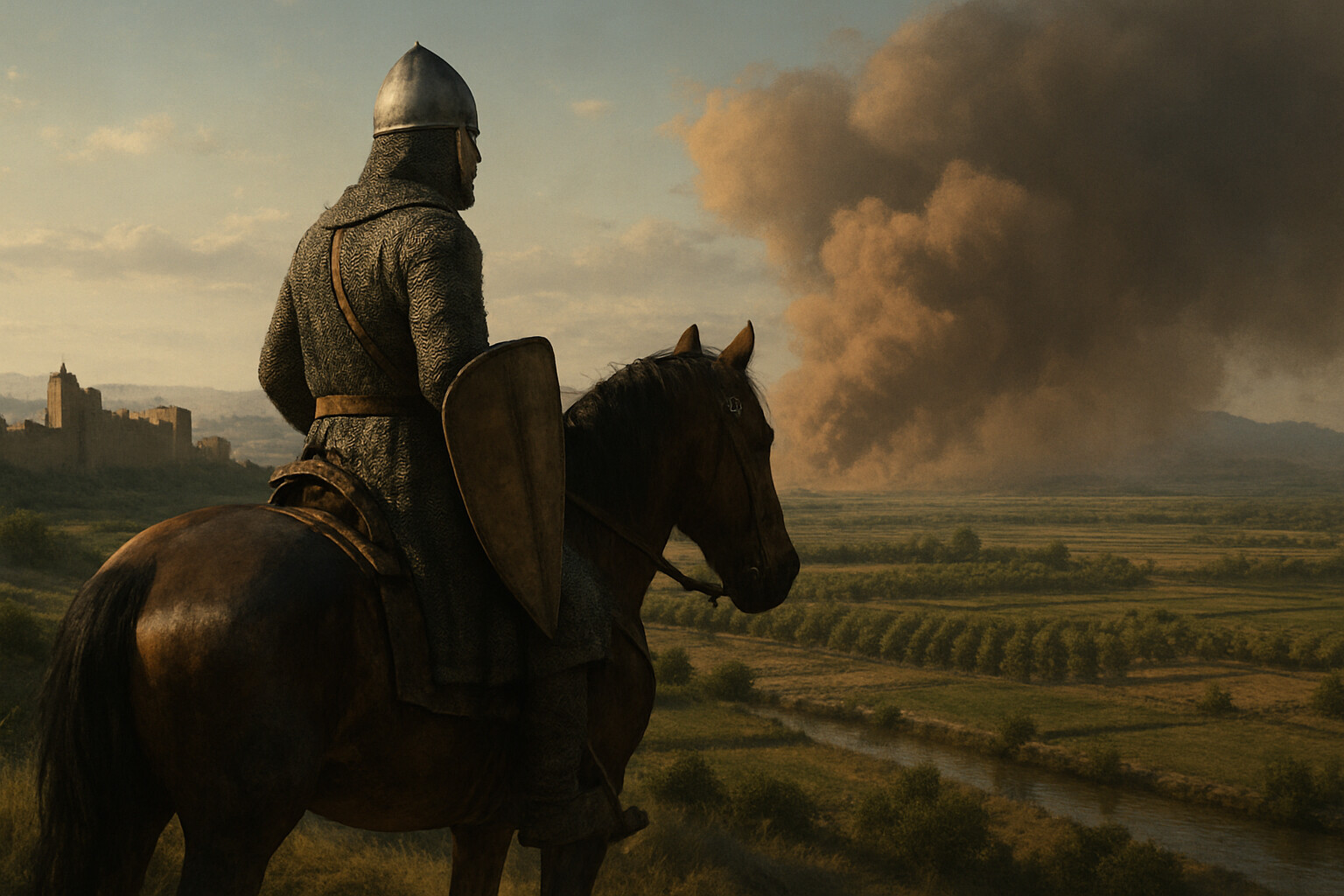
The dust came first.
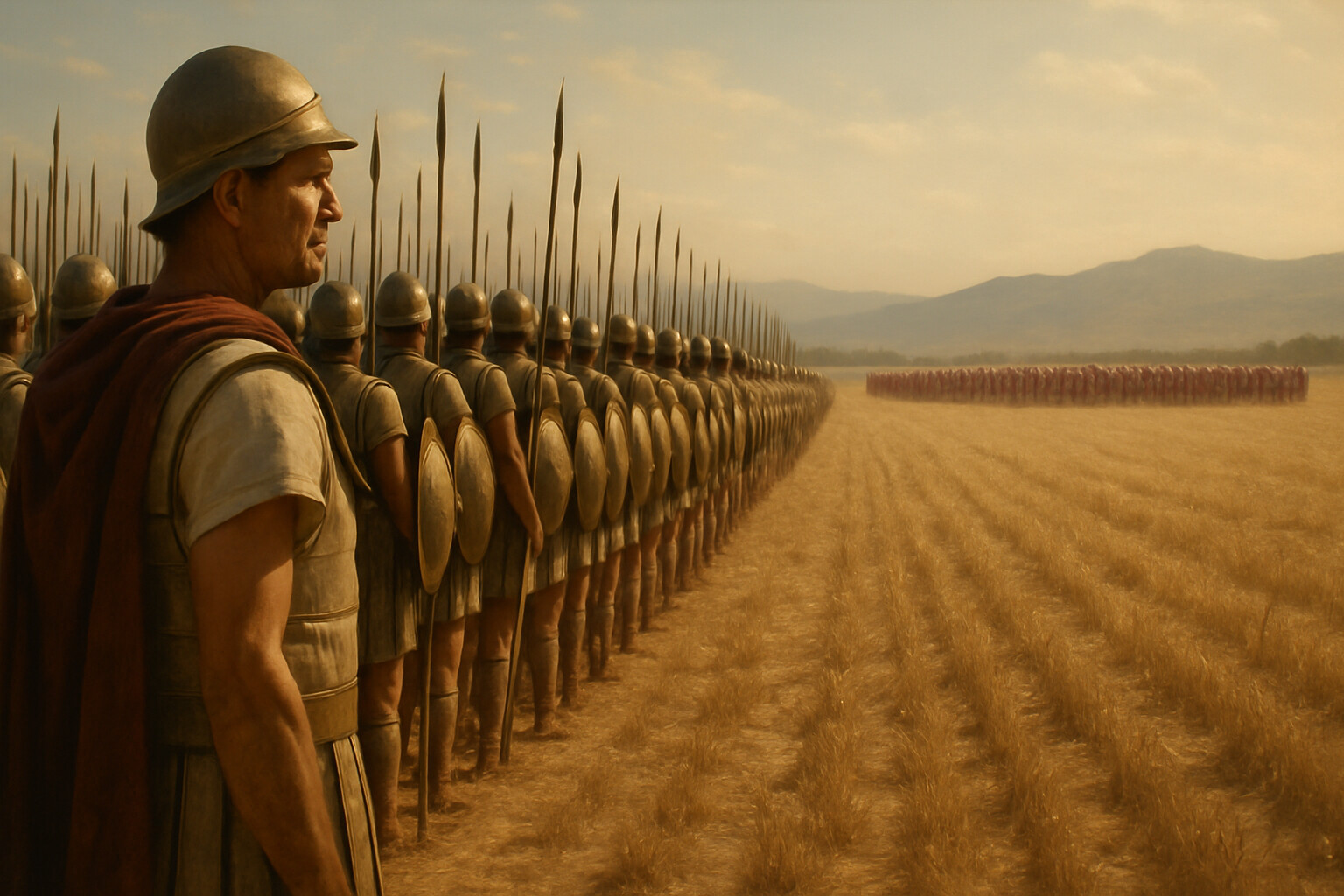
Long before the drums, before the columns of Almoravid infantry resolved into shapes on the southern plain, the dust announced them — a brown haze rising above the road from Almería, dense enough to blot the morning sky above the rice paddies and orange groves outside Valencia's walls. Inside the city, Rodrigo Díaz de Vivar would have had scouts reading that horizon carefully. He had spent thirty years reading horizons like that. He knew what they meant.
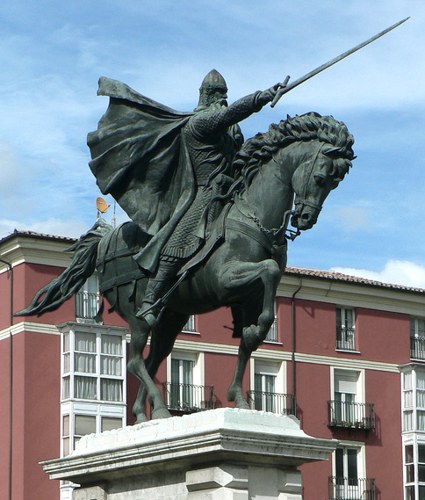
The year was 1094. The man his own people called El Campeador — the Champion — and the Moors called El Cid, from the Arabic Sayyid, meaning lord, was somewhere between fifty and fifty-five years old. He had been in nearly continuous warfare since his teens. He had been exiled by his own king twice. He had fought for Christian rulers and Muslim rulers, sometimes simultaneously. He had built, through a decade of independent campaigning, the most capable mixed-arms force on the peninsula. And he had just taken Valencia — one of the wealthiest cities in Iberia, a city of perhaps fifteen thousand people, a hub of silk, grain, and Mediterranean commerce — by siege, starvation, and his own refusal to stop.
Now the Almoravids were coming to take it back.
---
To understand what Rodrigo Díaz was doing at Valencia in 1094, you have to understand what the Iberian Peninsula was in the eleventh century — and what it was not.
It was not a simple confrontation between Christian north and Muslim south. The clean narrative of the Reconquista — the centuries-long Christian recovery of Iberia from Moorish rule — is a retrospective frame that later historians and the epic tradition draped over events that were, in reality, far messier, more commercial, and more politically opportunistic than the crusading mythology allows. Christian kings fought each other as readily as they fought Muslim rulers. Muslim taifa kingdoms — the small successor states that fragmented the old Caliphate of Córdoba after its collapse in 1031 — paid tribute, called parias, to their Christian neighbors in exchange for military protection and tactical breathing room. Alliances shifted with seasons.
Rodrigo Díaz de Vivar was born around 1043 near Burgos, in the Kingdom of Castile, into a family of the lesser nobility — infanzones, landed but not powerful. His father, Diego Laínez, held some military standing at court. The family's village, Vivar del Cid, sits about a dozen kilometers north of Burgos. The documentary record for this period is thin enough that basic biographical facts rely on charters, legal documents, and later chronicles, some written generations after the events they describe. What is clear from the surviving record is that Rodrigo became a ward or retainer of Crown Prince Sancho of Castile after his father's death, and that he proved himself quickly in military service.
He learned his trade fighting under Sancho in the brutal fratricidal wars that followed the death of King Fernando I of Castile-León in 1065. Fernando had divided his kingdom among his children, a decision that promptly fractured the realm into conflict. Rodrigo fought at the Battle of Llantada in 1068 and the Battle of Golpejera in 1072, where Sancho defeated and captured his brother Alfonso, briefly unifying the kingdoms. Contemporary charters from this period confirm Rodrigo's presence and rising status in Sancho's household.
Then Sancho was assassinated at the siege of Zamora in 1072, under circumstances that were murky then and remain disputed now. Alfonso, released from captivity, became King Alfonso VI of Castile and León — and Rodrigo Díaz suddenly served a king who had reason to distrust him. Rodrigo remained in royal service, and around 1074 he married Jimena Díaz, a noblewoman with ties to the royal family — a match that suggests he still held real standing at court.
The first exile came in 1081. The accounts differ on the precise trigger. The most commonly cited version, drawing on the Historia Roderici — a Latin chronicle likely composed in the early twelfth century and considered the most reliable near-contemporary source — indicates that Rodrigo launched an unauthorized raid into the Muslim kingdom of Toledo, which was at that moment under Alfonso's protection. Whether this was a unilateral military adventure, an act of insubordination, or a response to a perceived threat, it gave Alfonso the pretext he needed. Rodrigo was exiled.
Exile was a legal and social catastrophe. It stripped a nobleman of his lands, his income, and his legitimate standing in the realm. He could not return without the king's pardon. His family's security depended on Alfonso's goodwill. Rodrigo had his sword arm, his reputation, and whatever followers chose to throw in their lot with him — and he had to find someone willing to hire a recently disgraced Castilian knight.
He found the Moorish king of Zaragoza.
---
The next decade of Rodrigo's life is one of the most unusual trajectories in medieval European military history. He served al-Muqtadir and then his successor al-Mu'taman of the Banu Hud dynasty in Zaragoza as a military commander, fighting their wars with professionalism and — by all accounts that survive — considerable effectiveness. He defeated the Count of Barcelona, Berenguer Ramon II, at the Battle of Almenar around 1082, and captured the count himself, releasing him later for ransom or political consideration. He fought campaigns against the kingdom of Aragon. He learned how to command forces with mixed cultural and religious composition, how to work within the political frameworks of the taifa courts, and how to sustain an independent military force in the field over extended periods.
Alfonso briefly recalled him around 1087, apparently valuing his military ability enough to overlook the political friction, but the reconciliation did not last. A second exile followed around 1089 or 1090, the causes again disputed — some chronicles cite military insubordination, others suggest political rivalry at court. Whatever the cause, Rodrigo Díaz was again cut loose.
By 1090, the strategic situation in Iberia had transformed in ways that made Rodrigo's independent position both more dangerous and more potentially valuable than it had ever been.
The Almoravids had arrived.
---
The Almoravids — al-Murabitun in Arabic — were a Berber Muslim movement that had risen from the western Sahara in the 1040s and 1050s and built an empire spanning North Africa from Mauritania to Morocco. They were religious reformers and capable soldiers. Their army combined Saharan cavalry, Andalusian infantry and crossbowmen when campaigning in Iberia, and disciplined command structures that made the fractious taifa armies they absorbed look improvised by comparison.
They crossed into Iberia in 1086 at the invitation of the taifa rulers, who were being squeezed by Alfonso VI's increasingly aggressive expansion and needed military help they could not provide themselves. At the Battle of Sagrajas — also called Zallaqa — in October 1086, Almoravid forces under Yusuf ibn Tashfin dealt Alfonso a serious defeat. Yusuf returned to Africa without immediately consolidating political control in al-Andalus, but the strategic calculation changed over the following years. By the early 1090s, the Almoravids were systematically absorbing the taifa kingdoms, installing their own governors, and positioning for a permanent presence north of the Strait of Gibraltar.
The taifa of Valencia, ruled by al-Qadir, was a client of Alfonso VI — al-Qadir held his throne partly through Castilian military backing. But al-Qadir was an unstable ruler facing internal opposition and Almoravid pressure, and Alfonso was overstretched. Into this vacuum Rodrigo Díaz moved, systematically.
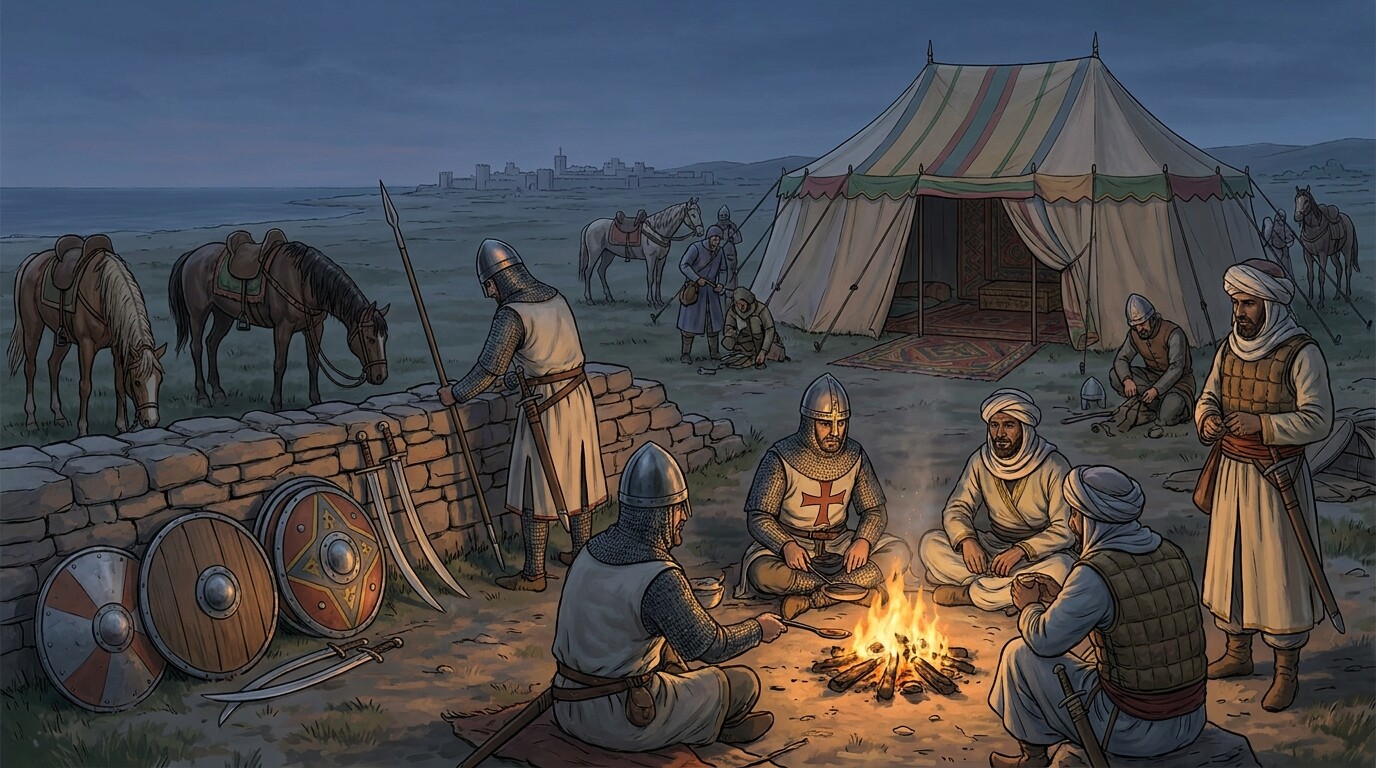
Beginning around 1089 and accelerating from 1091, he operated from the Valencian hinterland, extracting tribute from the taifa rulers of the region, fighting off Almoravid intervention when it came, and extending his effective control over territory through a combination of military pressure and careful negotiation. He built his army into a genuine mixed force — Castilian and Aragonese Christian knights and infantrymen, Mozarabs (Arabized Christians from al-Andalus), and Andalusian Muslim soldiers who found service under a predictable and tactically successful commander preferable to the disruptions of Almoravid absorption. The Historia Roderici and later chronicles consistently describe this mixed composition, and it is corroborated by the political logic of the period: capable soldiers went where they could be paid and led effectively, regardless of the commander's faith.
By 1092, Rodrigo effectively controlled Valencia's surrounding districts. He needed the city itself.
---
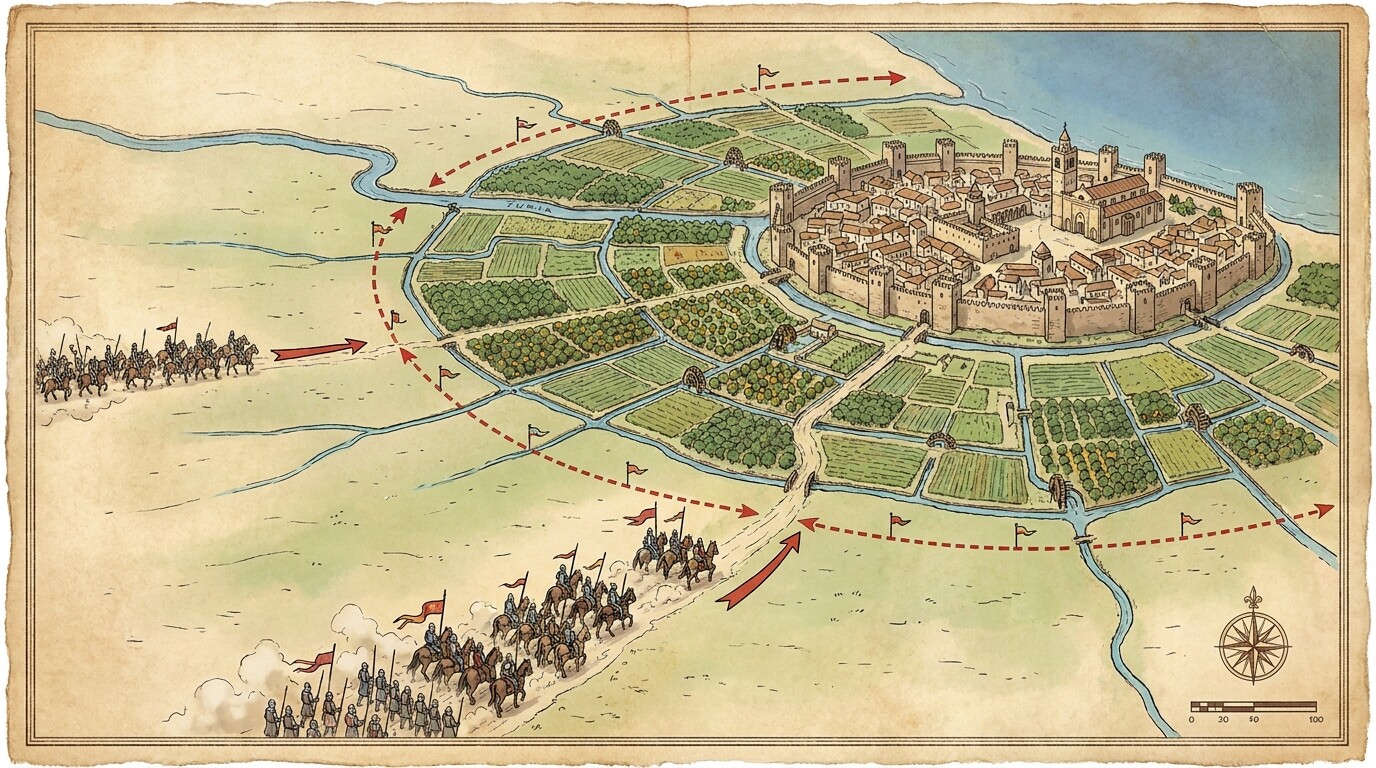
Valencia in 1092 was not simply a military objective. It was an economic engine — one of the wealthiest cities in Iberia, fed by the huerta, a densely farmed irrigated plain that produced grain, rice, fruit, and silk. The city sat where the Turia River reached the coastal plain, protected by walls, by its agricultural wealth, and by its population's awareness of their own value. Taking it required not just military force but a willingness to impose sustained economic pressure, and then to manage the political transition without destroying what made the city worth having.
Al-Qadir, Valencia's client king under Alfonso, was murdered in an internal uprising in October 1092, giving the anti-Castilian faction in the city a brief opening and complicating Rodrigo's position. He responded by beginning a systematic siege.
The siege of Valencia lasted roughly twenty months, from late 1092 into mid-1094. Rodrigo's approach was methodical: he cut the supply lines, controlled the agricultural hinterland, and waited. Attempts to relieve the city or break the siege — including a large relief force from the Almoravid client ruler of Denia and Murcia — were driven off or evaded. Inside the city, conditions deteriorated in the way siege conditions always deteriorate: food stocks diminished, prices rose, and the social and political fabric began to fray under sustained pressure. Contemporary Arabic sources, including Ibn Alqama's account preserved in fragments in later works, describe serious famine conditions within Valencia before the city capitulated.
The city surrendered in June 1094. Rodrigo Díaz de Vivar entered Valencia not as a conqueror razing it to the ground but as a lord taking possession of a going concern. He allowed the Muslim population to remain under their own law in a designated quarter. He installed his own administration. He brought his wife Jimena and their household from Castile to join him. He had, against considerable odds, made himself the independent ruler of one of the most valuable cities in Iberia.
Alfonso VI was not in a position to stop him. Rodrigo had taken Valencia in his own name, not the king's.
---
The Almoravid response was not long in coming.
In the late summer and autumn of 1094, a substantial Almoravid force under the command of Muhammad ibn Tashfin — nephew of Yusuf, the overall Almoravid leader — moved toward Valencia. The numbers given in the sources vary and should be treated cautiously: medieval chroniclers routinely inflated enemy force sizes, and the accounts for this campaign come from chronicles written later with varying degrees of reliability. What is not in doubt is that the force was significant — a serious military effort to reverse Rodrigo's seizure of the city and demonstrate Almoravid authority over al-Andalus.
Rodrigo did not wait behind his walls.
This is a critical tactical point that the later romantic tradition tends to obscure by focusing on El Cid as a heroic figure rather than as a commander making calculated decisions. Sitting inside Valencia with a mixed garrison behind intact walls was a defensible option. Rodrigo chose instead to come out and fight in the open field at Cuarte, a location generally identified as a few kilometers west or southwest of Valencia. The exact site has not been definitively established, and the precise date is given differently across sources — most place it in October 1094.
The Battle of Cuarte is described in the Historia Roderici and in later chronicles with enough consistency to accept its basic shape: Rodrigo's forces, smaller than the Almoravid army, launched a rapid assault — sources emphasize the speed and surprise of the attack — that broke or severely disrupted the Almoravid formation before it could bring its full weight to bear. The Almoravid force was routed. The sources describe significant captures of equipment, horses, and materiel, which constituted both a practical military gain and a powerful demonstration of Rodrigo's continued military dominance.
Why attack rather than defend? The tactical logic is worth examining. The Almoravid army's strength lay in its discipline and its ability to deploy combined arms — cavalry, infantry, and war drums used as psychological instruments — on ground of its choosing. A siege worked against Rodrigo's mixed garrison over time; it was a slower form of the same economic and psychological pressure he had used against Valencia. An aggressive sortie forced the Almoravids to receive battle on terms they had not chosen, at a tempo they had not set. Rodrigo had spent decades learning to use initiative as a force multiplier. At Cuarte he used it decisively.
---
The weapons of this period require some care, because the eleventh-century Iberian battlefield was neither the fully armored figure of later romantic imagery nor the lightly equipped warrior of earlier centuries. It was something more complex.
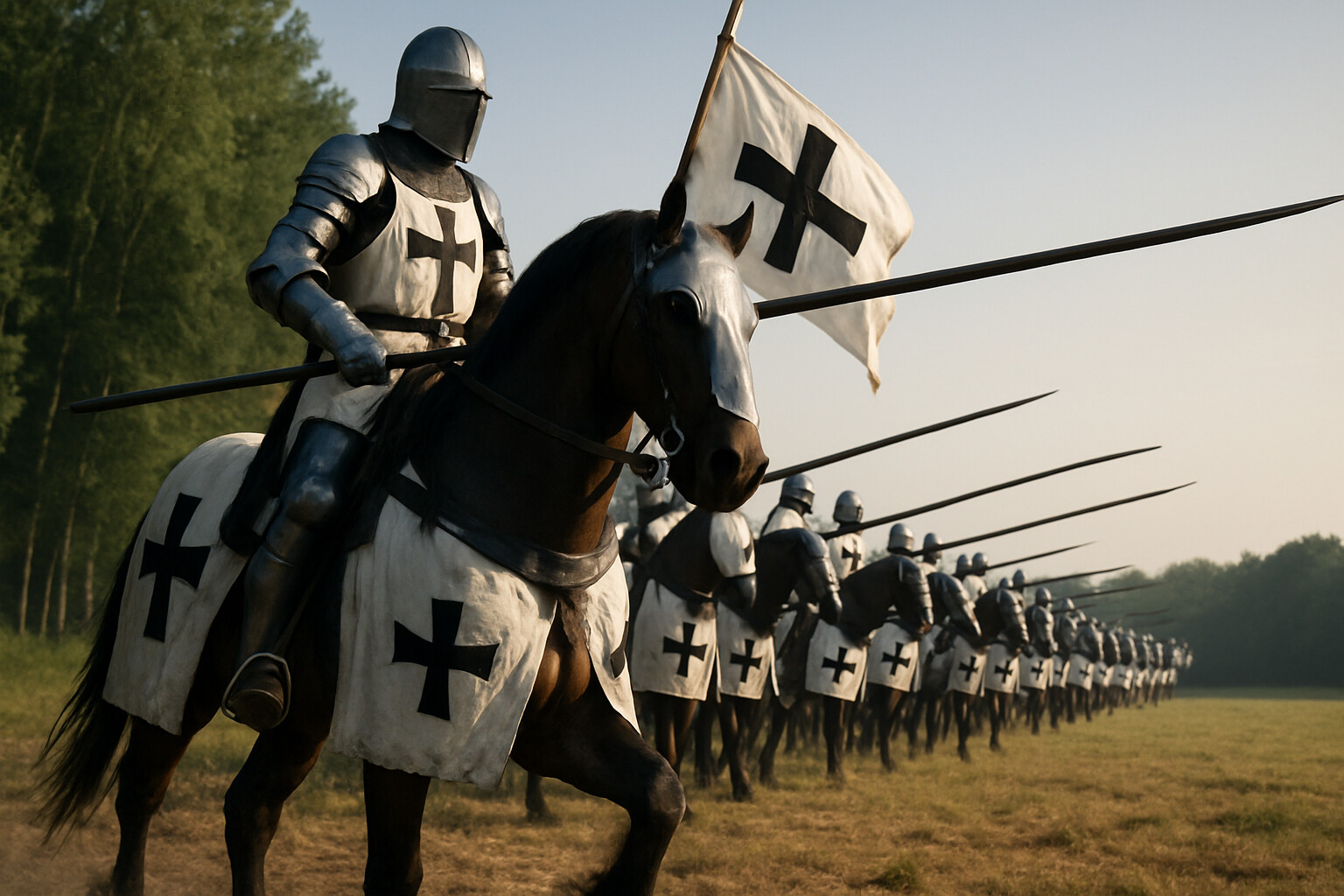
Cavalry on both sides carried lances. The Castilian and northern Christian knights used the couched lance technique that was becoming standard in Western European warfare, where the lance was held firmly under the arm and the combined momentum of horse and rider drove the point home, rather than the earlier overarm throwing or thrusting style. This concentrated the shock of the charge in a way that could break infantry formations not prepared to receive it. A knight and horse together could weigh over half a ton moving at speed; the couched lance delivered that mass through a steel point.
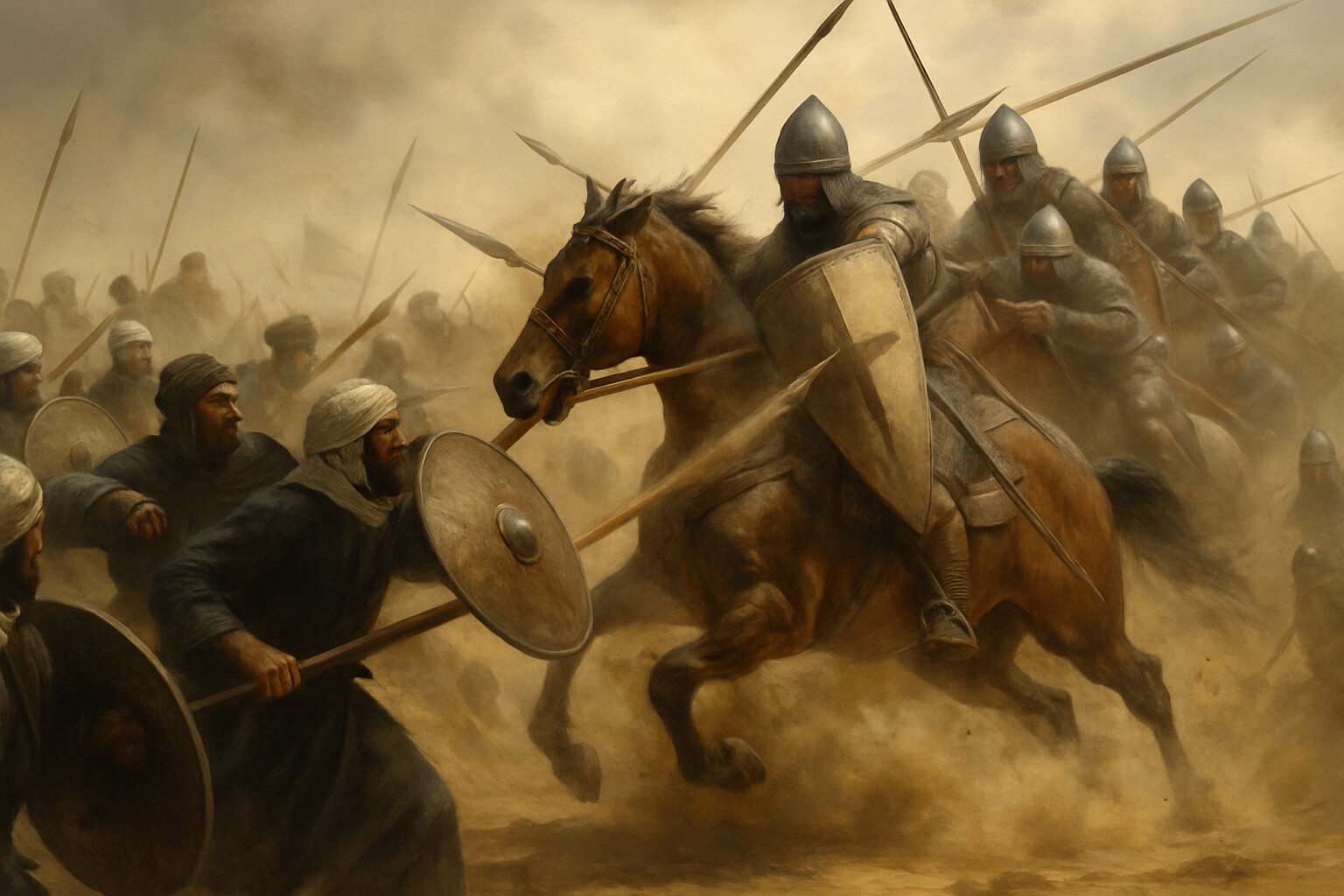
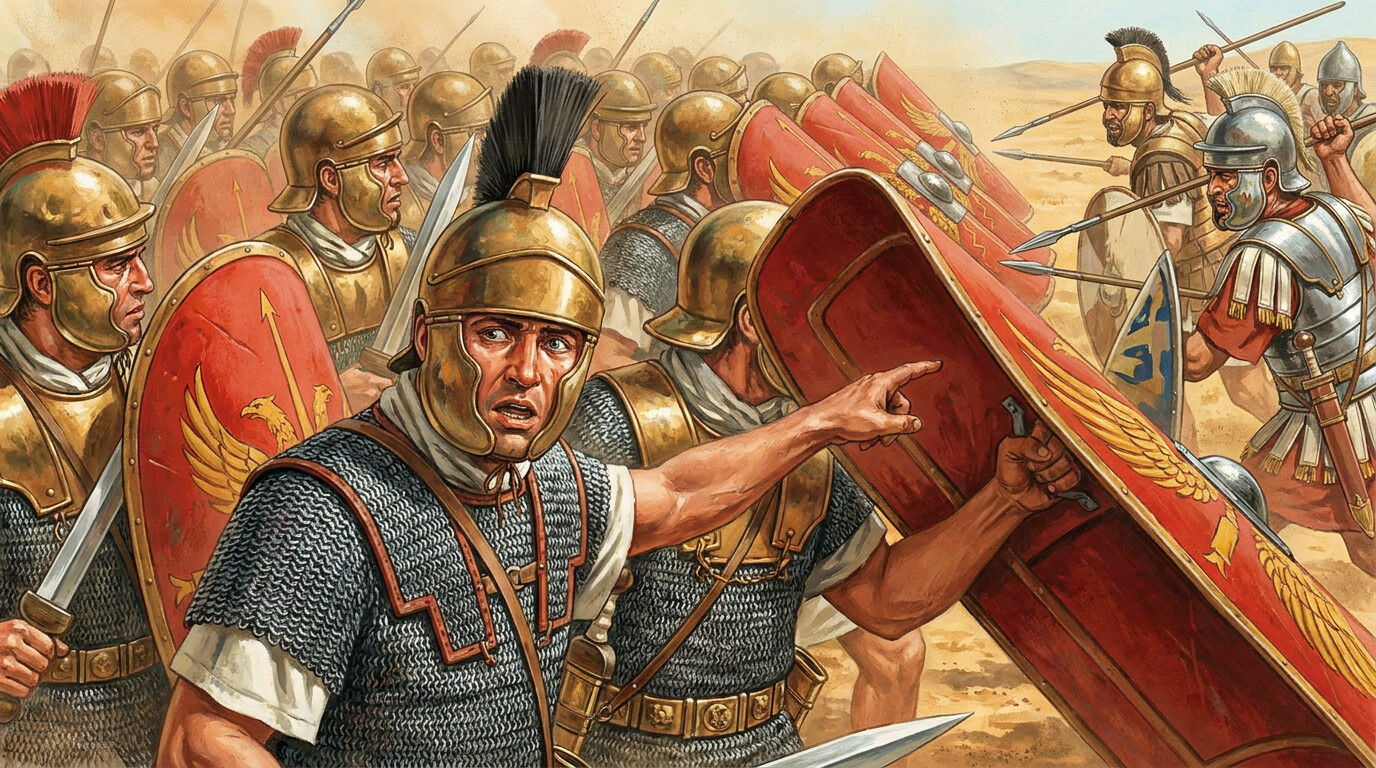
Almoravid cavalry used different traditions. The Saharan and Berber horsemen typically used a shorter lance, often thrown, combined with sword and shield. Their cavalry was not shock cavalry in the Western European sense but was fast, mobile, and capable of sustained harassment and encirclement. At Sagrajas in 1086, they had combined rapid movement, ranged harassment by Andalusian crossbowmen and archers, and tactical patience to wear down Alfonso's forces before committing decisively. They were not a force to be underestimated.
Swords on both sides of the Iberian battlefield in this period were typically double-edged, straight blades — the broad sword tradition descended from earlier Frankish and Carolingian patterns among Christian forces, and similar forms among Andalusian soldiers who had absorbed those influences. Toledo steel, from workshops already famous across medieval Europe, was produced on both sides of the religious divide. The practical difference in individual swordwork between a Castilian knight and an Andalusian or Berber soldier was less about blade design and more about training, armor, and fighting style.
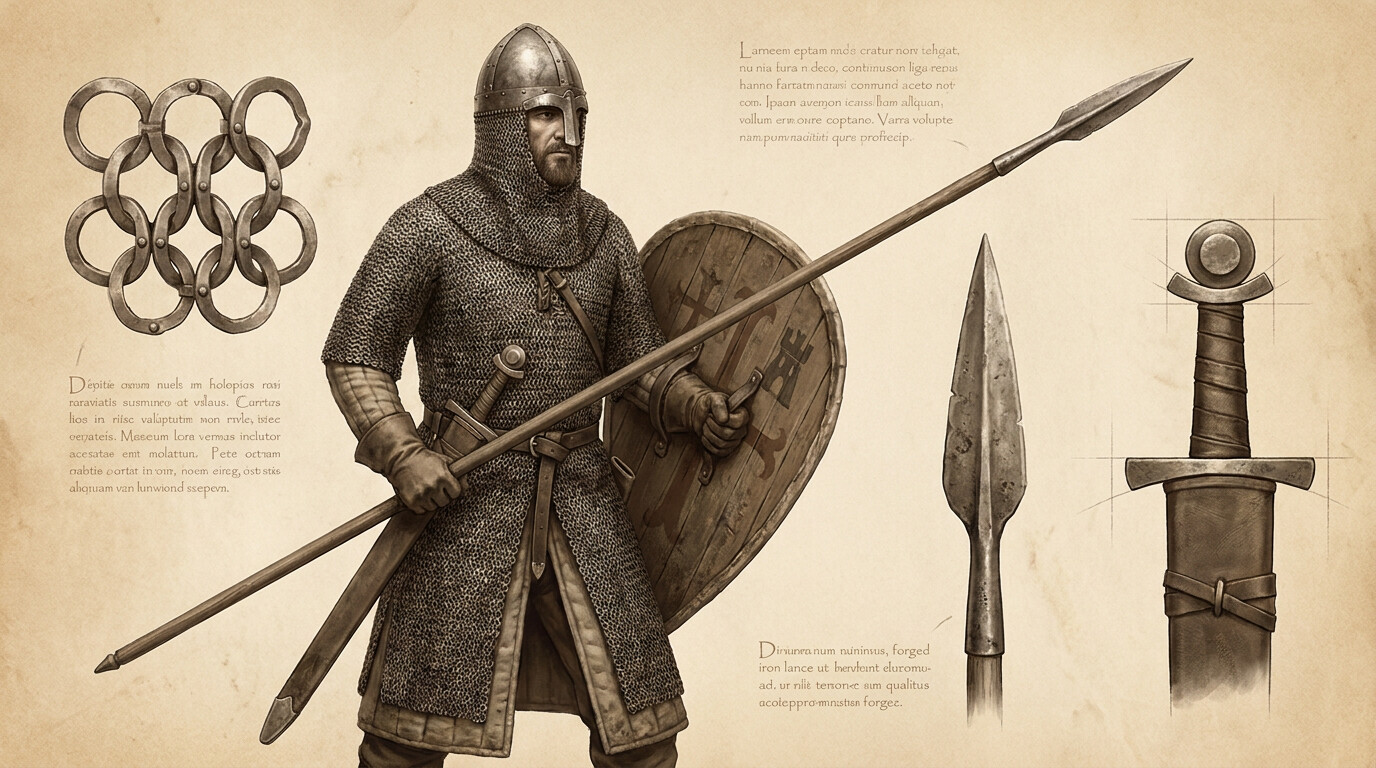
Armor at this level of command — for knights and cavalry — was primarily mail: interlocking iron rings forming a fabric of protection covering the torso, arms, and often legs. The hauberk, a long mail coat, was standard for a knight of Rodrigo's status and era. A mail coif covered the head and neck, topped by a conical helmet, sometimes with a nasal guard. Mail deflects cuts reasonably well but absorbs blunt impact less effectively; a powerful thrust from a lance or strike from a heavy weapon could drive rings into flesh even without full penetration. Underneath the mail, a padded garment — a gambeson — cushioned blows and kept the metal from chafing. Rodrigo's own armor is not specifically described in surviving sources; this reflects documented standards for Iberian knights of his rank and period.
Infantry on both sides carried spears and shields, with swords and axes as secondary weapons. Crossbowmen were important across the Iberian battlefield — Andalusian crossbowmen had been crucial at Sagrajas, and the crossbow was in wide use across Christian Iberia. The crossbow's advantage over the composite bow was that it required less strength and training to operate at effective levels, making it easier to field in large numbers among semi-professional or levy forces. Its disadvantage was reload time — a skilled archer could loose several arrows in the time a crossbowman reloaded — but in siege or defensive engagements, the crossbow's power and relative ease of use made it highly valuable.
The Almoravid forces at Cuarte almost certainly included Andalusian crossbowmen alongside Berber cavalry. The war drums — tabl — that Almoravid armies used were noted specifically by contemporary sources as psychologically effective: large kettledrums beaten by teams of players that produced a continuous, resonant sound documented as disorienting to horses and infantry not accustomed to it. Their use is confirmed for the Sagrajas campaign of 1086 and can be reasonably inferred for the Valencia-area engagements. The speed of Rodrigo's assault at Cuarte suggests he was not willing to let his troops stand and absorb that pressure.
---
The five years between the Battle of Cuarte and Rodrigo's death in 1099 were years of continuous pressure management, punctuated by major military tests.
The Almoravids returned. In 1097, another substantial force besieged Valencia. This effort too was defeated or repulsed, though the surviving sources cover these engagements in less detail than the 1094 campaign. The Historia Roderici, the primary documentary source for Rodrigo's career, thins considerably in its coverage of the later years, and the gap in reliable information is a genuine research concern.
In 1097, Alfonso VI suffered a severe defeat at the Battle of Consuegra against the Almoravids, in which his son Sancho — Rodrigo's own son-in-law — was killed. The defeat dramatically weakened Alfonso's position in the south and effectively isolated Valencia from any possibility of Castilian relief. Rodrigo was on his own in a more absolute sense than before — the city a lone outpost of his own making, surrounded by Almoravid-dominated territory.
He held it.
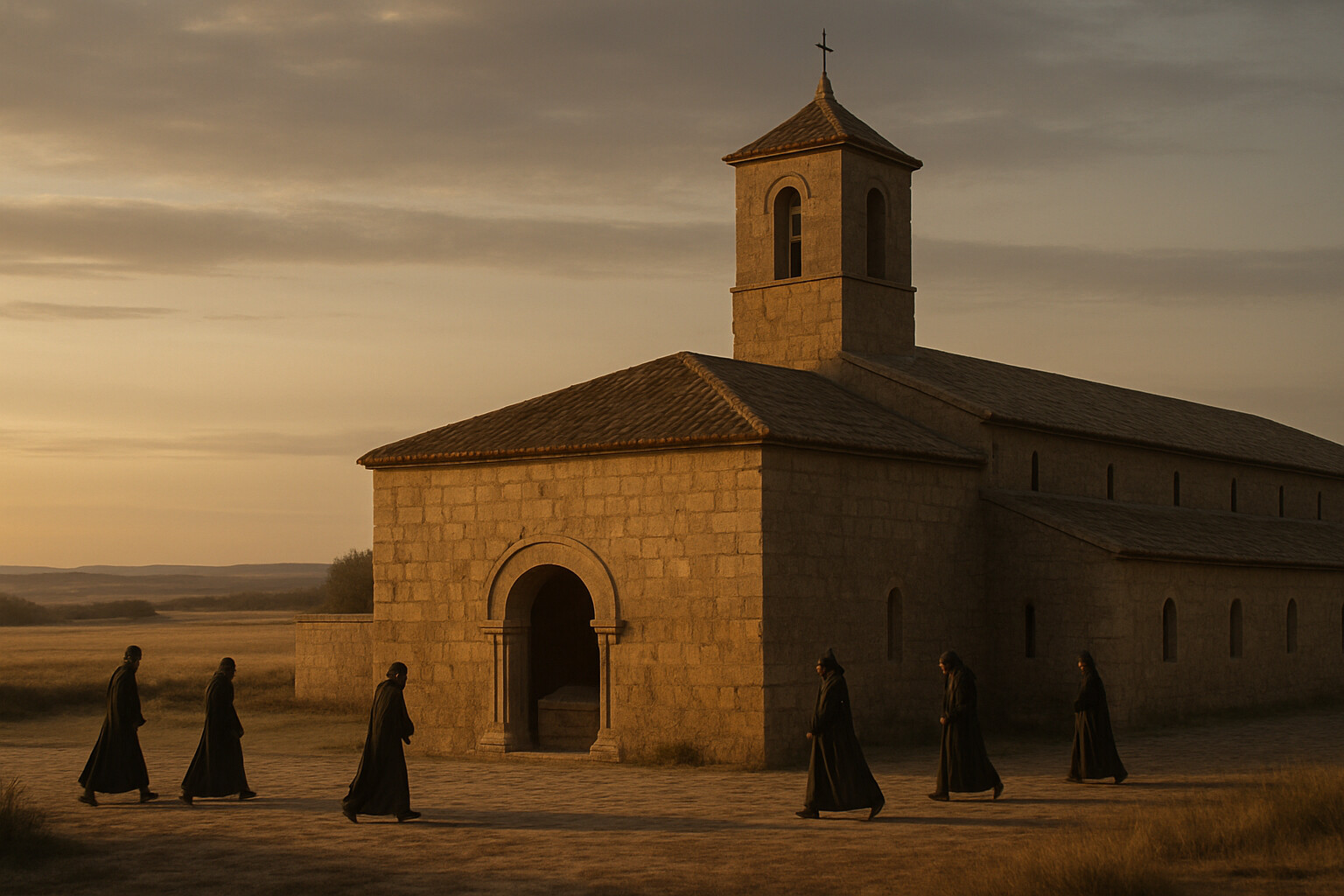
He also used the years of his rule to administer Valencia with what the sources suggest was practical competence. He maintained the Mozarab Christian community, allowed the Muslim population to practice their faith under their own legal customs, and appointed a bishop — Jerome of Périgord, a French cleric — to serve the Christian population and signal Valencia's ecclesiastical character to a broader European audience. The appointment of Jerome is documented and suggests Rodrigo was thinking about the long-term political and ecclesiastical legitimacy of his position, not simply military survival.
The economics of running Valencia mattered as much as its defense. The huerta's agricultural production had to be maintained. The silk trade routes had to function. The tax system — drawing on both Islamic and Christian administrative precedents — had to generate the revenue to pay Rodrigo's mixed army, maintain the walls, and sustain a court. None of this is dramatic in the way battles are dramatic, but it is why Valencia survived. A garrison that is not paid does not stay. Walls that are not maintained do not hold. Rodrigo understood that holding a city means running it, not just defending it.
---
Rodrigo Díaz de Vivar died in Valencia in July 1099. Later sources give illness as the cause, though no contemporary medical record survives and the specific circumstances cannot be confirmed with precision. He was somewhere between fifty-five and sixty years old — a remarkable age for a man who had spent the better part of four decades in active warfare.
He did not die fighting. He died in his city, which was still his.
What followed is described in later chronicle sources and must be flagged carefully as tradition rather than fully documented fact: Jimena, his widow, managed the city's affairs for approximately three years. The decision was eventually made — with Alfonso VI's involvement — to abandon Valencia rather than sustain the siege the Almoravids now pressed without Rodrigo to organize its relief. Alfonso arrived, took Rodrigo's body, and ordered the city burned in 1102 before withdrawing north. The Almoravids occupied the ruins.
Valencia would not return to Christian control until 1238, when James I of Aragon captured it.
Rodrigo's body was initially interred at the monastery of San Pedro de Cardeña near Burgos, where veneration and mythologizing began almost immediately. The great epic poem, the Cantar de Mio Cid, was likely composed in the late twelfth century — within possible living memory of people who knew survivors of Rodrigo's campaigns, though the poem's date and authorship remain contested among scholars. The Cantar is not history. It contains invented episodes, conflated timelines, and dramatic invention of the sort that oral epic tradition requires. But it preserves something of the cultural weight that the historical Rodrigo Díaz had accumulated during his lifetime, and it introduced the story to a wider European audience on terms that would shape how El Cid was remembered for centuries.
The distance between the poem's hero and the historical commander is worth holding clearly in mind. The poem's El Cid is a figure of absolute Christian loyalty — a faithful vassal wronged by treacherous courtiers and vindicated by God. The historical Rodrigo was more complicated: a vassal who twice gave his king cause to exile him, a Christian knight who commanded Muslim armies and served Muslim rulers, a man whose seizure of Valencia was an act of personal and military ambition as much as religious mission, and whose mixed forces drew their effectiveness precisely from the cross-cultural pragmatism that the epic tradition later smoothed away.
None of that complexity makes him less remarkable. If anything, it makes him more so.
---
What anchors Rodrigo Díaz in the historical record, as distinct from the literary tradition, is a body of evidence that is sparse by modern standards but substantial for the period.
The Historia Roderici is the foundation. This Latin prose chronicle, likely composed in the early twelfth century by someone with access to direct or near-direct sources — possibly written in Aragon or the Valencian region — covers Rodrigo's campaigns with enough tactical and logistical detail to suggest an informed author. It is not objective: it is clearly favorable to Rodrigo. But it cites specific places, specific adversaries, and specific outcomes that align with what is independently known about the period from Arabic sources.
Arabic sources provide a crucial counterpoint. Ibn Alqama wrote a chronicle of Valencia's fall from the Muslim perspective, surviving only in fragments preserved in later works such as Ibn Bassam's al-Dhakhira and Ibn Idhari's al-Bayan al-Mughrib. These sources are hostile to Rodrigo but confirm the basic outline of the siege, the famine conditions, and the capitulation. The convergence of Christian and Arabic sources on the same sequence of events — even when their evaluations differ sharply — gives the core narrative substantial credibility.
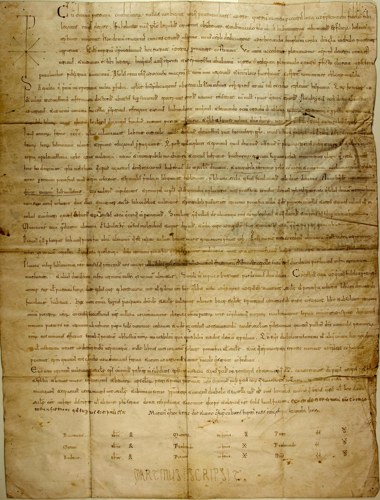
Contemporary charters and legal documents, while not numerous, confirm Rodrigo's presence and activity at key points in his career: his standing in Sancho's court, his land holdings in Castile, and aspects of his Valencian administration. These documents are less dramatic than chronicles but often more reliable, being created for practical legal purposes rather than narrative ones.
The commemorative and hagiographic material — the Cantar, later chronicles, and the long tradition of veneration at San Pedro de Cardeña — must be used more cautiously. They preserve real cultural information about how Rodrigo was perceived and why that perception mattered to later generations, but specific episodes, dialogues, and details from these sources should not be taken as historical record without corroboration.
Researchers working on El Cid today, including Richard Fletcher (The Quest for El Cid, 1990) and Simon Barton and Richard Fletcher's translation and analysis of the Historia Roderici (The World of El Cid, 2000), have done substantial work to separate the historical figure from the accumulated mythology. Their work forms the scholarly foundation for any reliable account of the historical Rodrigo Díaz.
---
Why does any of this matter beyond the history of one medieval Iberian commander?
Partly because Rodrigo Díaz represents something genuinely rare in the documented record: a military commander who operated outside the conventional frameworks of loyalty, religious solidarity, and political allegiance that structured his world — not from cynicism but from a clear-eyed understanding of what effective military and political power actually required. He did not transcend the categories of his age — he was a Christian nobleman with real religious convictions and real political ambitions — but he refused to let those categories limit his options when the stakes were high enough.
The mixed force he built was not an accident or a product of desperation. It reflected an understanding that effective soldiers could be found across the religious divides of Iberia, that a Moorish cavalryman who was paid reliably and led competently was worth more than a Christian knight motivated by sentiment but poorly supplied and erratically commanded. This was not a popular view in the later medieval tradition, which preferred its Christian heroes to be Christians fighting Moors. The historical record is less comfortable.
Partly too because Valencia itself, in 1094, was a singular achievement. To take a city of that size and complexity by siege, with an independent army sustained by tribute and careful logistics, against the opposition of both the Almoravid empire and the competing interests of Christian rulers, required a combination of military skill, administrative intelligence, and personal authority that the historical record rarely documents in such sustained form.
And partly because the end of the story — the death in the city, the abandonment of Valencia, the eventual Almoravid occupation — is honest in a way that mythology is not. Rodrigo Díaz held Valencia for five years and died in it. He did not live to see it lost. What he built did not outlast him by much, but it lasted as long as he did. The walls stood while he stood.
In the dry heat of that autumn of 1094, as the dust of an Almoravid army rose above Valencia's southern horizon and his scouts came back with their reports, Rodrigo Díaz de Vivar was already planning his next move. He had been in situations close enough to this one more times than most men survive. He was not a man who waited for the situation to come to him.
He rode out to meet it.