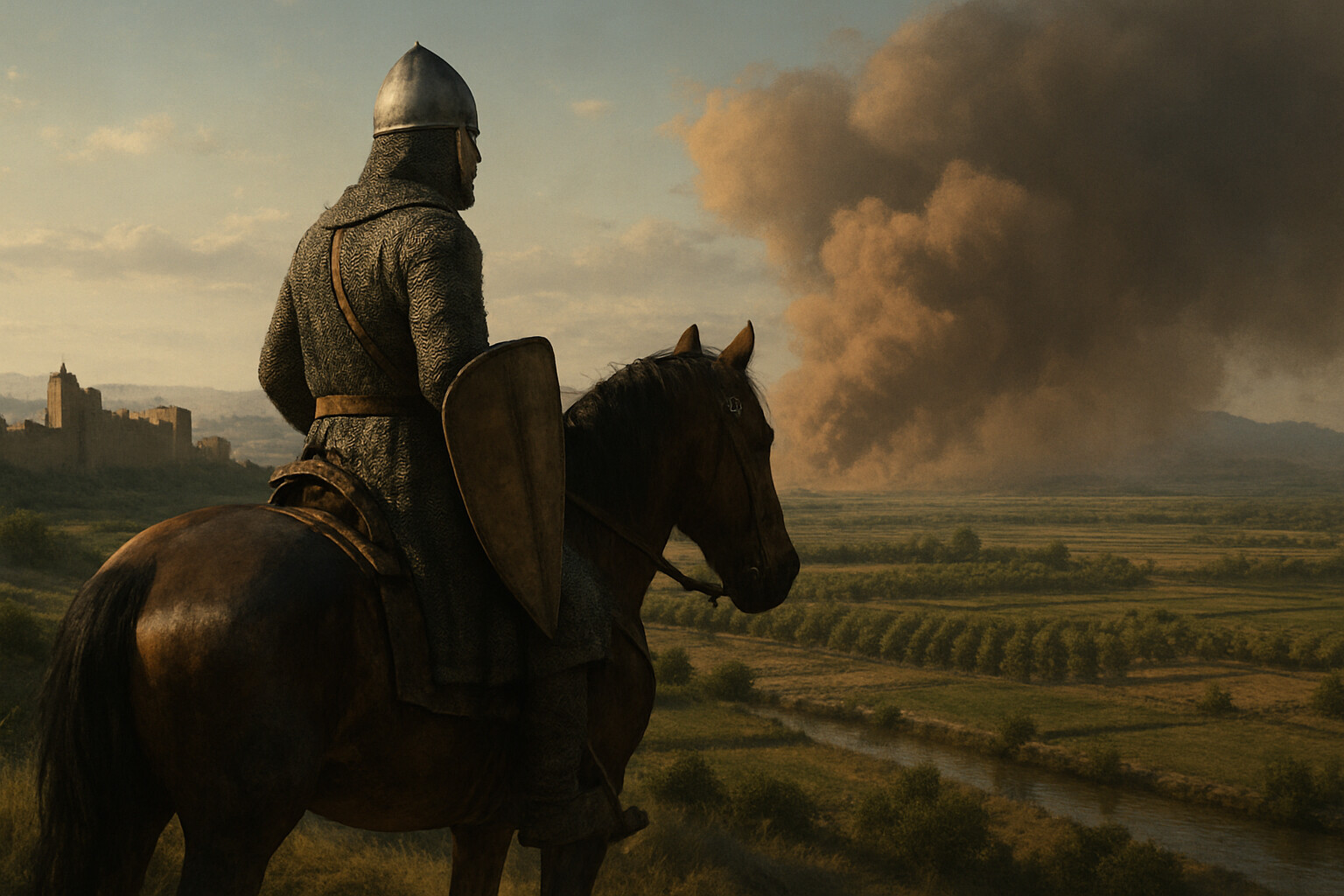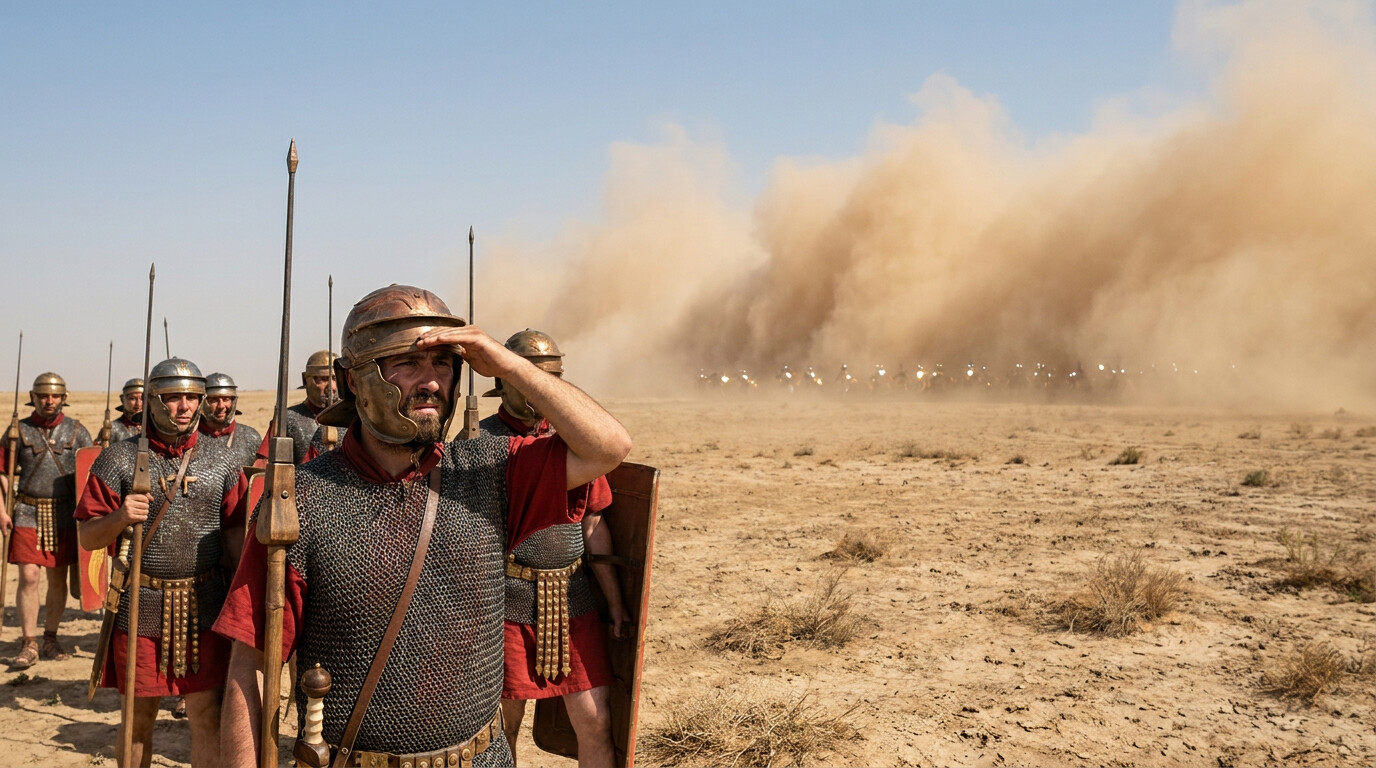
The dust arrived before the arrows did.
It was late spring in the Mesopotamian plain, somewhere between the Euphrates and the city of Carrhae, and the Roman column was already suffering. The legionaries had been marching for days through terrain that offered nothing—no shade, no reliable water, no cover, no high ground on which to anchor a line. The flat, sun-hammered plain stretched away to the horizon on every side, and the air shimmered with heat. Then, far out across the empty steppe, dust columns began to rise: thin at first, then thickening, spreading laterally, suggesting not a column of marching men but something that moved differently, something that did not need roads.
The Parthians had found them.
For the legionaries who had followed Marcus Licinius Crassus out of Syria that spring, what followed would define their lives—if they survived at all. Plutarch, writing roughly a century and a half later from sources now lost, describes the sound that came first: the deep, hollow boom of Parthian war drums, kettledrums carried on camels and designed to fill the air with a resonance that vibrated in the chest. Then, as the dust thinned and the shapes within it resolved into horsemen, came the glitter of armor—thousands of scale-armored cataphracts and their armored horses catching the desert sun, and between and behind them, in lighter gear, the horse archers who would define the day.
Crassus ordered his infantry into formation. It was nearly the last useful order he would give.
---
**The Man Who Needed a War**
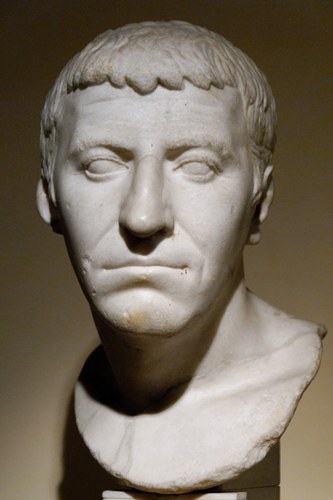
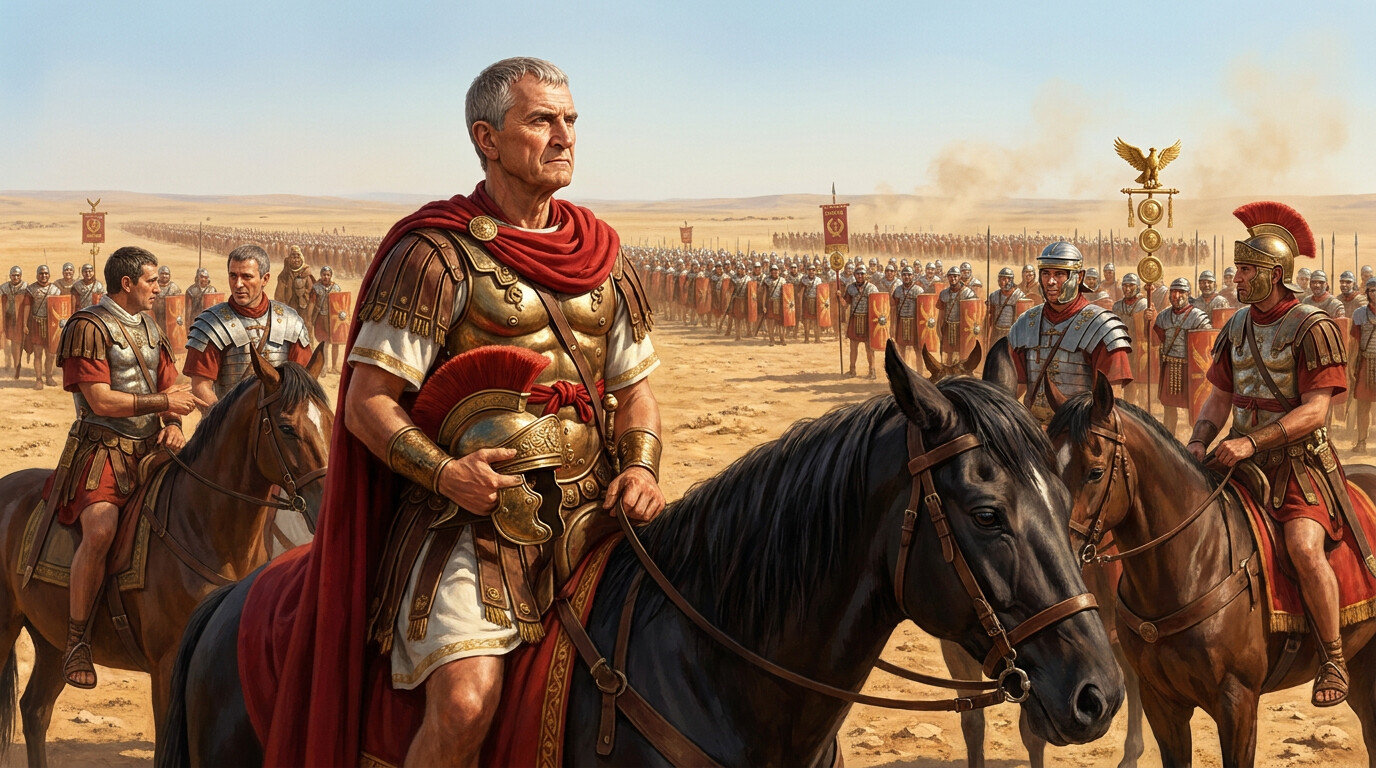
Marcus Licinius Crassus was, by 55 BC, one of the three most powerful men in the Roman world. He had made himself the wealthiest Roman of his generation through property speculation, slave training, and political investment, and he had leveraged that wealth into alliance with Julius Caesar and Gnaeus Pompeius Magnus—Pompey—in what historians would later call the First Triumvirate. The three men divided influence over the Roman state and its provinces informally but effectively, and for a time the arrangement held.
But Crassus had a problem that money could not solve. Caesar was conquering Gaul, adding campaign after campaign to a military reputation that was becoming extraordinary. Pompey held the glory of his eastern campaigns and the defeat of Mithridates, and he remained the most celebrated general alive. Crassus had crushed the slave rebellion of Spartacus in 71 BC—a significant military accomplishment—but the Senate had awarded him an ovation rather than a full triumph, reportedly because it considered the defeat of slaves a lesser achievement than foreign conquest. The distinction galled him. He needed a command that would generate the kind of glory his rivals already possessed.
The Parthian Empire, which controlled the territory east of the Euphrates from its heartland in what is now Iran and Iraq, was the obvious target. Rome and Parthia had maintained an uneasy coexistence since the 90s BC, with the Euphrates serving as a rough boundary. Periodic diplomatic contacts had produced a treaty of sorts, though both sides tested its edges. The Parthians were wealthy—their empire sat astride the Silk Road—and they were not Roman, which made them, in the political calculation of the late Republic, a legitimate target for an ambitious proconsul.
In 55 BC, the Triumvirs arranged their provincial commands at the Conference of Luca. Caesar received Gaul. Pompey received Spain, which he administered through legates while remaining in Italy. Crassus received Syria—and with it, the opportunity to launch a campaign against Parthia. He was approximately sixty years old. He had never commanded an army in major open-field battle. He crossed to Syria in 54 BC, gathered forces, and in 53 BC crossed the Euphrates with approximately seven legions and auxiliary forces.
The exact composition of his force is a matter of scholarly discussion. Ancient sources, principally Plutarch's Life of Crassus, place his infantry strength at roughly 28,000 to 35,000 legionaries, with several thousand cavalry and a smaller number of auxiliary infantry; other ancient accounts give higher figures. His son Publius Crassus, who had served under Caesar in Gaul and was considered a capable officer, commanded a wing that included Gallic cavalry—veterans of Caesar's campaigns who represented some of the best horsemen available to the Roman force.
The strategic plan was to advance through Mesopotamia toward the Parthian heartland. What Crassus lacked was reliable intelligence about the Parthian response.
---
**The Parthian World**
The Arsacid Parthian Empire in 53 BC was not the crumbling client state that Roman propaganda sometimes implied. It was a sophisticated imperial polity stretching from the Euphrates to the borders of Bactria, maintained not through a single centralized army but through a system of powerful noble families who provided cavalry forces to the king in times of war. The king in 53 BC was Orodes II, who had recently consolidated power after a succession conflict and was occupied with a campaign against the kingdom of Armenia when Crassus crossed the Euphrates. Defense of the Mesopotamian frontier fell largely to the commander known as Surena—his personal name is not preserved in any surviving source, as Surena was a title of his noble house—who was, by Plutarch's account, young, exceptionally able, and the second-ranking nobleman in the Parthian state.
Surena's force was cavalry-based, as Parthian armies characteristically were. It consisted of two principal elements: horse archers, light cavalry armed with the composite recurve bow and capable of sustained fire at the trot and canter; and cataphracts, heavily armored cavalry whose horses were also armored in bronze or iron scale and who carried the heavy two-handed kontos lance. The ratio of horse archers to cataphracts in Surena's force is debated, but Plutarch's account suggests the cataphracts served as a strike and intimidation element while the horse archers did the systematic killing. Crucially—and this detail is documented in Plutarch—Surena had arranged for a camel train carrying replacement arrows to accompany his cavalry, solving the logistical problem that had limited horse archer effectiveness in earlier operations: the archers would not run out of ammunition.
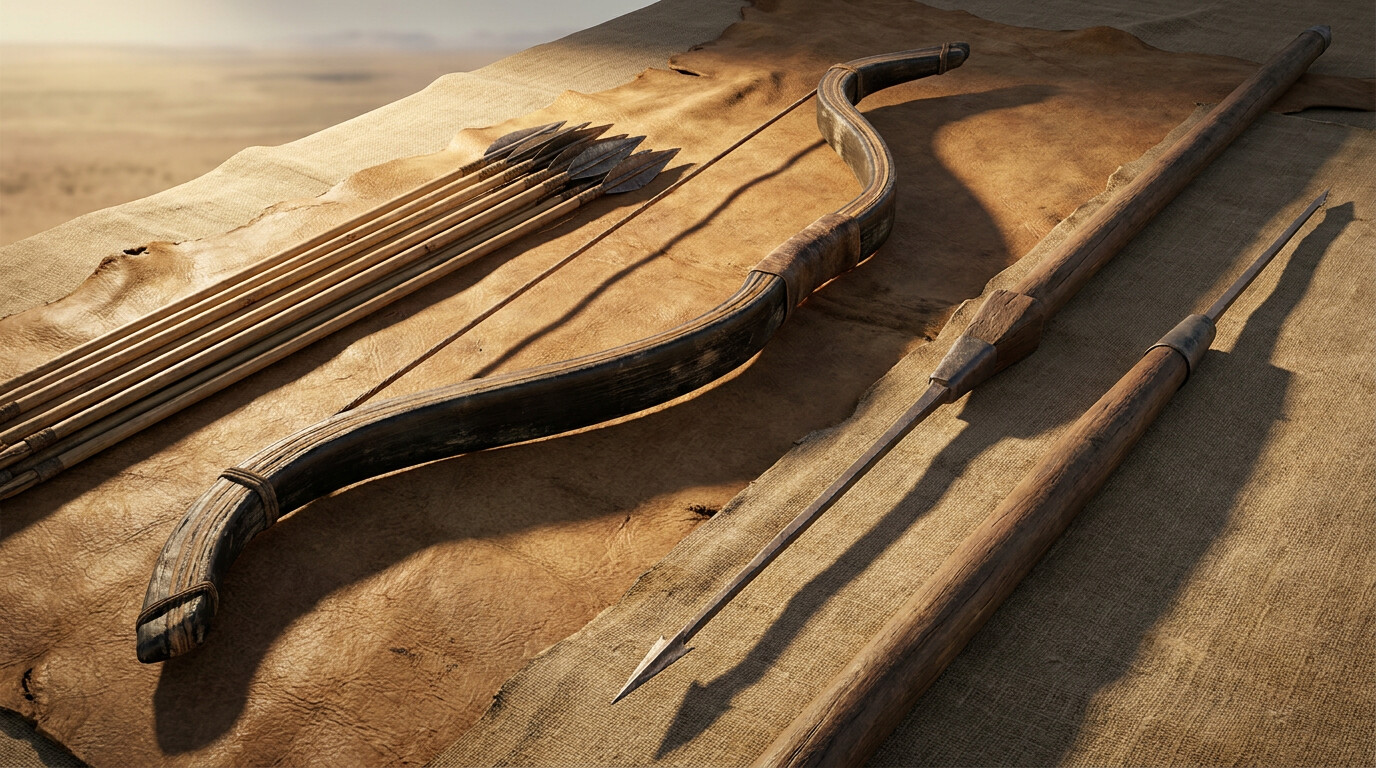
The Parthian composite bow was a weapon of extraordinary sophistication for its era. Constructed from a laminate of wood, horn, and sinew, it stored and released energy far more efficiently than a simple wooden bow of the same size, giving it an effective range that outclassed anything the Roman legionaries carried. The Roman legionary's primary ranged weapon was the pilum—a heavy throwing javelin with an iron shank designed to penetrate shields and pin them, or to bend on impact and disable the shield—effective at perhaps fifteen to thirty meters. Parthian horse archers could engage at ranges that ancient sources and modern analysis place considerably higher, and could sustain fire while moving. The tactical implication was stark: the Roman infantry could not close with the archers before taking serious casualties, and they could not drive them off at range.
The cataphracts, meanwhile, were built to exploit any formation that the archers had softened. Their armor—lamellar or scale in bronze and iron, covering both rider and horse—was designed to resist infantry weapons at close quarters. The kontos, held two-handed and estimated at around four meters in length, could pierce legionary armor in a charge.
Surena understood what his combined force could do to a Roman column caught in open terrain: the horse archers would envelop and exhaust the formation from range; the resupply camels would ensure the shooting never stopped; if the Romans advanced, the cavalry would outpace them and resume fire from a new angle; if they stood, they would be shot down; if they formed testudo to protect against arrows, they could no longer maneuver or strike back. The cataphracts would wait for the moment when the formation began to break.
---
**The Route and the Terrain**
The route Crassus chose has been debated since antiquity. Ancient sources indicate he received guidance from a local figure identified in the tradition as Ariamnes—described variously in different ancient accounts as a Galatian or Arab chieftain—whom Plutarch characterizes as a Parthian agent who deliberately steered the Roman column into the open plain rather than along the more defensible route closer to the Euphrates, where broken riverine terrain would have limited cavalry operations. Whether Ariamnes was a deliberate agent, a man caught between two powers, or a guide whose knowledge simply did not serve Roman tactical needs cannot be determined from surviving sources. Plutarch's framing reflects the Roman tendency to explain military disaster through betrayal; the underlying tactical failure was structural regardless of any individual's intent.
What is documented is the outcome: Crassus marched his force across the open, flat plain of northern Mesopotamia toward Carrhae—modern Harran in southeastern Turkey—through terrain that offered every advantage to cavalry and none to infantry.
His own officer Cassius Longinus—later one of Caesar's assassins—reportedly advised operating closer to the river and the broken ground it offered. Publius Crassus, newly arrived with his Gallic cavalry, may have urged a more aggressive advance. The elder Crassus appears to have steered a middle course that satisfied neither concern, committing to the open plain without a plan to address what mounted envelopment would look like against a Roman formation.
The terrain around Carrhae—the flat, rolling steppe of the Harran plain—is not featureless in an absolute sense: there are low rises, dried watercourses, and a general aridity that in late spring produces the conditions ancient sources describe. But it offered nothing to a Roman commander trying to anchor flanks or deny cavalry room to maneuver. In every meaningful tactical sense, it was ideal ground for Surena and lethal ground for Crassus.
---
**The Battle: First Contact**
The engagement took place near Carrhae in what is inferred from ancient context to have been late May or early June of 53 BC—the exact date is not preserved. It opened when Surena's advance elements were detected by the Roman column. Crassus initially formed his force in an extended line, then shifted on the advice of his officers to a formation with a strong center and covered flanks, placing cavalry and auxiliary infantry on the wings to guard against envelopment. Publius Crassus commanded one of the cavalry wings.
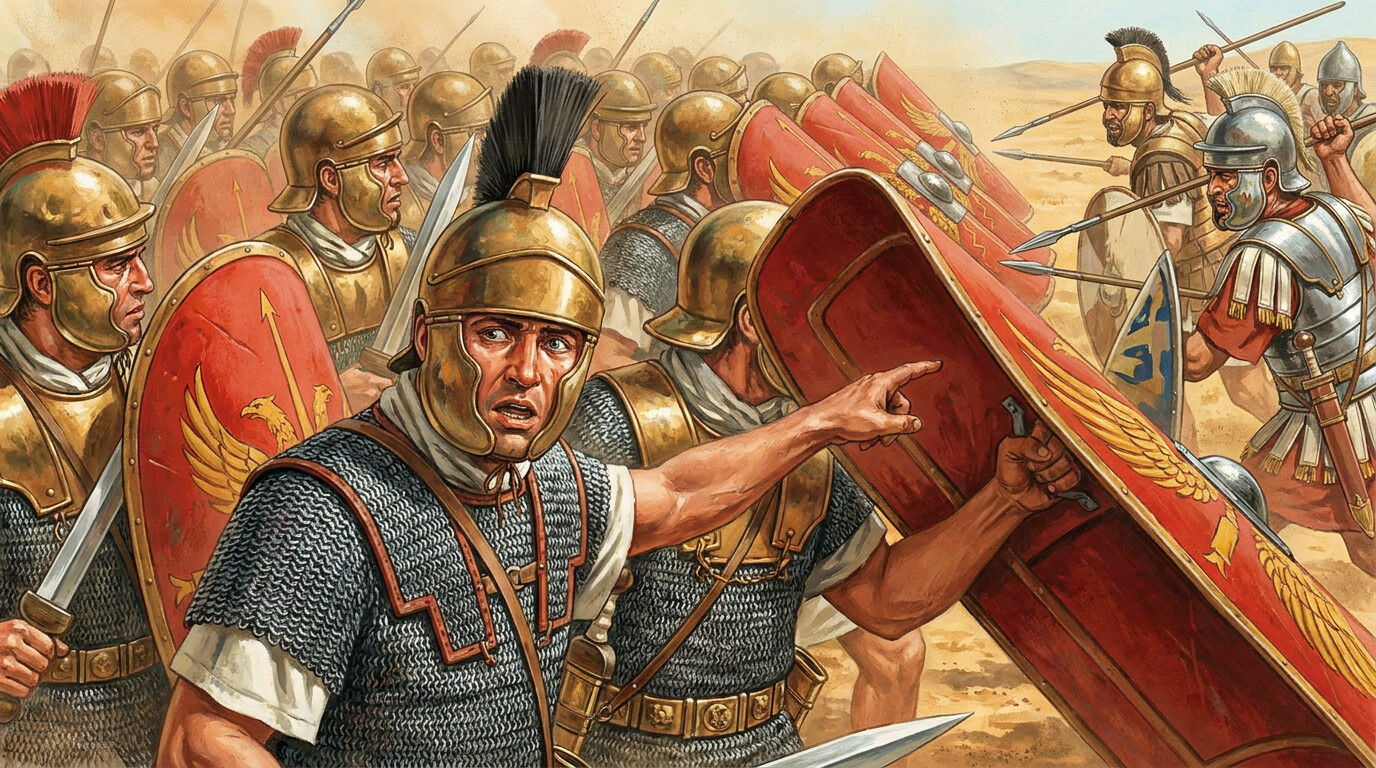
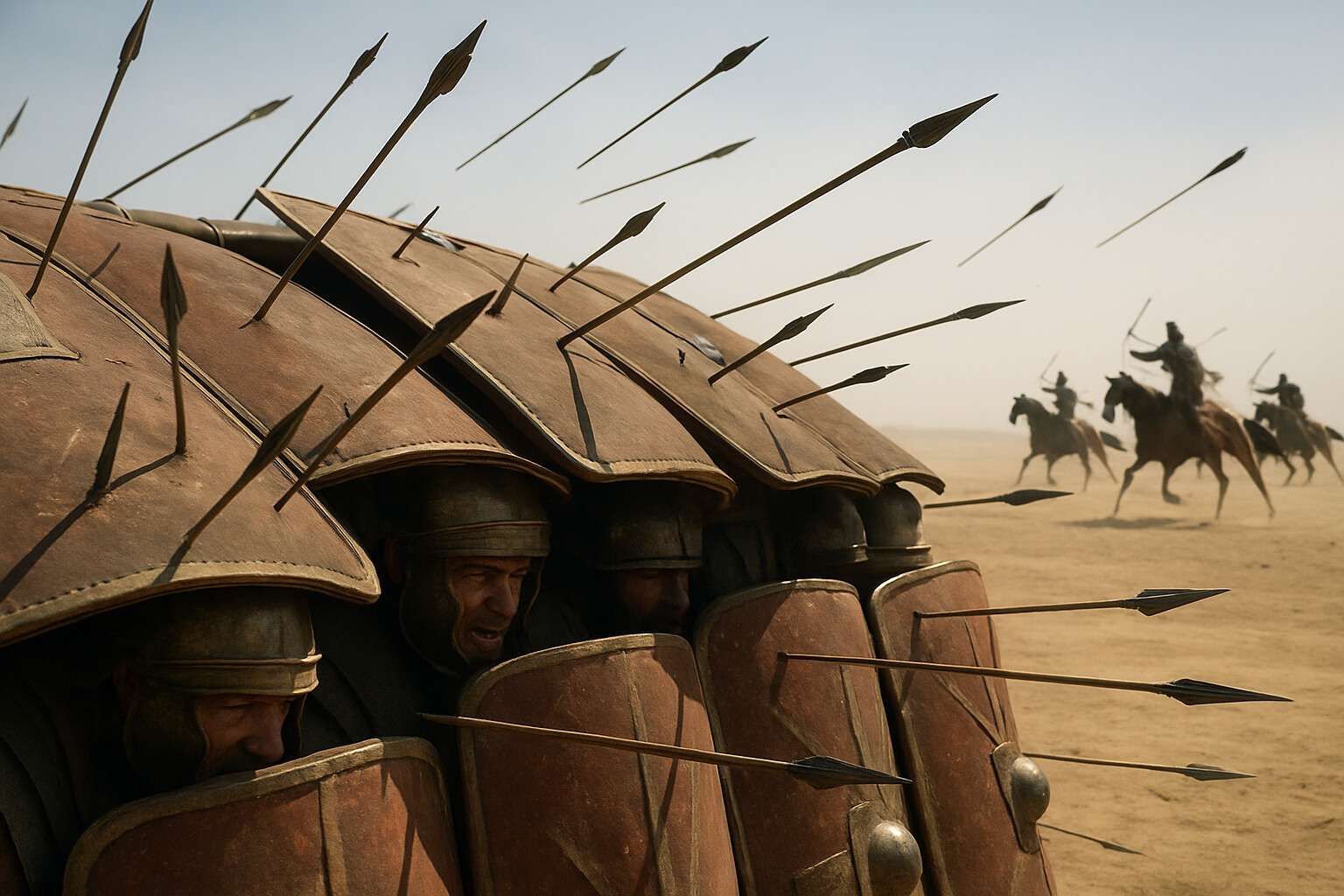
The Parthians did not engage in any conventional sense. They did not charge. The cataphracts appeared in the initial approach, then parted as the horse archers swept around the Roman flanks. What followed was a sustained archery bombardment from multiple angles simultaneously. The horse archers moved at the trot and canter, maintaining distance, firing continuously, and withdrawing whenever Roman formations moved toward them. The Romans could not charge the archers: the horsemen simply outpaced them and resumed fire from a new angle. The heavy scutum shields provided some protection, but Plutarch's account describes the arrows as powerful enough to drive through shields and pin limbs—suggesting the volume and weight of fire exceeded what the shields reliably stopped.
The Roman formation began to close up, men instinctively pressing together for mutual protection, but the denser the mass the better the target. Crassus ordered his son Publius forward with the Gallic cavalry, auxiliary infantry, and light troops—Plutarch gives the figure of approximately 5,500 men, which should be understood as an ancient estimate—to drive off the horse archers on the flank and relieve the pressure.
Publius's advance initially appeared to succeed. The Parthian horse archers withdrew, drawing the Roman cavalry and its accompanying infantry away from the main body and further across the plain. Then the Parthians turned.
The cataphracts struck the isolated Roman detachment from the front while the horse archers resumed fire from the flanks and rear. Publius's Gallic cavalry charged the cataphracts and discovered that their swords could not reliably penetrate scale armor, and that reaching the riders meant first getting past armored horses. According to Plutarch, the Gauls attempted to seize the kontos lances and drag riders down, or to strike at unarmored areas beneath the horses. It was not enough. The Roman and Gallic detachment was surrounded and destroyed. Publius Crassus died in the encirclement; Plutarch writes that he died by his own hand or that of a companion to avoid capture. His head was subsequently brought back to the main Roman force and displayed on a lance in view of the army.
This detail comes from Plutarch and cannot be independently confirmed from other sources. It is presented here as Plutarch's account, not as independently verified fact.
---
**The Long Afternoon**
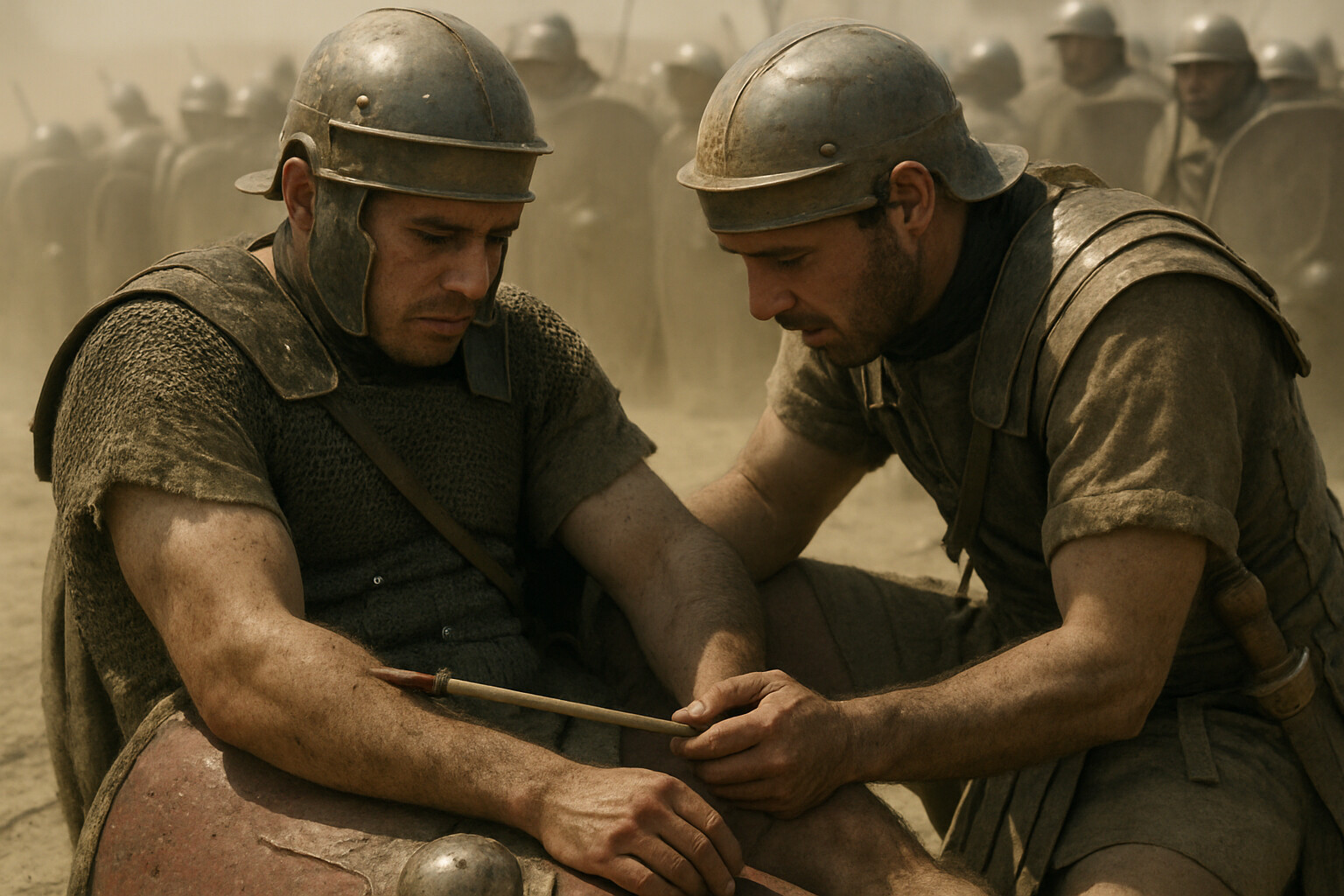
What followed was not a second decisive clash but something worse: a sustained, methodical attrition of the main Roman force by continuous archery, with no possibility of effective response.
The Romans formed the testudo—the tortoise, in which men in the center raised their shields overhead and those on the edges locked shields outward, creating a shell of interlocking scuta. Against arrows it provided meaningful but incomplete protection; against the Parthian volume of fire sustained over hours, it was an exhausting posture that left men unable to maneuver, unable to throw pila, and increasingly unable to see what was happening around them. The formation also imposed a psychological weight that the physical records cannot fully capture: standing locked inside a shield wall while arrows hammered the surface continuously, hearing men fall, with no means of striking back and no sense of when the killing would stop.
The horse archers circled and fired. The camel resupply columns kept the ammunition flowing. When the Romans stood, they were shot. When they tried to advance, the Parthians withdrew and resumed fire from a new angle. The sun moved across the sky toward evening.
At some point in the afternoon, Surena sent representatives offering Crassus the opportunity to come forward and negotiate. Whether this was a genuine offer—Surena may have valued a captured Roman general over a dead one, as political leverage with Orodes—or a trap is disputed in the ancient sources and cannot be resolved. Crassus was persuaded or pressured by his surviving officers to comply, as the alternative appeared to be the slow destruction of the entire force where it stood. He rode toward the Parthian line with a small escort.
The ancient accounts of what followed are inconsistent. Plutarch writes that a scuffle broke out—whether initiated by the Romans or the Parthians is unclear—and that Crassus was killed in the fighting. Other accounts differ on the circumstances. What is not disputed is the outcome: Marcus Licinius Crassus died at or near Carrhae during the contact with Surena's representatives. He did not die in a charge or at the head of his men. He died in circumstances the Romans of his era found difficult to narrativize with dignity, which may partly explain why the accounts diverge.
A later tradition, recorded by several ancient writers, held that the Parthians poured molten gold into his mouth after his death—a theatrical commentary on his legendary wealth. Modern historians treat this as symbolic embellishment rather than documented fact. It is noted here as tradition, not as a confirmed event.
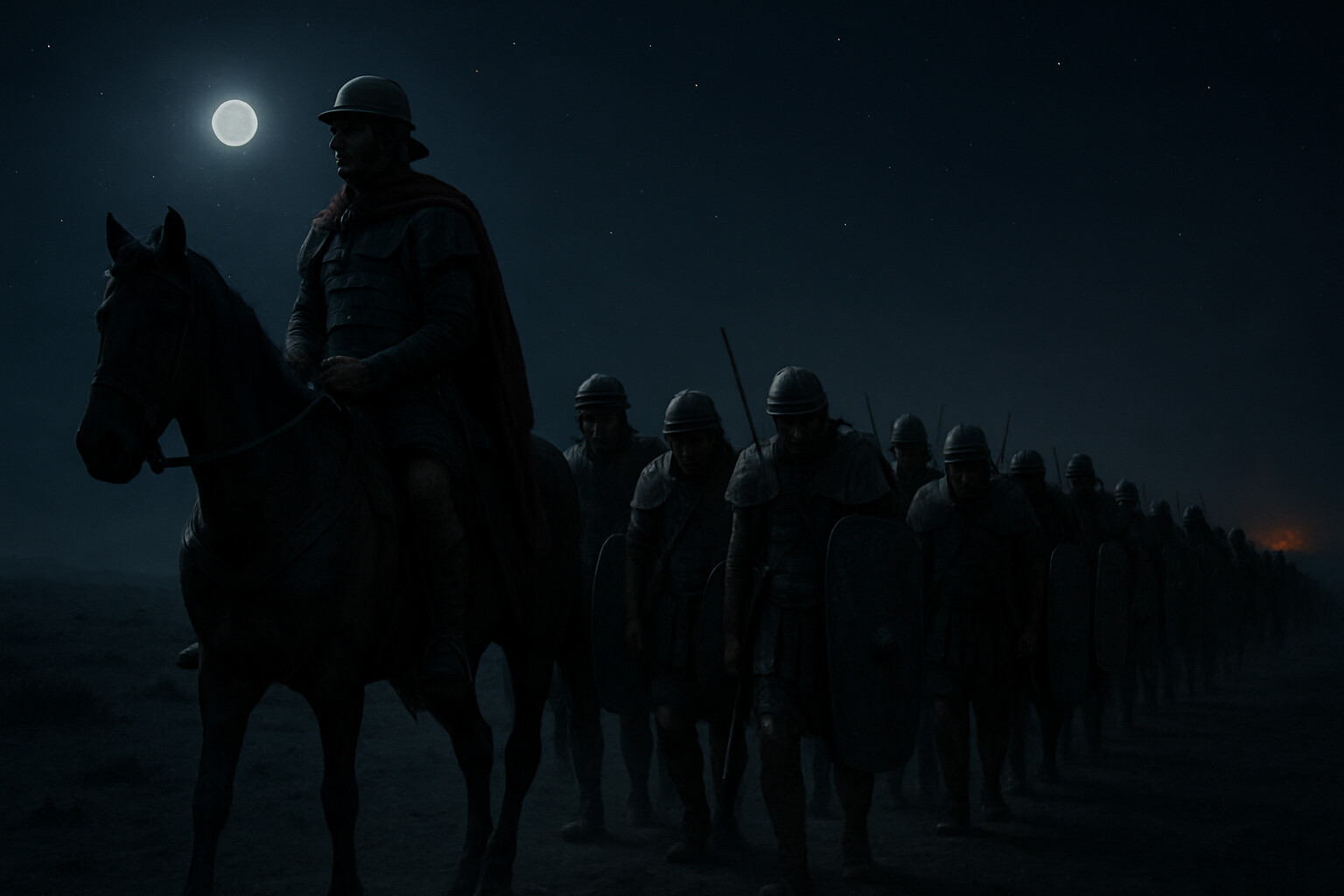
The remnants of the Roman army attempted to withdraw toward Carrhae under the surviving senior officers, including Cassius Longinus, who led a portion of the force in a night march and eventually reached Syria. Some units were captured. Plutarch places Roman losses at approximately 20,000 killed and 10,000 captured, with the remainder escaping in scattered groups. These figures cannot be verified against any independent source and should be understood as ancient estimates; the scale of the disaster is not in serious doubt, but the precision of the numbers is not recoverable.
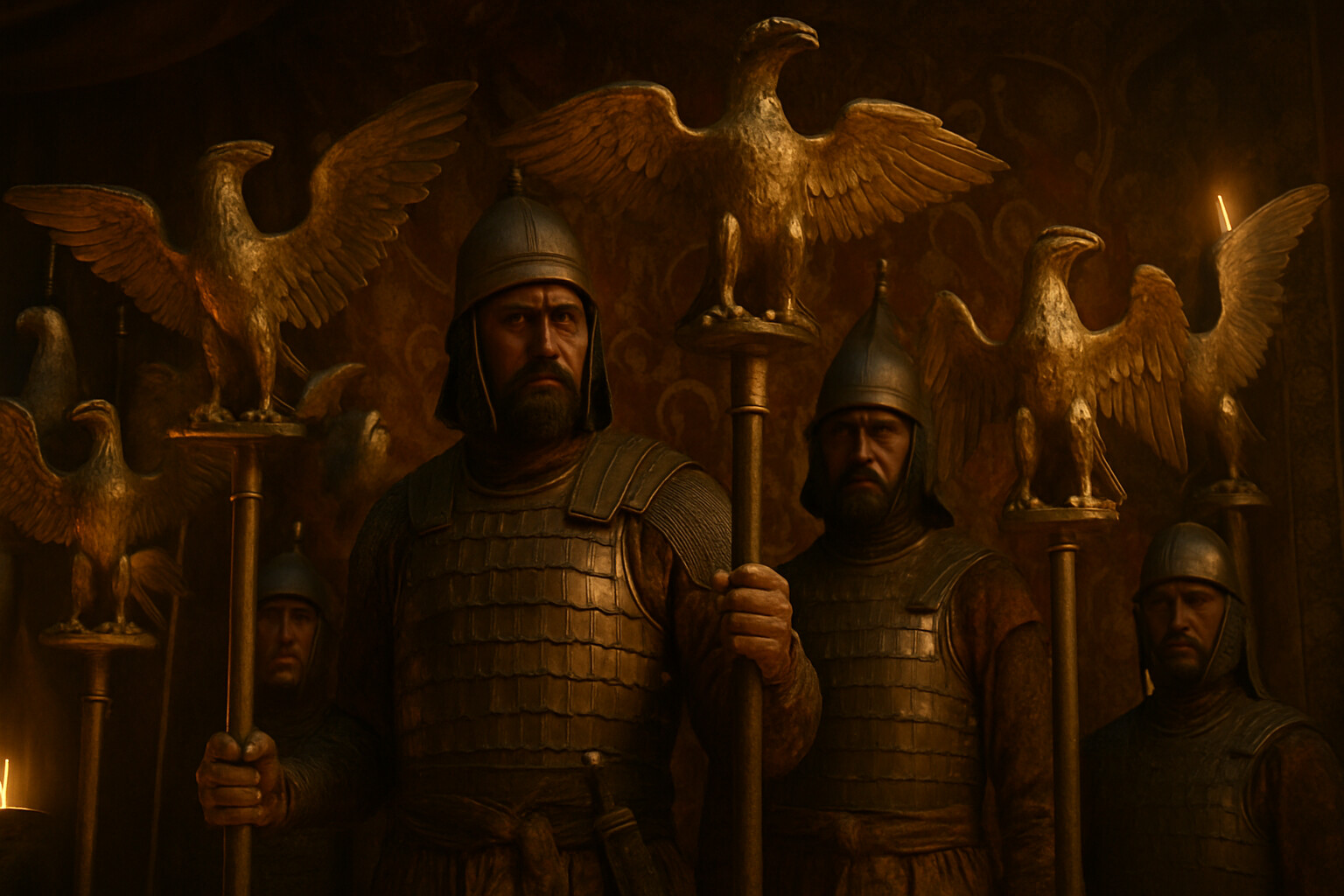
The legionary eagles—the sacred standards of the legions, each the embodiment of a unit's collective identity and honor in Roman military culture—were captured by the Parthians. Their loss represented something beyond a military defeat.
---
**The Cost in Full**
The Battle of Carrhae was not simply a Roman defeat. By the measure of the ancient world, it was a catastrophe.
Seven legions had crossed the Euphrates. By the most widely cited ancient accounts, roughly half were killed and a substantial portion captured—thousands of Roman legionaries who spent the remainder of their lives in Parthian captivity, reportedly settled in the eastern reaches of the empire near Merv, in what is now Turkmenistan. Their ultimate fate is unknown. Later accounts connecting Roman prisoners from Carrhae with Chinese Han dynasty records are considered by modern historians to be interesting speculation rather than documented history, and they are noted here only as a tradition that the sources do not support.
The three or more legionary eagles lost at Carrhae became a political wound that persisted for a generation. They were among the standards recovered in 20 BC through diplomatic negotiation under Augustus—an event celebrated with monuments and coinage. The fact that the eagles were returned by diplomacy rather than military force was reframed in Augustan propaganda as a form of Roman victory; the underlying message was that even the Republic's worst military shame could eventually be addressed, however it took.
For the Triumvirate, Carrhae had immediate political consequences. The death of Crassus removed one of the three poles of the power-sharing arrangement. The balance between Caesar and Pompey, already under strain, lost the mediating weight that Crassus had provided—his wealth, his political network, his ability to stand between two men whose ambitions were increasingly incompatible. The civil war that erupted in 49 BC was not caused by Carrhae, but Roman historians of the imperial period drew the connection between Crassus's death and the collapse of the Triumvirate explicitly, and the structural point is sound.
Surena himself did not long survive his victory. According to Plutarch—and this account cannot be independently confirmed—Orodes II had Surena executed shortly after the battle, apparently unwilling to tolerate a subordinate whose fame now rivaled his own. If true, it is a reminder that military success in ancient politics was not always protection against the power of the king one served.
---
**The Record and Its Limits**
The primary ancient source for Carrhae is Plutarch's Life of Crassus, written in the late first or early second century AD—roughly 150 years after the battle. Plutarch drew on earlier sources, some now lost, and his account is detailed and generally coherent, but it reflects the perspective of a Greek-Roman writer working from the Roman tradition and almost certainly without access to Parthian sources. The Parthian side of the battle—Surena's planning, the command discussions within his force, the experience of the horse archers themselves—is effectively invisible in the surviving record.
Cassius Dio, writing even later in the third century AD, provides a parallel account with some variations. Both writers were working far from contemporary witnesses and relied on written intermediaries. The specific troop numbers, casualty figures, precise tactical sequence, and exact circumstances of Crassus's death should all be understood as approximations and reconstructions rather than documented precision.
Modern historians—including Adrian Goldsworthy, whose Caesar provides useful comparative context on Roman command practice, and Gareth Sampson, whose dedicated study of the Carrhae campaign examines the ancient sources and their reconstruction—have analyzed the battle in light of what is now understood about Parthian military organization and the physical capabilities of composite bows and heavy cavalry. The tactical logic of what Surena did is clear and does not require the ancient accounts to be precise in their numbers to be convincing: a force of mobile archers with adequate ammunition resupply, operating in open terrain against a heavy infantry force without reliable cavalry support, held every structural advantage the day offered.
The debate among scholars concerns questions such as whether Ariamnes was genuinely a Parthian agent, whether Crassus had better options than he used, and how far the Roman cavalry shortfall was decisive relative to other factors. The sources do not provide definitive answers to these questions.
---
**Why Carrhae Still Matters**
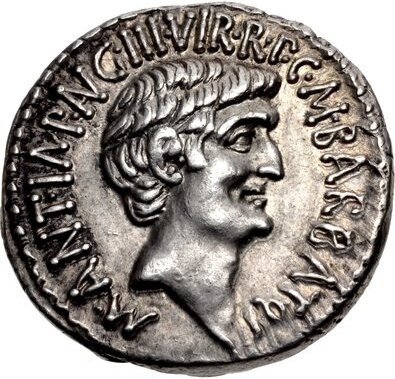
Carrhae was not the end of Roman ambition in the east. Rome and Parthia fought repeated wars over the following centuries, the advantage shifting back and forth. Mark Antony led a major Parthian campaign in 36 BC that also ended badly, though less catastrophically. Trajan conquered Parthian territory in 116 AD. The confrontation between Rome and the Parthian and later Sasanian Persian empires shaped the geopolitics of the Near East for centuries.
But Carrhae holds a specific place in the history of warfare for what it demonstrated about the limits of heavy infantry doctrine. The Roman legionary system was among the most effective military organizations of the ancient world in the terrain and conditions for which it was designed: broken ground, siege operations, disciplined close-quarters fighting, logistics over roads. Against a mobile archer force in open desert, it had no answer. Crassus did not fail only because of vanity, or bad advice, or because he was approximately sixty years old and had never commanded an army in open battle—though ancient sources suggest all of those things contributed. He failed because the tactical and strategic framework he brought to the campaign had no provision for what Surena's force could do.
The Roman military spent the following generations developing partial answers: greater integration of cavalry, use of auxiliary archer units recruited from Syria and other eastern provinces, reformed deployment doctrine for eastern campaigns. These changes did not come from Carrhae alone, but the battle's demonstration—that heavy infantry without adequate cavalry and missile support was catastrophically vulnerable to mobile cavalry in open terrain—was one Rome took decades to absorb into its institutional practice.
The legionary eagles returned to Rome in 20 BC, carried by a Parthian embassy and received with ceremonies designed to transform a diplomatic return into a martial occasion. Augustus placed them in the Temple of Mars Ultor—Mars the Avenger—which he built partly to fulfill a vow and partly to situate the recovery of the standards within a narrative of Roman power restored. The temple still partially stands in Rome. It is, in a sense, a monument to what happened at Carrhae as much as to what Rome eventually negotiated back.
The men who marched east with Crassus in 53 BC carried a plan that had worked for Roman generals before. It had worked for Pompey and for Lucullus. It did not work on the Harran plain, on the day the dust rose and the war drums sounded, and Surena's horsemen came out of the haze in their scale armor with their bows already drawn.