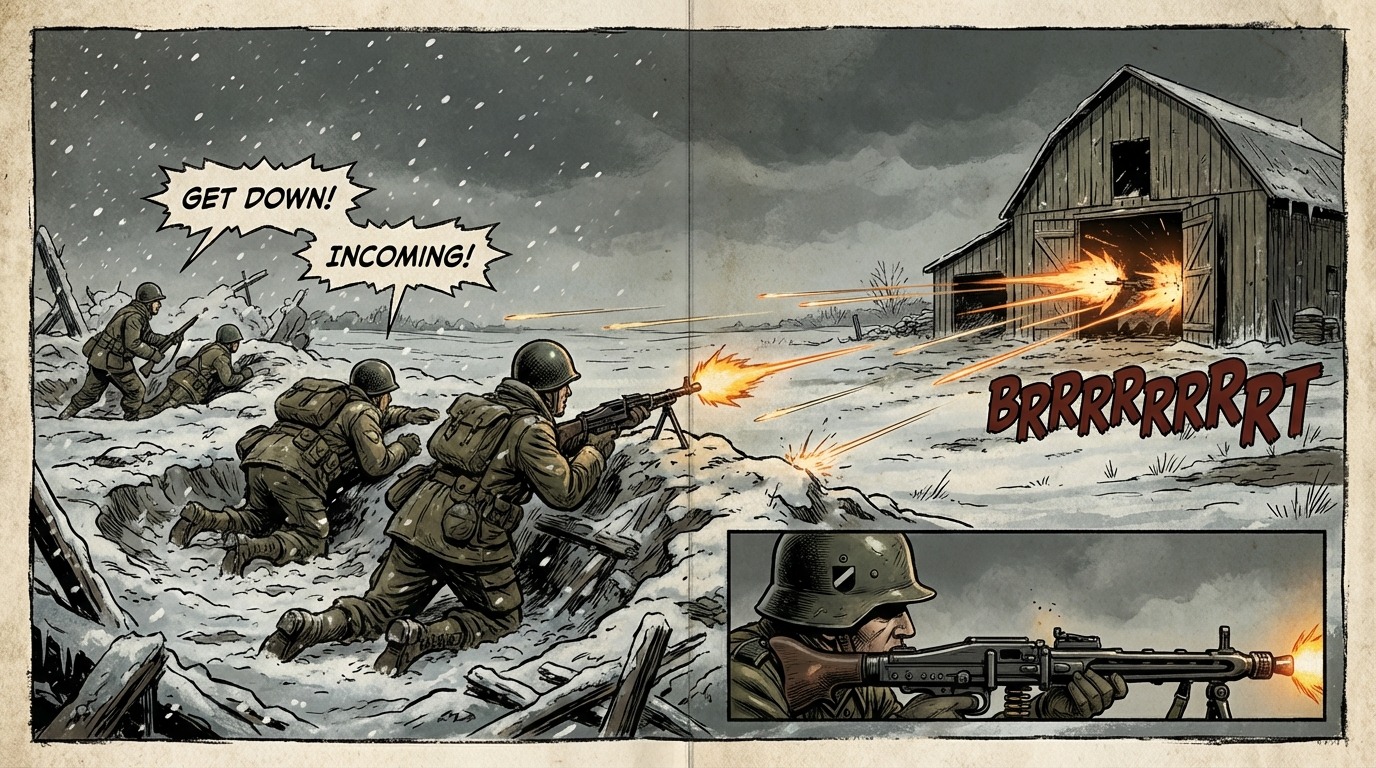
The German MG42 machine gun swept the rocky slope in methodical bursts, each traverse cutting down another Nisei soldier from the 442nd Regimental Combat Team. Second Lieutenant Daniel Inouye pressed himself against the cold Italian stone, feeling the vibration of bullets chipping granite inches from his face. Above him, three concrete pillboxes commanded the ridge line near San Terenzo. Behind him, his men waited for the order that would send them into that killing field.
It was April 21, 1945. The war in Europe had less than three weeks to run, but the German defenders in the Apennine Mountains fought with the desperation of men who knew retreat meant capture or death. For the soldiers of the 442nd Regimental Combat Team, this ridge was another in an endless series of bloody hills that had cost them friends from France to Italy.
Daniel Ken Inouye had been born in Honolulu in 1924, the son of Japanese immigrants who had built a life in Hawaii before Pearl Harbor changed everything. When the attack came, Inouye was a senior at McKinley High School, planning to become a surgeon. Instead, he found himself classified as an "enemy alien" despite his American citizenship. The U.S. Army initially rejected Japanese Americans for service, but by 1943, the military's desperate need for infantry led to the formation of the 442nd Regimental Combat Team—a segregated unit of Japanese American volunteers.
The 442nd had earned its reputation in blood. In the forests of the Vosges Mountains in France, they had rescued the "Lost Battalion"—211 men of the 36th Infantry Division surrounded by German forces. The cost was devastating: 814 casualties to save 211 men. The unit's motto, "Go For Broke," reflected both their gambling heritage and their willingness to risk everything for America, the country that had imprisoned their families while they fought.
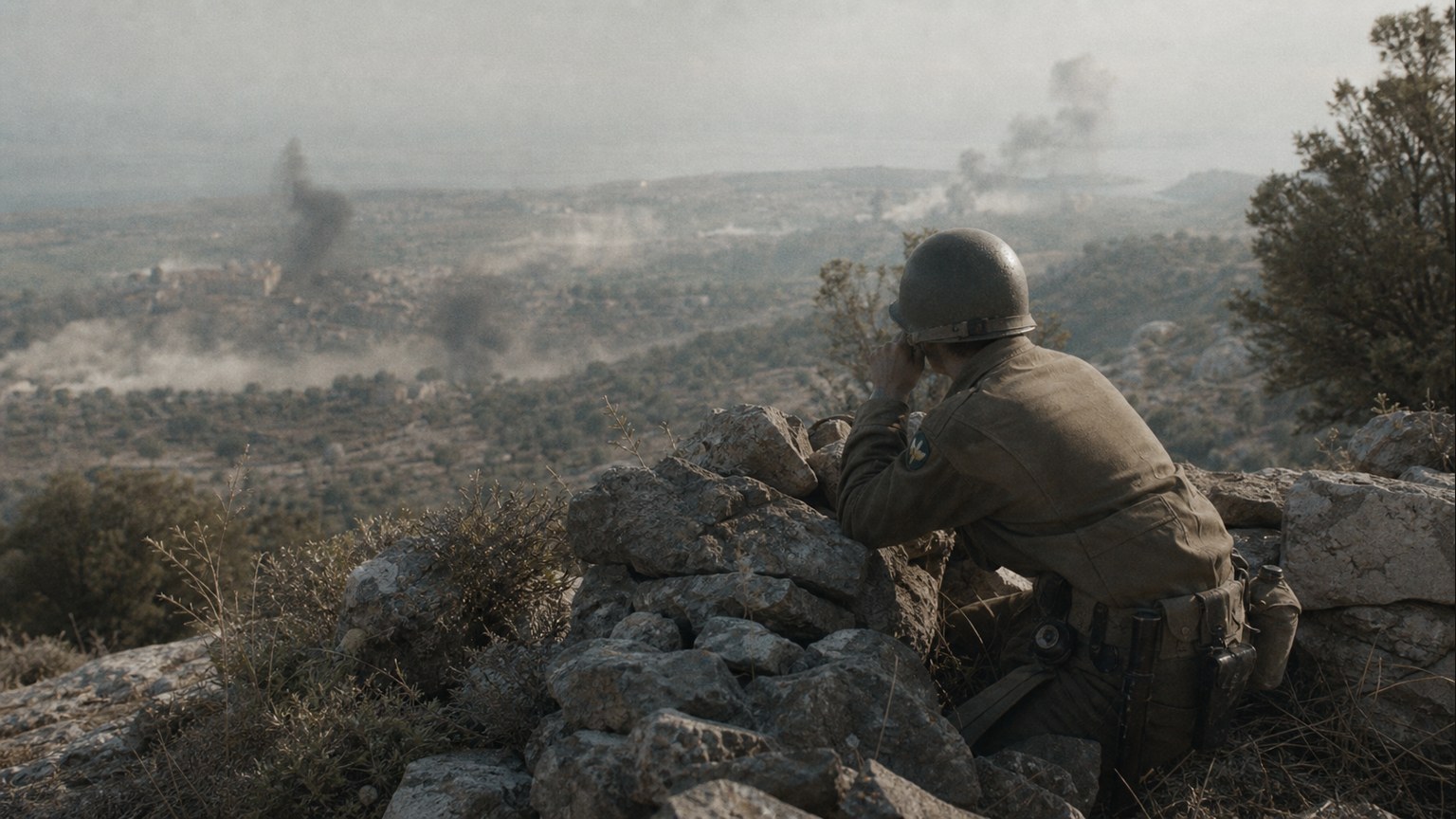
By April 1945, the 442nd had been transferred to Italy for the final push against the Gothic Line, Germany's last major defensive position south of the Po Valley. The mountainous terrain favored the defenders, who had spent months fortifying every ridge and valley with interlocking fields of fire. Near the coastal town of San Terenzo, German forces had constructed a series of concrete pillboxes and gun emplacements that controlled the approaches to the vital port facilities.

Inouye's platoon had been advancing up the rocky slope since dawn, moving from boulder to boulder under sporadic sniper fire. The lieutenant carried an M1 carbine, lighter than the standard Garand rifle but effective for the close-quarters fighting expected in the mountains. His men were armed with a mix of M1 Garands, Thompson submachine guns, and Browning Automatic Rifles, supplemented by fragmentation grenades and rifle grenades for bunker assault work.
The German positions ahead were well-sited and heavily armed. Intelligence reports indicated at least three MG42 machine-gun nests, supported by rifle squads and possibly a mortar team. The MG42, known to German crews as "Hitlersäge" (Hitler's buzzsaw) for its distinctive sound, could fire 1,200 rounds per minute with deadly accuracy. At ranges under 300 meters, it could cut through a man's torso or shatter concrete.
Inouye studied the approaches to the first pillbox through his field glasses. The Germans had cleared the slope of cover for fifty meters in all directions, creating an ideal killing field. Any assault would require crossing open ground under direct observation and fire. The standard infantry solution was overwhelming firepower and speed—suppress the enemy guns with covering fire while assault troops closed the distance before the defenders could react.
The lieutenant called his squad leaders forward for a brief conference. The plan was straightforward: covering fire from the BAR teams and riflemen while Inouye led the assault element in a frontal attack on the nearest pillbox. Once that position was neutralized, they could use it as cover to attack the remaining bunkers from the flank.
At 1400 hours, the attack began. The BAR gunners opened fire, their .30-06 rounds sparking off concrete and forcing the German gunners to keep their heads down. Inouye rose from cover and began his advance, moving in short rushes from boulder to boulder. Behind him, three soldiers followed at intervals, ready to exploit any breakthrough.

The first fifty meters went smoothly. The German defenders seemed surprised by the direct frontal assault, and their return fire was sporadic and poorly aimed. Inouye reached a position twenty meters from the first pillbox and prepared to throw a grenade through the firing port.
Then the MG42 opened fire.
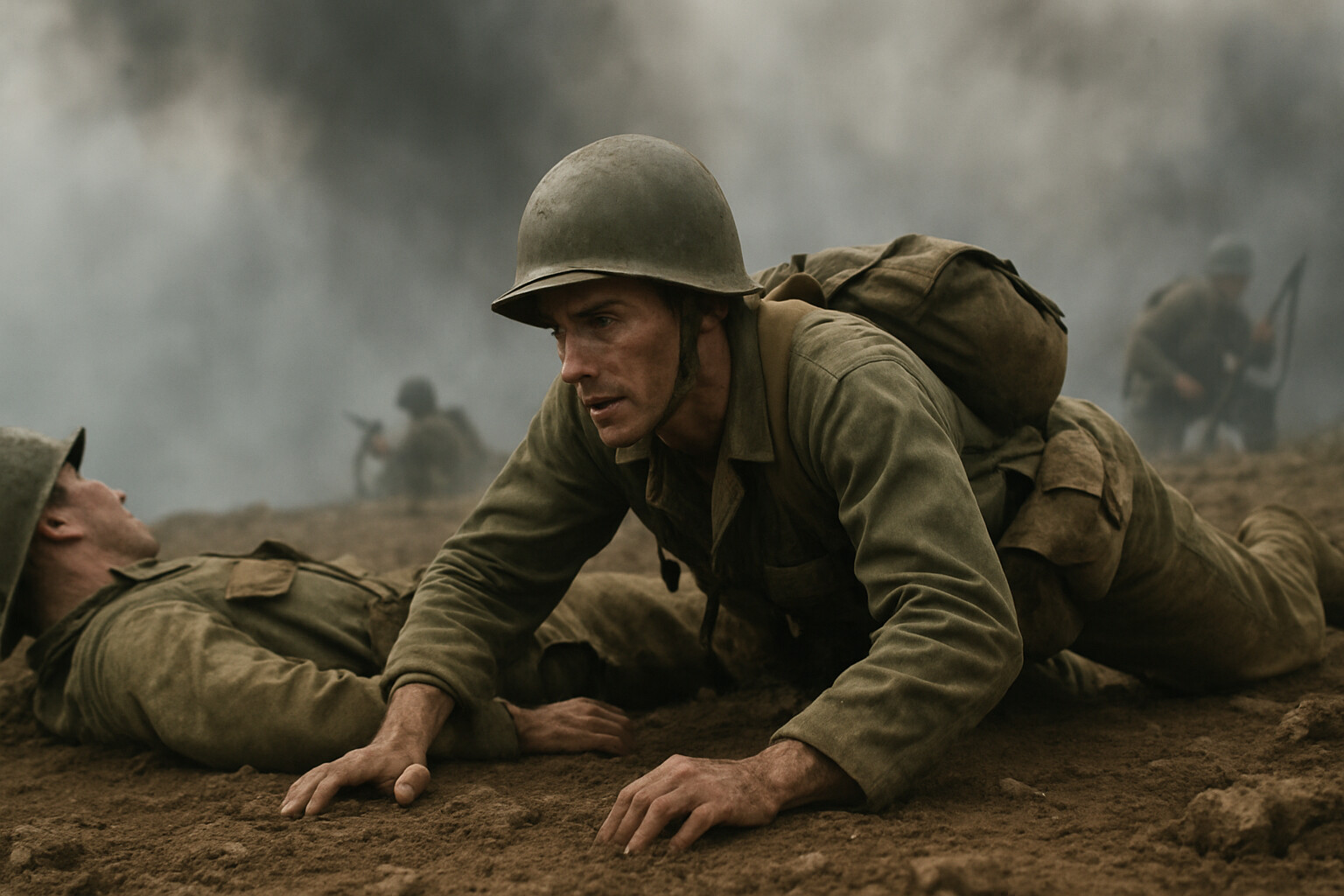
The burst caught Inouye across the stomach, the impact spinning him sideways and dropping him behind a low stone wall. Blood soaked through his field jacket as he assessed the damage. The bullets had torn through his abdomen, but he was still conscious and mobile. More importantly, his right arm was intact and he could still hold his carbine.
Behind him, his men waited for orders. The German machine gun continued its methodical sweeps, preventing any movement in the open ground. Inouye realized that without immediate action, the attack would stall and his platoon would be pinned down in an exposed position until German mortars or reinforcements arrived.
Ignoring the spreading warmth of blood loss, Inouye struggled to his knees and pulled two fragmentation grenades from his belt. The Mark II fragmentation grenade weighed 21 ounces and contained 2.5 ounces of TNT surrounded by a segmented cast-iron body designed to produce lethal fragments within a 15-meter radius. The five-second delay fuse required precise timing to prevent the enemy from throwing the grenade back.

The lieutenant pulled the pin on the first grenade and counted: one thousand, two thousand. He rose from behind the wall and hurled the grenade toward the machine-gun nest. The explosion silenced the MG42 temporarily, filling the pillbox with smoke and debris.
Inouye immediately followed up, advancing on the stunned defenders with his carbine ready. As he reached the pillbox entrance, German rifle fire from the second position raked his left side, sending him sprawling. The wounds were serious but not immediately life-threatening. More critically, German soldiers were already moving to reoccupy the first pillbox.
With his left arm now useless, Inouye shifted his carbine to single-handed operation and continued his assault. The M1 carbine, weighing only 5.8 pounds loaded, was manageable with one arm, though accuracy suffered significantly. He fired rapidly into the pillbox entrance, forcing the German troops to take cover while he prepared his final grenade.
As Inouye pulled the pin on his last fragmentation grenade, a German rifleman appeared in the second pillbox and took careful aim with his Karabiner 98k. The 7.92mm Mauser bullet, traveling at 2,500 feet per second, struck Inouye's right elbow with devastating effect.
The impact shattered bone and severed tendons, leaving his right arm hanging by threads of muscle and skin. The grenade remained clutched in his now-useless right hand, its pin already pulled and safety lever released. In approximately four seconds, the explosive would detonate.

Most men would have panicked or collapsed. Inouye made a different choice.
With his left hand, he pried the live grenade from his severed right hand, transferring it despite the excruciating pain and loss of blood. As German soldiers began emerging from the second pillbox to finish him, Inouye threw the grenade with his left hand. The explosion killed two German soldiers and wounded several others, effectively neutralizing the second position.
Still conscious despite massive blood loss, Inouye drew his .45 caliber pistol with his left hand and continued advancing on the third pillbox. His men, inspired by their lieutenant's incredible determination, rallied for a final assault. The remaining German defenders, shaken by the ferocity of the attack and the destruction of two positions, began withdrawing from the ridge.
Inouye collapsed fifty meters from the third pillbox, finally succumbing to blood loss and shock. His men secured the position and called for medical evacuation. According to witness accounts, the lieutenant had been conscious for nearly twenty minutes after losing his right arm, continuing to direct the attack and engage enemy forces throughout.
Field medics reached Inouye within minutes of his collapse. Captain Joseph Palumbo, the 442nd's medical officer, later reported that the lieutenant had lost approximately 40 percent of his blood volume and was in severe shock. Emergency field surgery stabilized his condition, but the right arm could not be saved. Amputation was performed at a field hospital behind the lines.

The capture of the San Terenzo ridgeline opened the coastal route for Allied forces advancing toward the Po Valley. German resistance in the sector collapsed within days, contributing to the broader breakdown of enemy defenses that led to the surrender of German forces in Italy on May 2, 1945.
For the 442nd Regimental Combat Team, the action was typical of their entire combat record. The unit had suffered 9,486 casualties during the war—a casualty rate of 314 percent, meaning the entire unit had been replaced more than three times. They earned 18,143 individual decorations, including one Medal of Honor, 52 Distinguished Service Crosses, and 560 Silver Stars.
Inouye's actions near San Terenzo were initially recognized with the Distinguished Service Cross, the Army's second-highest decoration for valor. However, in the 1990s, a comprehensive review of Asian American valor awards during World War II concluded that racial prejudice had prevented proper recognition of many heroic actions. In 2000, fifty-five years after the battle, President Bill Clinton upgraded Inouye's award to the Medal of Honor.
The official citation reads: "Second Lieutenant Daniel K. Inouye distinguished himself by extraordinary heroism in action on 21 April 1945, in the vicinity of San Terenzo, Italy. While attacking a defended ridge guarded by three machine gun nests, Second Lieutenant Inouye skillfully directed his platoon through a hail of automatic weapons and small arms fire, in a swift enveloping movement that resulted in the capture of an artillery and mortar post and brought his men to within 40 yards of the hostile force. Emplaced in bunkers and rock formations, the enemy halted the advance with crossfire from three machine gun nests. With complete disregard for his personal safety, Second Lieutenant Inouye crawled up the treacherous slope to within five yards of the nearest machine gun and hurled two hand grenades, destroying the emplacement and killing the two gunners. Although wounded by a sniper's bullet, he continued to engage other hostile positions at close range until an exploding grenade shattered his right arm. Despite the intense pain, he refused evacuation and continued to direct his platoon until enemy resistance was broken and his men were again deployed in defensive positions."
After the war, Inouye used the GI Bill to attend law school, eventually becoming Hawaii's first Congressman and later a U.S. Senator, serving for nearly five decades. He never regained use of his right arm but adapted to write, gesture, and conduct business with his left hand. During his political career, he rarely spoke publicly about his combat service, preferring to focus on civil rights and veterans' affairs.

The 442nd's combat record helped change American attitudes toward Japanese Americans and contributed to the eventual passage of the Civil Rights Act of 1988, which provided reparations to Japanese Americans interned during World War II. The unit's motto, "Go For Broke," became synonymous with courage under impossible circumstances.
The battlefield near San Terenzo remains largely unchanged today. Italian veterans' organizations maintain a small memorial to Allied forces who fought in the area, including a plaque honoring the 442nd Regimental Combat Team. The concrete pillboxes have been partially demolished, but their foundations remain visible among the rocks and scrub vegetation of the Mediterranean hillside.
Modern military medical analysis suggests that Inouye's survival was remarkable given the extent of his injuries and the primitive field medicine of 1945. The combination of massive blood loss, traumatic amputation, and multiple gunshot wounds should have been fatal within minutes. His continued consciousness and combat effectiveness represented an extreme example of human endurance under mortal stress.
The weapons and tactics employed in the San Terenzo action reflected standard Allied infantry doctrine for bunker assault: suppress enemy fire with automatic weapons, close rapidly with grenades and small arms, and exploit breakthroughs with immediate follow-up attacks. Inouye's success came from his willingness to execute this doctrine despite catastrophic personal injury.
The battle also demonstrated the effectiveness of Japanese American soldiers in close combat. Despite facing discrimination and skepticism from some military leaders, the 442nd consistently outperformed expectations in the most difficult tactical situations. Their success helped integrate the U.S. military and influenced postwar civil rights legislation.
For military historians, the action near San Terenzo represents a perfect case study in small-unit leadership under extreme conditions. Inouye's decisions—continuing the attack despite wounds, transferring the live grenade from his severed hand, and maintaining command presence until the objective was secured—illustrate the difference between competent and exceptional combat leadership.
The legacy of April 21, 1945, extends beyond military history into the broader American story of immigration, integration, and earned citizenship. Daniel Inouye's courage on an Italian hillside helped prove that American identity is defined by shared values and sacrifice rather than ethnic origin. His Medal of Honor, delayed by fifty-five years, represents both individual heroism and the nation's long journey toward racial justice.
Today, as America continues to wrestle with questions of inclusion and belonging, the story of the 442nd Regimental Combat Team offers both inspiration and instruction. Their motto—"Go For Broke"—reminds us that sometimes the highest patriotism requires risking everything for principles larger than ourselves.