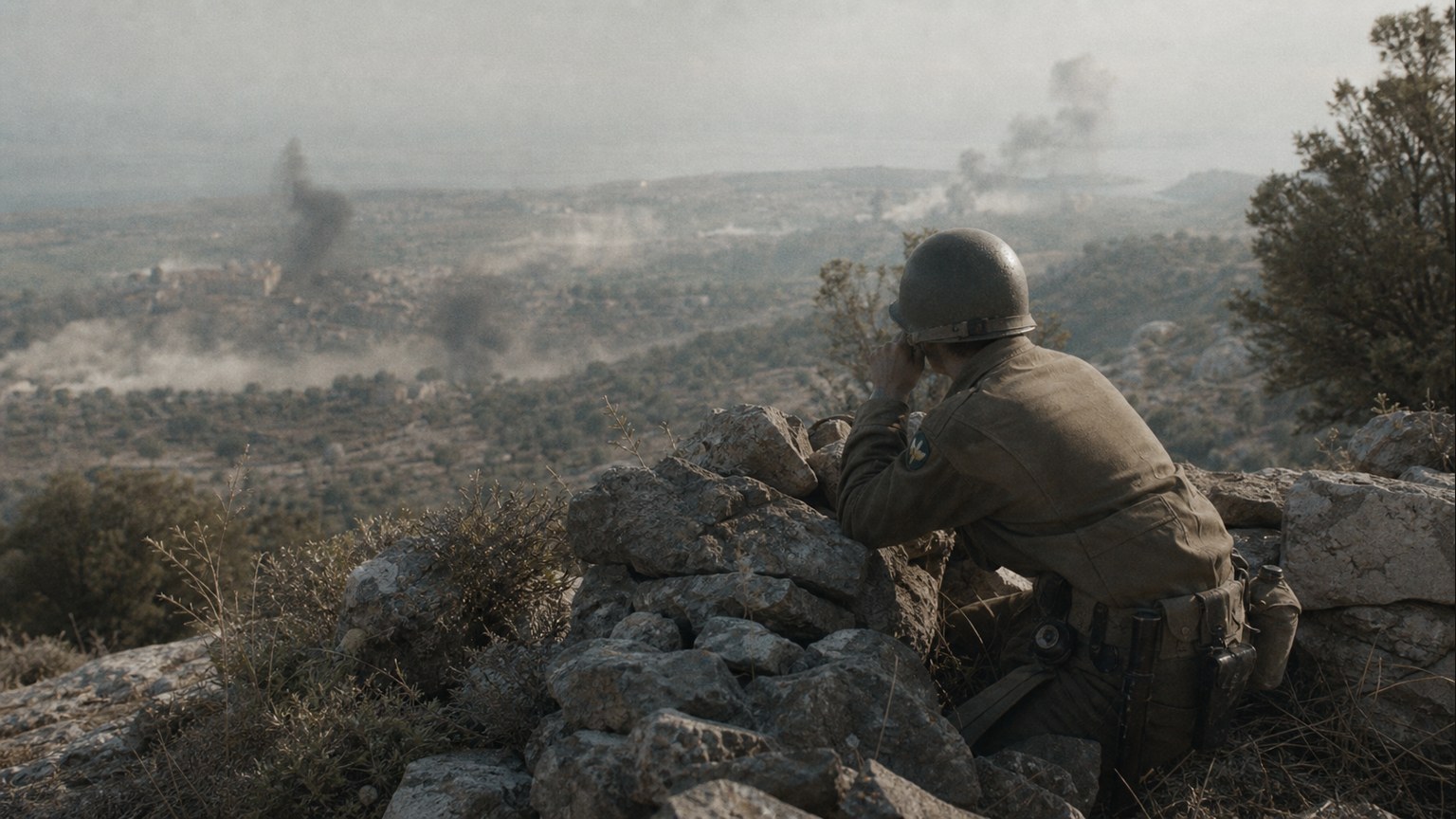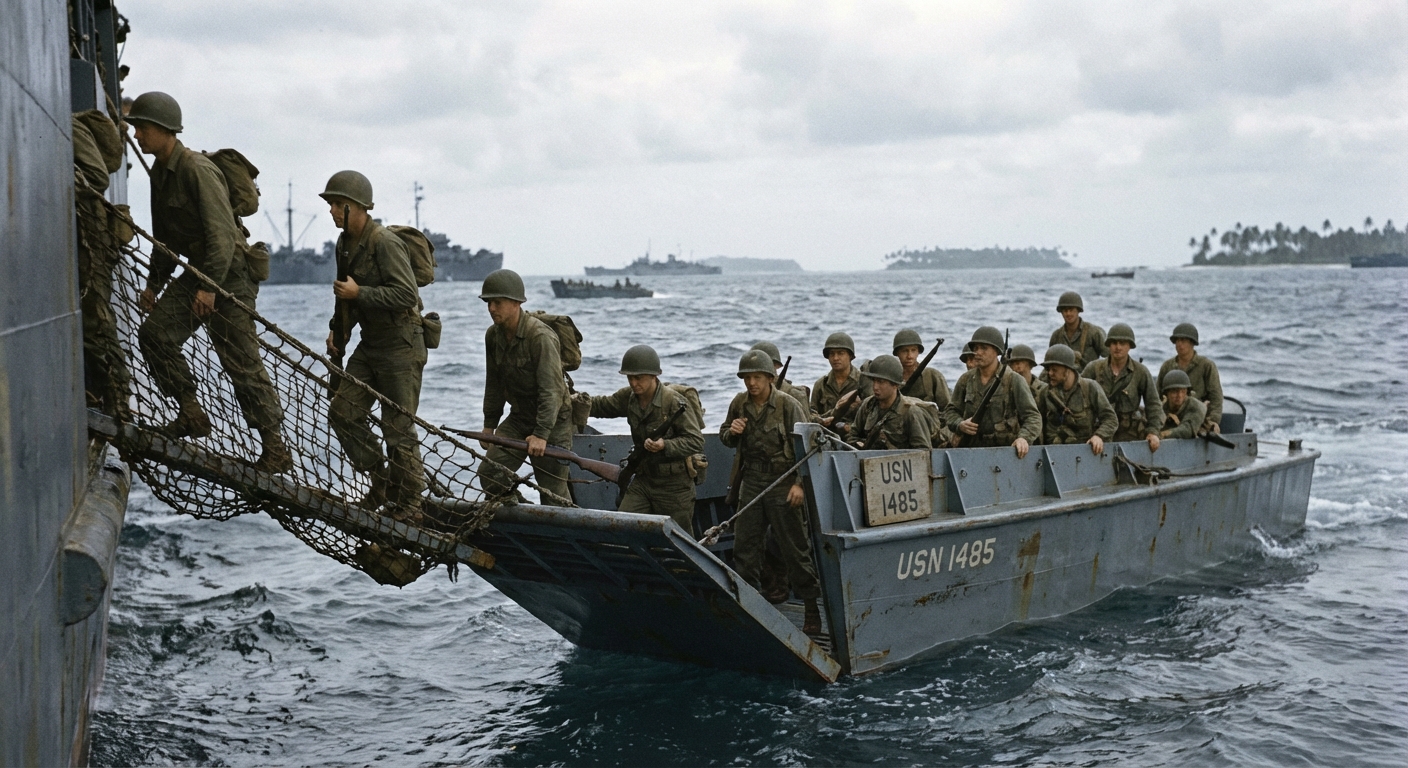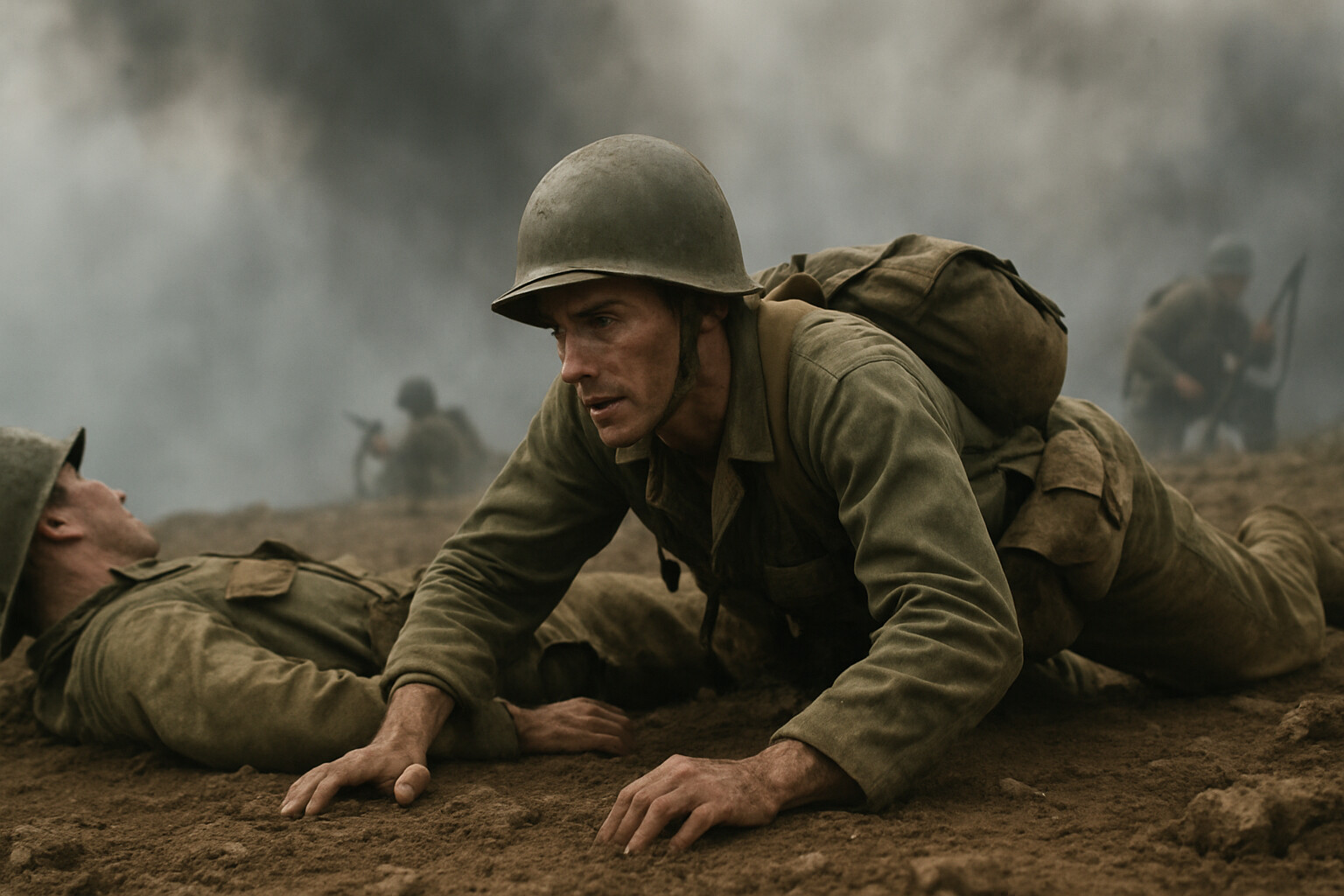
The machine gun opened up from the cave mouth at first light. Bullets snapped through the dawn air above the Maeda Escarpment, chipping fragments from coral limestone. Corporal Desmond Doss pressed against a shell crater, clutching his medic bag, listening to a wounded man crying twenty yards away in the open.
The cry came again, weaker. Doss looked at an M1 Garand rifle beside him—dropped by a dead GI—then pushed it away and crawled forward into the kill zone. It was May 5, 1945, and the 400-foot coral cliff that dominated Okinawa's landscape had become an impossible fortress to crack. For Doss, a 26-year-old conscientious objector from Virginia who refused to carry weapons, it would test his faith by fire.
The Maeda Escarpment rose like a coral wall from the Okinawan countryside, its limestone face scarred by countless explosions and honeycombed with Japanese defensive positions. The 77th Infantry Division had been grinding across this brutal terrain for three weeks, facing an enemy determined to make every yard cost American blood. What would happen on this plateau over the next twelve hours would challenge everything the Army thought it knew about courage and service.
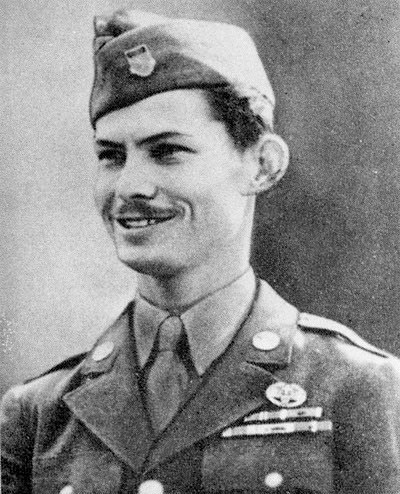
Desmond Thomas Doss grew up in Lynchburg, Virginia, the son of William Doss, a carpenter, and Bertha Doss, a devout Seventh-day Adventist. His religious convictions ran deep—he observed the Sabbath, avoided alcohol and tobacco, and held firm to "Thou shalt not kill." The family owned a framed copy of the Ten Commandments, and young Desmond studied the sixth commandment with particular intensity. He couldn't imagine taking another human life, even in war.
When Pearl Harbor thrust America into global conflict, Doss faced a moral crisis that thousands of other conscientious objectors resolved by seeking complete exemption from military service. Instead, he made a decision that baffled his family and would later enrage fellow soldiers: he enlisted, determined to serve his country as a medic. He would save lives, not take them, but he would serve.
The decision seemed simple to Doss but proved catastrophically complicated in practice. Basic training at Fort Jackson, South Carolina, became a months-long gauntlet of harassment and intimidation. Soldiers threw boots at him while he prayed beside his bunk. They cursed him for refusing Saturday duty to observe the Sabbath. They questioned his courage, his masculinity, and his loyalty. Some made direct threats about what might happen to him in combat—accidents, they suggested, were common in war zones.
Doss endured it all with quiet determination, convinced God had called him to serve. His company commander, Captain Jack Glover, tried repeatedly to have him discharged, arguing that a soldier who refused to carry weapons posed a danger to his unit. But Doss's legal right to serve as a non-combatant was clear under Army regulations, and his performance in medical training was exemplary. By early 1944, despite the ongoing hostility, he shipped out with the 307th Infantry Regiment, 77th Infantry Division, bound for the Pacific Theater.
The 77th Infantry Division—nicknamed the "Liberty Division" after the Statue of Liberty insignia—had already proven itself in the brutal mathematics of Pacific warfare. At Guam in summer 1944, the division faced its first test against fanatical Japanese resistance. The enemy had learned that conventional tactics were suicidal against American firepower; instead, they fought from prepared positions, caves, and underground tunnels that turned every advance into a deadly puzzle.
At Leyte in the Philippines, the division refined its understanding of cave warfare. Japanese defenders would allow American forces to pass, then emerge from concealed positions to attack from behind. Heavy mortars and artillery, positioned in caves that could be sealed against bombardment, would emerge to deliver devastating fire before withdrawing into protected positions. Each fortified ridge required explosives, flamethrowers, and close assault techniques that guaranteed heavy casualties.
By the time the division approached Okinawa in April 1945, both officers and enlisted men understood they were facing the culmination of Japanese defensive evolution. The island's 100,000 defenders, commanded by Lieutenant General Mitsuru Ushijima, had spent months preparing the most sophisticated defensive system the Pacific War had yet seen. They would not contest the beaches—instead, they would draw Americans inland and bleed them among ridges, escarpments, and cave systems that dominated the southern approaches to the island.
Operation Iceberg, the assault on Okinawa, represented the largest Pacific amphibious operation of the war. Over 500,000 Allied personnel participated in an attack designed to secure a staging base for the planned invasion of Japan itself. The stakes could not have been higher, and everyone from generals to privates understood that Japanese resistance would be unprecedented in its intensity and sophistication.
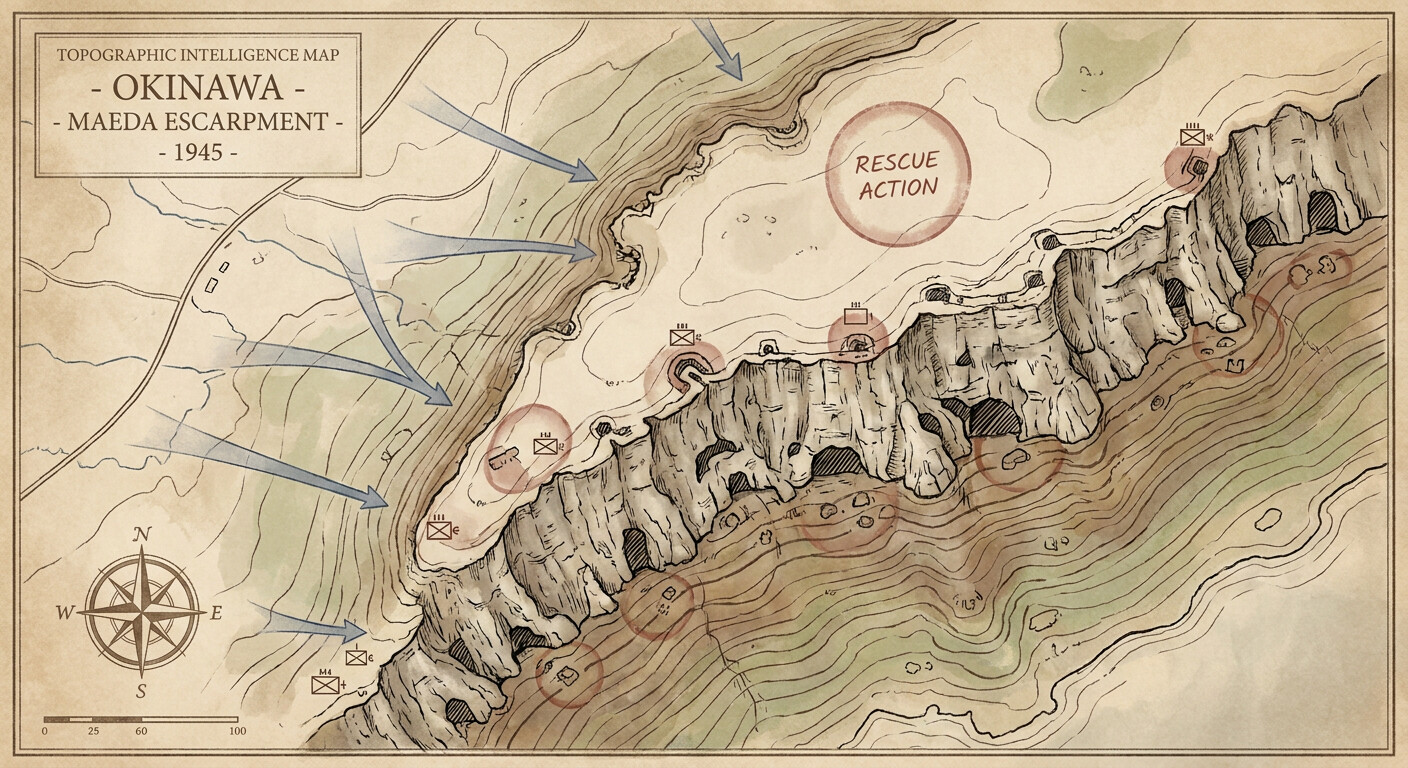
The Maeda Escarpment stood as the keystone of Japanese defenses. Known to the defenders as the Urasoe-Mura Escarpment, this coral limestone ridge rose 400 feet above surrounding terrain, offering commanding views and fields of fire across the American approaches. The Japanese had spent months turning the natural fortress into something approaching perfection. Engineers had carved interconnected tunnels through the coral, creating ammunition storage areas, command posts, medical stations, and fighting positions that could house hundreds of defenders.
The cliff face itself bristled with concealed weapons positions. Machine gun nests, positioned to create interlocking fields of fire, could sweep the plateau on top while remaining nearly invisible to American observers below. Heavy mortars and artillery pieces sat in caves that could be sealed with steel doors, emerging to deliver precise fire before withdrawing into blast-proof chambers. The entire position had been surveyed and mapped, with every potential American approach covered by pre-registered fire plans.
Doss's 1st Battalion, 307th Infantry Regiment, approached this fortress from the northwest on April 29, 1945. The initial assault up cargo nets scaling the cliff face seemed almost too easy—Company B gained the plateau without devastating casualties and began setting up defensive positions. For a brief moment, it appeared the Japanese had abandoned this crucial terrain feature.
The illusion lasted exactly as long as the Japanese intended. As soon as significant American forces occupied the high ground, the killing began. Pre-registered artillery and mortar fire crashed into the exposed positions with devastating accuracy. Machine gun positions that had remained perfectly concealed opened up from multiple directions, creating crossfire that turned the open plateau into a death trap. American soldiers found themselves pinned in the open, taking casualties from an enemy they could barely locate, let alone effectively engage.
The tactical situation highlighted fundamental challenges of Pacific warfare that would persist through the battle for Okinawa. American forces possessed overwhelming advantages in firepower, logistics, and air support, but these advantages often proved irrelevant against prepared positions carved from solid rock. The M1 Garand rifles carried by American infantry could deliver accurate semi-automatic fire to 500 yards, but they were designed for open-field combat where targets could be identified and engaged. Against cave positions, American weapons often fired at muzzle flashes and shadows.
The Japanese Type 99 Light Machine Gun, firing 7.7mm ammunition at 850 rounds per minute, could sweep the exposed plateau from concealed positions that were nearly impossible to locate and eliminate. These weapons had been specifically positioned to create overlapping fields of fire that left no dead space where American forces could find protection. The machine gun crews had practiced their fire plans for weeks, memorizing precise firing points and withdrawal routes that allowed them to engage effectively while minimizing exposure to return fire.
Japanese artillery observers, positioned in concealed observation posts throughout the escarpment, could call down fire from Type 96 150mm howitzers and smaller mortars with pinpoint accuracy. These positions had been carefully surveyed, with range cards prepared for every potential target area. American counter-battery fire and close air support attempted to suppress these positions, but the Japanese had learned to fire brief, devastating missions before withdrawing into deep caves that could withstand direct hits from large-caliber shells.
By May 5, the tactical situation had become desperate for American forces on the escarpment. Multiple assaults had succeeded in gaining the plateau temporarily, but each time, the pattern repeated: initial success followed by devastating fire that made the position untenable. Each time American forces withdrew, they left wounded behind who could not be evacuated under the intense fire. The steep cliff face made conventional stretcher evacuation impossible, and attempts to send additional medics or stretcher bearers up the cargo nets had resulted only in more casualties.
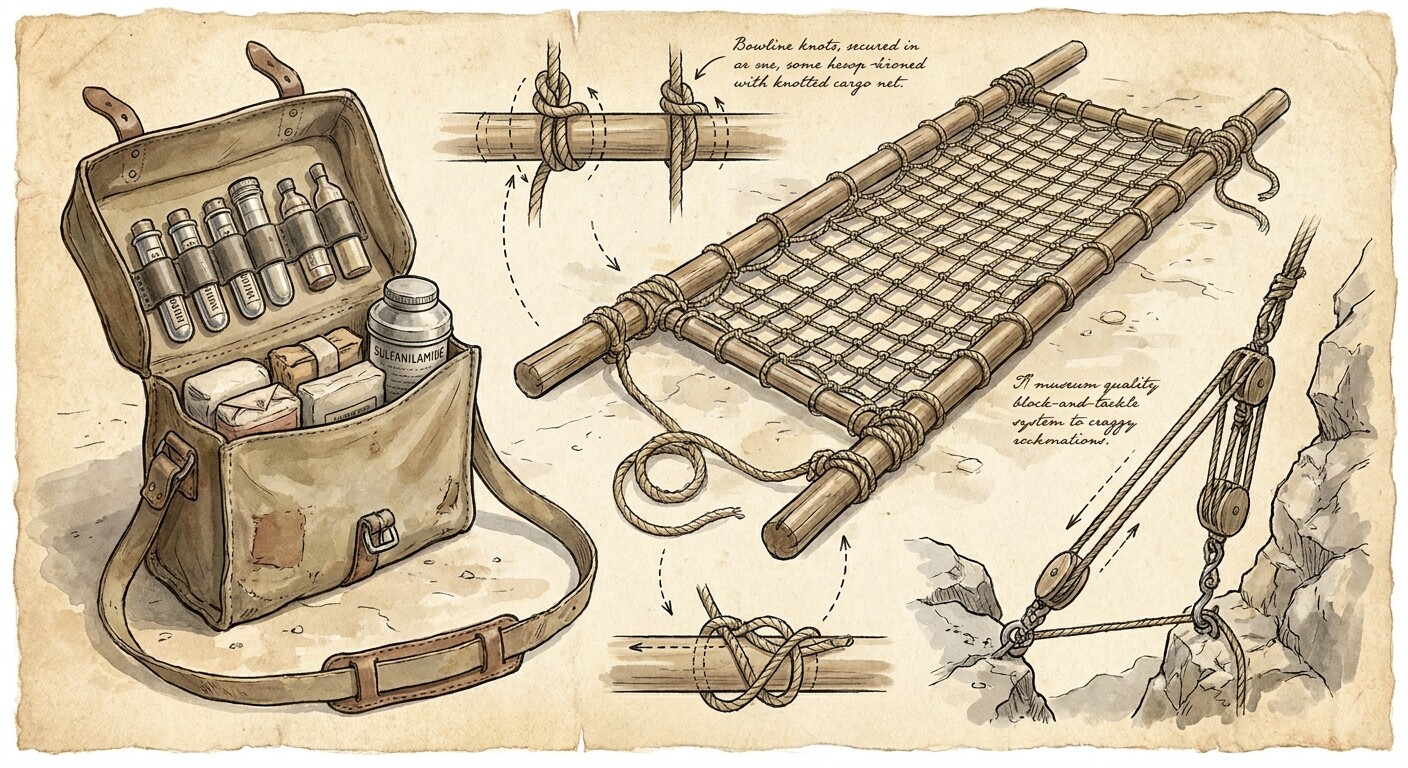
The action that would earn Doss the Medal of Honor began before dawn on May 5, 1945. Company B, 1st Battalion, 307th Infantry Regiment, received orders to assault the escarpment again and hold the position at all costs. The mission was crucial to the broader American advance, but everyone understood the cost would be enormous. Doss moved forward with the rifle squads, carrying his standard medic equipment: bandages, morphine syrettes for pain relief, sulfanilamide powder to prevent infection, and a small prayer book his mother had given him before deployment.
The pre-dawn assault succeeded in gaining the plateau once again, with American forces using darkness to minimize exposure during the dangerous climb up the cliff face. For several hours, the position seemed secure as soldiers dug fighting positions in the coral and established defensive lines. But as sunlight revealed American positions to Japanese observers, the familiar deadly pattern began again.
Japanese artillery and mortar fire began falling among the exposed positions with increasing accuracy. Observers had marked every potential fighting position during previous American occupations, and now they directed precise fire that turned individual shell craters into death traps. Machine gun fire swept across the plateau from multiple concealed positions, making movement between positions extremely hazardous. Within minutes of full daylight, wounded men were crying for medics across the exposed limestone plateau.
Doss immediately moved to aid the wounded, crawling from position to position under increasingly intense fire. The rocky terrain offered minimal cover, and Japanese weapons had been positioned to eliminate dead space where casualties might find protection. Each time Doss exposed himself to reach a wounded man, bullets struck the coral around him, sending sharp fragments flying through the air.
The physical demands were extraordinary from the beginning. Wounded soldiers, wearing full combat equipment, weighed 180 to 220 pounds. The rocky terrain was broken and uneven, scattered with shell craters, abandoned equipment, and the bodies of men killed in previous assaults. Moving a wounded man from his position to any form of cover required dragging him across ground constantly swept by enemy fire, often for distances of 50 to 100 yards.
As the morning progressed and Japanese fire intensified, the American position became completely untenable. Radio communications with battalion headquarters confirmed what everyone on the plateau already knew: the position could not be held without massive reinforcement that was impossible to provide under current fire conditions. The company commander made the agonizing decision that had been made repeatedly over the previous week—American forces would withdraw from the plateau and attempt the assault again later with better preparation.
The withdrawal order presented Doss with an impossible moral choice. Standard military procedure called for medics to withdraw with their units, providing what aid they could to wounded who were mobile enough to move, but leaving behind those too severely injured to survive the dangerous evacuation down the cliff face. The wounded left behind would almost certainly be killed by continuing artillery fire or by Japanese forces when they reoccupied the plateau.
Doss refused to leave. His religious convictions held that every life was precious, and his medical training had taught him that several of the wounded could survive if they received proper care and evacuation. As his unit withdrew down the cargo nets under continuing fire, Doss remained alone on the plateau with an estimated 75 wounded and dead American soldiers scattered across several hundred yards of broken ground.
What followed was one of the most extraordinary individual actions in American military history. Working entirely alone under continuous enemy fire, Doss began the methodical, dangerous process of reaching each wounded man, providing immediate medical care, and then somehow getting him to the cliff edge for evacuation. The task seemed impossible from both medical and logistical perspectives, but Doss approached it with systematic determination that would save dozens of lives over the next twelve hours.
The medical challenges were severe. Many of the wounded suffered from multiple injuries caused by shell fragments, machine gun bullets, or grenade explosions. Treating trauma injuries under field conditions required immediate decisions about which men could be saved and which were beyond help. Doss had limited supplies—standard medic equipment included bandages for controlling bleeding, morphine for pain management, and sulfanilamide powder to prevent infection, but no surgical instruments or equipment for treating complex internal injuries.
Doss prioritized casualties based on severity and survivability, focusing first on men who were conscious and responsive but needed immediate care to prevent shock or bleeding to death. He administered morphine to control pain, applied pressure bandages to control bleeding, and used sulfanilamide powder on open wounds. Throughout this process, he remained under observation from Japanese positions that continued firing at any movement on the plateau.
The logistical challenge of evacuation seemed even more impossible. The cliff face dropped 400 feet to the base where American forces waited, but conventional stretcher evacuation was impossible down the nearly vertical coral limestone. The cargo nets used for the assault had been designed to allow individual soldiers to climb up, not to lower wounded men weighing several hundred pounds each.
Doss solved the problem through improvisation that combined practical knowledge with desperate innovation. Using rope and sections of the cargo net left from the original assault, he developed a system for lowering wounded soldiers down the cliff face. He tied bowline knots around each casualty, creating a makeshift harness that distributed weight and prevented rope from cutting into flesh during the long descent. The technique required precise rope work to prevent the wounded from striking the rock face or becoming entangled during descent.
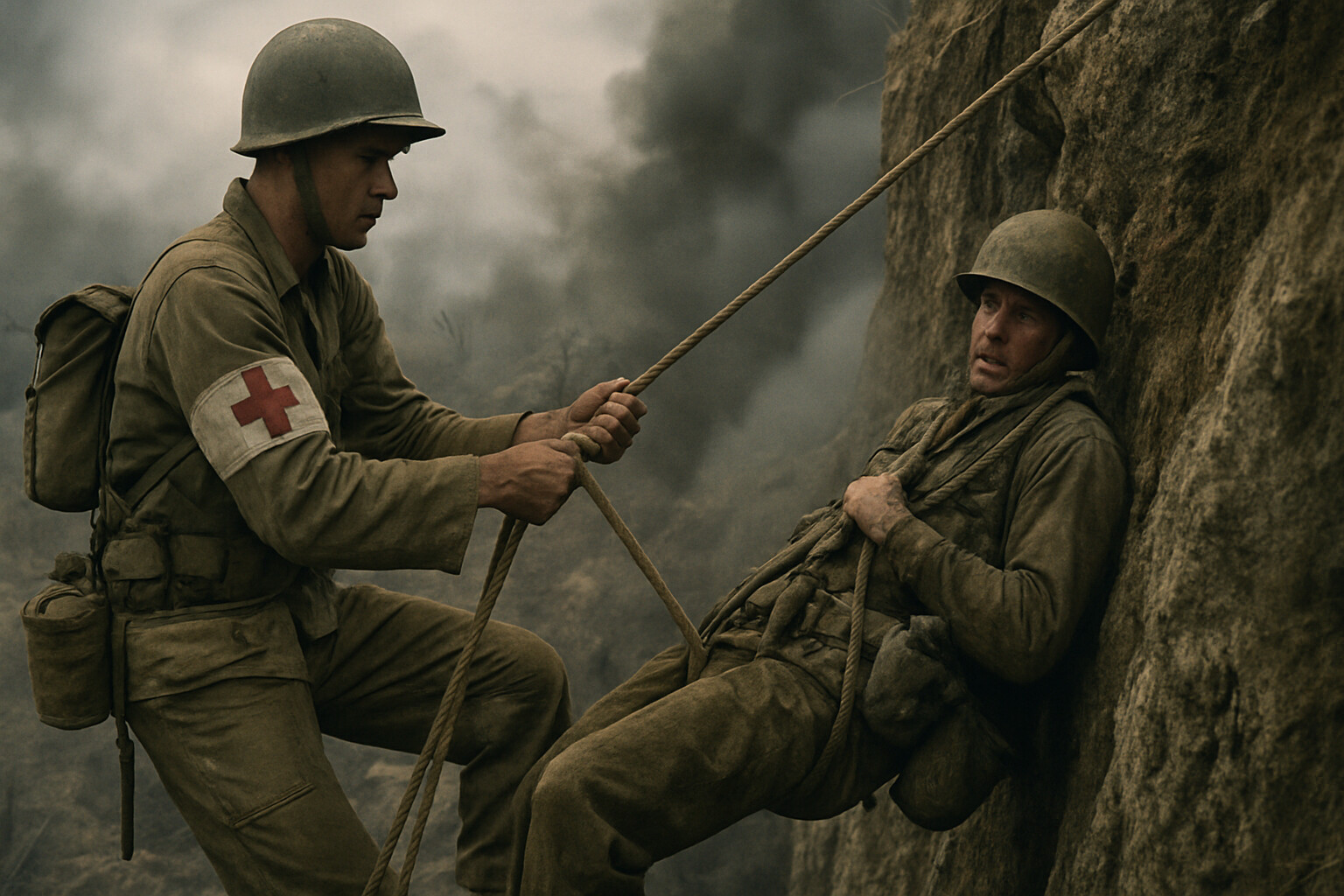
Working entirely alone, Doss would first treat each casualty's wounds, then drag or carry the wounded man across broken ground to the cliff edge. This often required moving across terrain under direct observation from Japanese machine gun positions, exposing himself to fire for the time required to cover distances that sometimes exceeded 100 yards. At the cliff edge, he would secure his improvised rope system, carefully position the wounded soldier to minimize injury during descent, and then control the lowering process from above.
The physical demands of this process were crushing. Each wounded soldier represented a dead weight of 180 to 220 pounds that had to be dragged across broken, rocky terrain. The rope work at the cliff edge required upper body strength and technique that few soldiers possessed, and a single mistake could result in a wounded man falling to his death. Doss had to repeat this process dozens of times while under continuous fire, working through exhaustion and the constant stress of knowing that Japanese soldiers could approach his position at any moment.
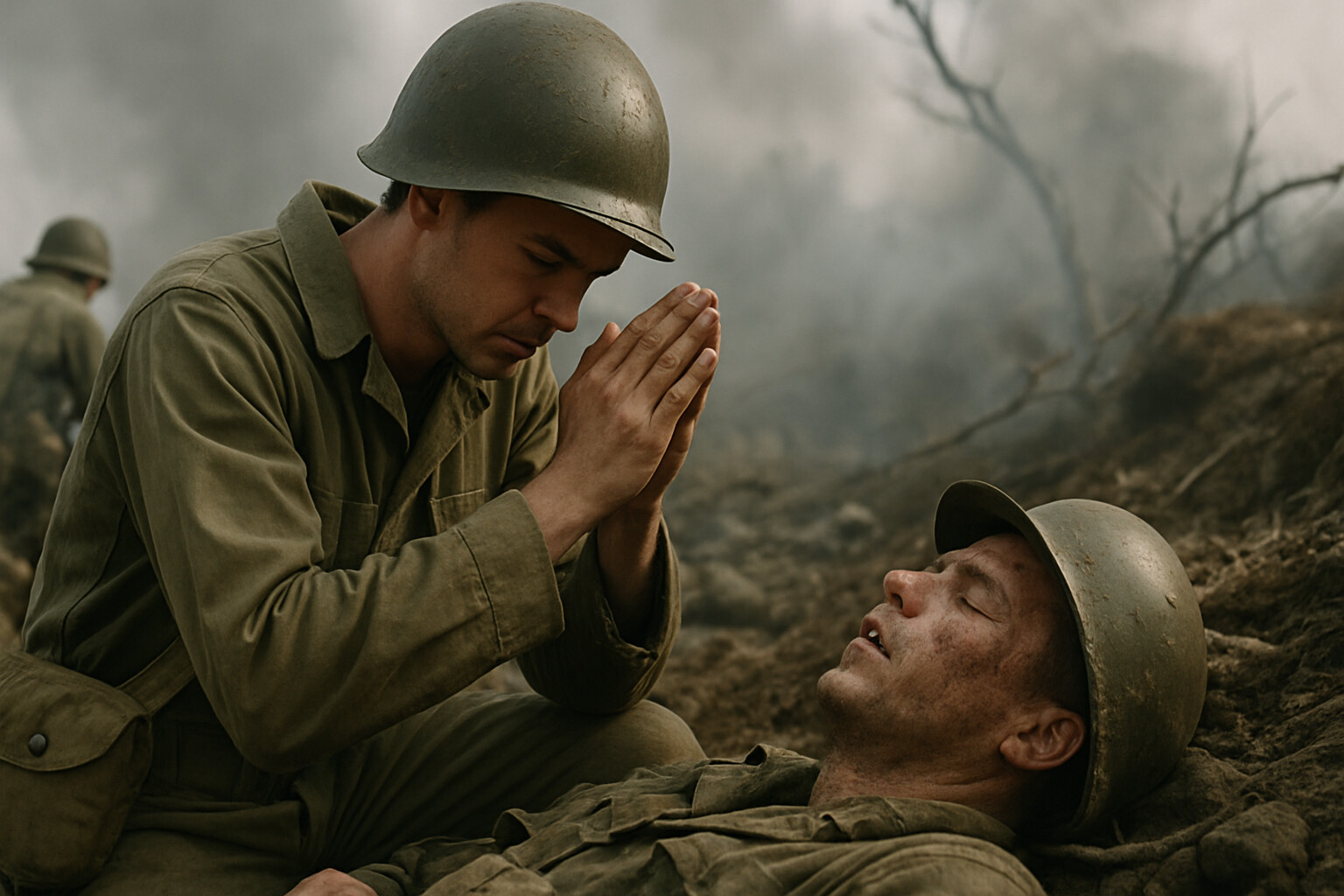
Throughout this extraordinary ordeal, Doss maintained his religious convictions and found strength in prayer. According to accounts he gave after the war, he prayed continuously as he worked, asking God for strength to reach just one more wounded soldier. Family members and fellow soldiers later reported that "Lord, please help me get one more" became his constant refrain as exhaustion mounted and the danger increased.
Several times during the day, Japanese soldiers approached close enough that Doss could hear their voices discussing his activities. The sight of a single American soldier working methodically on the plateau, apparently unaffected by intense fire and making no attempt to engage enemy positions, seemed to confuse Japanese observers. Some may have assumed he was already wounded or dying; others perhaps recognized his medical role and chose not to target him directly. The exact reasons for his survival remain uncertain, but his systematic approach and perhaps divine intervention allowed him to continue working when conventional military wisdom suggested he should have been killed within minutes.
Japanese defensive fire continued throughout the day, but patterns emerged that Doss learned to anticipate. Machine gun crews would fire short, precise bursts designed to conserve ammunition and avoid revealing their exact positions to American observers below. Artillery and mortar fire came in planned concentrations every few hours, designed to prevent American reinforcement or resupply of the plateau. Between these intense fire missions, there were brief periods when Doss could work with slightly reduced risk.
The number of men Doss saved became a matter of historical debate. Doss himself estimated he lowered 50 men down the cliff face during his solitary rescue mission. His company commander, observing from below, estimated the number closer to 100 based on the continuous activity he witnessed throughout the day. After extensive review of casualty reports, survivor interviews, and unit records, the official Medal of Honor citation settled on 75 men saved—a figure that reflects both the scope of Doss's achievement and the difficulty of maintaining precise counts during the chaos of combat.
The rescue operation continued into the afternoon, with Doss working alone while his unit remained at the cliff base, unable to provide assistance without exposing additional men to the devastating fire that controlled the plateau. Several attempts were made to send other medics or stretcher bearers up the cargo net, but Japanese fire made such efforts suicidal. Radio communications with Doss were impossible, leaving his unit to watch helplessly as he continued his solitary mission.
As afternoon turned toward evening, Japanese fire intensity increased as enemy commanders realized the scope of the American rescue effort. Mortar rounds began falling more frequently on the plateau, with some explosions occurring within yards of Doss's position. Machine gun fire swept the area in systematic patterns designed to prevent any movement. During this period, witnesses below reported seeing bullet impacts within inches of Doss as he worked to secure wounded men for evacuation.
The physical toll on Doss was severe and increasingly visible to observers below. After more than ten hours of continuous effort, dragging wounded men across broken terrain and lowering them down the cliff face, he was approaching complete physical exhaustion. His hands were raw and bleeding from rope burns, his uniform was torn and filthy, and he had not eaten or drunk water since before dawn. Yet he continued working, driven by religious conviction that every life was precious and that God would provide strength to save just one more wounded soldier.
As evening approached, the last wounded had been lowered to safety, and Doss finally prepared to descend himself. Japanese fire had not slackened, and several bullets struck close to his position as he secured his own rope for descent. American forces at the cliff base had prepared medical equipment, assuming he must have been wounded during the day's action. When Doss reached the bottom under his own power, many fellow soldiers were stunned to find him not only alive but apparently uninjured despite spending more than twelve hours under continuous enemy fire.
The immediate aftermath was overshadowed by the continuing Battle for Okinawa, which would rage for another month and a half. The Maeda Escarpment remained contested territory for weeks, changing hands multiple times as both sides poured reinforcements into the struggle for this crucial terrain. The 77th Infantry Division continued taking heavy casualties in the grinding warfare that characterized the Okinawa campaign, where every ridge and cave system required separate assault and reduction.
Doss continued serving as a company medic for the remainder of the Okinawa campaign, participating in additional actions that demonstrated the same courage under fire that had marked his rescue mission at the escarpment. On May 21, 1945, during a night assault on high ground near Shuri, he was finally wounded when grenade shrapnel tore into his legs and lower body. True to his character, he treated his own wounds and waited five hours for stretcher bearers to evacuate other wounded men before allowing himself to be taken to an aid station.
While being carried to safety on a stretcher, a Japanese sniper's bullet struck Doss in the arm, shattering the bone and adding a serious wound to his existing injuries. According to witnesses, he bound a rifle stock to his shattered arm as a splint and crawled 300 yards over rough terrain to reach the aid station rather than risk additional casualties by calling for help. This action, described in his Medal of Honor citation, demonstrated the same selfless courage that had characterized his service throughout the Pacific campaign.
Doss spent the war's remainder recovering in military hospitals, undergoing multiple surgeries to repair damage from grenade shrapnel and the sniper's bullet. His wounds were severe enough to require medical discharge, ending his military service just as the war itself was ending with Japan's surrender in August 1945. But by then, word of his extraordinary courage at the Maeda Escarpment had spread throughout the Pacific Theater and reached the highest levels of military command.
The full scope of Doss's actions became clear only gradually, as surviving unit members were interviewed and official after-action reports were compiled and reviewed. The Medal of Honor recommendation was initiated by Captain Jack Glover, the same company commander who had tried to have Doss discharged during basic training. Glover's recommendation, based on his personal observation of the rescue mission from below the cliff, was supported by multiple sworn statements from survivors who had been saved by Doss's actions.
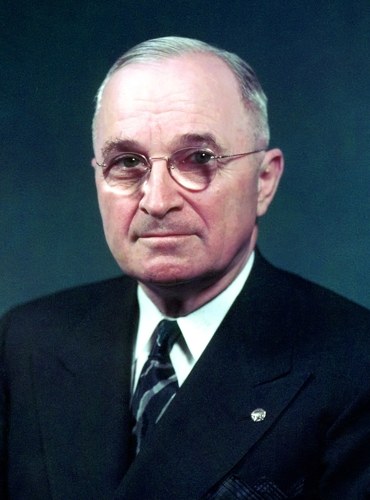
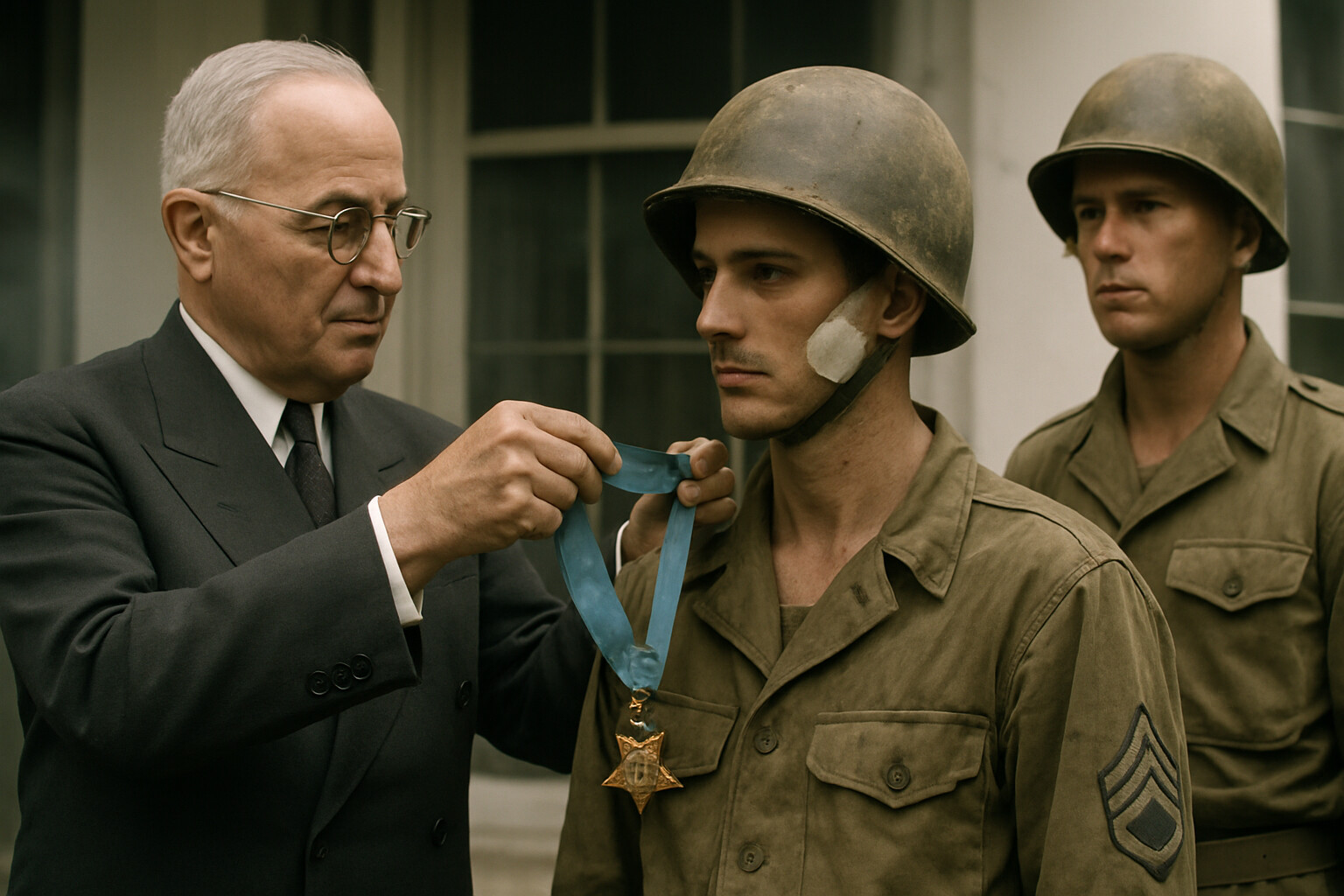
The Medal of Honor citation, signed by President Harry S. Truman, officially recognized Doss's "outstanding bravery and unflinching determination in the face of desperately dangerous conditions." The citation specifically noted that Doss "refused to seek cover and remained in the fire-swept area with the many stricken, carrying all 75 casualties one-by-one down the treacherous cliff face while enemy snipers and artillery tried to kill him."
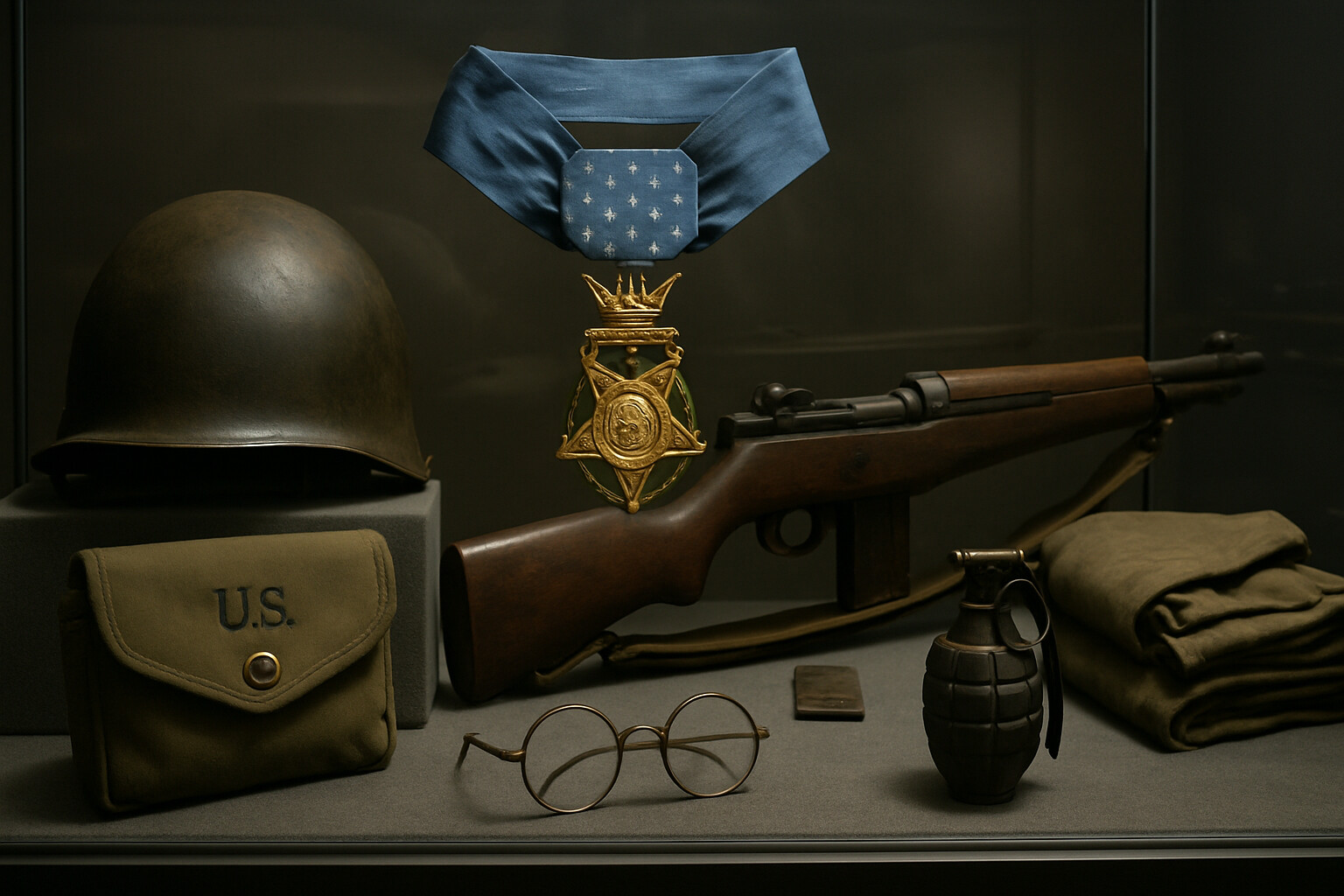
The award ceremony took place at the White House on October 12, 1945, with President Truman personally presenting the medal to Doss in the Blue Room. According to press accounts of the ceremony, Truman told Doss that he was proud of him and that he considered it "a greater honor than being president" to present the medal. The moment was particularly significant because Doss became the first conscientious objector to receive the Medal of Honor, challenging assumptions about courage and military service that had persisted since the nation's founding.
The broader Battle of Okinawa proved to be one of the bloodiest campaigns in Pacific War history. American casualties totaled more than 82,000, including 12,300 killed and 38,000 wounded. Japanese military casualties were even higher, with an estimated 110,000 killed and only 7,400 captured. Civilian casualties among the Okinawan population exceeded 100,000, making the campaign a humanitarian catastrophe as well as a military bloodbath.
The ferocity of Japanese resistance and the massive casualty figures at Okinawa profoundly influenced American planning for the proposed invasion of Japan itself. Military planners estimated that Operation Downfall, the planned assault on the Japanese home islands, could result in over one million American casualties. These projections contributed significantly to President Truman's decision to authorize use of atomic weapons against Hiroshima and Nagasaki rather than attempt the costly amphibious invasion that could have resulted in casualties exceeding the entire American toll for the European Theater.
Doss's story challenged fundamental assumptions about conscientious objectors and their place in military service. Before World War II, most Americans viewed conscientious objection as cowardice or disloyalty disguised as religious conviction. Doss's extraordinary courage under fire forced a national reconsideration of these attitudes and helped establish the principle that courage and patriotism could take many different forms. His willingness to serve in combat while maintaining his religious convictions provided a powerful model for future generations facing similar moral dilemmas.
The technical aspects of Doss's improvised evacuation system deserve recognition from military historians and medical professionals. Lowering wounded men down a 400-foot cliff without proper mountaineering equipment required both practical knowledge and desperate innovation. The cargo nets and ropes available to infantry units weren't designed for such use, and the risk of equipment failure or human error was enormous. That Doss successfully evacuated dozens of casualties without apparently losing anyone during the descent speaks to careful technique developed under extreme pressure.
Post-war research has confirmed the essential facts of Doss's Okinawa service, though some specific details remain subject to historical debate. Military historians have verified his Medal of Honor citation against unit records, casualty reports, and extensive survivor interviews. The figure of 75 men saved appears in the official citation and has been accepted by the Army's Center of Military History as accurate, though the exact methodology for reaching this precise number isn't detailed in surviving military records.
Doss returned to Virginia after the war, marrying Dorothy Schutte and settling in Rising Fawn, Georgia, where he worked as a carpenter following his father's trade. They raised one son, Desmond Tommy Doss Jr. Health problems related to war wounds, including tuberculosis that he contracted during military service, forced early retirement from physical labor. He remained active in his Seventh-day Adventist church throughout his life and frequently spoke about his war experiences, always emphasizing his faith in God's protection rather than his own courage.
The legacy of Doss's actions extends far beyond military history to broader questions about courage, faith, and moral conviction in extreme circumstances. His story demonstrates that heroism can manifest in many different forms and that adherence to deeply held religious beliefs need not compromise effectiveness in military service. For the Seventh-day Adventist community, Doss became a powerful example of how religious conviction could be maintained even in the most challenging circumstances imaginable.
Modern military medicine has built upon the foundation laid by medics like Doss, developing sophisticated trauma care techniques and evacuation procedures that save thousands of lives in contemporary conflicts. The principle that medics should be non-combatants, protected under Geneva Conventions, reflects international recognition of the special role played by medical personnel in warfare. Doss's refusal to carry weapons while serving in combat helped establish the legitimacy of this non-combatant status that continues to protect military medical personnel worldwide.
The Maeda Escarpment today is part of peaceful Okinawan landscape, but memorials and museums preserve the memory of the brutal battle fought there in May 1945. The cliff face where Doss performed his rescue mission has been marked with commemorative plaques, and his story is included in exhibits about the Battle of Okinawa at peace memorial sites throughout the island. These monuments serve as powerful reminders of war's human cost and the extraordinary courage individuals can display under the most desperate circumstances.
Doss's Medal of Honor stands as one of the most unusual awards in American military history—presented to a man who never fired a shot in anger but repeatedly exposed himself to enemy fire to save fellow soldiers' lives. His story challenges simple definitions of heroism and demonstrates that moral courage can be as powerful as physical bravery in determining the outcome of military operations. In an era when warfare often rewards aggression and destruction, Doss's unwavering commitment to preserving life offers a different model of military excellence.
The conscientious objector who became a war hero died on March 23, 2006, at age 87, having lived to see his story reach new audiences through books, documentaries, and a major motion picture. While some dramatic adaptations took liberties with historical accuracy for entertainment purposes, the core facts of his extraordinary service remain well-documented and continue to inspire new generations. His Medal of Honor citation stands as an enduring testament to the power of moral conviction and the many different forms courage can take when tested in combat's ultimate crucible.
On that coral plateau high above Okinawa, a young medic who refused to kill had proven that saving lives required courage every bit as profound as taking them. In a war that would be remembered for unprecedented destruction and massive casualties, Desmond Doss demonstrated that sometimes the greatest heroism lies not in what a soldier is willing to do, but in what he refuses to do—and in how far he will go to honor the sacred value of every human life.