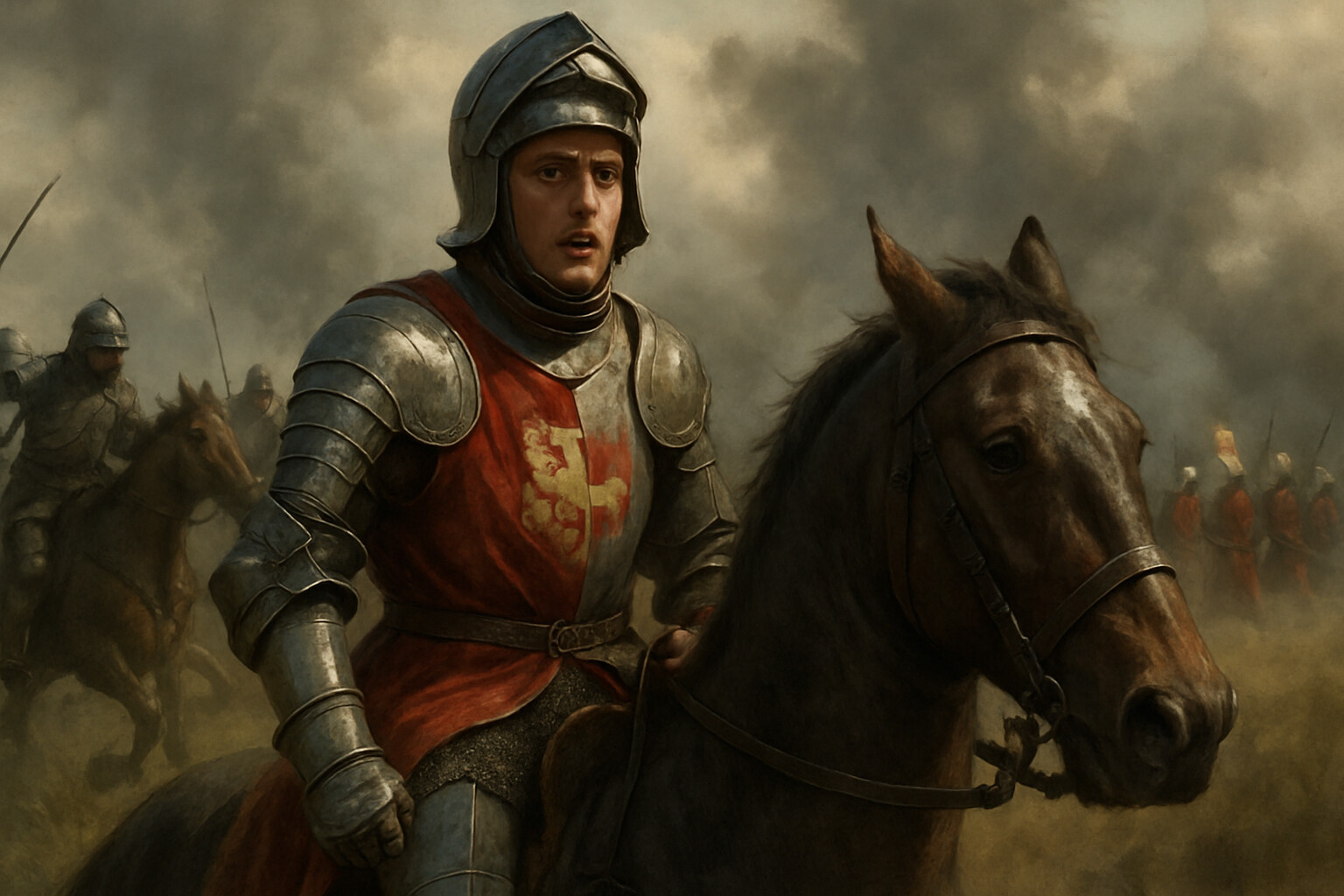
The bolt struck Jan Žižka somewhere near Rabi Castle in 1421. He had already lost one eye before that—possibly at the Battle of Grunwald in 1410, possibly in some earlier conflict whose record has not survived; the sources do not agree. Now the second eye was gone. He was somewhere past fifty years old and in the middle of a war that his side was not supposed to win.
The men around him might reasonably have read it as a sign that the enterprise was finished. Crusading armies were massing again across the Bohemian border. The Pope had sanctioned the campaign as a righteous extermination. The Holy Roman Emperor wanted Bohemia returned to a single orthodox faith and had the knights and treasury to press the point. Žižka was a former minor noble and mercenary soldier with a theology he had not written down himself, a force drawn largely from farmers and craftsmen, and now no functioning eyes at all.
He kept commanding.
---
To understand what Žižka built and why it worked, you have to understand what he was fighting against—and what the Hussite movement actually was.
The execution of Jan Hus at the Council of Constance on July 6, 1415, set the fuse. Hus was a Czech theologian, rector of Prague University, and a persistent critic of Church corruption. He had been promised safe conduct to present his views before the council. The promise was not honored. He was condemned as a heretic and burned. The news reached Bohemia with the force of a physical shock. Hus had been not only a religious reformer but a figure of Czech national identity, and his death fused religious grievance with ethnic resentment against German-speaking imperial authority in ways that cannot be cleanly separated even now.
The Hussites who organized in the years following his execution were not a single movement. They ranged from moderate Prague university reformers—the Utraquists, who insisted primarily on receiving communion in both kinds, bread and wine, which the Church restricted to clergy—to the radical Taborites, who established a communal city at Tabor in southern Bohemia and read scripture as license for sweeping social transformation. Žižka began on the Utraquist side and moved toward Tabor, leading the military wing of that more radical southern community from roughly 1419 onward.
What he brought to Tabor was a lifetime of professional military experience. The records of his early life are frustratingly sparse. He was born around 1360, possibly at the village of Trocnov in southern Bohemia, though that identification rests on later tradition rather than contemporary documentation. He served in various noble retinues, survived factional violence in Bohemia in the 1390s and early 1400s, and is documented fighting at Grunwald in 1410 with the forces that defeated the Teutonic Knights. A claim that he also fought at Agincourt in 1415 on the English side appears in later Czech tradition but is not confirmed in English records and must be treated as unverified. What is established is that by the time he took command of Hussite forces in 1419, he was not a farmer who had picked up a sword. He was an experienced soldier who had spent decades studying how armies moved, what broke them, and what did not.
---
The first test came at Sudomer on March 25, 1420.
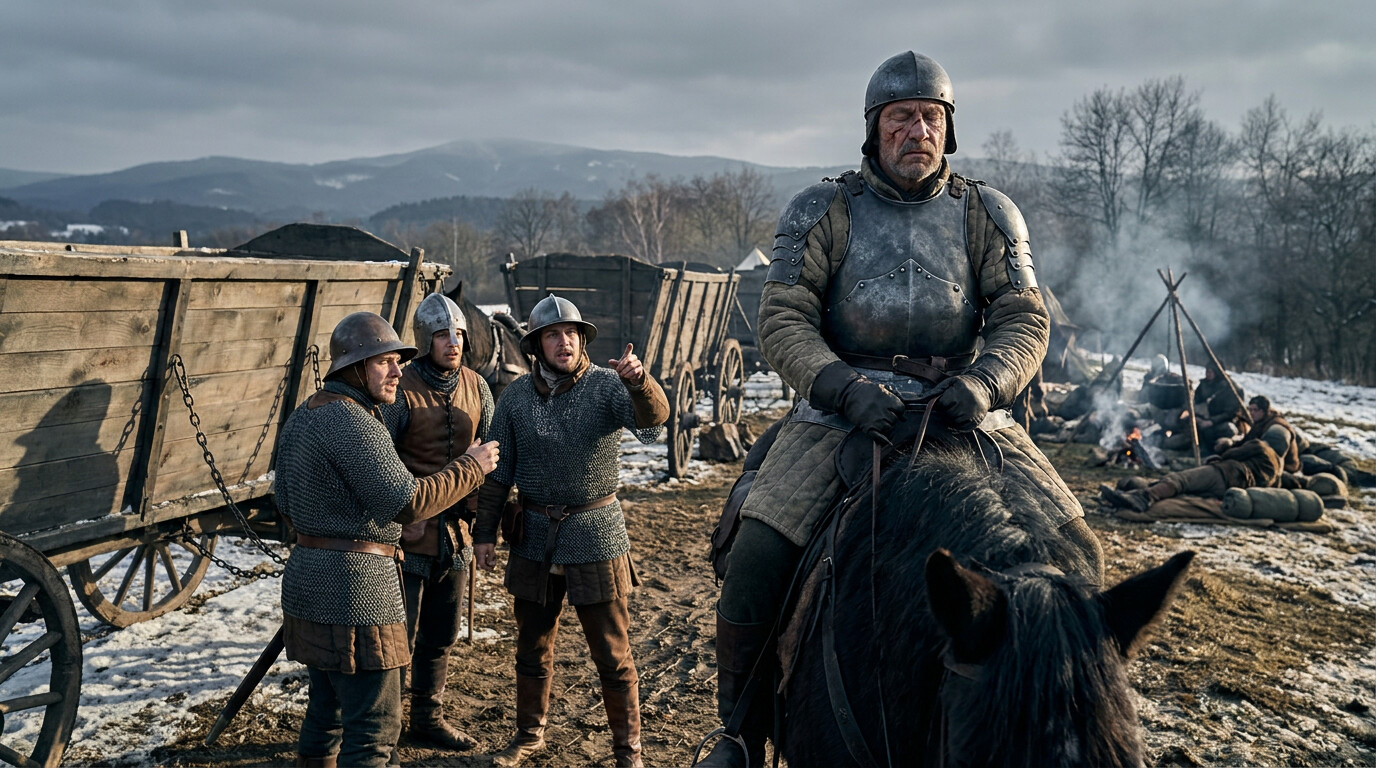
Žižka was moving a column of Hussite refugees and fighters southward through Bohemia toward Tabor. Estimates of the force in early sources range from roughly 400 to perhaps 2,000 people, with the distinction between fighters and noncombatants unclear; the numbers should be treated with caution. What the sources agree on is that the force was modest, heavily on foot, and encumbered with wagons. Whether those wagons were already part of a deliberate tactical concept at this early stage, or primarily logistical, is not fully established.
A royalist Catholic force under Pirátor of Sudomer and other regional commanders intercepted them near a frozen pond south of the village. The Catholic force was substantially larger and included armored cavalry—the decisive arm of conventional medieval warfare. A Hussite force caught on open ground by mounted knights in sufficient numbers should have been broken in the first charge.
Žižka did not stand on open ground.
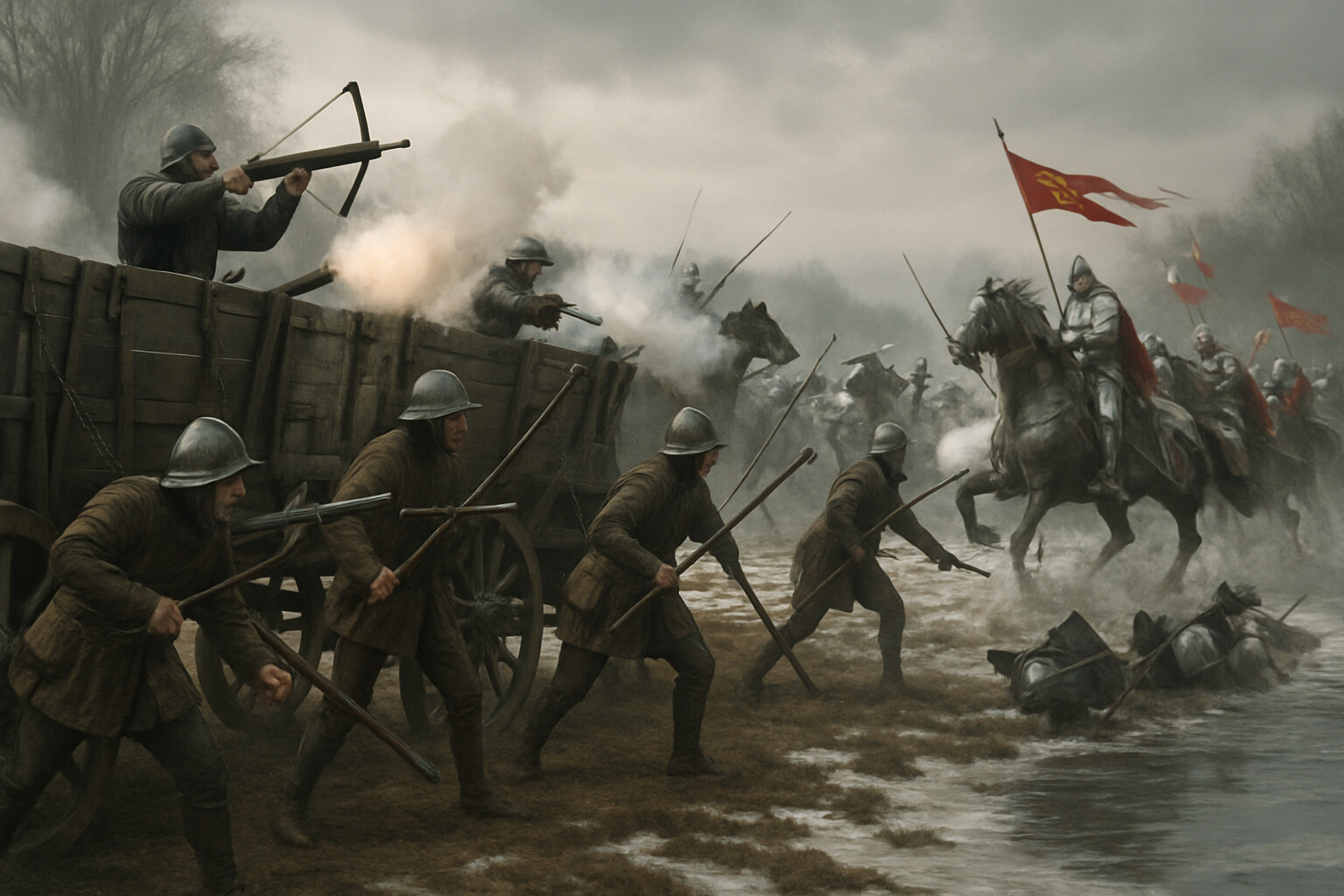
He used the wagons. He arranged them in a defensive ring—what the Czechs called a Wagenburg, a wagon fortress—anchored on one flank to the frozen pond, which cavalry could not easily cross. His men fought from behind the wagon walls with flails, pikes, and crossbows. The cavalry charges broke against the ring. The pond denied the attackers room to maneuver. The assault failed. The Hussites broke contact and continued south to Tabor.
Sudomer was not a large battle. By the scale of the crusading engagements that followed, it was a skirmish. But it demonstrated something essential: that a relatively small, infantry-heavy force could defeat armored cavalry using terrain, discipline, and mobile fortification. Žižka appears to have understood what that meant and began systematically building an army around it.
---
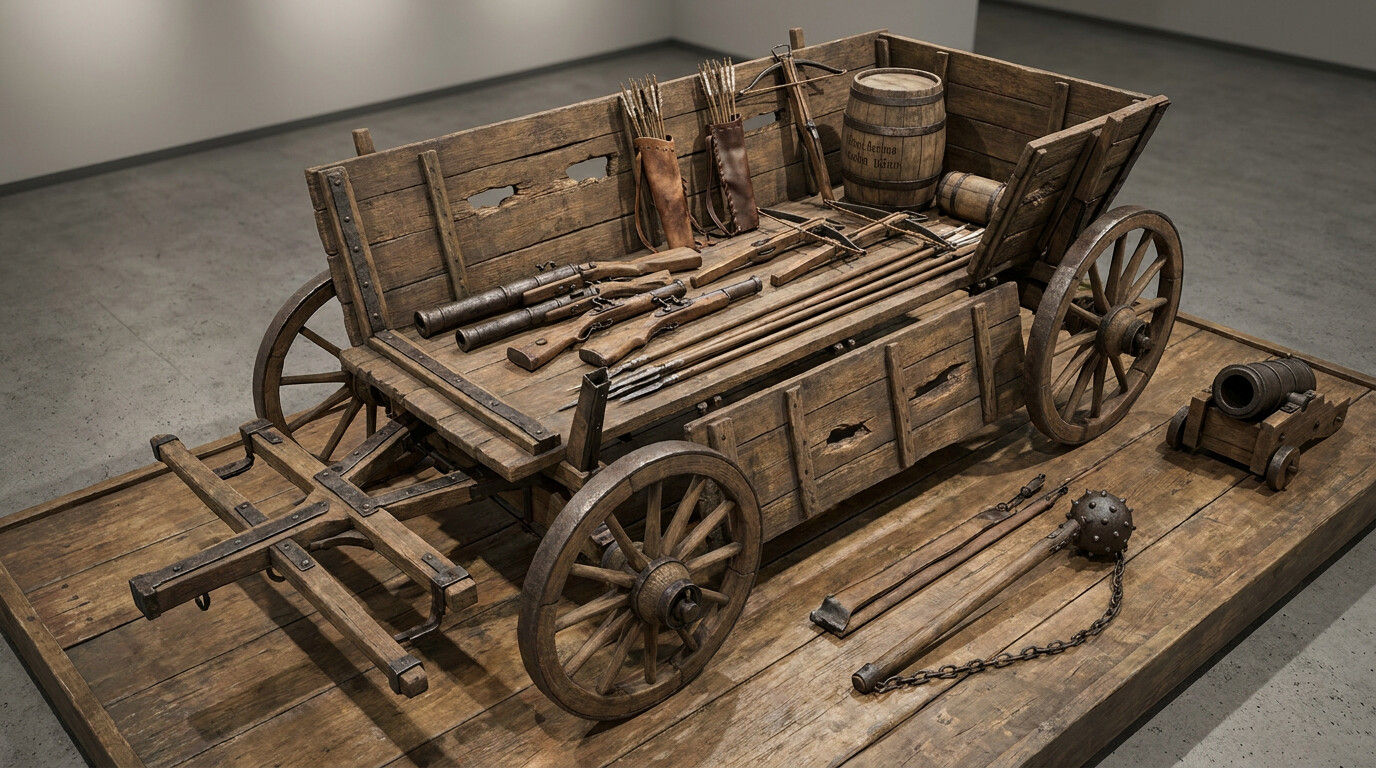
The wagon fortress—the Wagenburg—was not Žižka's invention from nothing. Wagon laagers had been used defensively in various forms across European and steppe warfare for centuries. What Žižka did was take the concept further than anyone before him in Western European practice: he standardized it, drilled it, regulated it by written ordinance, and eventually turned it from a purely defensive formation into an offensive weapon system.
The Hussite war wagons were heavy, purpose-modified farm carts reinforced with iron fittings and fitted with wooden side shields. Each wagon carried a crew of between fourteen and twenty-one men, depending on which source is consulted and what period of the war is described. The crew included crossbowmen and handgunners on the wagon itself, pike and flail men positioned to fight from the gaps between wagons, and eventually small artillery pieces—hand-placed bombards and early cannon—that could be fired from within the chain or through gaps in the formation.
The tactical doctrine Žižka developed around these wagons was sophisticated. The wagons moved in column on roads and deployed into defensive rings or rectangles on open ground. Infantry occupied the gaps between wagons with pikes and war flails—the latter a particularly Hussite weapon, derived from the agricultural threshing flail, with a heavier iron-studded head that could batter through armor or stun a horse. Cavalry operated from the flanks and exploited the moment after enemy charges broke on the wagon walls. Artillery—even the crude pieces available in this period—could be positioned to sweep the approaches.
The drill required to make this work was substantial. The wagons had to be positioned quickly and in coordination under pressure. The gaps had to be filled and held. The horses had to be unhitched and protected inside the ring. None of this happened automatically with a militia; it required training, repetition, and clear command. Žižka issued military ordinances—surviving documents from 1423 lay out rules for march discipline, formation, conduct in camp, and punishment for disorder. These are among the earliest examples of written military regulations for a Czech or Bohemian force, and they reveal a commander thinking systematically about how to create a reliable military institution rather than a temporary armed band.
---
The First Crusade against the Hussites reached Bohemia in the summer of 1420. Emperor Sigismund of Hungary, who held the contested claim to the Bohemian crown, assembled a large crusading army drawn from across the Holy Roman Empire. Contemporary estimates of its size vary enormously—from roughly 30,000 to figures that later chroniclers inflated toward 100,000—and both ends of that range must be treated with caution. What is clear is that the crusading force substantially outnumbered any Hussite field army that could be assembled.
The decisive engagement came at Vitkov Hill on July 14, 1420, on the eastern edge of Prague.
Žižka had positioned a Hussite force on Vitkov Hill—a steep ridge commanding one of the approaches to the city—to block the crusaders from completing an encirclement of Prague. He reinforced the position with earthworks; whether artillery was present at this stage is uncertain, and the detailed layout of the field fortifications is debated in the sources. What the battle accounts consistently agree on is the terrain advantage and the nature of the assault.
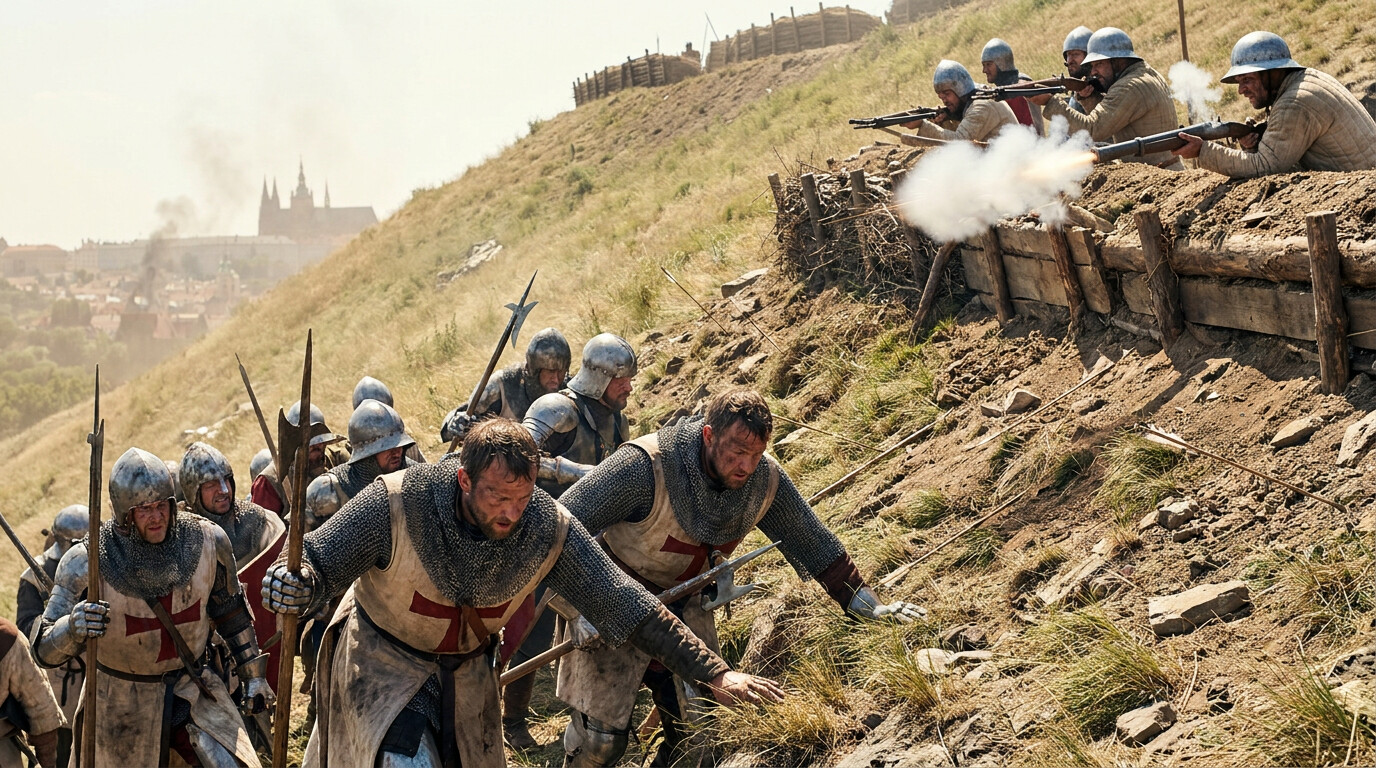
Sigismund's crusaders attacked uphill against the Hussite position. The Bohemian sources describe the defending garrison as small—possibly only a few hundred men at the critical point—but the hill itself multiplied their effectiveness. Cavalry that attempted the slope found no room to build momentum, took crossbow and handgun fire on the approach, and met pike and flail at close quarters when they reached the crest. The assault failed. The broader encirclement effort collapsed. Sigismund withdrew from Prague.
Vitkov Hill did not end the war. But it stopped the First Crusade in front of the city it was meant to capture, against odds that should have been prohibitive. Prague named the hill Žižkov in Žižka's honor—the name persists today as a district of the Czech capital. The extent to which Žižka personally directed the defense at the critical moment, as opposed to commanding the broader disposition, is harder to establish from the surviving accounts.
---
The middle years of the war, 1420 to 1422, saw Žižka fighting on multiple fronts simultaneously: Catholic royalist forces within Bohemia, recurrent crusading armies from outside it, and increasingly fierce internal conflict between the moderate Utraquist Hussites and the radical Taborites and related factions.
He lost his second eye in 1421, during the siege of Rabi Castle. The wound is recorded; the exact circumstances vary by source. He recovered. He reorganized his command structure to rely on trusted subordinates who could relay orders and report conditions back to him. He continued to ride with his forces, to direct dispositions, and to make tactical decisions. The chain of command he had built was coherent enough to function with a blind general at its head because it was designed to execute a system, not to improvise.
At the Kutná Hora campaign in late December 1421 and early January 1422, that system faced one of its hardest tests.
Sigismund had returned with a second crusading army and moved into Bohemia, initially catching Hussite forces in a difficult position—Žižka's army was briefly threatened with encirclement around Kutná Hora, then a major silver-mining center and one of the wealthiest cities in Central Europe. Sigismund occupied the town itself. Žižka's force risked being cut off.
What followed over several days was a fighting withdrawal and then a reversal. Žižka managed to extract his main force through what the sources describe as a night breakthrough on or around January 6–7, 1422, moving through positions that Sigismund's forces had not fully sealed. The exact route and coordination of this maneuver are reconstructed from Czech and German chronicles that do not fully agree; the broad sequence is consistent across sources. Having broken out, Žižka reorganized and counterattacked. At the village of Německý Brod—now Havlíčkův Brod—roughly three days later, on or around January 10, 1422, he caught part of Sigismund's army in a rout and inflicted severe casualties. Some sources describe retreating crusaders crossing a partially frozen river with catastrophic results; the precise losses are not verifiable, but the outcome was clearly decisive.
Sigismund did not attempt a third major crusade into Bohemia while Žižka lived.
---
The Hussite military system rested on several interlocking elements that military historians have examined carefully since the nineteenth century, and it is worth pausing to describe them concretely.
The firearms available to the Hussites were primitive by any later standard, but they were real. Hand cannon—simple iron or bronze tubes mounted on wooden stocks or poles, fired by touching a heated rod or slow match to a touchhole—had appeared in European warfare in the early fourteenth century and were in widespread enough use by 1420 that Hussite forces could deploy them in tactically meaningful numbers. Their advantage was not accuracy or rate of fire, both of which were poor. It was shock, noise, and the ability to penetrate armor that arrows and crossbow bolts sometimes could not. Fired in coordinated bursts from behind wagon walls at cavalry massing for a charge, even crude hand cannon were psychologically and physically disruptive.
The Hussites also deployed larger artillery—early bombards capable of firing stone or iron shot against fortifications or massed formations. These were heavy, slow to reload, and difficult to transport, but Žižka's wagon system provided a ready platform, and his ordinances apparently addressed how artillery was to be positioned within the Wagenburg. This integration of mobile infantry, wagon fortifications, and artillery into a combined-arms doctrine was ahead of contemporary European practice, even accounting for the crudeness of the individual components.
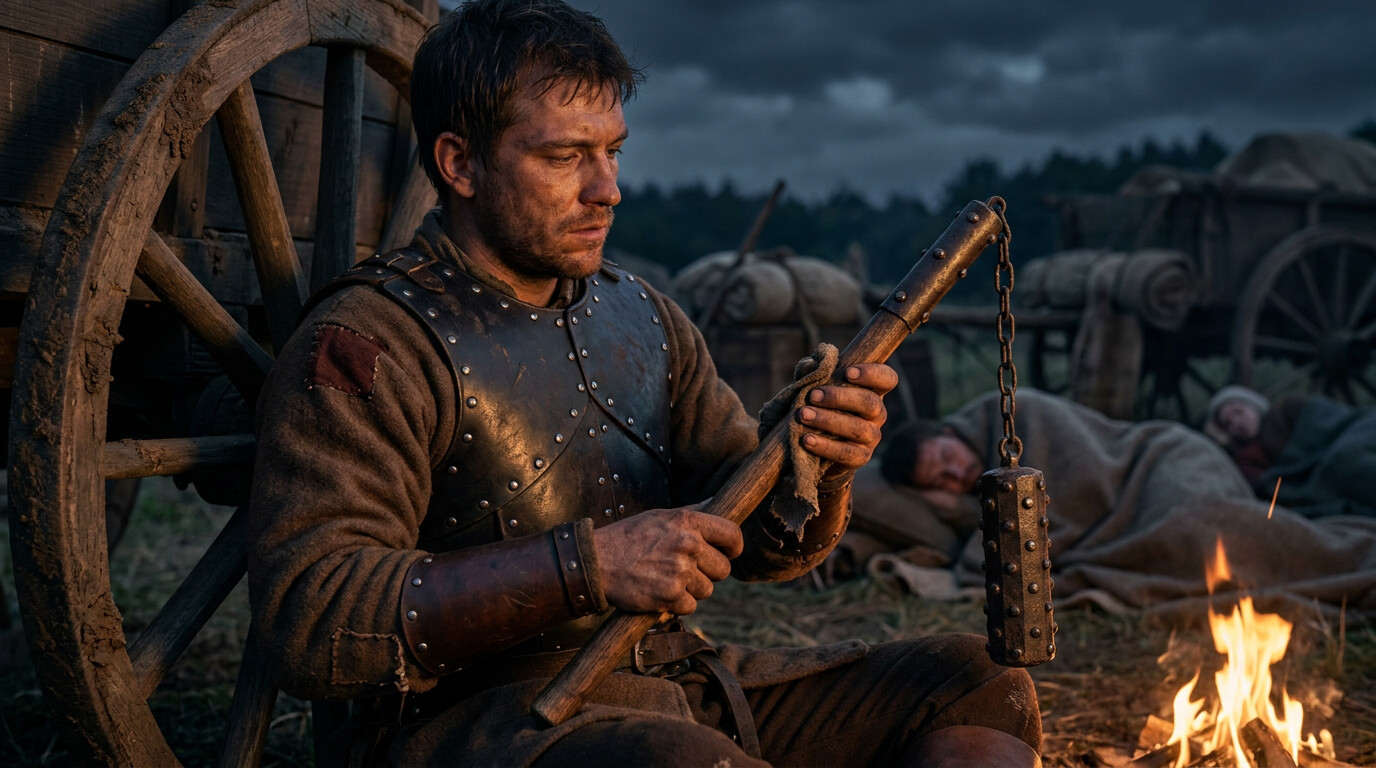
The war flail deserves particular mention because it illustrates the social character of the Hussite armies. The flail was not a knightly weapon. It was a farm tool—used to thresh grain—adapted for war by adding weight, length, and iron reinforcement to the striking head. It required no years of aristocratic training to use effectively, and it was available to men who owned no sword. In the confined, close-quarters fighting at wagon gaps, where armored knights were already disordered by the approach and slowed by the press of men and horses, a determined fighter with a heavy flail could be lethal. The weapon made visible something the Hussites understood about their own war: that it was being fought by a different kind of soldier than the crusaders had anticipated.
The crossbow gave the Hussites a standoff capability that complemented the wagon walls. Crossbows required more training than war flails but far less than the longbow, and they could penetrate most infantry armor at practical combat ranges. The Hussites appear to have used both conventional crossbows and the more powerful steel-prod arbalest. Neither was new technology; the novelty was the systematic combination with the wagon fortress and the firearm contingent—a layered defensive problem that cavalry of the period was not equipped to solve.
---
Internal Hussite politics drove Žižka from the main Taborite leadership in 1423. A faction called the Pikarts or Free Spirits—pushing certain Taborite ideas to extremes that Žižka and other leaders considered dangerous—had been violently suppressed around 1421. Later disputes about doctrine and authority within the broader Hussite coalition led Žižka to break with the Taborite command and form a separate force, sometimes called the Orebites or Žižkites—his own people, loyal to him personally and to the military organization he had built.
With this force he continued campaigning across Bohemia in 1423, fighting against Catholic royalists and, in a painful development, against other Hussite factions in the internal war that ran alongside the external crusading threat. He defeated a Utraquist force allied with his opponents at Hořice on April 27, 1423, and won again at Strakonice in October 1423. The sources for these engagements are thinner than for the major crusading battles; the basic fact of his victories is recorded, but tactical detail is limited.
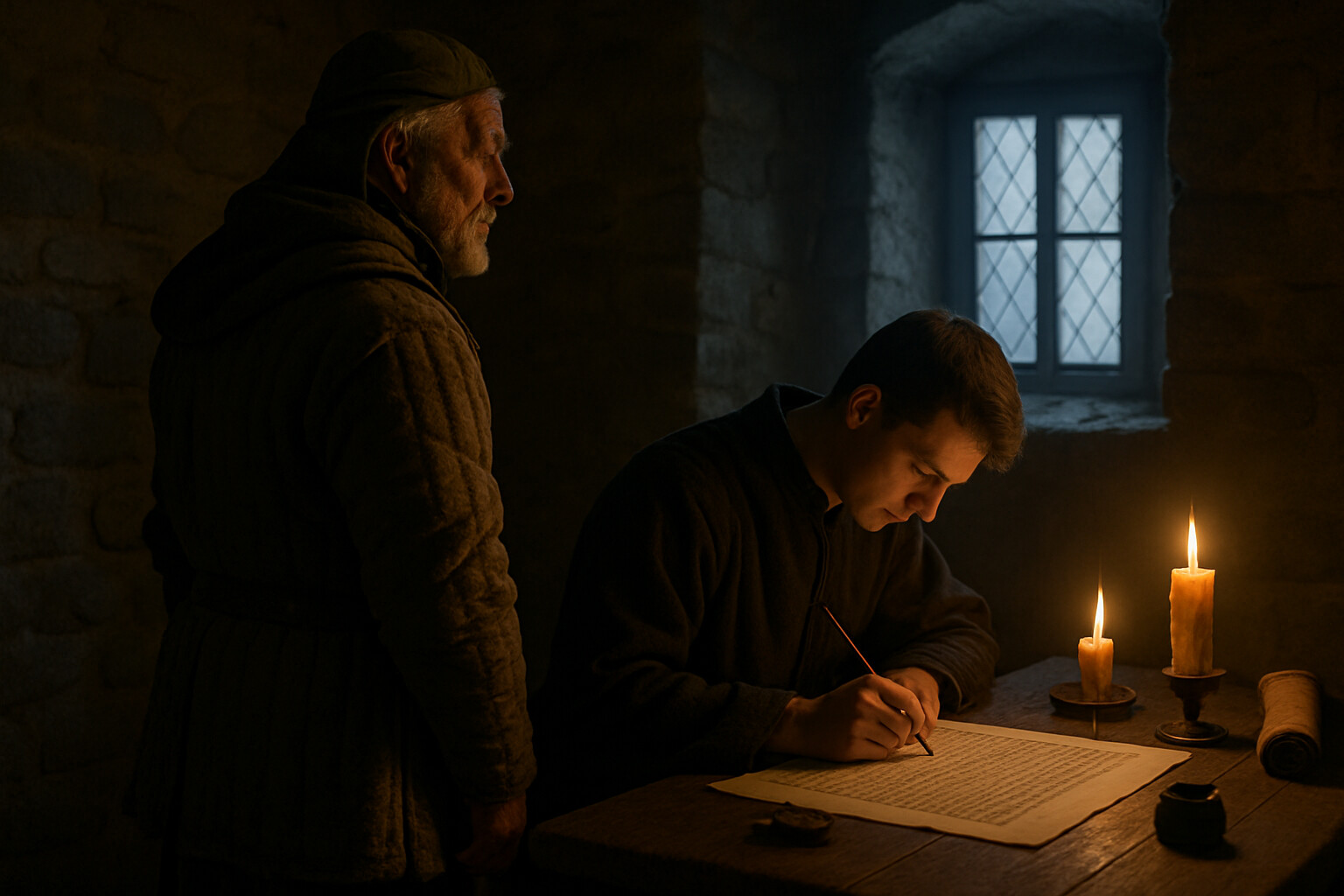
By this point Žižka was completely blind and by most estimates in his early sixties—old for a medieval soldier, old for any soldier. He dictated his correspondence and orders. He was informed of terrain by scouts and subordinates whose reports he synthesized into decisions. Whether he compensated through heightened reliance on trusted officers or through other adaptations, his command remained effective. His army kept winning.
---
On October 11, 1424, Jan Žižka died near the town of Přibyslav in Bohemia, during preparations for a new campaign. The cause was plague—bubonic or a related epidemic disease moving through his army. He was not killed in battle. He died of an illness that had nothing to do with the enemies he had fought for five years.
The tradition that he asked to have his skin made into a drum after his death, so that his enemies would flee at the sound of it, is recorded in later Czech accounts. It is a vivid story. It is not verified in contemporary documentation and should be treated as legendary tradition, not established fact.
What is established is the military record. Between 1420 and 1424, Žižka commanded Hussite forces in engagements against superior crusading armies on at least four major occasions—Sudomer, Vitkov Hill, the Kutná Hora and Německý Brod campaign, and Hořice—and was not defeated in any of them. No documented battlefield defeat has been identified for the period of his command. This is an extraordinary record in any era, and more so given that he was blind for the last three years of active campaigning.
His subordinates continued the fight after his death, using the doctrine and military organization he had built. The Hussite wars did not end until the Council of Basel negotiated the Compactata of 1436—a compromise recognizing some Utraquist demands—more than a decade after Žižka's death. But the military system he created sustained those years. The various Hussite armies that operated after 1424 were shaped by the ordinances, doctrine, and institutional practice he had established.
The wars ended without a complete military defeat of the Hussites. Bohemia retained modified religious rights. A force built around reinforced farm wagons, hand cannon, war flails, and written military regulations had fought the crusading armies of Catholic Europe to a negotiated outcome. That outcome was inseparable from what Žižka built between 1420 and 1424.
---
The military historians who have studied Žižka most carefully—Václav Tomek in the nineteenth century, Frederick Heymann in the twentieth, and more recent Czech scholarship—tend to emphasize two things above the tactical details.
First, the institutional achievement. Žižka did not simply win battles; he created a replicable military system that survived him. The Wagenburg doctrine, the written ordinances, the combined-arms integration—these were designed to function without his personal presence at every point of decision. That is harder to build than a battlefield reputation, and considerably rarer.
Second, the command achievement after his blindness. He continued to direct campaigns credibly after losing his sight in 1421. His men continued to follow him and to fight effectively under his direction. Whatever we attribute that to—his personal authority, the quality of his subordinate officers, the morale of a force fighting for its faith and its language—it sustained military effectiveness through a disability that would have ended most careers.
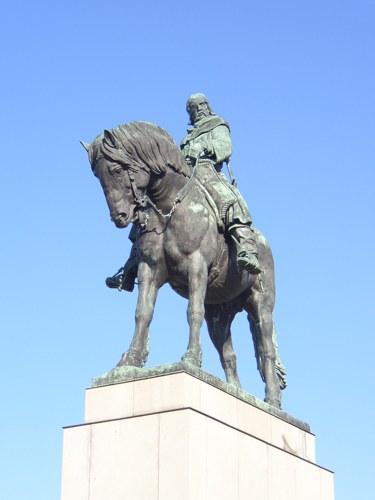
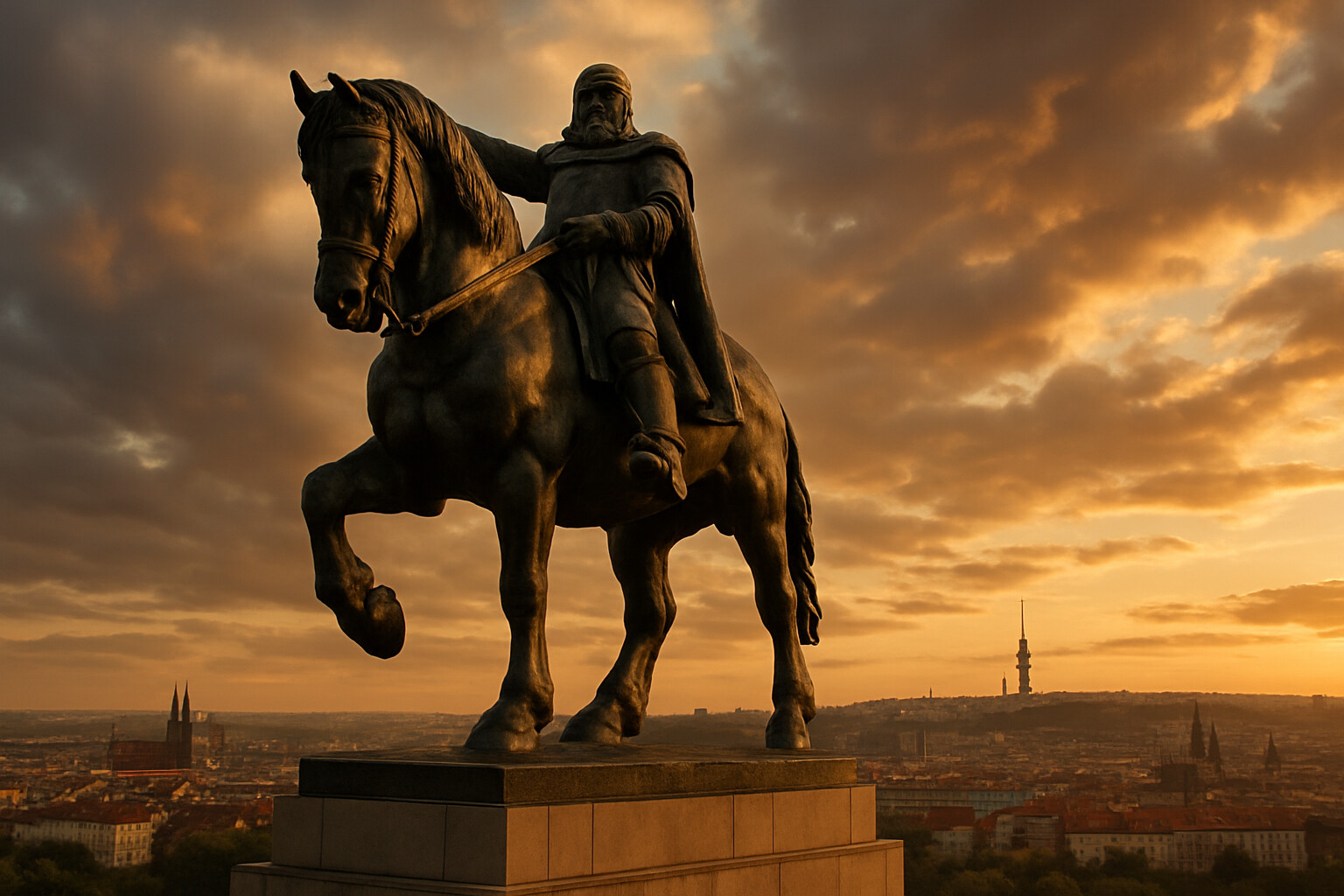
The city district of Žižkov in Prague, named in his honor after Vitkov Hill, stands today a few kilometers from where the crusading cavalry broke on those slopes in 1420. At the top of the hill there is a large equestrian bronze statue, cast in the twentieth century—one of the largest equestrian bronzes in the world. The figure is riding forward, one hand raised. He is not looking at anything. He cannot see where he is going. He is going anyway.
However the statue's makers intended it, that image captures something accurate about the historical record: a commander in motion, organizing the advance, past the point where most men would have stopped.
The Hussite wars were complicated, theologically dense, internally fractured, and frequently brutal on all sides. Žižka was a product of that violence and a shaper of it. He was not a saint or a simple hero. He could be ruthless—the burning of villages and execution of opponents were part of this war, and Žižka was not above those methods. What the record shows, clearly and repeatedly, is a military mind of the first order operating in conditions that should have made sustained success impossible.
Five years. Multiple crusades. No functioning eyes. No defeats.
The record is what it is.