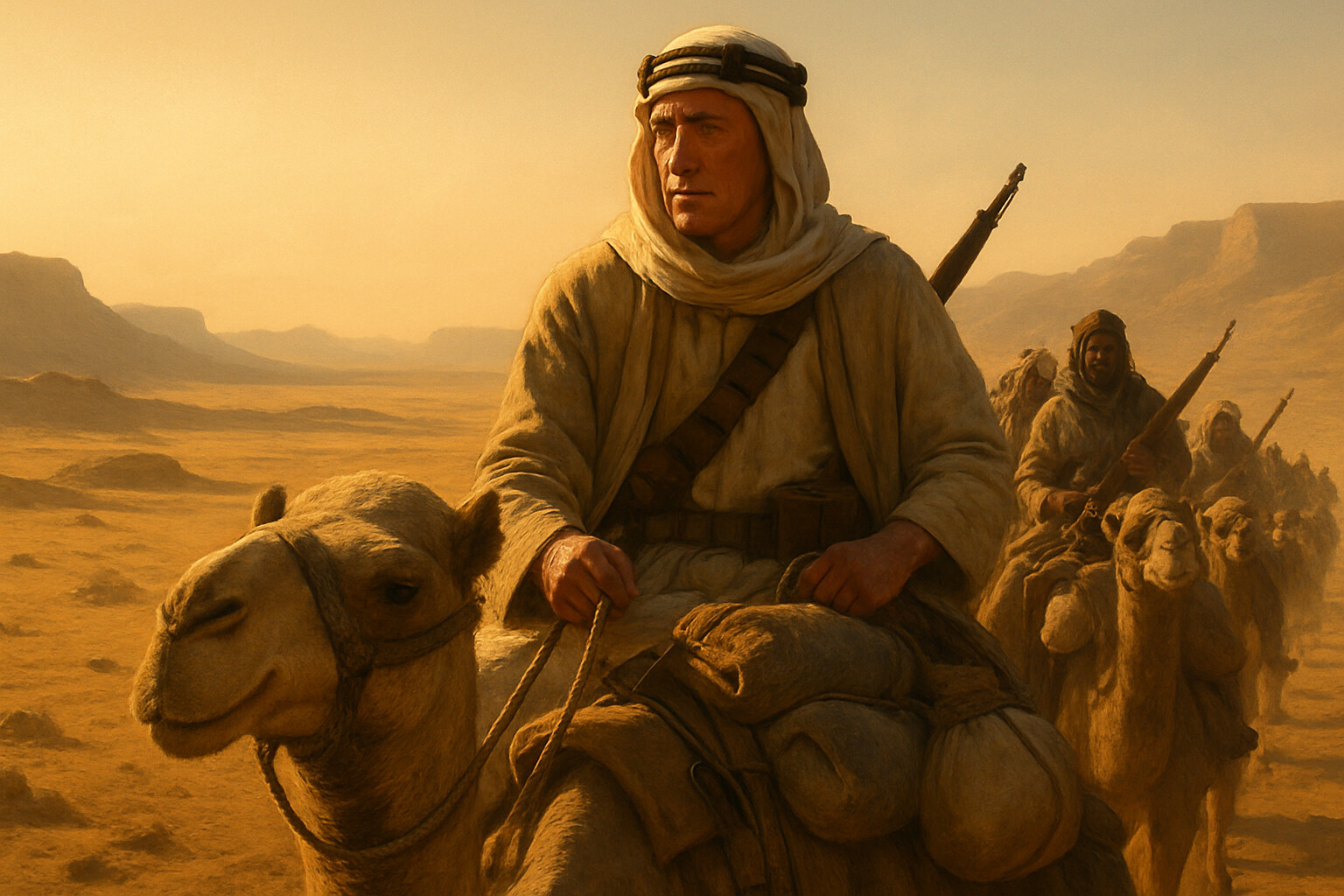
The camels were dying.
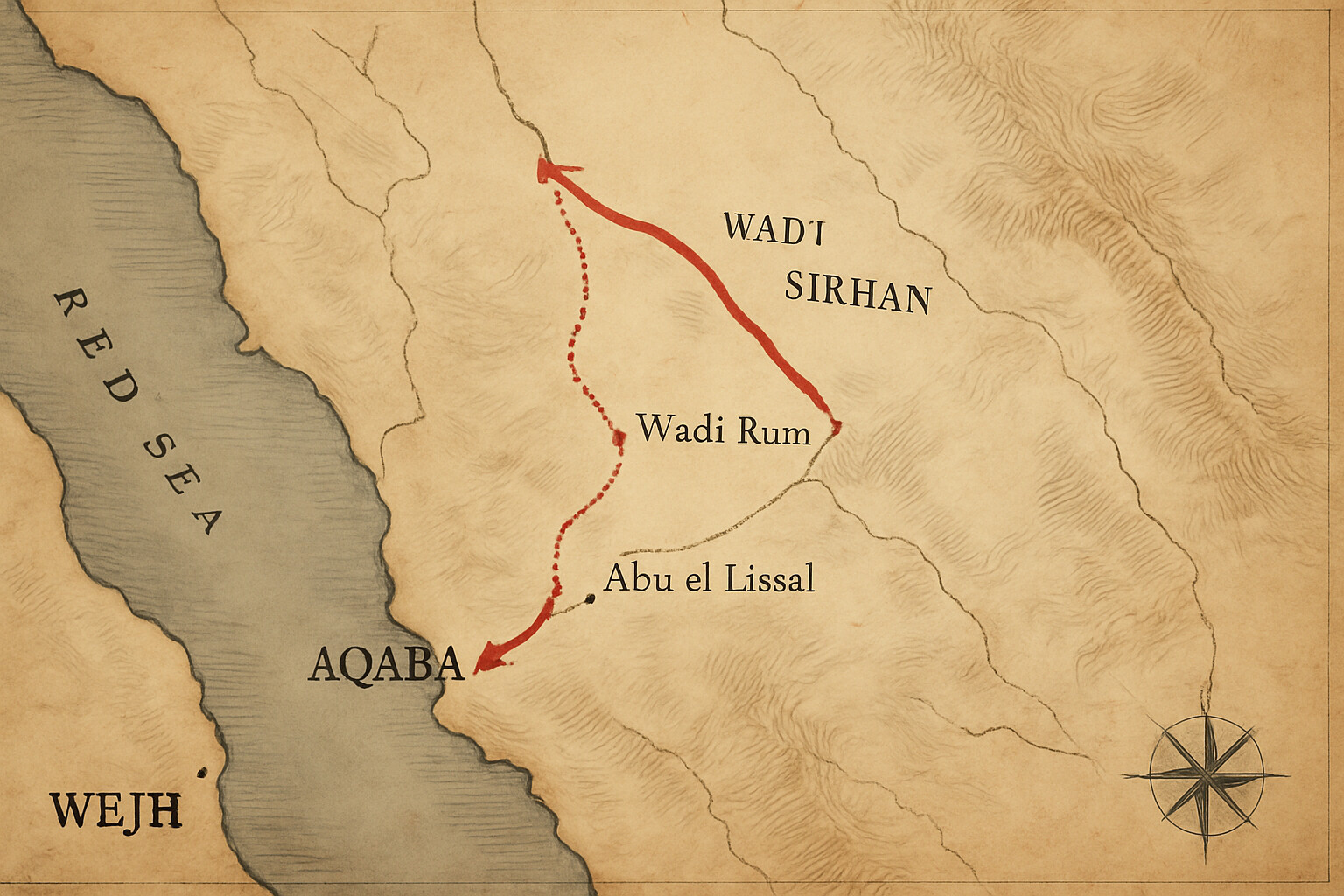
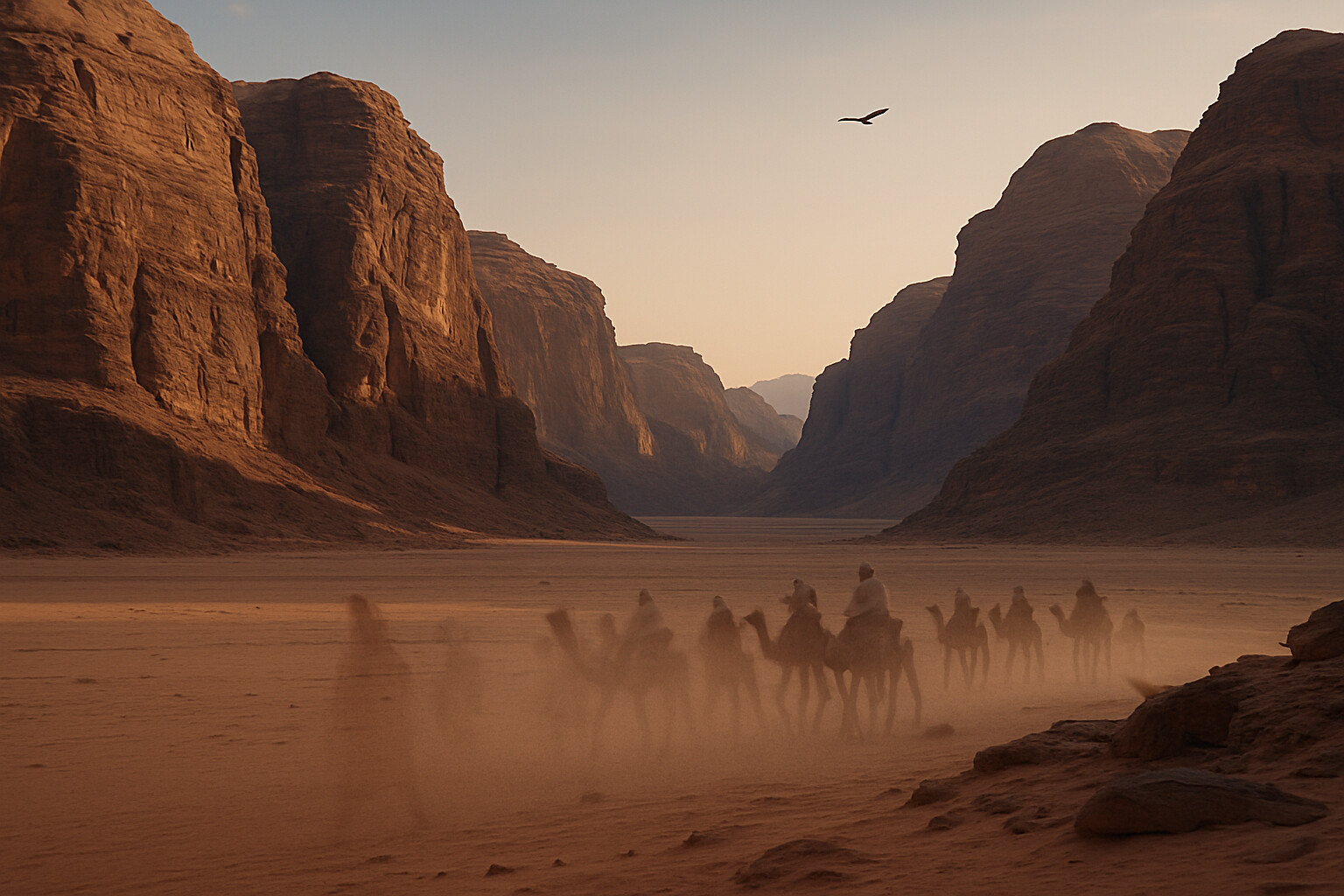
They had been moving for weeks through the Nefud — the great sand desert of northern Arabia — under a sun that turned the air into something actively hostile. Water was measured by the hour. Shade did not exist. Somewhere ahead, through the Wadi Sirhan and across the Hejaz plateau, lay a Red Sea port that the Ottoman Empire believed was safe from any landward attack because no rational force would approach it from the interior.
A force was approaching from the interior.
The date was early July 1917. Aqaba — at the northern tip of the Red Sea, commanding the gulf that bears its name — had its guns trained on the water. The Ottomans had fortified the port against an amphibious assault. They had not fortified it against a column of Howeitat tribesmen, Syrians, and one seconded British liaison officer who had ridden the better part of nine hundred miles across some of the most punishing terrain on earth to arrive at their backs.
What followed was not a conventional battle. It was the sudden collapse of an entire defensive logic.
---
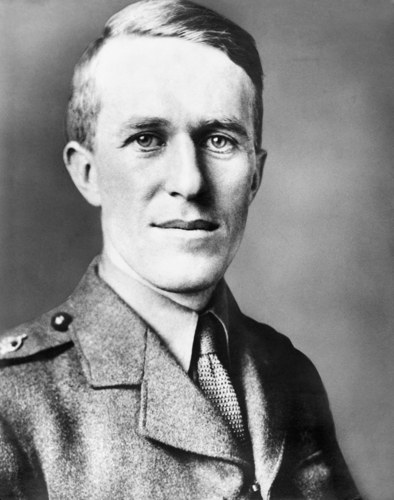
Thomas Edward Lawrence was twenty-eight years old when the Arab Revolt began in June 1916. He was not a conventional soldier by any standard measure. He had read history at Oxford, studied medieval fortifications, and traveled Arab lands before the war on archaeological work. He spoke Arabic. He understood, in ways that most British officers in Cairo did not, how the tribes of the Hejaz thought, moved, and fought.
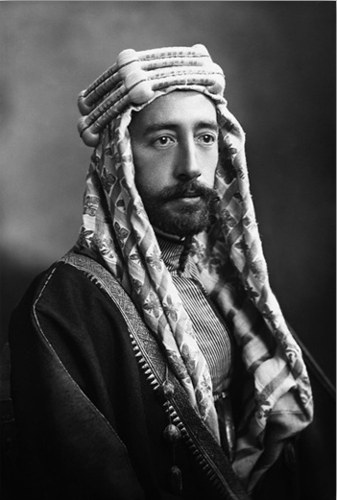
The British military establishment in Egypt had complicated feelings about him. He was brilliant, difficult, unconventional, and entirely uninterested in the routines of garrison soldiering. He held the rank of captain — later major — and operated primarily as a liaison and intelligence officer attached to the forces of Sharif Hussein of Mecca, whose sons Faisal and Abdullah were leading the revolt against Ottoman rule from their base in the Hejaz.
The Arab Revolt itself had strategic roots that went well beyond tribal grievance. Britain was fighting a global war. The Ottoman Empire was a German ally, and its control of the Arabian Peninsula, Palestine, and Mesopotamia tied down British forces and threatened British interests from Egypt to India. A successful Arab rising could divert Ottoman troops, cut the Hejaz Railway — the supply artery running south from Damascus through Medina — and open coastal ports for British logistical use.
By early 1917, the revolt had accomplished some of these goals and stalled on others. The Hejaz Railway had been raided repeatedly. Medina remained in Ottoman hands but was effectively besieged. British forces under General Archibald Murray had pushed into Sinai and were pressing toward Gaza. The question facing planners in Cairo was how to extend Arab operations northward — toward Syria, toward the Hauran, toward the flanks of whatever campaign would eventually aim at Jerusalem.
Aqaba was the key. Control of the port would give British ships a landing point for supplies, arms, and gold directly into the arena of northern Arab operations. It would establish a forward base from which Arab forces could threaten Ottoman communications in the north. And it would effectively link the Arab Revolt's theater to the wider British advance through Sinai and Palestine.
The problem was how to take it.
An amphibious assault had been considered and rejected. The port's seaward fortifications were substantial. A naval attack would be costly and might fail. The historical record is debated about how fully the landward approach was Lawrence's own conception versus a collaborative idea developed with the Arab Bureau in Cairo — but someone recognized that the guns facing seaward were the entire defensive calculation. If the attack came from the desert, there were almost no defenses at all.
The desert, in other words, was not merely the obstacle. It was the weapon.
---
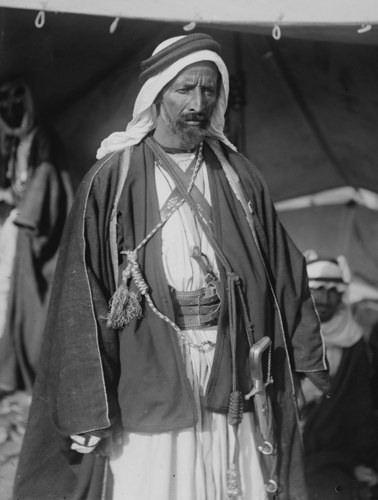
Lawrence departed the port of Wejh on the Red Sea coast in late May 1917. He traveled with a small initial party, carrying gold sovereigns provided by British Intelligence to recruit and pay Arab fighters along the route. The core of the eventual assault force would be drawn from the Howeitat tribe under their paramount chief Auda abu Tayi, whose territory lay east and north of Aqaba and who had his own reasons to oppose Ottoman authority.
Auda abu Tayi is one of the most vivid figures in the record of this campaign. A warrior of considerable reputation among the tribes of the northern Hejaz and the Wadi Rum region, he had fought on the Ottoman side before the revolt and then switched allegiance. His motivations were a mixture of tribal pride, personal animosity toward specific Ottoman officials, opportunity, and the gold Lawrence brought. He was not an ideological revolutionary. He was a practical man operating within the logic of tribal politics, and within that logic the raid on Aqaba made sense: it was audacious, it promised reputation and material gain, and it had British backing.
Lawrence's later accounts, published primarily in his memoir Seven Pillars of Wisdom, are vivid and detailed but must be read with care. Lawrence was a writer of exceptional gifts and a complicated relationship with strict factual accuracy. He revised his accounts, acknowledged some errors, and shaped his narrative with a literary consciousness that sometimes displaced material facts in favor of better prose. His descriptions of the route, the conditions, the personalities, and the fighting are the primary detailed source for the operation — but they require cross-checking against British military dispatches and later scholarship wherever possible. Where that cross-checking is not available, this account says so.
The route from Wejh was not a straight line. Lawrence and his party moved inland and northward into the Wadi Sirhan, the great seasonal watercourse running through the Nefud that served as a caravan route between Arabia and Syria. The Wadi Sirhan provided water points and cover. It also gave Lawrence access to additional tribes and the possibility of coordinating with factions beyond the original expedition's reach.
The heat in this season — late May and June in the Nefud interior — was extreme by any standard. Daytime temperatures in the Arabian interior during this period routinely exceed forty-five degrees Celsius. Camels, the transport and fighting platform of the entire operation, are more heat-tolerant than horses but not invincible. The march consumed animals and men steadily. Lawrence described the physical attrition in considerable detail in his memoir, and subsequent historians and travelers have generally accepted that the journey was genuinely grueling rather than merely dramatically framed.
One episode during the approach deserves careful treatment. Near the end of the desert crossing, Lawrence reportedly rode back alone across terrain the party had already covered to address a situation involving one of its members who had committed an offense that threatened to fracture the tribal coalition. Lawrence's account of this episode — which involved him personally executing a man to prevent a blood feud from destroying the alliance — appears in Seven Pillars of Wisdom and has been repeated widely in subsequent literature. It cannot be independently confirmed from any other source. Some historians accept the episode as essentially accurate; others consider it embellished or symbolically constructed after the fact. It is noted here as Lawrence's own account, without corroboration, and readers should treat it accordingly.
---
By late June and early July 1917, Lawrence and Auda had assembled a force estimated at several hundred Howeitat fighters, with additional tribal contingents and a small number of regular Arab troops. The precise composition and count is not firmly established in independent records. Lawrence's own figure of roughly six hundred men at the decisive stage is frequently cited; British military historians have found no strong reason to dispute the order of magnitude, though the exact number remains uncertain.
The tactical problem as they approached Aqaba's hinterland was the series of Ottoman-garrisoned positions guarding the approaches through the Wadi Itm — the valley descending from the plateau toward the port. These were not the main fortifications, which faced the sea, but they were posts that could delay or stop a raiding force and summon reinforcement.
The engagement at Abu el Lissal — the transliteration varies across sources — took place on approximately July 2, 1917, though the exact date is not established from sources independent of Lawrence's memoir. An Ottoman infantry force, variously estimated at between one hundred and several hundred soldiers, held a position near the wells at the head of the Wadi Itm.
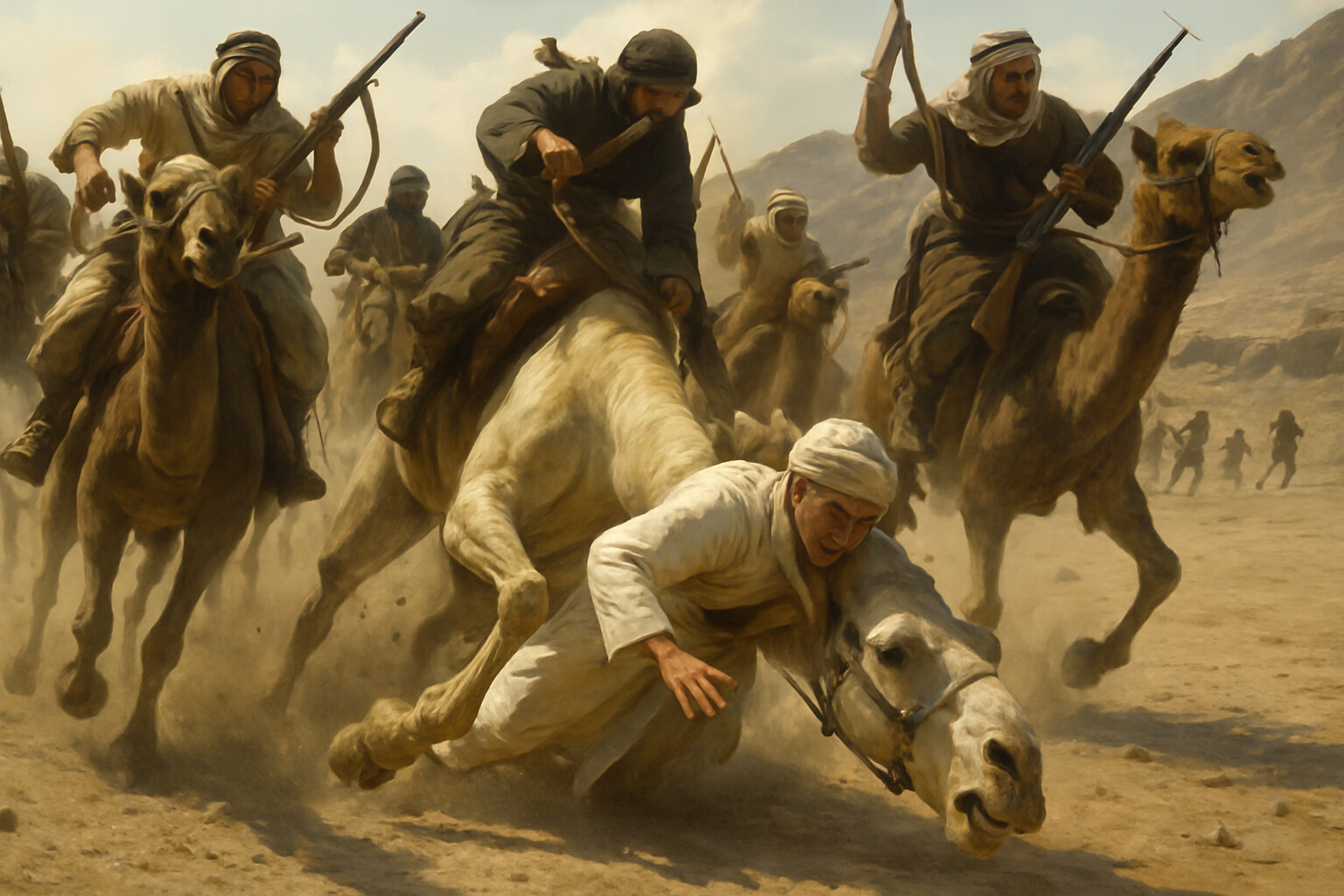
What happened next is described consistently across accounts, though in varying detail. The Arab force launched a mounted charge across open ground against the Ottoman position. Camel cavalry charging riflemen over open terrain is a tactically peculiar action — camels are not horses, and mounted charges in the European sense were not the standard mode of Arab tribal fighting, which favored harassment, ambush, and positional pressure. The charge at Abu el Lissal has attracted some historical discussion about whether it was a deliberate tactical decision or a spontaneous surge driven by the momentum of the approach. The outcome, by consistent account, was an Ottoman collapse. Lawrence later wrote that the charge covered roughly four hundred yards and that the Ottoman defenders, already shaken by the force and direction of the attack, broke before the Arab riders closed on their position. Ottoman casualties were reported as substantial — over a hundred killed or captured in Lawrence's account — while Arab losses were described as light. These figures come from Lawrence's own record and cannot be independently verified.
One additional detail: Lawrence reported that during the charge, his camel was shot from under him and he struck his head on the ground. The account appears in Seven Pillars of Wisdom and is often repeated; no independent witness account confirms it. It is noted here as part of Lawrence's narrative without corroboration.
The engagement at Abu el Lissal cleared the primary defensive positions before Aqaba. The road to the port was open.
---
On July 6, 1917, the combined Arab force descended from the plateau through the Wadi Itm and arrived at Aqaba.
The port's guns, as the entire strategic plan had anticipated, pointed out to sea. There was no prepared landward defense capable of stopping a force that had just crossed nine hundred miles of desert and broken the last Ottoman position in the heights. The Ottoman garrison — its size variously recorded, with figures between several hundred and upward of five hundred troops appearing in different sources, none authoritative — surrendered.
The town of Aqaba in 1917 was a small Red Sea port with a negligible civilian population. Its value was almost entirely geographic: a harbor at the head of the Gulf of Aqaba, commanding the approach to the Sinai and the Hejaz. What Lawrence and the Arab force now held was a door — open, on the right side, facing the direction of the war's next movements.
Lawrence understood immediately that the position had to be consolidated before Ottoman counterattack or the sheer logistical reality of supplying several hundred fighters at the end of a nine-hundred-mile desert line reasserted itself. There was almost no food in Aqaba. The wells were limited. The situation, despite the achievement, was precarious.
He left Aqaba almost immediately and rode across the Sinai Peninsula — roughly one hundred and fifty miles — to reach the British base at Suez. He completed the crossing in approximately forty-nine hours, according to his own account; the timing has not been independently verified, though the route distance is geographically consistent. The purpose was to report the capture directly and arrange immediate provisioning by sea.
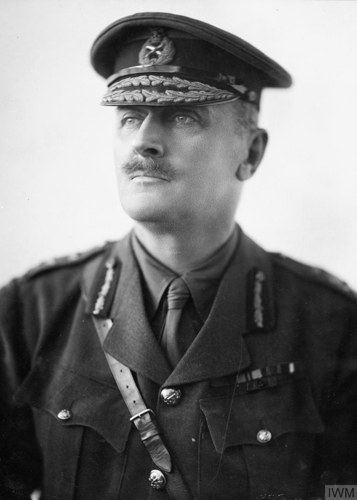
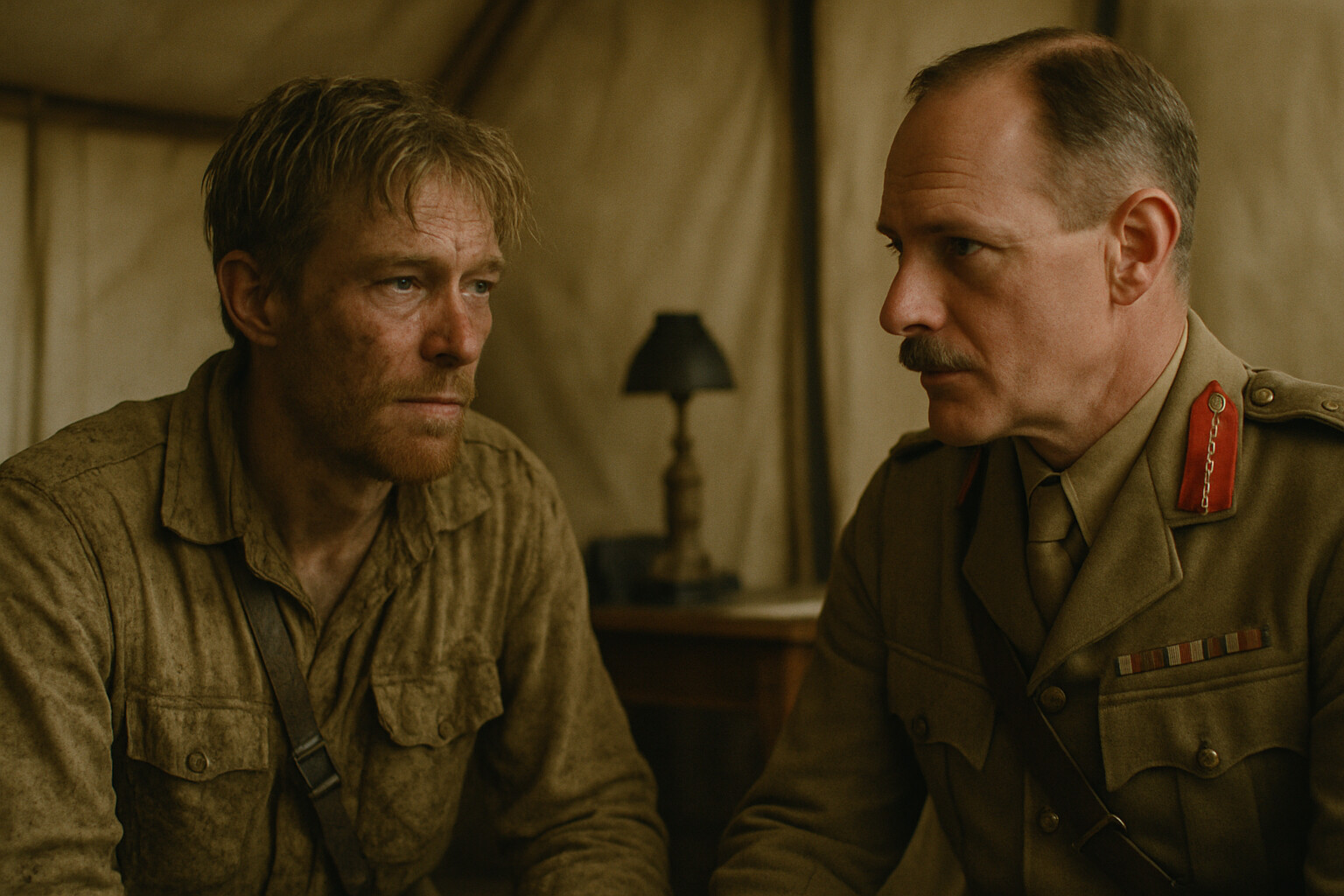
He arrived at Suez on approximately July 10, 1917, in the condition one might expect of a man who had spent six weeks crossing the Arabian interior. General Edmund Allenby had recently taken command of the Egyptian Expeditionary Force, replacing Murray, who had been removed following the failures at Gaza. The meeting between Lawrence and Allenby is among the better-documented encounters of this period, described in British military memoirs and official accounts as well as in Lawrence's own record. Allenby recognized immediately what the capture meant strategically: a coastal base for Arab operations that could support a northern advance toward Damascus and threaten the Ottoman right flank as his own force pushed toward Jerusalem.
The professional relationship between Allenby and Lawrence that followed became one of the more consequential command partnerships in the First World War's Middle Eastern theater. It was not without tension — Lawrence operated with unusual independence even by the standards of liaison officers, and his requests routinely bypassed normal military channels — but it was productive. Allenby later spoke of Lawrence with a respect that was not easily extracted from that particular general.
---
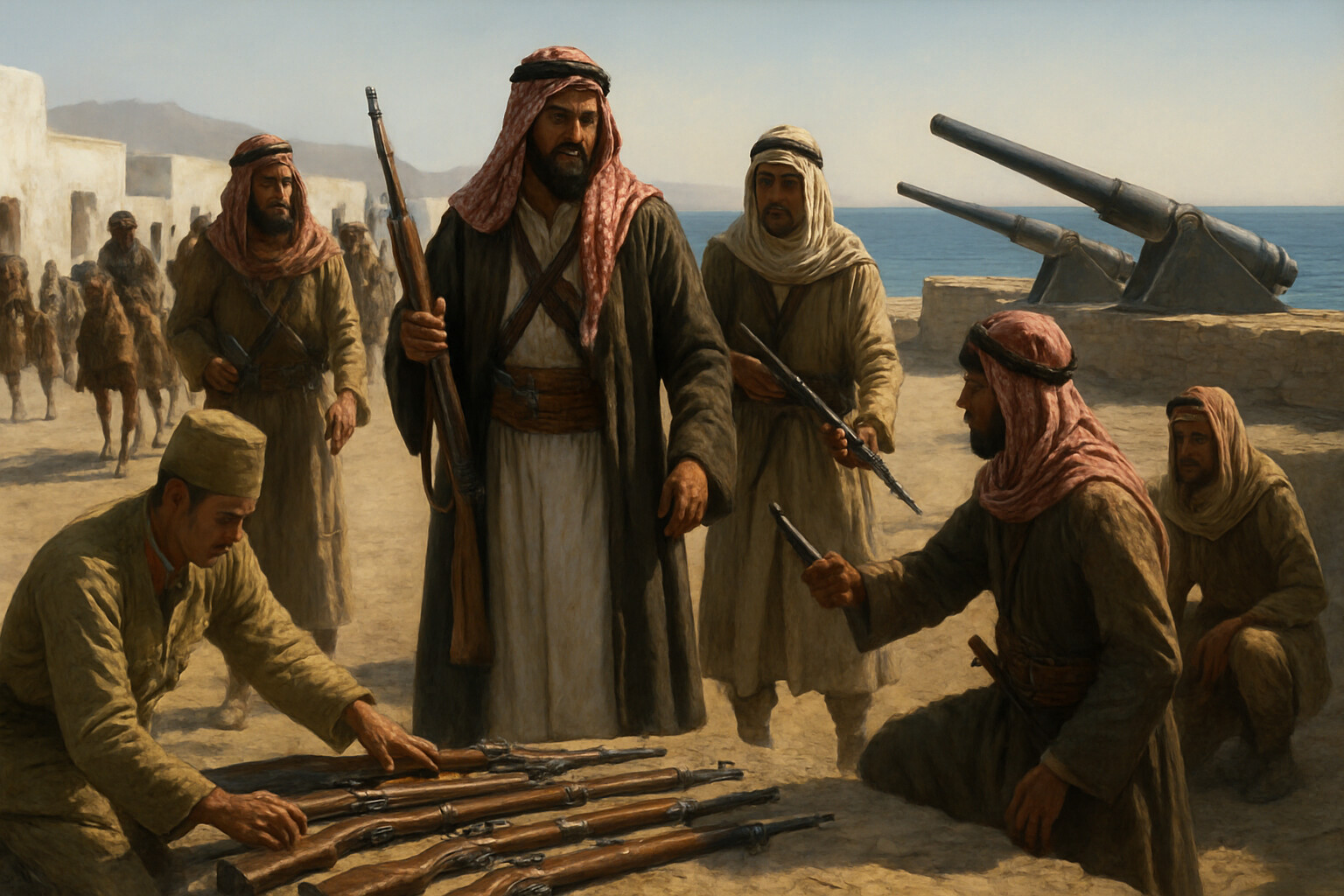
Before examining the aftermath, it is worth pausing on the weapons that shaped this campaign, because they are different from anything in the European theater and worth understanding on their terms.
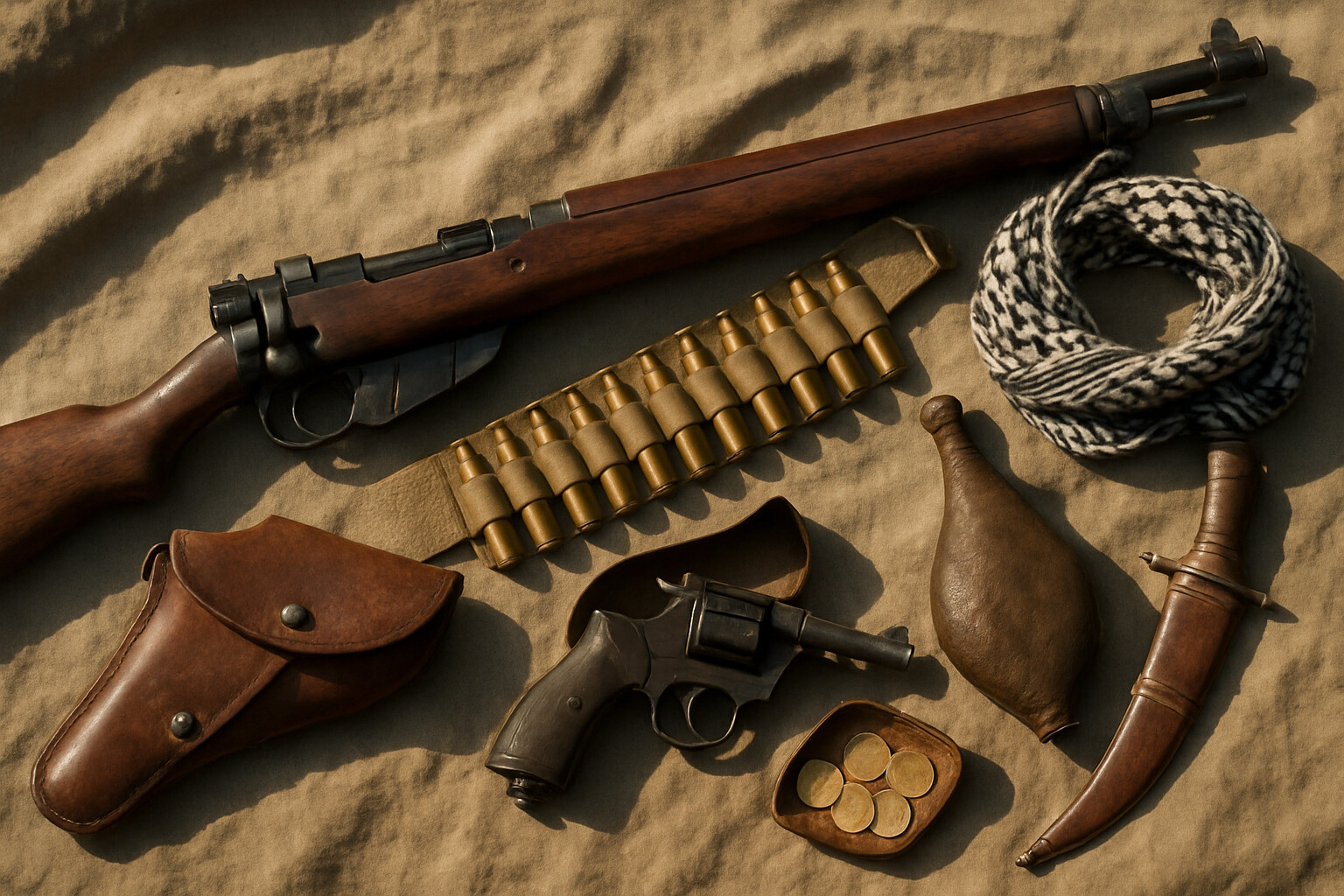
The primary personal weapons of Arab Revolt forces were bolt-action rifles, predominantly of varying make and origin. Many fighters carried Lee-Enfield rifles supplied through British channels — the standard British service rifle chambered in .303 British, accurate to several hundred yards in practiced hands, reliable in dusty conditions with reasonable maintenance. The Lee-Enfield's ten-round magazine gave it a faster practical rate of fire than most contemporaries. A trained British infantryman could deliver fifteen aimed rounds per minute; in the hit-and-run ambushes that defined Arab Revolt tactics, that volume of fire from a small party carried disproportionate weight.
Other fighters carried older or captured weapons — Mauser-pattern rifles of German or Ottoman manufacture, some Martini-Henry single-shots still in circulation — creating an ammunition supply problem that was never fully resolved throughout the revolt.
Lawrence's memoir references a Webley revolver and various rifles at different points, as was common for British officers operating in the field. The precise weapons he carried at Aqaba are not itemized in independent sources.
For indirect fire support on raids, the Arab forces used light mountain artillery pieces provided by Britain, capable of being broken down and transported by camel. Their role in the Aqaba operation was limited given the nature of the approach march and the speed of the final action.
On the Ottoman side at Aqaba, the garrison was armed with standard Ottoman infantry weapons: Mauser-pattern rifles in 7.92mm, and Maxim-pattern machine guns that formed the core of Ottoman crew-served firepower throughout the war. The coastal artillery was the port's principal military asset — but it pointed at the sea.
The Ottoman Mauser was a good weapon. The 7.92mm cartridge was powerful and accurate, and the Turkish soldier of the First World War had proven his quality repeatedly at Gallipoli and in Mesopotamia. The Ottoman garrison's failure at Aqaba was not a failure of weapons or men in isolation. It was a failure of defensive orientation, compounded by the shock of an attack from a direction that a rational assessment of the terrain should have made impossible.
That is perhaps the most important tactical observation about the entire operation: the desert crossing was itself the decisive weapon. Everything else — the rifles, the camels, the gold sovereigns holding the tribal alliance together — was in service of a single operational insight: a force willing to cross the Nefud would find Aqaba's defenses facing entirely the wrong direction.
---
The cost of the Aqaba operation is real but difficult to state precisely.
Arab casualties across the six-week operation are not recorded with the systematic documentation that European armies maintained for their dead and wounded. This reflects the different record-keeping traditions of the force, which was a tribal fighting coalition rather than a regimented military unit with unit diaries and casualty returns filed to a headquarters. Lawrence reported Arab losses as relatively light in the decisive engagements, particularly at Abu el Lissal. Camel casualties from the desert crossing itself were described as substantial — the animals that made the operation possible paid a considerable portion of its price.
On the wider scale: the Arab Revolt as a whole was a costly enterprise for those who fought it. The guerrilla campaign against the Hejaz Railway, which continued and intensified after Aqaba, involved repeated raids, ambushes, and the relentless physical attrition of extreme desert conditions sustained over more than two years. The promises made to Arab leadership by British officials — embodied in the correspondence between Sharif Hussein and High Commissioner Henry McMahon in 1915 and 1916 — were not kept in the form the Arabs understood them. The postwar settlement, the implementation of the Sykes-Picot Agreement, and the creation of European mandate territories in place of the Arab state that many revolt leaders believed they had been promised: these were the long-term costs that the campaign's military success could not prevent.
That political aftermath does not diminish the operational achievement of July 1917. But it is inseparable from any honest accounting of what the Arab Revolt ultimately meant for the people who fought it.
---
The historical record of the Aqaba operation rests on a narrow evidentiary base, and any serious treatment must acknowledge this directly.
The primary detailed narrative source is Lawrence's Seven Pillars of Wisdom, written in the early 1920s, published in a subscriber edition in 1926, and released to the general public in 1935. It is a work of extraordinary literary power and considerable historical value. It is also a memoir shaped by its author's particular vision, his literary ambitions, and his complicated self-regard. Lawrence himself acknowledged errors in the text and made revisions between editions. The work has to be treated as primary evidence — Lawrence was present, his knowledge of events was detailed, and his physical descriptions of terrain and logistics have been verified by subsequent travelers and researchers — while also being read critically.
British military records held at The National Archives contain dispatches and reports related to the Arab Revolt, including messages from Lawrence to his superiors in Cairo. These provide independent anchoring for key events, dates, and outcomes, though they are less detailed than the memoir on tactical specifics.
Scholarly works that have examined the campaign with critical rigor include Jeremy Wilson's authorized biography Lawrence of Arabia, published in 1989, which is regarded as the most comprehensively researched single-volume treatment and which cross-checked Lawrence's account against available archival material. Scott Anderson's Lawrence in Arabia (2013) provides accessible and well-sourced narrative history placing Lawrence's role in broader context. James Barr's Setting the Desert on Fire (2006) draws on British, Arab, and French archival material. David Lean's 1962 film Lawrence of Arabia shaped popular understanding of these events for generations; it should be understood as artistic interpretation, not historical record.
Auda abu Tayi's perspective is less well-documented in Western sources. Arabic accounts of the revolt, where accessible, complicate and enrich the picture Lawrence painted — in some cases confirming his tactical observations, in others emphasizing different priorities and different understandings of what was being fought for.
The question of Lawrence's personal role — how much of the strategic conception was his, how much was collaborative with Arab leaders and British intelligence staff in Cairo, and how much has been enlarged in the retelling — is one that historians continue to examine. The capture of Aqaba was a collective achievement. Lawrence was unquestionably central to its planning and execution. The precise apportionment of initiative between Lawrence, Auda, Faisal, and the Arab Bureau is more complicated than the heroic individual narrative allows.
---
What did Aqaba mean?
In the immediate military sense: Allenby received a base of operations on the Arab flank of his Palestine campaign at precisely the moment he needed it. The supply line through Aqaba allowed Arab forces to be armed, fed, and directed toward raids on Ottoman communications in the Hejaz and southern Syria. These raids — the destruction of railway bridges, the ambush of repair crews, the wrecking of locomotives — did not sever the Hejaz line permanently, but they kept Ottoman forces tied down in defensive postures along several hundred miles of railway that would otherwise have been available for the fighting front.
Allenby's campaign culminated in the capture of Jerusalem in December 1917 and the decisive victory at Megiddo in September 1918, which shattered Ottoman forces in Palestine. Arab forces, operating from the base that Aqaba made possible, contributed to the eastern flank of that final offensive and entered Damascus in October 1918 — an entry that carried enormous symbolic weight for the Arab national movement, regardless of the political disappointments that followed.
In the longer perspective, Aqaba demonstrated something that irregular warfare specialists have returned to repeatedly: the most formidable geographic obstacle can become an avenue of approach for a force willing to accept what crossing it costs. The Ottomans had made a rational defensive calculation based on the assumption that no meaningful force could traverse the Nefud and the Hejaz interior in high summer. They were wrong — not because the desert was less terrible than they thought, but because Lawrence and Auda and the Howeitat were willing to absorb what it took to prove the assumption false.
The moral and political dimensions of Lawrence's role — his stated conviction that Britain was using the Arab Revolt instrumentally, his understanding of the gap between the promises made and the settlement that was coming, his personal reckoning with what he had asked Arab fighters to do in British strategic interests — are recorded in his own writings and in accounts by those who knew him. Whether one reads those dimensions as genuine moral anguish or as part of a romantic self-construction, they are part of the historical record of the man and the campaign.
Lawrence left the army after the war and passed through a restless series of identities — political advisor, writer, enlisted airman under assumed names, finally a relatively private existence at his cottage in Dorset. He was killed on May 19, 1935, when his Brough Superior motorcycle crashed near his home at Clouds Hill after he swerved to avoid cyclists. He died six days later without regaining consciousness. He was forty-six years old. His ashes are buried in the churchyard at Moreton in Dorset.
The campaign he helped lead through the Arabian desert in 1917 remains one of the more unusual episodes in British military history: a largely mounted, mostly tribal, partly improvised operation conducted across some of the most hostile terrain on earth, that succeeded precisely because it was considered impossible.
The port of Aqaba today is the city of Aqaba in southwestern Jordan — a modern urban center and resort on the Gulf of Aqaba. The geography that defined the 1917 operation is still there: the escarpment to the east, the Wadi Itm descending to the sea, the Wadi Rum to the northeast with its towering sandstone formations. Travelers who visit recognize it from the landscape, even when they do not know the history.
The desert through which Lawrence and Auda rode is still there too — still largely impassable, still indifferent to anyone who crosses it. In the summer of 1917, a British liaison officer and several hundred Arab fighters crossed it anyway, and arrived at the sea.