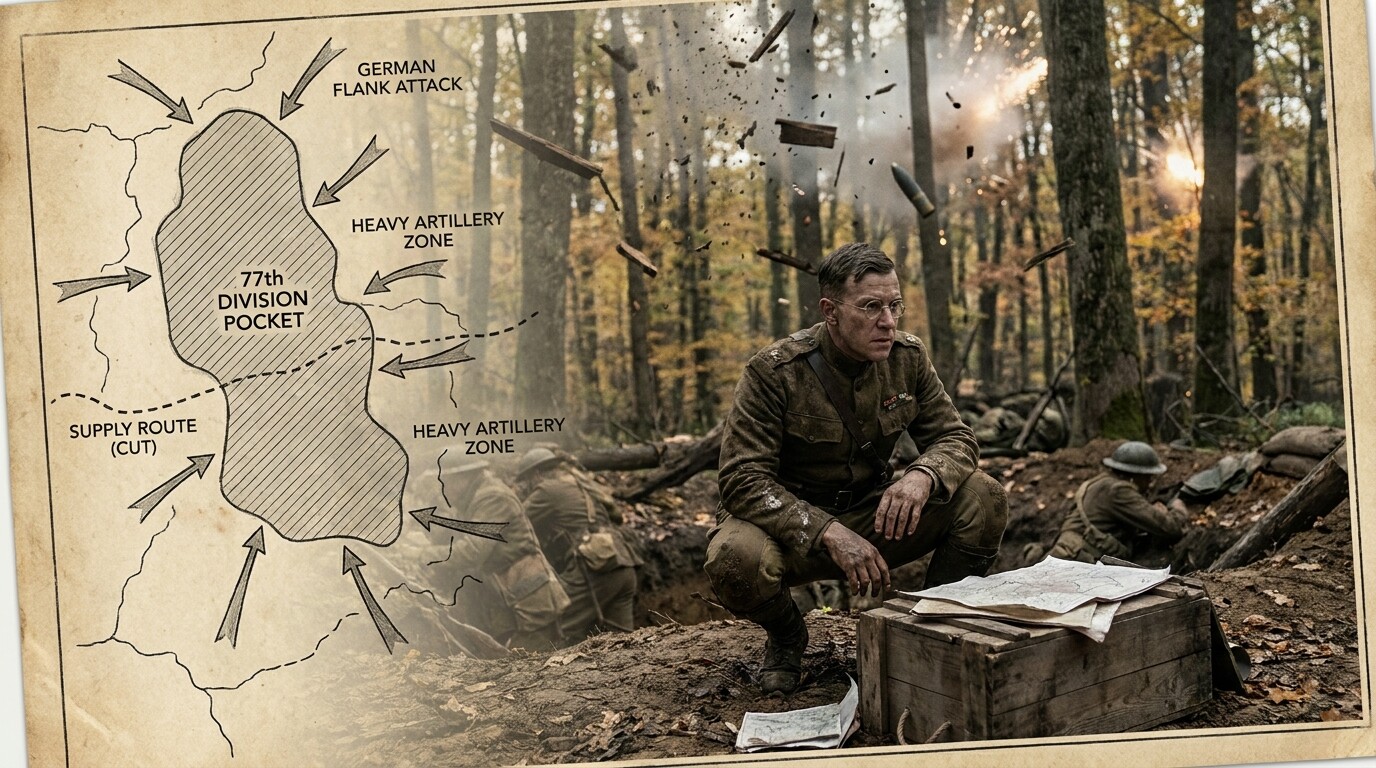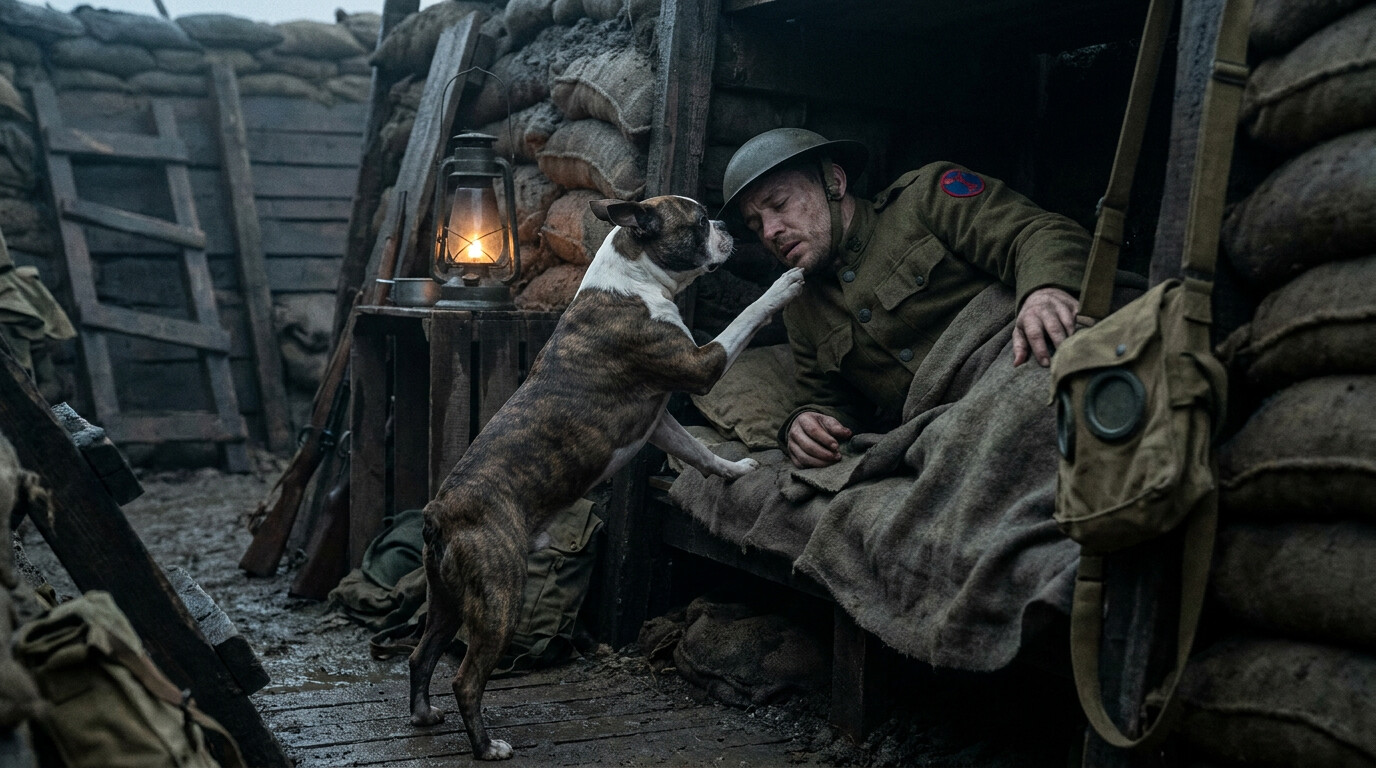
The dog moved before the men did.
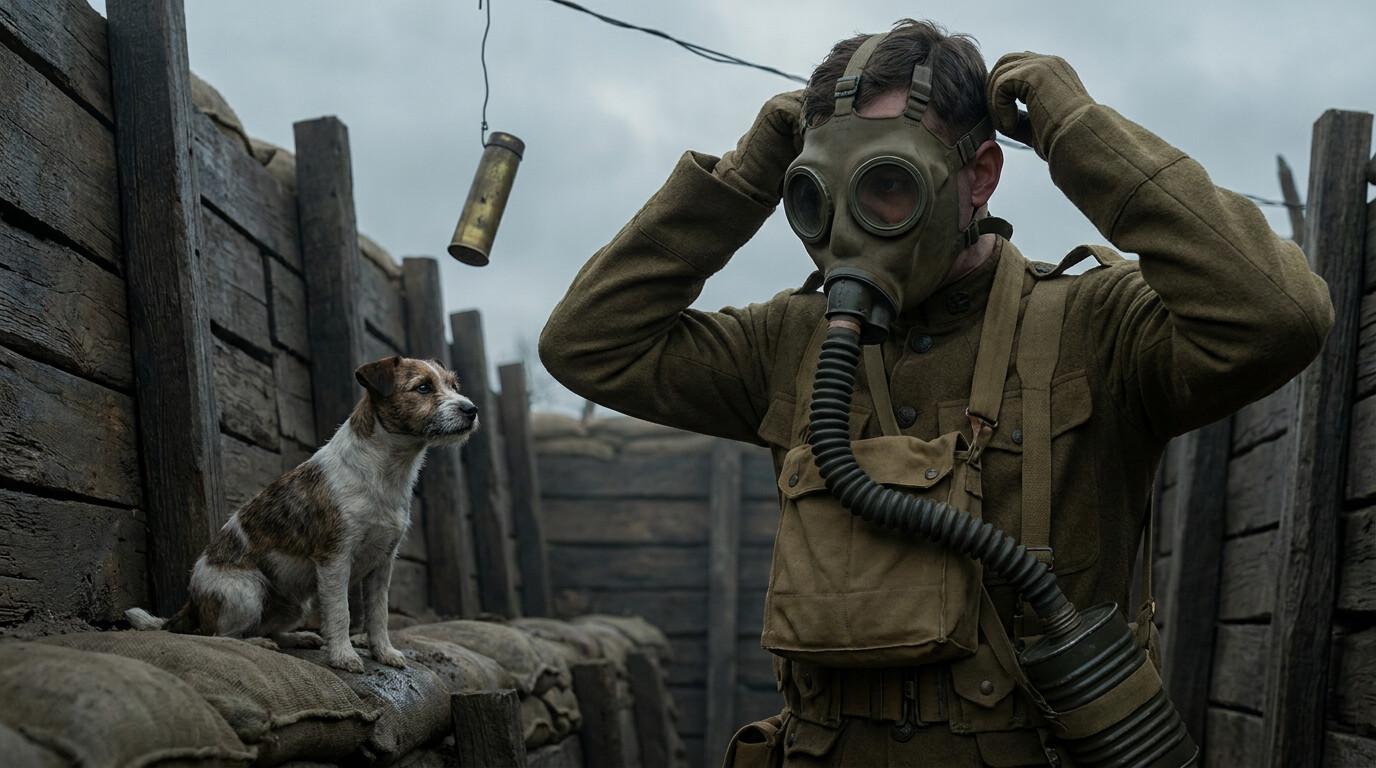
Sometime in the predawn hours of a gas-alert morning along the American sector of the Western Front in 1918, a small brindle-and-white dog stirred inside the dugout, pressed his abbreviated muzzle against a soldier's face, and would not stop. He pawed. He barked. He turned in tight circles. The soldiers, trained by then to read the dog the way they might read a shift in wind or the sudden silence of artillery, pulled on their gas masks. The alert spread through the trench.
The precise timeline of incidents like this one exists in the overlap between unit daily logs and the oral tradition preserved by men who survived. Which chemical agent was involved, and on which specific date, is not recorded with certainty in every account. But the core of it—a dog detecting something lethal in the air before human senses registered anything, and acting on it—was reported often enough by enough survivors that it carries a weight that simple embellishment rarely sustains.
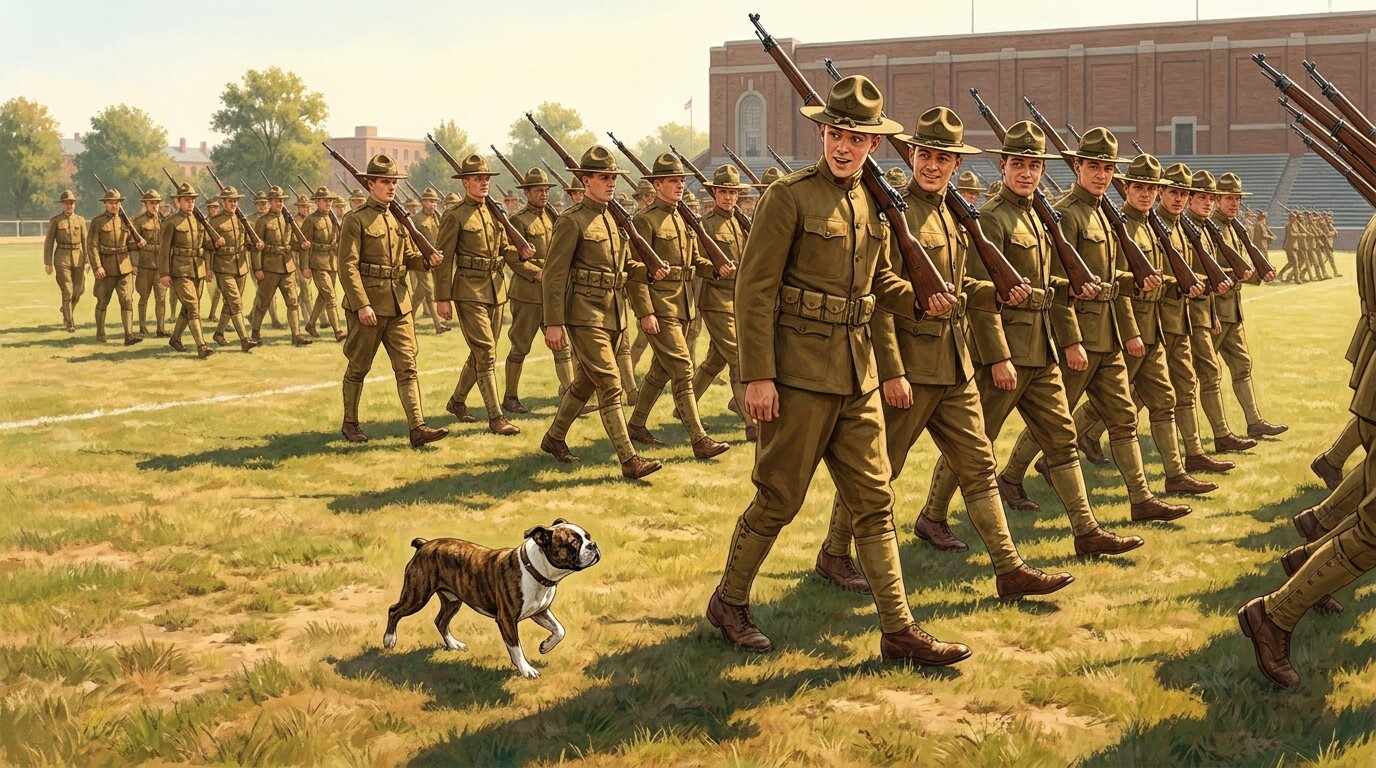
His name was Stubby. He had no official rank when he arrived in France, no service number, no military occupational specialty. He was a short-legged, broad-chested terrier mix of uncertain breeding and certain stubbornness who had wandered onto the grounds of Yale Field in New Haven, Connecticut, sometime in the summer of 1917, found a group of soldiers drilling in the heat, and made a decision. He stayed.
---
The United States entered the First World War in April 1917 with a declaration of war against Germany, but the men available to fight it were not yet soldiers in any meaningful tactical sense. The National Army and the reconstituted National Guard faced the challenge of building a modern military force from a population that had not fought a large-scale land war since 1865, and the training system was improvised under pressure. At Yale Field in New Haven, elements of what would become the 102nd Infantry Regiment, 26th Division, began their preparation. The 26th was a National Guard division drawn largely from New England states—Massachusetts, Connecticut, Maine, New Hampshire, Vermont, Rhode Island—and it carried the informal designation the Yankee Division, a name that stuck because it was accurate and because the men were proud of it.
The 26th Division would become one of the first complete American divisions to reach the Western Front. That distinction came with a cost: they arrived before American logistical infrastructure was mature, before the full weight of the American Expeditionary Forces could be brought to bear, and in a sector of the front where the war had already consumed years and an almost incomprehensible number of lives.
Into this formation, sometime in the summer of 1917, walked a dog.
According to accounts preserved through J. Robert Conroy—the private from New Britain, Connecticut, who would become the closest thing Stubby had to an owner—the dog appeared at Yale Field during a period of drill and made himself comfortable among the trainees. He was compact and muscular, with a smooth short coat in brindle tones and white markings, a broad skull, and the characteristically abbreviated tail that gave him his name. His breed has been described in various sources as a Boston terrier or a Boston terrier mix. The Smithsonian Institution's National Museum of American History, which holds his preserved remains and personal effects, describes him as a mixed-breed dog with Boston terrier characteristics. He was not purebred, and that detail is in some ways the right one—a purebred show dog would have been a curiosity; Stubby's ambiguous, working-class origins matched the division around him.
Conroy taught him to salute—sitting up and lifting one paw toward his forehead when a soldier raised a hand in greeting. Whether this was deliberate training or an evolution of the dog's natural attention-seeking behavior is not established in the record. What is established is that the behavior worked, and worked well enough that when Conroy eventually smuggled Stubby aboard the troop transport for France, the dog's calm demeanor and his salute reportedly helped defuse any official objection. The specific method of concealment varies across accounts—a coal bin, a kit bag, or simple boldness are all mentioned—and the details differ enough that no single version should be presented as certain. What the accounts agree on is that Stubby made the crossing.
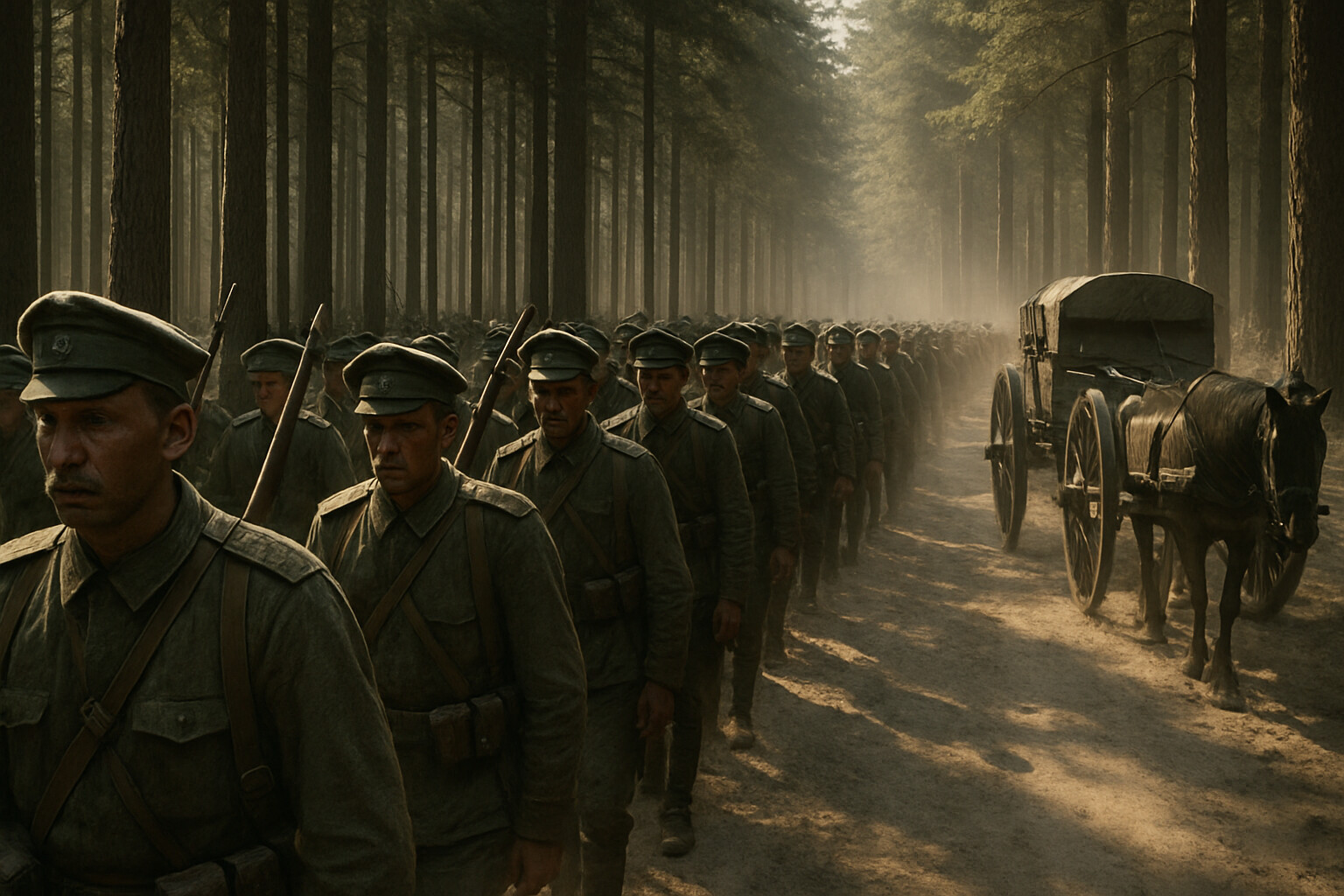
The 102nd Infantry, as part of the 26th Division, arrived in France in late 1917 and began integration into Allied front-line operations. French and British commanders were aware that American troops needed time to absorb the hard-won tactical knowledge that had been purchased across three years of trench warfare, and American units initially entered relatively quiet sectors under Allied tutelage before being committed to major offensive operations.
---
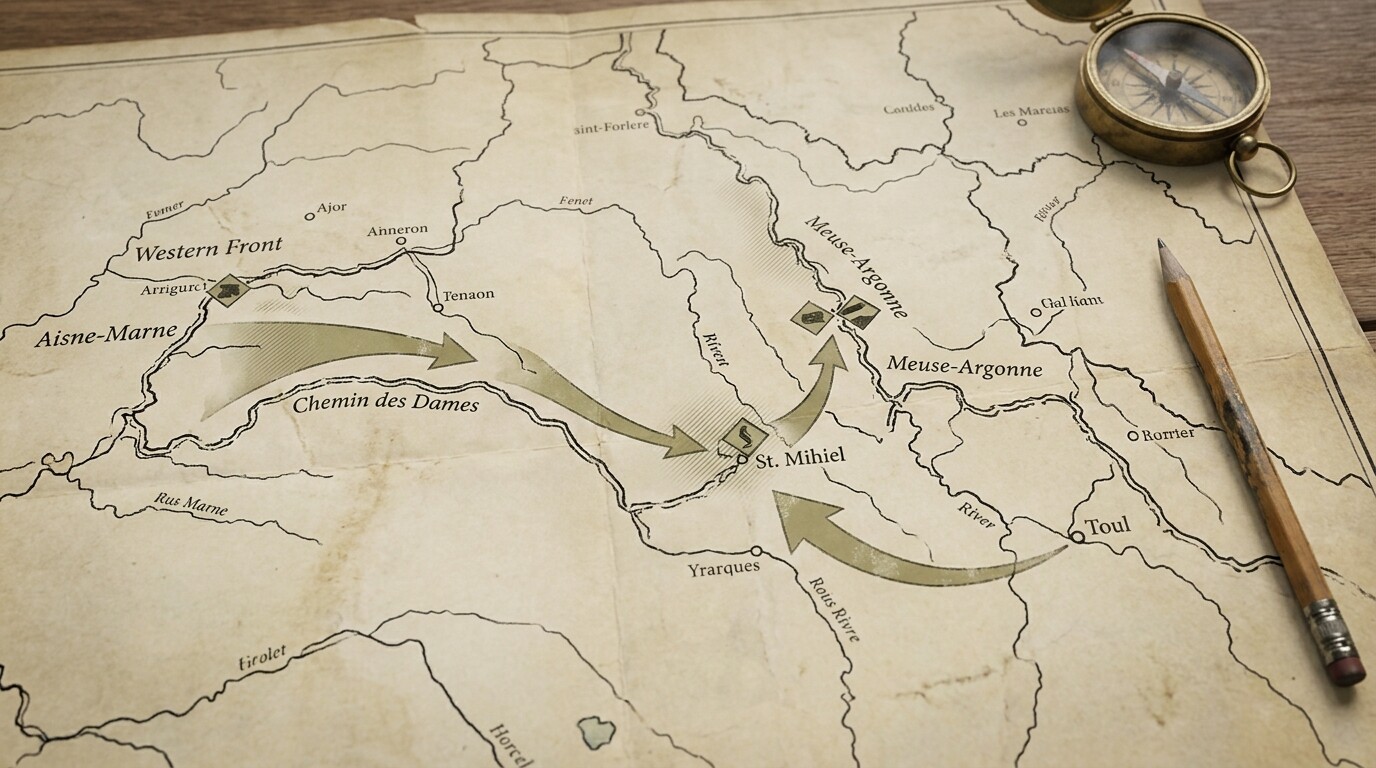
The Western Front in late 1917 and through 1918 was a landscape that had been fought over so long it had ceased to resemble the countryside it had once been. The Meuse River and the Argonne Forest in northeastern France—where Stubby and the men of the 102nd would eventually operate—presented terrain that compounded every military difficulty. The Argonne was dense, broken woodland cut by ravines and ridgelines, well suited to the layered German defensive positions that had stopped Allied advances for years. Villages that appeared on maps as intact communities were often ruins. The infrastructure of agriculture and civilian life had been systematically destroyed or had simply collapsed under years of shelling.
The trench systems the 26th Division occupied were not the temporary field fortifications that the word trench sometimes conjures. By 1917–1918 they were complex engineering works: parallel lines of excavation connected by communication trenches, reinforced with timber and sandbags and corrugated iron, fitted with dugout rooms cut below the trench floor where soldiers could sleep, store equipment, and shelter from bombardment. The dugouts smelled of damp earth, human bodies, wet wool, gun oil, and the pervasive chemical residue of previous gas attacks. Rats were a constant presence. Lice were universal. The mud of northern France and the Argonne, churned by shells and rain and the boots of millions of men, was a physical antagonist in its own right.
In this environment, a dog was not merely a mascot. He was a presence that broke the psychological weight of the trenches in ways that no military planner could have designed. Men who had not touched an animal in months, who had not been in a domestic space in a year, found in Stubby something ordinary. He slept in dugouts, curled against men who were cold. According to the consistent account of survivors, he remained calm under bombardment in a way that told the soldiers around him something about the moment. Dogs are not inert under shellfire. That Stubby stayed, and stayed close to the men, was noticed.
But the documented operational contributions are more specific than comfort.
The gas threat on the Western Front in 1917–1918 was lethal and varied. German chemical warfare had advanced significantly from the early chlorine attacks of 1915. Phosgene, which was colorless and smelled faintly of fresh hay, could not be detected visually. Mustard gas—technically a vesicant, not a true gas—was an oily liquid that off-gassed vapors and could contaminate ground, equipment, clothing, and skin for hours or days. It was not immediately fatal but caused severe blistering of the eyes, throat, and respiratory tract. Both agents required a soldier to mask quickly; delays of even seconds could mean permanent injury. The standard American gas mask issued to AEF troops was the British-derived Small Box Respirator—a rubberized face piece connected to a canister filter worn on the chest, effective against most agents if donned promptly.
Dogs have olfactory systems estimated at roughly forty times more sensitive than human noses. Whether Stubby specifically identified German chemical agents by scent or was responding to the physiological effects of trace concentrations—irritation of his mucous membranes that caused distress—is not a question the historical record answers directly. What the record does carry, through survivor accounts, is the behavioral pattern: Stubby reacted to gas before the men could smell or see it, and the men had learned to act on that reaction. This is not described in contemporary military documents as a formal gas-detection protocol. It appears to have been informal, learned behavior on both sides of the relationship—the dog alerted, the men masked. That it was reported consistently enough by enough survivors to be remembered across decades suggests it was not a coincidence.
He was also wounded. In the Chemin des Dames sector—a ridge in the Aisne region of France that had been the site of catastrophic French losses in 1917—Stubby was hit by a German hand grenade fragment. The wound was to his left foreleg and chest area, according to accounts. He was treated at a field hospital and recovered in the care of the unit's medical personnel. Accounts also describe French women in a nearby town making him a chamois blanket to carry his medals and insignia; this detail appears consistently enough across sources to be treated as well-supported tradition, though the specific community is not named consistently. He returned to the unit.
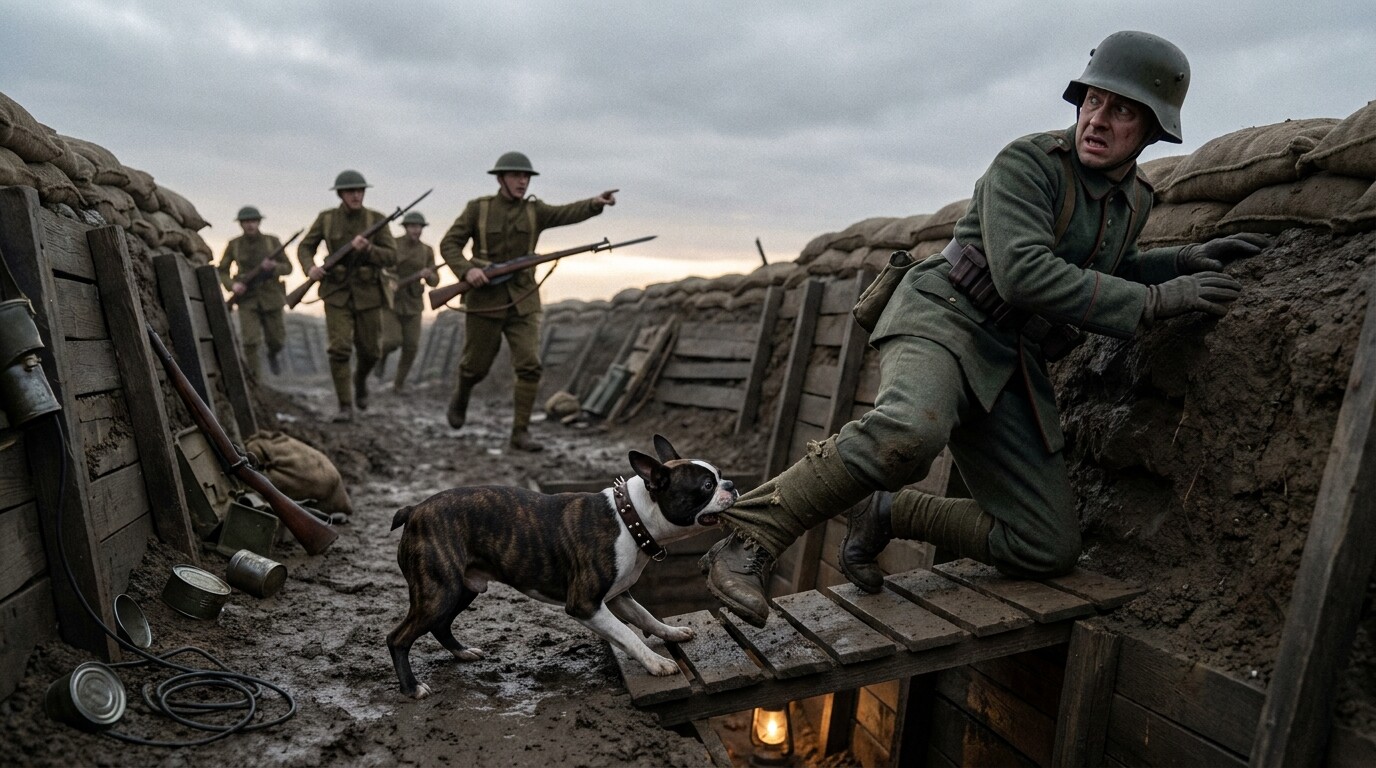
The German infiltrator incident is the most dramatic episode in Stubby's reported service, and it requires the most careful handling because it rests substantially on accounts recorded after the fact.
The broad outline is consistent across multiple sources: during a period of relative quiet in a forward position, Stubby encountered a German soldier moving through the Allied lines—possibly on a reconnaissance mission, possibly mapping American positions, possibly an individual who had become separated from his own lines. The German attempted to flee. Stubby seized him by the seat of the trousers or the leg—accounts vary on the specific hold—and held him in place until American soldiers reached the location and took the man prisoner. The prisoner was reported to be carrying materials consistent with a mapping or intelligence mission.
This event appears in contemporaneous accounts by soldiers of the 102nd Infantry. It cannot be verified through a named prisoner's post-war account or any accessible German document. The core of the story—that Stubby detained a German soldier until troops arrived—was affirmed by enough men present that it should not be dismissed. But it also cannot be corroborated with the same documentation that would establish a named officer's position during a named engagement. It belongs in the category of well-attested military tradition: reported by credible witnesses, consistent in outline, not contradicted by other evidence, but not independently confirmed from the German side.
What happened over those eighteen months was cumulative. The 26th Division participated in significant engagements: the defense of the Toul sector, the Aisne-Marne operations following the German spring offensives of 1918, the St. Mihiel salient operation in September 1918, and the Meuse-Argonne offensive—the largest American military operation in history to that point, involving over one million American troops attacking in difficult terrain against prepared German defensive positions from late September through November 11, 1918.
The Meuse-Argonne was neither quick nor clean. The Argonne Forest's terrain channeled attacking forces into killing grounds covered by German machine guns, artillery, and mortars. American troops fought through ravines and broken ridges against defenders who had prepared their positions for years. The cost was severe: the AEF suffered over 26,000 killed and more than 95,000 wounded in the Meuse-Argonne alone, across forty-seven days of fighting. The 26th Division participated in these operations, and the men of the 102nd Infantry who moved through that terrain did so with a clear awareness of what lay ahead.
Stubby was there. Where precisely—moving with the headquarters element, staying with specific companies, or held at a rear position during large-scale assaults—is not documented with the specificity that would allow precise placement. The records and the unit history place him with the 102nd Infantry throughout the campaign. The operational detail of his location during specific assaults is less certain.
What the record is clear about is what happened after.
---
The equipment around Stubby and the men of the 102nd Infantry tells its own story. American infantrymen on the Western Front in 1917–1918 carried the Springfield Model 1903 rifle—a bolt-action weapon chambered for the .30-06 cartridge, accurate and reliable, but requiring more machining time to produce than rapid mobilization allowed. As that production strain grew, the Enfield Pattern 1917—originally designed for the British Lee-Enfield round but rechambered for American .30-06 and manufactured in American factories—was issued alongside the Springfield. By the end of the war, more American soldiers carried the M1917 Enfield than the Springfield. Both were bolt-action, requiring the shooter to manually cycle a bolt between shots; both were capable of accurate fire at ranges well beyond most engagements in the confined trench environment.
The German infantryman's primary weapon was the Gewehr 98—also bolt-action, also effective. In the close-range, nighttime infiltration operations that produced encounters like the one Stubby reportedly disrupted, both sides supplemented or replaced their rifles with pistols, trench knives, and shorter weapons better suited to confined trench spaces than a full-length service rifle.
Machine guns defined the tactical landscape of the Western Front in ways that shaped everything about how infantry operated. The German MG 08—a variant of the Maxim design, water-cooled, belt-fed, capable of sustained fire at rates that could sweep an open field in seconds—was a primary reason why infantry attacks across No Man's Land required artillery preparation and cost so many lives when that preparation failed or when German positions survived the bombardment. American units employed the Browning M1917 water-cooled machine gun and the French Chauchat light automatic rifle. The Chauchat was mechanically unreliable, particularly the American-caliber version, and was poorly regarded by the troops who carried it. The Browning, introduced in 1917, was more reliable and would serve the American military for decades.
The artillery that defined the soundscape of the Western Front—the rolling barrage, the counter-battery fire, the harassing rounds falling on road junctions and assembly points—ranged from the French 75mm field gun to heavy siege pieces firing shells weighing hundreds of pounds. The 26th Division operated under a system where artillery preparation and coordination were central to any forward movement. When coordination worked, infantry could follow a moving wall of shells. When it failed, or when shells fell short, or when German defensive positions survived, men died in the open.
And there was the gas. The Small Box Respirator issued to American troops was a capable piece of engineering—a rubberized face piece with eyepieces, a breathing valve, and a hose leading to a filtered canister that absorbed most chemical agents in use by 1918. The gap between the equipment's capability and a soldier's survival was the time required to put it on: with cold-numbed fingers, in the dark, while disoriented or under fire. The few seconds of warning that Stubby's behavior reportedly provided mattered not as a curiosity but as the difference between masked in time and not.
---
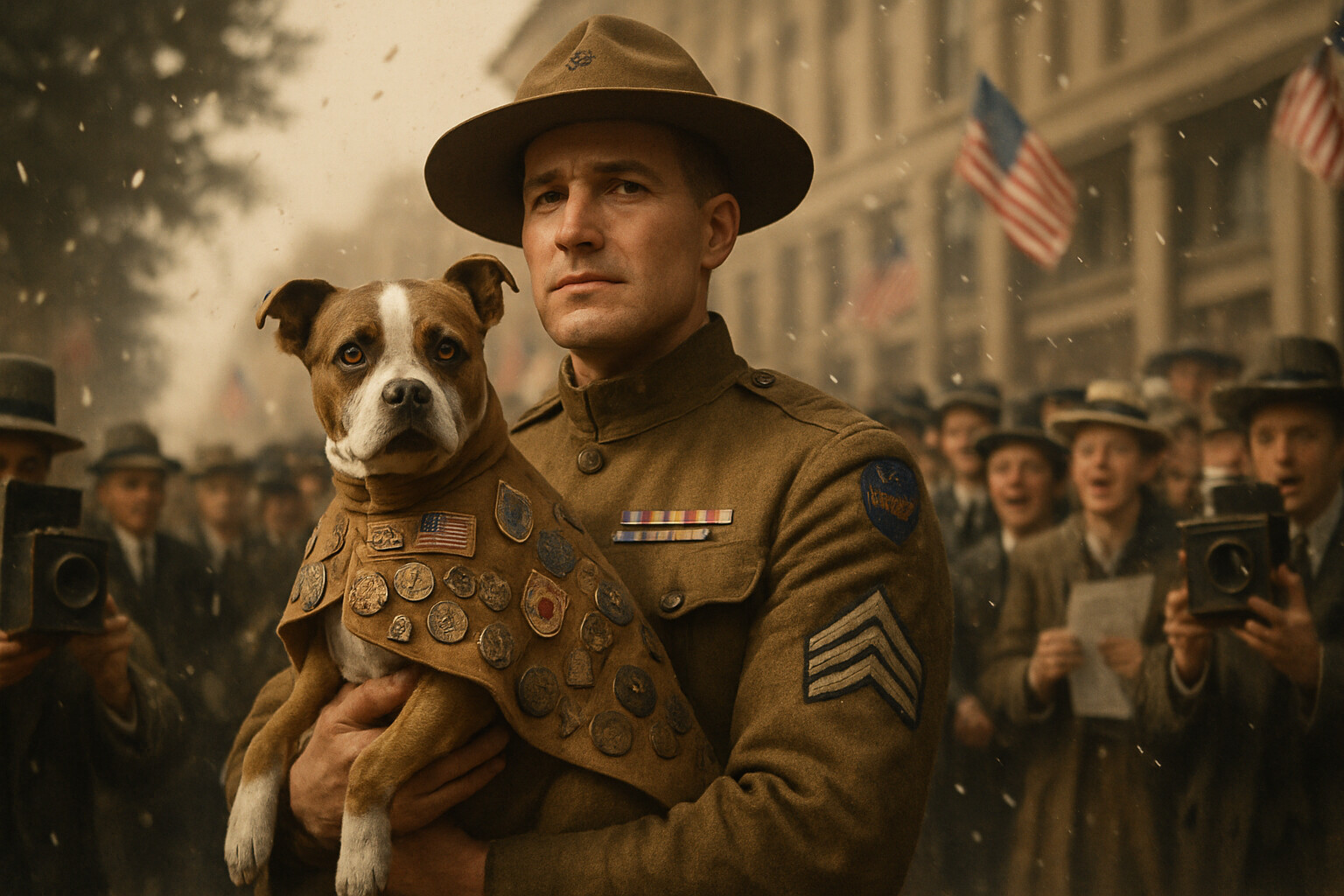
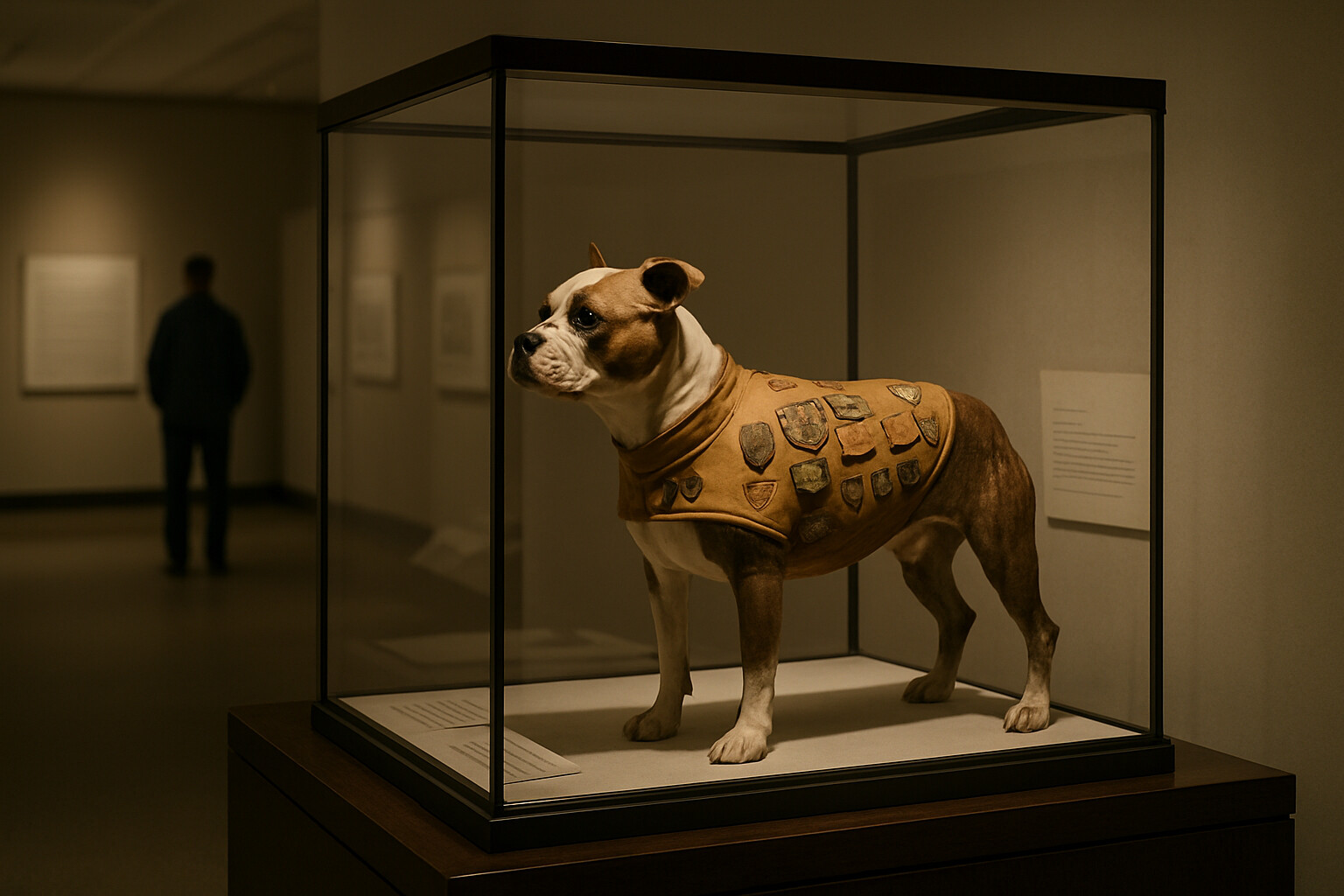
When the 26th Division returned to the United States in 1919, Stubby came with them. He had accumulated what might fairly be described as the most decorated career of any military animal in American history—not through official channels, but through the informal practice of soldiers and commanders who gave him physical recognitions of his service. The collection preserved at the Smithsonian includes a small chamois coat to which were attached numerous medals, insignia, wound chevrons, and other decorations. These were not standard military awards issued through a formal process. They were gestures: unit emblems given by soldiers, insignia from Allied units the 26th had served alongside, a reported Humane Education Society medal, and wound chevrons in the style of the American wound stripe. The coat itself was reportedly made by French women near where Stubby had been treated—a physical artifact of the attention his story attracted, though the specific community remains unidentified across sources.
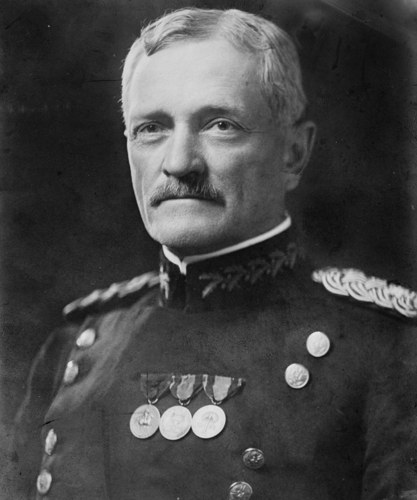
General John J. Pershing, commanding general of the American Expeditionary Forces, reportedly met Stubby; this meeting is corroborated by enough independent accounts to be treated as established. The specific circumstances, date, and location of that meeting have not been confirmed through Pershing's papers or official AEF records in any source reviewed for this narrative, and no words attributed to Pershing at that meeting should be treated as verified.
The rank of Sergeant—as in Sergeant Stubby—is a matter of tradition and informal designation. He was never formally promoted through the military's administrative system. The rank was applied informally by his unit and repeated widely in press coverage. When he died in 1926, newspaper obituaries called him Sergeant Stubby. The Georgetown University Hoyas athletic mascot today carries his name and likeness. The Smithsonian's care for his preserved body and effects represents the most formal institutional acknowledgment of his service. A 2018 animated film brought his story to a new generation, though like all popular dramatizations it compressed and dramatized elements that the historical record handles with more ambiguity.
---
J. Robert Conroy mustered out of the Army in 1919 and returned to civilian life, eventually attending Georgetown University Law School, where Stubby reportedly attended classes and games with him. Stubby continued to appear in parades, veterans' events, and public gatherings through the early 1920s. He died in Conroy's arms in 1926. His body was preserved through taxidermy, mounted on a plaster form, and eventually donated to the Smithsonian, where it remains in the collection of the National Museum of American History. His chamois coat with its attached decorations, the documentation of his service, and the artifacts around him are maintained there.
The historical question Stubby's story raises is not really about the dog. It is about what soldiers carry with them into extreme environments, what they hold onto, and what holds them. The Western Front in 1917–1918 was a place that had been systematically stripped of ordinary human experience for years. The men who entered it brought whatever connections to the world outside they could manage. Some brought photographs. Some brought letters. Some brought a dog who had wandered onto a drill field and decided to stay.
The encounters Stubby witnessed—gas, bombardment, infiltrators moving through wire at night, the wounded being carried back through communication trenches—are documented in the unit history and the broader record of the 26th Division and the 102nd Infantry. His role in specific moments is attested through survivor accounts, through press coverage, and through the physical artifacts that survive. The story is real. The degree of certainty around its individual episodes varies, and honesty about that variation is the only responsible way to handle a figure who has also been, inevitably, the subject of popular embellishment.
What can be said without qualification: a dog named Stubby served with the 102nd Infantry Regiment, 26th Division, on the Western Front for approximately eighteen months. He was present in the trenches during major American engagements of 1918. Soldiers who served with him credited him, consistently, with warning them of gas attacks. Soldiers who served with him reported that he detained a German scout until troops arrived. He was wounded in action and returned to the unit. He came home. He is preserved at the Smithsonian.
The rest—the precise timeline of gas warnings, the German scout's name or fate, the exact words of generals—falls into the space between documented fact and the oral tradition of men who were there and needed to tell someone what they had seen. That space is not nothing. It is where most of what we know about war actually lives.
The dog who stayed. Eighteen months. The full span of American involvement in the war's active fighting. He outlasted the war, outlasted the unit's service, and outlasted, by a few years, the peace that followed. In 1926, in an apartment in Washington, he died as he had apparently lived since 1917—close to one soldier, warm, and present.
The Western Front took everything it could reach. It did not take Stubby.