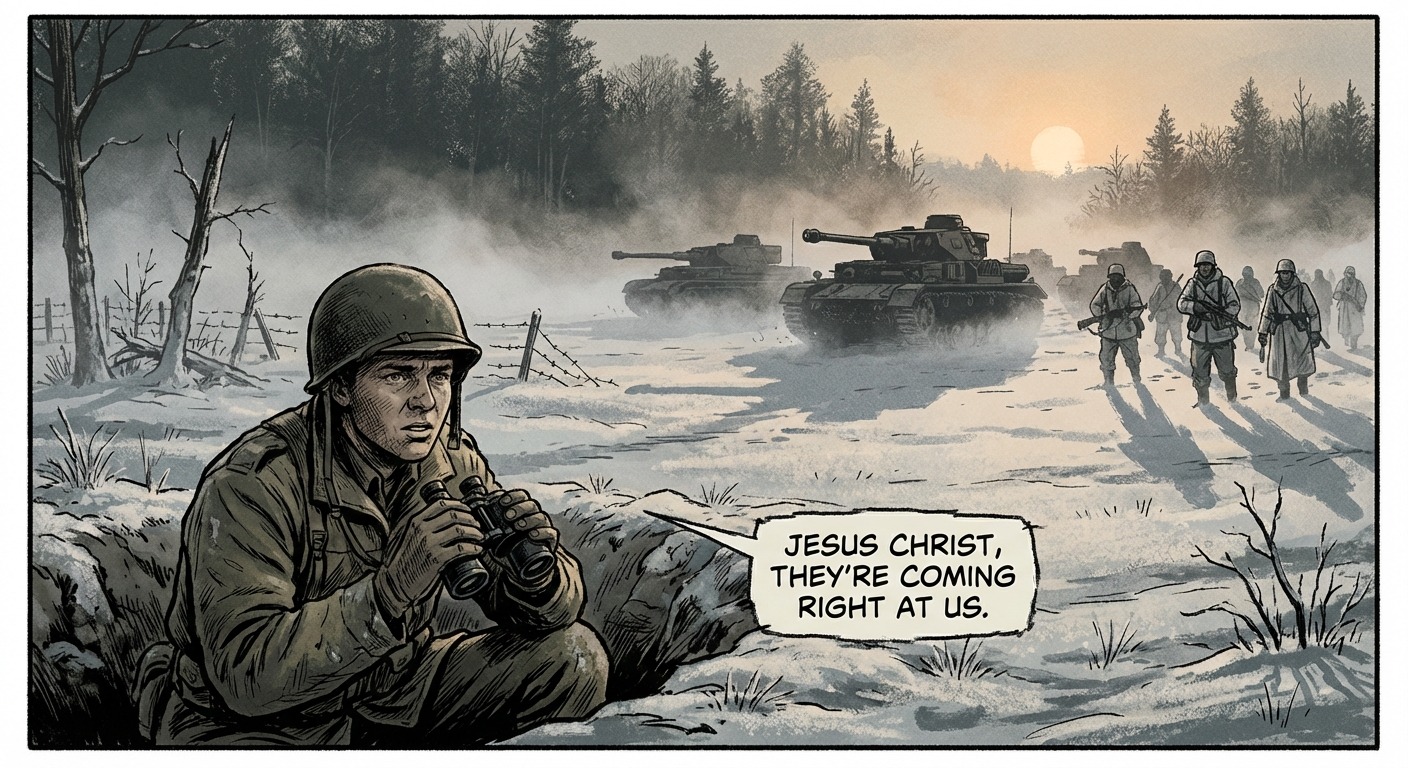
The Soviet column stretched along the forest road like a steel snake, exhaling white breath into the December air. Tanks, trucks, and artillery pieces crawled through snow that reached their axles, while Red Army soldiers huddled in greatcoats against the Finnish cold. From concealed positions two hundred meters into the treeline, Finnish ski troops watched through field glasses as the enemy force passed below. The temperature hung at minus thirty Celsius, cold enough to freeze rifle bolts and turn exhaled breath into ice crystals.
White-clad figures raised their hands along the ridge. Each soldier carried a Suomi submachine gun, spare ammunition, and explosives. They had been moving through these forests since before dawn, using narrow ski trails that no tank could follow. Now they held the high ground above a road that represented everything the Soviets needed to survive in this wilderness: supply, warmth, and the way home.
The forest erupted.
Finnish ski companies operated throughout the eastern forests during the opening weeks of the Winter War, when the Soviet Union launched its massive invasion of Finland on November 30, 1939. Stalin expected his forces to reach Helsinki within days, crushing Finnish resistance through overwhelming superiority in men, tanks, and aircraft. Instead, the Red Army found itself fighting a war unlike anything in military history, where small units of Finnish soldiers on skis could appear from nowhere, strike with devastating effect, and vanish back into the forest before the enemy could respond.
The tactical innovation that made this possible was called motti, a Finnish word meaning a stack of firewood. Just as wood is cut into manageable pieces, Finnish forces would isolate large enemy formations by cutting their supply lines and dividing them into smaller, more vulnerable segments. These isolated pockets could then be destroyed one by one, even when they contained forces far larger than the attacking Finnish units.
Finnish ski companies operated in the forests east of Lake Ladoga, where Soviet mechanized columns struggled through narrow roads carved between towering pine trees. The terrain favored defenders who knew how to use it. Finnish soldiers had grown up in these woods, hunting and skiing from childhood. They understood how sound carried in the cold air, how to read snow conditions, and how to move silently through terrain that channeled enemy movement into predictable corridors.

The Winter War began with Soviet confidence and Finnish desperation. The Red Army deployed over 450,000 men, 2,000 tanks, and 3,800 aircraft against Finland's army of 337,000 soldiers supported by minimal armor and air power. Soviet planners expected to overwhelm Finnish defenses through massive frontal assaults, particularly along the Karelian Isthmus where the Mannerheim Line guarded the approaches to Helsinki.
But Stalin's generals had failed to account for the nature of Finnish terrain and the character of Finnish soldiers. Finland in winter was a landscape of frozen lakes, dense forest, and temperatures that could kill exposed men within minutes. Roads were few and narrow, forcing mechanized forces into predictable routes of advance. The Finnish Army understood this terrain intimately and had spent years preparing defensive positions designed to channel attackers into killing zones.
More importantly, Finnish soldiers possessed tactical flexibility that Soviet doctrine could not match. Where Red Army units relied on rigid command structures and predetermined battle plans, Finnish forces operated with initiative and improvisation that allowed small units to achieve effects far beyond their numbers. This was particularly true of the ski troops, elite soldiers who could cover vast distances through trackless forest and strike at times and places where the enemy felt secure.
These companies exemplified Finnish capabilities. The soldiers were drawn from the forests of eastern Finland, farmers and loggers who had spent their lives moving through snow-covered wilderness. They could ski forty kilometers in a day carrying full combat loads, navigate by compass and terrain features in whiteout conditions, and operate for days in temperatures that would disable most military equipment. Each soldier was trained in demolitions, marksmanship, and small-unit tactics that emphasized speed and surprise over sustained firepower.
Finnish officers represented a generation that had studied modern warfare while remaining rooted in their country's military traditions. Many had civilian experience as forest engineers, surveyors, and hunters—backgrounds that proved invaluable in understanding how to use terrain for military advantage. They knew how to read topographical maps, estimate snow loads, and predict how mechanized forces would respond to different obstacles.
When the Soviet invasion began, Finnish ski companies were positioned to interdict enemy supply lines running through the forest road network east of Lake Ladoga. Soviet forces advancing along these routes faced a tactical nightmare. The roads were barely wide enough for two vehicles, with drainage ditches on either side and dense forest pressing close. Vehicles could not leave the roadway without becoming mired in deep snow, while the forest canopy limited air reconnaissance and close support.

These conditions were perfect for motti tactics. Finnish forces would identify enemy columns advancing along predictable routes, then position ski troops at multiple points along the line of march. The attack would begin simultaneously at several locations, cutting the column into isolated segments while blocking reinforcement or withdrawal. Each isolated pocket would then face attacks from multiple directions by forces that could appear suddenly, strike hard, and disappear before effective counter-attacks could be organized.
The effectiveness of these tactics depended on precise coordination and detailed intelligence. Finnish ski companies operated with forward observers who could track enemy movements and relay information through radio networks designed to function in extreme cold. Finnish forces had adapted their communications equipment with special batteries and insulation, while Soviet units often found their radios failing in the harsh conditions.
Weapons selection reflected the demands of forest warfare. The Suomi KP/-31 submachine gun became the signature weapon of Finnish ski troops, providing devastating close-range firepower while remaining reliable in extreme cold. This weapon fired 9mm Parabellum ammunition at 900 rounds per minute, allowing a single soldier to suppress multiple enemies during the brief, violent engagements that characterized motti attacks. The weapon's robust construction and simple operation made it ideal for soldiers wearing heavy gloves and operating in conditions that would jam more delicate firearms.
Finnish forces also employed the Lahti L-35 anti-tank rifle, a 20mm weapon capable of penetrating Soviet tank armor at close range. These rifles weighed over seventeen kilograms but could be transported by ski troops and positioned to cover road approaches. In the confined spaces of forest roads, even heavily armored vehicles became vulnerable to well-placed shots from concealed positions.
The psychological impact of motti tactics proved as important as their material effects. Soviet soldiers quickly learned that every forest road could become a killing zone, that supply convoys might never arrive, and that retreat could be cut off as easily as advance. This uncertainty degraded unit cohesion and command effectiveness, as officers became reluctant to operate beyond mutually supporting distances.
A documented example of motti effectiveness occurred during December 1939, when Finnish forces identified Soviet supply convoys moving through forest roads toward forward positions near the Mannerheim Line. These convoys included hundreds of vehicles carrying ammunition, fuel, and winter clothing desperately needed by Red Army units already suffering from the cold. Finnish intelligence intercepts revealed convoy routes and timing, allowing ski companies to position forces for coordinated ambushes.

Typical attack plans required splitting companies into multiple elements, each responsible for cutting convoys at specific points along multi-kilometer stretches of road. Leading elements would block advance vehicles and prevent convoys from pushing through, while follow-on elements would attack middle sections where fuel trucks and ammunition carriers were concentrated. Trailing elements would block retreat while serving as reserves that could reinforce other positions as needed.
Execution required precise timing and communication under conditions that challenged both men and equipment. Ski troops moved into position during early morning hours, navigating through forest that was pitch black except for the faint reflection of snow. Each element carried demolition charges, white phosphorus grenades, and extra ammunition for sustained combat. They positioned themselves within fifty meters of roads, close enough to ensure accurate fire but concealed by terrain and vegetation that would provide escape routes when actions ended.
Convoys appeared at dawn, proceeding cautiously along icy roads with advance guards and interval spacing that reflected hard-learned lessons about Finnish ambush tactics. But these precautions could not overcome the fundamental vulnerability of mechanized forces operating in terrain that favored defenders. When Finnish attacks began, convoys found themselves trapped between walls of forest with no room to maneuver and no clear avenue of escape.
Initial explosions occurred simultaneously at multiple points along columns, blocking roads with burning vehicles while creating isolated pockets that could be attacked separately. Finnish soldiers poured automatic weapons fire into trapped convoys from multiple directions, creating confusion and preventing organized resistance. Soviet forces attempted to return fire but found themselves shooting at muzzle flashes that appeared and disappeared among the trees.
Engagements lasted less than thirty minutes, but their effects were devastating. Typical successful ambushes destroyed dozens of vehicles including critical fuel tankers and ammunition trucks. More importantly, attacks demonstrated that Soviet supply lines remained vulnerable despite increased security measures. Word of successful ambushes spread quickly through both armies, reinforcing Finnish morale while contributing to growing Soviet concerns about their tactical disadvantage in forest warfare.
Finnish forces suffered minimal casualties, often losing single-digit killed and wounded while inflicting losses that exceeded their own strength by factors of ten or more. These ratios reflected the fundamental advantages of motti tactics when executed by well-trained soldiers operating on familiar terrain. Attacking forces could concentrate fire from concealed positions while enemies remained exposed and unable to maneuver effectively.

The tactical lessons of these engagements extended far beyond immediate military results. Soviet forces began requiring larger escort forces for supply convoys, reducing troops available for offensive operations. They also started using alternative routes that added hundreds of kilometers to supply runs, straining logistics networks already challenged by harsh weather and difficult terrain.
More significantly, the success of motti tactics influenced Soviet tactical doctrine throughout the Winter War. Red Army commanders became increasingly cautious about operating beyond mutually supporting distances, reducing the aggressive tempo of operations that had characterized the initial invasion. This tactical caution gave Finnish forces time to strengthen defensive positions and organize counterattacks that would have been impossible if Soviet forces had maintained their original momentum.
The broader strategic context reflected the collision between two fundamentally different approaches to warfare. The Soviet Union sought victory through massive application of conventional military power, deploying overwhelming numbers of men and machines in coordinated offensives designed to crush Finnish resistance through sheer force. This approach had proven successful in previous conflicts and reflected doctrine developed for fighting large-scale battles against similarly equipped enemies.
Finland, lacking resources for conventional resistance, was forced to develop asymmetric tactics that leveraged natural advantages while avoiding direct confrontation with superior enemy forces. Motti tactics represented the epitome of this approach, using mobility, terrain knowledge, and tactical surprise to achieve effects that would have been impossible through conventional means.
The success of these tactics required not just individual skill but systematic preparation that had begun years before the war. The Finnish military had studied the lessons of the Spanish Civil War and other recent conflicts, identifying the importance of small-unit leadership and tactical flexibility in modern warfare. They had also invested heavily in winter warfare training, developing equipment and techniques specifically designed for operations in extreme cold.
This preparation proved decisive when war came. While Soviet forces struggled with equipment failures, frostbite, and supply difficulties, Finnish soldiers operated effectively in conditions they had trained for extensively. Their weapons functioned reliably, their clothing provided adequate protection, and their tactics were specifically designed for the terrain where they fought.

The international significance of the Winter War extended far beyond the immediate military results. The conflict demonstrated that small nations could resist larger powers through superior preparation and tactical innovation, lessons that would influence military thinking throughout World War II. The motti tactics developed by Finnish forces would be studied and adapted by resistance movements and special operations forces facing similar challenges of fighting larger, conventionally superior enemies.
German military observers were particularly interested in Finnish tactical innovations, later incorporating elements of motti tactics into their own doctrine for Eastern Front operations. The Wehrmacht's success in encircling large Soviet formations during the opening months of Operation Barbarossa reflected tactical lessons learned from studying Finnish operations during the Winter War.
The human cost of these operations remained severe despite their tactical success. Finnish ski troops operated under conditions that pushed human endurance to its limits, with temperatures that could cause frostbite within minutes and terrain that offered little shelter from wind and snow. Soldiers had to carry everything they needed for survival, from ammunition and explosives to food and medical supplies, while maintaining the mobility necessary for rapid movement through difficult terrain.
Finnish forces developed techniques for operating in these conditions that would be studied by cold-weather specialists for decades afterward. They learned to recognize the early signs of hypothermia and frostbite, to maintain weapons and equipment in extreme cold, and to navigate accurately when landmarks were obscured by snow and darkness. These skills were developed through years of peacetime training but refined under the pressures of combat that allowed no margin for error.
The psychological demands proved equally challenging. Motti tactics required soldiers to operate in small groups far from friendly forces, often for days at a time, while maintaining the discipline and coordination necessary for complex operations. The stress of combat was compounded by isolation, extreme weather, and the constant awareness that capture might mean death in conditions where prisoners could not be easily evacuated or cared for.
Finnish military records document the effectiveness of motti tactics through careful analysis of enemy losses and tactical results of specific operations. These records show that small units employing these tactics could achieve effects far beyond their numerical strength, disrupting enemy operations while suffering relatively light casualties. The cumulative impact of these successes contributed significantly to Finland's ability to resist Soviet invasion despite overwhelming numerical disadvantage.

The Winter War officially ended on March 13, 1940, with the Moscow Peace Treaty that ceded significant Finnish territory to the Soviet Union. Despite this territorial loss, Finland had achieved its primary objective of maintaining independence while inflicting casualties on Soviet forces that exceeded their own losses by significant margins. The tactical innovations developed during the conflict, particularly motti tactics, had proven that asymmetric warfare could achieve strategic results when employed by well-trained forces operating on favorable terrain.
Many Finnish officers continued to serve throughout the Continuation War (1941-1944), when Finland fought alongside Germany against the Soviet Union in an attempt to regain lost territories. Their experience with motti tactics proved valuable in training new generations of Finnish soldiers who would face many of the same tactical challenges that had characterized the Winter War.
The legacy of Finnish motti tactics extends far beyond the immediate military context of the Winter War. These techniques influenced the development of special operations doctrine, guerrilla warfare theory, and cold-weather military training programs throughout the world. Military academies continue to study the Winter War as an example of how tactical innovation and terrain advantages can offset numerical and technological superiority.
The human dimension of these operations remains equally important. The soldiers who developed and executed motti tactics demonstrated that individual initiative and small-unit leadership could achieve effects that rigid command structures and overwhelming firepower could not match. Their success reflected not just military skill but deep understanding of the terrain where they fought and the conditions under which they operated.
Contemporary military analysis of the Winter War emphasizes the importance of adaptation and innovation in warfare, particularly when conventional approaches prove inadequate. The Finnish experience demonstrates that military effectiveness depends not just on the quantity of available resources but on the ability to employ those resources in ways that exploit enemy vulnerabilities while maximizing friendly advantages.
The technical aspects of motti tactics continue to be studied by military historians and tactical analysts seeking to understand how small units can achieve disproportionate effects against larger forces. The principles underlying these tactics—mobility, surprise, terrain advantage, and tactical coordination—remain relevant to modern military operations despite significant changes in technology and equipment.
Modern military forces facing irregular warfare challenges have found particular value in studying Finnish tactical innovations from the Winter War. The ability to operate effectively in small units, exploit terrain advantages, and coordinate complex operations without centralized control represents capabilities that remain highly relevant to contemporary military challenges.
The Winter War demonstrated that military history is shaped not just by grand strategy and major battles but by the accumulated effects of countless small actions carried out by soldiers who understood their terrain, their equipment, and their enemy. The motti tactics developed by Finnish ski troops represent one of the most significant tactical innovations of modern warfare, proving that asymmetric approaches could achieve strategic effects when employed by forces that combined traditional military virtues with adaptive thinking and intimate knowledge of their operational environment.