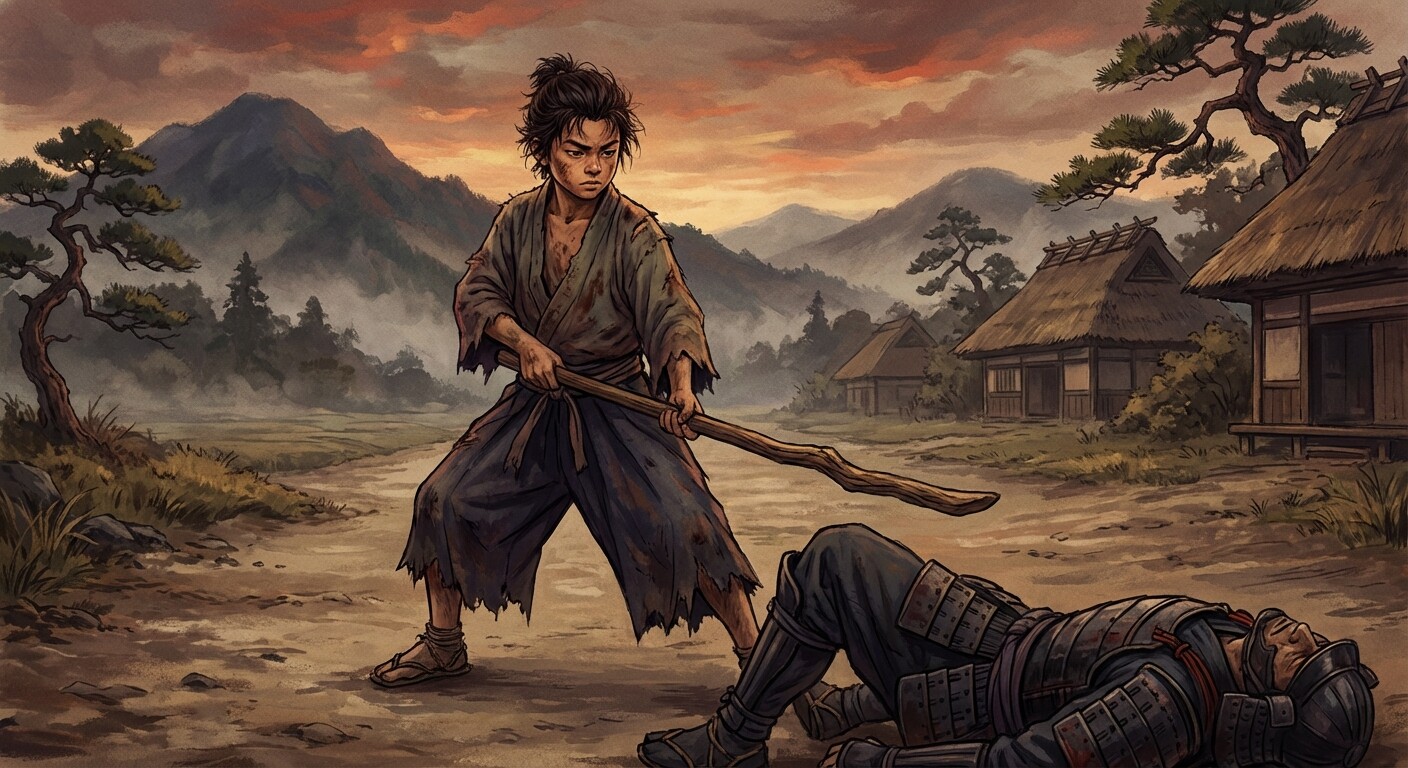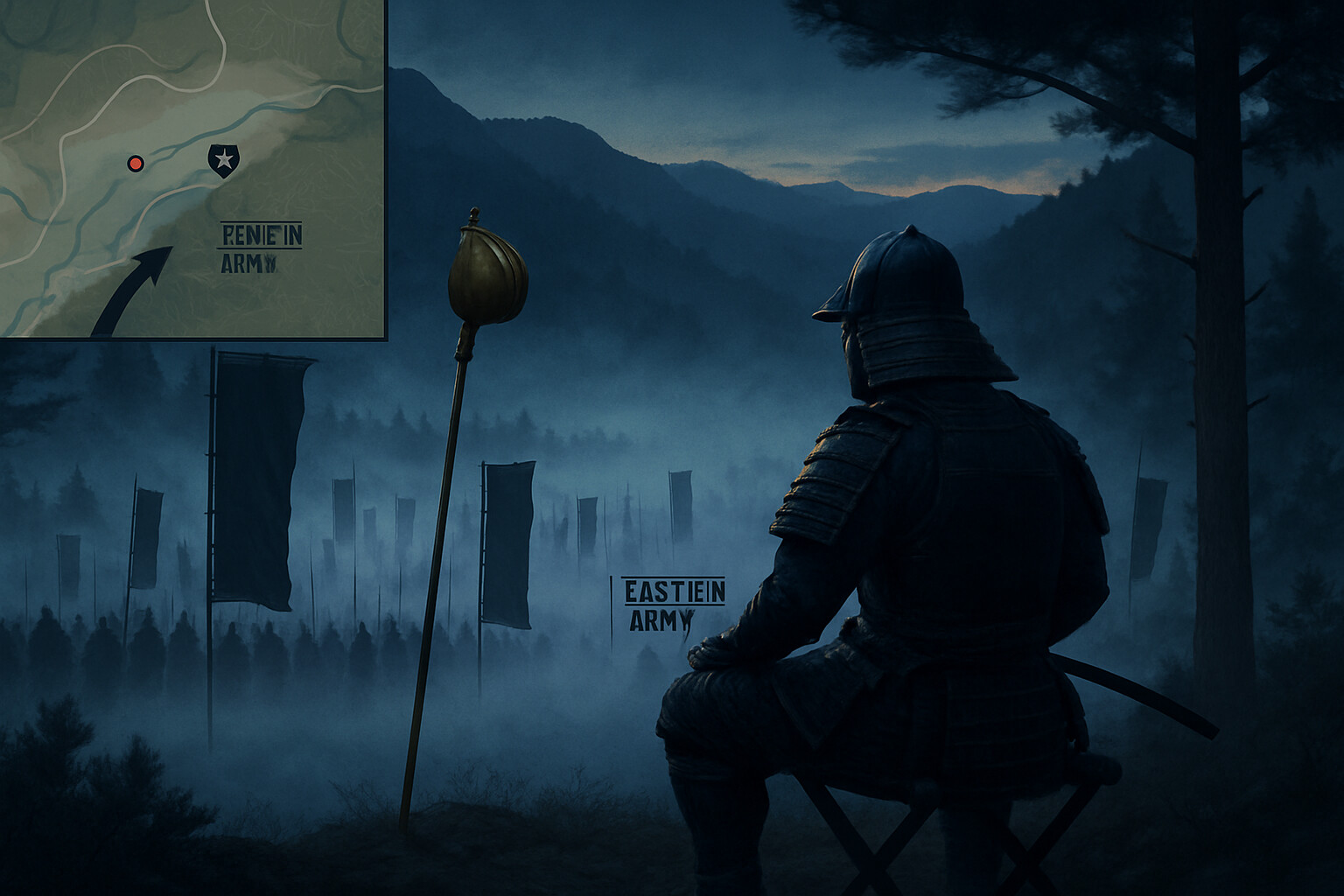
The fog came in dense off the valleys between Ibuki and Nangu, the kind that turns an army into ghosts of itself. By four in the morning on the twenty-first day of the ninth month of Keichō 5—October 21, 1600 by the Western calendar—tens of thousands of men were already in position on the terraced ridges and rice-paddy flats of a narrow valley in Mino Province. They could not see one another clearly. They could barely see the banners of their own contingents. In that grey stillness, Tokugawa Ieyasu, fifty-seven years old and the dominant lord of eastern Japan, sat behind his lines and waited.
He had been waiting, in some sense, for most of his life.
---
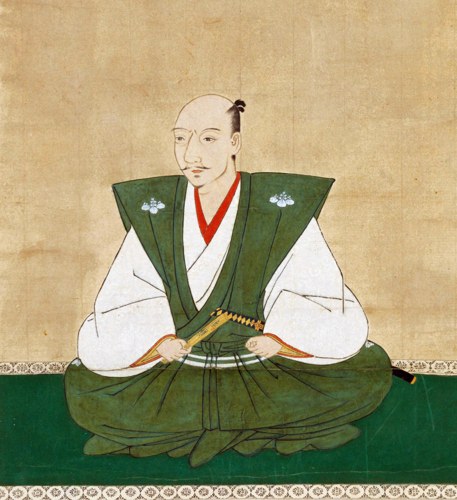
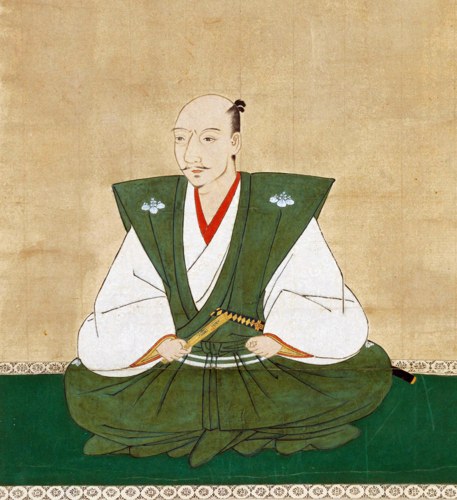
To understand what happened at Sekigahara, you have to understand what Japan had been for the previous 150 years: a country in which no central authority had managed to hold power long enough to die of old age. The Ashikaga shogunate had guttered out in the 1570s. A succession of great lords had risen and broken themselves against the task of unification. Oda Nobunaga came closest, and was assassinated in 1582. Toyotomi Hideyoshi finished what Nobunaga began, united the country under his personal authority, and then complicated everything by dying in 1598 without a capable heir. His son, Toyotomi Hideyori, was five years old when Hideyoshi died. Hideyoshi had extracted promises from his senior retainers—a council of five regents, the Go-Tairō—to protect the boy and govern on his behalf. Those promises lasted roughly two years.
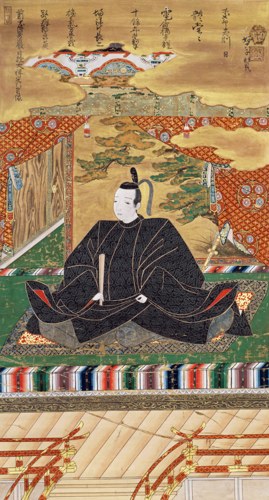
Tokugawa Ieyasu had been born in 1543 in Mikawa Province, the son of a minor lord caught between two regional powers. He spent a substantial portion of his childhood as a hostage—first with the Oda, then with the Imagawa—a formative experience that scholars have long argued shaped an unusual patience and a calculating temperament. He emerged from those years an experienced practitioner of survival. He allied with Nobunaga, fought alongside him, watched him die, and then navigated the turbulent years under Hideyoshi without being destroyed. By 1598 Ieyasu controlled a domain centered on the Kantō plain worth, by some estimates, 2.5 million koku of rice—the largest single domain in Japan and a foundation of enormous military and administrative power.
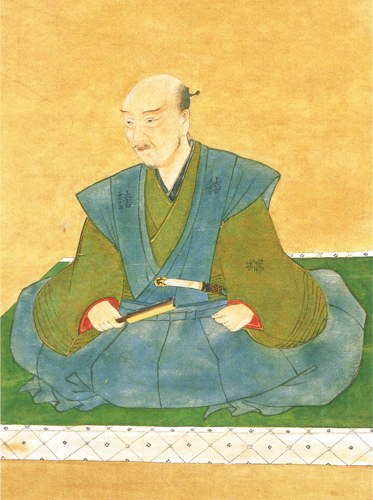
What he did not have was legitimacy to rule the whole country. That would require either the Toyotomi heir to acknowledge him or the other great lords to accept him. Neither was freely offered. When Ieyasu began arranging marriages among daimyo houses without council approval—a political act that Hideyoshi had explicitly prohibited—the other regents, led by Ishida Mitsunari, concluded that Ieyasu was positioning himself to seize power. They were correct. The question was whether they could stop him.
Mitsunari, a brilliant administrator who had served Hideyoshi as one of his most capable commissioners, began organizing resistance in the summer of 1600. He circulated a document—widely known as the denunciation of Ieyasu, sometimes called the Oath of the Thirteen Articles—among daimyo houses to build a coalition. The lords who aligned with Mitsunari became the Western Army. The lords who aligned with, or were pressured into alignment with, Ieyasu became the Eastern Army. By September 1600, both sides were maneuvering for position.
The campaign that preceded Sekigahara was not a single inexorable march. Ieyasu conducted a deliberate strategic diversion: while he moved west, he left forces to reduce castles still held by Western Army allies along his flanks. Siege operations at Gifu, Ōgaki, and other strongpoints consumed weeks and resources on both sides. Mitsunari's attempt to hold Ieyasu's advance at the fortified position at Ōgaki was undermined when, on the night of October 20, Ieyasu's forces bypassed Ōgaki and moved toward Sekigahara—a narrow valley pass on the Nakasendō road, one of the main arteries connecting eastern and western Japan. The move forced Mitsunari's hand. If Ieyasu controlled Sekigahara, the Western Army's lines of communication and retreat would be severed. Mitsunari had to fight.
Both armies force-marched through the night of October 20 and deployed in darkness and rain on the ridges and flatlands around the valley. The Western Army held the higher ground on three sides. On paper, this was a significant advantage.
---
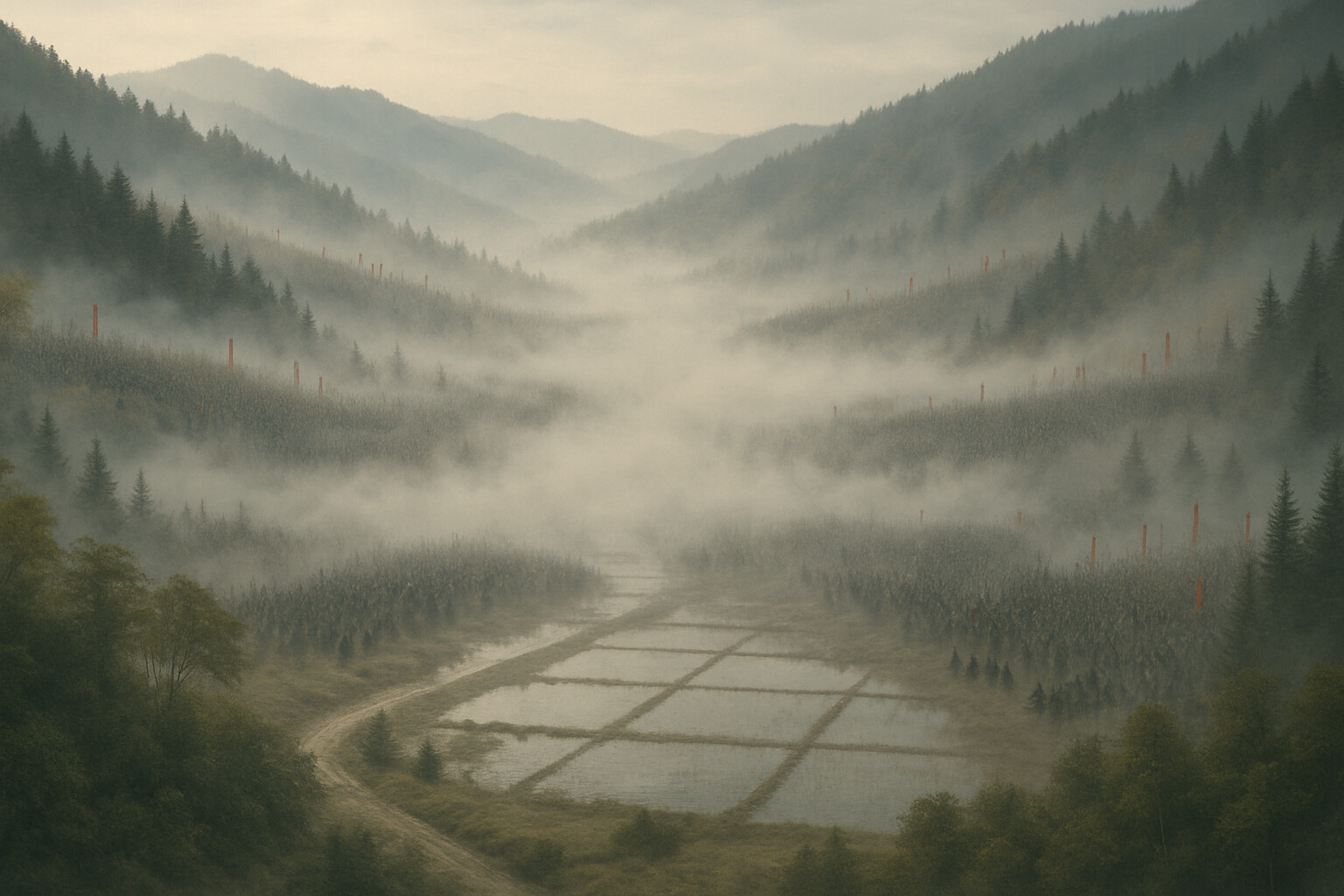
The terrain at Sekigahara is not a great open plain. The valley is roughly two kilometers wide where the fighting would concentrate, pressed between forested ridges on the north—where Mount Sasao and Mount Tenzan rise sharply—and the southern slopes of the Nangū range. A small river runs through the flat agricultural ground at the center and was crossable in the season, though the rice paddies covering much of the valley floor in 1600 made formed movement across the flats slow and difficult. The Nakasendō road ran along the valley's edge and was the only reliable hard surface for moving supply and artillery.
The Western Army's position was, in its conception, a trap. Mitsunari positioned his own forces on the western slope of Mount Sasao, with a clear view down into the valley. To his right, along the northern heights, allied contingents under Shimazu Yoshihiro, Ukita Hideie, and others held a rough line extending east. On the southern heights overlooking Ieyasu's right flank, the key force was Kobayakawa Hideaki, commanding perhaps fifteen thousand men from Mount Matsuo. Kobayakawa's position dominated the entire southern approach. If he struck Ieyasu's right flank when the fighting in the valley reached full intensity, he could potentially roll up the entire Eastern Army.
The problem, which Ieyasu had reason to suspect, was that Kobayakawa was not reliably committed to the Western cause.
Kobayakawa Hideaki was twenty years old in 1600, an adopted son of the Kobayakawa clan who had been placed in that position through Toyotomi political maneuvering. He had a troubled relationship with Mitsunari, who had previously worked to have him removed from a command he had disgraced in Korea. Ieyasu had quietly cultivated Kobayakawa through intermediaries in the weeks before the battle. The historical record is clear that contact was made and that Kobayakawa's loyalty was, at minimum, ambiguous. What specific assurances were exchanged, and what Kobayakawa understood his role to be, remains a matter of historical debate.
Also on the southern heights was the force of Mōri Hidemoto, commanding the Mōri clan's contingent—nominally among the strongest in the Western coalition. The Mōri domain had been among the great western powers for decades. Their defection or inaction would matter enormously.
Ieyasu's Eastern Army deployed on the valley floor and the lower eastern slopes, its back to the east. The arrangement appeared to give the Western Army the advantages of elevation and encirclement. What Ieyasu was counting on was that those advantages would not all materialize simultaneously—and that he had already done enough prior work to ensure at least one of the flanking forces would not fight.
The morning of October 21 began cold and still. Both armies formed in the fog. Visibility was poor enough that commanders could not see across the valley clearly. The standard accounts, including the chronicle Keichō-ki and later Edo-period compilations, record that the fog did not begin to lift until around eight or nine in the morning—though the precise timing in these sources should be treated as approximate rather than exact.
---
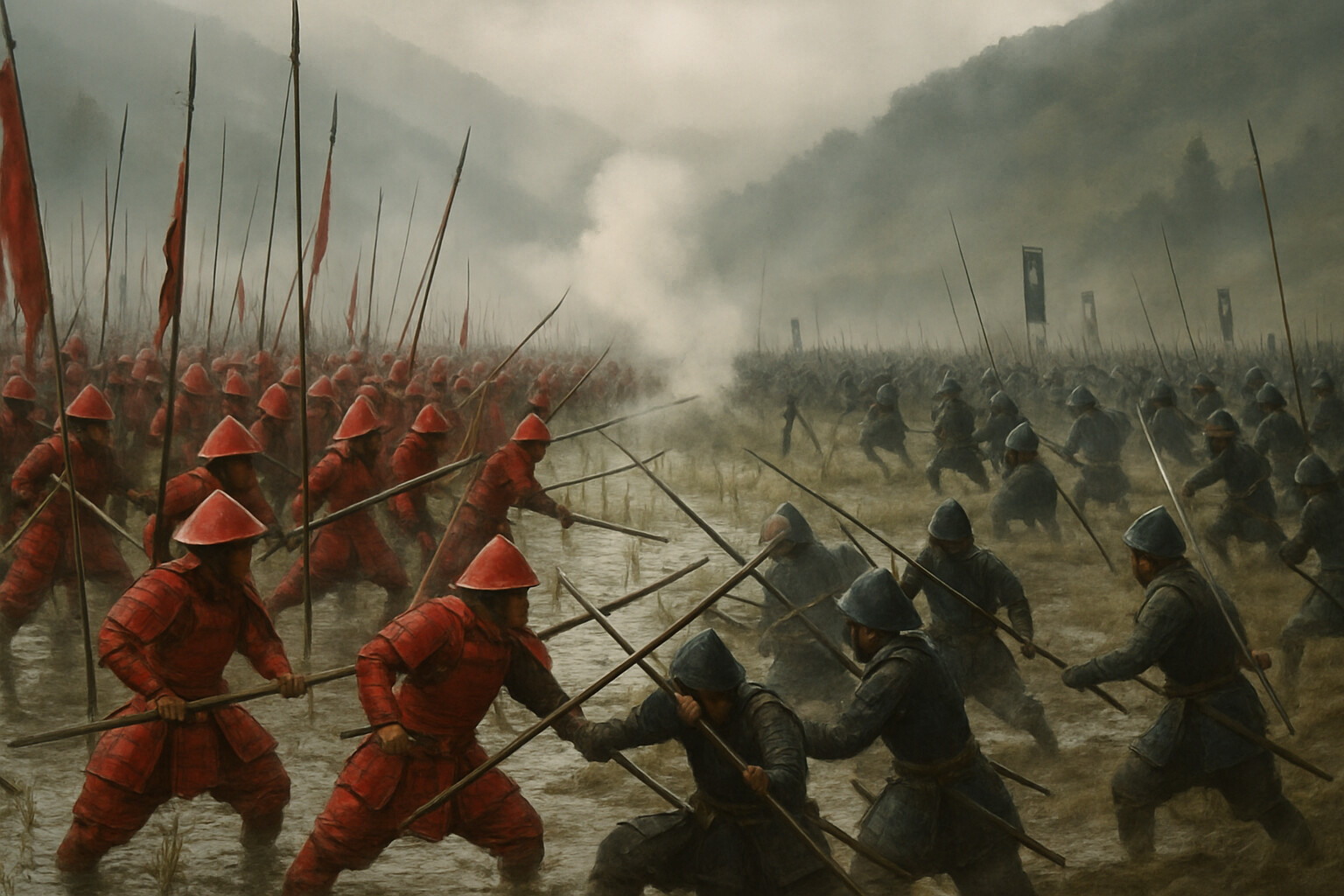
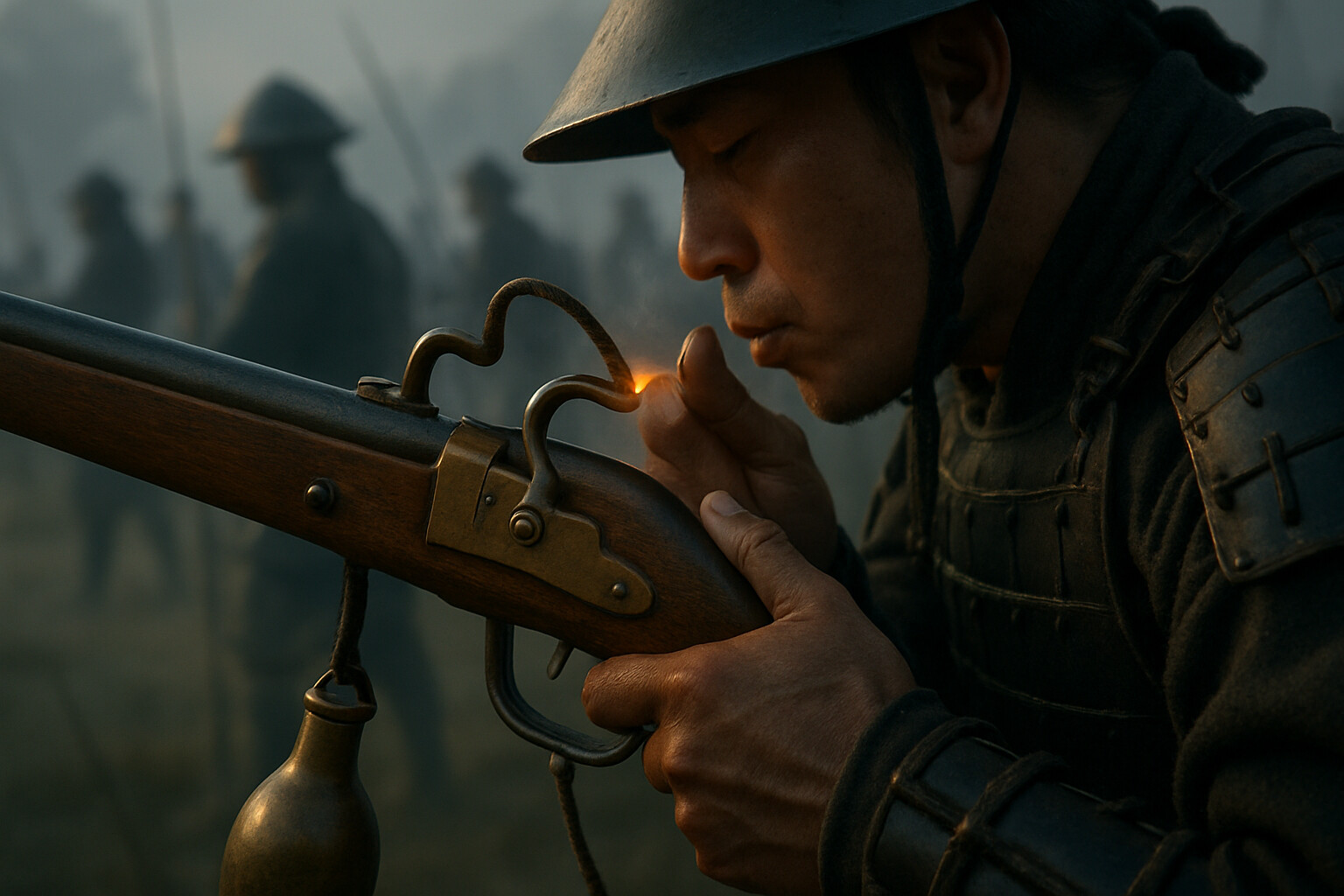
The armies that faced each other at Sekigahara were equipped and organized in a manner that reflected forty years of military evolution during the Sengoku period. The arquebuses—the teppo—that Nobunaga had deployed in organized volley fire at Nagashino in 1575, in ways later chronicles would dramatize and some historians have since questioned in their details, were by 1600 a standard component of Japanese military forces on both sides. The weapon in use was the Japanese derivative of the Portuguese arquebus, introduced to Japan via Tanegashima in 1543—by an irony of chronology, the same year Ieyasu was born. Domestic production had expanded rapidly, and by 1600 Japanese smiths had developed considerable expertise in manufacturing and modifying the design.
The arquebus of this period fired a lead ball propelled by a matchlock ignition mechanism. Its effective range against armored targets was roughly fifty meters; against unarmored or lightly armored troops it could be lethal at greater range. Rate of fire was slow—a trained man might manage two to three shots per minute under ideal conditions, less under battlefield stress or wet weather. The weapon's greatest tactical weakness was its vulnerability to moisture: a wet match cord or wet powder rendered the gun useless, and the rainy night march of October 20 would have left many units struggling to keep their equipment functional by morning.
Alongside the arquebus, both armies fielded the naginata (a curved blade on a long pole), the yari (spear), and the tachi and katana (swords of varying length). Cavalry—mounted samurai armed with bow or spear—remained a battlefield presence but had been gradually repositioned by the prominence of arquebusiers and massed pike formations over the previous decades. Large-bore firearms sometimes called ōzutsu were present in Ieyasu's forces in limited numbers; their specific contribution to the fighting at Sekigahara is not well documented in primary sources, and historians generally assess their role as secondary to the arquebus-armed infantry and the political factors that shaped the battle's outcome. The primary killing work was done by archers, arquebusiers, and men with spears fighting at close quarters.
Armor in this period was the tosei-gusoku, the composite lamellar and plate armor that had evolved through the Sengoku period to accommodate the new threat of firearms. It incorporated a solid breastplate (dō) and reinforced helmet (kabuto), but it was not proof against an arquebus ball at close range. The armor distinguished samurai from ashigaru (foot soldiers), who wore lighter, cheaper versions or simplified field equipment.
Both armies organized around han (domain) contingents, each under its own daimyo. This made coordination more complex than a unified chain of command would allow: orders from Mitsunari had to travel through political relationships as much as military hierarchy, and a daimyo who decided not to act—or to act against orders—could not simply be overruled in the way a modern officer could be relieved. This structural reality was the key vulnerability the morning would expose.
---
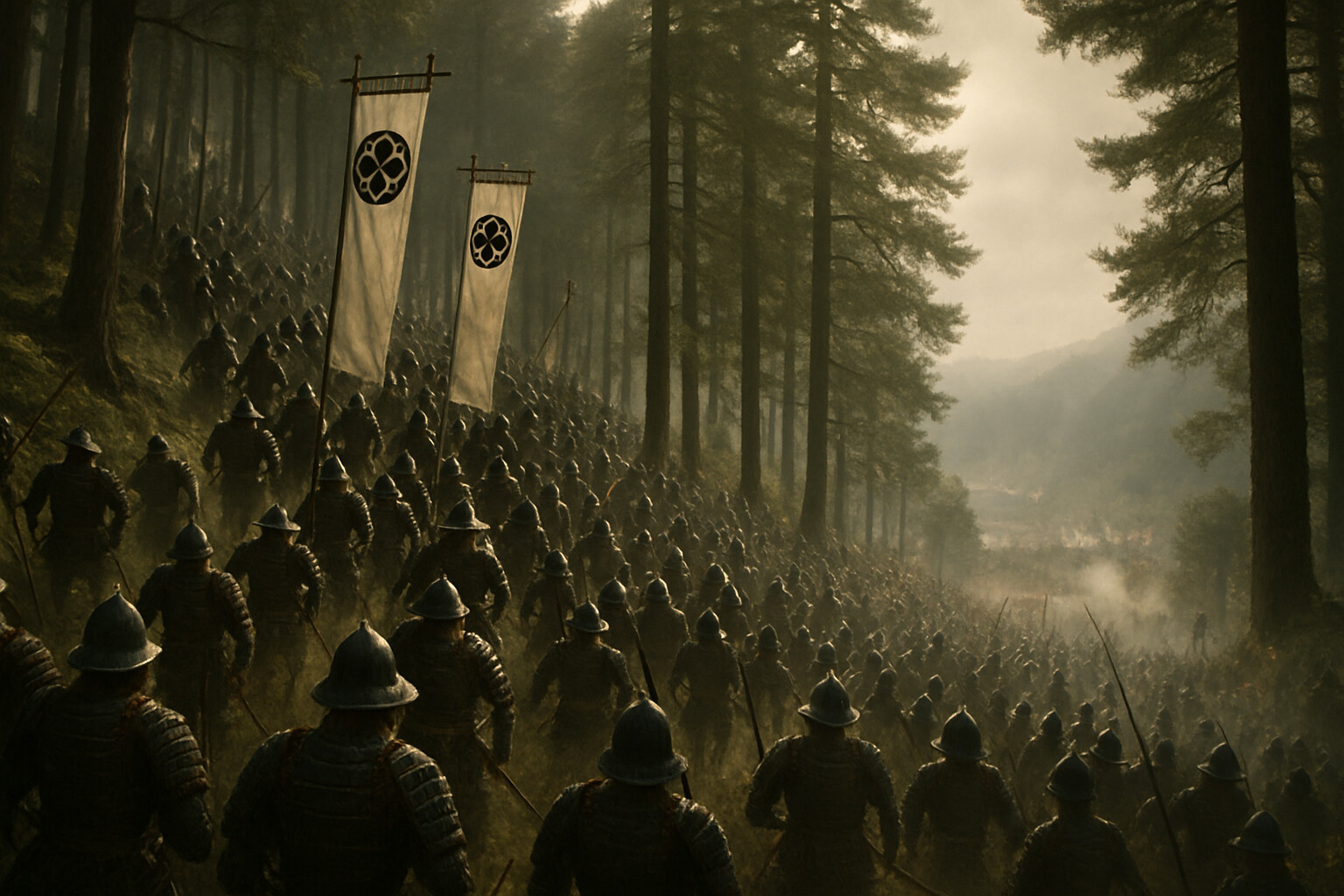
Fighting began, by most accounts, when the Ii clan's contingent—identifiable across the valley floor by their uniformly lacquered red armor, operating under the standard of Ii Naomasa, one of Ieyasu's most reliable generals—advanced against Ukita Hideie's position in the valley center. The exact timing is debated across sources; some accounts suggest arquebus exchanges preceded the main advance, while others place the general engagement at around eight in the morning as the fog thinned. The battle became general across the valley floor within a short period.
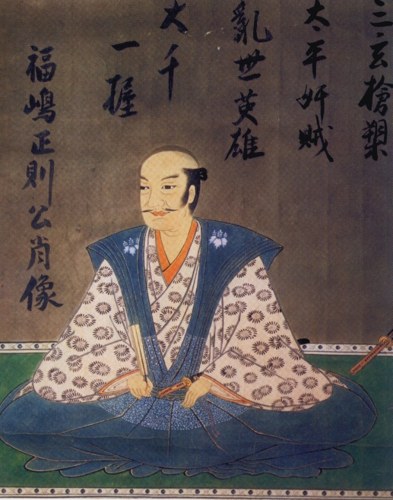
Ii Naomasa and Fukushima Masanori's contingents pushed hard into the center. The fighting in the rice paddies and on the lower slopes was close, sustained, and costly on both sides. Arquebusiers exchanged fire at ranges where misses were expensive and hits were often decisive. Spearmen moved in behind the shooters. The noise—matchlock reports echoing off the valley walls, the shouts of formations moving, the percussion of bladed weapons against lacquered armor—would have made coherent communication across any distance nearly impossible.
Mitsunari's forces held. The Western Army's position on the heights gave them the ability to receive attacks from a prepared posture and to observe the broader battlefield, and for the first hours of the engagement, the fight in the valley was unresolved. Ukita's forces pushed back against Fukushima. Shimazu Yoshihiro's contingent, positioned on the north slope, largely declined to press an offensive—a decision whose causes are debated, with accounts ranging from a genuine miscommunication about the battle plan to a deliberate choice by Shimazu to preserve his force. The result was that the northern flank did not press the attack as Ieyasu might have feared.
The critical hour came sometime around midday. The fog had cleared. The fighting in the valley had not produced a decisive advantage for either side. On Mount Matsuo, Kobayakawa Hideaki's fifteen thousand men had sat motionless through the morning.
According to accounts compiled in the Edo period and recorded in later standard histories, Ieyasu sent a signal—or, in some versions, had gunfire directed toward Kobayakawa's position on the hillside—as an ultimatum: act now, or be treated as an enemy. The detail of warning shots directed at Kobayakawa's lines appears in some Edo-period sources and is absent or differently characterized in others; historians have noted the difficulty of establishing this episode with certainty, and it should be read as tradition rather than confirmed fact. What is documented is the outcome: Kobayakawa's forces descended Mount Matsuo and struck the Western Army's left flank.
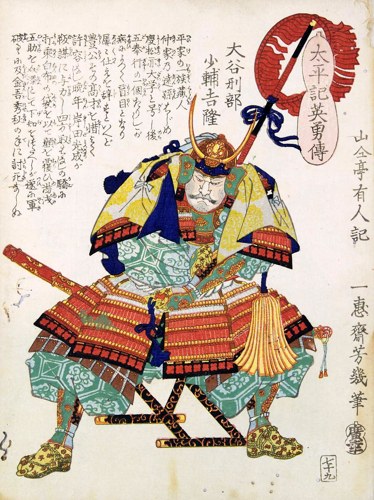
The effect was immediate and severe for the Western coalition. Ōtani Yoshitsugu's contingent, which held the position Kobayakawa struck, had apparently anticipated a possible betrayal and constructed a defensive line against exactly this possibility. Ōtani—described consistently in later sources as suffering from a debilitating illness severe enough that he was reportedly carried to battle in a palanquin, though the specific diagnosis is a retrospective inference and cannot be confirmed—fought back hard. For a period, his men held. Then further defections followed: the Wakisaka, Ogawa, and Akaza contingents that had been assigned to Western Army positions also switched sides, compounding the collapse of Ōtani's position. Ōtani Yoshitsugu reportedly took his own life as his lines failed.
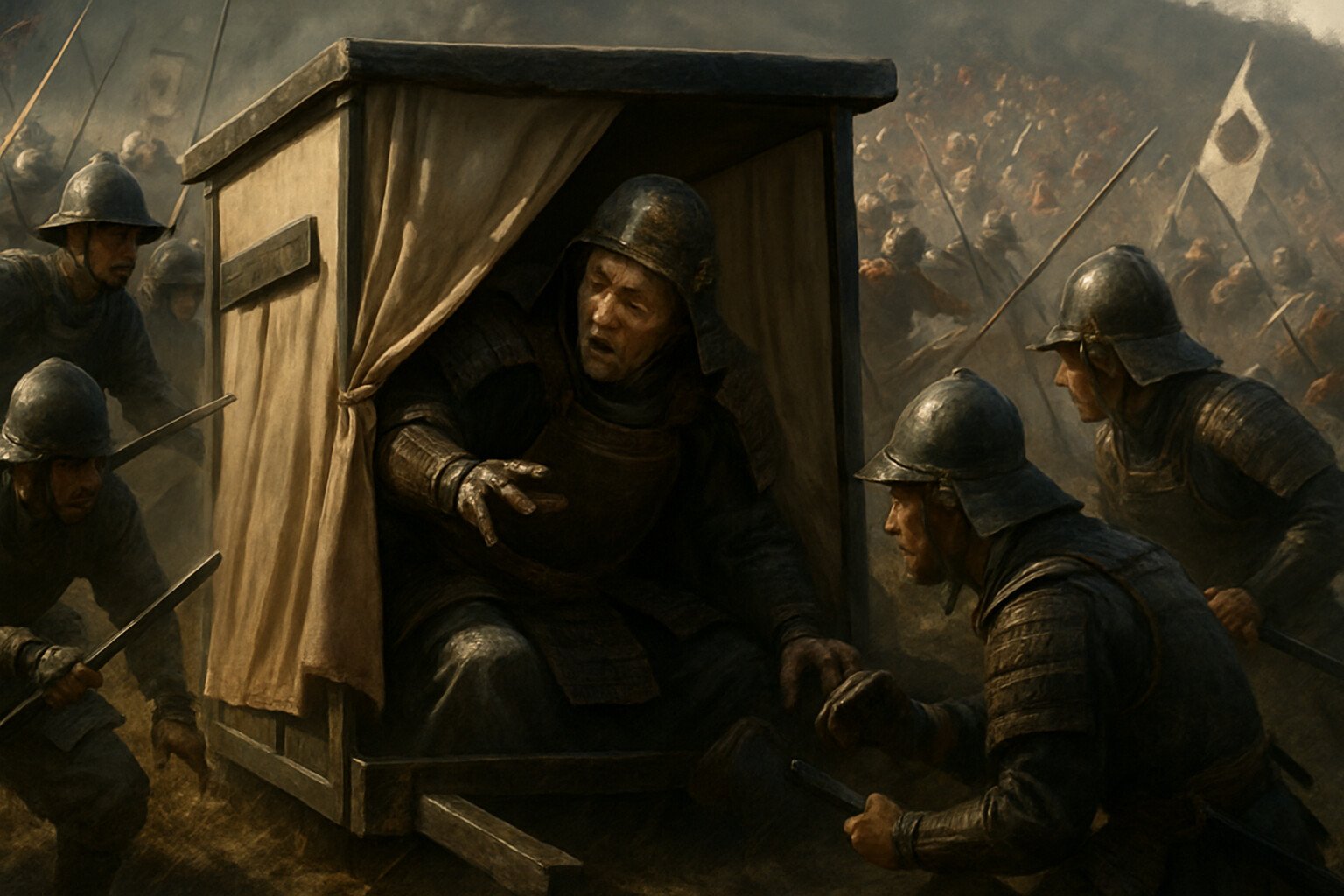
With Kobayakawa's fifteen thousand adding their weight to the Eastern Army's attack and the secondary defections fracturing the Western line, the battle's character changed entirely. Units that had fought effectively all morning began to break apart. Mitsunari's own position on Mount Sasao became untenable as flanking pressure increased and the valley force drove harder. The Western Army did not conduct an orderly withdrawal. It broke.
Shimazu Yoshihiro's contingent—having fought little during the main engagement—found itself caught in the collapse. Their attempt to withdraw produced one of the striking episodes of the battle: rather than retreat back the way they had come, Shimazu led his men in a fighting advance directly through the Eastern Army's lines. The tactic is sometimes referred to in later accounts as a sutegamari-style breakthrough, though whether that term was applied to the action at the time or represents a later characterization is not certain. They took severe casualties. Shimazu himself escaped. Most of his men did not.
Mitsunari escaped from the field on foot. He was captured several days later, tried, and executed in Kyoto on November 6, 1600, along with two other Western Army leaders, Ankokuji Ekei and Konishi Yukinaga.
---
The battle lasted, by most estimates, six to eight hours from the first exchanges to the general collapse of the Western Army—a figure inferred from available accounts and approximate rather than precisely established. Reliable casualty figures for either side do not exist; later estimates place Western Army dead in the thousands, with Eastern Army losses also significant but lower, though these figures should be treated as rough approximations and not precise counts.
The aftermath was not simply a military operation. It was a political reorganization of Japan accomplished through the mechanisms of victory. Ieyasu moved quickly and systematically. Western Army daimyo who had fought against him were punished with reduction or confiscation of their domains. The Mōri clan—whose forces under Hidemoto had held position on the southern heights and largely watched the battle without committing—lost the bulk of their domain, reduced from a holding of over one million koku to the two provinces of Nagato and Suō. Uesugi, whose movements in the east had partly precipitated the campaign, was similarly reduced. Lords who had sided with the Eastern Army, or who defected at the critical moment, were rewarded: Kobayakawa Hideaki received a substantial domain transfer, though he died two years later in 1602. Later tradition attributed psychological disturbance to his final months, connecting this to guilt over the betrayal; this account is not verifiable from contemporary records and should be treated as tradition rather than documented history.
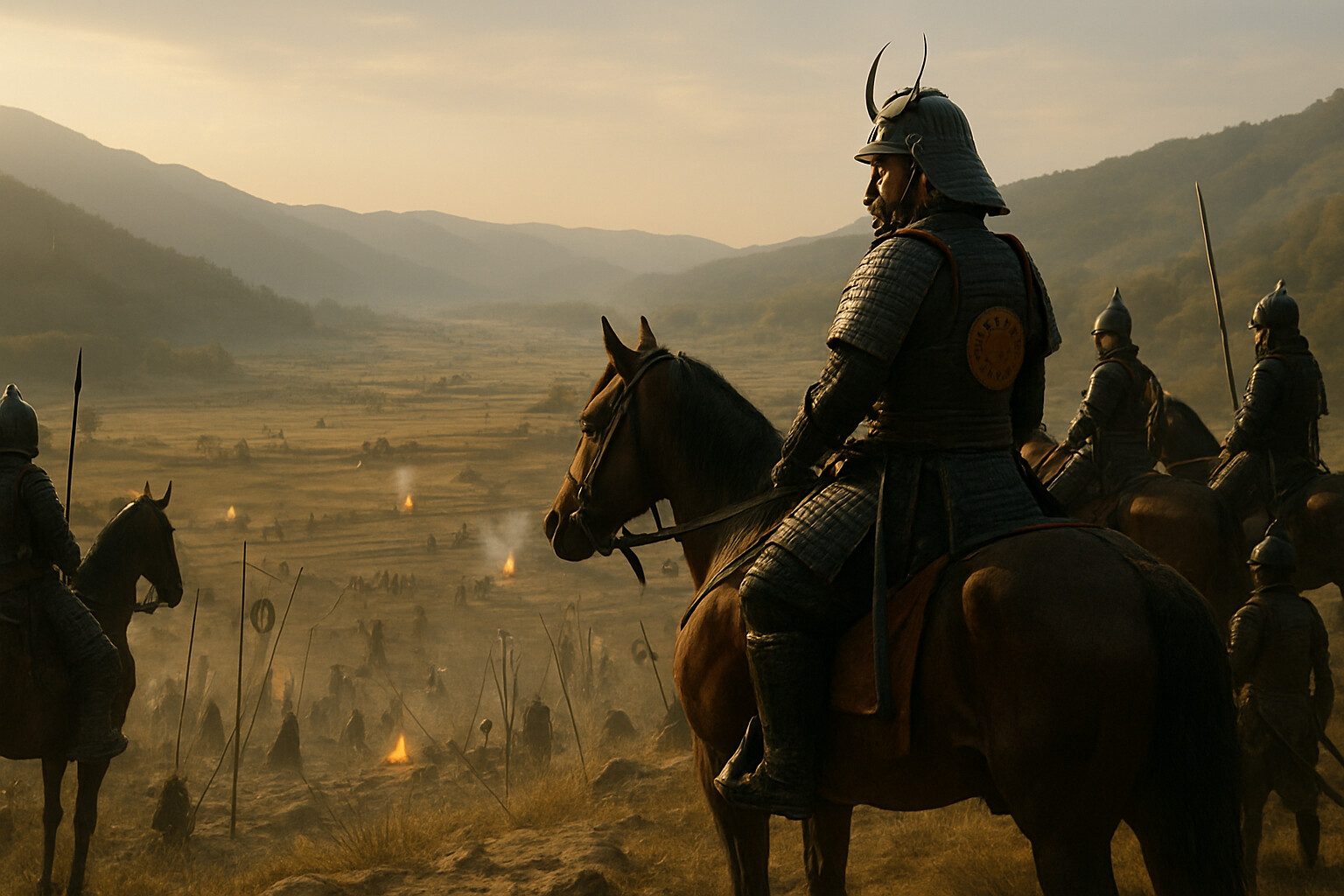
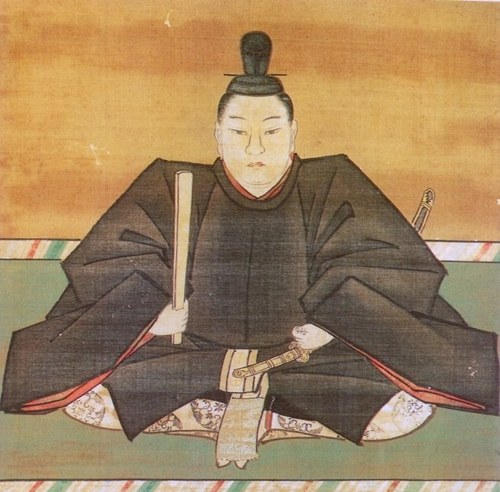
Ieyasu did not immediately assume the title of shogun. He moved with the same deliberation that had characterized his career. In 1603, the imperial court granted him the title of Sei-i Taishōgun—the military ruler of Japan, a title that had been held by the Ashikaga for two centuries before their collapse. Ieyasu was sixty years old. Two years later, in 1605, he transferred the title to his son Hidetada, demonstrating in the most direct way possible that the shogunate was a Tokugawa inheritance, not a personal grant. He spent the remaining decade of his life dismantling the last serious challenge to Tokugawa permanence: the Toyotomi house, destroyed at the Siege of Osaka in 1614–1615. He died in 1616, at seventy-two or seventy-three years of age—old enough to have seen his family's dominance secured.
The Tokugawa shogunate he founded governed Japan until 1868. It presided over a period of enforced peace, rigid social stratification, controlled foreign contact, and sustained cultural development. The great castle towns of the period, the formalization of samurai codes of conduct, the development of kabuki theater and ukiyo-e woodblock printing, the particular character of Edo as a city—all of these emerged from the stable order that Sekigahara made possible. The costs of that order were real: the system's rigidity would eventually produce the crisis of the 1850s when American and European pressure forced open a country that had been deliberately sealed. But for two and a half centuries, the architecture Ieyasu built at Sekigahara held.
---
What the historical record cannot tell us cleanly is the degree to which Sekigahara was won by Ieyasu's generalship on the day as opposed to prior political work. The tactical conduct of the Eastern Army—the hard fighting by Ii Naomasa, Fukushima Masanori, and others in the valley—was genuine and consequential. The battle could not have been won without soldiers who fought effectively through a morning of close combat. But the battle's decisive moment was Kobayakawa's defection, and that defection was the product of months of negotiation, incentive, and political calculation rather than anything that happened on the morning of October 21. Mitsunari's army was numerically larger. It held better ground. It lost because its commander could not trust some of his most important subordinates, and because the man responsible for its eastern flank had already, in some measure, decided not to fight for the Western cause.
Those negotiations were Ieyasu's work. The patience to cultivate Kobayakawa quietly while managing a major military campaign, to identify the fracture lines in an enemy coalition and press on them before the battle began, to position forces where a turncoat force's arrival would be maximally destructive—this was a form of strategic competence harder to see than a cavalry charge but no less important to the outcome.
The historians who have written most carefully about this question—among them Mary Elizabeth Berry, Conrad Totman, and the Japanese scholars whose work shapes the standard academic understanding of the period—tend to present Sekigahara not as a clear demonstration of Ieyasu's superiority but as a convergence of long preparation, structural advantage, and a calculated gamble on human betrayal that happened to pay off. Mitsunari was capable. His plan was sound. He lost control of it before the fighting started.
For Ieyasu, the fog at Sekigahara lifted to reveal a battlefield in the process of deciding itself in his favor. He had done the work that made that possible. The morning did the rest.
The valley today is a quiet agricultural area in Gifu Prefecture. A museum stands near the traditional site of Ieyasu's field headquarters. Rice is still grown on the flat ground where the armies fought. Autumn comes early in the mountains, and on cold mornings the fog still collects in the passes.