The kitchen knives came out first.
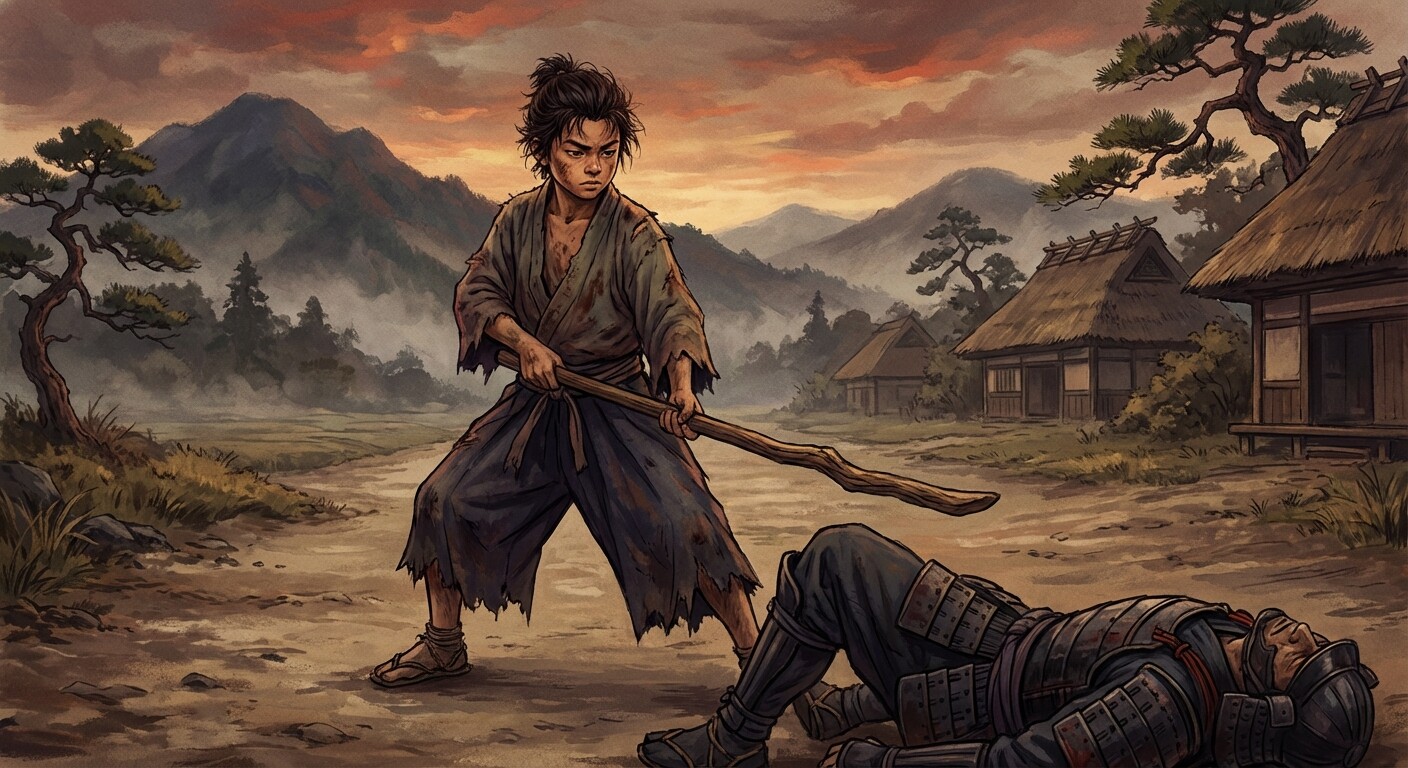
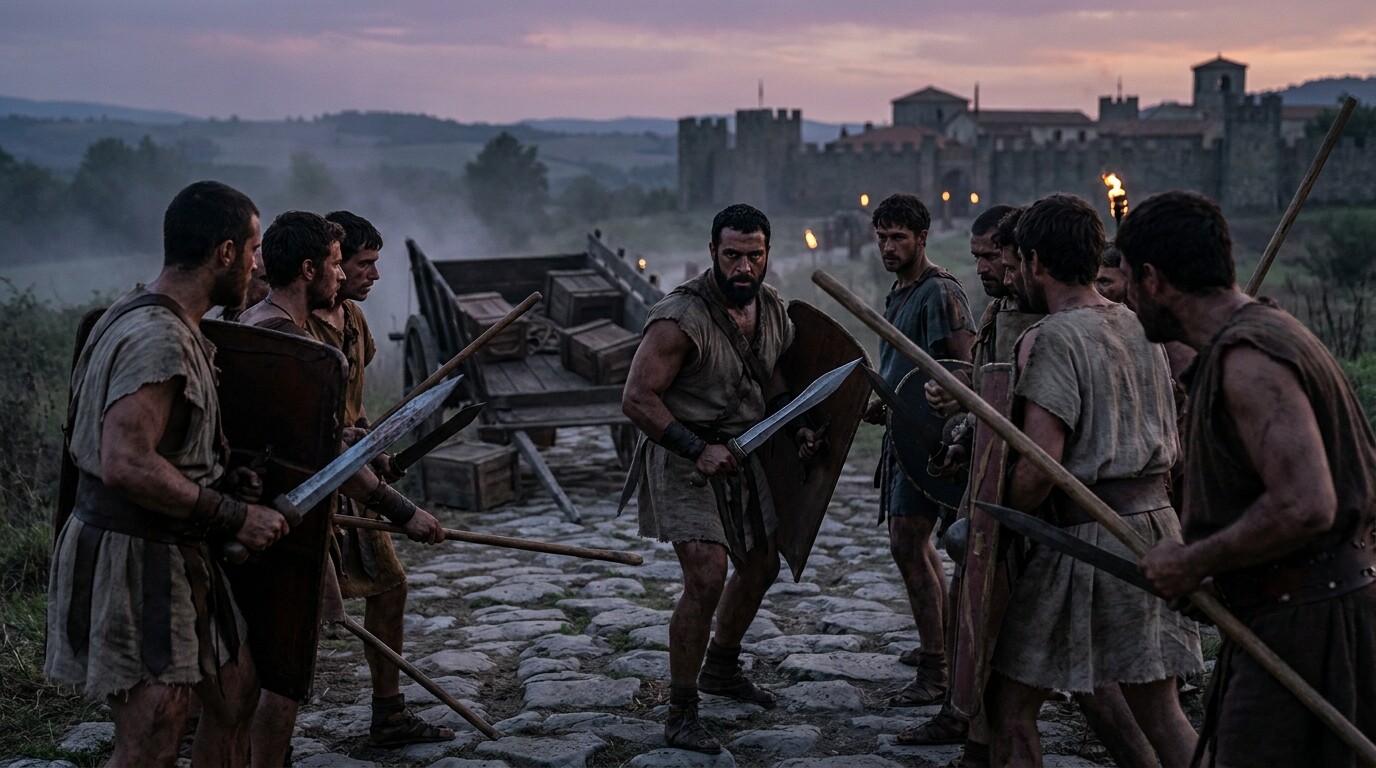
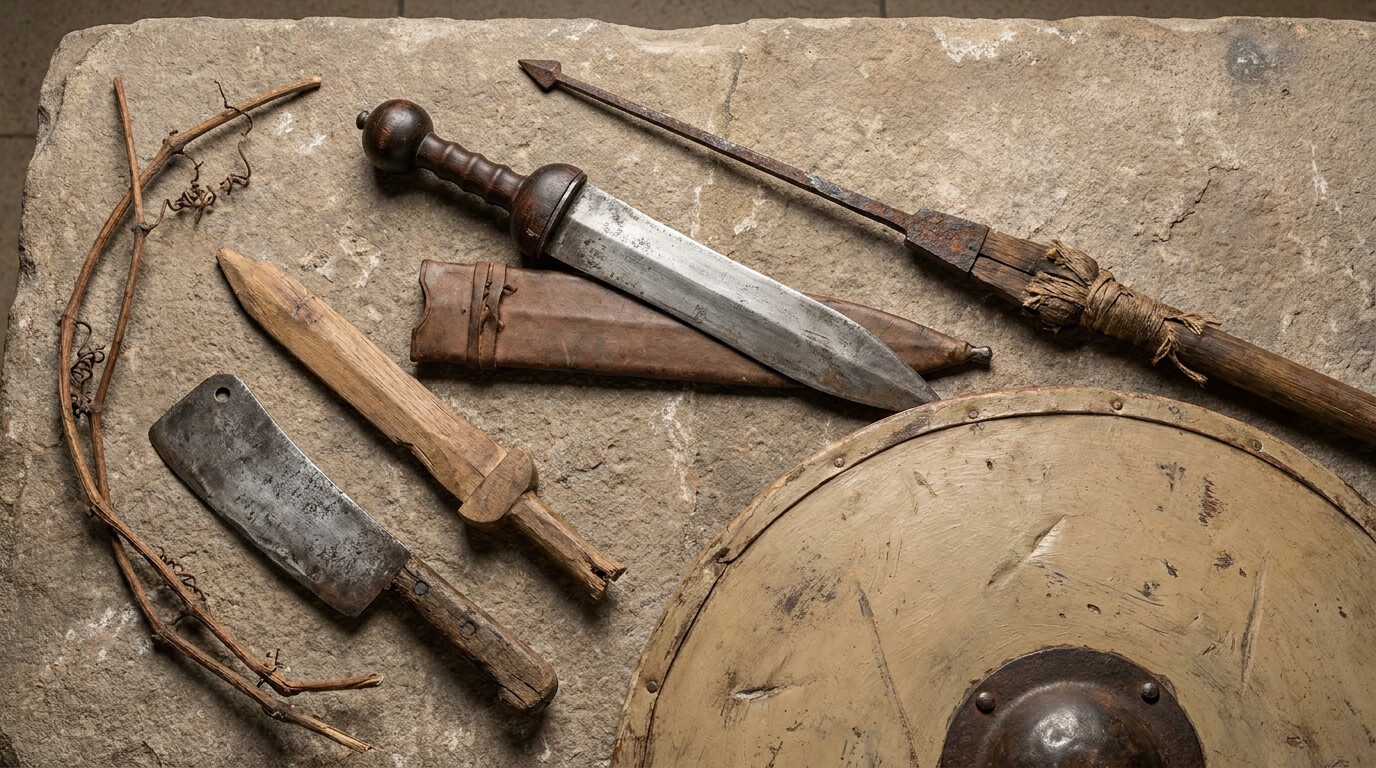
Somewhere in the training compound at Capua, in the late summer of 73 BC, a group of gladiators resolved that they would not fight for the crowd's entertainment any longer. Ancient sources disagree on the exact number who broke out—Plutarch says approximately seventy, Appian offers a similar figure—but they agree on the method: the men armed themselves with whatever implements they could seize from the school's kitchen, fought their way past the guards, and reached the road. They intercepted a wagon loaded with gladiatorial weapons and equipment somewhere outside the walls, rearmed properly, and fled into the open countryside around Capua.
They had no legions, no treasury, no city. What they had was a man named Spartacus.
Two years later, that man would command an army of perhaps seventy thousand fighters—the ancient sources range widely, and modern scholars treat the specific numbers with caution—and the Roman Senate would be dispatching a general of enormous personal wealth and political ambition to end what had become an existential embarrassment. The Third Servile War was not the first slave revolt Rome had faced. By nearly every measure, it was the last one Rome could afford to face at that scale.
---
Who Spartacus was before Capua is partially documented and partially reconstructed from contradictory ancient accounts.
Plutarch, writing roughly a century and a half after the events, describes him as a Thracian—a man from the region corresponding roughly to parts of modern Bulgaria, northern Greece, and European Turkey. Plutarch also states that Spartacus had once served with Roman forces, possibly as an auxiliary soldier before being enslaved. Appian and Florus offer fragments that partly corroborate and partly complicate this picture. That detail about prior Roman military service is drawn from a single ancient source and is not independently corroborated; it may be inferential or traditional. If accurate, however, it would explain something that becomes tactically significant very quickly: Spartacus understood how Roman armies were organized, how they deployed, and where their doctrine made them predictable.
He had been sold to Lentulus Batiatus, owner of a gladiatorial training school—a ludus—at Capua, one of the most important cities in Campania and a major center for gladiatorial training in the late Republic. The ludus was not a prison in the modern sense, but it was a controlled environment: gladiators were investments, kept alive and fed and trained precisely because their bodies had commercial value. The conditions were brutal by any measure, and the mortality rate in the arena was real, though modern scholarship has modestly revised upward gladiators' survival rates compared to popular imagination. For the men who trained there, the life was a managed form of captivity with death as the most prominent professional risk.
The conspiracy to escape was discovered before it could be fully executed, according to Plutarch. Only a portion of the plotters got out. But the ones who did were men trained for combat, physically conditioned, and—in the weeks following the breakout—rapidly joined by more enslaved people from the farms and estates of Campania.
They established their initial base on the slopes of Mount Vesuvius.
Vesuvius in 73 BC was not the catastrophically active volcano it would become in AD 79. It was a dormant mountain with forested slopes, a collapsed caldera grown thick with wild vines, and steep flanks that made approach difficult. In military terms, it was good defensive ground. A Roman force under a praetor named Claudius Glaber—identified in most sources as a praetor, though his name is spelled variously across manuscript traditions—was sent to contain the rebels. His force is described as roughly three thousand men, though whether these were trained legionaries or a hastily assembled contingent is debated.
Glaber chose to blockade rather than assault. He positioned his men at the base of the mountain's primary accessible path and waited for hunger to do the work.
Spartacus did not wait.
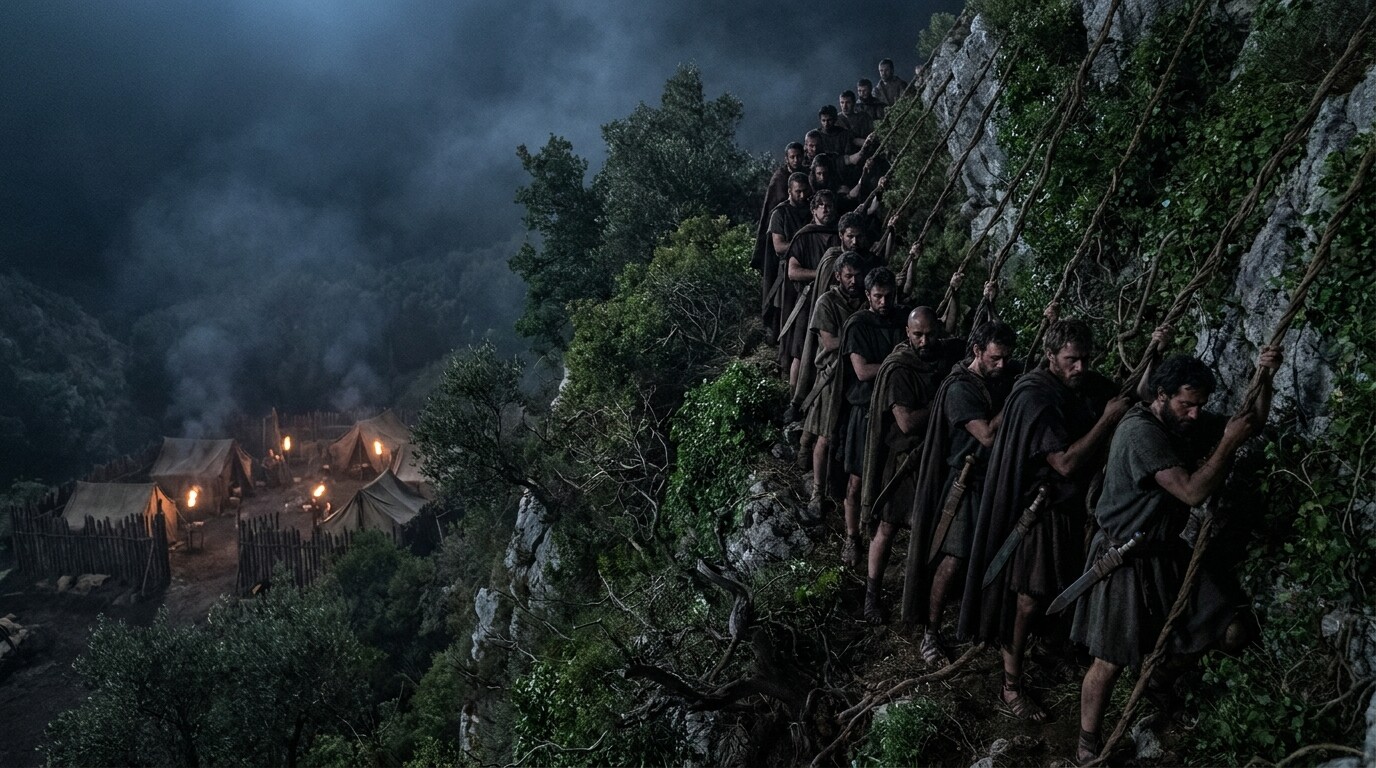
Using ropes woven from wild vines—a detail recorded by Plutarch and repeated in later sources, though some scholars note it may have been elaborated in transmission—the rebels descended the far side of the mountain through terrain Glaber apparently considered impassable. They came around behind the Roman camp at night. The camp, not fortified against attack from that direction, was struck from the rear. Glaber's force was routed. The rebels captured the Roman military equipment left behind, which mattered enormously: proper legionary weapons, shields, and armor would begin replacing the improvised armament of the first days.
A second Roman force, under a praetor named Publius Varinius, was subsequently dispatched. The campaign against Varinius became a series of engagements in which the rebels consistently outmaneuvered the Roman units sent against them. Varinius lost subordinate officers in separate actions. According to Plutarch, Spartacus at some point captured Varinius's own horse and his lictors' fasces—a humiliation with symbolic as well as practical significance. The precise locations and force compositions of these engagements are not recoverable from surviving sources.
By the winter of 73–72 BC, the rebel force had grown substantially. Slaves were escaping from estates across Campania and joining the column. The army was no longer a band of escaped gladiators; it was a large, mobile fighting force with captured equipment, an emerging organizational structure, and a base of operations that shifted as the situation demanded.
---
Two other leaders appear prominently in the ancient accounts alongside Spartacus: Crixus and Oenomaus. Both are described as Gallic or Germanic in origin—Appian and Plutarch use varying terms. They were part of the original Capua breakout or joined very shortly after, and they served as co-commanders in the early phase of the war.
The relationship between Spartacus and Crixus was not uniformly cooperative. Ancient sources record that the two disagreed on strategy. Plutarch presents Spartacus as arguing for moving north through Italy, crossing the Alps, and dispersing—allowing the enslaved people in the army to return to their homelands. Crixus and a faction of his followers wanted to remain in Italy and continue raiding. Whether this reflects genuine strategic disagreement or is a later literary construction designed to explain the subsequent division of forces cannot be determined with certainty.
What the sources agree on is that the forces divided at some point in 72 BC. Crixus led a separate group—sources differ on the precise direction—and was caught by a Roman consular army under the consul Lucius Gellius Publicola near Mount Garganus in Apulia. Crixus was killed in that battle along with a large portion of his force. The casualty figures given in the sources vary and should be treated as approximate.
Spartacus, moving north, defeated the consular forces sent against him. The two consuls of 72 BC—Gnaeus Cornelius Lentulus Clodianus and Lucius Gellius Publicola—both engaged his army at various points during the year. Both were defeated or checked. Appian records that after one of these victories, Spartacus held gladiatorial games in honor of Crixus, forcing Roman prisoners to fight as gladiators—inverting the social order that had defined his own captivity. This detail is reported in ancient sources and is broadly accepted by modern historians, though the precise circumstances are not fully recoverable.
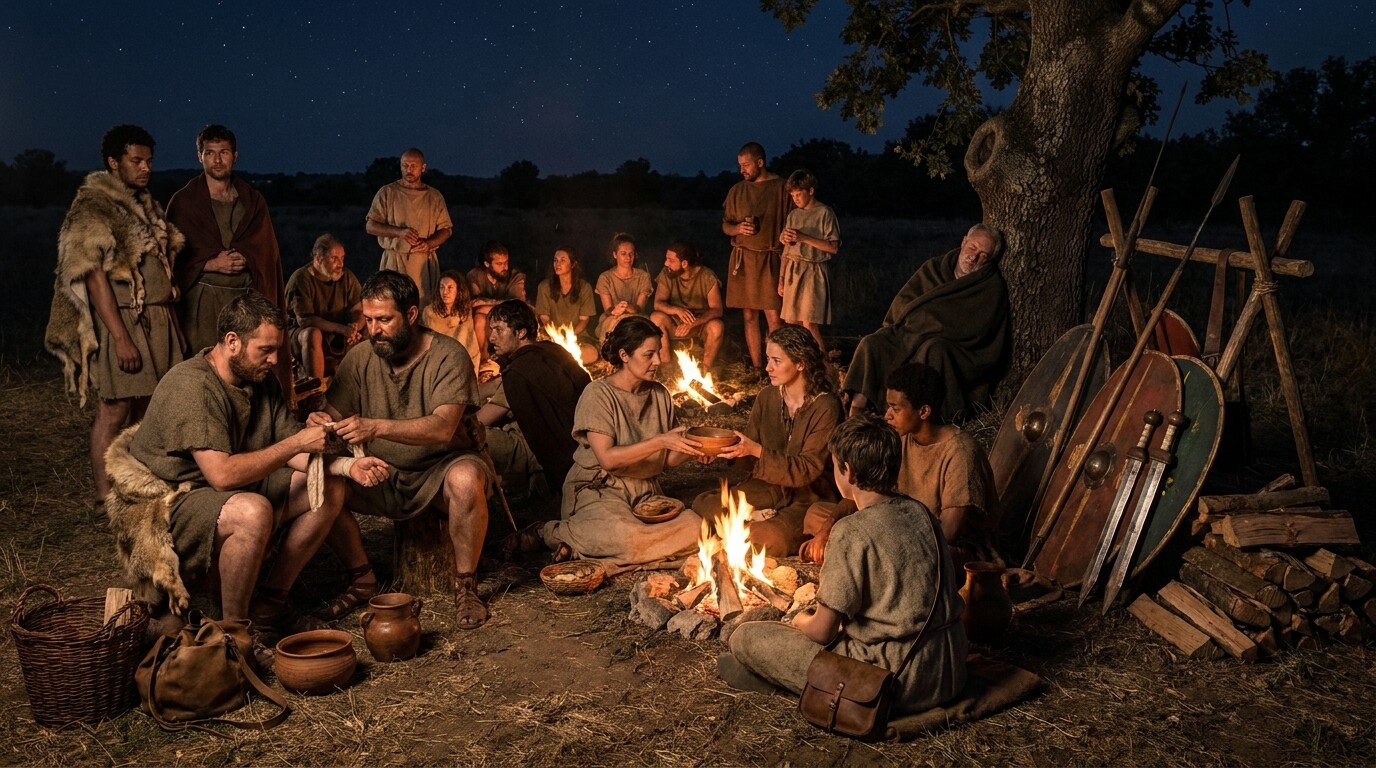
The army moved north through central Italy. Their route toward the Alps carried them through territory where they continued to absorb more escaped slaves, and the logistical demands on the column grew correspondingly. Ancient sources place the army's strength in this period at figures ranging from seventy thousand to over one hundred thousand; modern historians accept that the force was very large by the standards of the war while treating the upper estimates with caution.
Then, at a point the ancient sources record but do not fully explain, the march to the Alps stopped. The army turned south again.
This reversal has generated substantial scholarly debate. Some ancient writers suggest the rank and file refused to cross the mountains and insisted on remaining in Italy. Others hint at lost opportunity or miscalculation. Modern scholars have offered various interpretations: that the army's composition—many of whom were Italian-born slaves with no homeland to return to beyond the Alps—made the northern escape route less appealing in practice than in theory; that a force grown too large and too culturally diverse could no longer sustain a single strategic purpose; or that supply and logistics made the march untenable. The surviving sources do not provide enough information to settle the question.
---
The Senate, by this point, was treating the war as a genuine crisis.
Two consular armies had failed to destroy the rebel force. A significant portion of Italy's agricultural slave workforce was in open revolt or flight. The economic damage to the estates of Campania and the surrounding regions was serious. And the spectacle of a slave army defeating Roman legions in open battle—repeatedly—carried political implications that went well beyond the military situation.
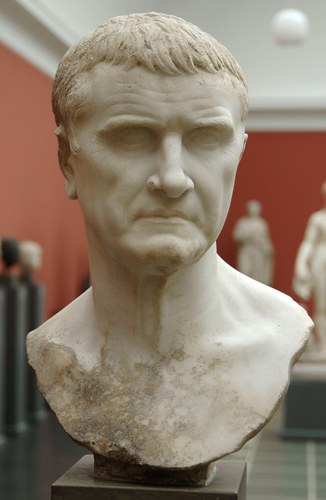
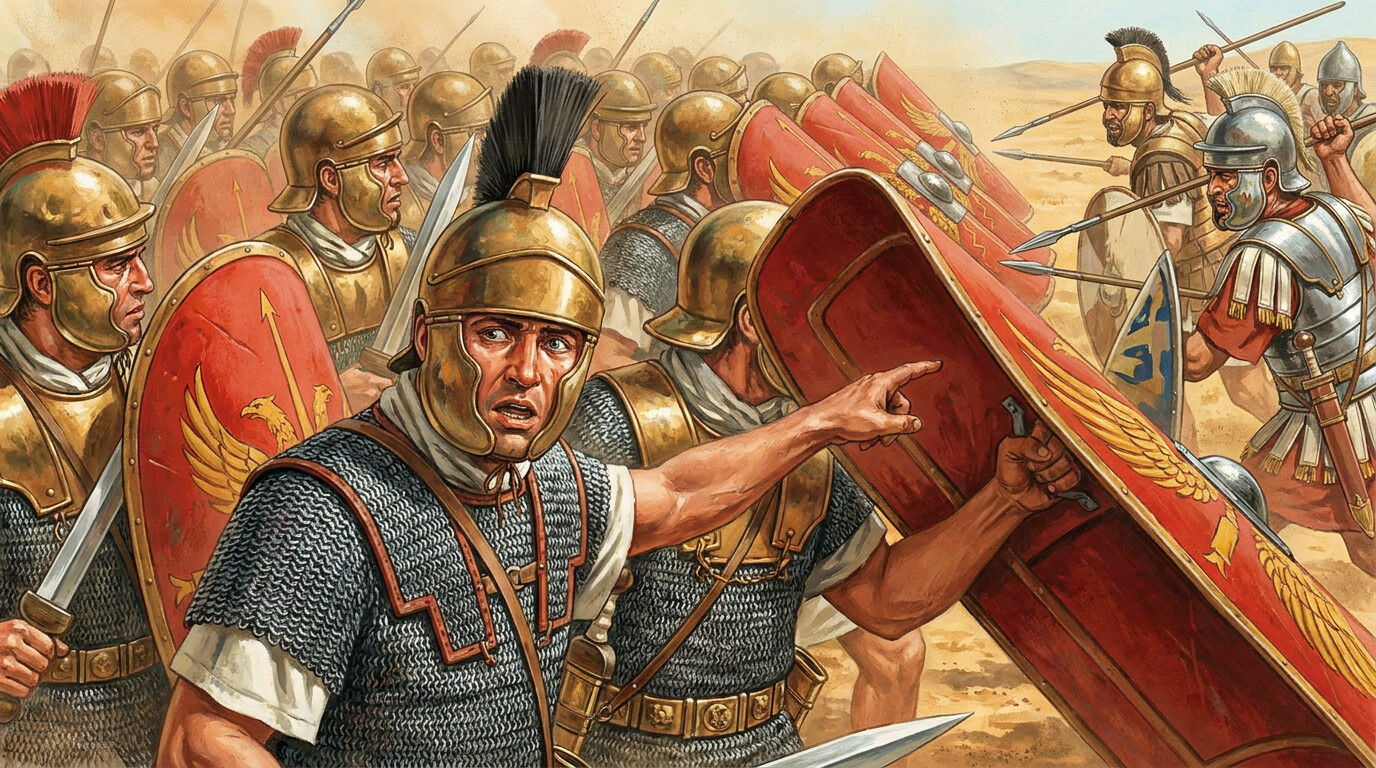
Marcus Licinius Crassus was appointed to command in 72 or 71 BC—the exact timing is slightly uncertain in the sources. He was one of the wealthiest men in Rome, a figure of enormous political weight, and a military commander of competence if not brilliance. He raised and equipped new legions, reportedly partly at his own expense, and took command of six legions in total, some of them the reconstituted remnants of earlier failed forces.
His first significant internal challenge was discipline. When a subordinate legate, Marcus Mummius, engaged the rebels against explicit orders and was repulsed with significant losses, Crassus revived an archaic Roman punishment: decimation. He selected a portion of the soldiers who had fled or failed—ancient sources give numbers that vary and cannot be reconciled precisely—and had every tenth man beaten to death by his fellow soldiers. The intent was to make the enemy in front of the army less terrifying than the officers behind it. Ancient sources confirm the punishment was carried out. Its precise effect on morale is a matter of inference.
Crassus pursued the rebel army as it moved south through Italy toward the toe of the peninsula. Spartacus reportedly made contact with Cilician pirates—piracy was a significant force in the late Republic Mediterranean before Pompey's famous campaign against it in 67 BC—with the intention of transporting a portion of his force to Sicily, where the memory of earlier slave revolts was still alive. The pirates accepted payment and then withdrew without providing transport. Whether this represented simple betrayal, changed circumstances, or the intervention of Roman naval forces is not clear from the sources.
Stranded in Bruttium—the toe of the Italian boot, modern Calabria—with the sea route gone, the rebel army was now on a peninsula within a peninsula.
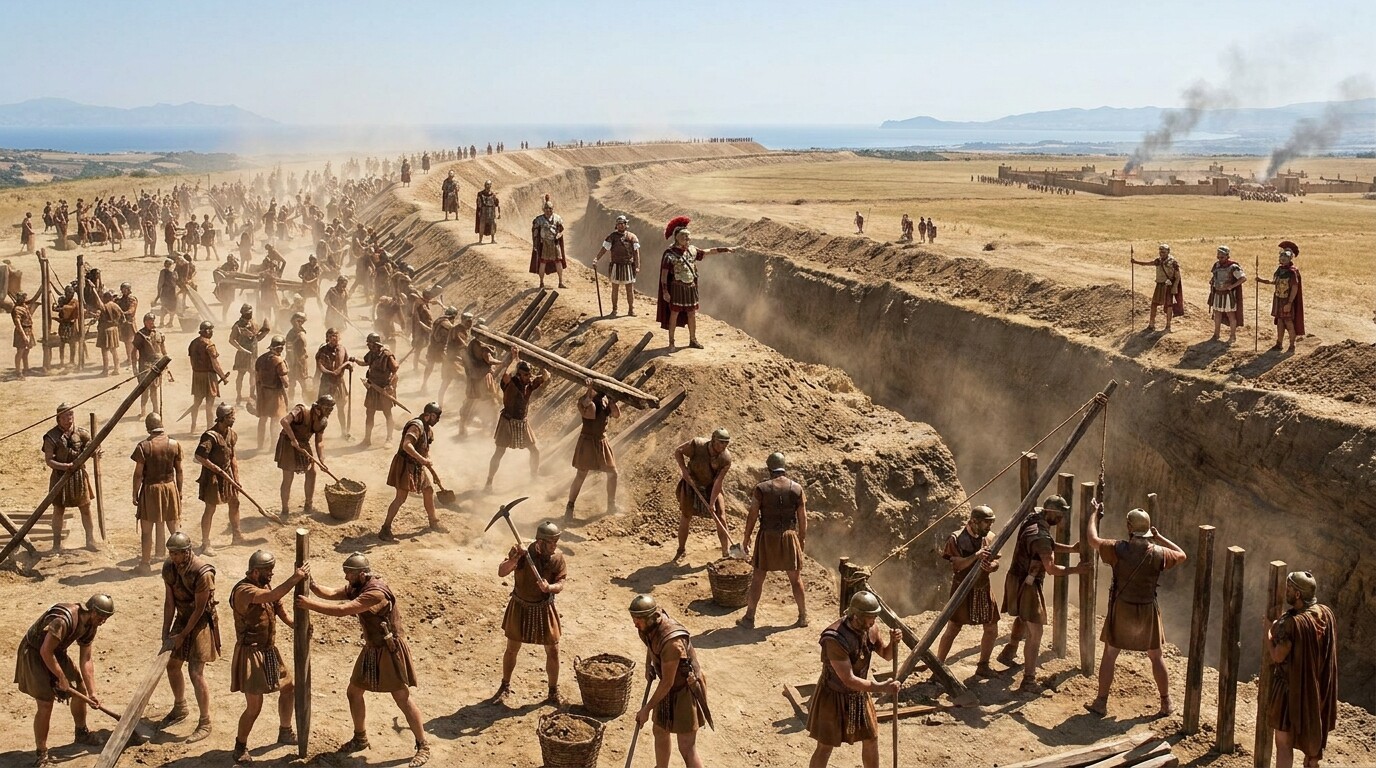
Crassus recognized the geography. He ordered the construction of a ditch and rampart across the width of the Bruttian peninsula, roughly from sea to sea. Ancient sources describe this as a significant engineering feat: Appian gives dimensions of approximately three hundred stades in length—which scholars translate as roughly thirty to thirty-seven miles—and fifteen feet in width and depth. The exact figures may be rounded or conventionally exaggerated in transmission, but the basic fact of the fortification line is broadly accepted. Its purpose was straightforward: not to assault the rebels directly, but to seal them in, cut off their foraging, and starve them into a disadvantageous fight.
Spartacus attempted to break through the lines. An initial attempt failed. A second attempt—reportedly made on a winter night when the ditch was partially filled with debris, timber, and the bodies of pack animals, according to Appian—succeeded for a portion of the force. A significant body of fighters broke through the Roman fortifications and was loose in southern Italy again.
But the cohesion of the rebel army was fracturing. Factionalism that had been present since the death of Crixus reasserted itself. Two commanders named Castus and Gannicus—both described in Appian and Plutarch as Gallic or Celtic—separated their forces from Spartacus and operated independently. Crassus's lieutenants caught these separate columns and destroyed them in detail. The numbers given for these engagements vary across sources; the outcomes are consistent.
---
The final battle is placed by ancient sources in Lucania—the region of modern Basilicata in southern Italy. Plutarch locates it near a river, though neither ancient sources nor modern archaeology has identified the site with certainty. The date is generally placed in 71 BC.
By this point, Pompey's army was returning from Spain, where it had been fighting the Sertorian War. The Senate ordered Pompey to march through Italy and assist in finishing the slave war. Marcus Terentius Varro Lucullus, proconsul of Macedonia, was also moving forces toward the theater. According to Plutarch, Spartacus understood that time was running out and moved to bring Crassus to a decisive engagement before the other Roman forces could converge.
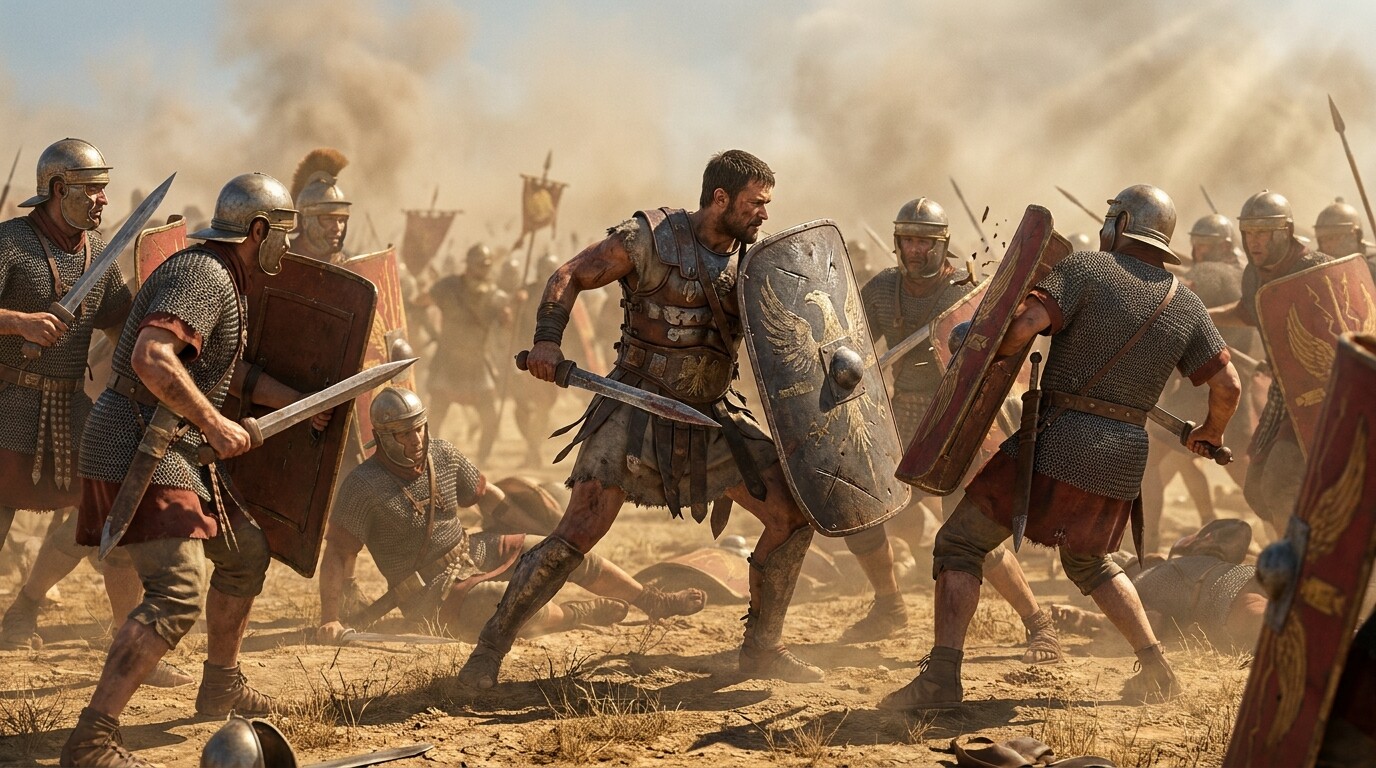
In the final engagement, the rebels attacked. The tactical details of the battle's progression are not preserved in the kind of operational specificity that later Roman military accounts sometimes provide. What the sources record is that the rebel army was eventually broken. Spartacus himself, according to Plutarch, fought toward Crassus and killed two centurions who opposed him before being surrounded and killed. His body was never formally identified afterward—Plutarch notes this explicitly, and it became a point of some significance in the aftermath.
Appian writes that Spartacus's wounds were consistent with having fallen in the front rank, fighting forward. This is presented here as the ancient account, not as confirmed biographical fact.
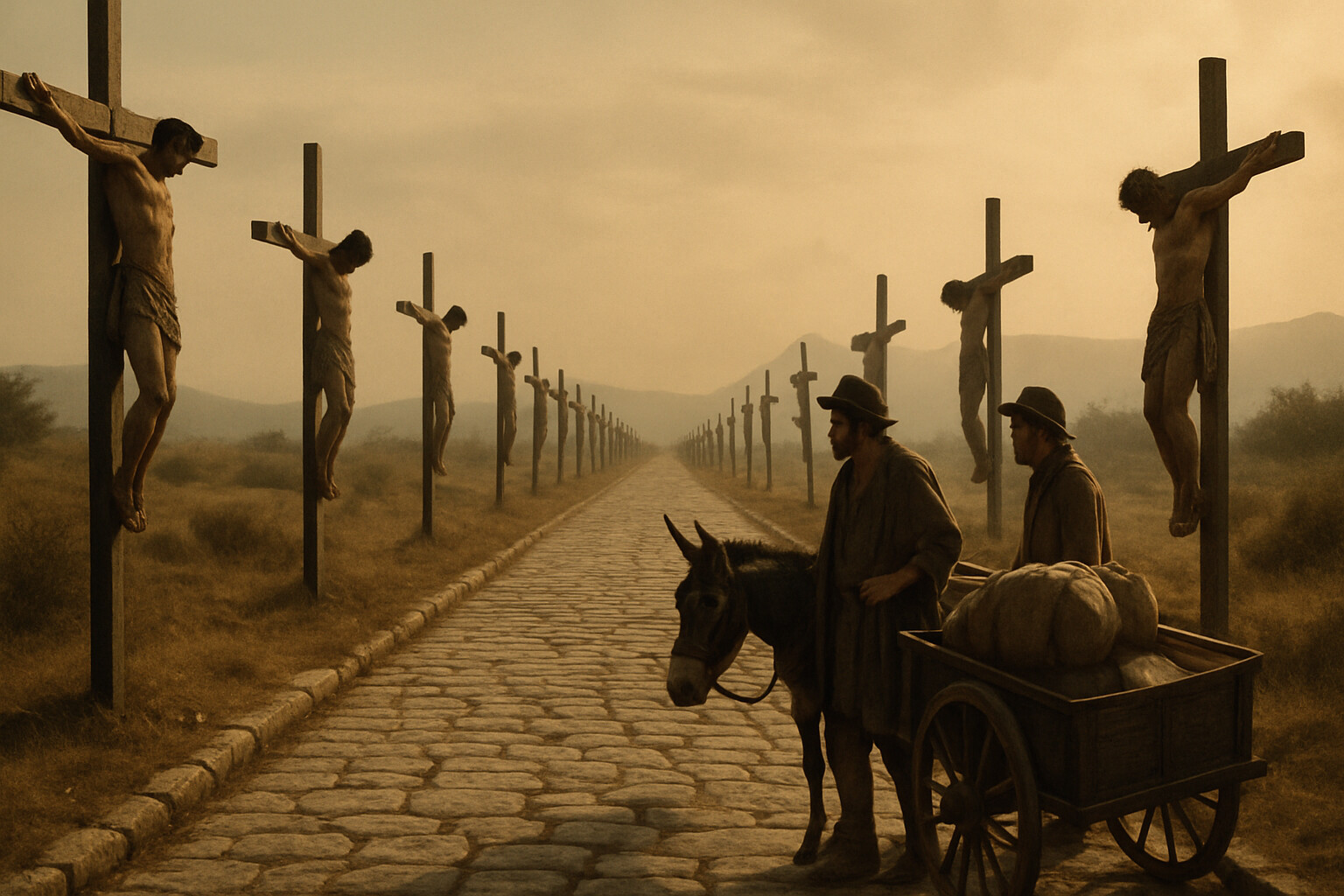
Six thousand survivors of the rebel army were captured. Crassus ordered them crucified along the Appian Way, the main road from Capua to Rome, at regular intervals. The distance covered is approximately one hundred thirty miles. Ancient sources confirm this act. It was a deliberate, large-scale public message: the road that commerce and armies used to move through Italy was now lined with the bodies of the men who had threatened its safety.
Pompey's forces, arriving from Spain, encountered and destroyed a separate group of survivors still moving through northern Italy—reportedly several thousand men. Pompey claimed in dispatches that he had finished the war. Crassus, who had done the primary work, was deeply irritated by this, according to Plutarch. The political rivalry between the two men predated the war and would outlast it.
---
What Spartacus actually wanted—what the war meant in the terms its leaders understood—is a question the ancient sources raise without clearly answering.
He was not pursuing the abolition of slavery in any general political sense that the sources record. The ancient writers do not present him as a social theorist or an advocate for a changed world order. He was leading people who did not want to be slaves and were willing to fight to stop being slaves. Whether that constitutes a revolutionary program in the modern sense is a question historians have debated at length, with conclusions shaped as much by the political contexts of the historians themselves as by the ancient evidence.
What the sources do record, and what matters for understanding the war on its own terms, is that Spartacus led a force that defeated Roman armies repeatedly in open terrain, maintained cohesion across a large and diverse force for two years, and demonstrated tactical flexibility and geographic awareness that his opponents consistently underestimated. He extracted better terms from the battlefield than any slave army in Roman history had previously managed.
He also, ultimately, lost.
The reasons are worth examining clearly. The rebel army had no secure logistical base, no allied cities, no treasury beyond what it captured. It grew large enough to win battles but too large to feed easily. It had genuine internal divisions—the separation of Crixus's force, the later independence of Castus and Gannicus—that allowed the Romans to engage it in pieces rather than as a single mass. The pirate plan failed. And when Crassus built his fortification line across Bruttium, the fundamental geographical problem became undeniable: an army that cannot hold territory must eventually run out of room.
Rome drew several lessons from the war. Oversight of slave populations increased. The ludus system continued—gladiatorial entertainment did not end—but conditions of oversight were more carefully managed in subsequent decades. More broadly, the war accelerated a political context that was already dangerous: Crassus and Pompey, rivals who had both claimed credit for ending the revolt, would later form with Julius Caesar the informal alliance known to historians as the First Triumvirate. The political consequences of the Third Servile War run, through a chain of connected events, into the final decades of the Republic itself.
Spartacus does not appear in the historical record after the final battle in Lucania. His body was not identified. His name, unlike those of most enslaved people in the ancient world, survived in the record. Plutarch wrote about him with something approaching respect, noting his intelligence and moderation alongside his courage—notable praise in an ancient literary tradition that was under no obligation to speak well of a slave rebel.
The ancient accounts were written by Roman citizens, for Roman audiences, decades or more after the events. They preserved the war partly because it was a major military crisis, partly because it featured individual figures dramatic enough to be worth recording, and partly because the political consequences were genuinely significant. They were not writing to give Spartacus or his fighters a voice. What survived passed through a single filter.
The slaves who fought on Vesuvius and in the fields of Lucania left no written accounts. What we know of what they wanted, what they feared, and why they followed Spartacus comes only through the pens of the men who defeated them.
That is the clearest limitation of the historical record, and it is worth stating plainly before closing any account of this war.
The Appian Way ran from Rome to Brundisium. For the traveler of 71 BC, it was also, for one hundred thirty miles of its length, a monument to what happened when Rome felt genuinely afraid of the people it owned.