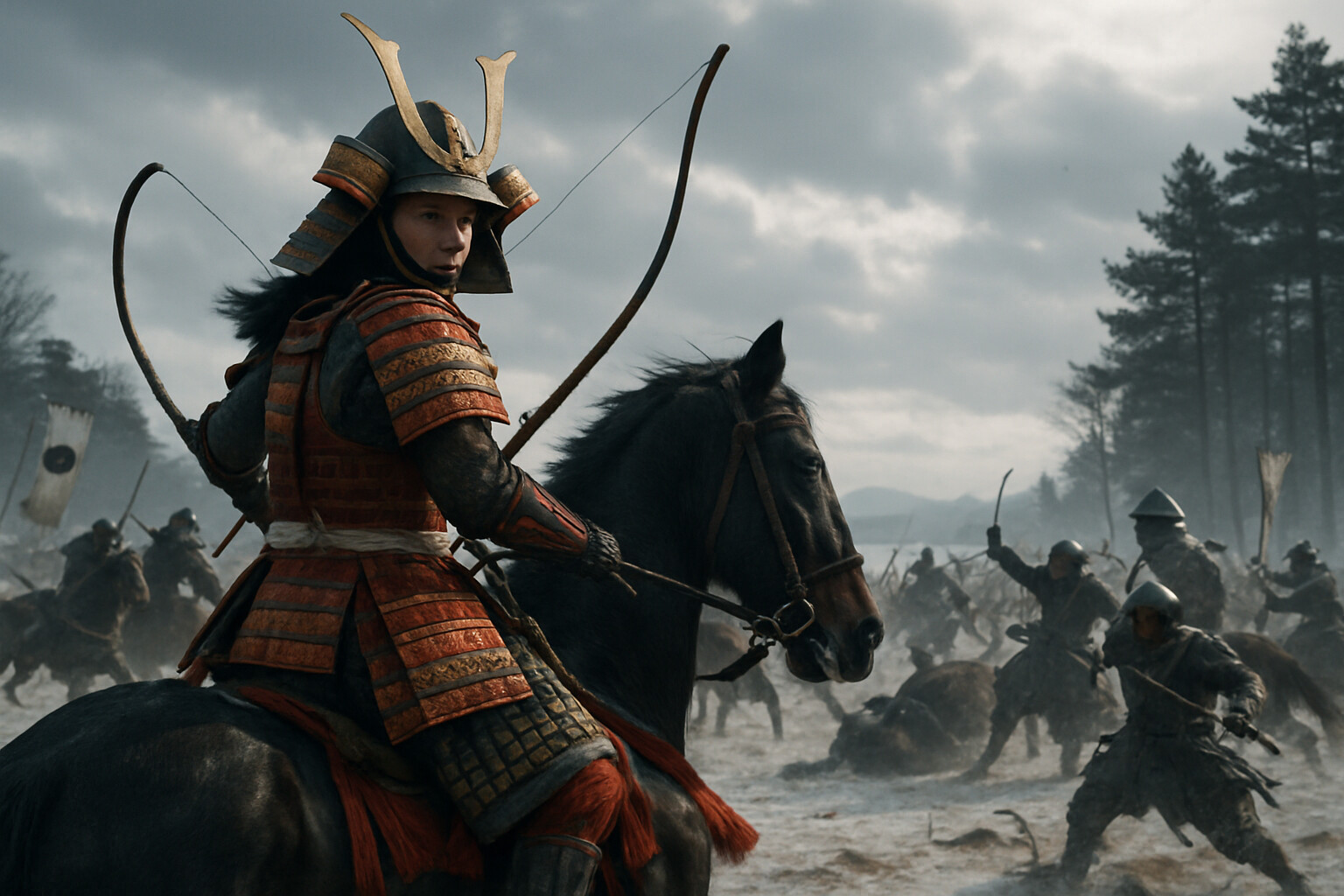
The horses were already dying.
It was the twenty-first day of the first month, by the old reckoning — late winter, 1184. The ground around Awazu, in Omi Province, had frozen hard enough to ring under iron hooves. Minamoto no Yoshinaka had perhaps three hundred riders left. Hours earlier he had commanded an army. Now the riders coming at him flew the banners of his own kinsmen, the forces of Minamoto no Yoritomo, and they were not slowing down.
Somewhere in the remnant column, on a horse that had carried her through months of campaign, was a woman the Heike Monogatari would later describe as worth a thousand warriors. Her name was Tomoe. She was skilled — perhaps extraordinarily so — with horse, bow, and blade. And on this day, the story goes, she would take one final head before the field demanded something else of her entirely.
What happened at Awazu is documented, in broad strokes, by one of the great literary monuments of medieval Japan. What that documentation tells us, and what it cannot tell us, is part of the story itself.
---
To understand the day Tomoe Gozen rode at Awazu, you need to understand the war that made it possible.
The Genpei War — Genpei Kassen — ran from 1180 to 1185 and consumed the Japanese archipelago in a struggle between two great warrior clans: the Taira, who had dominated the imperial court at Kyoto for a generation, and the Minamoto, who had been pushed to the margins and who now rose in a series of increasingly coordinated revolts. The war's name is a contraction: Gen from the Chinese reading of Minamoto's character, Pei from the reading of Taira. Two clans. Five years. Tens of thousands dead.
The Taira had held power through court politics, intermarriage with the imperial family, and the careful cultivation of influence in the capital. The Minamoto came from a harder tradition — provincial warriors, horsemen, men and women raised in the saddle in the eastern provinces where the land was difficult and survival required competence above ceremony. They were not a unified force. They were a fractious clan with multiple strong leaders, competing ambitions, and old grudges.
Minamoto no Yoshinaka was one of those leaders. He was a cousin of Yoritomo, the paramount Minamoto commander whose headquarters were at Kamakura in the east. Yoshinaka had grown up in the provinces of north and central Honshu, a tough, capable fighter who had raised his own army and won his own battles. In 1183, he led his forces through the mountain passes into the capital region and dealt the Taira a catastrophic defeat at the Battle of Kurikara, forcing them to abandon Kyoto and retreat westward. Yoshinaka entered the capital in triumph.
Triumph did not suit him. His troops plundered Kyoto. His behavior at court was abrasive. The retired Emperor Go-Shirakawa, a survivor of decades of political maneuvering, began working against him almost immediately. And in the east, Yoritomo watched his cousin's growing power with undisguised alarm.
By early 1184, Yoritomo had seen enough. He dispatched his younger brothers, Minamoto no Noriyori and the brilliant, dangerous Minamoto no Yoshitsune, with a substantial force to bring Yoshinaka to heel — or to end him.
Yoshinaka knew it was coming. What he could not solve was the arithmetic of his situation. His army had been depleted by attrition, desertion, and the simple difficulty of holding together a coalition of provincial warriors far from their home territories. When the eastern Minamoto forces arrived and moved against him, his numbers were not sufficient. He fought a losing engagement at the Uji River bridge on the twentieth. By the morning of the twenty-first, he was falling back toward Awazu with whatever he had left.
Three hundred riders, the sources suggest. Against thousands.
---
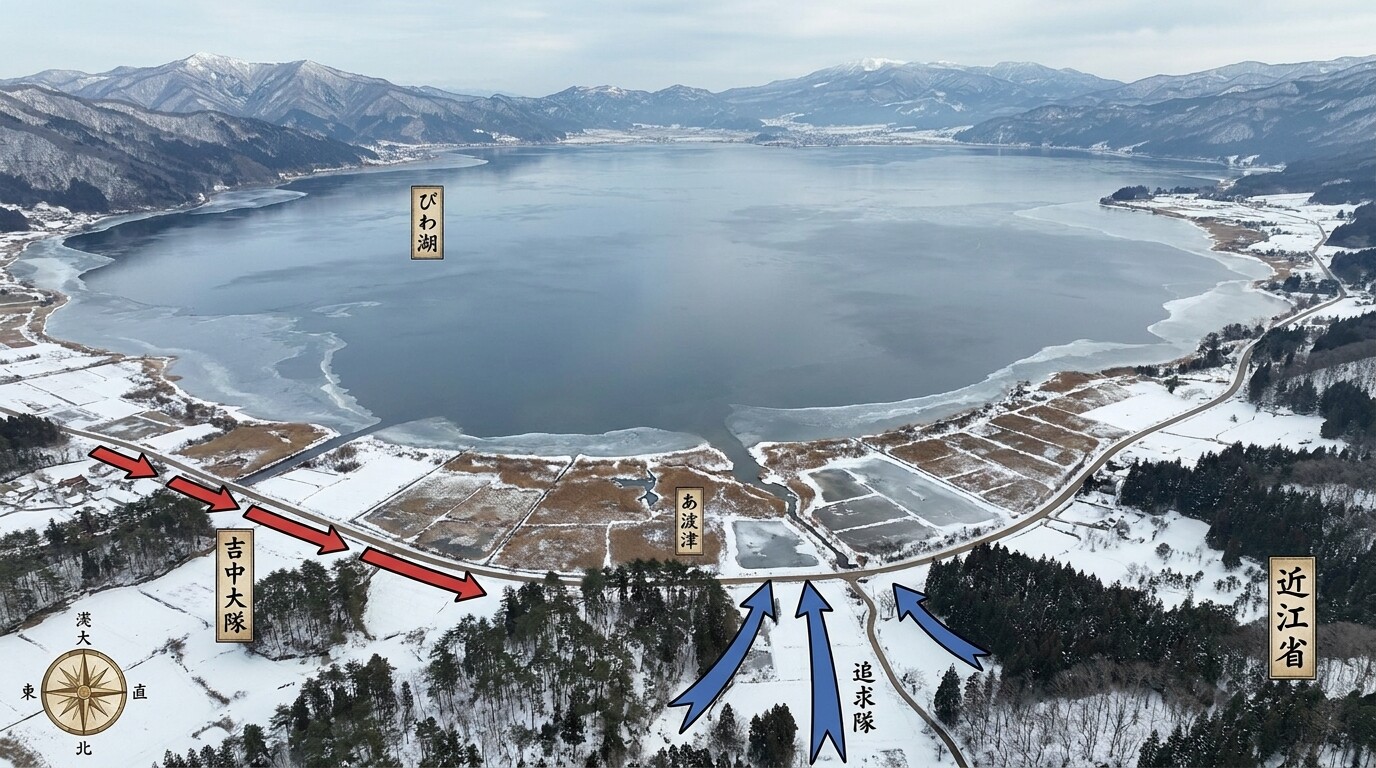
Awazu sits at the southern end of Lake Biwa, the largest freshwater lake in Japan, in what is now Shiga Prefecture. In 1184, the area was a mix of frozen paddies, marshy lowland, stands of pine, and open ground cut by irrigation channels that would be invisible under snow or frost-hardened soil. The geography was not kind to a force in retreat. There was no natural defensive line to anchor, no bottleneck where a small force could make superior numbers irrelevant. A retreating column could be flanked, encircled, and destroyed by faster or more numerous pursuers.
The winter cold in the Omi basin in late January is real and sharp. Breath clouds in the air. Ice collects at the edges of Lake Biwa. The horses' hooves on frozen ground would have been audible at a distance. The light, in that season, comes flat and gray, and the mountains that ring the basin hold their snow well into spring. This was not a battle in comfortable conditions. It was a pursuit in killing weather.
Yoshinaka's column was trying to reach open ground. The Heike Monogatari's account suggests he intended to ride for the Kiso region, back toward the home territory where he had first built his power. He never made it. The pursuing forces were too close, too fast, and too many.
---
Tomoe Gozen enters the historical record in a specific and unusual way: she appears in the Heike Monogatari, the great war chronicle of the Genpei conflict, described in terms that Japanese military literature almost never applied to women.
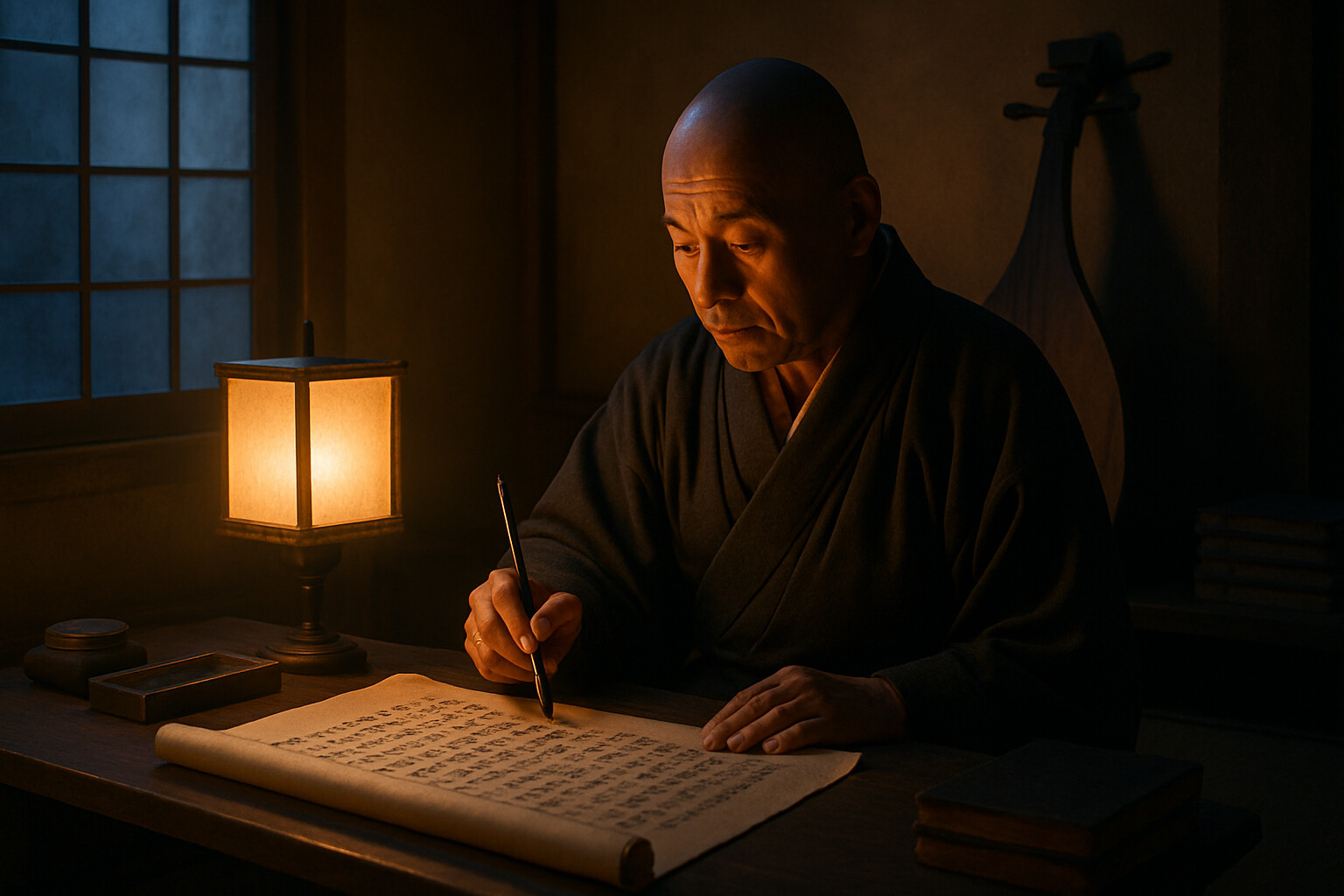
The Heike Monogatari is a work of enormous scope and literary ambition, compiled from oral traditions and earlier written records into something approaching its current form by the late thirteenth or early fourteenth century — a century or more after the events it describes. It was performed by blind lute-playing monks called biwa hoshi, and its narrative combines historical record with Buddhist themes of impermanence, the sorrow of transience, and the folly of worldly ambition. Its opening line — one of the most famous in Japanese literature — declares that the sound of the bell of Gion Shoja echoes the impermanence of all things.
This matters for how we read the account of Tomoe. The Heike Monogatari is not a military dispatch or an administrative record. It is a literary-historical work shaped by the concerns of its era, its performers, and its audience. It preserves real events, real names, and real battles, but it also shapes them, dramatizes them, and loads them with meaning. The description of Tomoe is, by any standard, extraordinary — and it is also a literary portrait, not a field report.
What the Heike Monogatari says, in translations that vary somewhat in their handling of the original Japanese, is roughly this: Tomoe was especially beautiful, with fair skin, long hair, and charming features. She was also a fearless rider whom neither the fiercest horse nor the roughest ground could master, a skilled archer who in hand-to-hand fighting was a match for a thousand warriors — fit to meet either man or demon in battle. She was one of Yoshinaka's most valued retainers, and he had taken her with him on his campaigns.
The description is formulaic in some respects — the pairing of beauty and martial prowess is a literary convention in Japanese warrior narratives. But the specificity of her role is not formulaic. She is not a decorative figure or a tragic bystander. She is a mounted archer and close-quarters fighter described as present throughout the campaigns and present at Awazu.
Her relationship to Yoshinaka is described differently in different versions of the text. Some accounts describe her as his concubine. Some as a retainer. Some traditions — including later genealogical records from families who claim descent from her — describe a more complex relationship, including a life after the war. None of this is established with the certainty of an official record. What is consistent across the main versions of the Heike account is her martial function and her presence at the last battle.
---
The column was shrinking by the mile.
As Yoshinaka's remaining forces rode toward Awazu, the pursuing Minamoto horsemen were cutting into his flanks and rear. The Heike Monogatari describes the dissolution of what had been, months earlier, a conquering army. Warriors peeled away, fell, surrendered, or simply could not maintain the pace. By the time the remnant reached the vicinity of Awazu, the three hundred had become a fraction of that.
Yoshinaka called to Tomoe. The words attributed to him in the Heike Monogatari — that she should go, because it was unseemly for him to die alongside a woman, or that he wanted her to carry word of his end — vary by version and by translation. These are part of the literary text, not a documented historical exchange, and they should be read as such. The scene they establish is, however, tactically coherent: a commander at the end of his options, with a capable subordinate he is trying to extract from a battle that cannot be won.
Tomoe did not leave immediately.
Instead, she turned toward the enemy. The Heike Monogatari identifies the warrior she encountered as Onda no Hachiro Moroshige of Musashi — a powerful man, the text emphasizes, strong and large. She rode at him, pulled him from his horse, pressed his head against the pommel of her saddle, and cut it from his body. Then, with the head taken, she removed her armor and rode away to the east.
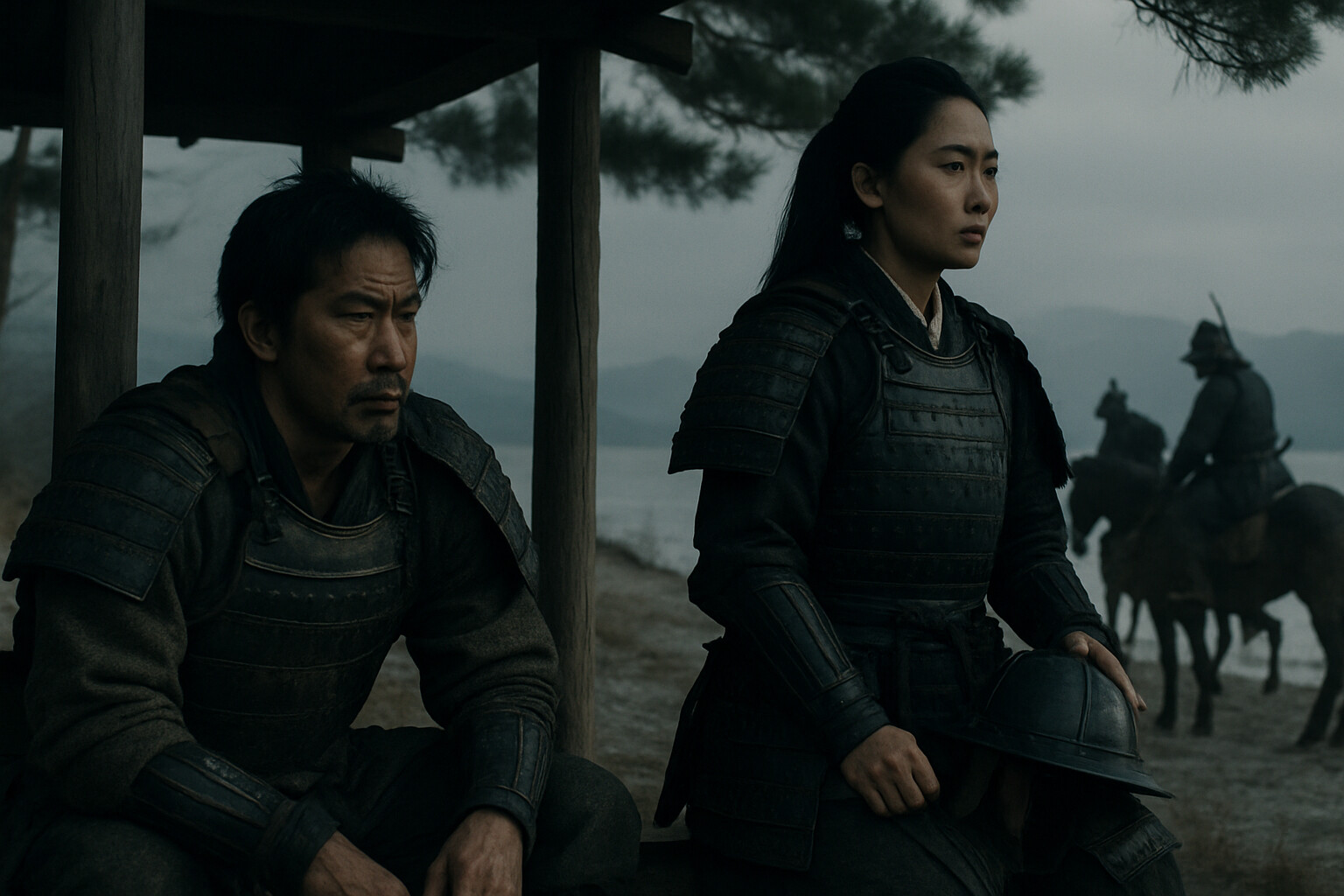
This is the account as preserved in the major versions of the Heike Monogatari. She took a head. She withdrew. Yoshinaka continued toward his death.
How much of this is documented, and how much is literary construction or later tradition? The honest answer is that we cannot fully separate them. The Heike Monogatari is the primary source. No surviving administrative record, no period battle log, no contemporaneous document independently confirms Tomoe's presence at Awazu or the specific action described. She appears in the chronicle, and the chronicle is the record.
What we can say is that the Heike Monogatari is not fiction in the simple sense. It preserves the names of real people, real battles, real places. Yoshinaka was real. Awazu was real. The battle was real. Tomoe Gozen appears in a document that is, at its core, a historical chronicle shaped by the literary conventions of its era. Her presence at Awazu is attested by the most comprehensive source we have for the Genpei War.
---
The weapons of the battle at Awazu require some attention, because they shaped what was possible on that frozen ground.
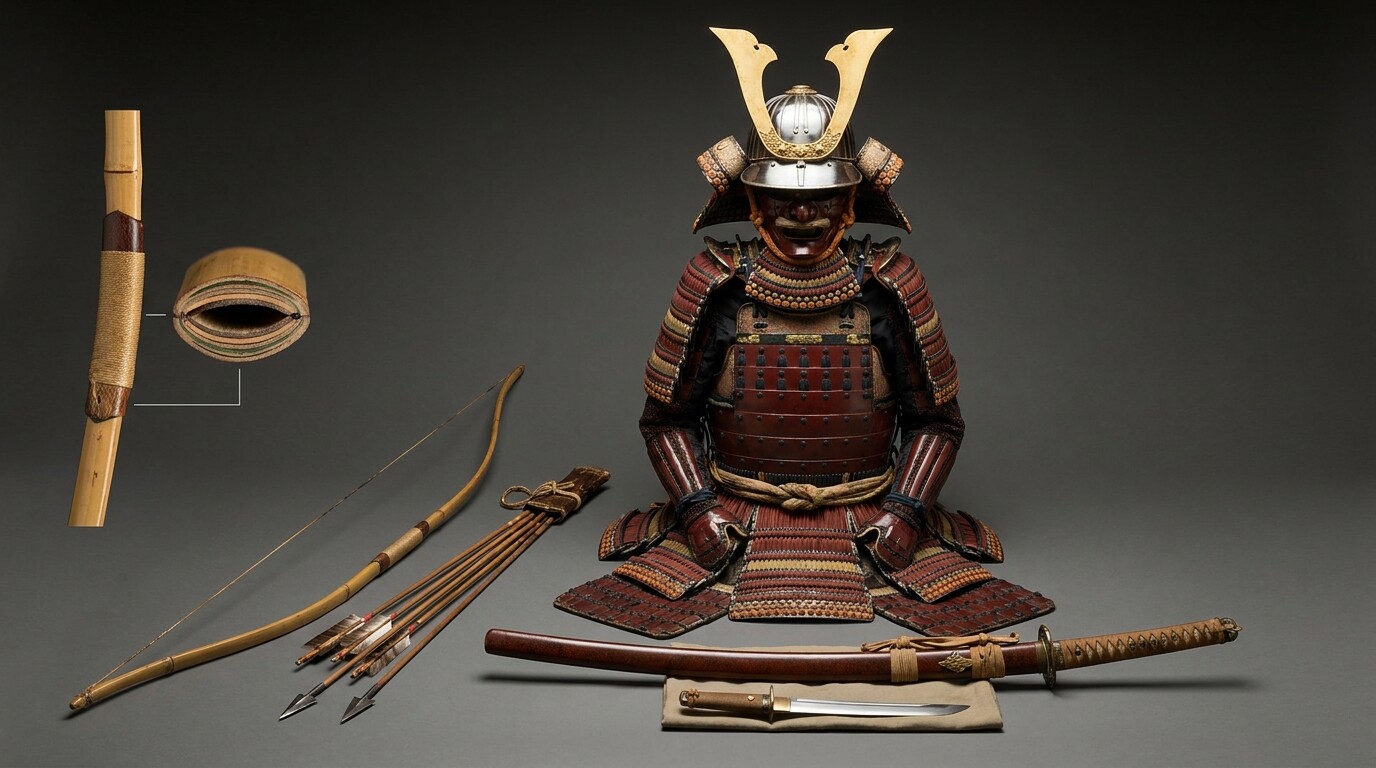
The primary weapon of the mounted Japanese warrior — the samurai, in terminology that was still taking formal shape in this era — was the asymmetrical longbow, a distinctive instrument that the Japanese military tradition had refined over centuries. These bows were composite constructions of wood and bamboo, with roughly two-thirds of the bow's length above the grip and one-third below. That asymmetry was functional, not decorative: it allowed a mounted archer to shoot in multiple directions without the lower limb striking the horse, and it gave the bow a natural anchor point suited to use in the saddle. The bows were long by global standards, typically around two meters or more, and required significant physical strength and years of practice to use accurately at speed.
Arrows were constructed of bamboo with iron heads. Armor-piercing heads, called yanone, were designed to penetrate the lamellar armor of the period. Turnip-head arrows, kaburaya, had hollow bulbous tips that whistled in flight, used in certain ritual contexts to signal the opening of battle. The effective range for aimed mounted archery was perhaps thirty to fifty meters under practical combat conditions, though skilled archers could achieve accurate shots at greater distances in favorable circumstances.
The bow was not a backup weapon. It was the primary offensive instrument of the mounted Japanese warrior of the late Heian and early Kamakura period. The saying in the warrior tradition — yumi ya no michi, the way of the bow and arrow — predates by generations the later emphasis on the sword that would come to define samurai identity. A warrior like Tomoe, described as a skilled archer, was being described as skilled at the central military art of her era.
The sword carried by mounted warriors of this period was the tachi — a long, curved blade worn edge-down, suspended from the belt rather than thrust through it as later katana would be. The tachi was a cavalry weapon, designed for sweeping cuts from horseback. Its curve suited the downward diagonal strikes available to a mounted fighter against a standing or unhorsed opponent. The blades of this period were already demonstrating the sophisticated folded-steel construction, differential hardening, and visible temper line — the hamon — that would define Japanese sword-making for centuries. A high-quality tachi of the late twelfth century was a product of considerable craft and significant expense, and wielding one effectively from horseback required training that began in childhood.
For close-quarters work, warriors also carried shorter blades in various forms. The naginata, a pole weapon with a curved blade mounted on a long wooden shaft, was also in use in this period and is associated in later tradition specifically with women warriors, though that association is stronger in later eras than in 1184.
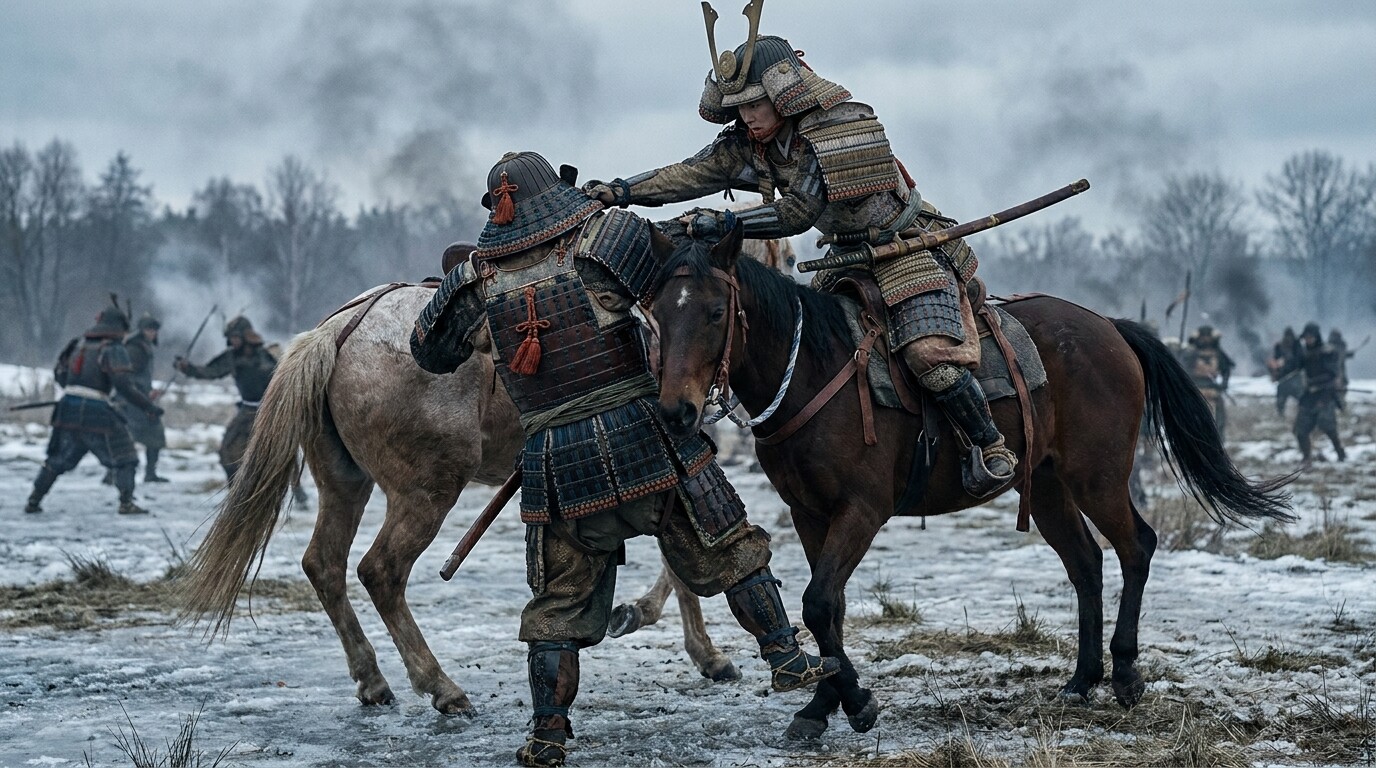
The armor of the period was the oyoroi — great armor — a substantial, boxy construction of lamellar plates: small scales of iron or leather laced together with silk or leather cords and lacquered against the weather. The oyoroi was designed primarily for mounted combat. It protected the torso, shoulders, and upper arms with large sode — shoulder guards — that also served as partial shields. A complete set could weigh well over twenty kilograms. It was expensive, the product of specialist craftsmen, and its lacings and materials announced the wearer's status as clearly as any badge of rank. Warriors of Tomoe's standing would have worn armor of this type, its color and lacework identifying her affiliation with Yoshinaka's forces.
On the Awazu ground, in the winter cold, that armor would have been stiff. Lacings tightened in the cold. Movement was constrained. And the frozen ground, which gave firm footing for a horse at speed, became treacherous the moment the surface broke — cracked ice over mud or water, concealed beneath snow, could trap a horse or throw a rider without warning.
---
Yoshinaka's end came in the marsh.
The Heike Monogatari describes his final moments with the particular intensity it reserves for great warriors meeting their deaths. He was riding hard when his horse drove into marshy ground near Awazu — the account is specific about this, suggesting local knowledge of the terrain that the chroniclers or their sources possessed. The horse became mired. Yoshinaka was trying to free it when an arrow struck him in the face — specifically, the text says, in the gap of his helmet visor. He fell forward over his horse's neck. A warrior of the pursuing force, Ishida no Jiro Tamehisa, closed on the downed commander and took his head.
He was approximately thirty-one years old. He had held Kyoto for a matter of months. His military career, measured from his first major campaign through the collapse at Awazu, spanned perhaps three years of active fighting. In those three years he had won remarkable victories — Kurikara, in particular, stands as one of the decisive engagements of the Genpei War — and had then, through a combination of political failures and military overextension, lost everything.
The Heike Monogatari mourns him in its way, as it mourns most of the warriors it describes. The Buddhist framing of the chronicle makes their deaths part of a larger pattern of impermanence — the mighty fallen, the proud humbled, the cherry blossom that blooms briefly and is scattered. All of this mattered enormously to the people living it. The chronicle's task was to say so, and to keep saying so, long after the ground at Awazu had frozen and thawed and been forgotten by everyone who had not been there.
---
Tomoe left the field. The Heike Monogatari records her departure — east, with the head of Onda no Moroshige as her final act of the battle. What became of her after Awazu is among the most contested questions in the scholarship and tradition surrounding her.
Several distinct traditions exist. One holds that she eventually became a Buddhist nun — a not-uncommon fate for women whose male protectors died in the wars of this era, and one that would have provided both shelter and a form of honorable withdrawal from the world. Some accounts associate her with a temple in Echigo Province, in what is now Niigata Prefecture. Another tradition, based on genealogical records of uncertain reliability, claims that she survived, remarried, and had descendants — that the line continued, that there are families who trace their ancestry to her. A third layer of tradition, accumulated over the centuries, places her in local accounts across several regions of Japan, each claiming some connection to her presence or her grave.
None of these traditions can be confirmed against contemporaneous records. The Heike Monogatari, which is not shy about following its major figures through their fates after battle, does not describe what happened to Tomoe beyond her departure from Awazu. That silence is itself a kind of evidence — at minimum, it tells us that the chronicle's compilers did not have, or did not choose to include, a definitive account of her later life.
What the tradition as a whole demonstrates is the enduring weight of her presence in cultural memory. For more than eight centuries, people have returned to the question of Tomoe Gozen — who she was, what she did, where she went. The inquiry itself is a form of tribute, if an imperfect and sometimes distorting one.
---
The question of what Tomoe Gozen was — in institutional terms, in the terms of her own society — is one that historians have examined from multiple angles.
The term onna-musha, woman warrior, is applied to her in later tradition. The term itself was not in common formal use in the late twelfth century, and its application to Tomoe is partly retrospective categorization. What the Heike Monogatari describes is a woman functioning in a military role within Yoshinaka's retinue — riding, fighting, present at the campaigns. Whether this was unusual or exceptional in the context of the eastern warrior class of the late Heian period is itself a matter of historical debate.
Some historians have argued that the relative autonomy and martial capacity of women within the warrior class of eastern Japan in this era was meaningfully greater than the more restrictive models that would come to define gender roles under the Tokugawa shogunate centuries later. The eastern provinces where Yoshinaka and his people had their roots were not Kyoto. They operated under different social pressures and different practical necessities. A household that required all available adults to ride and to fight in order to survive could not afford to exclude half its members from military training.
This is not to overclaim. Tomoe is described in the Heike Monogatari as remarkable — and the fact of her remarkable description implies she was unusual, not that women routinely served as front-line cavalry in Genpei armies. But unusual and unique are different things. The historical record preserves other women of warrior households from this era who trained with weapons, managed estates in their husbands' absences, and in some cases fought. Tomoe may have been the most skilled, or the most prominent, or simply the one whose story was captured by the chronicle in enough detail to survive.
The later tradition of the naginata as a weapon associated specifically with women of the warrior class — to the point where it became part of the formal education of women in samurai households in later centuries — may connect, however indirectly, to a longer history of female martial training in Japan that figures like Tomoe represent.
---
The Heike Monogatari endures. Its language shaped Japanese literary style for centuries. The biwa monks who performed it across Japan carried the Genpei War's stories into communities that might never see a written text — and in doing so, they fixed certain images in cultural memory with the permanence that only repeated telling can achieve.
Tomoe Gozen, in that text, occupies a specific and powerful position. She is not a peripheral figure. She is present at the climax of Yoshinaka's story. Her action — taking the head of Onda no Moroshige — is the final military act described before Yoshinaka's death. In the grammar of the warrior narrative, this is significant placement. The chronicle could have described her as absent, or as fleeing, or as killed. Instead, it describes her fighting, and then departing with deliberateness.
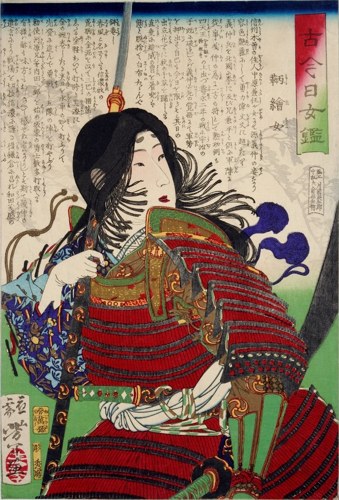
She has been depicted in woodblock prints since at least the Edo period (1603–1868), when artists including Utagawa Kuniyoshi produced striking images of her in full oyoroi armor, mounted, bow in hand. These images are themselves historical documents — not of the twelfth century, but of how the intervening centuries processed and transmitted her story. In the popular imagination she became an archetype: the woman warrior who matched or exceeded the men around her, who was not erased by the gender conventions of her era, who fought and survived.
The twenty-first century has been generous to her story. She appears in novels, films, manga, video games, and historical fiction across multiple languages. Each retelling makes its own choices about the details the sources cannot supply — her interior life, her motivations, the precise nature of her relationship with Yoshinaka, what she felt as she rode away from his last stand. These are creative works, not historical claims, and they are valuable as cultural artifacts even when they depart from the known record.
The historical record, stripped of the embellishments of eight centuries of tradition, is both smaller and more interesting than the mythology. It is the account of a woman who fought in a brutal civil war, who was skilled enough that the defining chronicle of that war named her and described her in terms reserved for the greatest warriors, and who was present at one of the war's decisive endings. It is a record with real limits and real gaps — we cannot see her, we cannot know her beyond what the text tells us, and the text is itself a literary construction built on oral tradition and shaped by the concerns of a later era.
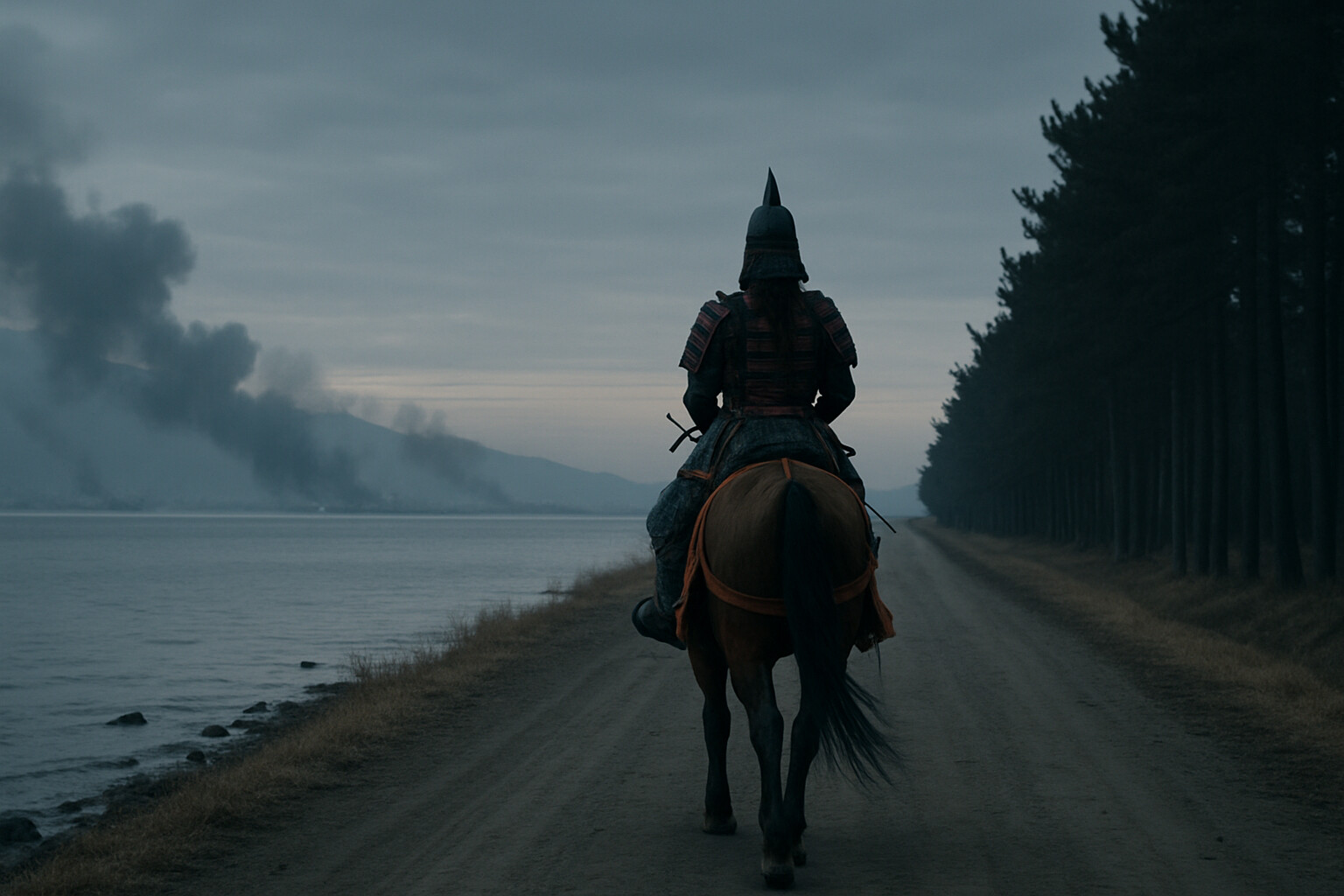
But within those limits, she is there. On a horse, in winter, at the edge of a frozen marsh, at the collapse of everything her commander had built. Taking a head. Riding east.
What happened after is, as of now, unrecovered.
---
The Battle of Awazu lasted, as a distinct engagement, a matter of hours on the morning of the twenty-first day of the first month, 1184. By midday, Yoshinaka was dead, his force destroyed or dispersed. Yoshitsune and Noriyori had their victory. The western campaign against the Taira could proceed — it would culminate the following year at the sea battle of Dan-no-Ura, where the Taira clan was effectively annihilated and a child emperor drowned in his grandmother's arms rather than fall into Minamoto hands.
The Genpei War ended the Heian period and inaugurated what would become the age of the shogunate — the centuries of warrior-class governance that would persist, in changing forms, until the nineteenth century. Yoshinaka's death at Awazu was, in this larger frame, the elimination of an internal rival before the main event. It would not have felt that way to the people riding in his column.
For students of military history, Awazu is a compact case study in the collapse of an overextended force under pressure from a better-resourced opponent. Yoshinaka's military successes in 1183 had been genuine and significant. His failure to consolidate political support — at court, with Yoritomo, with the retired emperor — meant that his military position eroded even when his battlefield performance did not. The eastern Minamoto forces that destroyed him at Awazu were not simply stronger. They were the product of Yoritomo's systematic construction of a stable institutional base at Kamakura — an administration, a loyalty structure, a supply chain — that Yoshinaka had never built and perhaps never fully understood the need for.
This is the context into which Tomoe Gozen rode. Not a story of glory, finally, but of institutional defeat — and of one figure within that defeat who, against the logic of the situation, turned toward the enemy one final time before the field was given up.