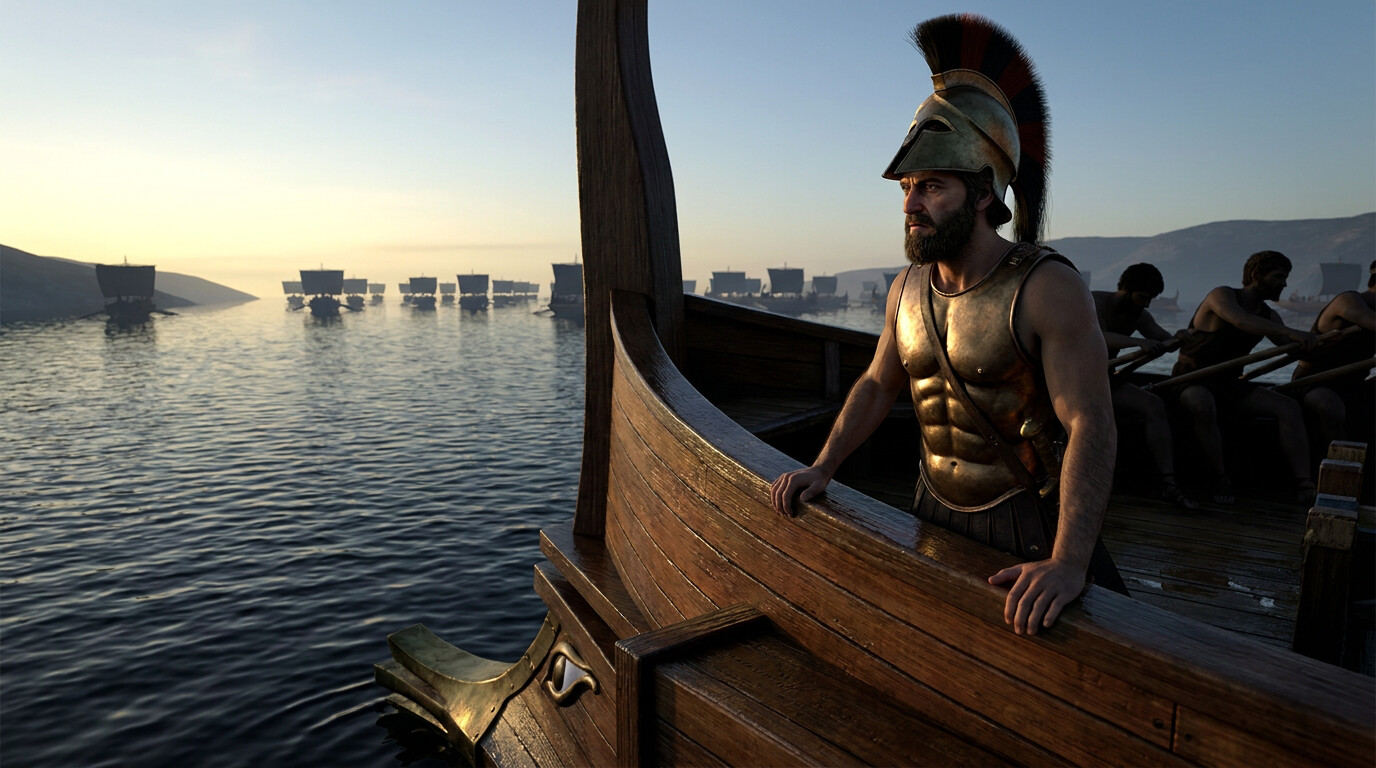
The oar-masters were already calling the stroke rate when the first Persian ships entered the strait.
It was dawn — probably the last days of September 480 BC, the exact date remaining debated among scholars — and the water between the island of Salamis and the Attic mainland was still dark. On the Athenian trireme decks, marines checked the fastenings on their bronze corselets. Rowers hunched over their oars in three tiers, nearly two hundred men per ship pressed together in the low-slung hull, the air thick with sweat and pitch and salt. The Greek line waited. It had been waiting all night.
Across the water, the Persian fleet was moving through a passage it had been told was the route to victory. Their fleet numbered in the hundreds, had already burned Athens, and their king sat on a throne above the cliffs of the mainland to watch the annihilation of the Greek resistance. Everything appeared arranged for Persian triumph.
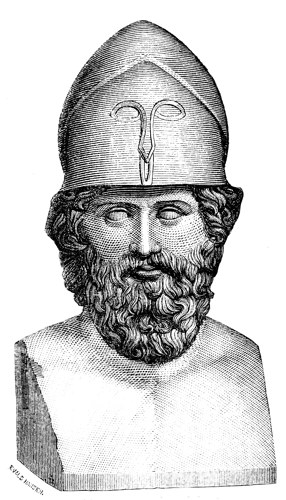
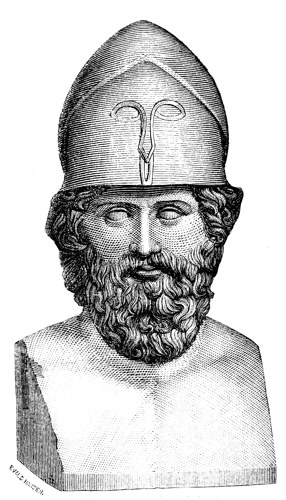
Themistocles of Athens had arranged it that way.
---
To understand Salamis, you have to understand what Themistocles was working with — and what he was working against.
He was born around 524 BC, the son of an Athenian father and a non-Athenian mother, a circumstance that made his social standing in Athens ambiguous from the start. Ancient sources including Thucydides and Plutarch describe him as exceptionally shrewd, politically aggressive, and willing to use methods his more aristocratic contemporaries considered beneath them. He was not beloved in the way Miltiades, hero of Marathon, had been. He was respected, feared, used, and periodically despised — which in Athens amounted to a kind of rough political durability.
He served as strategos, one of ten generals elected annually to command Athenian military forces, and he operated within an alliance structure — the Hellenic League — that made every decision a negotiation. His authority was real but constrained. Sparta held nominal overall command of the allied fleet through the Spartan admiral Eurybiades. Corinthian, Aeginetan, and other allied contingents had their own commanders, their own interests, and their own views on where and how to fight.
What Themistocles had done in the years before 480 BC was arguably as important as anything he did at Salamis itself. In 483 BC, Athens discovered a major new silver vein at the Laurion mines in Attica. The standard political instinct was to distribute the windfall directly to Athenian citizens. Themistocles argued instead for warships — a fleet of two hundred triremes, more than Athens had ever possessed. He framed the proposal around an ongoing conflict with the island state of Aegina, which was more politically palatable than invoking the specter of a Persian return. The assembly voted for the fleet. That decision, taken three years before Xerxes crossed the Hellespont, was the material foundation of everything that followed at Salamis.
Themistocles also interpreted the Delphic Oracle's declaration that Athens should trust in its "wooden walls" as a reference to those new warships — a reading he promoted aggressively, persuading the Athenians to abandon their city rather than defend it with a land force. This was not a small thing to ask. It meant the total evacuation of Athens: families, the elderly, the sacred objects of the city, everything transported to Troezen, Aegina, and Salamis while Xerxes' army marched south. The Acropolis burned. The city stood empty. And the Athenian navy, crewed largely by the city's poorer citizens who pulled the oars, became the only Athens that still existed.
---
The Persian expedition of 480 BC was an enormous undertaking. Herodotus gives figures for Xerxes' forces — 1,207 warships and over a million soldiers — that modern scholars universally reject as wildly inflated. There is no serious dispute, however, that the Persian fleet substantially outnumbered the Greek one, or that the land army was a genuine imperial force. Scholarly estimates for the Persian fleet at the time of Salamis range from roughly 600 to 1,000 warships, after losses sustained in storms off Magnesia and Euboea and in the fighting at Artemisium. The Greek fleet numbered approximately 310 to 380 triremes, depending on the source. Herodotus provides a breakdown by contingent: Athens contributed the largest share, 180 triremes; Corinth provided 40; Aegina 30; Megara 20; and smaller numbers from Chalcis, Sparta, Sicyon, Epidaurus, Eretria, Troezen, Styra, Ceos, Naxos, and others.
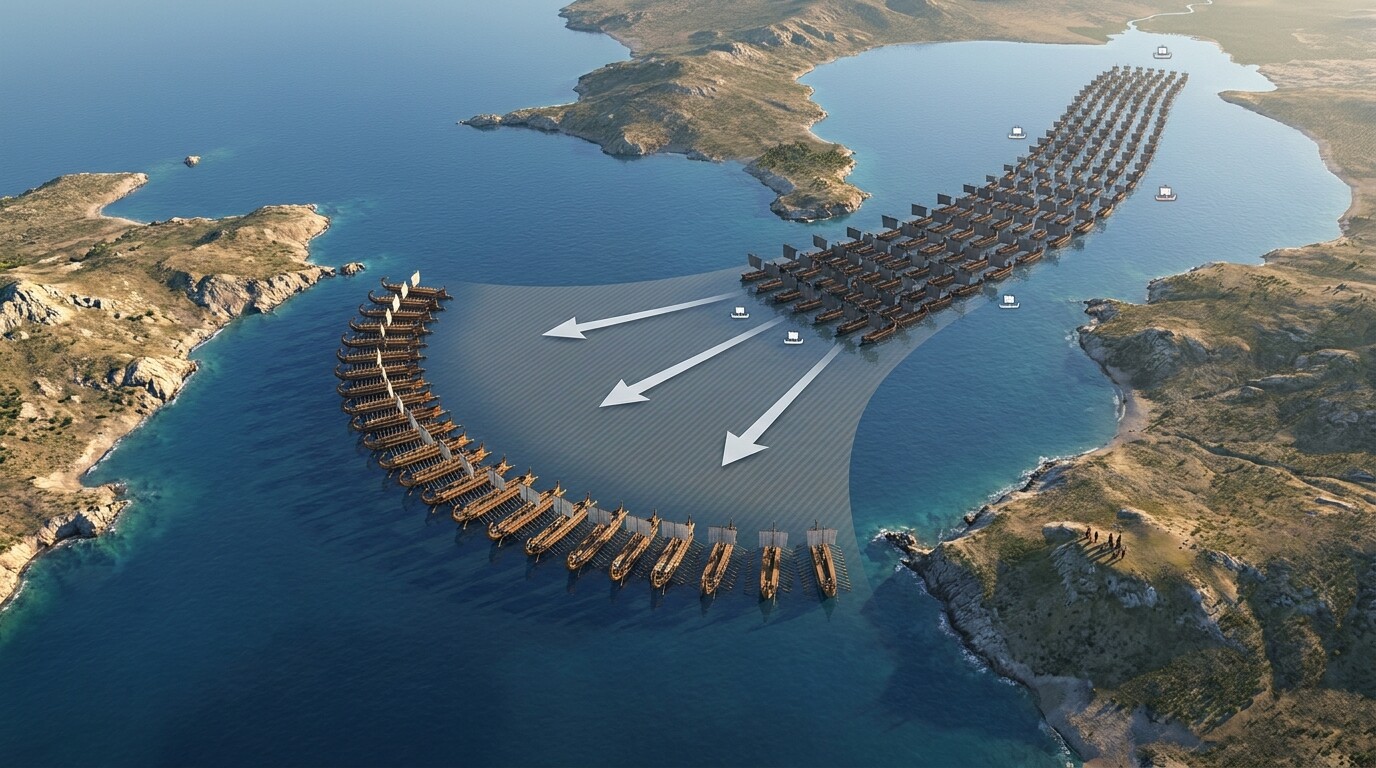
The geographic situation was decisive. The strait between Salamis and the Attic mainland is narrow — roughly one to two kilometers at various points, and considerably tighter at the eastern entrance where the main engagement unfolded. A fleet fighting in that confined space could not deploy in deep formations. Ships on the outer edge could not maneuver freely to support those in the center. Numerical superiority became a liability rather than an asset once the water was packed with hulls. This was precisely what Themistocles understood, and what he needed to make happen.
The difficulty was getting the Persian fleet to enter on his terms, at the time and angle of his choosing, while also preventing the Greek allies from abandoning the position entirely.
That second problem was nearly as dangerous as the Persians themselves.
---
In the days before the battle, the Greek commanders gathered to debate strategy aboard their ships off Salamis. The Peloponnesian contingents — Corinthians, Spartans, and others — repeatedly argued for withdrawing the fleet to the Isthmus of Corinth. Their logic was not irrational: a defensive position at the isthmus could be supported by the Spartan-led land army, and the narrow isthmus would prevent Xerxes from outflanking them by sea. From the perspective of mainland Greek states, this made geographic sense.
From Themistocles' perspective, it was a path to defeat. A fleet fighting in open water off the isthmus would surrender the advantages of the narrows. The Persians could split their force, send one element around the Peloponnese, land troops behind the defensive line, and the entire strategy would unravel. He understood, as he pressed Eurybiades, that the Greeks had to fight at Salamis — or not at all as a unified force.
Herodotus and Plutarch both record an episode — presented by Plutarch in his Life of Themistocles with narrative color that modern historians treat carefully — in which the Corinthian commander Adeimantos told Themistocles that a man without a city had no standing to speak in council. Themistocles reportedly answered that Athens possessed two hundred ships, a fighting force capable of overcoming any city in Greece. The specific exchange may have been sharpened in later retelling, but the underlying dynamic it captures — the political precariousness of Themistocles' position even as he commanded the largest single fleet present — is well-attested in the sources. Direct quotes from this episode cannot be verified and should be read as literary tradition rather than verbatim record.
With the allied council still wavering, Themistocles made a decision that has occupied historians for over two millennia.
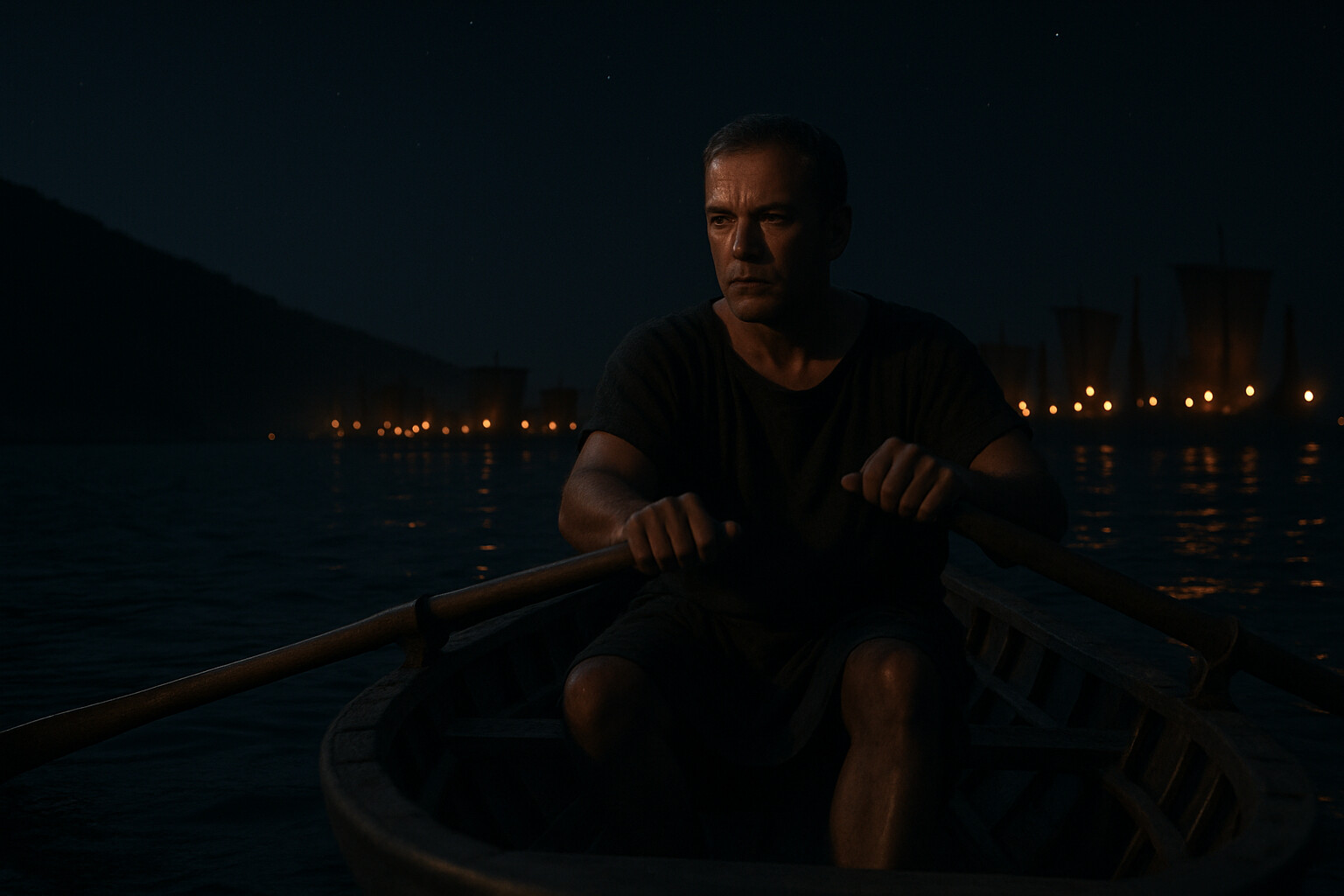
He sent a trusted household servant — a man named Sicinnus, who served as tutor to his children — by boat to the Persian fleet under cover of darkness. According to Herodotus, the message Sicinnus carried claimed that Themistocles was secretly favorable to the Persian cause and was warning Xerxes that the Greeks intended to flee during the night. He urged the Persians to move quickly to block the western exit of the strait and send a force around Salamis, so that no Greek ship could escape. If Xerxes acted on this intelligence, the Persian fleet would divide, exhaust itself in a night movement, and arrive at the battle already constricted by the very strait Themistocles had chosen.
Xerxes acted on it. Egyptian squadrons were dispatched to seal the western channel. The main fleet was repositioned toward the eastern approach. Persian rowers spent the night maneuvering and entered the battle fatigued.
Whether Sicinnus' mission happened precisely as Herodotus describes, whether the message was as carefully calculated as it appears in retrospect, and whether Themistocles could have known with confidence that Xerxes would act on it — none of these questions can be fully resolved. Herodotus is the primary source and was writing roughly fifty years after the event. He had access to living witnesses and genuine documentation, but he also worked in a tradition that valued compelling narrative. Modern scholars including Barry Strauss in The Battle of Salamis (2004) and Peter Green in The Greco-Persian Wars (1996) treat the Sicinnus episode as broadly credible while acknowledging that the precise details of the message and its reception cannot be verified.
What is not disputed is the outcome: the Persian fleet entered the strait.
---
The trireme was the dominant warship of the fifth-century Mediterranean, and to understand what happened in the Salamis strait you need to understand what it was built to do.
An Athenian trireme of the period was roughly 37 meters long and approximately 6 meters wide at the outriggers, but only about 3.5 meters at the waterline hull. It was crewed by approximately 170 oarsmen arranged in three overlapping banks — thranites on the upper tier, zygians in the middle, thalamians at the lowest level — plus roughly 30 officers, sailors, and marines. The oarsmen in the Athenian fleet were not slaves; they were free citizens and resident aliens, the Athenian demos themselves. This had political consequences Themistocles had understood from the beginning of his fleet-building program. A democracy that rowed its own warships was a democracy that expected to have its voice heard.
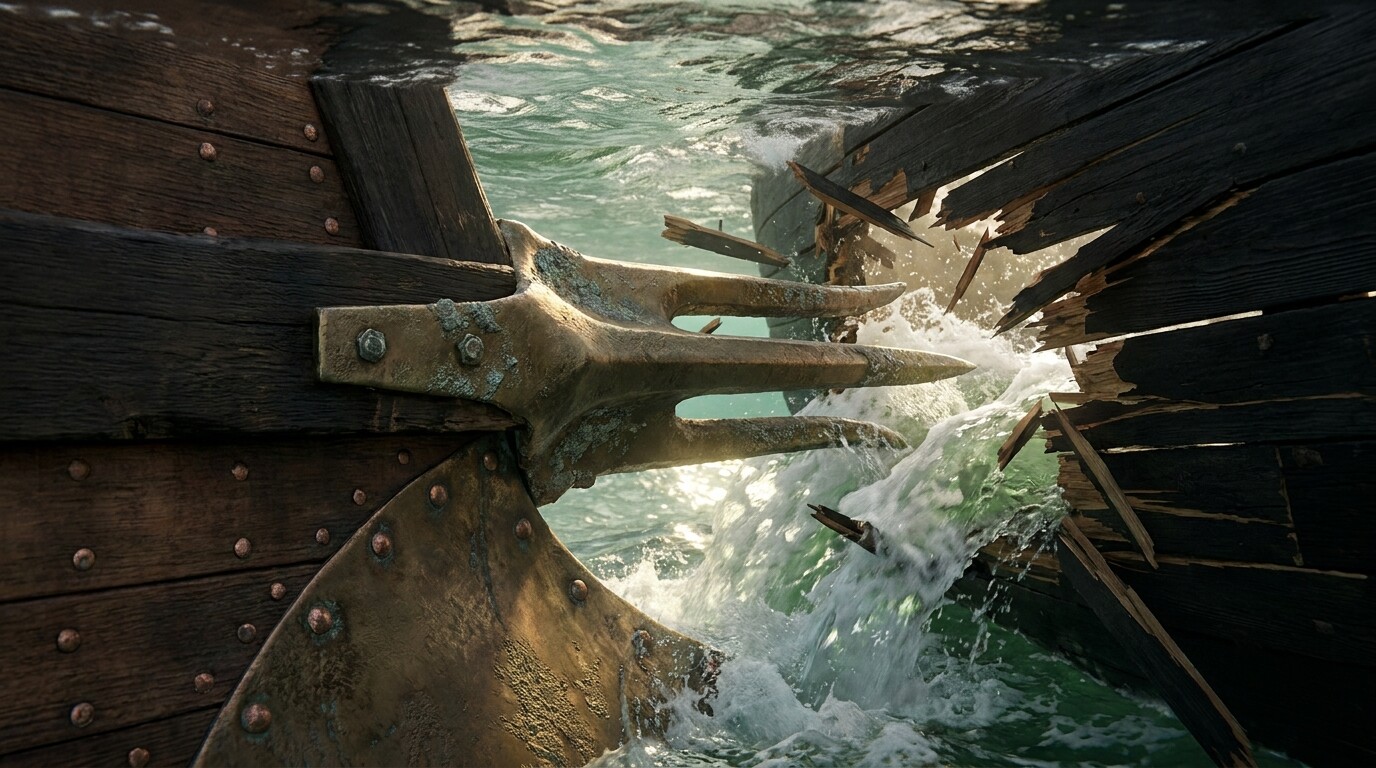
The primary weapon of the trireme was its bronze-sheathed ram, the embolon, fitted to the bow just below the waterline. The tactical goal was to strike an enemy vessel at the waterline, shear off its oars, or hole its hull, then back water before the sinking ship could drag the attacker down. This required extraordinary seamanship: the ability to accelerate to combat speed of roughly 7 to 8 knots, hold course precisely, strike at the angle needed to damage rather than lock, and reverse before the enemy crew could respond. Crews trained relentlessly. In Athenian tradition, the Aeginetans were considered the most skilled rowers at the time of Salamis; the Athenian fleet was newer and some of its crews less experienced — another reason Themistocles needed the narrows.
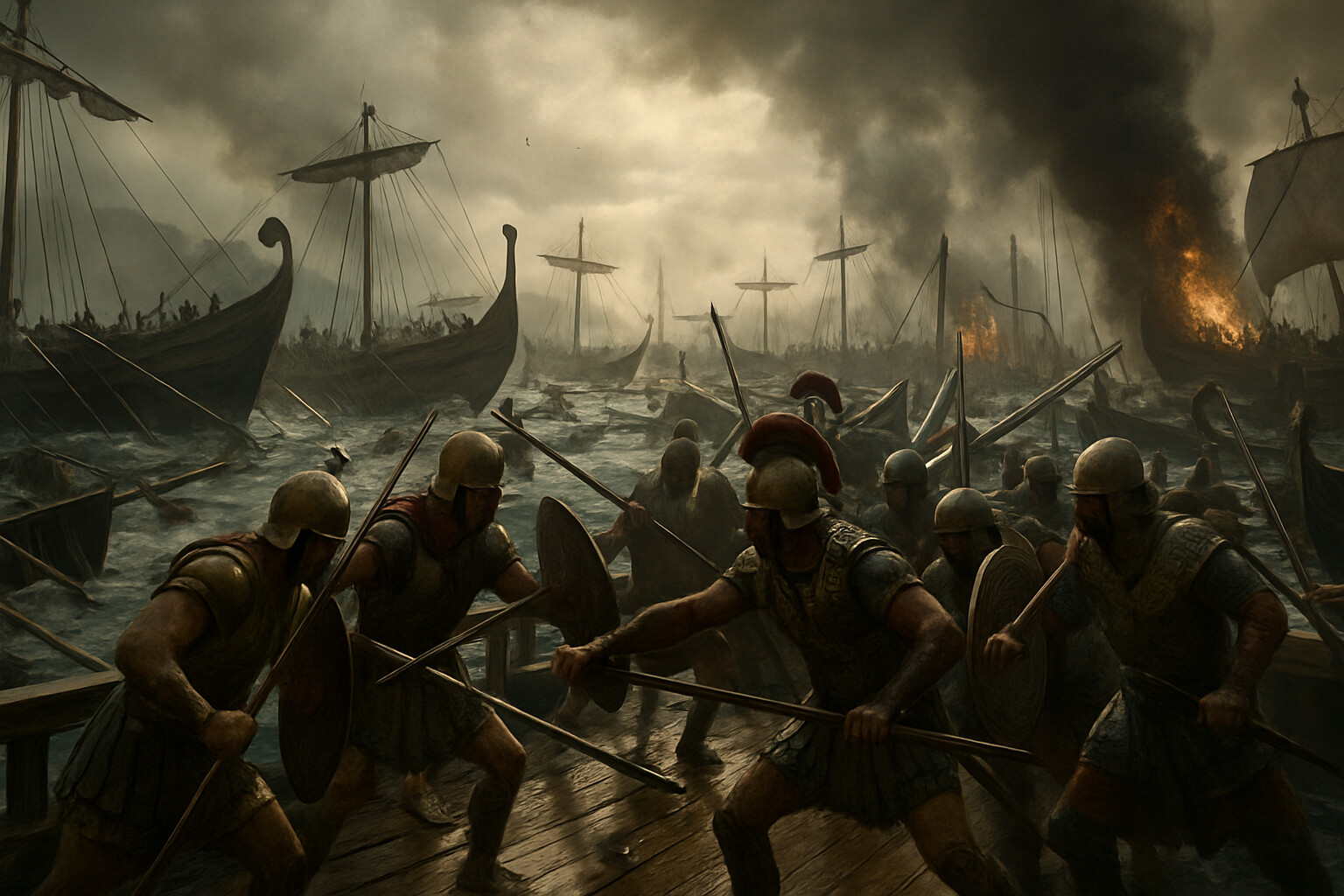
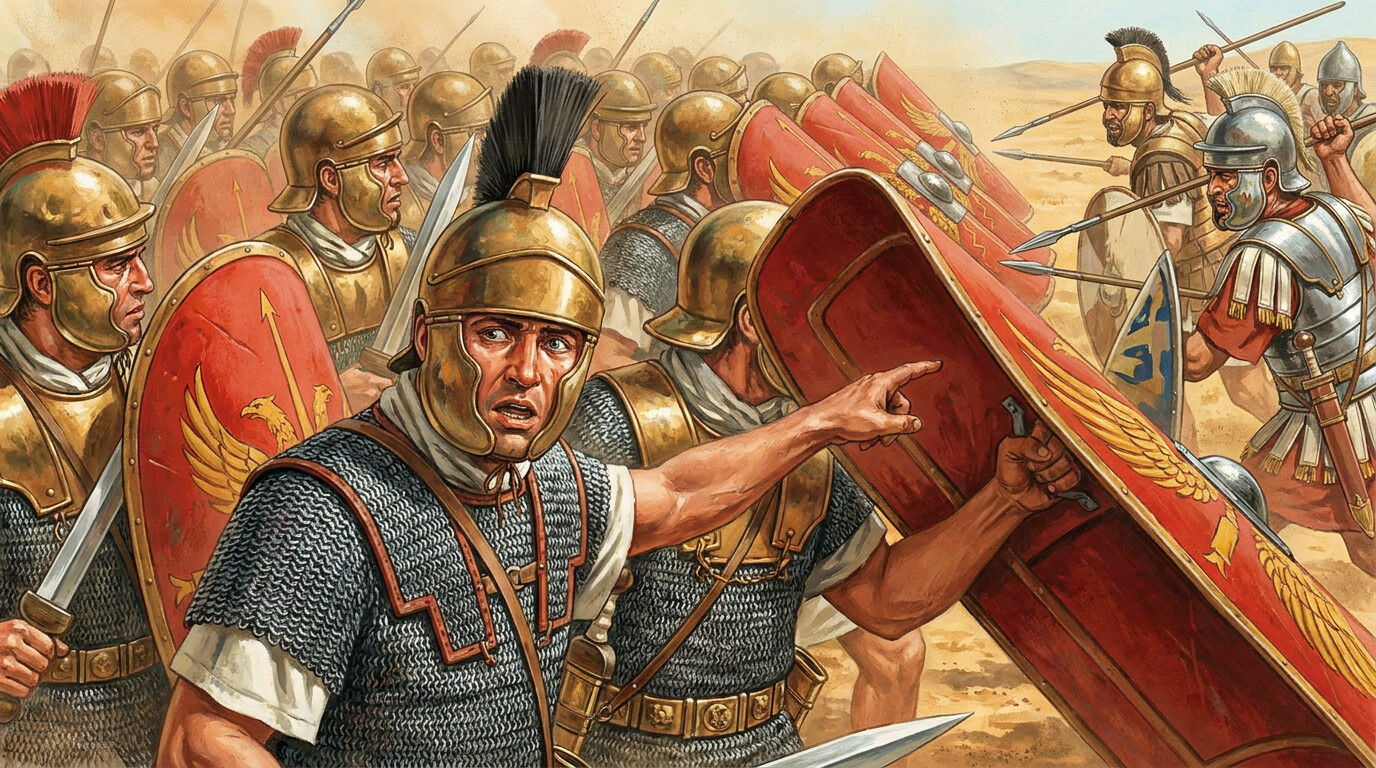
In confined water, the sophisticated open-water maneuvers were largely unavailable. The diekplous — a tactic in which a warship drove through a gap in the enemy line, turned sharply, and rammed the exposed flank of a passing ship — required room to execute. The periplous, in which a faster fleet swept around the enemy's flank, required open water to complete. In a narrow strait packed with hundreds of ships, brute positioning and boarding action became more decisive. Greek marines were hoplites: heavily armored infantry carrying large round shields, bronze corselets, greaves, and helmets, armed with thrusting spears. When ships locked together, these men fought the close infantry battle they had trained for since childhood. Persian marines, well-equipped and numerous in open-water engagements, found their advantages diluted in the chaos of the strait.
---
The battle began, by the best reconstruction from ancient sources, in the early morning hours. The Persian fleet entered the strait from the east. Greek accounts — primarily Herodotus and the playwright Aeschylus, who fought at Marathon and described the Salamis engagement in his play The Persians, composed in 472 BC and performed for Athenian audiences who had survived it — describe a moment of initial Greek hesitation before the attack began. Whether Aeschylus was personally present at Salamis rests on tradition rather than explicit documentary confirmation, though it is widely accepted by modern scholars.
Aeschylus' The Persians is the most immediate literary source for the engagement: a dramatized account, written within a decade of the battle, performed for audiences who remembered it. His description of the Persian fleet caught in the strait, unable to maneuver, ships fouling one another, is consistent with the geographic and tactical logic of the engagement. It is dramatic verse rather than historical documentation and must be read accordingly.
As the Persian vanguard entered the strait, it encountered the problem Themistocles had designed for it. The lead ships, advancing in column through the eastern entrance, had insufficient room to deploy into the battle line that a fleet of their numerical strength required. Ships behind pressed forward; ships ahead could not spread out. The water filled with hulls. The Greeks, waiting in a battle line that fit the width of the strait, attacked before the Persian formation could stabilize.
The fighting was intense, prolonged, and extremely costly to the Persian fleet. Herodotus names specific engagements: Athenian ships held the center of the Greek line; Aeginetans formed the southern wing. The Persians suffered from command confusion. Their Phoenician contingent, which formed the strongest element of the fleet and occupied the right wing facing Athens, bore the brunt of the early fighting and was driven back. The Ionian Greeks serving in Xerxes' fleet — communities compelled to serve the Persian empire — performed variably; Herodotus names individuals in both categories.
Ariabignes, a brother of Xerxes and one of his fleet commanders, was killed in the fighting — his death is reported by Herodotus. Queen Artemisia of Halicarnassus, commanding a small contingent fighting for Xerxes, appears in Herodotus in an episode in which, pursued by an Athenian trireme, she rammed one of her own allied vessels to escape — an act Xerxes reportedly misread from his throne on the cliffs, believing she had rammed a Greek ship. Herodotus presents this with evident narrative relish; modern historians regard the broad episode as plausible in outline while treating the precise details as uncertain. Herodotus' own origins in Halicarnassus may account for the unusual attention and sympathy he extends to Artemisia's portrayal.
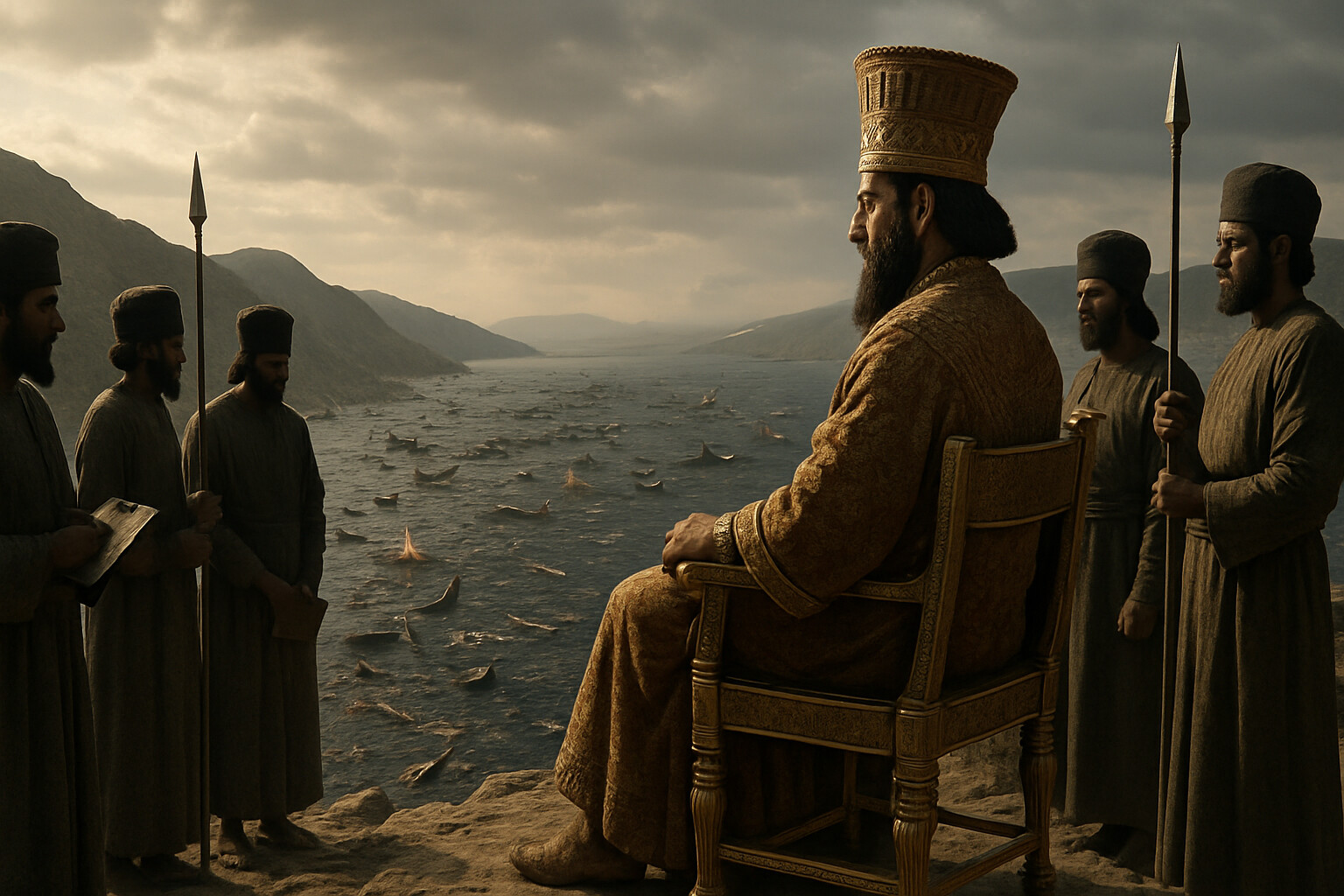
Xerxes watched from a throne set on a promontory of the Attic shore, with scribes present to record acts of valor and cowardice. This detail, reported by Herodotus and consistent with Persian court practice of documenting royal observation of battle, gives the engagement an almost theatrical quality: a king watching his fleet destroyed across a narrow strip of water, with no means to intervene.
By the time the day was over — the battle appears to have consumed most of the daylight hours — the Persian fleet had suffered catastrophic losses. Ancient sources give varying figures: Herodotus states the Persians lost more ships at Salamis than the Greeks, and Aeschylus' The Persians describes wholesale destruction of the fleet. Modern scholars estimate the Persians may have lost roughly 200 or more ships sunk or captured; Greek losses were significantly lower, perhaps around 40 ships. These are approximations. Ancient battle casualty numbers were not recorded with modern precision, and both sides had incentive to shape the numbers in their retellings.
What is not in dispute is the strategic result. The Persian fleet retreated. Xerxes, his supply lines threatened and the season growing late, decided against a second major engagement. He withdrew the bulk of his army from Greece, leaving a land force under Mardonius to winter in Thessaly and attempt a renewed campaign the following year. That campaign would end at the Battle of Plataea in 479 BC, where Spartan-led Greek land forces defeated Mardonius. The naval threat was functionally over after Salamis.
---
The human cost of Salamis fell heavily on people whose names history has not preserved.
The rowers who powered the trireme fleet were not the aristocratic hoplites who carried literary reputations into the sources. They were the Athenian poor, the thetes — the lowest property class, men who owned little and had previously carried minimal political weight. They rowed for a daily wage, for survival, and for a city that now existed physically only in the ships they occupied. When a trireme was rammed and began to take on water, those men — packed in the dark lower tiers of the hull, unable to see beyond the planking around them, unable to see where the next blow was coming from — had very little time and very little room to escape.
Persian sailors drowned in the strait by the hundreds, possibly the thousands. Many who ended up in the water faced an additional danger: Greek marines and armed fighters on the nearby Salamis shore were waiting. Herodotus states explicitly that many Persians serving in the fleet could not swim, and identifies this as a factor in the casualty disparity. It is a grim detail — men who had crossed the Aegean on warships, undone by the water beneath them.
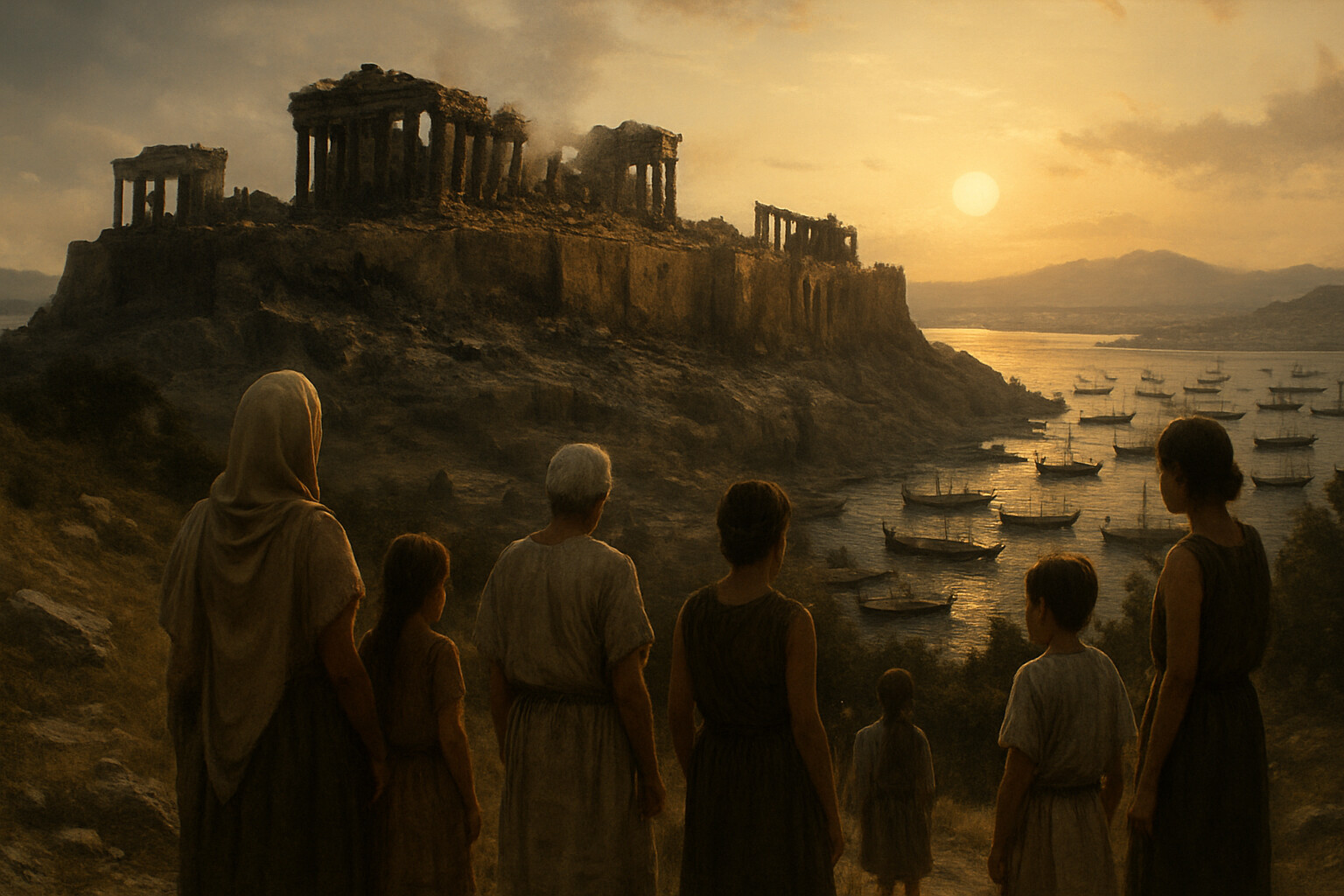
The Athenian civilians sheltering on Salamis — the families evacuated from Athens before Xerxes' army arrived — were within sight of the engagement that would determine whether they had a city to return to. Plutarch describes this scene in his Life of Themistocles with evident narrative purpose; the broad circumstance itself, however, is consistent with the documented geography and the documented evacuation.
Athens had been burned. The Acropolis temples were destroyed. The evacuation inscription known as the Themistocles Decree, found at Troezen and published in 1960, purports to document the evacuation order — though most modern scholars consider it a fourth-century reconstitution of an earlier text rather than a surviving original fifth-century document. The decree debate illustrates the level of scrutiny these sources require.
---
After Salamis, the allied Greek council met to award prizes for valor. Herodotus records that each commander voted for himself as the bravest and for Themistocles as second. Since no single individual received a plurality of first-place votes, no official first prize was awarded. Themistocles received the most second-place votes of any commander. He was taken to Sparta, where the Spartans awarded him an olive wreath for wisdom and cunning and presented him with a chariot — their most significant gesture of honor. Three hundred Spartan horsemen escorted him to the Tegean border as he departed.
This is a remarkable record even filtered through the distortions of time: the Greeks themselves, in a formal council, acknowledged Themistocles as the decisive mind of the battle. They could not politically award him the first prize without fracturing the alliance around Spartan pride. The honors they gave him instead made the point clearly enough.
Themistocles' later life did not match the triumph of Salamis. Athenian politics were volatile, and his postwar ambitions — particularly his efforts to fortify Piraeus and rebuild Athens' walls — generated resentment and opposition. He was ostracized from Athens, probably around 471 BC, and went into exile. He eventually fled to Persia, where he was received by Artaxerxes I — Xerxes had been assassinated by then — and granted a position governing the Persian city of Magnesia on the Maeander. He died there, probably around 459 BC, though the date and cause of death remain uncertain. Thucydides, who admired Themistocles' intelligence with unusual directness for such a careful historian, assessed him as a man who by native wit, with the least study, was the best improviser of measures required by the immediate moment. Thucydides' assessment is not simply literary praise. It is a historical judgment from a writer rigorous about such things and personally connected to the events of this period.
---
The legacy of Salamis requires care to state accurately, because the temptation to overreach is considerable.
What can be said with confidence: Salamis ended the Persian naval threat in the Aegean during the campaign of 480 BC. Combined with the land victory at Plataea the following year and the Greek naval action at Mycale on the Ionian coast, Salamis was part of a sequence that broke the Persian attempt to absorb Greece into the empire. The Greek city-states that survived — above all Athens — went on to produce, in the following decades, an extraordinary concentration of philosophical, literary, theatrical, and political development whose influence persists in legal, governmental, and intellectual traditions across much of the modern world.
None of that was inevitable. None of it was solely the product of one battle. History does not work that cleanly. But the narrows of Salamis were where the question was put most sharply — where a Persian fleet with numerical superiority ran into a body of water too small for numbers to decide anything, and a Greek fleet crewed by free citizens who had nowhere else to go.
Themistocles built the fleet, chose the ground, lured the enemy into it, held the alliance together through the force of argument and political maneuver that stopped just short of outright insubordination, and stood on a trireme deck as the plan he had spent a decade constructing came to its conclusion in a morning's hard rowing.
The throne on the cliff was empty before sunset.
Xerxes was already preparing to leave.