The Dodge staff car lurched over another shell crater, its headlights cutting through the desert darkness. Susan Travers gripped the steering wheel as tracer rounds arced overhead. To her right, the German minefield stretched into the night. To her left, Italian artillery sought their convoy with methodical precision. Behind her sat Colonel Amilakvari and the wounded officers of the 13th Demi-Brigade of the Foreign Legion. Ahead lay sixteen miles of enemy-controlled desert and the slim hope of reaching British lines.
It was 0200 hours on June 11, 1942, and Bir Hakeim was dying.
Susan Travers had never intended to become a warrior. Born in London in 1909 to Royal Navy Admiral Reginald Travers, she had lived between England and the French Riviera. When war broke out in 1939, she was working as a nurse in France. The fall of France in 1940 changed everything. While most fled the advancing Wehrmacht, Travers made her way south to join the Free French Forces rallying to Charles de Gaulle's call.
By 1942, she had become the personal driver for General Marie-Pierre Koenig, commander of the 1st Free French Brigade. The Free French were desperate for recognition, for a chance to prove they could fight alongside the British in North Africa. That chance came at a remote crossroads in the Libyan desert called Bir Hakeim.
Bir Hakeim sat at the southern anchor of the Gazala Line, the British Eighth Army's defensive position stretching from the Mediterranean coast inland toward the desert. The position was little more than a collection of wells and stone buildings, but it controlled the desert tracks that Rommel's Afrika Korps would need to outflank the British defenses. In February 1942, Koenig's brigade had been assigned to hold this desolate outpost.
The Free French turned Bir Hakeim into a fortress. They laid thousands of mines, dug interconnected trenches, and positioned their artillery with overlapping fields of fire. The garrison included the 13th Demi-Brigade of the Foreign Legion, colonial troops from Chad and Cameroon, Jewish volunteers from Palestine, and anti-aircraft gunners manning British Bofors guns. In total, 3,700 men held a position designed for half that number.
Travers spent those months learning the desert. She drove supply convoys through sandstorms, navigated by compass when landmarks disappeared, and memorized every track between Bir Hakeim and the British supply bases to the east. The Dodge staff car became her domain—a battered but reliable vehicle that carried orders, wounded men, and precious water across the hostile landscape.

On May 26, 1942, Rommel launched his offensive. While his main force struck the center of the Gazala Line, he sent his Afrika Korps racing around the southern flank. Bir Hakeim suddenly found itself surrounded, with German panzer divisions and Italian infantry cutting all supply lines to British forces.
For sixteen days, the Free French held their ground. German Stukas screamed down daily, their sirens adding to the thunder of artillery. The 88mm guns of the Afrika Korps methodically destroyed French positions. Italian infantry probed the perimeter, looking for weak points in the wire and minefields. Each attack was beaten back, but the defenders grew fewer with each assault.
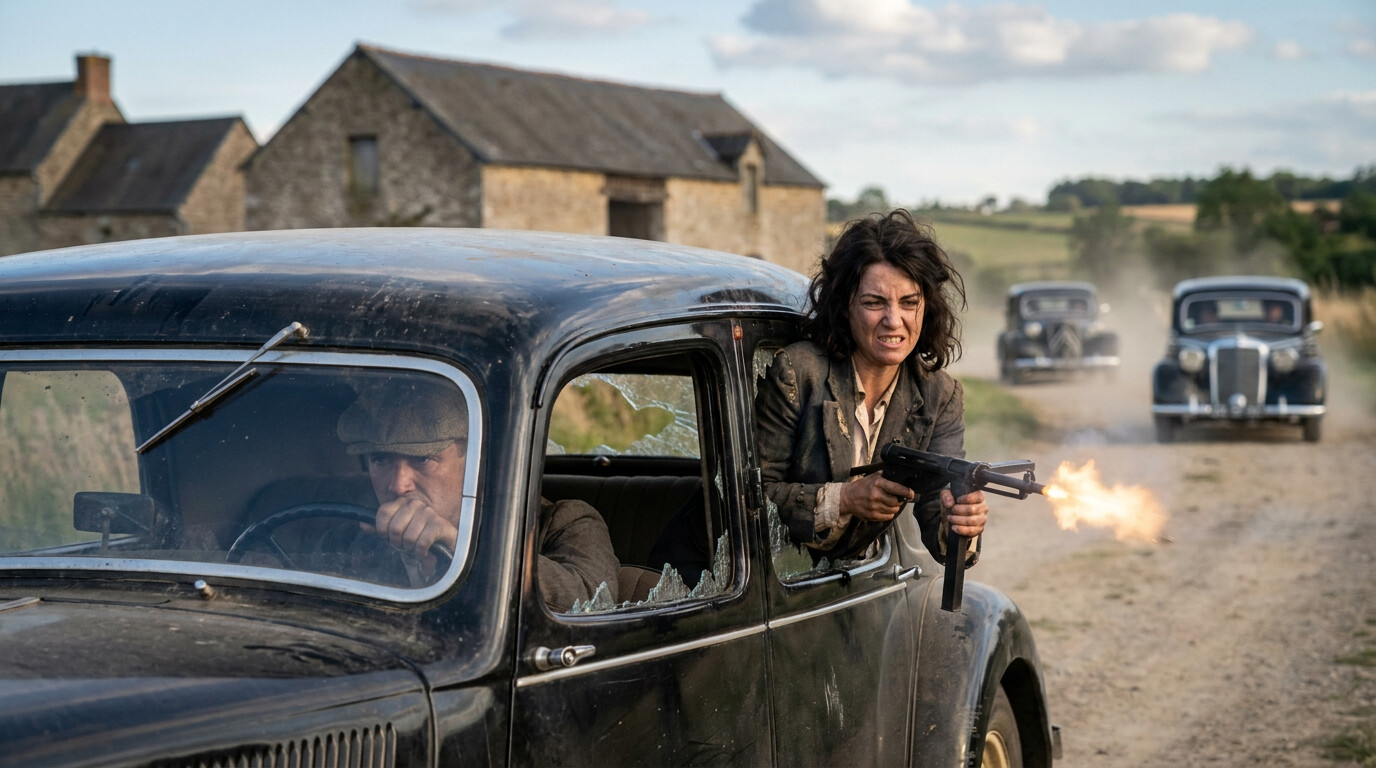
Travers continued her duties under fire. She drove ammunition to forward positions during bombardments, evacuated wounded men through minefields, and carried messages when radio communications failed. The Dodge took shrapnel through its doors and windscreen, but the engine kept running.
By early June, the situation was desperate. British forces to the north had been pushed back toward Tobruk. Bir Hakeim was now completely isolated, surrounded by the Afrika Korps and running short on ammunition, water, medical supplies, and men. Radio intercepts revealed German plans for a final massive assault that would overwhelm the remaining defenders.
On June 10, General Koenig received orders from British Eighth Army headquarters: Bir Hakeim had fulfilled its mission of holding up Rommel's advance. The garrison was authorized to attempt a breakout. They would abandon the fortress that night and try to reach British lines to the east.
The breakout plan was simple and desperate. At 2300 hours, the garrison would move out in convoy—vehicles carrying wounded and essential equipment, while most men would march on foot. They would head northeast, threading between German and Italian positions, crossing enemy minefields, and covering sixteen miles of open desert before dawn. Speed and stealth were their only advantages.
Travers prepared the Dodge for what might be its final journey. She checked the engine, topped off the radiator, and loaded extra ammunition for the officers who would ride with her. Colonel Dimitri Amilakvari, the Georgian prince who commanded the 13th Demi-Brigade, would be her primary passenger along with other wounded officers who couldn't march.

As darkness fell on June 10, the Free French began their systematic withdrawal. Artillery pieces were spiked, excess ammunition destroyed, and wounded men loaded into the few remaining vehicles. Radio operators sent final messages to British headquarters, then smashed their sets. At 2300 hours precisely, the convoy began moving.
Travers drove without headlights at first, following the dim shape of the vehicle ahead. The column moved slowly, picking its way through gaps in their own minefields before heading into the desert. Behind them, delayed-action charges began exploding in the abandoned positions, adding to the confusion for any German forces that might discover the breakout.
Twenty minutes into the march, disaster struck. The lead vehicle triggered a mine in an Italian minefield. The explosion lit up the night and alerted every German position for miles. Within minutes, flares burst overhead, turning night into harsh, flickering day. Artillery began falling along the convoy route as German observers called in fire missions.
The breakout became a running battle. Vehicles were destroyed by mines or direct hits. Men scattered into the desert, some trying to continue on foot, others seeking cover in the rocky ground. The convoy fragmented as drivers tried different routes through the minefield.
Travers found herself separated from the main column. The Dodge carried Colonel Amilakvari, two other wounded officers, and a radio operator. Around them, the desert erupted with gunfire as German machine gun positions opened up. Tracer rounds streaked past the car, some punching holes through the bodywork.
Navigating by compass and instinct, Travers drove across terrain she had never seen before. The car bucked over rocks and slammed through dried wadis. The wounded officers in the back seat gripped whatever they could as the vehicle bounced and lurched. Colonel Amilakvari, despite his wounds, kept watch through the rear window and called out warnings about pursuing vehicles.
Miles ahead, Travers could see the muzzle flashes of German weapons positioned along their route. The enemy had clearly anticipated the breakout and prepared ambushes at key points. Some were 88mm anti-tank guns, capable of destroying any vehicle with a single shot. Others were machine gun nests designed to sweep the open ground with interlocking fire.

The Dodge's engine began overheating from the sustained high-speed driving across rough terrain. Steam rose from under the hood, and the temperature gauge climbed into the danger zone. Travers had to balance speed against the risk of mechanical failure. If the engine seized, they would be stranded in the open desert with German forces converging from all directions.
As they approached a low ridge, Travers saw muzzle flashes from German positions on the crest. The enemy had established a blocking position that commanded the entire area. There was no way around—the rocky ground channeled all traffic through this single gap. She would have to drive straight through the killing zone.
Travers floored the accelerator. The overheating Dodge engine screamed as she aimed for the gap between two machine gun positions. Tracers converged on the car from multiple angles. The windscreen shattered, showering the occupants with glass. Bullets punched through the doors and fenders, some passing inches from the passengers.
For thirty seconds that felt like hours, the car raced through concentrated fire. A bullet creased Travers' scalp, drawing blood but not stopping her. Another round shattered the rear window, sending fragments across the wounded officers. The radio operator pressed himself to the floor as bullets whistled overhead.
Then they were through, racing down the reverse slope with German fire fading behind them. But the worst was still ahead. Intelligence reports indicated that the Germans had established their main blocking positions farther east, where the desert tracks converged toward British lines.
The Dodge's engine was failing. Steam now poured from the radiator, and the engine missed and coughed as overheated components began to fail. Travers nursed the dying vehicle forward, using gravity and momentum to carry them down slopes, coasting whenever possible to let the engine cool slightly.
Dawn was breaking on the horizon, ending their cover of darkness. Soon German aircraft would be overhead, hunting for survivors of the breakout. The car needed to reach British lines quickly or find cover from air attack.

Ahead, Travers could see dust clouds raised by other vehicles—some from the Free French convoy, others possibly German pursuit forces. Radio chatter on the operator's set indicated that British forces were aware of the breakout and had sent patrols forward to assist, but the broadcasts also revealed German forces moving to intercept the escapees.
As the sun climbed higher, the temperature in the car became unbearable. The wounded officers were suffering from heat exhaustion and dehydration. Water was nearly gone—the few canteens had been shared among all passengers, but it wasn't enough for the sustained effort of crossing the desert under fire.
The engine finally seized completely just eight miles from British lines. The Dodge coasted to a stop in a slight depression between two rocky ridges. Steam hissed from the radiator as the metal contracted in the morning heat. They were stranded with German forces somewhere behind them and British forces still miles ahead.
Colonel Amilakvari assessed their situation with the calm professionalism that had made him respected in the Foreign Legion. The wounded officers could walk short distances but not eight miles across open desert. The radio was working but had limited range. Their position was defensible against small arms but would not survive artillery or air attack.
Travers volunteered to walk to British lines and guide back a rescue patrol. She was the strongest, knew the desert better than the others, and could navigate by sun and landmarks. The colonel initially refused—it was too dangerous for anyone to cross the desert alone. But Travers insisted, pointing out that she was their best chance of reaching help.
She set out at 0800, carrying one water bottle and a compass. The sun was already brutal, and the rocky ground radiated heat that made each step an effort. Behind her, the officers took cover in what shade the broken car provided, while the radio operator tried to contact British forces.
For two hours, Travers walked northeast across increasingly familiar terrain. She recognized landmarks from previous supply runs and adjusted her course toward a British patrol base she remembered. The heat was becoming dangerous—she had to rest frequently in whatever shade she could find.

At 1030, she spotted dust clouds moving toward her position. Through binoculars taken from the car, she could make out British vehicles—a patrol from the King's Dragoon Guards reconnaissance regiment. She fired her service pistol into the air and waved a white cloth torn from her uniform shirt.
The British patrol reached her within minutes. She quickly explained the situation and guided them back to the disabled Dodge. The wounded officers were evacuated in British vehicles, while Travers rode in the lead car to help navigate back to friendly lines.
By noon on June 11, they had reached safety at the British forward base at El Adem. Behind them, the desert was filled with scattered groups from the Bir Hakeim garrison—some in vehicles, others on foot, all making their desperate way toward British lines. German aircraft circled overhead, strafing isolated groups and hunting for the main body of escapees.
Of the 3,700 men who had defended Bir Hakeim, approximately 2,700 eventually reached British lines. The breakout had been costly—nearly 1,000 casualties from combat, mines, heat exhaustion, and German air attacks during the withdrawal. But the garrison had achieved something remarkable: they had held up Rommel's offensive for sixteen crucial days and then successfully evacuated most of their force under impossible conditions.
General Koenig personally thanked Travers for her actions during the breakout. Her driving under fire had saved the lives of key officers whose leadership would be needed for future operations. According to later accounts, her volunteering to cross the desert alone to get help demonstrated the kind of courage and initiative that the Free French needed to prove their worth as allies.
The battle of Bir Hakeim had strategic consequences far beyond the desert fortress. The sixteen-day delay had disrupted Rommel's timetable and allowed British Eighth Army to stabilize new defensive positions. The fierce resistance by French forces had also restored some measure of French military honor after the defeat of 1940.
For Travers personally, the breakout marked a turning point. General Koenig recommended her for decoration, and she was reportedly awarded the Croix de Guerre for her actions under fire. More significantly, she was accepted into the French Foreign Legion—making her the first and only woman ever to serve in that elite force. She would go on to serve through the rest of the North African campaign and into Italy.

The Dodge staff car was recovered several weeks later by a British salvage unit. According to various accounts, mechanics counted between 140 and 200 bullet holes in the bodywork, testament to the intensity of fire it had driven through. The engine was beyond repair, but the chassis was solid enough to be rebuilt with a new power plant. The car served through the rest of the war with various Free French units.
Archival records from the French Ministry of Defense document Travers' service and some decorations, though details of her personal awards remain classified or disputed. British Eighth Army war diaries confirm the timeline and general circumstances of the Bir Hakeim breakout, providing the framework for understanding her actions.
Travers' own memoir, published decades later, provides personal details of the breakout but must be read carefully. Written many years after the events, it contains some demonstrable errors in chronology and unit designations. Military historians have corroborated the major elements of her account through cross-reference with official records, but specific conversations and personal reactions cannot be independently verified.
The French Foreign Legion museum at Aubagne maintains records of her service, including the unique circumstances of her admission to the force. She remains the only woman to have achieved the rank of adjutant-chef in the Legion, a distinction that reflects both her exceptional service and the unusual circumstances of wartime.
Postwar interviews with other Bir Hakeim survivors generally support the broad outline of Travers' account of the breakout, though details vary depending on where each person was in the convoy and what they personally witnessed. The fragmented nature of the withdrawal meant that no single person saw the entire operation.
Susan Travers died in 2003, taking with her many details of that night drive through enemy fire. But her legacy remains in the records of the French Foreign Legion and in the history of the Free French Forces. At Bir Hakeim, she demonstrated that courage takes many forms—sometimes it's charging an enemy position, and sometimes it's keeping your foot on the accelerator when bullets are punching holes through your windscreen.
The desert has long since reclaimed Bir Hakeim. The trenches have filled with sand, and the minefields have been cleared by postwar disposal teams. But the memory remains of a small force that held out against impossible odds and a woman who drove through fire to save her comrades.