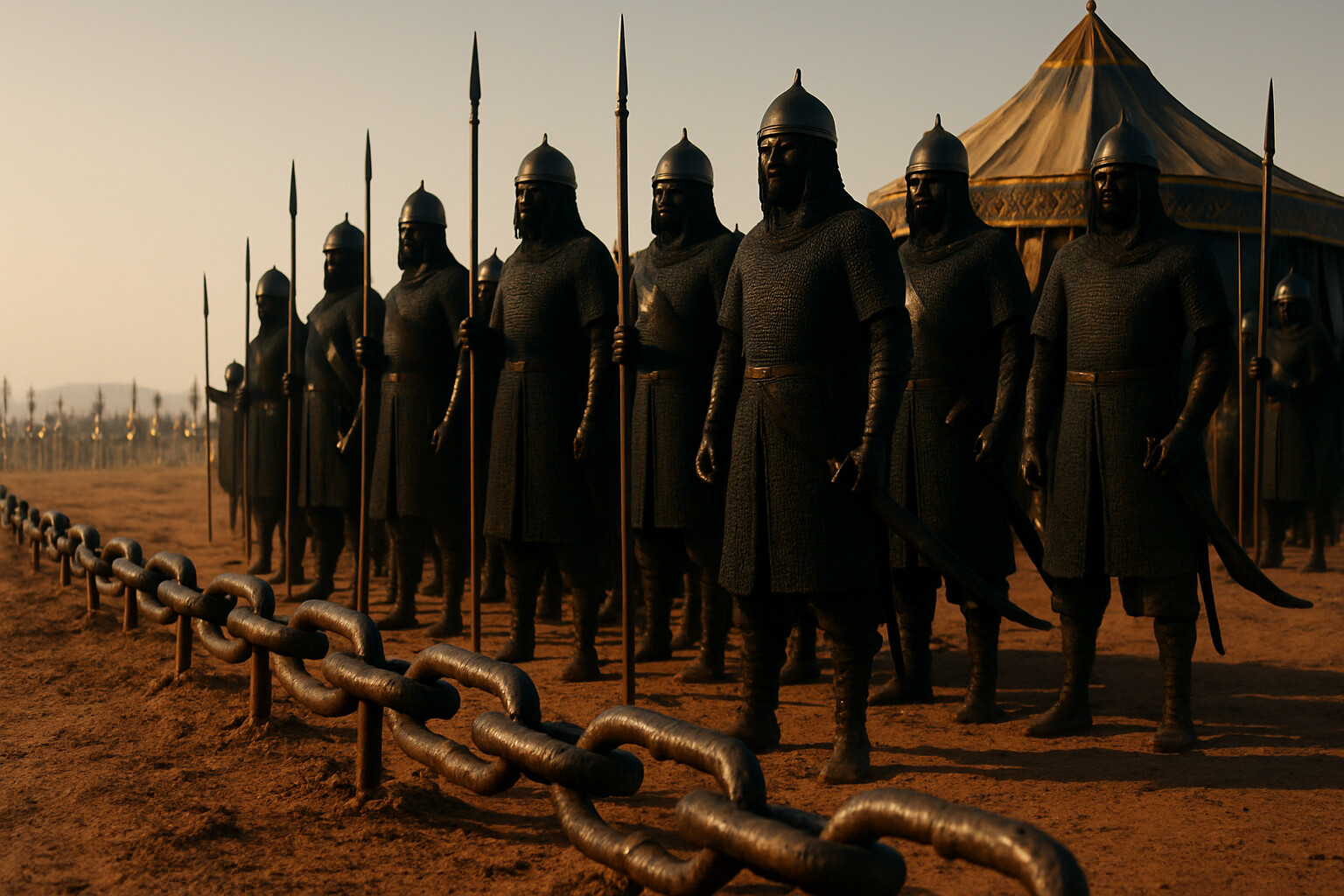
The plain had been swept clean.
Darius III, Great King of Persia, ruler of an empire stretching from the Aegean coast to the Indus River, had ordered his engineers to level the ground at Gaugamela. They had worked for days—filling ruts, removing stones, smoothing the earth—so that his scythe-wheeled chariots could run without obstruction. The plain near the village of Gaugamela, roughly thirty miles northeast of the ancient city of Arbela (modern Erbil in northern Iraq), was intended to be the site of a final, decisive Persian victory. On it, Darius planned to end the Macedonian invasion of Asia.
What he had built, without quite intending it, was a stage.
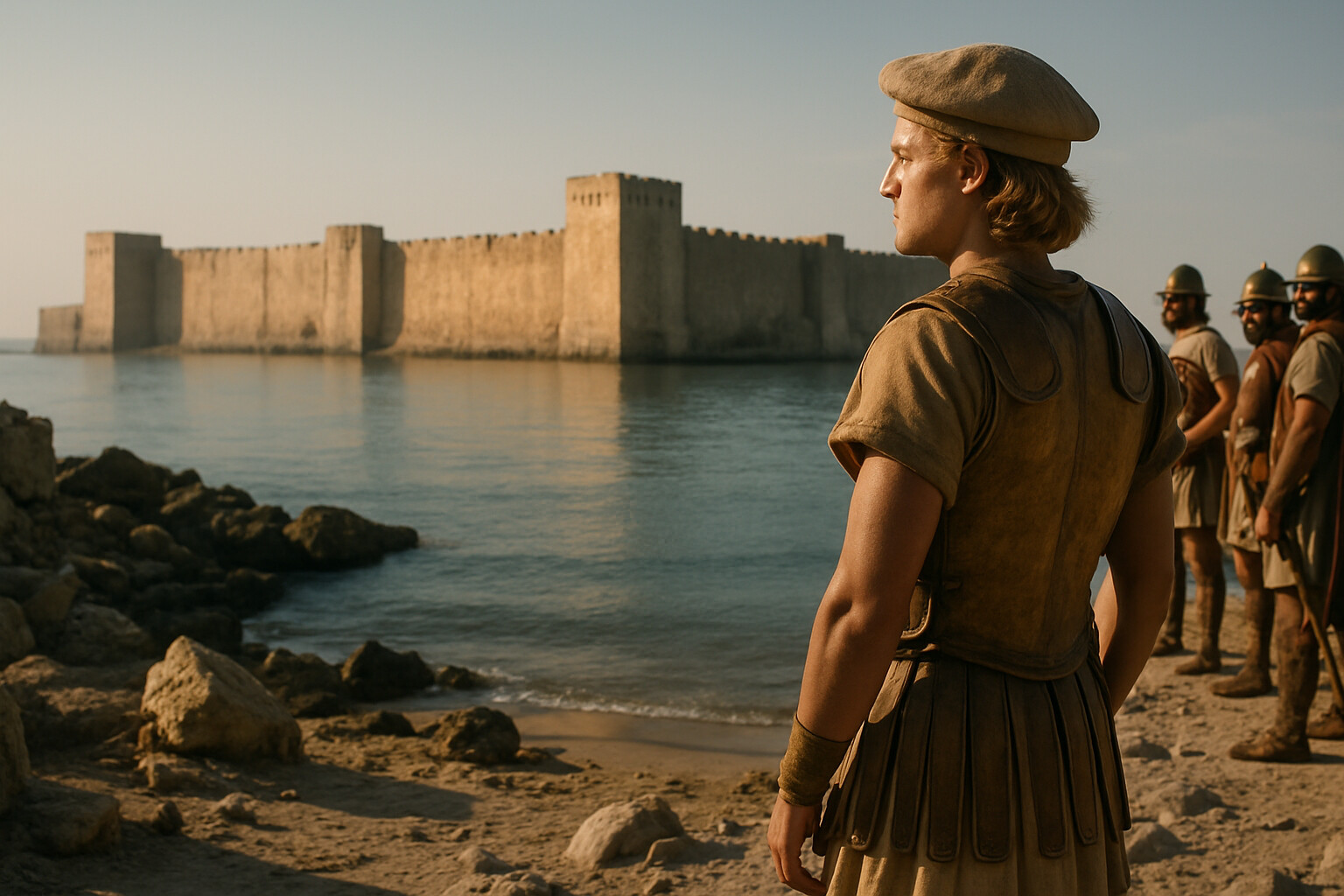
On the morning of 1 October 331 BC, Alexander III of Macedon, twenty-five years old, rode out to survey what he faced. The Persian host stretched across the horizon. Ancient sources vary wildly on Persian numbers—Arrian, drawing on Ptolemy and Aristobulus, gives figures that modern scholars treat as massive but uncertain, with estimates ranging from around 200,000 to numbers the ancient sources push far higher; most modern historians regard the largest figures as rhetorical exaggeration rather than reliable counts. What is not in dispute is the scale of the imbalance. Alexander commanded somewhere between 40,000 and 47,000 men. He was outnumbered by a ratio that most commanders in history would not have accepted on those terms.
He accepted them.
---
To understand what happened at Gaugamela, it is necessary to understand what had already happened. This was not Alexander's first encounter with Darius.
In 334 BC, Alexander had crossed the Hellespont into Asia with an army of roughly 37,000 men—Macedonians, Greeks of the Corinthian League, Thracians, and allied contingents. He was twenty-one years old, had already suppressed a revolt in Thrace and crushed the city of Thebes, and was carrying out the pan-Hellenic war of revenge against Persia that his father Philip II had planned and begun. Philip had been assassinated in 336 BC before he could complete it. Alexander completed it.
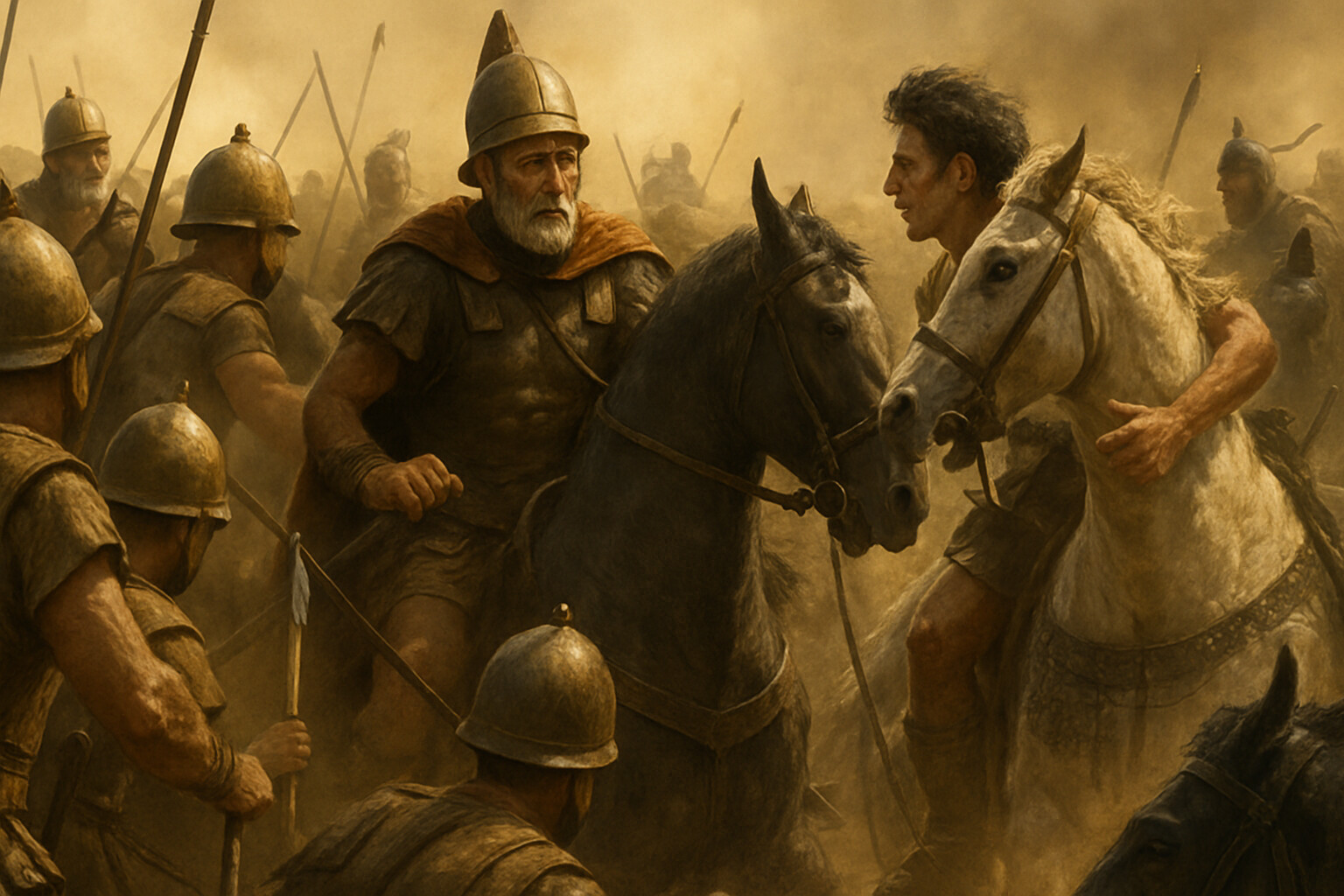
At the Granicus River in 334 BC, Alexander personally led the assault across a steep-banked river against Persian cavalry and Greek mercenary infantry, and came close to dying—ancient accounts describe him being struck on the helmet by a Persian nobleman's sword, and being saved by the intervention of Cleitus the Black, one of his Companion officers. He survived. The Persian commanders at the Granicus did not.
At Issus in 333 BC, Darius himself commanded. The battle was fought in a narrow coastal plain between mountains and sea in what is now southern Turkey. Alexander's oblique advance shattered the Persian center, and Darius fled in his chariot—abandoning his mother, wife, daughters, and substantial treasure to the Macedonians. Ancient sources, largely favorable to Alexander, record that he treated them with respect; this detail is widely repeated but filtered through a tradition that has every reason to present the Macedonian king well.
Darius attempted negotiation. He offered Alexander the western half of the Persian Empire, his daughter in marriage, and an enormous ransom for his captured family. According to Arrian, Parmenion reportedly said that if he were Alexander, he would accept. Alexander's reported reply—that he would too, if he were Parmenion—is transmitted through Arrian and Plutarch and cannot be verified as actual speech. What is documented is the outcome: Alexander declined the offer and continued east.
That decision forced Darius to fight again, this time on ground of his own choosing, with the largest army he could assemble, on terrain his engineers had prepared.
---
Alexander's army in 331 BC was a precision instrument refined by years of campaigning. At its core were two complementary systems that Philip II had forged and Alexander had inherited and sharpened.
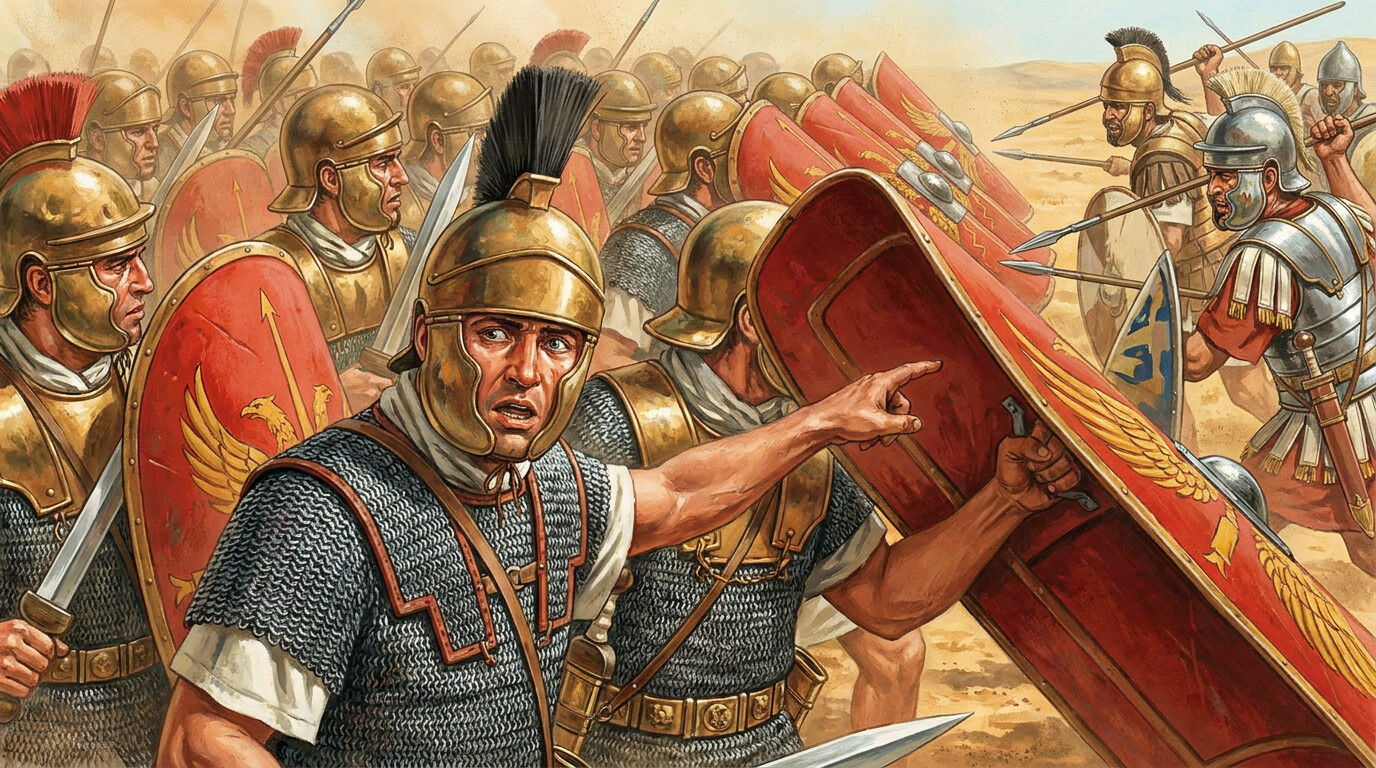
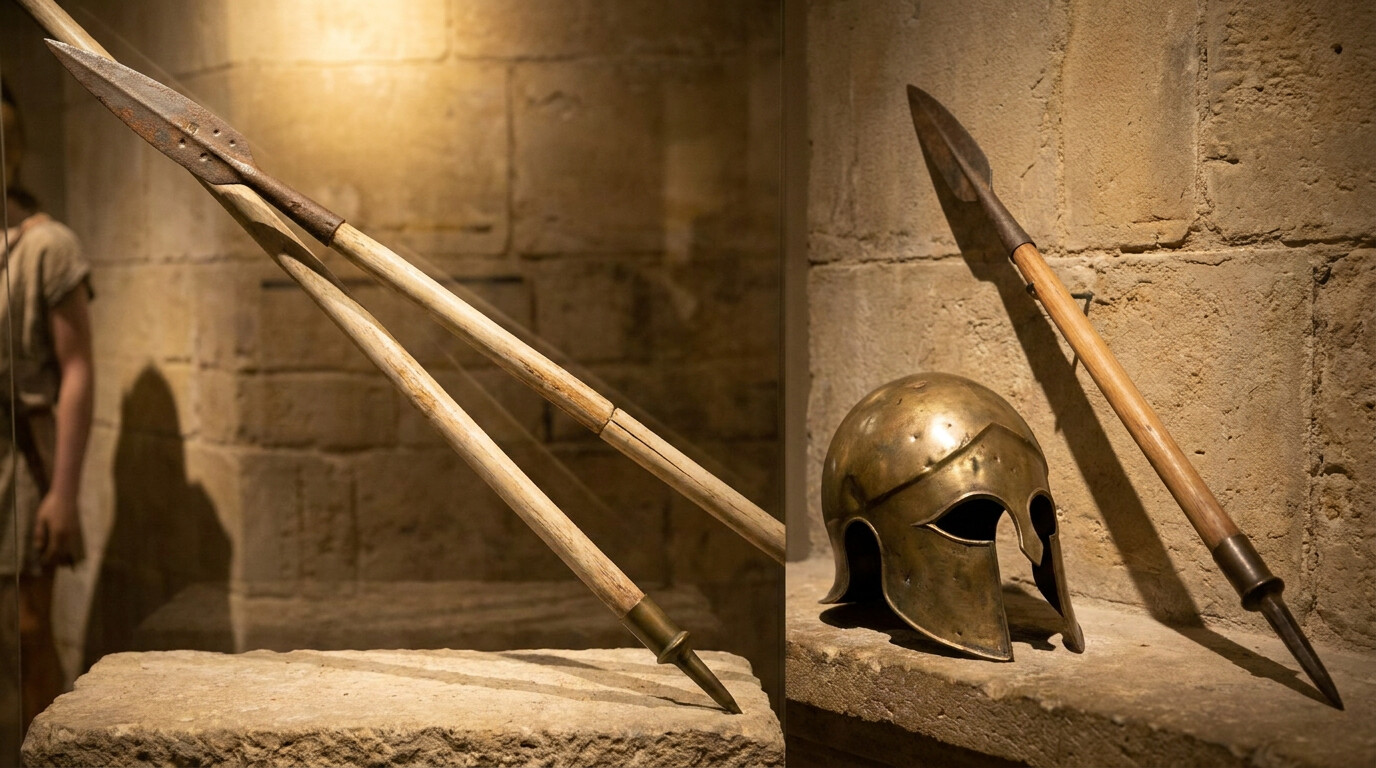
The Macedonian phalanx was built around the sarissa—a pike of extraordinary length, approximately 15 to 18 feet in total, though ancient sources and modern scholars continue to debate the exact measurement. The sarissa was wielded with two hands, held at an angle, creating a wall of overlapping iron points that extended well in front of the men holding the weapon. An enemy closing on a Macedonian phalanx faced not one spear point but several, each from a different file, before he could reach the first rank with his own weapon. The system required precise drill and close-order cohesion; a phalanx that lost alignment became vulnerable, particularly on its flanks. On flat, open ground and in proper order, it was a nearly irresistible offensive engine.
The six regiments of the Macedonian infantry phalanx—the asthetairoi, or foot companions—were the engine. The Companion cavalry was the blade.
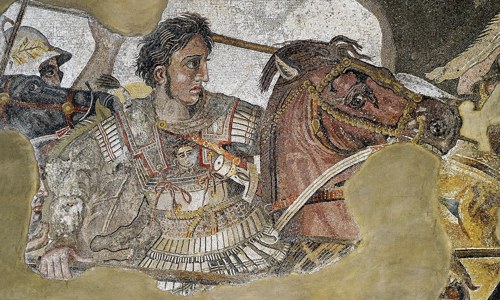
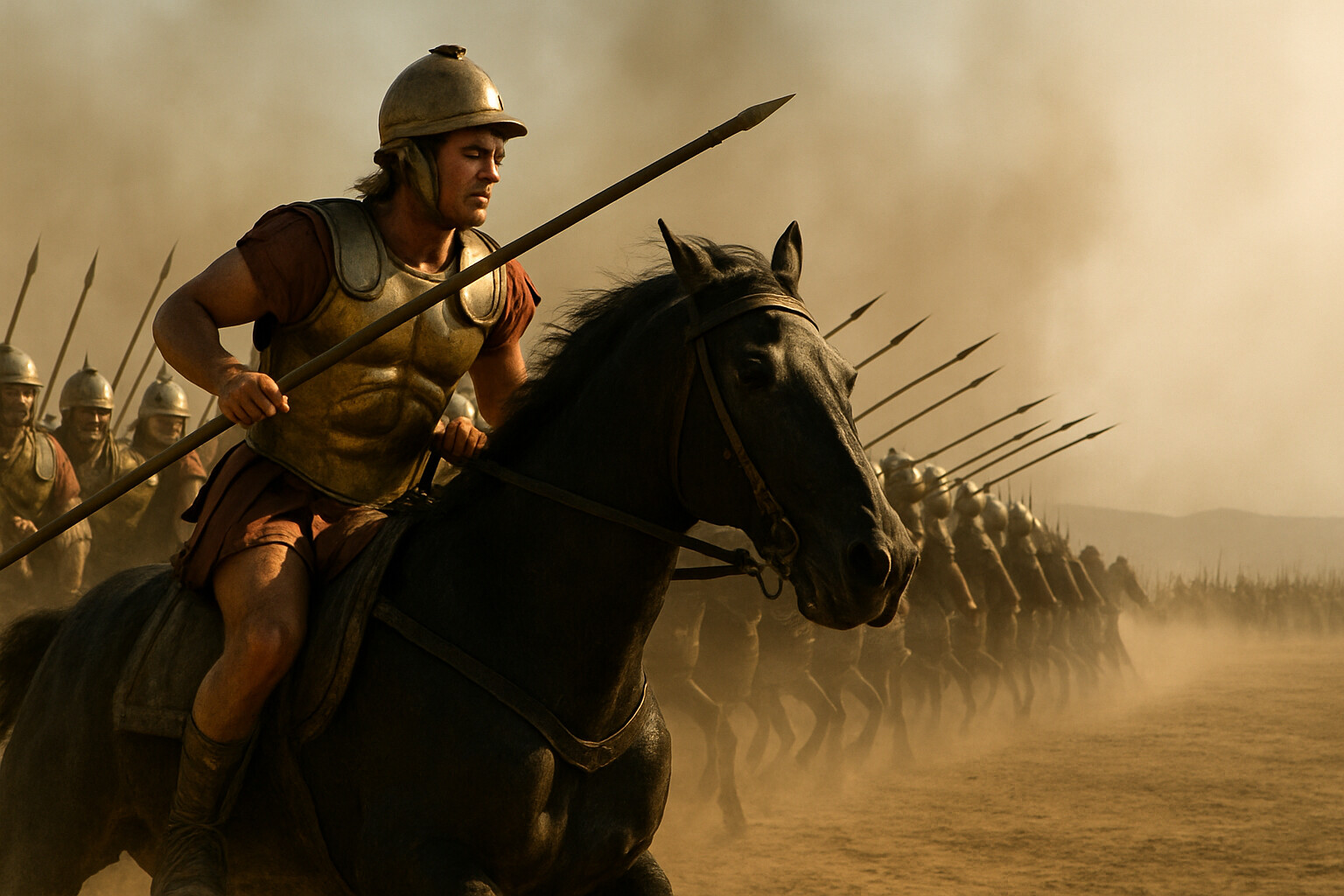
The Hetairoi, the Companion cavalry, were heavy horsemen recruited from the Macedonian nobility. They rode without stirrups—stirrups would not reach the ancient world for centuries—relying on leg pressure and balance to remain mounted at speed. Their primary weapon was the xyston, a heavy cavalry lance roughly nine to ten feet long, held underarm for a driving thrust. They wore bronze armor—Boeotian or Macedonian-style helmets, corslets, and greaves—and carried a short sword as a secondary weapon. They fought in a wedge formation, a configuration that concentrated shock at a point and allowed penetration into an enemy line before spreading inside it.
Alexander rode at the point of that wedge. This was not symbolic posturing. The Companion charge worked because it was genuinely fast, genuinely coordinated, and genuinely lethal, and Alexander's presence at the tip both executed his own tactical intent and concentrated the psychological weight of the blow at the decisive moment. It also meant he was regularly within arm's reach of men trying to kill him.
On the left wing, commanding the Thessalian cavalry and the allied Greek horse, was Parmenion—Alexander's most senior general, a man who had served Philip before Alexander, and who Alexander trusted with the task of holding a defensive left flank against whatever Darius could bring to bear. This was the harder assignment on the field.
On the right rode Alexander, with the Companion cavalry, the hypaspists (elite infantry who bridged the gap between the phalanx and the cavalry), and allied light cavalry screening the flank.
---
The night before the battle, according to Arrian, Parmenion suggested a night attack to reduce the Persian numerical advantage. Alexander declined. Ancient sources offer what reads as a confident rationale—he would not steal a victory—but the more practical consideration, which those same sources also note, was that a night engagement with a force as dependent on precise coordination as the Macedonian army risked catastrophic confusion in darkness against an enemy whose numbers gave him redundancy against disorder.
Alexander slept. This detail appears in Arrian and Plutarch. Whether he actually slept soundly, or whether the sleep was recorded because it was remarkable, or because it served a rhetorical purpose in ancient biography establishing a commander's composure, cannot be resolved from the record. What is noted is that his officers had to wake him, and that he appeared untroubled.
The Persian army had stood under arms through much of the night. Darius feared a night attack. His men were exhausted before the fighting began.
---
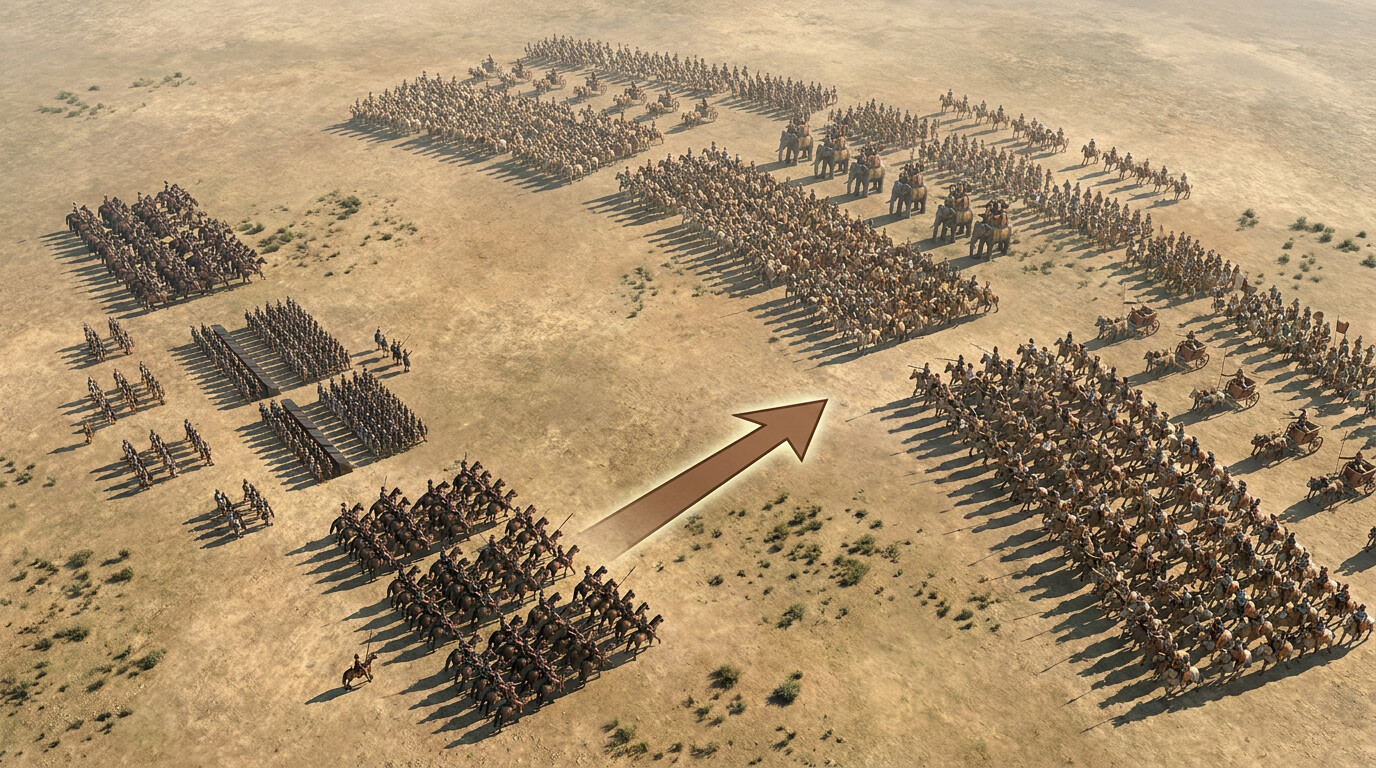
The Persian order of battle at Gaugamela reflected both the empire's reach and its central tactical problem.
Darius had assembled cavalry and infantry contingents from across the empire: Bactrian and Scythian cavalry on his left, commanded by Bessus; the royal cavalry and elite Persian foot in the center around the king; Indian war elephants—fifteen, according to Arrian—and scythed chariots positioned to disrupt the phalanx before the main infantry clash; Cappadocian and Armenian cavalry on the right, opposite Parmenion.
The scythed chariots were the most specialized element. Each carried blades projecting from the wheel axles, designed to cut through infantry ranks, driven by a man whose purpose was to force the vehicle into an enemy formation at speed. Their effectiveness depended entirely on the enemy standing to receive them. They had not worked at Cunaxa in 401 BC. They would not work effectively here.
The Persian cavalry, particularly the Bactrian horsemen on the left under Bessus, were skilled, numerous, and capable. Darius's plan required them to sweep around and overlap Alexander's right wing, enveloping the smaller Macedonian force from both sides simultaneously. The army's frontage was designed to accomplish exactly that.
The prepared ground was essential. It gave the chariots room to accelerate. It denied the Macedonians the broken terrain that might have neutralized Persian numerical depth. Darius had thought carefully about this.
Alexander had thought about it longer.
---
Alexander's deployment on the morning of 1 October was not standard.
He arranged his army in a double-facing formation—a refinement that ancient sources describe in some detail, though specific elements remain debated by modern scholars. The main phalanx and heavy cavalry formed the front line, but behind and angled outward on both flanks, Alexander posted additional infantry and cavalry units to refuse envelopment. If the Persian wings swept around his flanks, a second line would be there to meet them. The formation was not a simple line; it was a system designed to fight while partially surrounded and still function.
Alexander also placed his hypaspists between the phalanx and his Companion cavalry on the right, as a pivot element that could swing with the cavalry or hold with the phalanx as the action required.
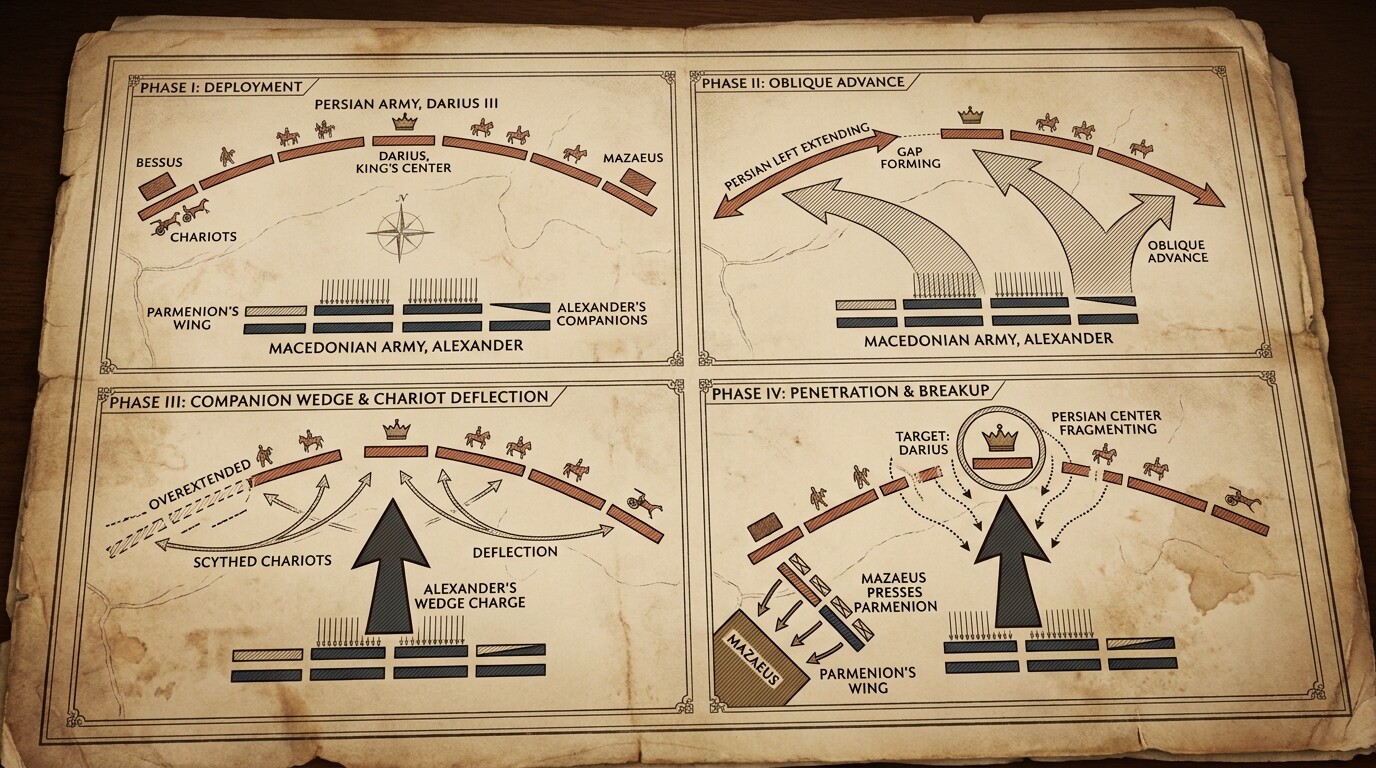
When the two armies advanced toward each other, Alexander did something that alarmed Darius immediately: he did not advance straight ahead. He drifted his entire right wing steadily to the right as the lines closed. The movement was controlled, deliberate, and purposeful.
Darius had leveled a specific area of ground for his chariots. Alexander was walking his cavalry off the edge of that prepared zone, onto rougher terrain where the chariots would be less effective. He was also angling toward the space between Darius's prepared ground and the outer edge of the Persian left wing.
More critically, Alexander's drift was doing something to the Persian formation. To keep Alexander's cavalry facing Bessus's cavalry—and prevent Alexander from sliding around the Persian left—Darius had to order his left wing to extend laterally to stay opposite the Macedonian right. The Persian left stretched to match. Stretching creates gaps.
Darius responded by launching his scythed chariots.
The Macedonian infantry did not stand passively to receive them. Following Alexander's prior orders, the light infantry—Agrianian javelin men and archers positioned forward of the phalanx—began targeting the chariot horses and drivers with missiles. The noise, the wounds, and the disorder turned many chariots aside before they reached the line. Those that did penetrate met a different response: the phalanx opened lanes, with files of men stepping aside to let the vehicles pass through harmlessly, then closing back into formation behind them. The chariots that reached the Macedonian rear were dealt with by grooms and rearguard troops.
The scythed chariot assault—the centerpiece of Darius's prepared-ground strategy—failed with minimal Macedonian casualties.
---
The crisis on the Macedonian left began almost simultaneously.
Bessus launched his Bactrian and Scythian horsemen in a wide, sweeping charge intended to curl around Alexander's rightmost flank. The Macedonian light cavalry screening the flank—Paeonians and prodromoi—engaged and slowed them but could not stop the pressure. The threat to Alexander's right was real and growing.
But Alexander was not looking at his right flank.
He was looking at what the Persian left's lateral extension had created: a gap. As Bessus's cavalry swung outward and the Persian center shifted to maintain contact, a seam opened between the Persian left cavalry and the Persian center infantry around Darius.
Alexander had been waiting for exactly this. He may have been engineering it with the oblique advance—though whether the gap was fully pre-planned or exploited as it appeared cannot be established from surviving sources. Both Arrian and Diodorus describe the subsequent charge as deliberately aimed at Darius, which suggests intent, and the gap's creation through the oblique advance is consistent with design. Most modern scholars treat it as intentional while acknowledging that certainty is out of reach.
He turned the Companion cavalry—several squadrons, with the Royal Squadron at the tip and Alexander at the point—into a wedge, aimed it at the gap, and charged.
What followed was one of the most studied moments in ancient military history, and one of the most violent.
The Companion wedge hit the Persian line at the seam—not into the solid wall of Persian infantry, but into the space between formations. Concentrated heavy cavalry driving at speed through a gap in a line does not produce a cavalry skirmish; it produces a rupture event. The wedge pushed in, spread inside the gap, and Persian infantry and cavalry on either side found themselves attacked from an unexpected direction. The coherence of the Persian center began to come apart.
Alexander drove directly toward Darius.
According to Arrian, missiles and javelins were exchanged at close range around the king's position. The Persian royal bodyguard—heavily armed cavalry who surrounded Darius—engaged the Companions at short distance. Men died on both sides at very close quarters. Arrian describes the fighting around the king as extremely intense.
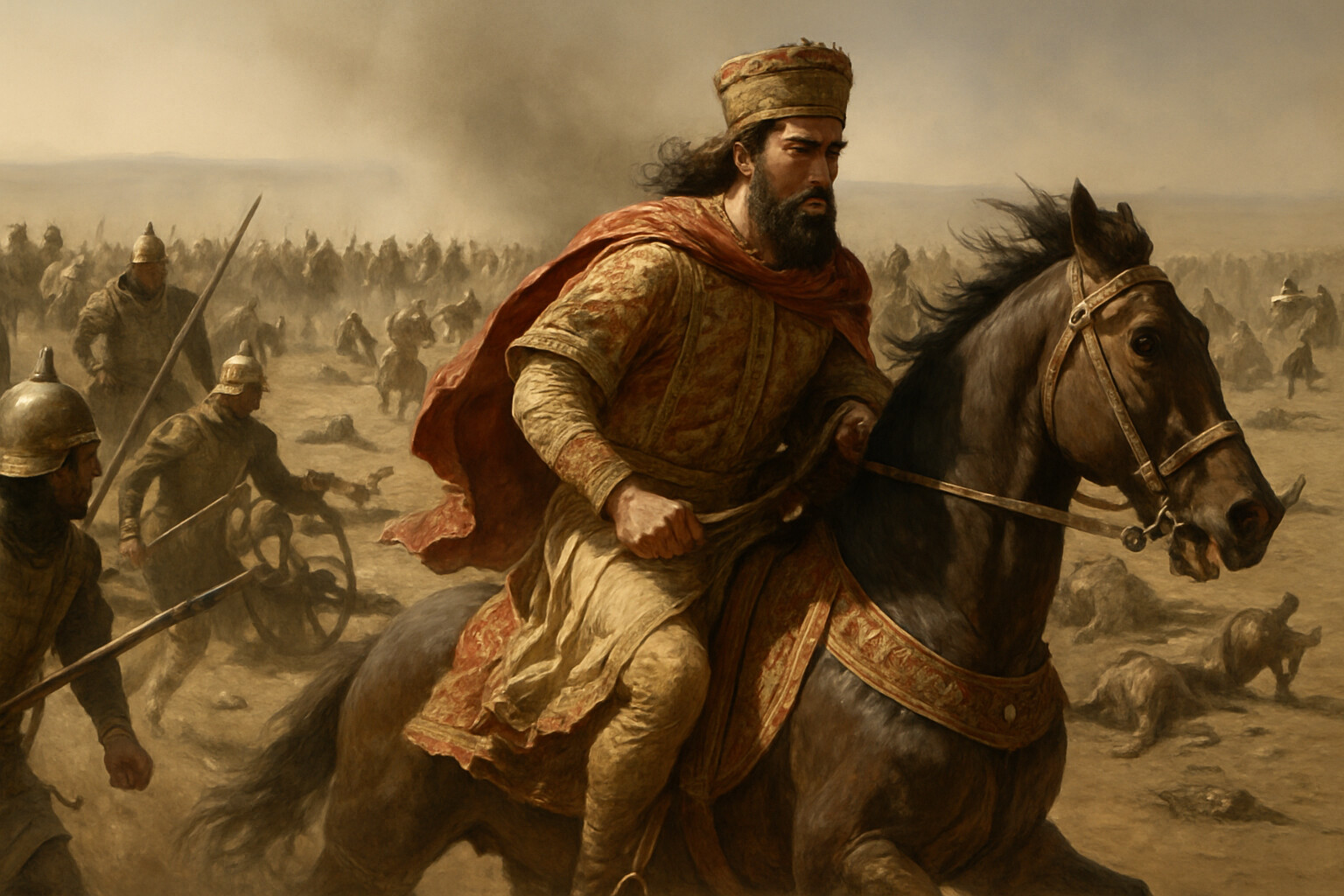
Darius, for the second time in three years, fled.
The exact moment of his decision is reported differently across the ancient sources, and at this distance it is impossible to know whether the choice reflected panic, a rational assessment of a collapsing situation, or some combination. What the sources agree on is the result: the Great King abandoned his chariot, mounted a horse, and rode east. When the king fled, the Persian center collapsed around him. The news traveled with the speed that bad news always travels in armies.
---
Alexander did not pursue immediately.
This is where the day nearly broke in two.
On the Macedonian left, Parmenion faced serious trouble. The Persian right wing under Mazaeus had pressed the Thessalians and Greek allies hard, and in the gap created by the phalanx's forward advance, a large force of Persian and Indian cavalry had broken through the Macedonian line and ridden into the baggage train. They were looting and reportedly freeing prisoners being held there—some ancient sources suggest this included members of Darius's family captured since Issus, though this detail is not universally attested and its accuracy is uncertain.
Parmenion sent urgent word to Alexander: he needed support. The message reached Alexander as he was weighing whether to pursue Darius.
Alexander turned back.
He led the Companion cavalry—many of whom had just driven through the Persian center—back across the battlefield toward the Macedonian left. They ran directly into retreating Persian cavalry from Mazaeus's force. The engagement that followed was described by Arrian as one of the sharpest cavalry fights of the entire battle: the Persians were falling back in order, not routing, and the collision was head-on. Ancient sources record significant Macedonian casualties in this phase, including sixty Companion cavalry killed—a figure that historians treat as plausible given the intensity of the fighting, while noting that all ancient casualty numbers require caution.
By the time Alexander reached the left, Parmenion's Thessalians had held. The Persian right had begun to withdraw when word of Darius's flight reached them. The battle was over, but it had not been clean.
Alexander resumed the pursuit of Darius, riding through the night toward Arbela. He did not catch him. Darius escaped with a remnant of cavalry—Bactrians, Greeks, and Persian guard—into the mountains of Media.
---
The cost of Gaugamela fell very differently on the two armies.
Macedonian losses are reported in ancient sources as relatively light for a battle of this scale—Arrian gives figures in the hundreds killed, a number that most modern historians regard with appropriate skepticism but that is consistent with the broader pattern of Alexander's battles, where tactical coordination and the early collapse of Persian resistance in the center reduced Macedonian exposure. The sixty Companion cavalry killed in the mop-up fighting is among the more specific figures in the ancient record and is treated by scholars as credible, with the standard caveat that no ancient casualty figure can be independently verified.
Persian losses were catastrophic, though ancient figures—tens of thousands dead—cannot be confirmed with precision. What is documentable is what followed. Within weeks, Babylon surrendered without a fight. Susa, one of the Persian royal capitals, followed shortly after. In early 330 BC, Persepolis, the ceremonial heart of the Achaemenid Empire, fell to Alexander. The palace of Xerxes—whose army had burned Athens in 480 BC—was itself burned. Ancient sources disagree on whether this was deliberate symbolic revenge for the Persian sack of Athens or the result of a celebration that went badly wrong; some record that Alexander later expressed regret. The truth of the matter is unresolved.
Darius III never assembled a fighting force capable of meeting Alexander again. He fled through Media and into Bactria, pursued by Alexander's cavalry across hundreds of miles of harsh terrain. In the summer of 330 BC, he was murdered by the satrap Bessus—the same man who had commanded the Persian left at Gaugamela—who stabbed the king and left him to die as Alexander's advance cavalry closed in. Alexander found the body, reportedly treated it with respect, and had Darius buried with royal honors at Persepolis. Bessus was later captured, tried, and executed.
The Achaemenid Empire, which had endured for more than two centuries, was finished.
---
What made the victory at Gaugamela possible was not simply Alexander's personal courage, though that is well documented. It was a convergence of factors that the ancient sources preserve—incompletely, and from a single cultural vantage point—and that modern military historians have spent considerable effort analyzing.
The oblique advance served a dual purpose. It moved Alexander's cavalry toward terrain the Persians had not leveled, reducing the scythed chariot threat. It also drew the Persian left wing into an overextension that opened the gap through which Alexander's charge drove. Whether this outcome was fully pre-planned or whether Alexander recognized and exploited the gap as it developed is a question the surviving sources cannot answer. The charge's aim at Darius, described in both Arrian and Diodorus, suggests deliberate intent. Most modern scholars treat the gap's creation as designed, while acknowledging that certainty is impossible.
The double-facing formation was equally essential. Without the refused flanks and the second line of infantry angled outward to resist envelopment, Bessus's sweep on the Persian left and Mazaeus's pressure on the Persian right would have curled around the Macedonian flanks and produced exactly the encirclement Darius intended. That formation held the flanks while Alexander executed the decisive blow in the center.
Parmenion's Thessalians deserve particular attention. They held the Macedonian left against heavy pressure from some of the finest cavalry in the Persian army, for the duration of the main action, without the support of the Companions who were committed on the right. The Thessalian cavalry were trained and equipped to a high standard—heavy horse, experienced riders—and their performance was indispensable to the outcome. Parmenion's generalship on that flank is regularly overshadowed in accounts that concentrate on Alexander's central charge, but the battle could not have been won if the left had broken.
The communication between Parmenion and Alexander—a message dispatched across a chaotic battlefield—and Alexander's decision to respond rather than continue the pursuit of Darius reveals something about the command relationship and about the real limits of Alexander's situation. There was a genuine period when the Macedonian left was under extreme pressure and the reserve capacity of the army was exhausted. The battle worked. At several points it could have broken differently.
---
The ancient sources for Gaugamela are rich by ancient standards and remain frustratingly limited by modern ones.
Arrian of Nicomedia, writing in the second century AD, drew primarily on the memoirs of Ptolemy—one of Alexander's generals who later ruled Egypt—and on the account of Aristobulus of Cassandreia, a military engineer in Alexander's entourage. Both men were present at Gaugamela. Both wrote accounts that no longer survive in their original form. Arrian's use of them makes his account generally the most reliable we have, while modern scholars note that Ptolemy's memoirs, written decades after the events during his reign as king, may have been shaped by the political needs of that later moment.
Diodorus Siculus, writing in the first century BC, provides a different account with different numbers and different emphases. His source tradition is less transparent than Arrian's. Plutarch's Life of Alexander, from the late first or early second century AD, is valuable for anecdote and character but is not a tactical history and should not be treated as one.
The Persian side of the battle has almost no surviving indigenous documentation. Persian administrative records, inscriptions, and one fragmentary Babylonian astronomical diary—which briefly notes a military defeat in the month of Ululu in the seventh year of Darius—provide external confirmation that a major battle occurred roughly when and where the Greek sources say it did. But the Persian commanders' perspective, the internal deliberations of Darius's staff, and the experience of the Persian infantry and cavalry are almost entirely absent from the record. Every reconstruction of Persian decision-making at Gaugamela is inference drawn from sources written by the other side.
Modern scholarship has worked extensively to reconcile the ancient accounts with geographical analysis, numismatic evidence, and comparative military history. The works of A. B. Bosworth on Arrian and on Alexander's campaigns, and of Peter Green, Paul Cartledge, and others, represent the most rigorous modern treatment of the evidence. The exact location of the Gaugamela battlefield remains a subject of ongoing scholarly discussion, with the site generally placed near Tel Gomel in northern Iraq; precise archaeological confirmation has not yet been achieved.
---
Gaugamela entered military history not simply as a famous victory but as a case study in what asymmetric success looks like when it is built on system rather than fortune.
The Macedonian synthesis—a phalanx that fixed and pressed the enemy center, heavy cavalry that delivered the decisive blow at a chosen gap, light troops that neutralized specialized weapons, and a command structure resilient enough to handle a battle that fractured into multiple simultaneous crises—was not improvised at Gaugamela. It had been developed over decades by Philip II and refined through Granicus, Issus, and the siege campaigns in between. What Alexander contributed was the judgment of where and when to strike, the nerve to lead the charge personally, and the flexibility to respond when Parmenion's crisis demanded it.
The battle also illustrates, at large scale, the vulnerability of mass to coordination. Darius's army was not incompetent. His preparation of the ground was methodical. His deployment of the scythed chariots and his attempt to overlap both Macedonian flanks were rational responses to an enemy who had beaten him once before. But coordinating simultaneous action across an enormous frontage, with contingents speaking different languages, under different commanders, relying on riders and visual signals for communication, is a problem that grows harder with scale. The Macedonian army was smaller, more tightly drilled, more unified in command. That asymmetry in internal cohesion mattered as much as anything that happened on the day.
The battle ended Persian political dominion over an empire that had stretched from Libya to the Punjab. What replaced it—the Macedonian successor kingdoms, the spread of Greek language and culture across the Near and Middle East in what historians call the Hellenistic period—shaped the history of the region for the next three centuries, and through those centuries shaped the cultures that followed: the Roman East, the early Christian and Jewish worlds, the Persian revival under the Parthians and Sassanids.
Alexander died in Babylon in 323 BC, less than eight years after Gaugamela, at approximately thirty-two years of age. The cause of his death remains disputed: fever, possibly complicated by heavy drinking, possibly typhoid, possibly other factors. Ancient sources raise the possibility of poisoning; modern medical and historical analysis generally treats that claim as unproven. He left no clear successor. His generals divided the empire into kingdoms that would fight each other for decades.
The plain at Gaugamela, swept clean for a battle intended to be Darius's final answer, became instead the place where the Achaemenid Empire effectively ended. On ground prepared for Persian victory, an outnumbered Macedonian king found a gap, formed a wedge, and drove it home.