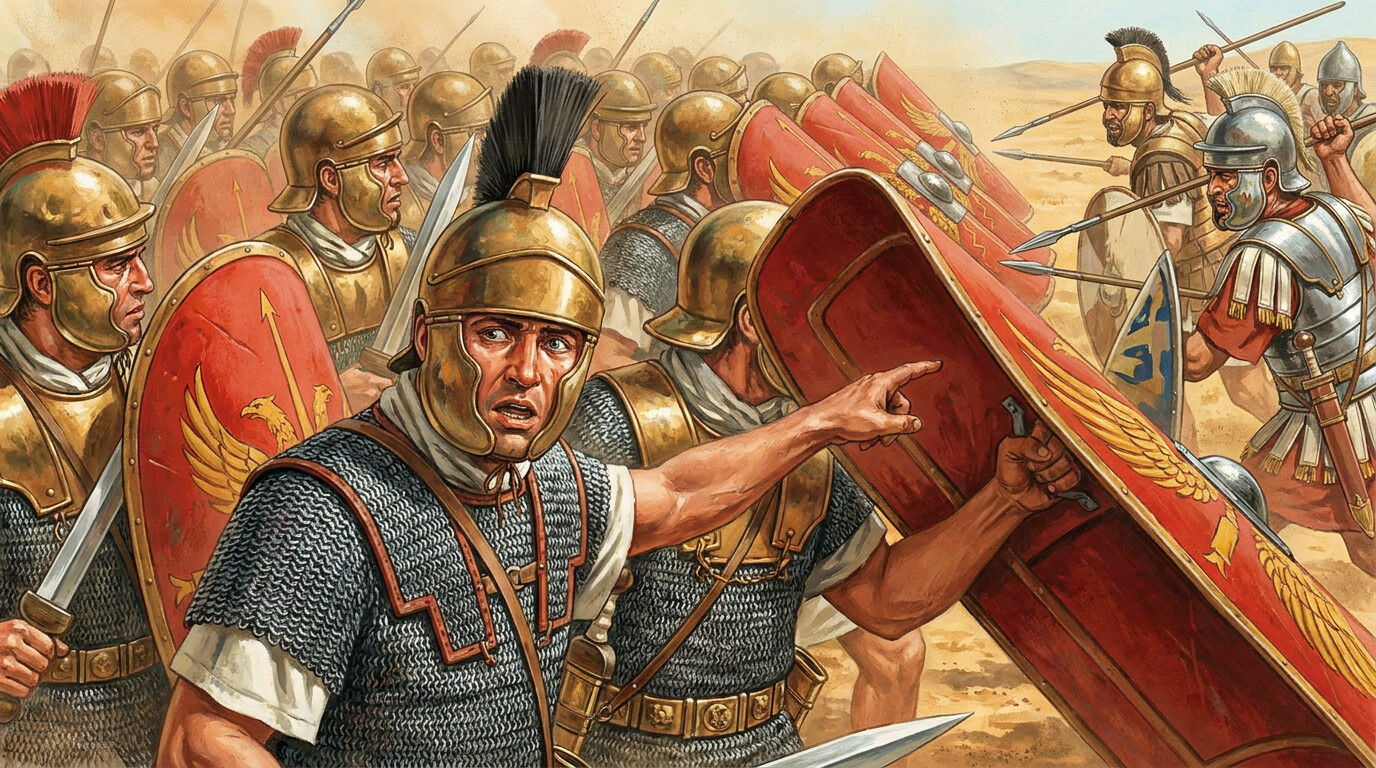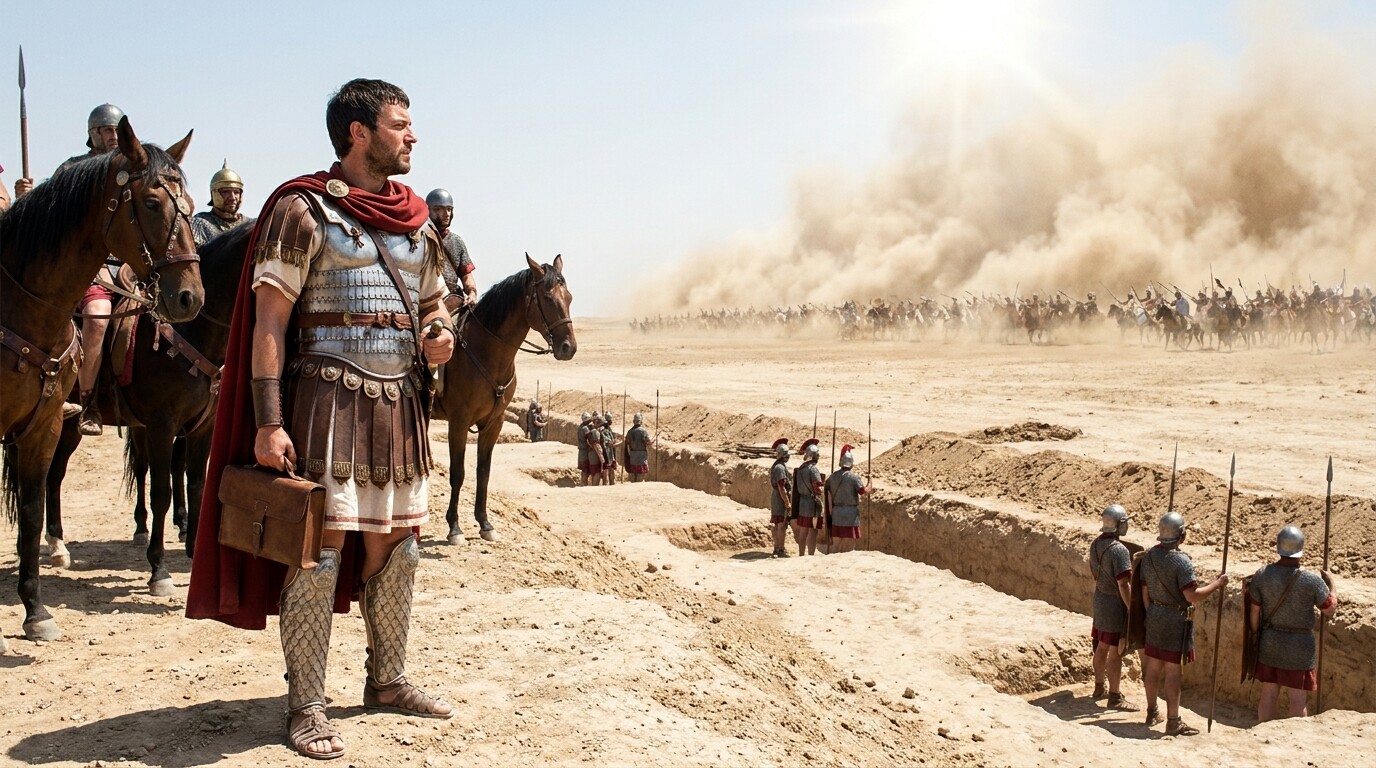
The trireme's oars bit hard into the harbor water. Dawn had barely broken over the Sicilian coast when the signal came down from the flagship: advance in line, strike before the city could man its defenses. The Roman commander Marcus Claudius Marcellus had done this before. He had taken Leontini in a matter of days. He had broken fortified towns across southern Italy. He commanded one of the finest amphibious assault forces Rome had ever assembled—eight quinqueremes lashed together in pairs, each pair carrying a siege ladder called a sambuca, a device wide enough to discharge soldiers directly onto a wall top. Sixty more warships flanked them. Behind, on land, his colleague Appius Claudius Pulcher pressed toward the city's landward walls with a full consular army. Rome had numbers, discipline, and momentum. What it did not have—what neither commander appears to have anticipated—was the man already standing at the battlements, watching the fleet come in.
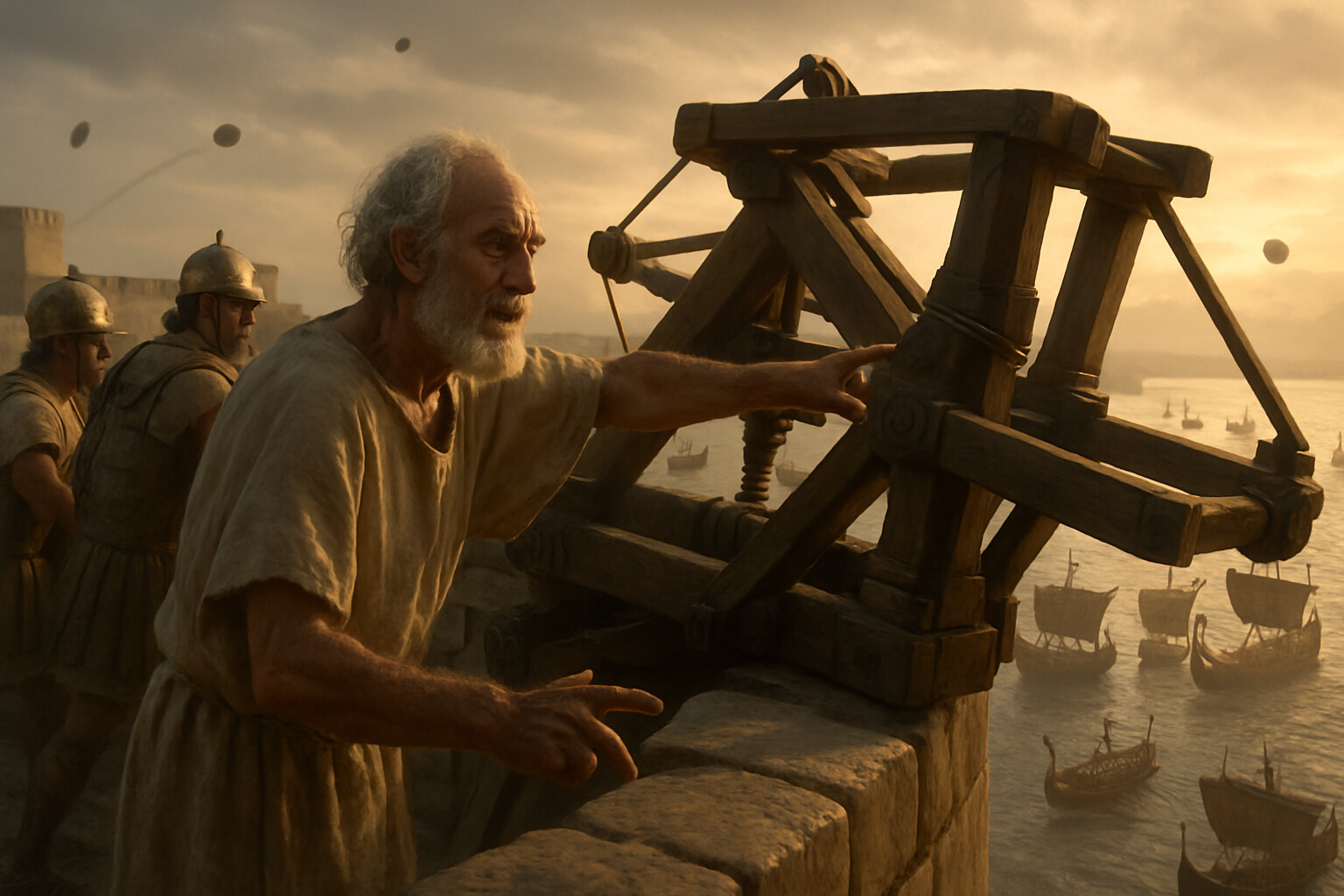
Archimedes of Syracuse was approximately seventy years old in 213 BC. Ancient sources, including Plutarch writing roughly three centuries later, describe him as having already gained a formidable reputation across the Greek world for his mathematics, his mechanics, and his understanding of the physical principles that governed machines. He had spent much of his career on pure theoretical problems—calculating the value of pi, developing methods for determining the volume of irregular solids, laying groundwork for ideas that would not be formalized as calculus for another eighteen centuries. But Archimedes was not purely a philosopher in the Greek abstract tradition. He was a practical engineer in a city that was about to need him more than it had ever needed anyone.
Syracuse in 213 BC was one of the wealthiest and most strategically vital cities in the Mediterranean world. Founded as a Corinthian colony in the eighth century BC, it had grown into a city-state of enormous power—capable of defeating Athenian expeditionary forces, holding off Carthaginian sieges, and projecting influence across Sicily and the central Mediterranean. By the time of the Second Punic War, Syracuse occupied a peninsula on Sicily's eastern coast. The island district of Ortygia formed the original city, connected to the mainland quarters of Achradina, Tyche, Neapolis, and Epipolae. The city's harbor geography was a natural asset: the Great Harbor to the south was broad and relatively sheltered; the Little Harbor to the north, near the island district, was tighter and more enclosed. Walls, towers, and cliffs provided multiple defensive layers. The city was, by any measure, formidable.
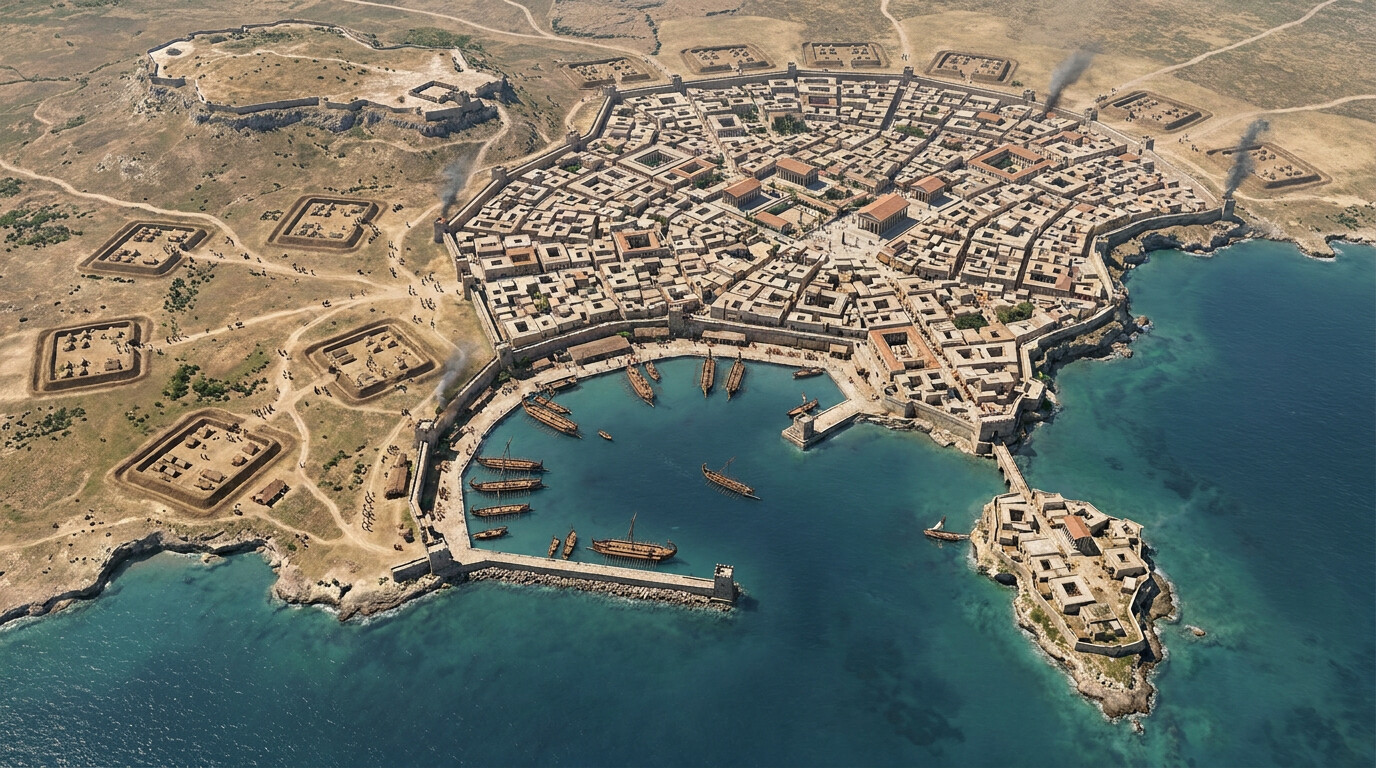
The political situation that brought Rome to Syracuse's walls was a direct consequence of Hannibal Barca's catastrophic defeat of the Roman army at Cannae in 216 BC. That single engagement—in which Carthaginian forces encircled and destroyed approximately fifty thousand Roman soldiers in a matter of hours—sent shockwaves through Rome's allied network. For communities whose loyalty to Rome rested primarily on fear of Roman military power, Cannae was the moment that fear evaporated. King Hiero II of Syracuse had been a loyal Roman ally for decades; his death around 215 BC brought his young grandson Hieronymus to power. The boy-king quickly switched allegiance to Carthage, was assassinated shortly after, and Syracuse fell into factional violence that ultimately produced a pro-Carthaginian leadership under generals named Hippocrates and Epicydes. When Rome demanded Syracuse return to alliance, the city refused. Marcellus marched.
The Roman siege force that arrived before Syracuse was, by ancient standards, formidable. Polybius—writing within living memory of the events and drawing on sources close to them—gives details of the Roman approach that suggest Marcellus expected a rapid assault to succeed. The sambuca apparatus he deployed was a genuine piece of military engineering, and Marcellus was not a man given to caution when aggression had historically worked. He ordered a simultaneous assault: the naval force would strike the harbor walls while Appius Claudius pressed the landward defenses. Speed, shock, and mass were the Roman theory. Neither commander appears to have had accurate intelligence about what Archimedes had built.
What the Romans encountered when their fleet entered weapon range was, by the testimony of ancient sources, a layered artillery system calibrated for every band of the approach. Plutarch, drawing on the earlier historian Polybius, describes Archimedes as having organized the city's defensive engines according to a principle of range differentiation. Long-range catapults—the Greek term used in sources is generally rendered as lithoboloi, stone-throwers—opened on the fleet while it was still far out in the harbor. As the ships closed, shorter-range machines came into action. In Plutarch's account, the Romans found themselves under fire at every distance, with no safe approach. The timing and calibration described suggest that Archimedes had done more than simply place artillery on the walls; he had organized interlocking fields of fire across the harbor approaches. That concept is described in the ancient sources through its effects; the formal military vocabulary for it is modern.
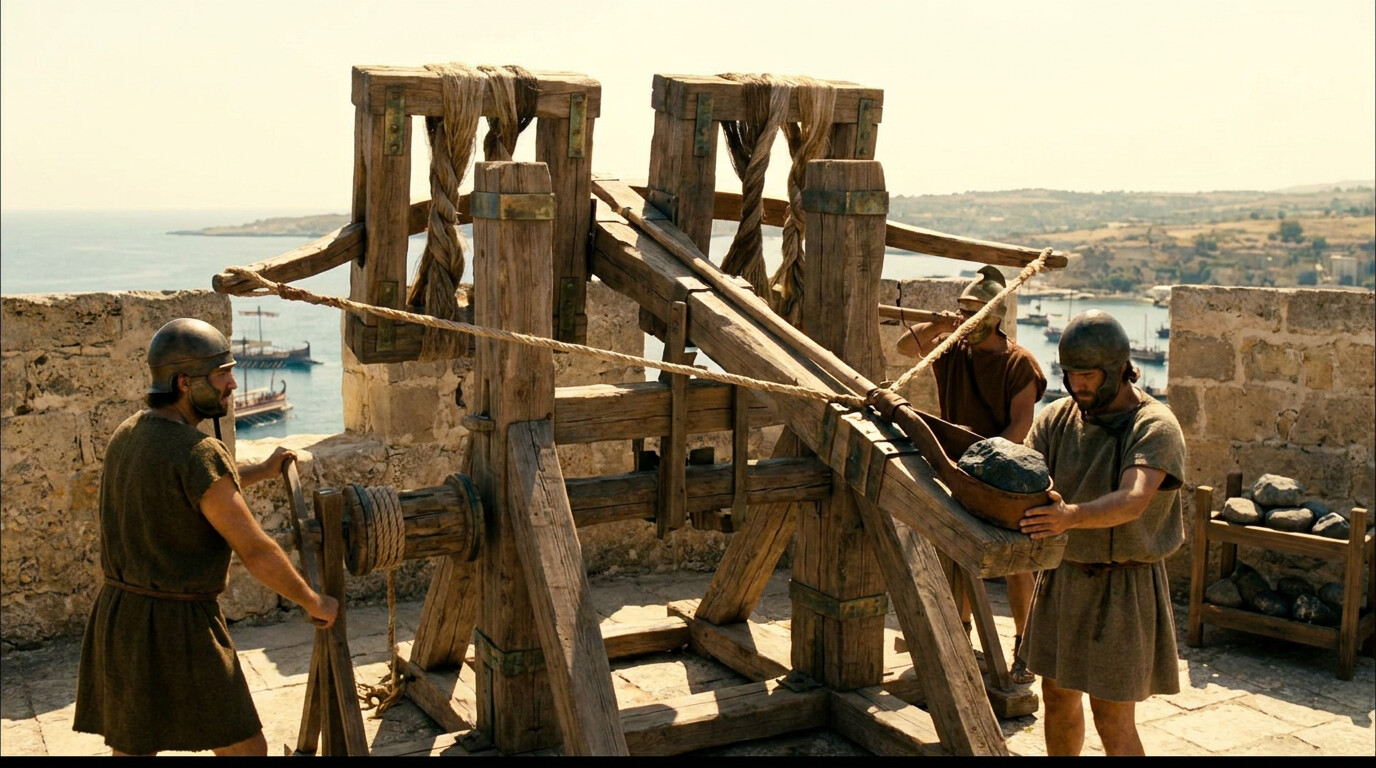
The catapult technology available to Archimedes was well-developed by the third century BC. Torsion artillery—engines powered by twisted skeins of sinew, hair, or fiber—had been refined by Macedonian and Greek engineers over the preceding century and a half. Philip II of Macedon and Alexander the Great had both used sophisticated siege artillery; the workshops of Syracuse itself had a tradition of military engineering going back to the wars against Carthage in the fifth and fourth centuries. The engines Archimedes deployed were not novel in type. What was reportedly novel—and here Plutarch is the primary witness, writing roughly three centuries after the fact—was their calibration, coordination, and the degree of personal involvement Archimedes brought to their design and positioning. Earlier sources such as Polybius attribute the defensive machines to the city's defenses more broadly; it is Plutarch who most explicitly places Archimedes at the center of their conception and direction. The distinction matters, and readers should weigh it accordingly.
The stone-throwing catapults—lithoboloi—were large torsion engines capable of hurling stones of varying weights over considerable distances. Ancient technical manuals, including Heron of Alexandria's Belopoeica and Vitruvius's De Architectura, describe the proportional design principles for Greek and Roman torsion artillery, and surviving archaeological evidence from sites including Rhodian arsenals confirms that these engines were manufactured to precise specifications. The mechanism was a twisted skein of animal sinew or hair under extreme tension; releasing one arm drove the throwing arm forward with enormous force. Range, trajectory, and projectile weight could be adjusted by varying the tension and arm configuration. Ancient technical manuals suggest large engines could throw stones of twenty to one hundred kilograms over distances that might reach three hundred meters or more under favorable conditions—though the exact specifications of the machines at Syracuse are not recorded, and applying those figures directly to Archimedes' engines requires caution. The physical impact of heavy stone projectiles against wooden hulls was significant: a direct hit on a trireme or quinquereme could kill crew members, disable oar benches, or breach planking.
But stone-throwers, however effective, were not what broke the Roman assault. What shattered Marcellus's attack in the harbor—and what made the Siege of Syracuse famous in antiquity—were the cranes.
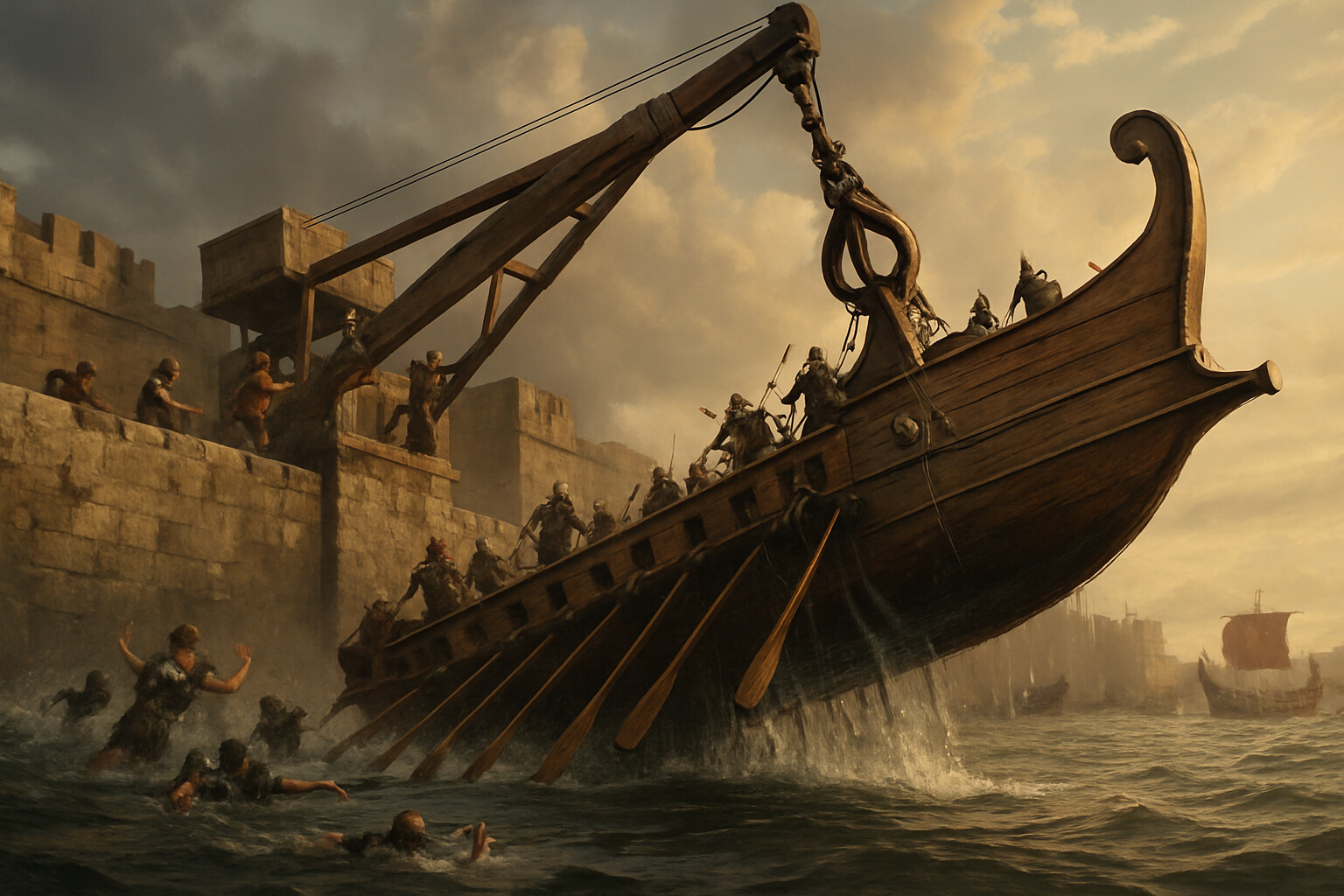
Archimedes, according to both Plutarch and Livy, designed and deployed large crane-like devices positioned on the city walls and towers overlooking the harbor approaches. The devices are described differently across sources, but the consistent account is this: these machines could extend an arm over the water, drop a heavy grappling hook or claw onto the prow of an approaching ship, and hoist the ship's bow into the air before releasing it—causing the vessel to pitch violently, capsize, or drive into the harbor bottom. Some accounts describe ships being shaken until soldiers fell into the sea. Polybius, generally the most reliable ancient source for military and technical details, supports the basic account of these crane weapons. Modern historians of ancient technology have largely concluded that the fundamental mechanism described—a large counterweight or winch-driven crane mounted to extend over the harbor—is consistent with what would have been mechanically achievable with the materials and techniques available in third-century BC Syracuse. The physics of tipping rather than lifting a vessel fully reduce the force required substantially below the ship's total displacement; ancient engineering scholarship has found no insuperable objection to the mechanism as described.
The tactical effect described in the sources is vivid and, if given reasonable weight, decisive. Plutarch records that Roman soldiers, already under stone and bolt fire, would see a large iron claw emerge over the wall, descend on a ship, grip it, and haul the bow upward. The effect on oarsmen and soldiers confined in an enclosed harbor under fire from multiple directions can be inferred from what followed: Marcellus eventually abandoned daylight close assaults on the harbor and attempted a night attack, reasoning that darkness would deny the defenders their aim. According to Plutarch, this also failed. Archimedes had reportedly prepared for approaches at multiple angles and distances.
The burning mirrors—the claim that Archimedes used large polished bronze mirrors to focus sunlight onto Roman ships and set them ablaze—are a different matter entirely. This account does not appear in Polybius or Livy, the earliest and most reliable sources. The earliest surviving references are in Lucian of Samosata, writing in the second century AD, and more fully in the Byzantine historian John Tzetzes in the twelfth century AD—roughly thirteen hundred years after the siege. The absence of the burning mirrors from Polybius and Livy is significant; both historians are detailed enough about other Archimedean devices that omitting something as dramatic as ship-burning mirrors requires explanation if the event occurred. Modern experimental tests, including a widely publicized 1973 effort by Greek engineer Ioannis Sakkas using volunteers holding polished bronze mirrors, and a 2005 MIT student project that achieved ignition of a stationary wooden target under controlled conditions, have produced mixed results. The MIT experiment demonstrated that ignition is not physically impossible; it did not confirm that the method was employed at Syracuse. Historians of ancient technology treat the burning mirrors as a later tradition that cannot be verified against the primary record. This account follows that judgment: the burning mirrors are noted as part of the Archimedes tradition, clearly distinguished from what the earliest sources actually report.
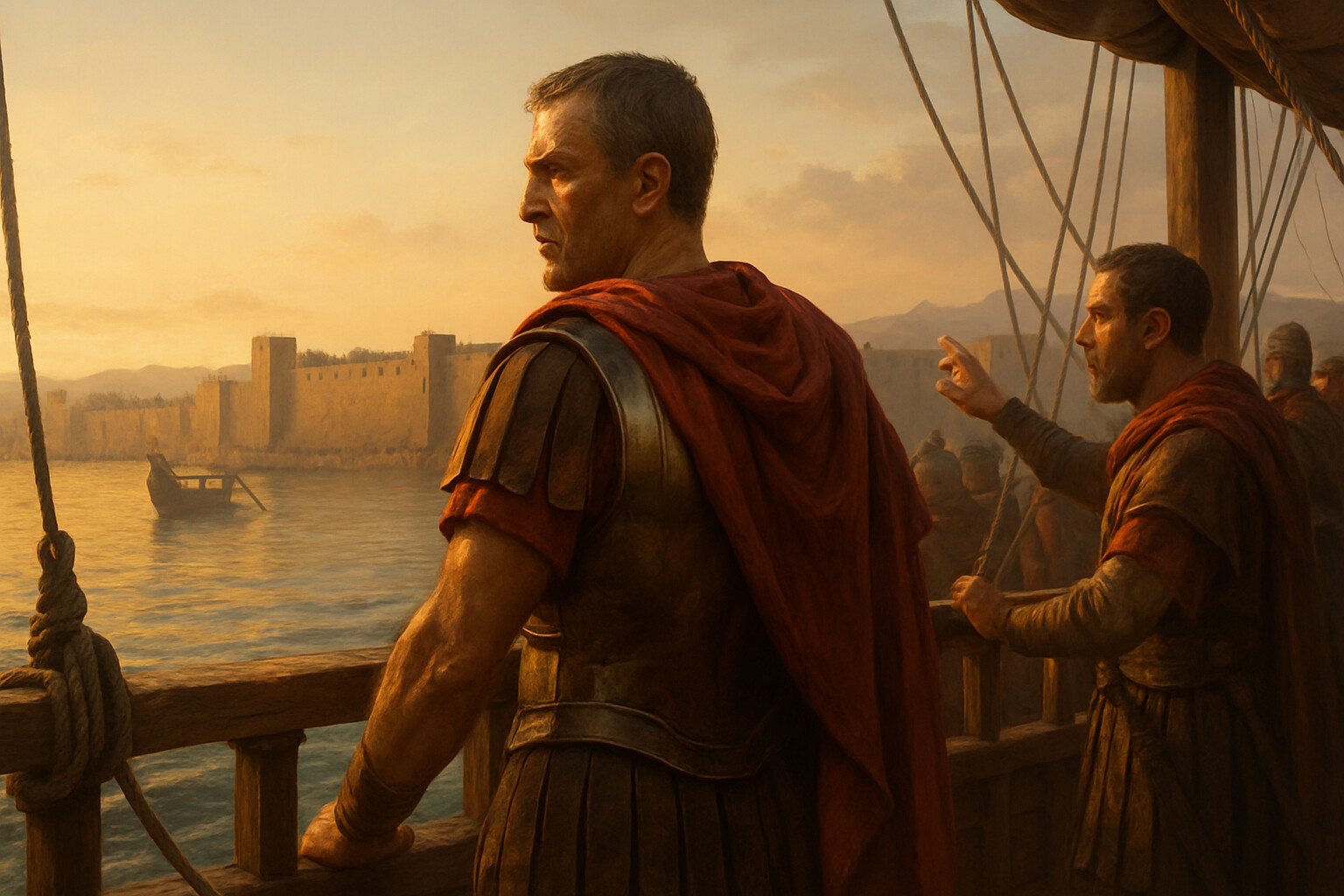
What is not in dispute—across Polybius, Livy, and Plutarch—is that the Roman assault failed repeatedly, that the failure was attributed to Archimedes' devices, and that the siege settled into a prolonged blockade rather than the rapid reduction Marcellus had intended. Plutarch attributes to Marcellus a remark to his staff comparing the situation to fighting a geometer whose machines were driving the sea itself back. Plutarch's phrasing is a paraphrase rather than a verbatim quotation, and the sentiment may have been sharpened in the retelling; it is included here as reported speech, not direct quotation.
The siege ground on through 213 and into 212 BC. Marcellus was an experienced commander and he did not abandon the effort. He blockaded the harbor, cutting the flow of Carthaginian supplies to the city, and maintained the land investment. The Carthaginian general Himilco landed a relieving army on Sicily and attempted to coordinate operations with the Syracusan garrison; a Carthaginian fleet under Bomilcar also made attempts to break the naval blockade. These efforts complicated the Roman position without resolving it. Plague—described by both Livy and Plutarch as devastating—struck both the Syracusan defenders and the Carthaginian relief forces during the summer of 212 BC. Himilco's army was effectively destroyed by disease. Bomilcar's fleet withdrew. The fate of Himilco himself after this disaster is given variously in ancient sources and cannot be confirmed from surviving primary accounts.
Inside Syracuse, the prolonged siege was generating fractures. The city was not uniform in its commitment to the Carthaginian alliance. Factions favoring accommodation with Rome existed alongside mercenary troops whose loyalty was transactional. In 212 BC, Marcellus obtained intelligence that a section of the Epipolae wall—the elevated western quarter of the city—was lightly guarded during a festival period when the garrison's attention was directed elsewhere. Livy's account indicates the Syracusans were celebrating the festival of Artemis and that wine consumption had been significant. Marcellus moved a small force to a gate at the Hexapylon and entered the Epipolae district without resistance. The high ground secured, the outer defenses had been effectively turned.
The fall of Syracuse was not instantaneous. After the breach at Epipolae, fighting and negotiation continued within different districts of the city. Ortygia, the old island center, held out longer. A Syracusan officer named Moeriscus eventually negotiated its surrender to Marcellus. The Romans had been patient—unusually so by the standards of ancient siege warfare—and Marcellus had maintained enough discipline over his troops to prevent immediate total destruction. Plutarch reports that he wept when he saw the city below him from the heights of Epipolae, contemplating what Rome was about to do to one of the most beautiful cities in the Greek world. The detail is preserved across multiple sources; the emotional interpretation is Plutarch's.
The sack, when it came, was extensive. Roman soldiers looted the city's artwork, temples, and private wealth. Marcellus brought a significant quantity of Syracusan art and treasure back to Rome—a transfer that ancient writers including Polybius and Livy note was controversial among Romans of the older tradition, who regarded the import of Greek luxury as corrosive to Roman virtue. Later writers traced significant cultural consequences to that transfer, seeing in it the beginning of Rome's sustained engagement with Greek artistic culture.
Among the dead was Archimedes.
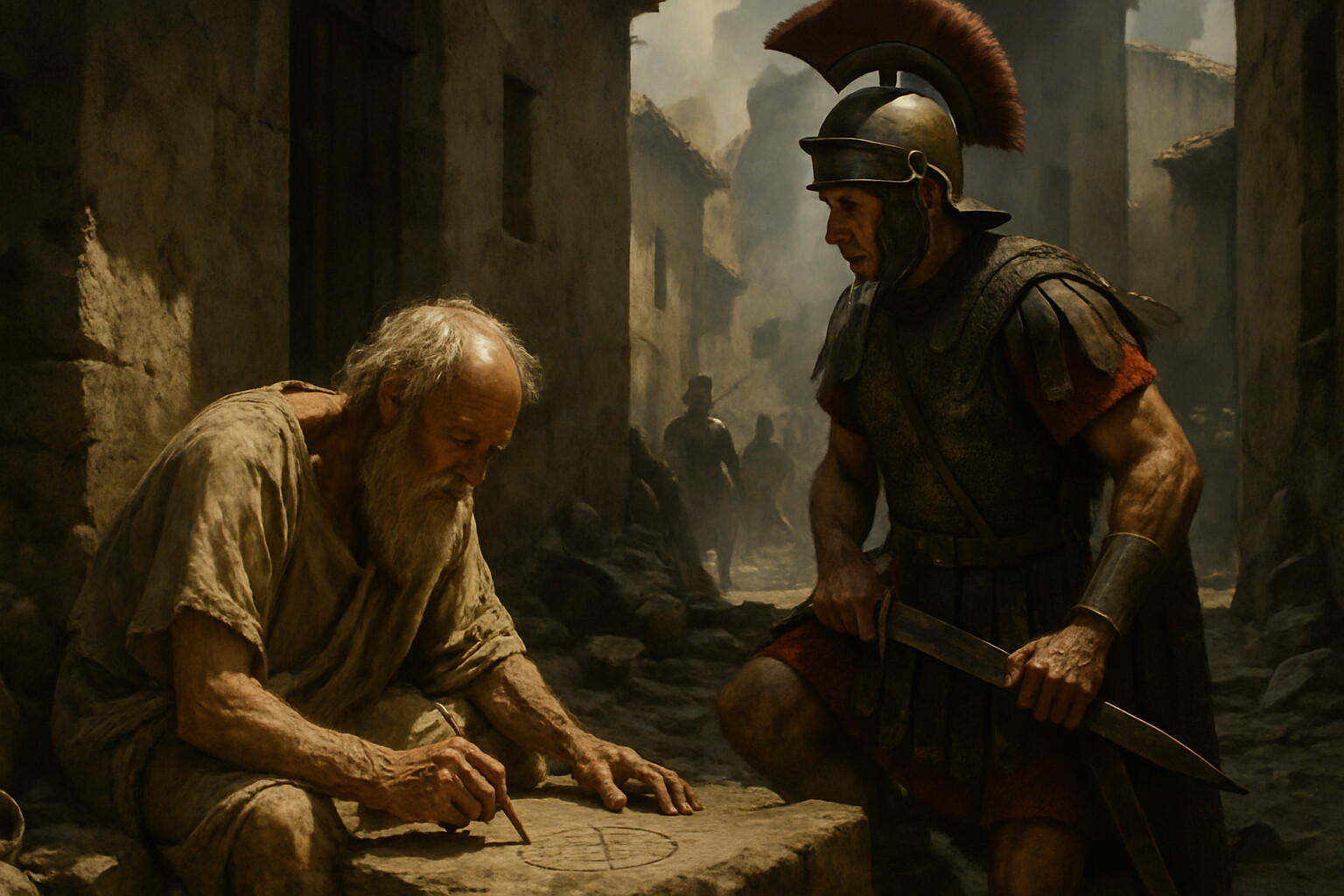
His death is reported across multiple ancient sources with broad consistency but significant variation in detail. The agreed facts: he was killed by a Roman soldier during or immediately after the fall of the city, and Marcellus had given explicit orders that he was not to be harmed. The circumstances are where the accounts diverge. Plutarch preserves several versions—in one, a soldier killed him because he refused to abandon a mathematical diagram long enough to comply with orders; in another, a soldier killed him while he carried mathematical instruments, not recognizing who he was. Livy says a soldier killed him while he was working, without knowing his identity. The image of Archimedes dying absorbed in his diagrams is one of the most persistent in ancient intellectual biography. It cannot be verified, and the story may have been shaped in retelling to emphasize the contrast between the man of pure thought and the violence surrounding him. What is not in dispute is the outcome.
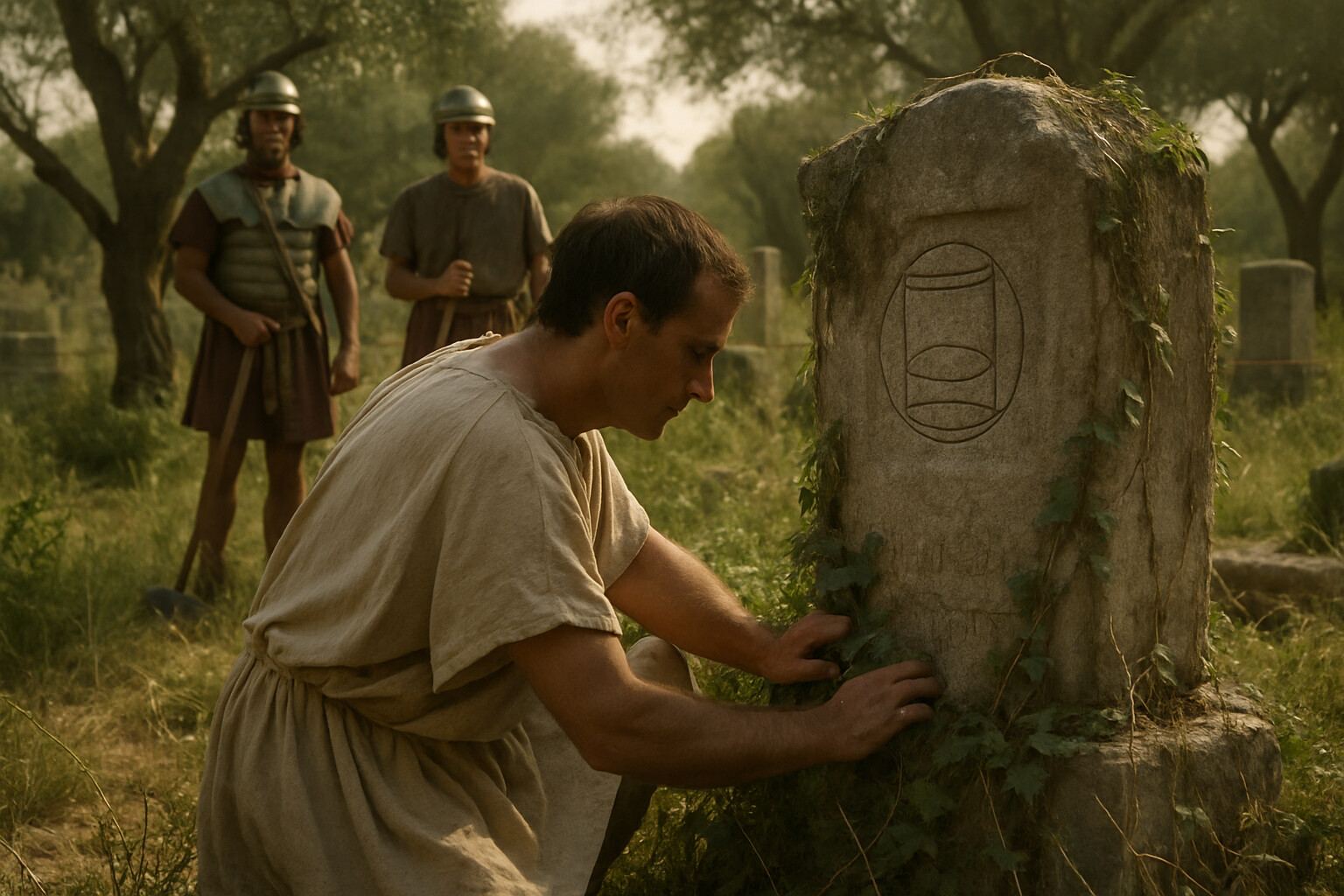
Marcellus, according to Plutarch, was genuinely distressed by the death and condemned the killer. He sought out Archimedes' relatives and treated them well. The tomb of Archimedes was reportedly marked with a sphere inscribed in a cylinder—a reference to one of his most famous mathematical proofs, establishing the volume relationship between a sphere and its enclosing cylinder. The Roman orator and politician Cicero wrote in the first century BC that he had personally found and restored the neglected tomb when serving as a Roman official in Sicily, describing the overgrown monument and its inscription. Cicero's account in the Tusculan Disputations is the last contemporaneous literary reference to the physical tomb. Its current location is unknown; no modern archaeological identification has been made.
The legacy of the Siege of Syracuse sits at an unusual intersection of military history, history of science, and cultural history. From the military perspective, the siege demonstrated something that would be demonstrated repeatedly in subsequent centuries: that fortification and prepared artillery defense, when intelligently organized, could neutralize a significant advantage in manpower and offensive capability. Marcellus had overwhelming force on paper. What the defenders had done—and what sources make clear Archimedes directed, to whatever degree his precise role can be established—was optimize Syracuse's physical defenses so that Roman numerical and tactical advantages could not be brought to bear effectively. The siege lasted somewhere between eighteen months and two years. It fell not to Roman assault but to internal betrayal, disease, and a careful exploitation of a moment of inattention.
From the perspective of the history of technology, the Siege of Syracuse represents the most extensively documented deployment of systematically designed defensive machinery in ancient history. The accounts in Polybius, Livy, and Plutarch—considered against what is known from ancient technical manuals about catapult and crane design—provide a picture of an engineering mind operating in direct contact with the physical and military realities of siege defense. Whether every detail in every source is accurate, the broad picture is consistent: the organized application of mechanical principles, developed over a lifetime of theoretical and practical work, extended a city's resistance against a major military power by a period measured in years rather than days.
Modern assessments of Archimedes as a military figure have been careful to distinguish between the mathematician-philosopher visible in his surviving works—On the Sphere and Cylinder, On Conoids and Spheroids, The Sand-Reckoner, The Method, and others—and the siege engineer described by the historians. His extant writings make no reference to his military work; they are works of pure mathematics and physics, addressed to colleagues, concerned with problems remote from weapons design. Later biographical tradition, including accounts preserved by Diodorus Siculus and others, suggests that Archimedes regarded his mechanical work as secondary to his theoretical work—a view consistent with the intellectual priorities of Greek philosophy in his period. These accounts cannot be independently verified and should be read as tradition rather than documented biography. What is not in doubt is that he was capable of both, and that he deployed his mechanical capabilities fully in the defense of his city.
Syracuse recovered in time under Roman rule. It remained an important city in Roman Sicily, and traces of the fortifications Archimedes defended still exist in the archaeological record—sections of the Epipolae walls survive, and the harbor geography of Ortygia remains recognizable. The Great Harbor that Marcellus's fleet attempted to force in 213 BC is still the harbor of the modern city of Siracusa. The ancient walls are largely gone or buried. But the shape of the place is the same.
For eighteen months or more, the most powerful military machine in the western Mediterranean could not take a single city because one elderly mathematician had applied himself to the problem. Rome eventually prevailed, as it usually did—through patience, blockade, plague, and the political fractures that prolonged sieges always produce. But the cost in time, reputation, and strategic momentum was real. Other communities watching Rome's difficulties before Syracuse drew their own conclusions about the value of prepared defenses and the outer limits of Roman invincibility. In that narrow sense, the cranes and catapults of Archimedes were not merely weapons. They were, for the duration of their operation, a demonstration of what organized knowledge could accomplish against organized force.