The rain came before the Romans fully understood where they were.
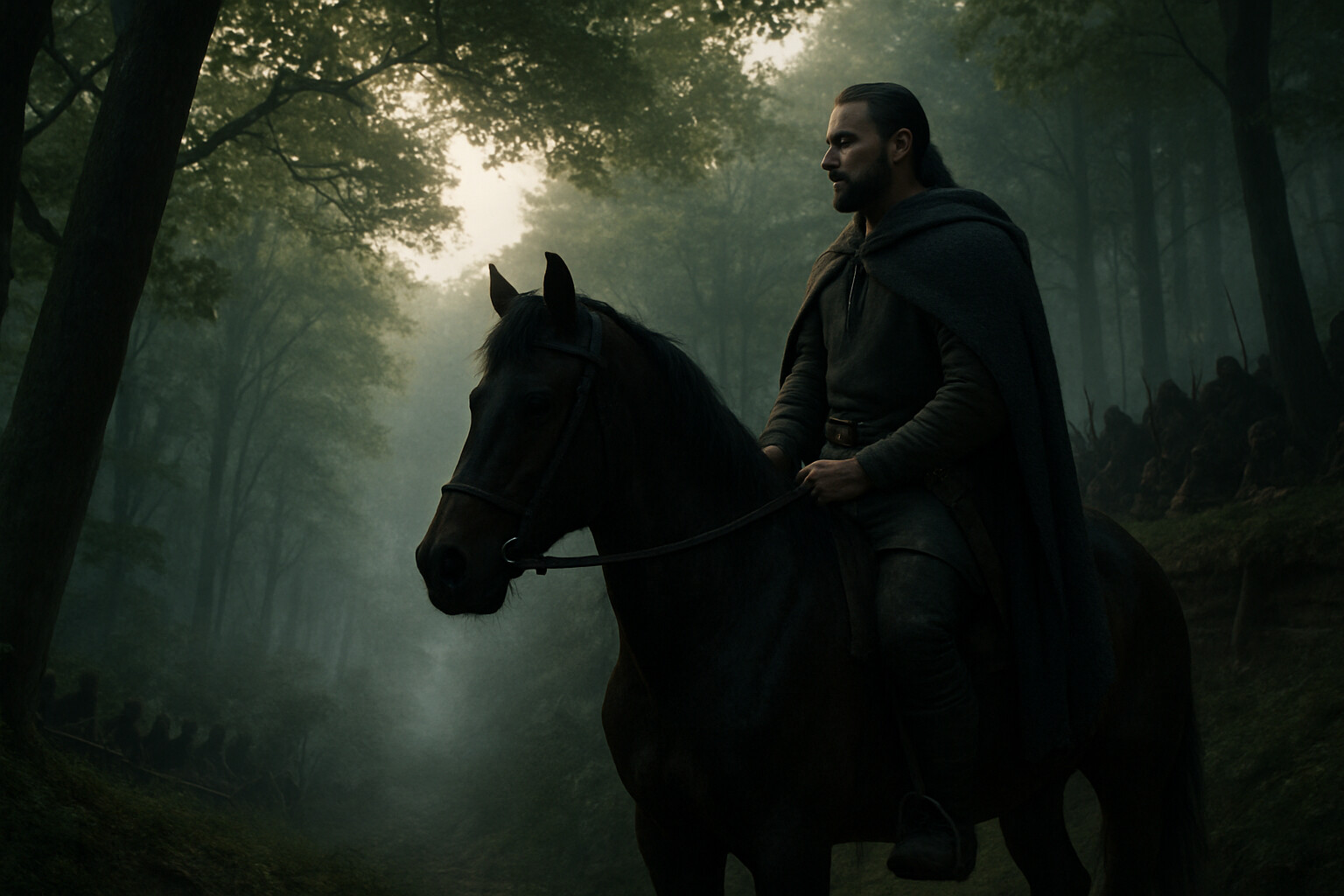
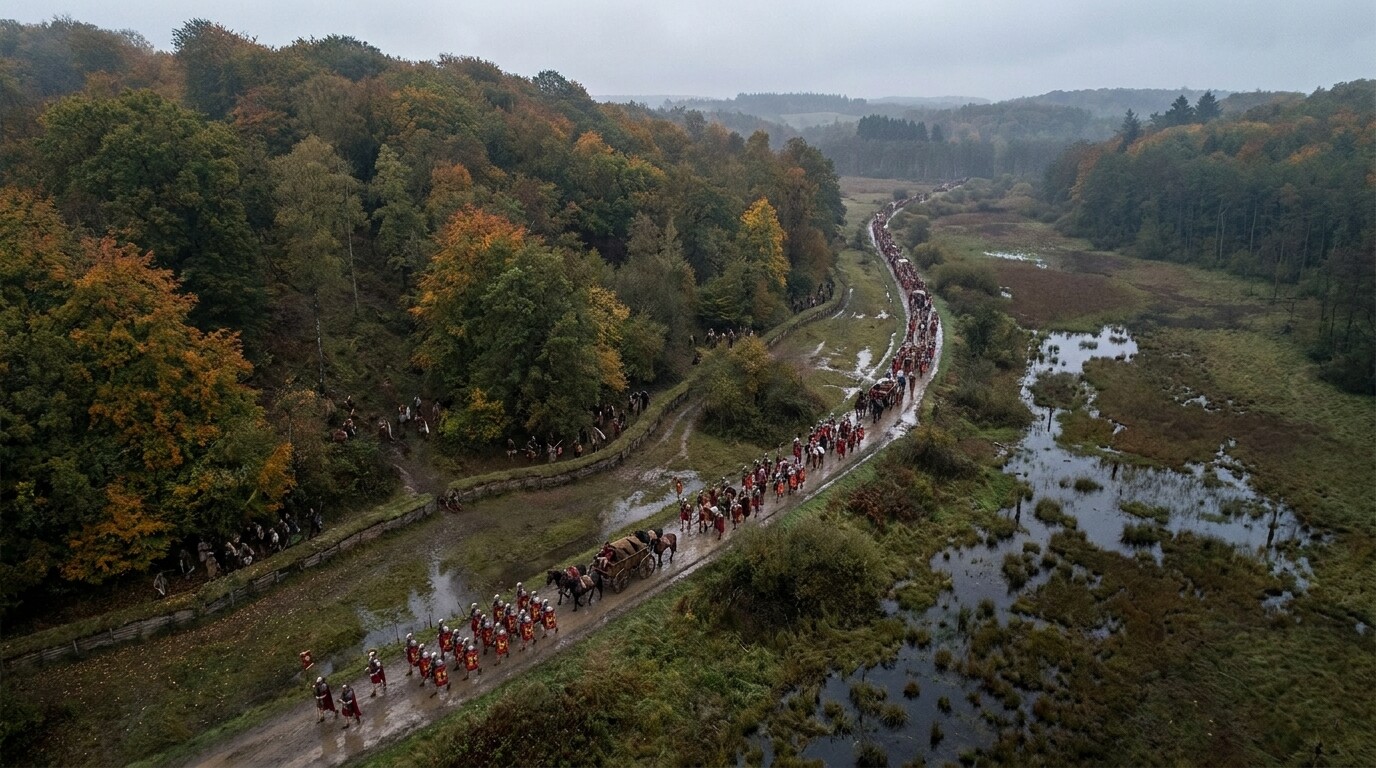
It had been building for hours — the low, iron-colored sky pressing down through the canopy of oak and beech, the ground beneath the marching column softening from packed earth to something that sucked at sandals and slowed the wagons to a crawl. The column stretched for miles through a corridor of trees and ridge that narrowed like the neck of an amphora. On either side, the forest rose into dense shadow. There were no open flanks. There was no room to form a battle line.
Publius Quinctilius Varus, governor of the Roman province of Germania and commander of three legions, did not see the ambush coming. He had been given no reason to suspect one. His guide, riding close to his staff, was Arminius — a chieftain of the Cherusci, a Roman citizen, a former auxiliary officer who had served with distinction in the Pannonian campaigns, a man Rome had honored with the rank of equestrian. Arminius knew Roman formations, Roman march discipline, Roman command rhythms. He had spent years inside the system he was now preparing to destroy.
When the attack came — from the ridge above, from the tree line on both flanks, from men who had moved into position through the night while Arminius kept Varus calm — the Roman column had no good options left. It was already inside the trap.
---
To understand how the trap was built, you have to understand what Rome thought it had already won.
By the year 9 AD, Rome had been pushing east of the Rhine for roughly two decades. Julius Caesar had reached the river and declared it the edge of the civilized world, but Augustus had different ambitions. Under his direction, Roman commanders — including his stepsons Drusus and Tiberius — had mounted deep campaigns into Germania, crossing the Weser River, forcing tribal submissions, building winter camps as far east as the Elbe. Roman administrators followed the soldiers. Taxes were imposed. Courts were established. Roman roads were planned or begun.
Varus was part of this administrative project. He was not primarily a field general — he was a governor, a legal administrator, experienced in the eastern provinces where Roman rule was already entrenched. He had governed Syria successfully. Augustus trusted him with the task of formalizing Roman control over Germania — turning a military occupation into a functioning province. Varus arrived with that institutional mandate, and he appears to have approached the task the way Roman administrators typically did: by demanding taxes, settling legal disputes on Roman terms, and expecting compliance from the local population.
The Germanic tribes had different expectations.
The Germanic peoples east of the Rhine in the early first century AD were not a unified nation. They were a patchwork of tribes — Cherusci, Bructeri, Marsi, Chatti, Sicambri, and others — with their own internal politics, rivalries, and shifting alliances. They fought among themselves. Some had cooperated with Rome for pragmatic reasons. But Roman taxation and Roman legal jurisdiction — specifically the imposition of Roman courts over Germanic disputes, which had always been handled by tribal custom and chieftain authority — generated friction that Varus appears to have underestimated.
Arminius read that friction. And he used it.
Arminius was born around 18 or 17 BC — the date is inferred from his recorded career stages, not stated directly in any surviving ancient source — as the son of Segimer, a chieftain of the Cherusci tribe in what is today northwestern Germany. As a young man he was sent to Rome as a hostage, a common Roman practice for securing the loyalty of client tribes on the frontier. The hostage arrangement was both a guarantee and an education. Arminius grew up in Rome or its military orbit. He learned Latin. He served in the Roman auxiliary forces, almost certainly in the Pannonian campaigns of 6–9 AD where Rome was suppressing a major revolt in the Balkans. He performed well enough to earn Roman citizenship and the rank of equestrian — the second social class in Rome. He was, by Roman administrative standards, a success story of integration.
He returned to Germania as a Roman officer and tribal chieftain simultaneously. He held both identities at once, and the ancient sources — primarily Tacitus, writing more than a century after the events — suggest he had been building the coalition that would destroy Varus for some period before the battle. Whether the plan developed over years or was assembled in the months before September 9 AD is not clear from the surviving record. What is established is that he kept it hidden from the Romans, maintained their confidence, and appears to have actively discouraged Roman concern about the tribal situation in the region.
His father-in-law Segestes warned Varus directly, according to Tacitus. Segestes told Varus that Arminius was planning a revolt and asked that Arminius be detained. Varus dismissed the warning, apparently viewing Segestes as motivated by personal rivalry rather than genuine intelligence. Whether Segestes acted out of loyalty to Rome, personal enmity, or a calculated hedge against outcomes is a matter the record does not resolve. What is established is that the warning was given and ignored.
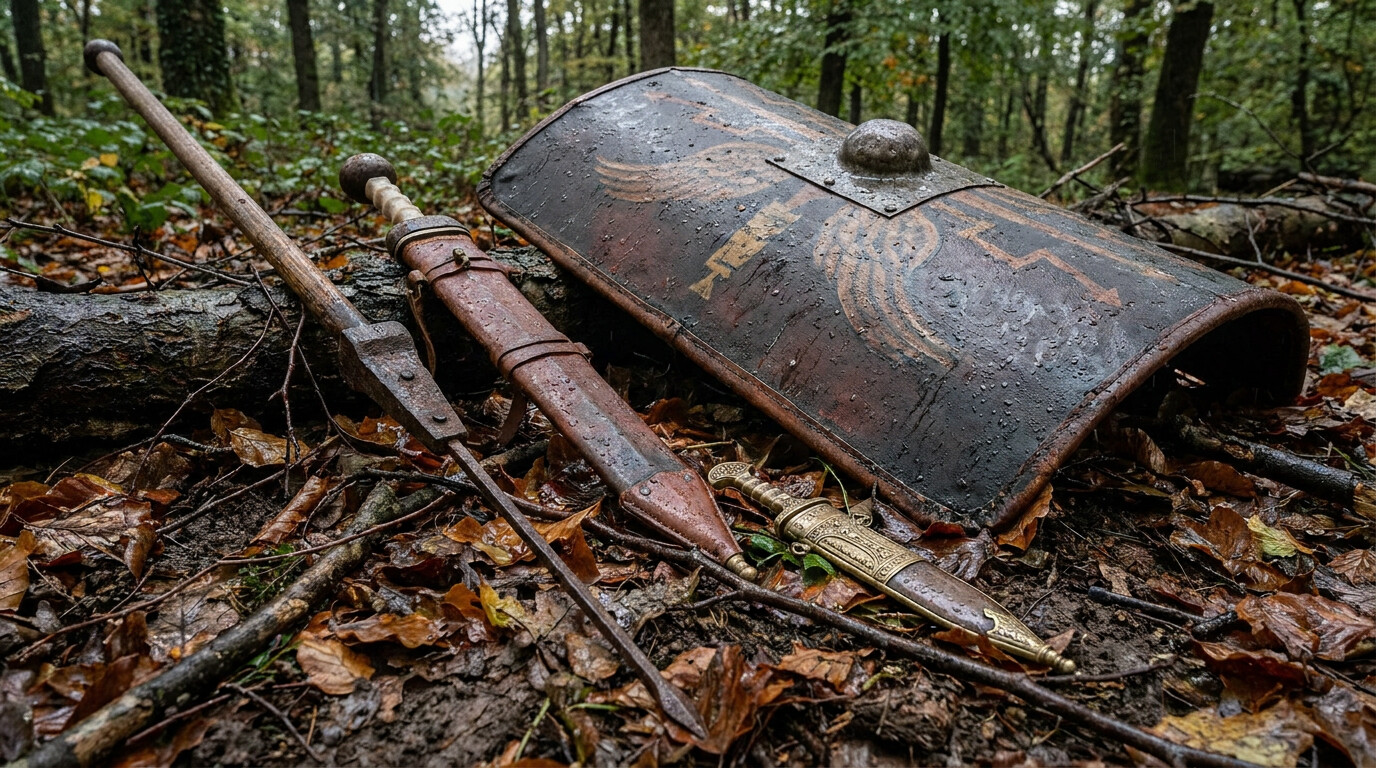
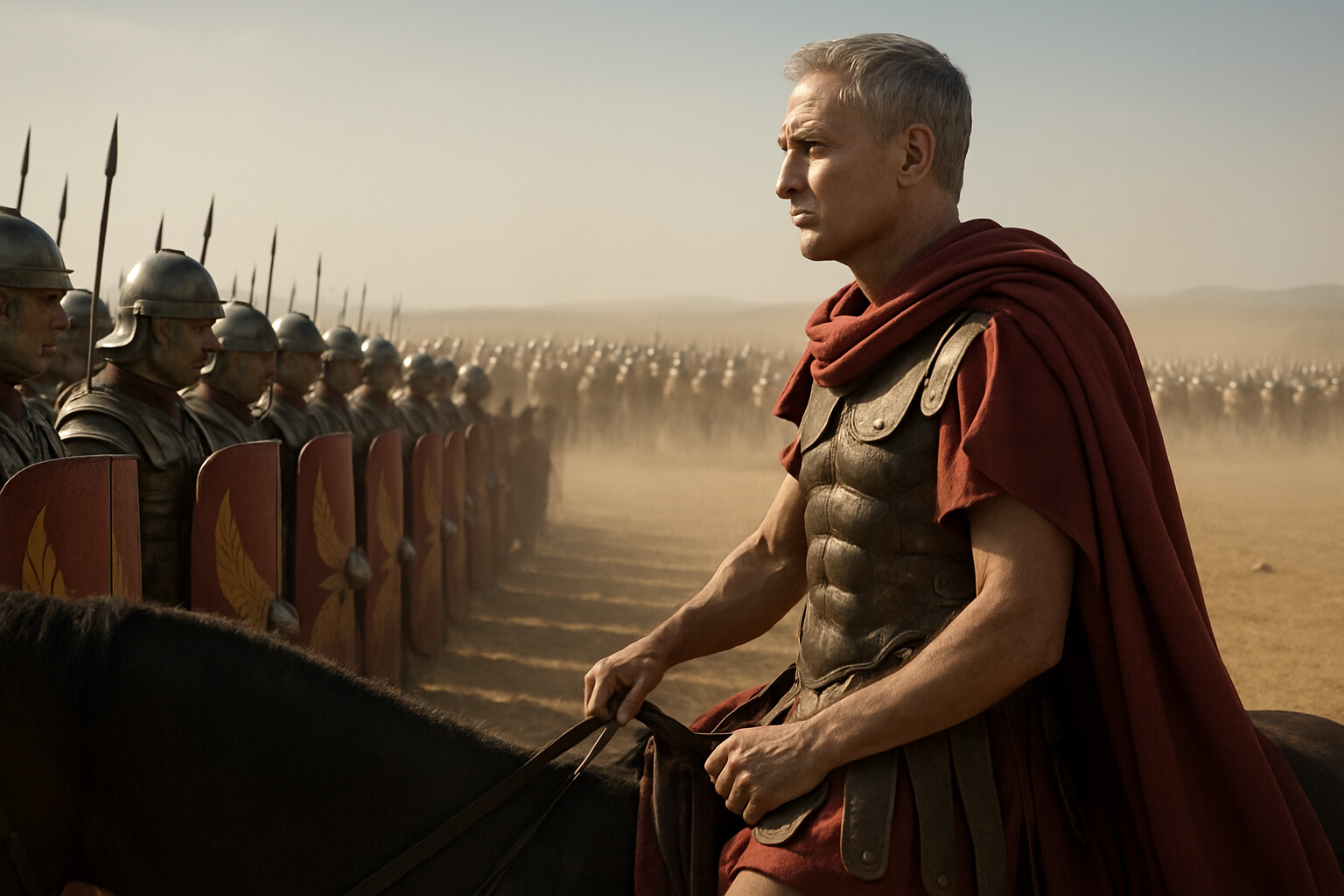
The Roman force Varus commanded in September of 9 AD was substantial. Three full legions — Legio XVII, Legio XVIII, and Legio XIX — marched under his command, along with three cavalry alae, six auxiliary cohorts, and an enormous baggage train of non-combatants: servants, merchants, camp followers, the families of soldiers serving in the auxiliary units. Ancient estimates of the total number in the column range from fifteen to twenty thousand military personnel, with thousands more non-combatants. The column was not organized for a contested march through difficult terrain. It was organized for the road.
There was no road through the Teutoburg passage.
---
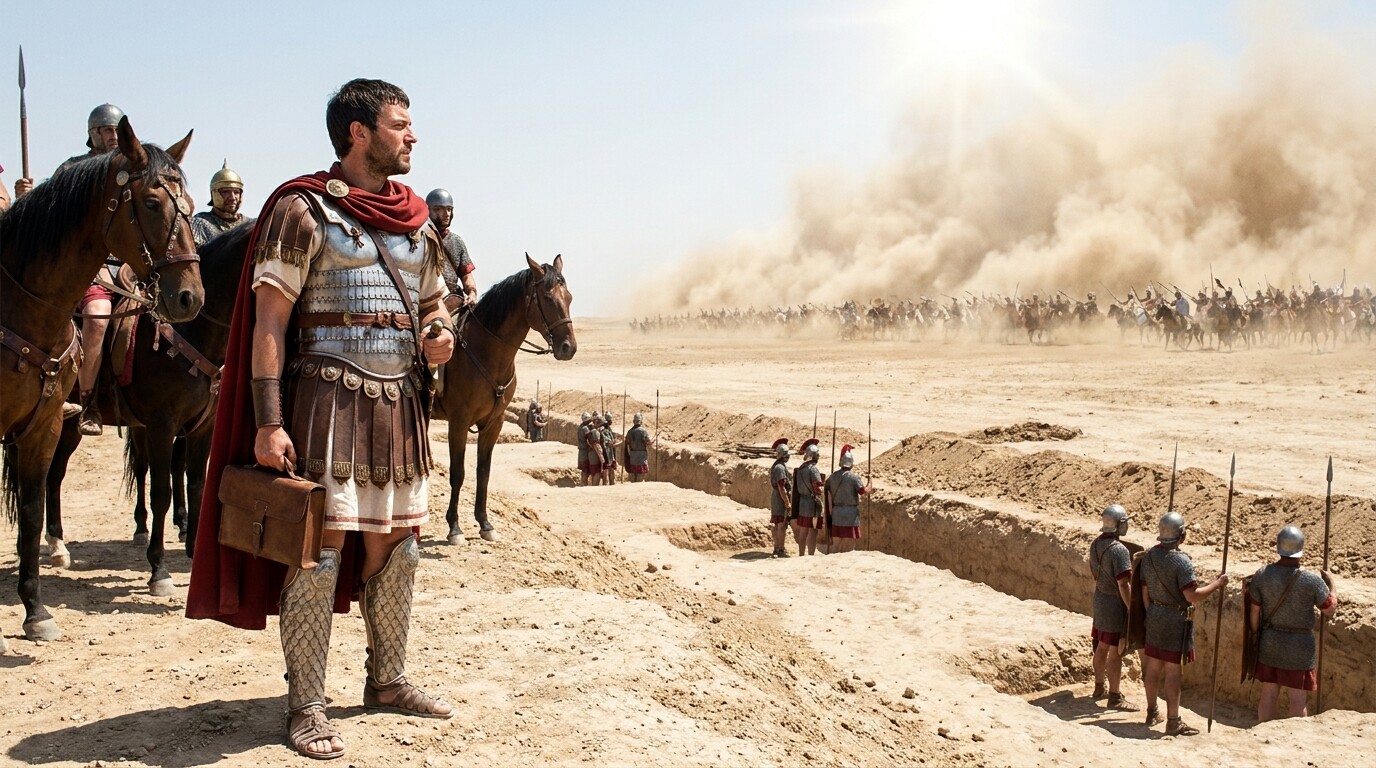
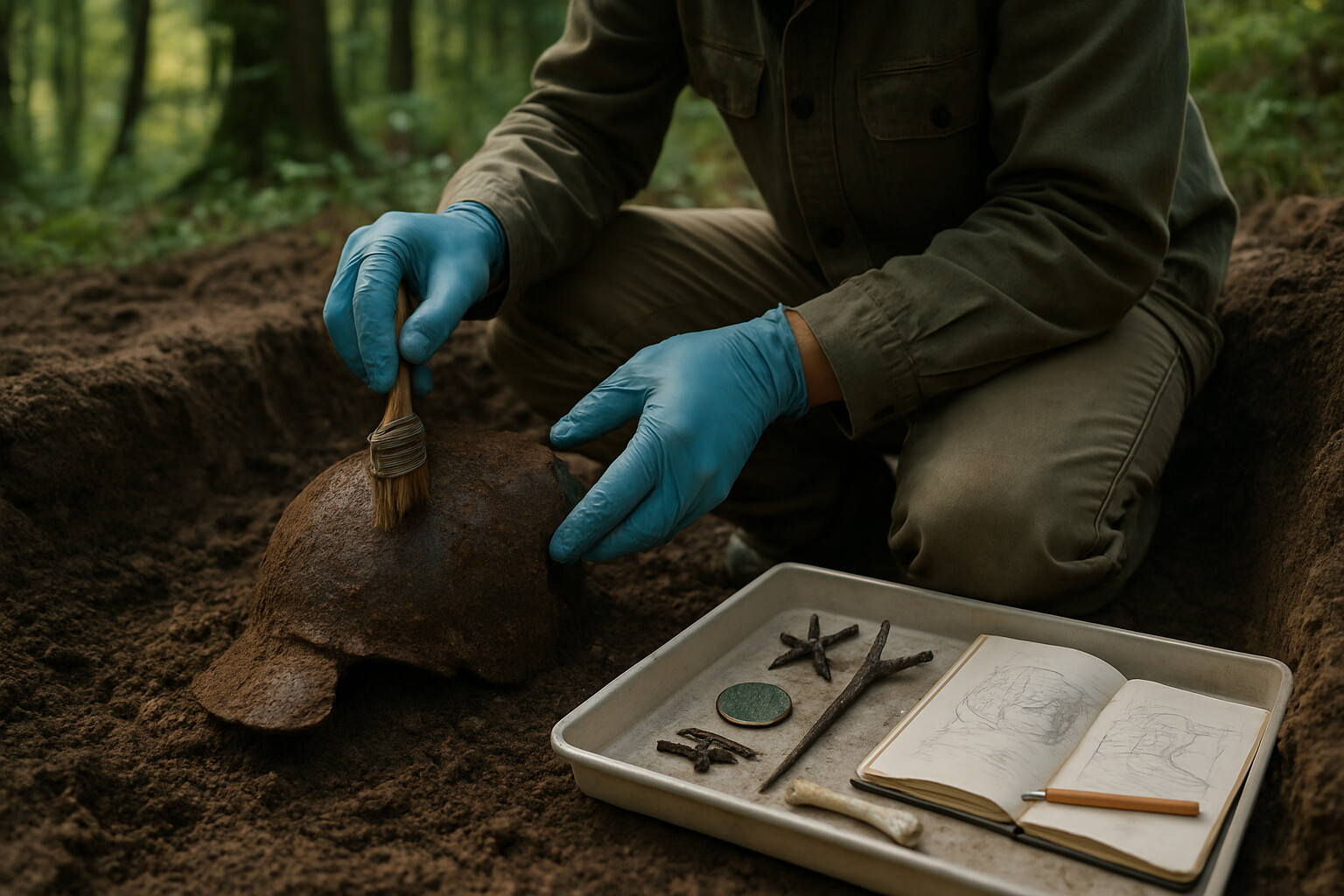
The exact location of the battle was unknown for nearly two thousand years. Ancient sources described the terrain in general terms — a dense forest, a narrow defile between a long ridge and swampy low ground, terrain unsuitable for Roman formations. The specific geography was lost until 1987, when a British amateur archaeologist named Tony Clunn, then serving with the British Army in Germany, began finding Roman coins near the town of Kalkriese, about fifteen kilometers north of modern Osnabrück in Lower Saxony. Systematic excavation at the Kalkriese site has since recovered an extraordinary volume of Roman military material: coins, weapons, armor fragments, human and animal bones, lead sling bullets, iron caltrops, and the remains of a Germanic turf wall built along the southern face of Kalkriese Hill.
The Kalkriese evidence has been accepted by most scholars as the site of at least a major portion of the battle, though debate continues about whether all three days of fighting occurred there or whether the engagement was more dispersed across the region. The physical evidence — particularly the constructed Germanic earthwork running along the hillside parallel to the narrow corridor between the hill and the Grosses Moor marshland — is consistent with the ancient descriptions of a prepared ambush. This was not a spontaneous attack. The earthwork was built in advance. The killing ground was chosen.
The Germanic coalition Arminius assembled included warriors from several tribes, though the precise composition is not fully established in the record. The Cherusci formed the core of his force, but the Bructeri and the Marsi are mentioned in association with the battle in ancient sources. Estimates of the Germanic force vary widely in ancient and modern accounts. They almost certainly outnumbered the Roman force in the initial phases of the ambush, and they held the critical advantages of chosen ground, chosen timing, and chosen conditions.
The Germanic warrior of this period fought very differently from a Roman legionary. He was lightly armored — most Germanic warriors in this era wore little to no metal armor, relying on a wooden or hide shield — and fought in a loose, aggressive style suited to broken terrain and rapid movement. His primary offensive weapon was the framea, a spear with a short iron head, an economical but effective weapon for close quarters in dense forest where the long pilum of the legionary was difficult to throw and even more difficult to use in tight formation. Germanic warriors also used short swords, axes, and in some cases bows. Tacitus, in his ethnographic work Germania written decades after the battle, noted that the Germanic peoples preferred the framea above all other weapons and used it for both throwing and thrusting.
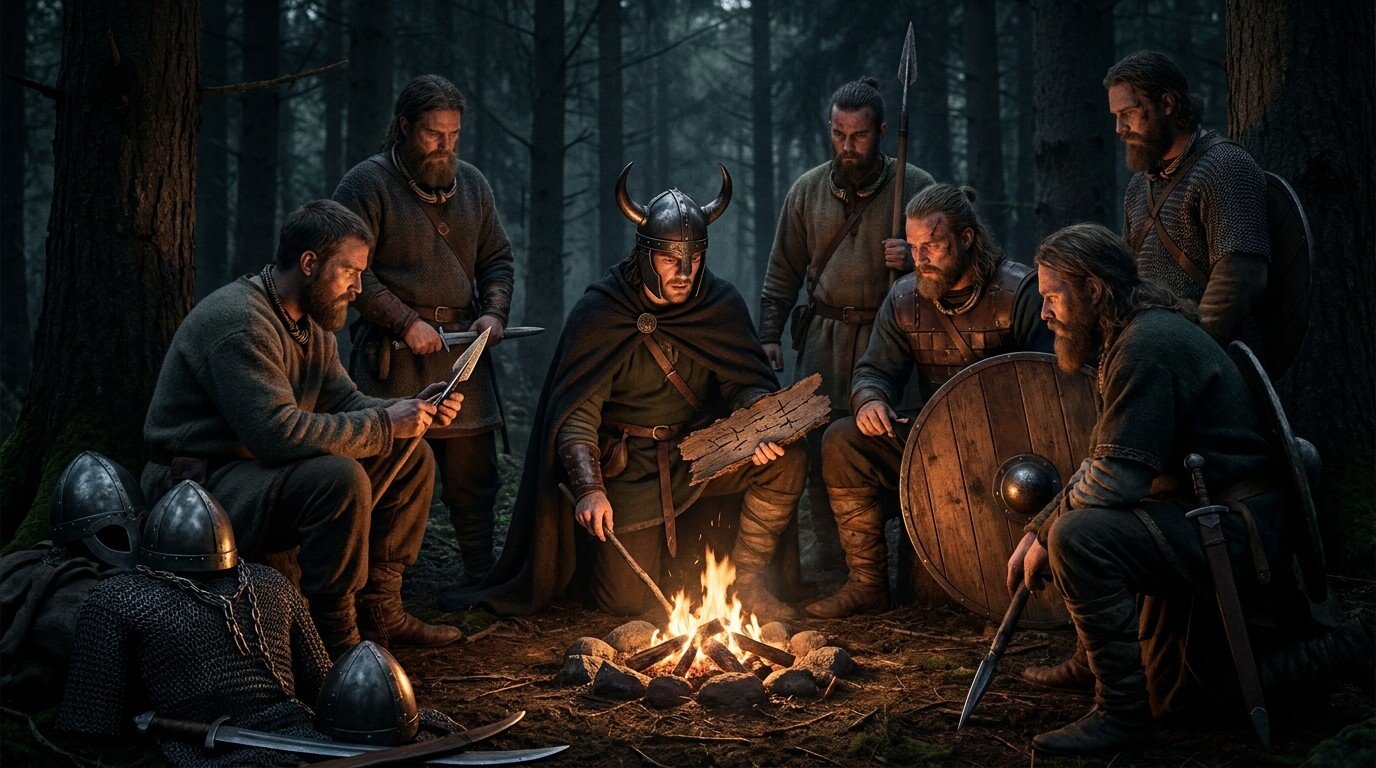
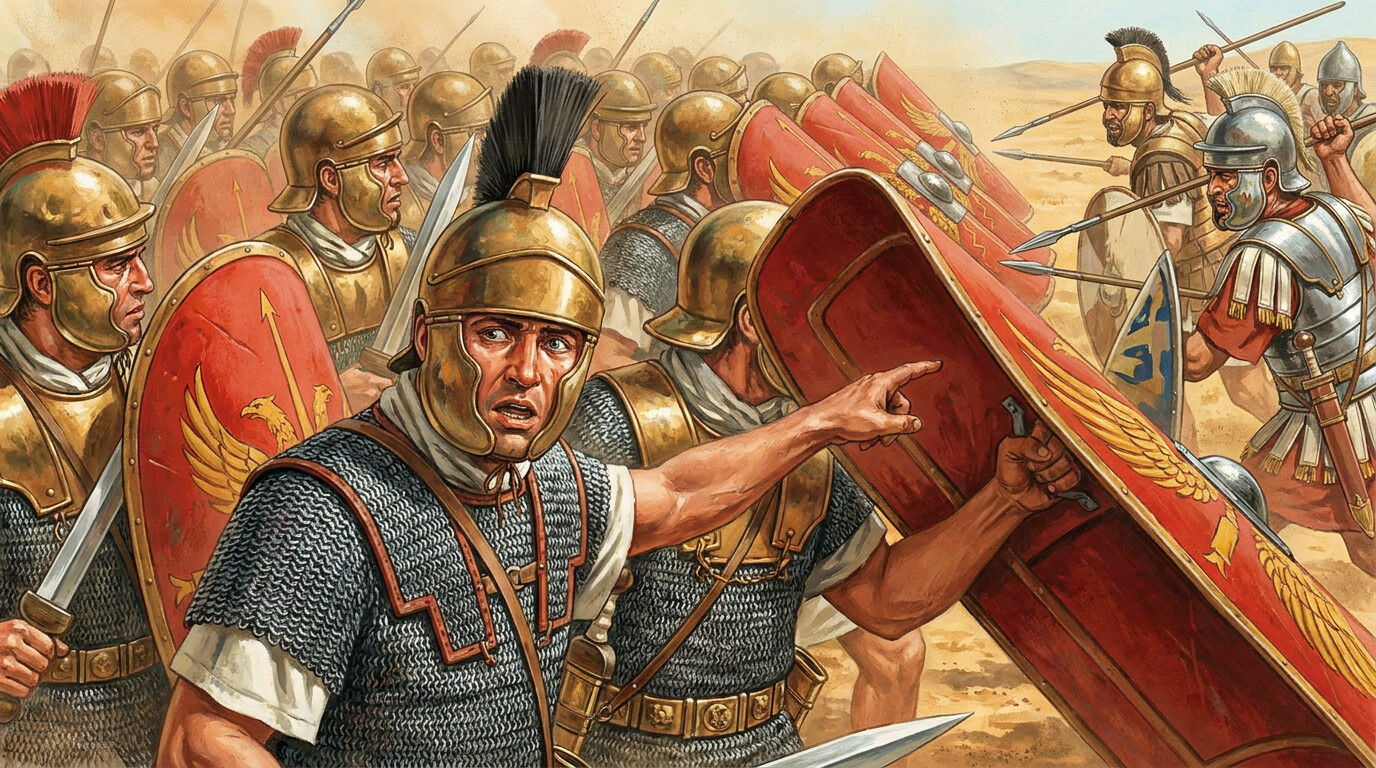
The Roman legionary carried a fundamentally different kit designed for a fundamentally different kind of war. The pilum — the Roman heavy javelin — was an engineering achievement of offensive infantry warfare. A legionary typically carried two: one lighter, one heavier. The pilum had a long iron shank attached to a wooden shaft, designed so that on impact the shank would bend, preventing an enemy from throwing it back and also making a shield difficult to use if the pilum lodged in it. At close quarters the legionary drew his gladius — the short, broad-bladed stabbing sword, built for the press of a shield wall where there was no room to swing. The scutum — the large rectangular curved shield — completed the close-combat system. Roman infantry tactics depended on formation integrity: the testudo, the line, the ability to interlock shields and advance as a collective organism. In open terrain, against enemies who stood and fought, this system had proven catastrophic for Rome's opponents.
In the Teutoburg Forest in September of 9 AD, Roman formation tactics had almost no room to operate.
---
The march into the forest passage almost certainly began on a late summer or early autumn day. The ancient sources do not give a specific date within September. The legions were returning from their summer campaigning area to their winter quarters on the Rhine — a routine march that had been made before. Arminius had provided Varus with a route, and he had also provided a pretext: there was a local disturbance somewhere to the side of the route that required attention, a minor uprising that could be suppressed on the way. This was the kind of mission colonial governors handled routinely.
The column entered the forest passage. The terrain between Kalkriese Hill and the marshland to the north narrowed the available marching space to perhaps one hundred meters in places, possibly less. The column, with its miles of wagons and animals and camp followers, was strung out over an enormous distance — essentially unable to form, unable to concentrate, unable to maneuver. Rain had begun to fall, making the slopes slippery and the ground soft. The shields Roman soldiers carried were typically covered in leather to protect the layered wood core, but prolonged rain soaked through and added weight. Wet ground made pilum throws less predictable.
At a point the sources do not precisely locate in the march's timeline, the attack began.
The Germanic warriors struck from the ridge above and from the tree line on both flanks simultaneously. The ambush was coordinated across a wide front — not a single mass assault but a series of attacks timed to prevent the Romans from consolidating. Arminius had understood Roman response doctrine: when attacked on the march, Roman units would attempt to form a defensive perimeter, drive off the attackers with volley fire, and then resume movement. The Germanic attack denied them that option by hitting multiple points of the column at once and sustaining the pressure rather than withdrawing after the initial shock.
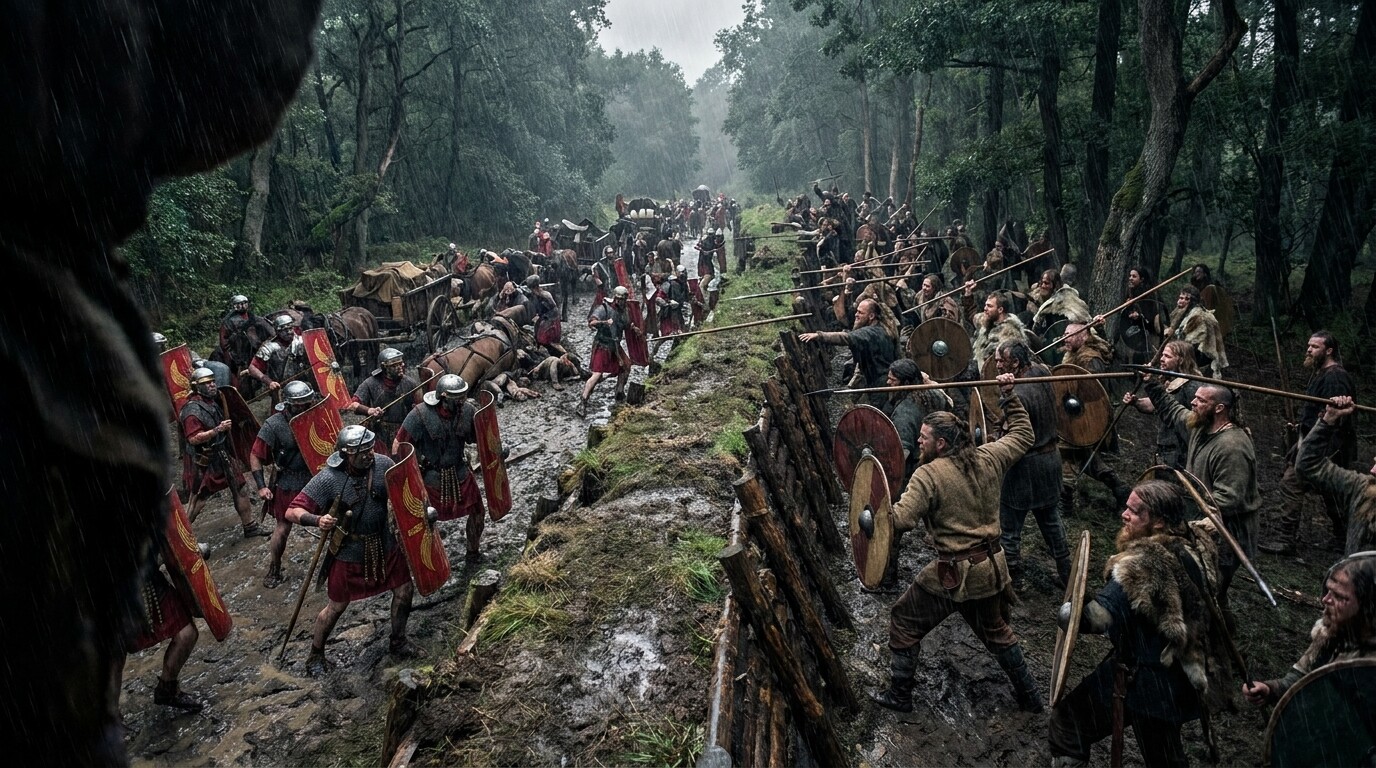
The first day appears to have been devastating for the Romans but not immediately decisive. Roman discipline held in places. Units at the front of the column, or in less constricted sections of the pass, may have been able to form some defensive posture. The Romans pushed forward, trying to move through the killing zone rather than stand in it. They suffered heavy casualties but the column did not immediately collapse.
That night, according to the ancient sources — primarily the account preserved in Cassius Dio, writing in the early third century AD and drawing on earlier sources now lost — Varus attempted to build a fortified camp. Roman soldiers, even when badly mauled, were trained to construct a defensive encampment at the end of every day's march: ditch, rampart, palisade. It was one of the institutional habits that made Roman armies difficult to destroy even after a defeat in the field. The camp provided a defensive position and time to organize.
The next day brought more of the same. The column attempted to move again. The terrain did not improve. The Germanic attacks resumed. Tacitus, in his Annals, describes a scene of progressive breakdown: wagons blocking the narrow path, animals panicking, soldiers unable to form ranks, the wounded hampering the movement of the unwounded. The rain continued.
Varus burned or destroyed the wagons and baggage that could not be moved — a decision that acknowledged the column could not maintain its logistical tail and fight at the same time. The army was now moving with nothing but what soldiers could carry, trying to fight its way through a prepared ambush in terrain designed to prevent them from using their main tactical advantages.
The fighting continued through a second day and into a third. By the final day, the Roman force was fragmented, its commanders dead or dying, and organized resistance had effectively ceased. Varus, according to the ancient sources, died by his own hand rather than face capture — a death consistent with Roman aristocratic tradition in military catastrophe. Some senior officers did the same. A small number of Roman soldiers may have escaped through the forest individually or in small groups. A portion of the cavalry, under the prefect Numonius Vala, apparently broke away and rode for the Rhine — though Velleius Paterculus, the account's primary source, records the flight with contempt and does not confirm whether Vala survived to reach it.
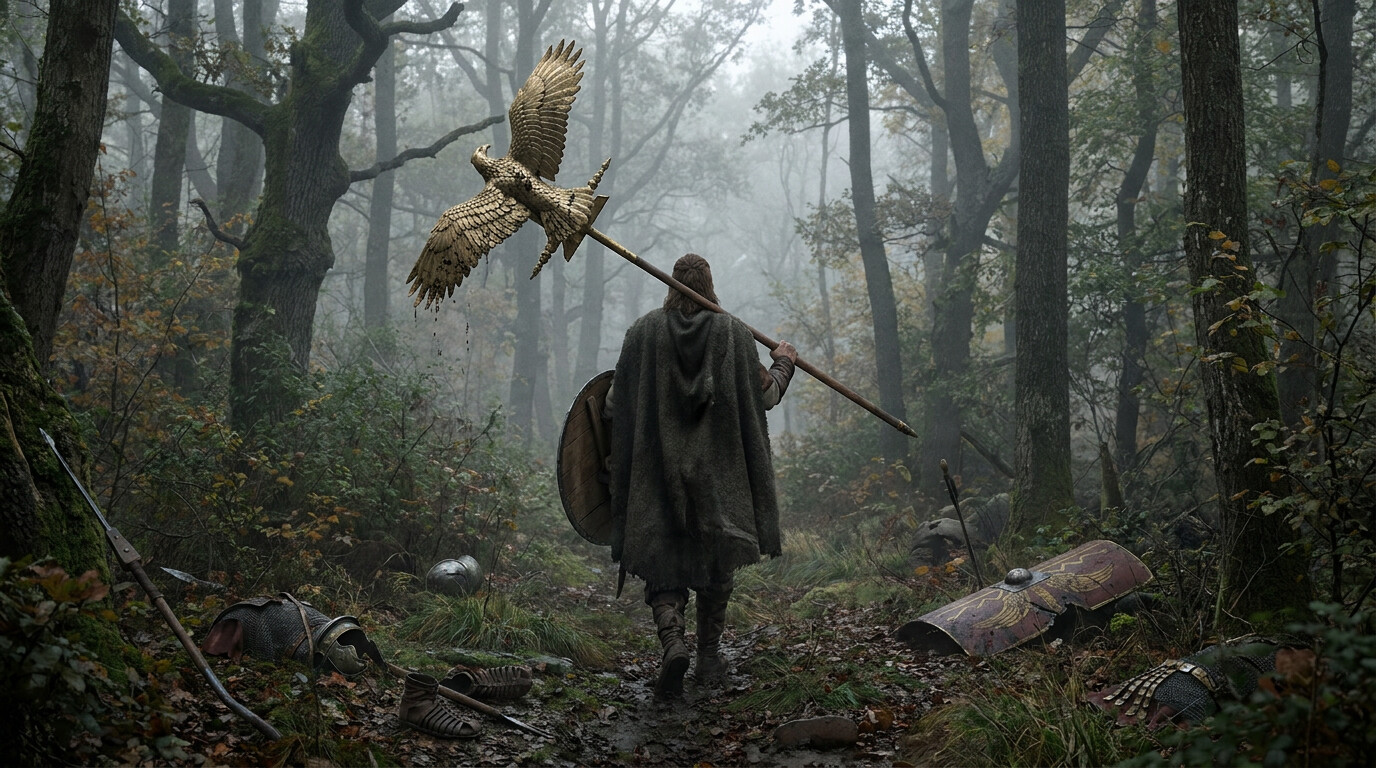
The three legions — XVII, XVIII, and XIX — were destroyed as combat formations. Their eagles, the sacred standards that represented the institutional identity and honor of a Roman legion, were captured. Losing a legionary eagle was the most profound military disgrace the Roman system recognized. Three eagles lost in a single engagement was without precedent in living Roman memory.
The numbers of dead are uncertain. Ancient sources give figures that range from the plausible to the clearly inflated. Modern historians working from the archaeological evidence at Kalkriese and comparative studies of Roman legion strength have generally estimated the Roman military dead at somewhere between fifteen thousand and twenty thousand, with additional thousands of non-combatant deaths. The Kalkriese excavations have recovered the bone fragments and personal equipment of many soldiers, but the forensic picture remains incomplete — the site covers a large area and excavation is ongoing.
Arminius and his coalition did not attempt to pursue into Roman-held territory in the immediate aftermath. The battle was complete. The forest had done its work.
---
The news reached Augustus in Rome with a shock that the ancient sources describe as profound and lasting. Suetonius, in his Lives of the Twelve Caesars, records that Augustus was so disturbed by the defeat that he refused to shave or cut his hair for months and would at times beat his head against the walls of his palace. Suetonius also attributes a lament to Augustus — rendered in Latin as a phrase meaning roughly that Varus should give back his legions. Suetonius was writing more than a century after the events, and the specific words cannot be confirmed as verbatim; they are presented here as a later tradition rather than documented speech. But the overall picture of deep imperial distress is consistent across multiple independent sources.
The three legions — XVII, XVIII, and XIX — were never reconstituted. Their numbers were retired from the Roman order of battle entirely, a decision that speaks to the weight of the catastrophe: Rome rebuilt defeated legions routinely, but these three designations simply disappeared from the Roman military record. The psychological and political weight of the defeat was treated as something beyond the normal accounting of military loss.
Augustus, in the final years of his reign, reportedly advised his successor Tiberius to hold the Rhine as the boundary of Roman power. The advice was followed. Rome mounted subsequent punitive expeditions into Germania — most notably the campaigns of Germanicus in 14–16 AD, who found the battlefield of Teutoburg and buried the bones of the fallen — but Rome never again made a serious attempt to establish a permanent province east of the Rhine. The Rhine remained the frontier for the next four centuries, until the empire itself began to fragment.
Arminius continued to lead the Cherusci after the battle. He fought against the Roman campaigns of Germanicus, demonstrating consistent tactical skill in terrain fighting and the ability to sustain a coalition of tribes under pressure. Tacitus, in the Annals, gives him some of the most admiring language he applies to any enemy of Rome, calling him the liberator of Germania — though that framing reflects Roman literary convention as much as historical assessment, and the degree to which it captures Arminius's own self-understanding cannot be known. But Arminius's political position within the Germanic world was not as secure as his military achievement might suggest.
The Germanic tribal system ran on personal loyalty, kinship networks, and the constant negotiation of status among chieftains. Arminius's post-battle power created resentments and rivalries. His father-in-law Segestes, who had tried to warn Varus, became an open enemy and at one point, according to Tacitus, captured Arminius's pregnant wife Thusnelda and handed her to the Romans. She spent the rest of her life in Rome. Arminius never recovered her.
Around 21 AD, twelve years after the Teutoburg battle, Arminius was killed by members of his own tribe — murdered, according to Tacitus, by kinsmen who feared he was reaching for kingship. Tacitus records it as a fact without elaboration, in a brevity that suggests he considered it established. The identities of the killers are not preserved in the surviving record.
Arminius was approximately thirty-seven years old.
---
The record of the Battle of the Teutoburg Forest rests on a limited but significant documentary foundation. The primary ancient sources are Cassius Dio's Roman History, Book 56, which contains the most detailed narrative account; Tacitus's Annals, Books 1 and 2, which covers both the Teutoburg disaster and the subsequent campaigns of Germanicus; and Velleius Paterculus's Compendium of Roman History, written within living memory of the battle — Velleius served under Tiberius, and his account, though brief, carries the quality of near-contemporary knowledge.
All of these sources are Roman. There are no surviving Germanic written accounts. The Germanic peoples of this period did not maintain a written literary tradition, and their oral traditions were not recorded in ways that have survived. Everything we know about Arminius's thinking, planning, and personal life is filtered through Roman authors writing for Roman audiences, at varying removes from the events, with varying degrees of access to primary sources.
Tacitus writes about Arminius with what appears to be genuine respect for military competence, but he is also constructing a narrative for a Roman readership and using Arminius partly as a mirror for Roman virtues and Roman failure. The Tacitean Arminius is a compelling figure — the trained Roman officer turned against his trainers, the client chieftain turned insurgent leader — but he is a literary construction as well as a historical one. How much of his character as described reflects the actual man is genuinely uncertain.
The archaeological evidence at Kalkriese has done more to ground the battle in physical reality than any subsequent historical work. The turf wall. The coins. The Roman military equipment — including fragments of parade-grade armor, suggesting the presence of senior staff. The caltrops, designed to injure horses, found scattered across the approach routes. The mass of Roman material on one side of a clear physical boundary, and the near-absence of it on the other. The Kalkriese finds do not answer all questions — the precise routing of the Roman column, the exact sequence of attacks, the position of Arminius during the fighting — but they confirm the basic physical reality of what the ancient sources describe: a prepared ambush in a narrow, controlled space, executed with deliberate precision.
The battle's meaning has been constructed and reconstructed many times since the Renaissance rediscovery of Tacitus's Germania text in 1455. German nationalist movements in the nineteenth century claimed Arminius — rebranded as Hermann the German — as a founding hero of the German nation, and a massive monument called the Hermannsdenkmal was erected in the Teutoburg Forest region between 1838 and 1875. This nationalist appropriation has almost nothing to do with Arminius's actual world, in which the category of Germanic identity was a Roman ethnographic label applied to a variety of distinct tribes who did not share a common national identity or political project. Arminius was a Cherusci chieftain defending Cherusci territory and leading a coalition of tribes against a specific Roman threat. He was not building a German nation. The monument commemorates a nineteenth-century political idea, not the man.
What the battle actually decided — at the level of documentary fact and archaeological confirmation — was that Rome could not sustain the cost of subjugating the Germanic tribes east of the Rhine. Whether the Teutoburg disaster alone forced that conclusion, or whether it accelerated a policy shift already becoming apparent from the difficulty of the Pannonian revolt and the general strain on Roman military resources, is a question historians continue to debate. The battle was real. The three legions were destroyed. The eagles were lost. Rome did not go back.
For Arminius himself, the historical record ends with a brief entry in Tacitus: killed by kinsmen, in his late thirties, the cause of his death the same political gravity that shapes the fate of every successful warlord who cannot translate battlefield dominance into stable peacetime authority. He left no written record. He left no monuments of his own commissioning. He left the physical evidence at Kalkriese — the turf wall, the caltrops, the bones of Roman soldiers — and the accounts of the people he defeated, who could not quite bring themselves to diminish him even as they recorded his treachery.
That is all we have. It is enough to understand what happened in the forest.
The rain came down. The column moved into the narrowing corridor. The ridge rose on one side, the marsh spread on the other, and the trees closed overhead. Somewhere along that passage, in a September that the Roman calendar would mark for the rest of the empire's life, the trap shut.
Three legions went in. The eagles did not come out.