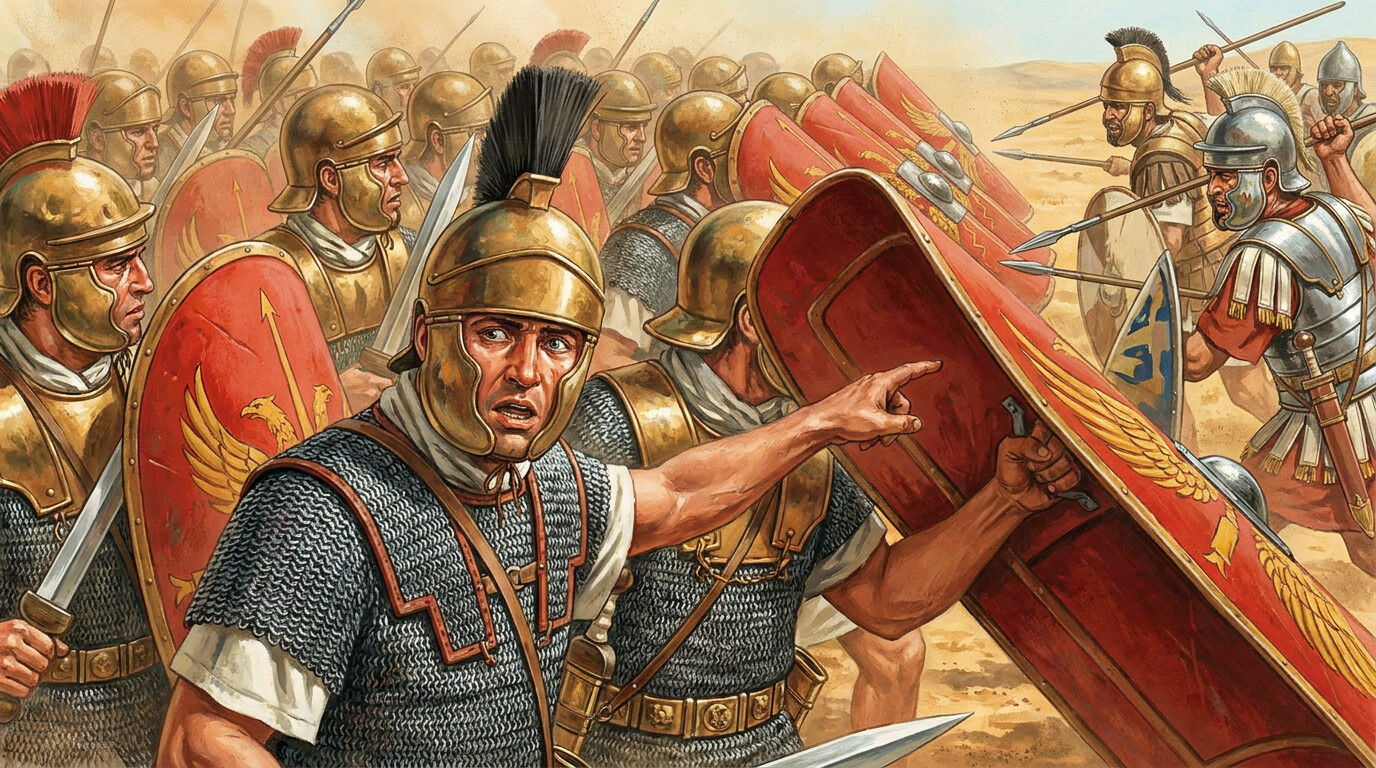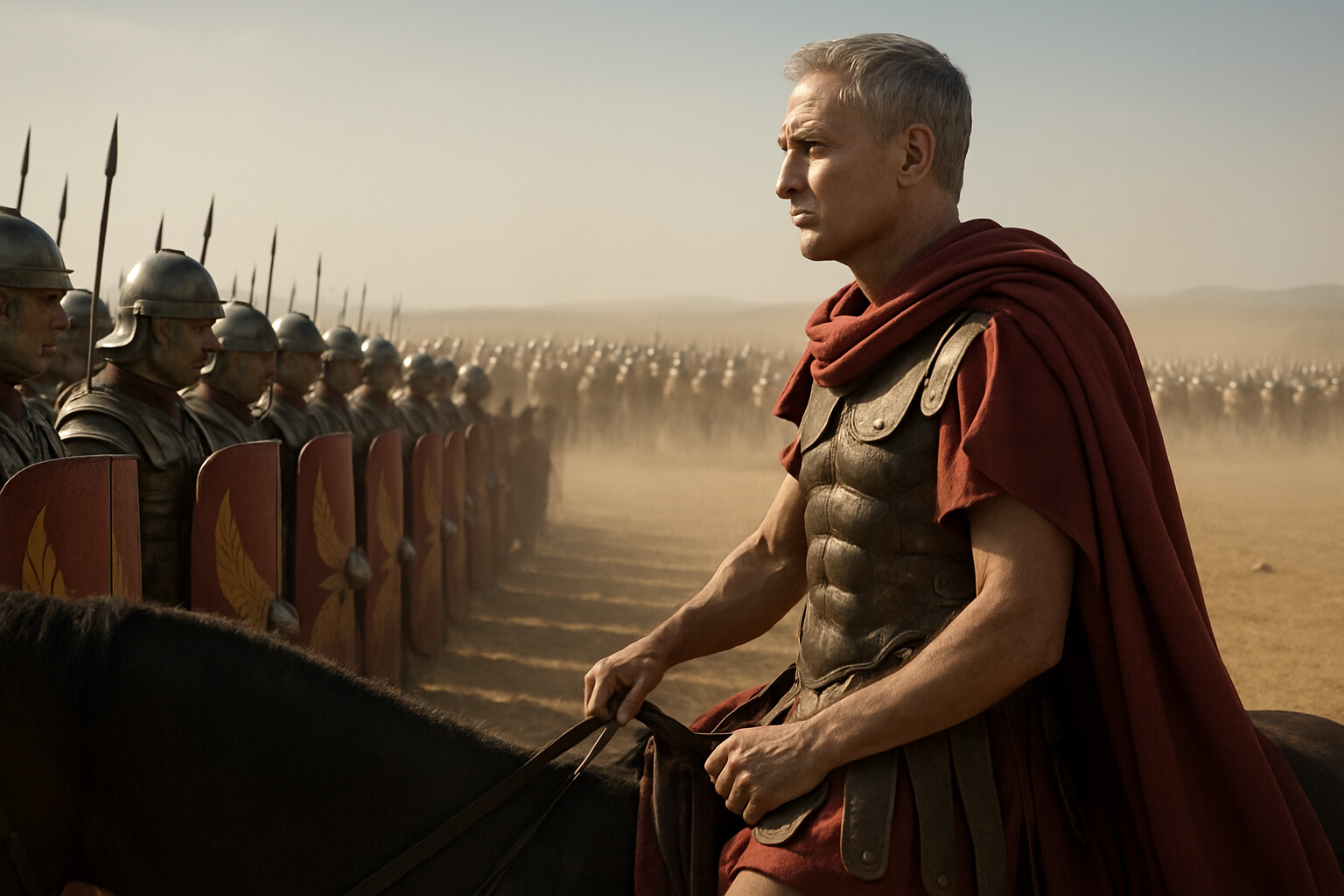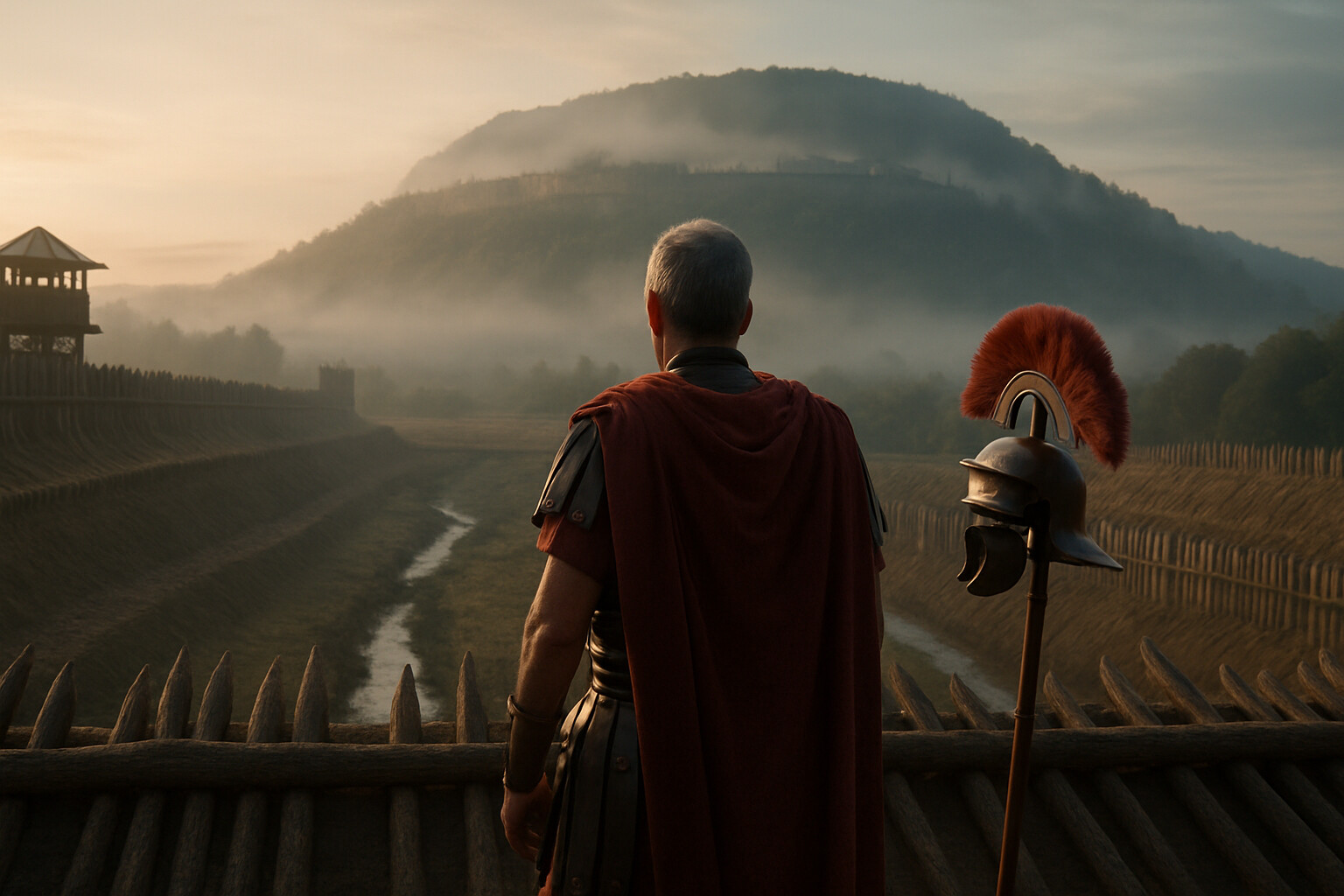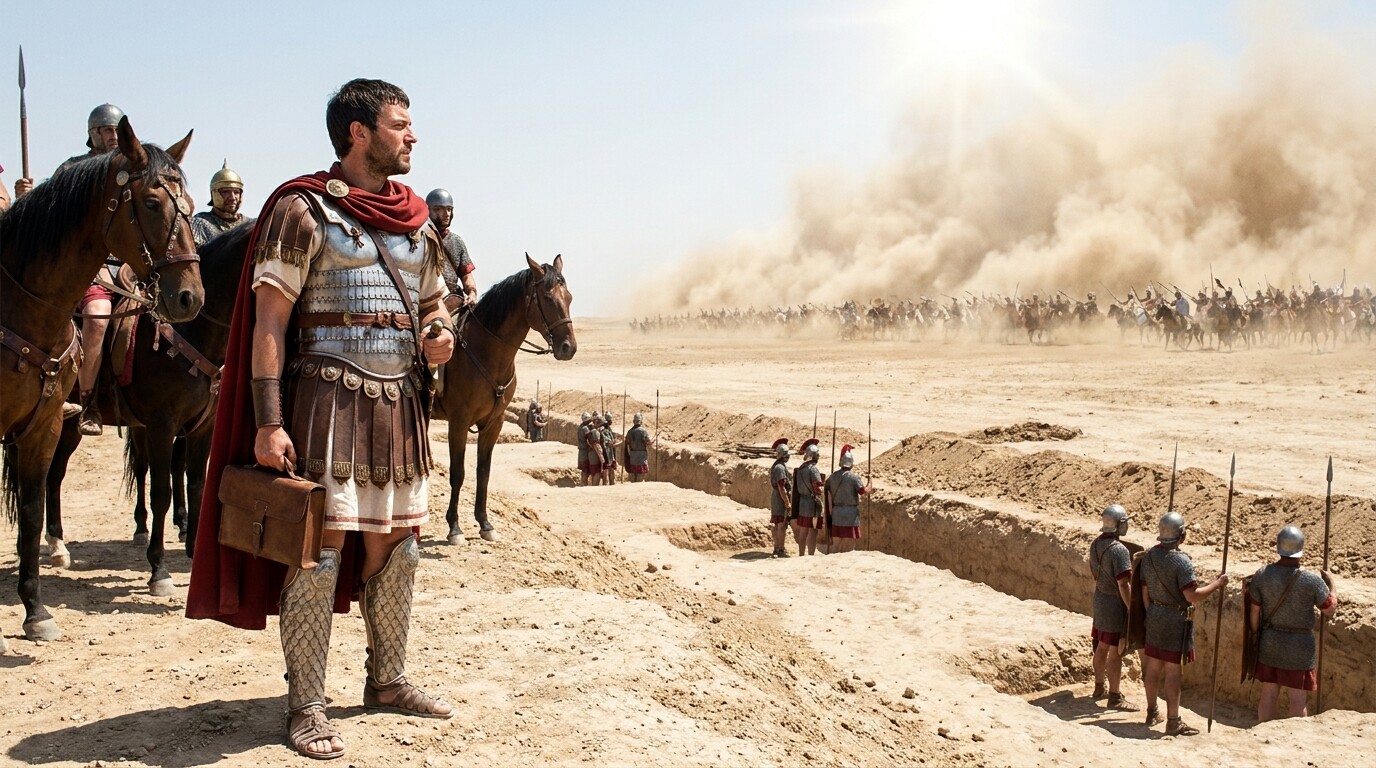
The dust rising from the plain outside Dara had a particular quality in late June — thick and pale, almost white, the kind that coated the throat and reduced visibility to a few hundred yards at the margins of a formed line. The Persian army approaching from the east made no attempt at concealment. Tens of thousands of heavily armored cavalry, massed infantry, and war elephants advanced in deliberate column, confident that the Roman frontier fortress would fall as so many before it had. Their commander, Perozes, led a force that contemporary sources placed at around fifty thousand — a figure modern historians treat as approximate at best, but sufficient to establish the scale of the disparity. Facing him across the ditch-scarred plain stood Belisarius — magister militum per Orientem, master of soldiers of the East — with perhaps twenty-five thousand men.
What followed was not a desperate last stand. It was a tactical solution, engineered in advance, that military historians have examined and debated for fifteen centuries.
---
**The Man and the World He Inherited**
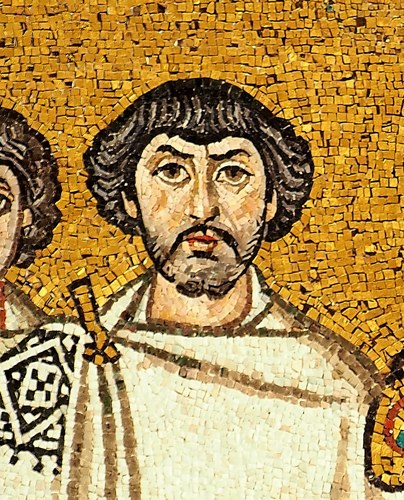
Flavius Belisarius was born around 500 AD. The precise location is uncertain — the historian Procopius, who served on his staff and is the principal source for his life, gives ambiguous geographic information, and modern scholars disagree on whether Thrace or another region of the Balkans is more likely. He rose through the military household of Justinian before the latter became emperor, and his early career placed him in the Danubian frontier commands that produced some of the Eastern Empire's hardest professional soldiers. By his late twenties he commanded a field army. By thirty he would defeat a Persian force that had not tasted serious defeat at Roman hands in a generation.
The world Belisarius served was one in urgent need of a general who could actually win. The Eastern Roman Empire — centered on Constantinople, ruling Anatolia, the Levant, Egypt, and the Balkans — had survived the catastrophic fragmentation of the West and remained a sophisticated, literate, and functionally administered state. But it was not secure. To the east, the Sassanid Persian Empire under Kavadh I and then his son Khosrow I pressed the Roman frontier hard and expensively. To the west, a patchwork of Germanic successor kingdoms — Vandals in North Africa, Ostrogoths in Italy, Visigoths in Spain — occupied territory that Constantinople still regarded as Roman by right. Emperor Justinian I, who came to power in 527, drove the project of reconquest. Belisarius would be his instrument.
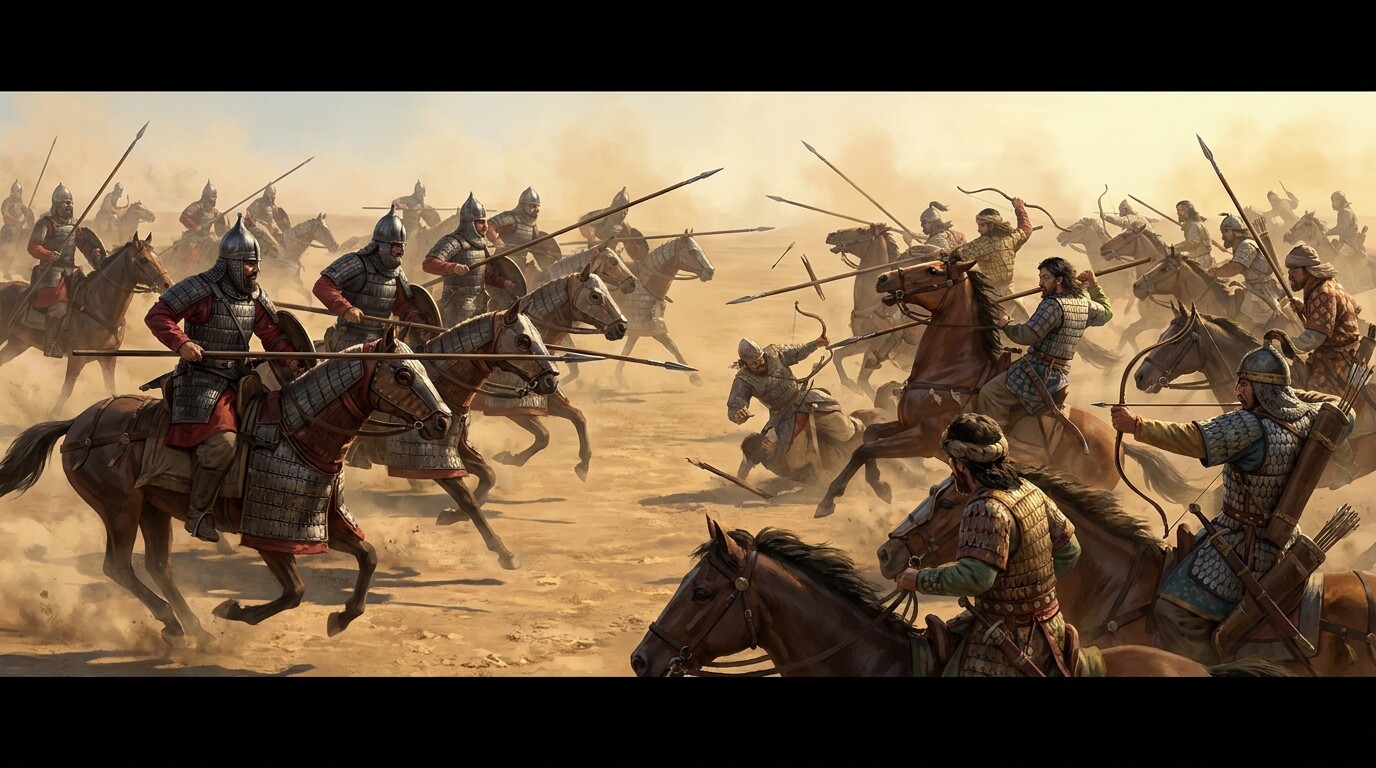
The army Belisarius commanded bore little resemblance to the legion-based force of classical Rome. The Eastern Roman military of the sixth century was a professional, heavily cavalry-dependent institution that blended Roman administrative discipline with tactical innovations drawn from the steppe and the Persian frontier. Its core combat arm was the cataphract — the heavily armored mounted archer — and its elite regiment was the bucellarii, the general's personal household cavalry, privately maintained, intensely loyal, and trained to a standard that regular unit soldiers rarely matched. The bucellarii of Belisarius eventually numbered in the thousands and fought as a concentrated strike force wherever he needed decisive local superiority. Alongside them stood lighter cavalry, Hunnic and Herulian federates of considerable shock and archery capability, and infantry that, while not the dominant arm, could hold prepared positions under sustained pressure.
This was an expensive, sophisticated force, perpetually short of supply, and politically dependent on an emperor who admired but also feared the popularity that battlefield victories generated. That tension — between a general who needed operational freedom and a sovereign who worried about independent power — would define the entire decade.
---
**Dara, June 530: The Architecture of a Defensive Victory**
The fortress city of Dara sat in Mesopotamia near the modern Turkish-Syrian border, constructed by Emperor Anastasius as a forward supply and command center for Eastern frontier operations. Strategically important but not impregnable, in the summer of 530 it became the focal point of a Persian offensive that expected to sweep it from the map.
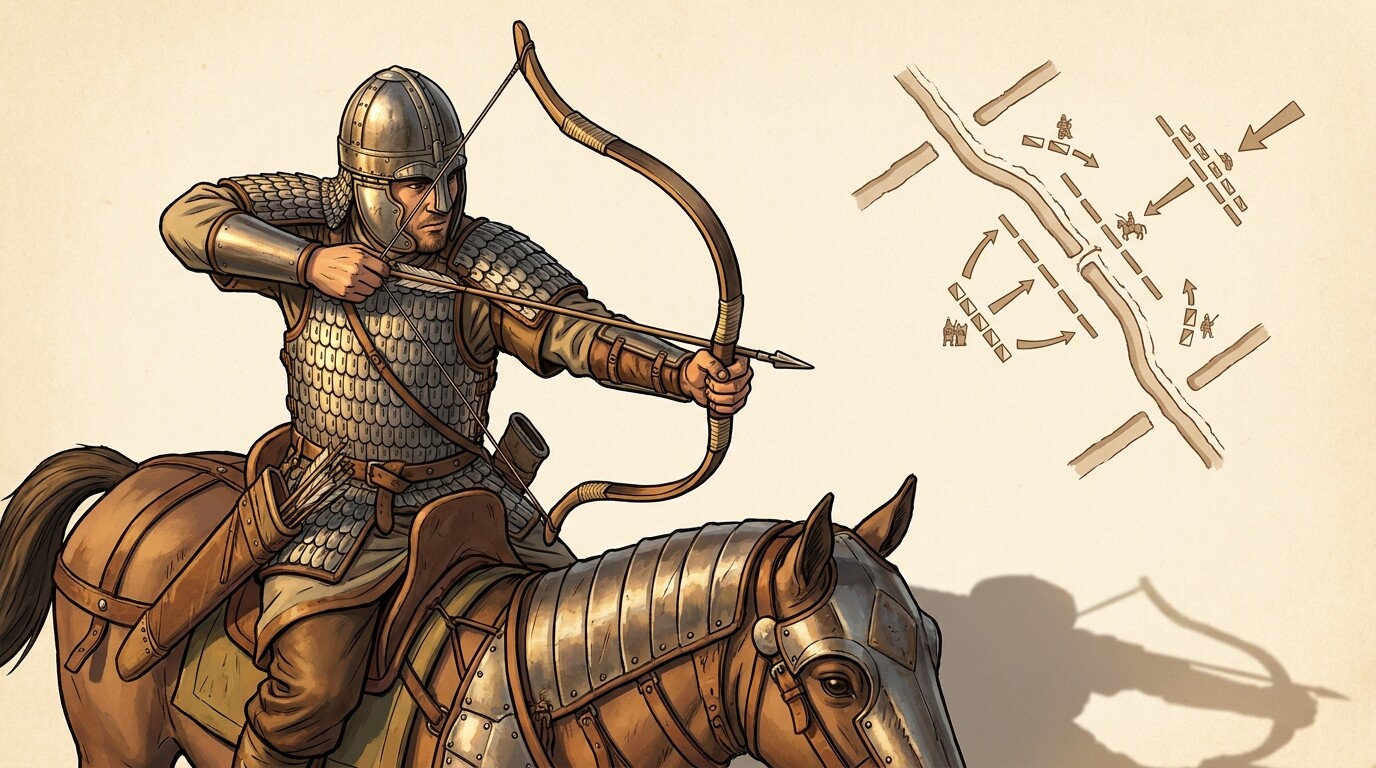
Belisarius had time to prepare, and he used it carefully. His tactical problem was essentially mathematical: he could not match the Persians in mass, and an open-field engagement would allow their numerical superiority to envelop his flanks and break his lines by sheer weight. His solution was to deny the Persians the use of those numbers. In the days before battle, he put his infantry and engineering troops to work digging a system of trenches across the plain in front of Dara. According to Procopius's account — the only detailed description available — the system was not a simple linear barrier. It was designed with deliberate geometry: a long central ditch parallel to the Roman front, connected by shorter perpendicular sections jutting forward on each flank. The resulting shape forced attacking Persian cavalry into narrow corridors where their numerical advantage became a liability. The precise engineering dimensions of the system are not independently documented; the reconstruction here follows Procopius's narrative description rather than archaeological measurement.
Behind this prepared position, Belisarius arrayed his force with care. Roman and allied infantry held the center, positioned behind the central trench. Cavalry, including Hunnic auxiliaries under commanders Procopius names as Sunicas and Aigan, anchored the flanks. The bucellarii he kept in reserve, positioned where they could move rapidly to wherever the line threatened to give.
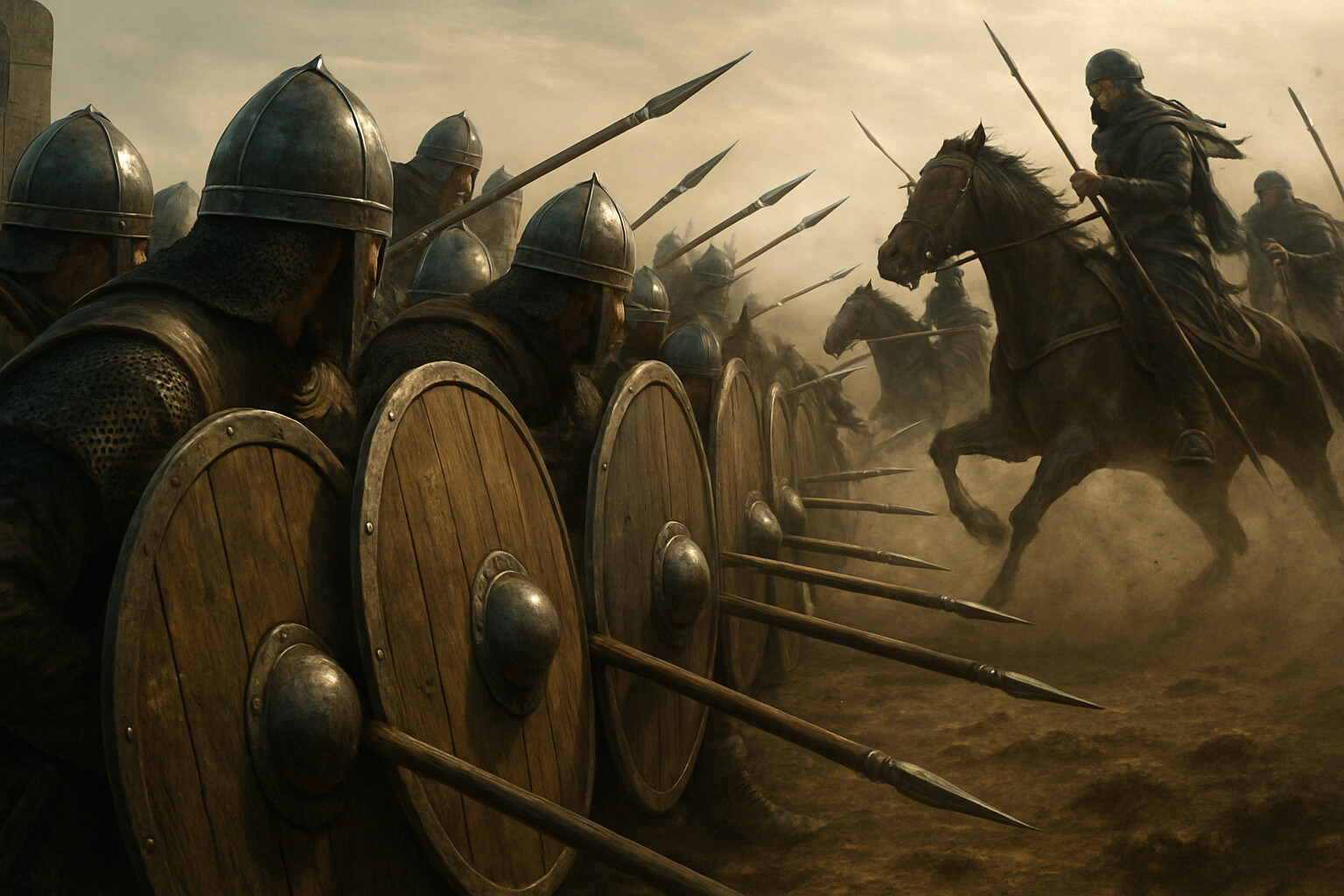
Procopius, present at Dara as Belisarius's legal secretary, provides the most detailed account of the engagement. The first day saw heavy skirmishing and cavalry probing on both flanks, as the Persians discovered that the terrain Belisarius had constructed was systematically negating their advantage in numbers. On the second day, the main engagement developed. Perozes committed his cavalry in a massive charge intended to break the Roman line through momentum alone. The Roman left flank, under intense pressure, began to buckle. This was the moment of genuine crisis.
Belisarius's response, as Procopius describes it, was a coordinated counterattack timed to the moment of Persian overextension rather than a shift from a position of stability. As Persian cavalry broke through on one flank and began to wheel inward — the classic envelopment — the Hunnic federates on that wing struck the advancing Persian column in the flank before it could consolidate. Simultaneously, the bucellarii from reserve pressed against the other wing of the Persian cavalry, which was still pressing toward the trench obstacle. The two-directional counterattack turned the Persian envelopment into a trapped column. Persian cohesion broke. The withdrawal became a rout.
Roman casualties were not trivial — Procopius does not provide precise figures, but his account makes clear that the fighting was genuinely intense and the left-flank crisis real. What Belisarius achieved was a hard-fought victory against a force roughly twice his size, secured through advance preparation, careful positioning of reserves, and the discipline to wait for the correct counterattack moment rather than committing prematurely.
Dara was the first major Roman victory over Persia in decades. It did not end the war — Belisarius was defeated the following year at the battle of Callinicum, a sharp reminder that sixth-century warfare punished command errors without mercy — but it established his reputation and demonstrated that the Eastern Roman army, properly handled, could compete on equal terms with the most formidable military power in the known world.
---
**The Eternal Compromise: An Expensive Eastern Peace**
Between the Persian frontier campaigns and the great Western reconquests, the Eastern Empire concluded the Eternal Peace of 532 with Persia — a diplomatic settlement that required payment of a substantial indemnity to Constantinople's eastern neighbor but freed Justinian's military resources for the Western project. The peace was expensive and diplomatically awkward, but strategically necessary. Justinian could not conduct major offensive operations in two directions simultaneously with the resources available. The decision to purchase stability in the east in order to pursue reconquest in the west was a calculated imperial gamble, and Belisarius would be the instrument that made it pay.
The political context of the peace is worth noting. It came in the immediate aftermath of the Nika Riots of January 532, the most dangerous urban uprising in Constantinople's history, during which Justinian came close to abandoning the capital entirely. Procopius records that it was the empress Theodora who steadied the court and prevented abdication. The riots were suppressed with substantial bloodshed — contemporary estimates placed the dead at around thirty thousand in the Hippodrome, a figure modern historians consider almost certainly exaggerated but indicative of a large-scale massacre. The Eastern Roman Empire, even at its most formidable, was a polity under constant internal and external pressure. Belisarius conducted his campaigns against that background of permanent institutional fragility.
---
**North Africa, 533: Eleven Thousand Men Against a Kingdom**
The Vandal kingdom of North Africa was, by the early sixth century, a military power with a record that Roman memory had not forgotten. In 455, Vandal forces had sacked Rome itself. Their kingdom controlled Carthage, the most important port in the Western Mediterranean, and the grain-producing provinces that had once been the empire's breadbasket. Gelimer, the Vandal king in 533, commanded an army that included veterans of internal political conflicts and a fleet that could theoretically contest the sea-lanes.
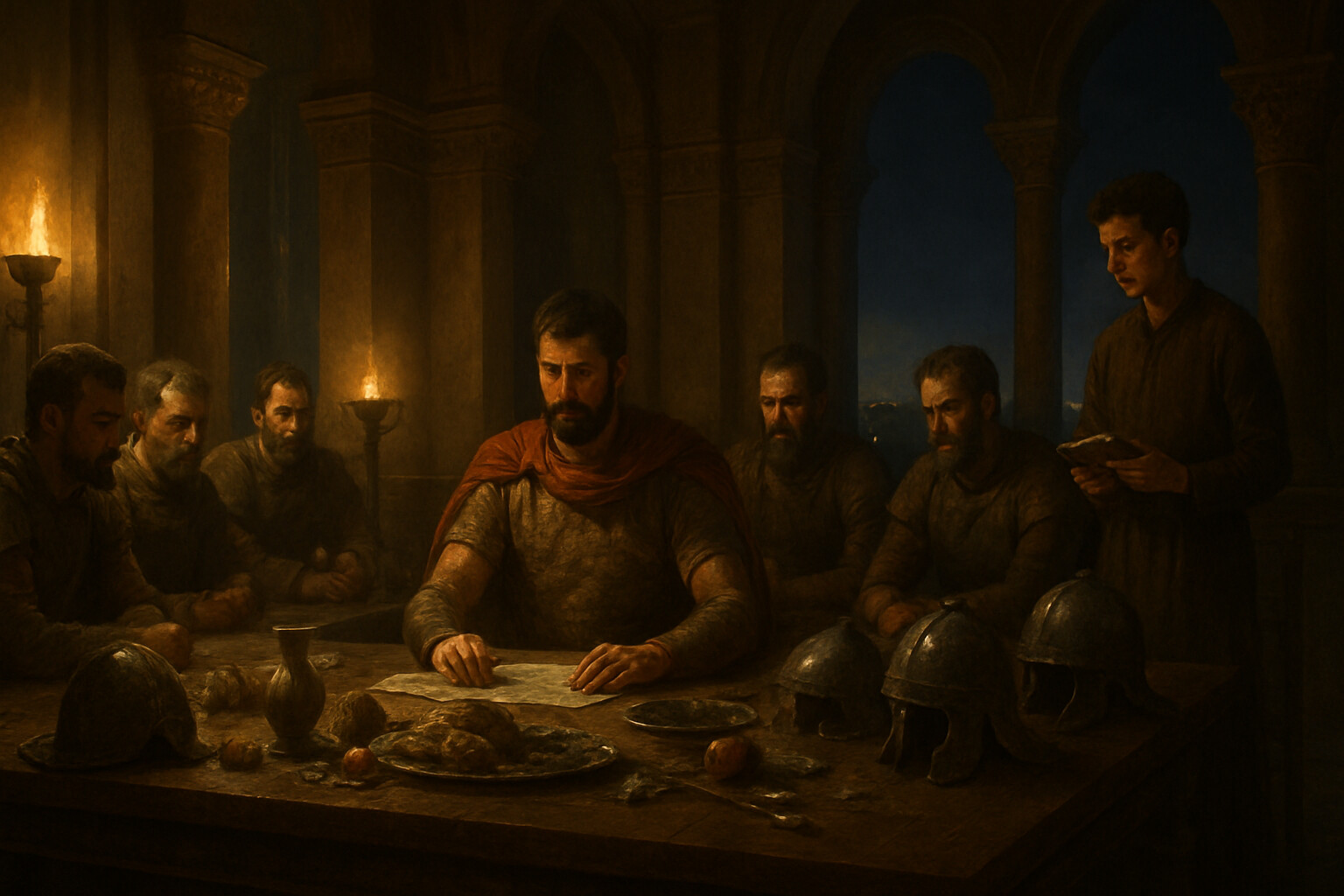
Justinian's decision to send Belisarius against the Vandals was opposed by senior military and financial advisors on practical grounds. The expedition force was small — approximately fifteen thousand soldiers, a mix of infantry and cavalry, transported on around five hundred vessels with ninety-two warships as escort. The logistical margin was minimal. There was no certainty that the North African population, which had lived under Vandal rule for nearly a century, would welcome or assist a Byzantine invasion.
Belisarius departed Constantinople in June 533. The fleet landed in North Africa — in the region of modern Tunisia — and the force marched toward Carthage along the coast, with the fleet maintaining support along the sea route. The landing and initial advance met no naval opposition, a significant piece of operational luck the sources attribute partly to Gelimer's miscalculation: a substantial Vandal force had been dispatched to Sardinia to suppress a rebellion shortly before the Byzantine fleet arrived, reducing the troops available to contest the landing.
The first serious engagement came at Ad Decimum — the tenth milestone south of Carthage — on September 13, 533. Gelimer's plan was an ambush intended to strike the Byzantine column simultaneously from multiple directions, using forces commanded by himself, his brother Ammatus, and his nephew Gibamund. It was sound in conception. In execution it collapsed because the three converging forces failed to synchronize their timing. Ammatus arrived ahead of schedule, engaged the Byzantine vanguard before the other columns were in position, and was killed in the initial fighting. Gibamund's column encountered Hunnic cavalry prematurely and was routed. Procopius records that when Gelimer arrived with the main body and found his brother's body on the road, he halted to mourn, and the opportunity to reconsolidate the ambush dissolved. The Byzantine column continued toward Carthage.
The city fell without a siege on September 14, 533 — the day after Ad Decimum. Byzantine forces entered through gates the population had opened. Procopius describes Belisarius dining in Gelimer's palace that evening, using the plates the Vandal king had set for his own anticipated victory feast. The detail has the quality of a carefully shaped narrative and may contain embellishment, but it captures something true about the speed and completeness of the reversal.
Gelimer regrouped. He recalled the Sardinian expedition force and gathered his remaining strength. The decisive second engagement came at Tricamarum in December 533. Belisarius again held his infantry in reserve and committed cavalry first — his bucellarii and allied horsemen struck the Vandal cavalry across a shallow stream, broke them in a series of charges, and forced Gelimer from the field. The Vandal infantry, left without cavalry support and facing a formed Byzantine force, disintegrated. Gelimer fled into the Numidian interior, was pursued to the mountain fortress of Pappua, and was besieged there for several months before surrendering in March 534.
The conquest of a kingdom that had existed for nearly a century took less than a year. That speed reflected several converging factors: Gelimer's strategic misjudgment in dispersing his forces before the landing, the coordination failure at Ad Decimum, and the quality and confidence of the Byzantine cavalry in shock action. But it also reflected the operational principles Belisarius applied consistently — moving fast, keeping logistics workable, using cavalry as the primary offensive instrument, and maintaining the discipline of his forces even in victory to prevent the looting and disorder that would have alienated the North African population.
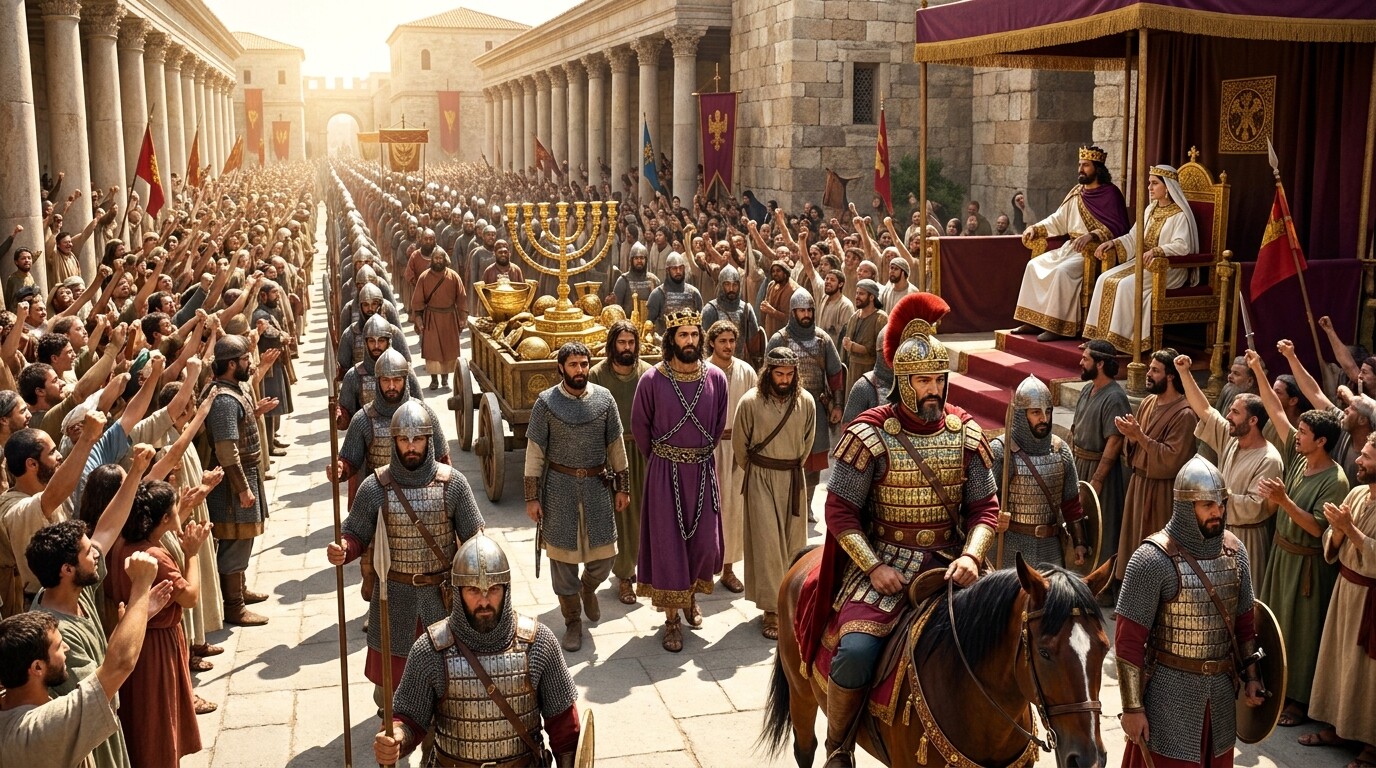
Belisarius returned to Constantinople in 534 and was awarded a triumph — described by Procopius as the first granted to a private citizen in centuries, a claim that reflects his rhetorical framing and would require detailed comparison with other late antique triumphs to fully assess. Contemporary sources describe the display of Vandal prisoners, plundered treasury including sacred objects from the Temple of Jerusalem that the Vandals had themselves taken from Rome, and Gelimer walking in the procession before prostrating himself before Justinian.
---
**Italy, 535–540: The Long War**
The Italian campaign was a different order of difficulty from North Africa. The Ostrogothic kingdom was larger, better organized, and far more resilient than the Vandal state. Italy itself was a more complex operational environment — mountainous, fragmented by the Apennines and the Alps, a long peninsula that offered a skilled defender a series of natural defensive lines to exploit in succession.
Belisarius landed in Sicily in 535 with approximately eight thousand men — a force that seems almost implausibly small for the conquest of a major kingdom. Sicily was largely secured by the end of the year. In 536, he crossed to the Italian mainland and took Naples after a siege that, according to Procopius, involved the discovery of an abandoned aqueduct channel large enough for soldiers to pass through, allowing Byzantine troops to infiltrate the city and open the gates from within. The episode appears only in Procopius and cannot be independently verified from other sources; its operational specifics must be treated accordingly.
The road to Rome opened. The Ostrogothic king Theodahad was deposed and killed by his own people for his failures, replaced by the more capable Witiges. But Witiges made the critical error of withdrawing northward to Ravenna to consolidate his forces before mounting a serious response, and Belisarius used the window to enter Rome in December 536. The city had not been under Roman imperial authority since the fall of the Western Empire in 476.
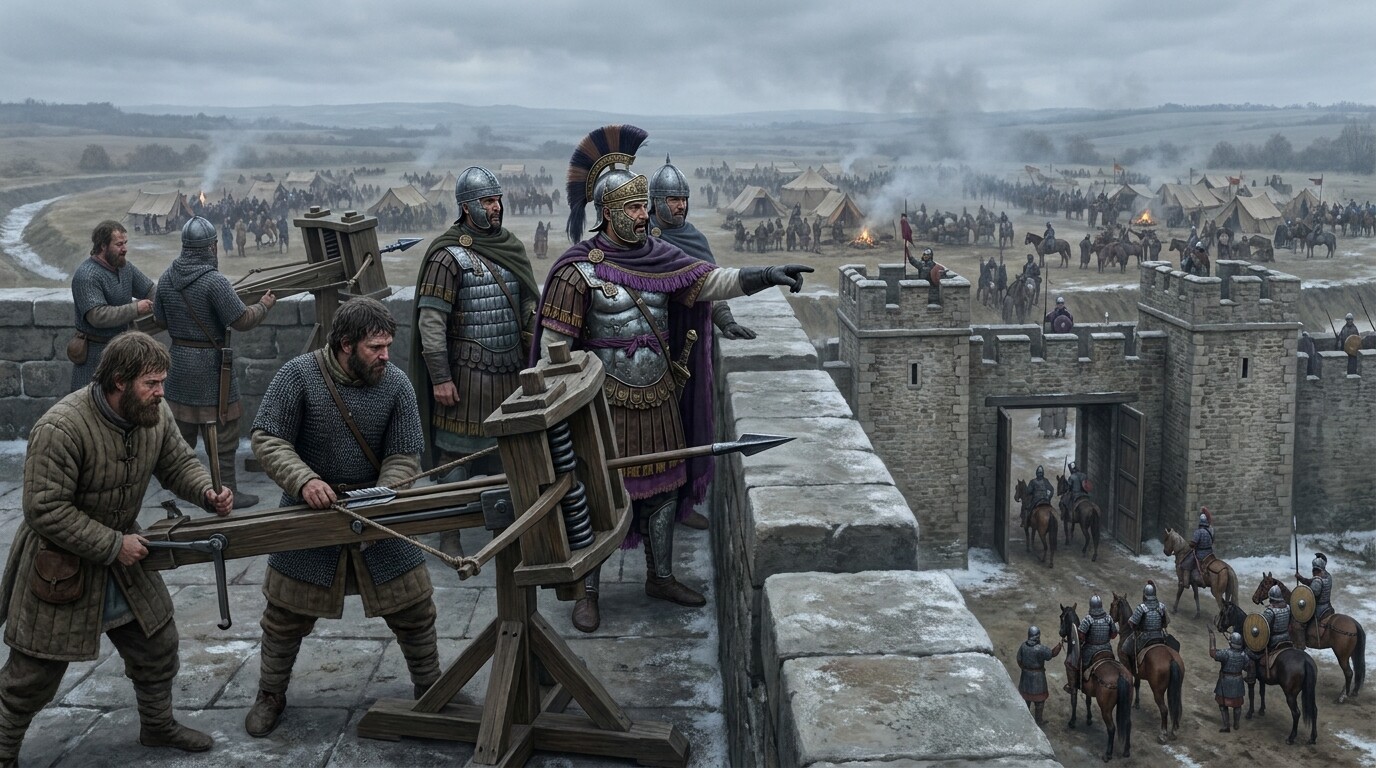
What followed was one of the most remarkable sieges of the late antique world. Witiges returned south with a large Ostrogothic army — contemporary estimates reach as high as a quarter million, figures modern historians consider substantially inflated, with more credible estimates placing the force in the tens of thousands, though still vastly larger than the Byzantine garrison. The siege of Rome ran from approximately late February 537 through March 538. Belisarius held the city with a force dramatically outnumbered, conducting an active defense that combined repeated cavalry sorties, artillery fire from the walls, and careful management of the city's food supply.
The Aurelian Walls — built in the third century and still largely intact — were the foundation of the defense. Belisarius distributed his forces across the wall circuit and used his cavalry in aggressive sorties that disrupted Ostrogothic camps and prevented a consolidated siege. The Goths cut the aqueducts, which also powered the city's grain mills, forcing the Byzantines to improvise. Procopius describes floating mills on the Tiber River as the solution — a detail consistent with late antique engineering practice but, like the Naples aqueduct episode, attested only in his account. The city suffered food shortages and disease during the long siege, and there were political tensions both within the garrison and between Belisarius and reinforcing commanders sent by Justinian with their own operational ideas.
The Goths eventually withdrew without having taken Rome, frustrated by their siege operations and increasingly pressed by Byzantine forces in their rear. Belisarius drove north through Italy. Ravenna, the Ostrogothic capital, fell in 540. Witiges was captured and sent to Constantinople.
The fall of Ravenna completed the formal military objective. Italy was nominally restored to imperial rule. Belisarius was recalled to Constantinople in 540 — summoned back to address a renewed Persian threat. Khosrow I had torn up the Eternal Peace and invaded Syria, sacking Antioch. The Italian campaign had ended at a moment of apparent success, but it left military problems unresolved that would generate devastating consequences within years.
---
**The Cost**
The true cost of the Italian campaign only became fully visible after Belisarius left. Ostrogothic resistance did not collapse after Ravenna. A new Gothic leader, Totila, emerged as an exceptionally capable commander who reconquered most of Italy during the 540s, taking Rome itself more than once. The Byzantine position would not be permanently secured until the final Gothic War concluded in 554, under different commanders with substantially larger forces — and even then, the Lombard invasion of 568 dismantled much of the work within a generation.
North Africa proved easier to hold. Byzantine rule in the Maghreb, though troubled by Berber resistance and periodic military crises, persisted for over a century.
Belisarius was recalled to Italy for a second campaign from 544 to 548, but arrived without adequate resources and could not recover the momentum. He returned to Constantinople again without decisive success and spent years navigating the treacherous politics of Justinian's court. Procopius — who had spent years at his side and produced the official histories that document his campaigns — also wrote the Secret History, a violently critical account of Justinian's court that includes damaging material about Belisarius and his wife Antonina. The Secret History's reliability on personal matters is contested among scholars; its portrait of court politics is generally taken more seriously.
Belisarius faced accusations of conspiracy and corruption at various points in his later career. The most famous tradition — that he was blinded and reduced to begging in the streets of Constantinople in his final years — is almost certainly a later medieval invention with no support in contemporary sources. Procopius records no blindness or destitution. What the sources do record is that he was stripped of his property and command for a period near the end of his life, then restored to rank shortly before his death in 565, the same year as Justinian.
He had outlived almost everyone who fought alongside him. He had campaigned across a span of geography stretching from Mesopotamia to the Atlantic coast of North Africa, from the edges of the Sahara to the Alps. He had governed conquered provinces, negotiated surrenders, managed supply lines across the Mediterranean, and held Rome against a larger army for nearly a year. He had done most of this without the resources his plans required and without the unqualified backing of the emperor he served.
---
**The Record**
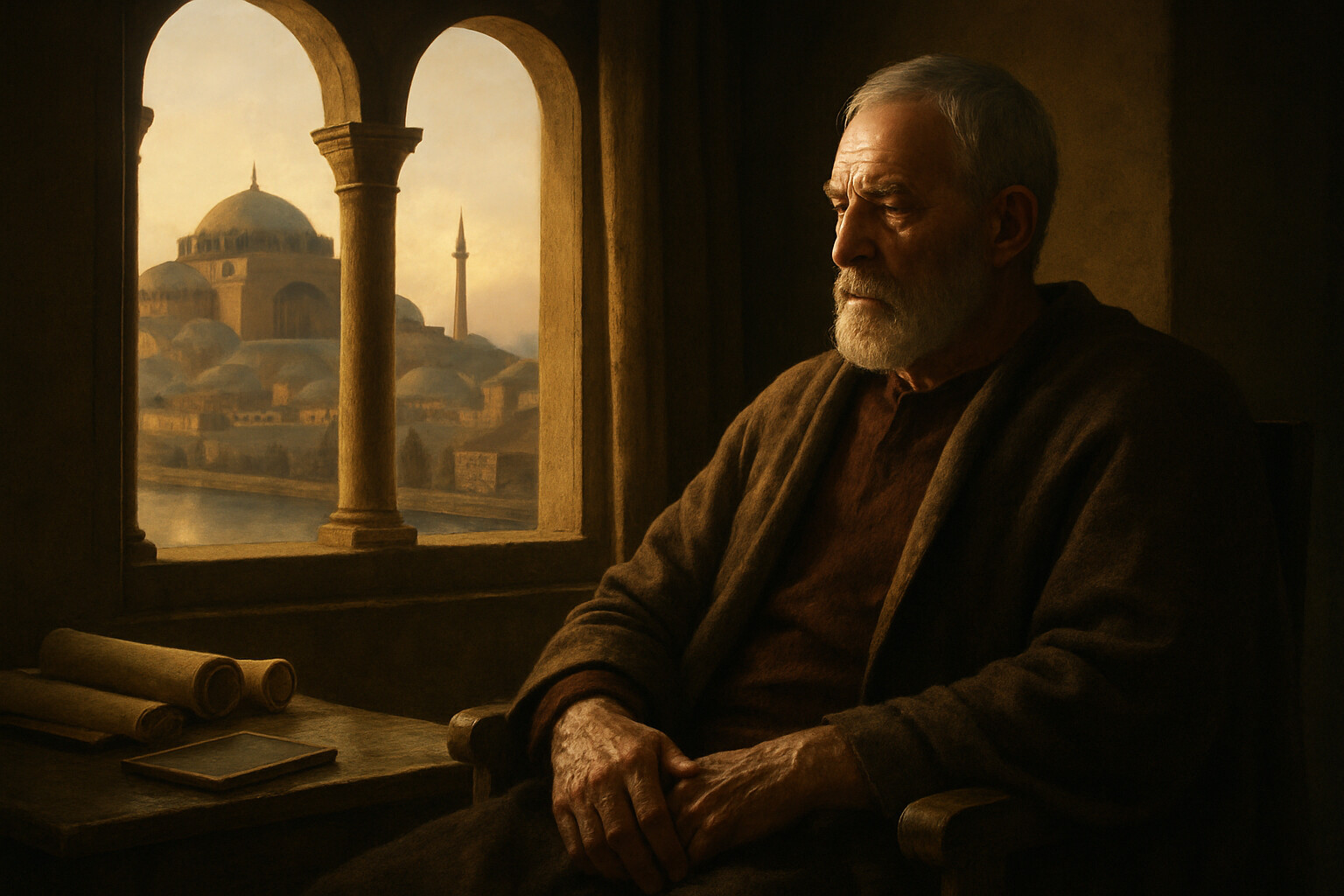
The primary source for Belisarius's campaigns is Procopius of Caesarea, who served as his legal secretary and accompanied the general in Persia, North Africa, and Italy. Procopius's Wars — divided into the Persian Wars, the Vandal Wars, and the Gothic Wars — provide the most detailed contemporary account available and are invaluable, but they require careful use. Procopius wrote in a rhetorical tradition modeled on Thucydides and Herodotus, which means that formal speeches, calculated narrative shaping, and ideological framing are embedded in his text. His battle descriptions are often vivid and tactically detailed in ways that suggest genuine eyewitness observation, but troop strength figures and casualty numbers throughout ancient and late antique history are notoriously unreliable and must be treated as approximate at best.
The Secret History, almost certainly also by Procopius, was apparently not intended for public circulation and presents a dramatically different picture of the same events and people described in the Wars. Scholars continue to debate how much of its personal attacks reflect genuine observation versus rhetorical score-settling. On the broad sequence of campaigns, unit compositions, and the structure of events, the Wars are generally corroborated by other sources including the chronicles of John Malalas, the Syriac chronicle of Zacharias Rhetor, and administrative papyri from Egypt documenting logistical operations.
Modern scholarly work on Belisarius and the Justinianic campaigns — particularly that of John Moorhead, John Haldon, and Averil Cameron — has significantly refined the picture Procopius provides. The consensus is that while his basic narrative is reliable on major events, the portrait of Belisarius's personal genius needs to be read alongside the institutional strengths of the army he commanded and the structural weaknesses of the kingdoms he opposed.
---
**Legacy**
Belisarius was, in the judgment of his own age and of many subsequent ones, the greatest general the Eastern Roman Empire produced. The comparison most often reached for is with the great commanders of classical antiquity — Scipio Africanus, who destroyed Carthage and returned to die in relative obscurity; perhaps Hannibal, whose military genius outran what his state could support. The parallels are imprecise, as historical parallels always are, but they point at something real: a commander whose tactical and operational abilities consistently exceeded the institutional resources available to him.
What Belisarius achieved between 530 and 540 was the largest expansion of imperial territory in centuries, executed against opponents that contemporaries considered formidable, with forces consistently smaller than those opposing them. The methods he used — prepared defensive positions, careful reserve placement, combined-arms cavalry as the primary offensive strike force, discipline in captured cities to maintain political legitimacy among occupied populations — were not invented by him. But he applied them with a consistency and precision that produced results his contemporaries found extraordinary.
The Western reconquest, viewed from the long perspective, was partially reversed by the Lombards and by the collapse of Byzantine resources in the seventh century. It did not rebuild the Western Empire. What it did was preserve Carthage, Rome, and Ravenna as functioning centers of Roman administration for several additional generations, delay the final political fragmentation of Mediterranean civilization, and produce in Procopius's account one of the most detailed military histories of the late antique world.
The plain outside Dara — now somewhere near the modern village of Oğuz in Turkey's Şırnak province — shows no trace of the trenches Belisarius's men dug in June 530. The dust still rises in summer in the same pale, throat-coating way it must have when two armies faced each other across a prepared field and the smaller one waited with professional patience for exactly the right moment to move.