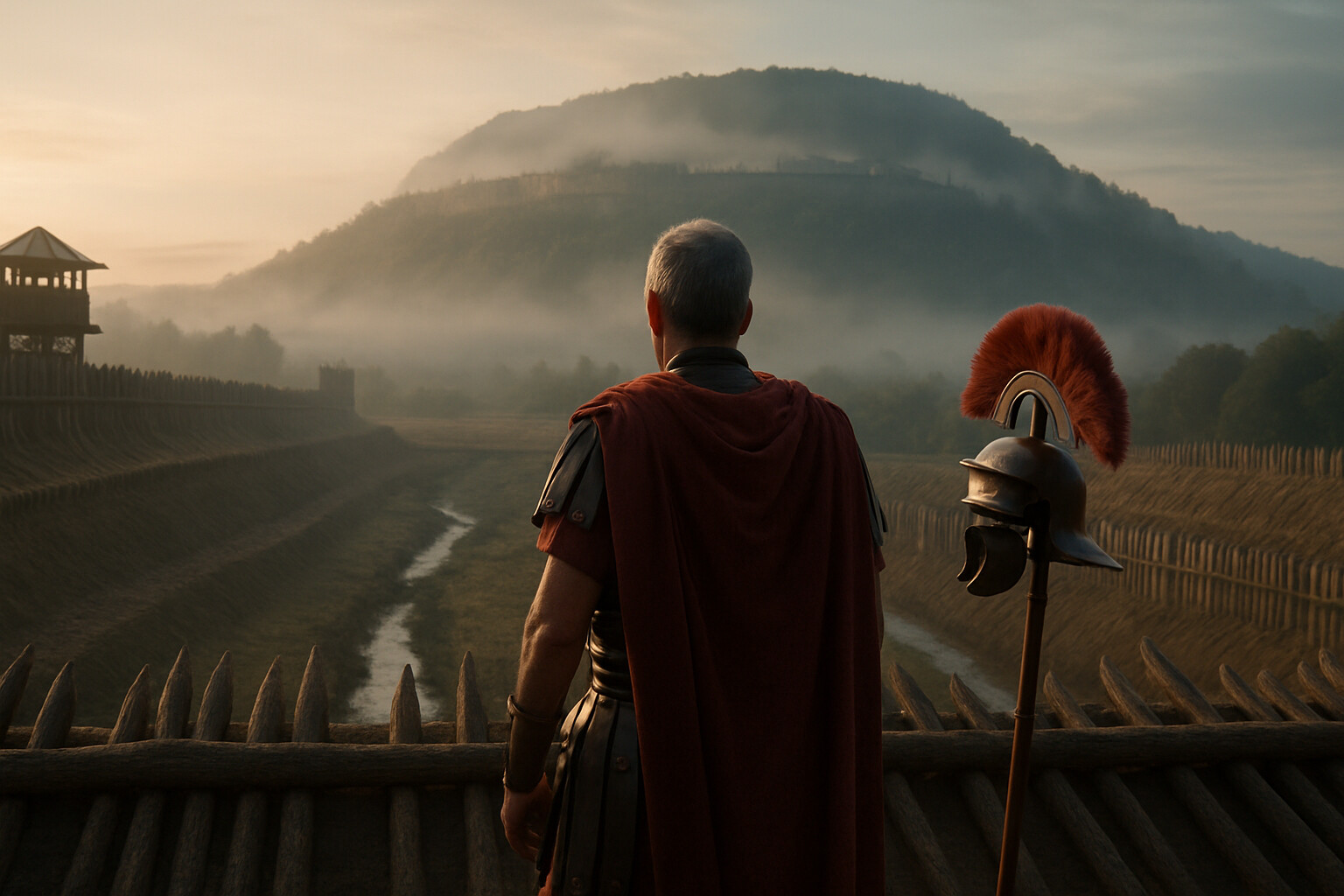
The grain was gone. The wells were running low. On the hill of Alesia, tens of thousands of Gallic warriors and the civilians who had followed them into the fortress were beginning to understand that the Romans below had no intention of leaving.
It was late summer of 52 BC. Below the oppidum — the fortified hilltop settlement — the legions of Gaius Julius Caesar had done something that seemed, from inside those walls, close to impossible. They had surrounded an entire mountain with a continuous line of fortifications stretching nearly eleven Roman miles. Every ditch, every palisade stake, every watchtower had been placed with engineering precision. There was no gap. There was no weak point that Vercingetorix's commanders could identify. And somewhere beyond the Roman outer wall, a relief army of unprecedented size was reportedly assembling.
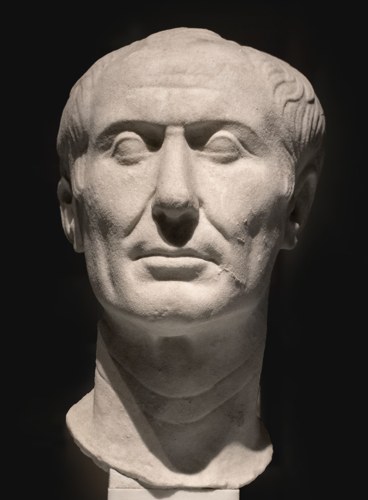
The man who ordered those walls built was fifty years old — a politician as much as a general, a man whose career had been constructed on calculated risks and decisive timing. Julius Caesar had been in Gaul for six years. He had fought across rivers, through forests, and into tribal confederacies that had never before been unified against him. He had crossed the Rhine twice to send a message to the Germanic tribes beyond. He had landed in Britain twice, operations that served their own political purposes back in Rome. And now, in the summer of the seventh year, all of it had come down to a single hill in central Gaul.
Vercingetorix had changed the shape of the war.
The Arverni chieftain was perhaps in his mid-to-late twenties in 52 BC — his birth year is not recorded in ancient sources, and modern estimates range from approximately 72 to 82 BC, making him somewhere between twenty-five and thirty years old at Alesia. He had been expelled from the Arverni capital by his own uncle before rallying warriors to his cause through force of personality and a clear strategic vision: the Romans could be beaten not by pitched battle, but by denying them food. Gaul was vast. The Gallic tribes knew the land. If they burned their own grain stores, abandoned their own settlements ahead of the Roman advance, and refused to offer the kind of decisive engagement where Roman discipline and organization produced their most lethal results, the legions would eventually starve and withdraw.
The strategy nearly worked.
Through the early months of 52 BC, Vercingetorix frustrated Caesar repeatedly. He struck Roman foraging parties. He pressured besieged towns by threatening Caesar's supply lines rather than fighting on the enemy's terms. At Gergovia — the Arverni tribal capital — Vercingetorix inflicted a genuine tactical defeat on Caesar, a rare and serious setback that encouraged wavering tribes to declare for the revolt. The Aedui, long Rome's most reliable Gallic allies, changed sides. The tribal coalition swelled. For a period that summer, it appeared possible that Gaul might expel its occupier.
Then Vercingetorix made a decision that his later fate would be measured against. After a cavalry engagement in which his horsemen were routed by Caesar's Germanic cavalry auxiliaries, he withdrew his forces into Alesia rather than continuing the mobile campaign that had served him. Caesar's account in De Bello Gallico — the primary ancient source for these events, written by Caesar himself and shaped by his own political purposes — suggests the rationale was to hold at Alesia and await a relief force already being assembled across Gaul. With a large garrison inside the walls and a coalition of tribal contingents reportedly marshaling beyond the horizon, Vercingetorix may have calculated that Caesar would be caught between two fires.
He was right about the trap. He was wrong about who would be caught in it.
Alesia occupied a plateau approximately two kilometers long and roughly half a kilometer wide, sitting atop a steep-sided hill that rose above the confluence of two rivers — the Ose and the Ozerain — in territory belonging to the Mandubii tribe. The flat summit made it defensible. The surrounding valleys made approach difficult. The rivers provided some water, though not unlimited supply. It was a strong position. It was also a fixed one.
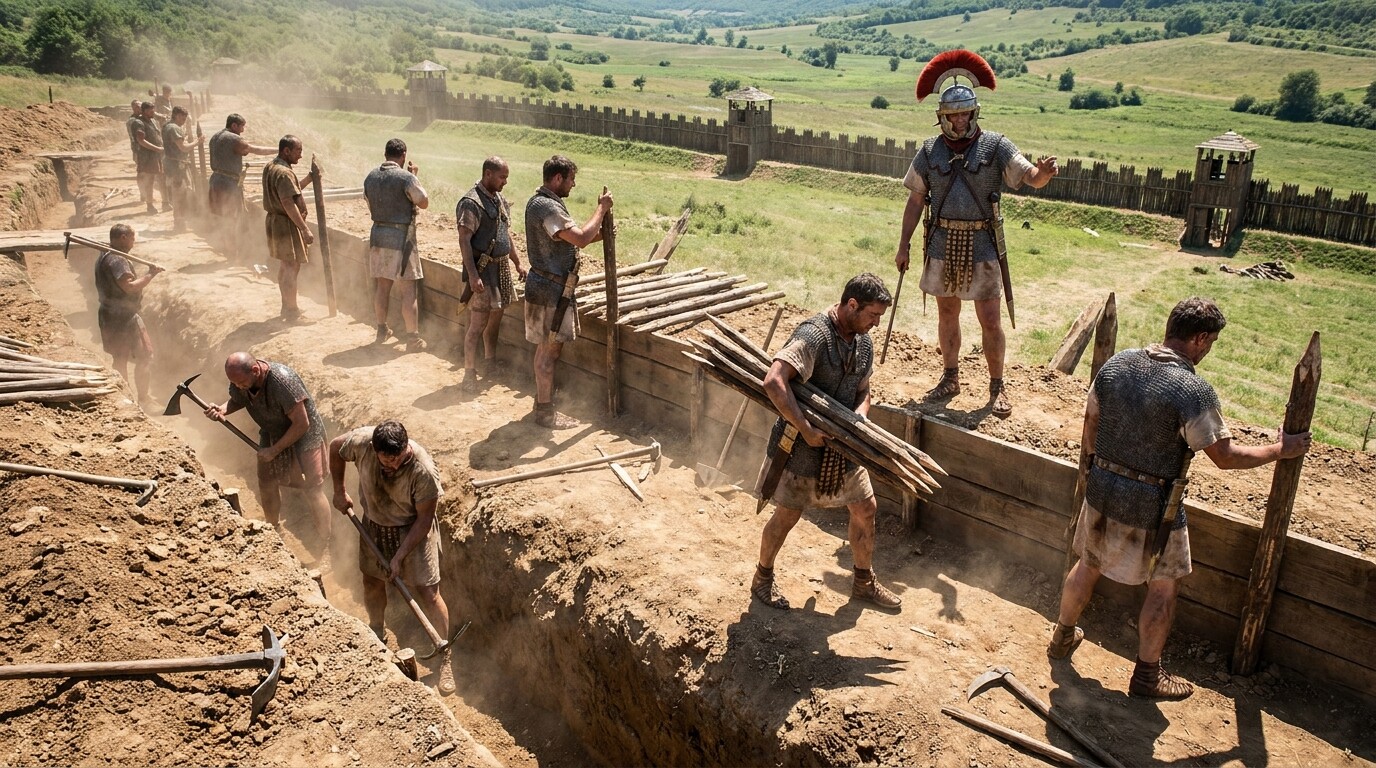
Caesar recognized immediately that a direct assault would be costly and likely unsuccessful. His legions had taken hilltop fortifications before, but those assaults had been expensive even when they succeeded. The approach he chose instead was total containment: build a wall around the entire hill, garrison it without interruption, and wait. The Roman term for this kind of encircling fortification was a circumvallation — a wall built to keep defenders in.
What made Alesia extraordinary was the second wall.
When Caesar's intelligence confirmed that a large relief army was forming — drawn from tribal contingents across Gaul, with war leaders competing to demonstrate their commitment to the rebellion — he ordered a second line of fortifications built facing outward. This contravallation would face the relief force. Together, the two concentric rings would allow Caesar to defend against attacks from both directions simultaneously with the same force, fighting from interior lines without having to divide his army and march into the open.
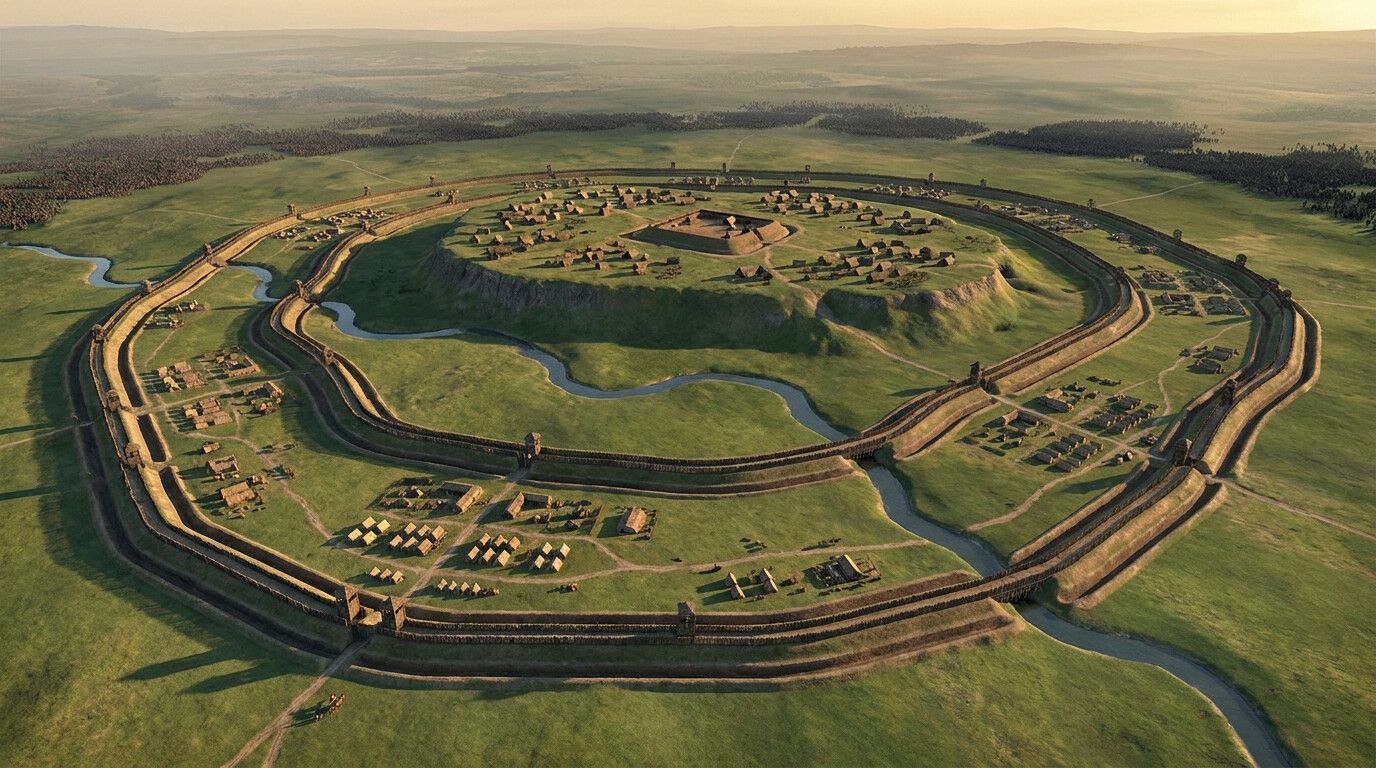
The engineering project that followed was one of the most ambitious military construction efforts of the ancient world, and it is documented in considerable detail by Caesar in De Bello Gallico. Modern archaeology — particularly excavations in the 1990s around Alise-Sainte-Reine in the Côte-d'Or department of France, the site associated by mainstream scholarship with ancient Alesia — has confirmed many of the structural details Caesar described.
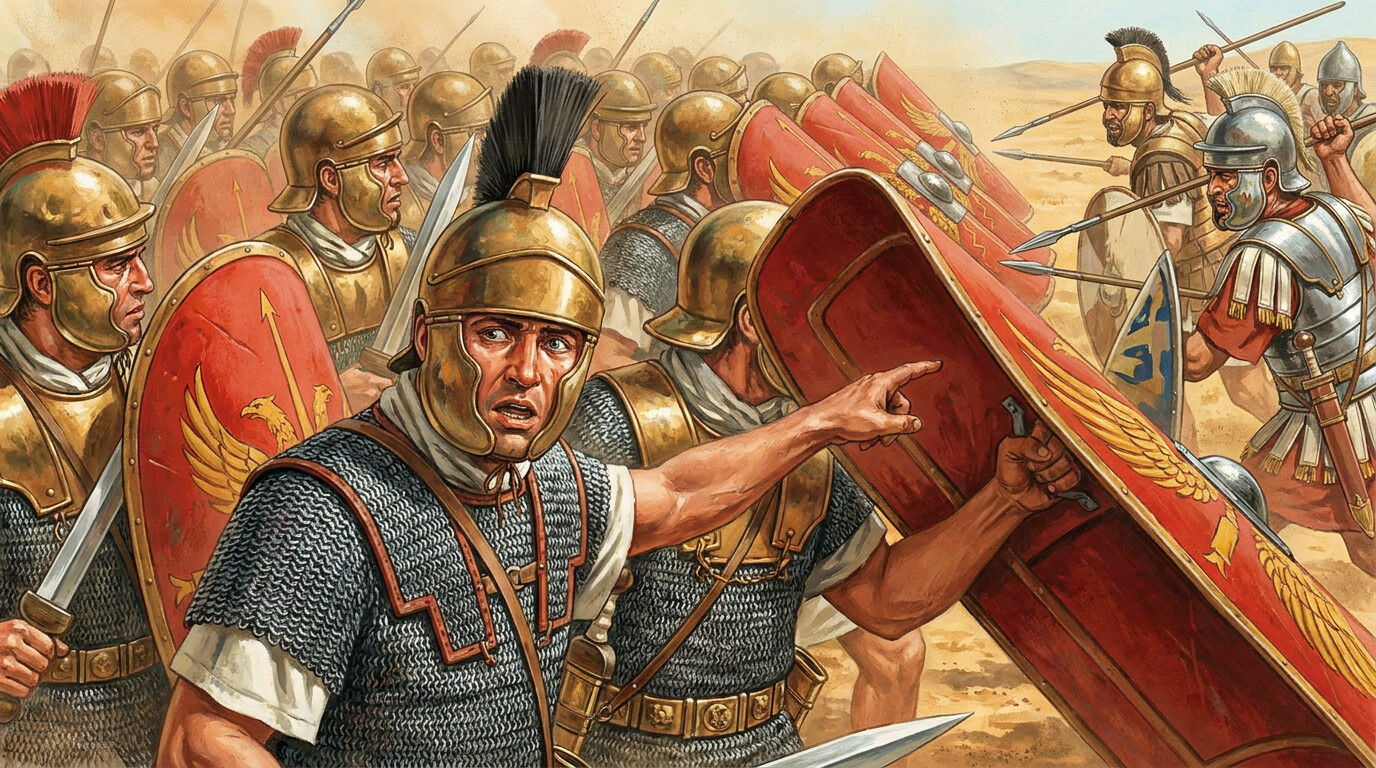
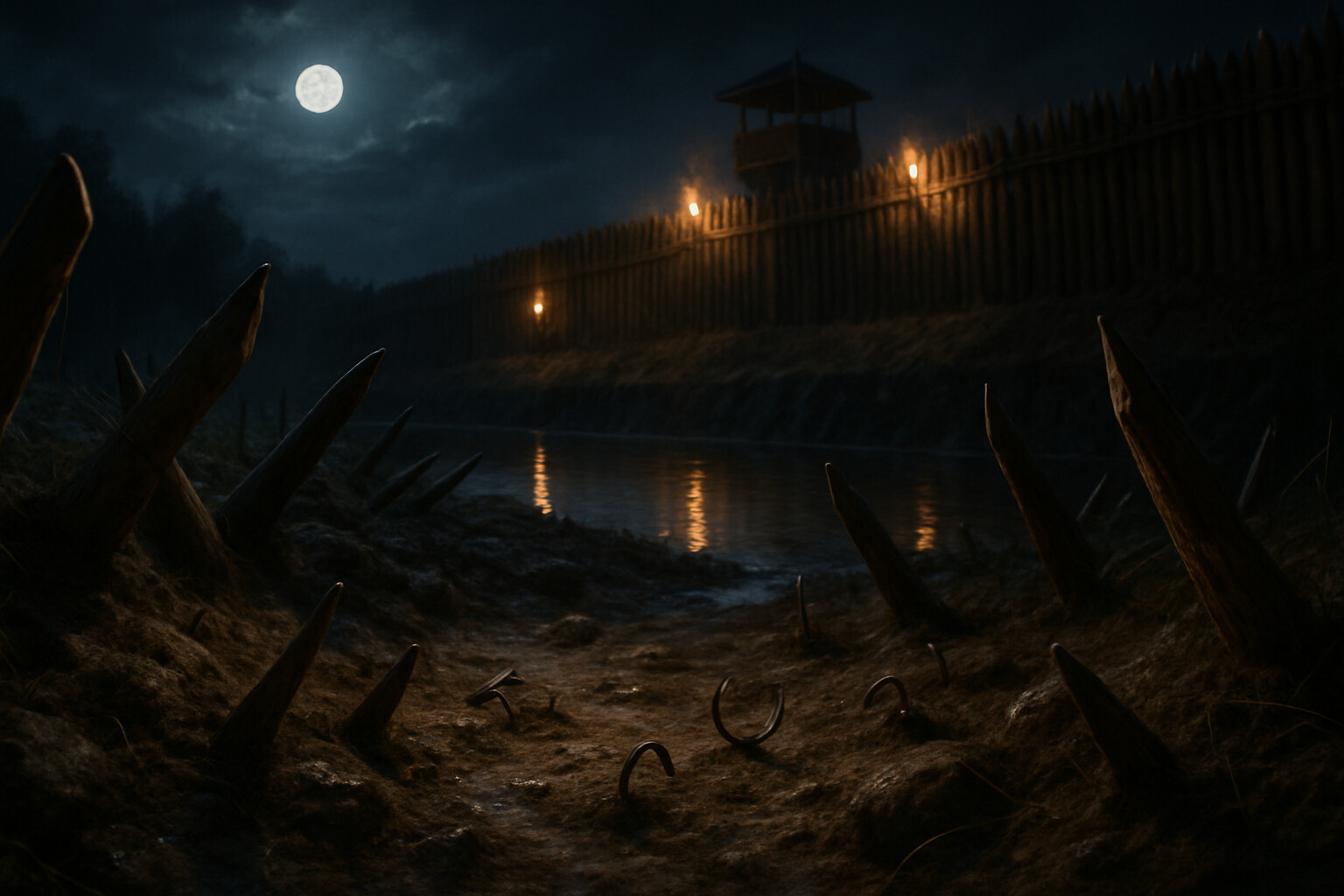
The circumvallation ran approximately eleven Roman miles — roughly sixteen kilometers — around the hill. The contravallation ran approximately fourteen Roman miles — roughly twenty-one kilometers — providing a larger perimeter facing outward. Both lines incorporated multiple obstacle systems. Caesar describes a double ditch in front of the main earthwork, with the innermost ditch on the circumvallation side flooded with water diverted from the rivers. Beyond the ditch and rampart were concealed fields: sharpened stakes set into hidden pits — which the legionaries called cippi, a sardonic reference to boundary markers — and iron barbed hooks called stimuli buried just beneath the soil surface. Towers rose at intervals along both lines, positioned close enough that artillery and archers could cover the ground between them. The artillery included scorpiones, torsion-powered bolt-throwers capable of accurate fire at several hundred meters, and heavier stone-throwing ballistae. A legionary standing at the palisade with his pilum was the last line in a killing system that began a hundred meters out in the obstacle fields.
The construction timeline cannot be established precisely from Caesar's account, which does not give explicit dates within the season. Modern scholars generally estimate three to six weeks from the beginning of investment to the completion of the main works — a figure inferred from the narrative pacing of De Bello Gallico rather than any explicit statement. That estimate, if accurate, represents an organizational and physical effort of the first order.
Caesar's army at Alesia is placed by modern historians at somewhere between forty thousand and sixty thousand men — six to eight legions at varying strength, plus auxiliary cavalry and supporting troops. Caesar himself does not give a clear aggregate figure, and ancient commanders' numbers require the same skepticism applied to all ancient military statistics. What is not in dispute is that the force was substantially outnumbered on both fronts and that the Roman supply situation, while better than the besieged garrison's, was not easy to maintain.
For several weeks after the investment was completed, conditions inside Alesia deteriorated. The grain supply was exhausted faster than anticipated. At some point — the exact timing is uncertain in the ancient record — Vercingetorix made the agonizing decision to expel the non-combatant civilians from the oppidum. The Mandubii — the tribe on whose land Alesia stood, and whose people had taken shelter there — were driven out through the gates. They descended toward the Roman lines below, hoping for food or mercy. Caesar, unable to feed them and unwilling to open his lines, refused to admit them. According to his account, they were left in the space between the walls. The sources do not record what ultimately became of them. It is one of the episode's most disturbing passages, and it sits in the record without mitigation.
The Gallic relief army arrived in stages. Caesar gives a figure of approximately two hundred and fifty thousand infantry and eight thousand cavalry, organized under a council that included leaders from virtually every major tribal group in Gaul, with a commander named Vercassivellaunus — named in De Bello Gallico as a cousin of Vercingetorix — leading the principal assault. Modern historians regard Caesar's relief army figures as significantly exaggerated. Numbers in the hundreds of thousands strain ancient logistics and command capacity well beyond what most armies of the period could sustain. The relief force was almost certainly very large; how large cannot be established with confidence from the surviving sources.
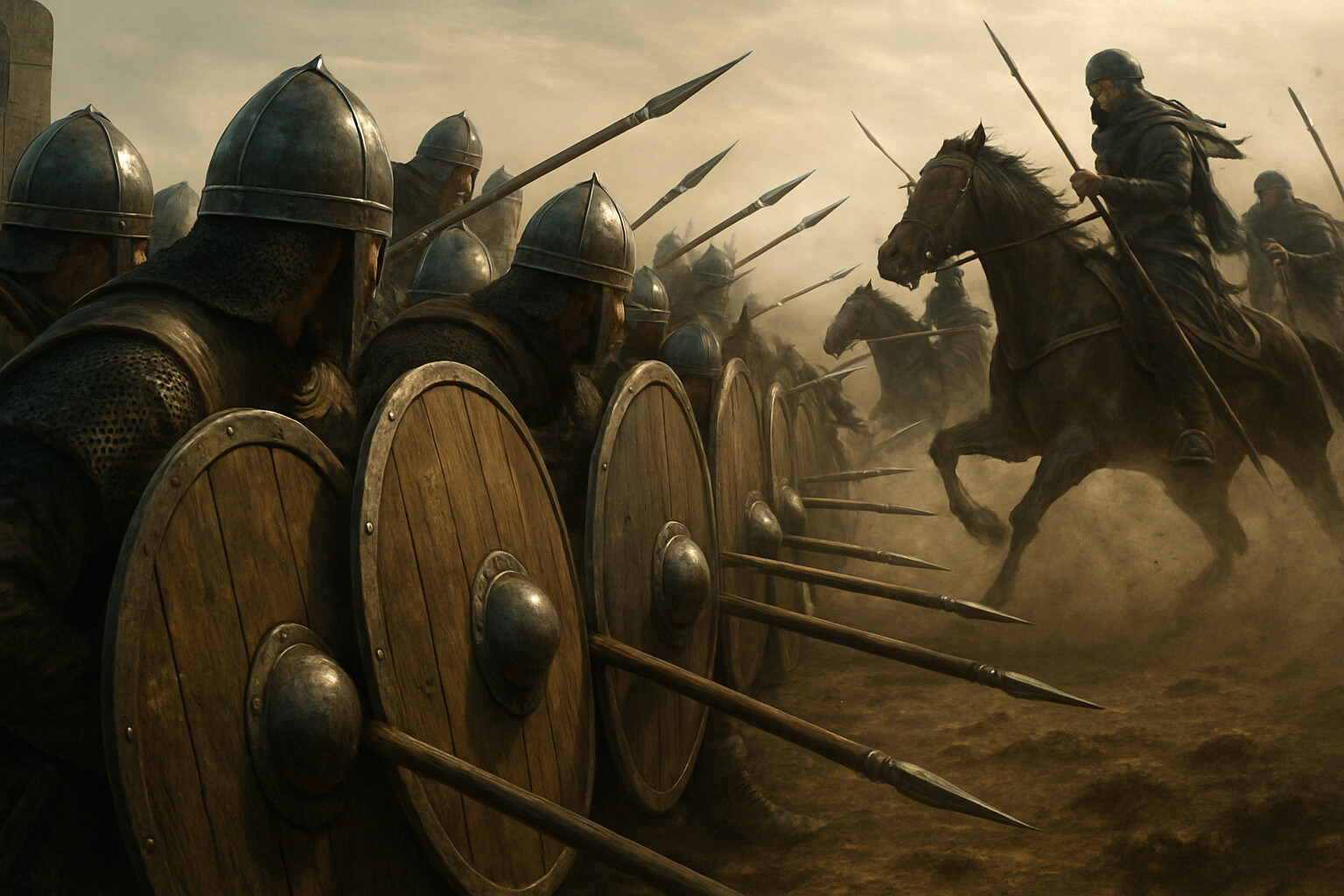
The relief army's first serious assault came against the outer contravallation. Gallic cavalry pressed hard against Roman positions, supported by infantry following closely. Caesar's Germanic cavalry auxiliaries — recruited from tribes east of the Rhine, fighting in a mixed cavalry-and-infantry formation that gave them durability in sustained contact — repulsed the initial horsemen. The infantry assault against the contravallation was beaten back by missile fire and the obstacle fields. But the relief force was reading the defenses, looking for weakness.
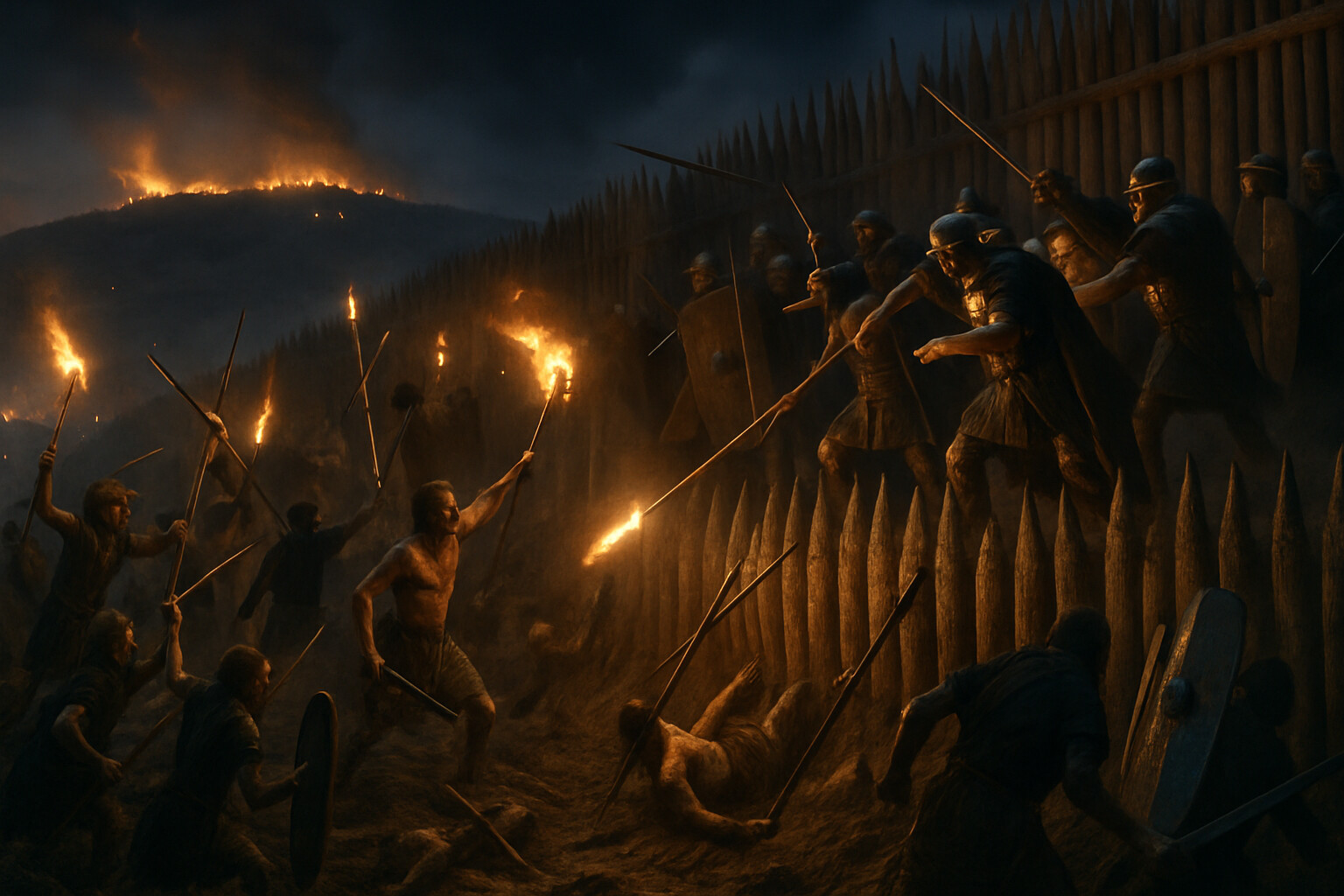
The most vulnerable point in Caesar's position was at the northern end of the fortification system, where elevated terrain — a feature Roman accounts associate with a prominent hill — made it impossible to run the wall along the same contour as elsewhere. Caesar placed two senior officers, Mark Antony and Gaius Trebonius, in command of this sector and positioned a reserve force behind it. He appears to have anticipated that it would draw the heaviest attack.
The decisive engagement came over the course of approximately two days. According to Caesar's account — which must be read with awareness of his authorial perspective on his own generalship — the relief army launched coordinated assaults that included a night attack against the outer contravallation timed to coincide with a major sortie from within Alesia against the inner circumvallation. The broad tactical logic is consistent with the situation: force Caesar to defend two walls simultaneously, find a sector where the pressure from outside and the pressure from inside could be made to coincide. The night attack is described with vivid specificity in De Bello Gallico. Its exact hour and the precision of the coordination with the inner sortie are reconstructed from that account and cannot be independently confirmed.
The fighting on the inner circumvallation was severe. Warriors from inside Alesia, watching the relief assault from the walls above, sallied out through the gates carrying everything available — filling the Roman ditches with bundled brush and timber to create crossing points, attacking the palisade with tools and with their hands, attempting to tear open a gap through which either they could escape or the relief force could enter. The Roman defenders on the circumvallation were fighting men who understood that surrender meant enslavement and that this was their last viable attempt.
At the northern sector, the relief force's main assault eventually broke through an outer line. Caesar committed his reserve and — as De Bello Gallico describes in one of the most cited passages of his Gallic narrative — personally led cavalry around the exterior to strike the relief force's flank. The combination of fresh troops arriving at the crisis point from an unexpected direction was decisive. The Gallic assault lost its cohesion. Unable to see how deep the Roman reserves were, battered by the obstacle fields and the sustained missile fire that had destroyed each successive wave, the relief force began to come apart. The cavalry struck the flank. The main assault column broke. The force withdrew from the walls.
Inside Alesia, the defenders watching from above could see the relief army falling back. The simultaneous sortie had failed. There was no breach. No second attempt of equivalent scale materialized.
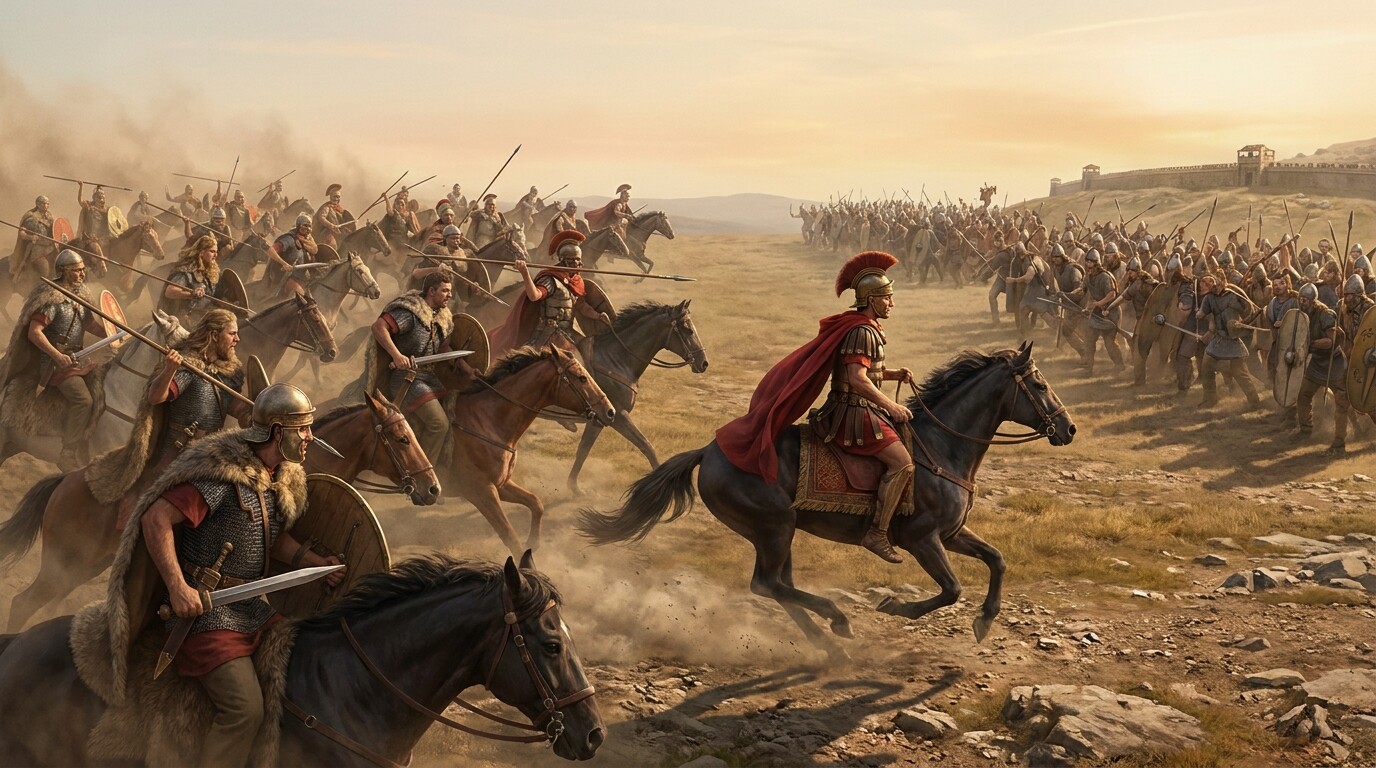
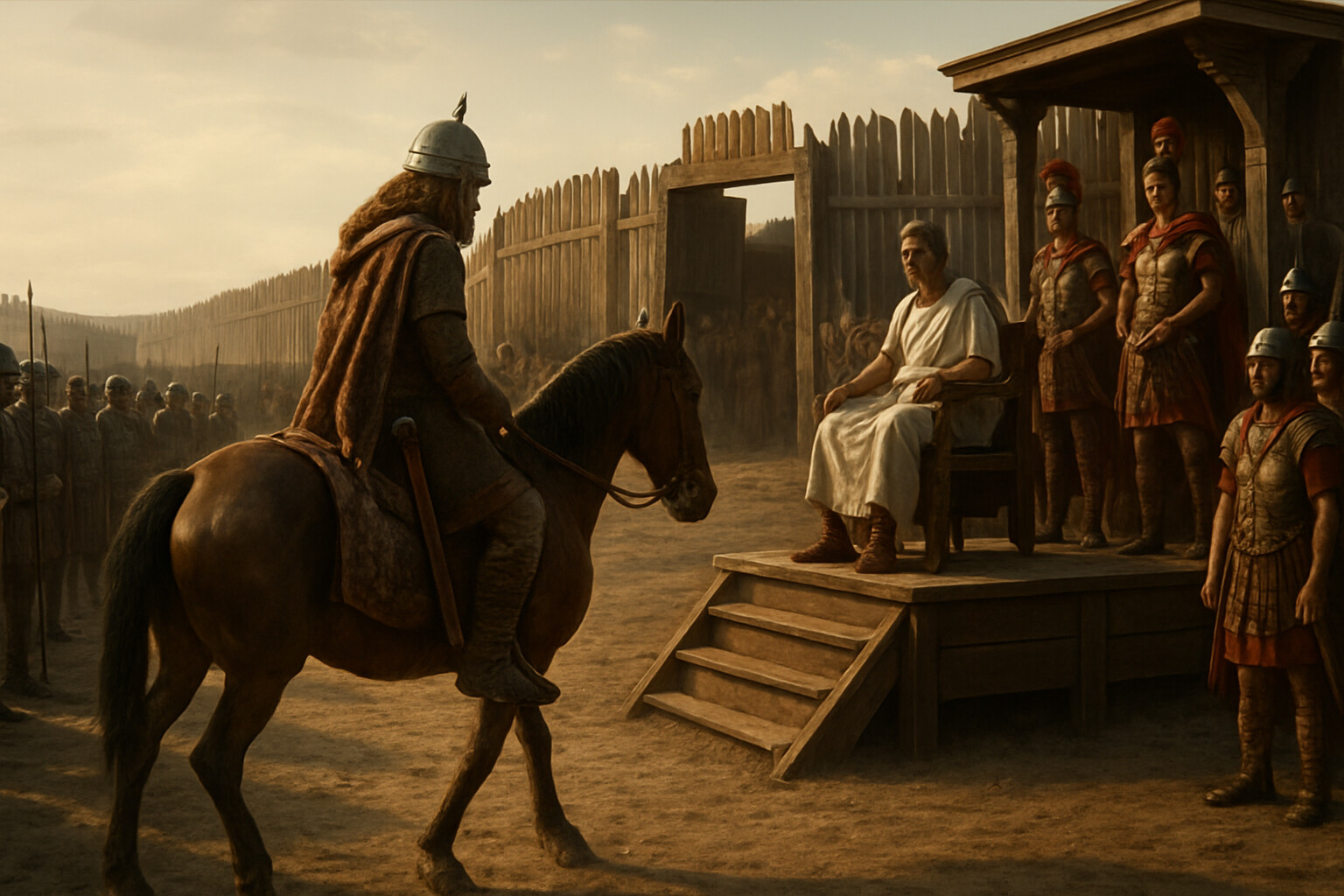
According to Caesar's account — with the caveat that his narrative pacing has some interpretive flexibility — Vercingetorix called a council the following day. The surviving ancient sources, including Caesar and the later Greek historian Plutarch writing approximately a century and a half after the events, describe a surrender ceremony in which Vercingetorix rode out from the gates of Alesia, fully armed and mounted, and laid down his weapons before Caesar's tribunal. Caesar's own account of this moment is terse. The more elaborated image — the chieftain circling the tribunal, dismounting with deliberate ceremony before placing his arms on the ground — comes primarily from Plutarch, who was not present and wrote long after the fact. The romantic dignity of the scene as it has come down through history owes as much to later literary elaboration as to the primary record. What is documented is the surrender itself and what followed: Vercingetorix was taken prisoner, transported to Rome, and held for approximately five years. He was displayed in Caesar's Triumph of 46 BC and then executed, as was Roman custom for captive enemy commanders after a triumph.
The human cost of Alesia cannot be stated with precision. Caesar's figures for Gallic casualties and prisoners carry the same credibility problems as his other numbers. The surviving garrison — those soldiers and civilians who lived through the siege — were distributed among the legionaries as slaves, with one documented exception: members of the Aedui and Arverni tribes were released rather than enslaved, a political calculation by Caesar aimed at rebuilding the cooperation of those two large confederacies. How many people had entered Alesia before the siege closed and how many survived it is not recoverable from the existing sources.
Alesia was not the end of military operations in Gaul. Scattered resistance continued through 51 BC, and one further significant siege — at Uxellodunum — was required before the province could be considered pacified. But Alesia broke unified resistance. The coalition that Vercingetorix had assembled through force of will and strategic clarity dissolved when its leader surrendered. No subsequent leader managed to reconstitute anything comparable.
The political effects of the victory were immediately legible in Rome. Caesar had a triumph. He had a province. He had revenues and loot and — crucially — he had demonstrated to the Roman political world that his years in Gaul had produced a result of the first order. His enemies in the Senate, who had been maneuvering against him throughout the campaigns, could not easily argue with Alesia. His position — financially, politically, militarily — was transformed by it. The road from Alesia to the Rubicon was not straight, and nothing about it was inevitable, but Alesia gave Caesar the standing to make that crossing at all.
What Caesar built at Alesia also passed into the literature of military engineering. The double-wall concept — simultaneous circumvallation and contravallation — was not original to Caesar. Scipio Africanus had used related forms, and the underlying principle was well established in Hellenistic siegecraft. But no other documented commander had executed it at this scale, with this construction speed, against this kind of simultaneous pressure from two directions. The works at Alesia became a reference point that later Roman military writers returned to as an example of what systematic engineering could accomplish against superior numbers.
The archaeological record around Alise-Sainte-Reine has produced physical confirmation of many of the structural details Caesar described. The postholes and ditch systems have been identified and mapped through successive excavation campaigns, most notably the Franco-German work of the 1990s that used modern survey methods to trace the fortification lines across the contemporary landscape. A minority academic position argues for a different site entirely — Chaux-des-Crotenay in the Jura has been proposed — but this view is not accepted by mainstream archaeology, and the weight of current geographical and archaeological scholarship places Alesia at or very near the modern town.
Vercingetorix himself has undergone a parallel historical transformation that runs alongside the military history without touching it. In nineteenth-century France, in the context of nation-building and the search for a pre-Roman French identity, he was elevated to the status of founding national hero — a symbol of resistance to foreign domination. Enormous statues were commissioned. His image appeared on coins and public monuments. Napoleon III, who personally funded the major mid-nineteenth-century excavations at Alise-Sainte-Reine, had a monumental bronze statue of Vercingetorix erected on the plateau in 1865. This nationalist recasting is historically problematic on its face. The Gauls of 52 BC had no national identity in any modern sense. The coalition Vercingetorix led was a fragile construction of competing tribal interests held together by strategic urgency and his own authority. It began to fracture even before the surrender. The idea of Vercingetorix as a proto-French patriot reflects nineteenth-century political need, not first-century BC reality.
The fortifications Caesar built at Alesia were temporary. They were dismantled or simply decayed after the army moved on. What they accomplished was not. The containment of coordinated Gallic resistance opened four centuries of Roman rule. Latin took root in Gallic soil and, across those centuries, grew into what would eventually become French. Roman administrative structures shaped the geography of a continent. Roads Caesar's engineers built or improved left traces still visible in modern French infrastructure.
None of that was visible or certain in late summer of 52 BC, when a Gallic chieftain rode out of a gate, dismounted, and placed his weapons on the ground in front of a proconsul from Rome.
What was certain was the wall. Eleven miles of it facing inward. Fourteen facing out. Every ditch, every concealed stake, every bolt-thrower positioned exactly where it needed to be. Against every probability of logistics, engineering, and tactical coordination, built in weeks and held under simultaneous pressure from two directions, it had not broken.