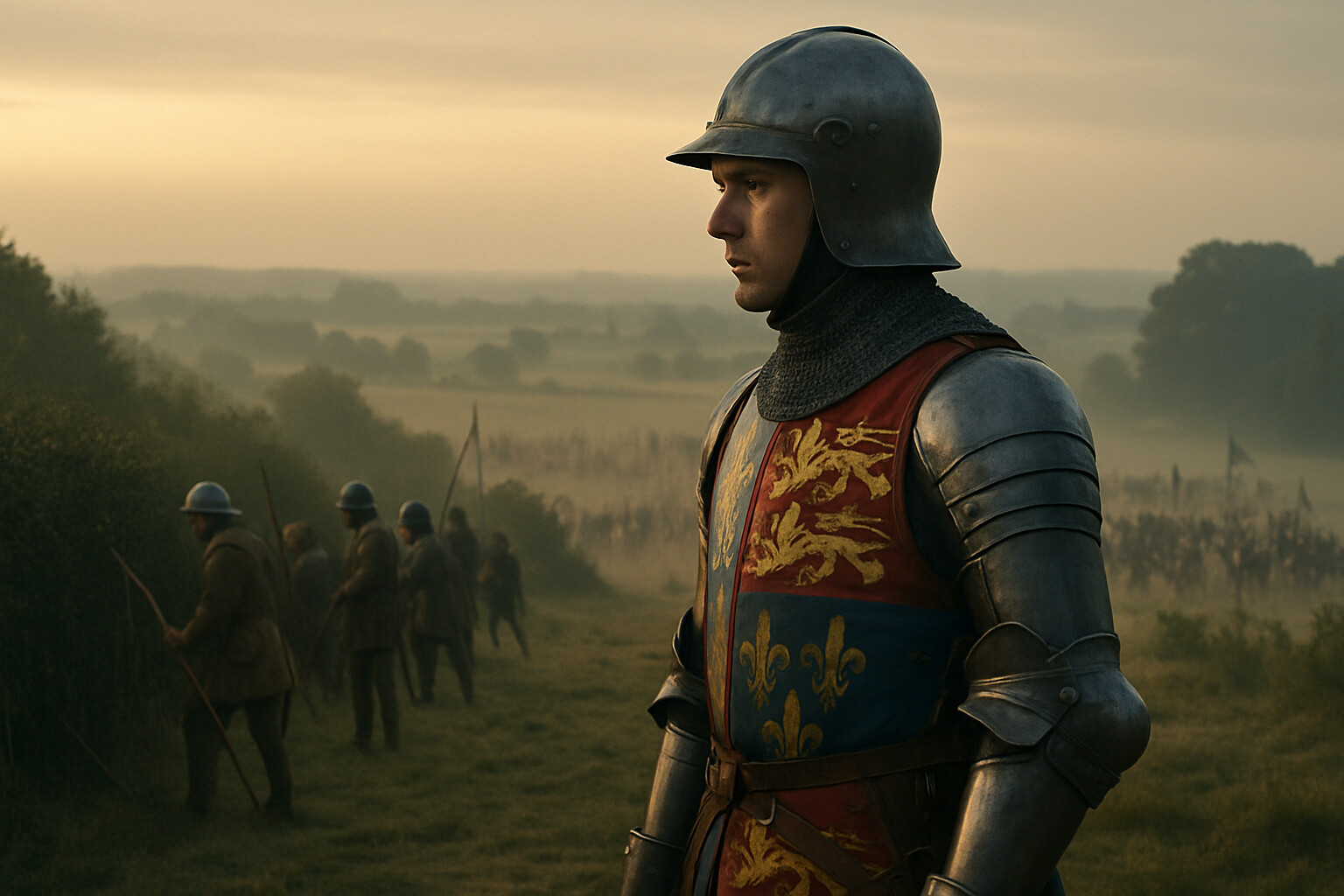
The ridge smelled of late-summer wheat and horse dung. Along its crest, between a hedge line and a muddy lane, men stood in ranks and waited. It was the morning of 19 September 1356, and Edward of Woodstock, Prince of Wales, had nowhere left to run.
He was twenty-six years old, a veteran of Crécy at sixteen, and he had spent the past month leading a chevauchée—a deliberate campaign of destruction—through the heartland of France. His army had burned its way from Périgueux northward, collecting plunder and stripping the countryside of anything that could feed or enrich the French crown. Now the French crown had caught up with him.
Behind the hedge stood perhaps six to eight thousand men. In front of it, according to the chronicler Jean Froissart, marched a French army that some contemporaries estimated at three times that number. Modern historians treat those figures with caution—medieval army counts were notoriously unreliable—but the French force under King Jean II substantially outnumbered the Anglo-Gascon army; that much is not in scholarly dispute. The Prince could not retreat; French cavalry had closed the roads. He could not resupply; his wagons were already loaded with plunder and his men were short of provisions after weeks in the field. What he could do, and what he did with considerable skill, was choose the ground.
---
Edward of Woodstock was born 15 June 1330 at Woodstock Palace in Oxfordshire, the eldest son of King Edward III of England and Philippa of Hainault. His later sobriquet—the Black Prince—does not appear in any source from his own lifetime. It surfaces in the sixteenth century, and its precise origin remains a matter of scholarly debate, with theories ranging from black armor to the terror his campaigns inspired. During his own era he was known simply as the Prince of Wales, a title conferred on him at the age of thirteen.
He was blooded young. At sixteen he commanded the right wing of the English army at the Battle of Crécy in August 1346, a position of genuine responsibility even allowing for the experienced advisors at his side. Crécy established a tactical template that would reappear at Poitiers: archers positioned on the flanks, men-at-arms dismounted in the center, and a disciplined refusal to charge until the moment was right. The French at Crécy had sent their cavalry and their Genoese crossbowmen against that template and been shattered. Edward had watched it work.
In the decade between Crécy and Poitiers he had campaigned in France, attended to duties in England, and developed the administrative and political skills that made him, in the judgment of contemporaries, one of the more capable commanders of his generation. When his father authorized the chevauchée of 1356, Edward was the natural choice to lead it. He was given command of an Anglo-Gascon force assembled in Gascony—the English crown's continental duchy in southwestern France—and instructed to ride north and strike into the French heartland. The strategic logic was brutal and deliberate: the chevauchée was not primarily a battle-seeking operation. It was an economic and psychological attack. By burning crops, sacking towns, and demonstrating that the French crown could not protect its own territory, the English aimed to erode French royal legitimacy and pressure Jean II toward a favorable peace or a costly ransom arrangement.
Edward executed the mission through July and August 1356 with methodical efficiency, moving through Berry and the Touraine. By mid-September the French king had assembled a substantial army and was moving to intercept him. The English were north of the Loire, heavily laden with plunder, and the river crossings behind them were contested. Edward turned south and tried to disengage. The French matched his movements. By 17 September the two armies were in contact near Poitiers, and despite attempts at negotiation—the papal legate Hélie de Talleyrand-Périgord spent part of 18 September shuttling between the camps attempting to broker terms—no agreement was reached. Jean II would not accept conditions he considered inadequate. Edward, by some accounts, offered to return all prisoners and plunder and to refrain from fighting in France for seven years. The French king reportedly demanded the Prince himself as a captive. The talks collapsed. These accounts of the negotiating positions reach us only through chronicle sources and may reflect later diplomatic shaping rather than verbatim terms.
On the night of 18 September, Edward finalized his dispositions on a low ridge south of the village of Maupertuis, near the Forest of Nouaillé, roughly six miles from Poitiers. The ground would matter enormously.
---
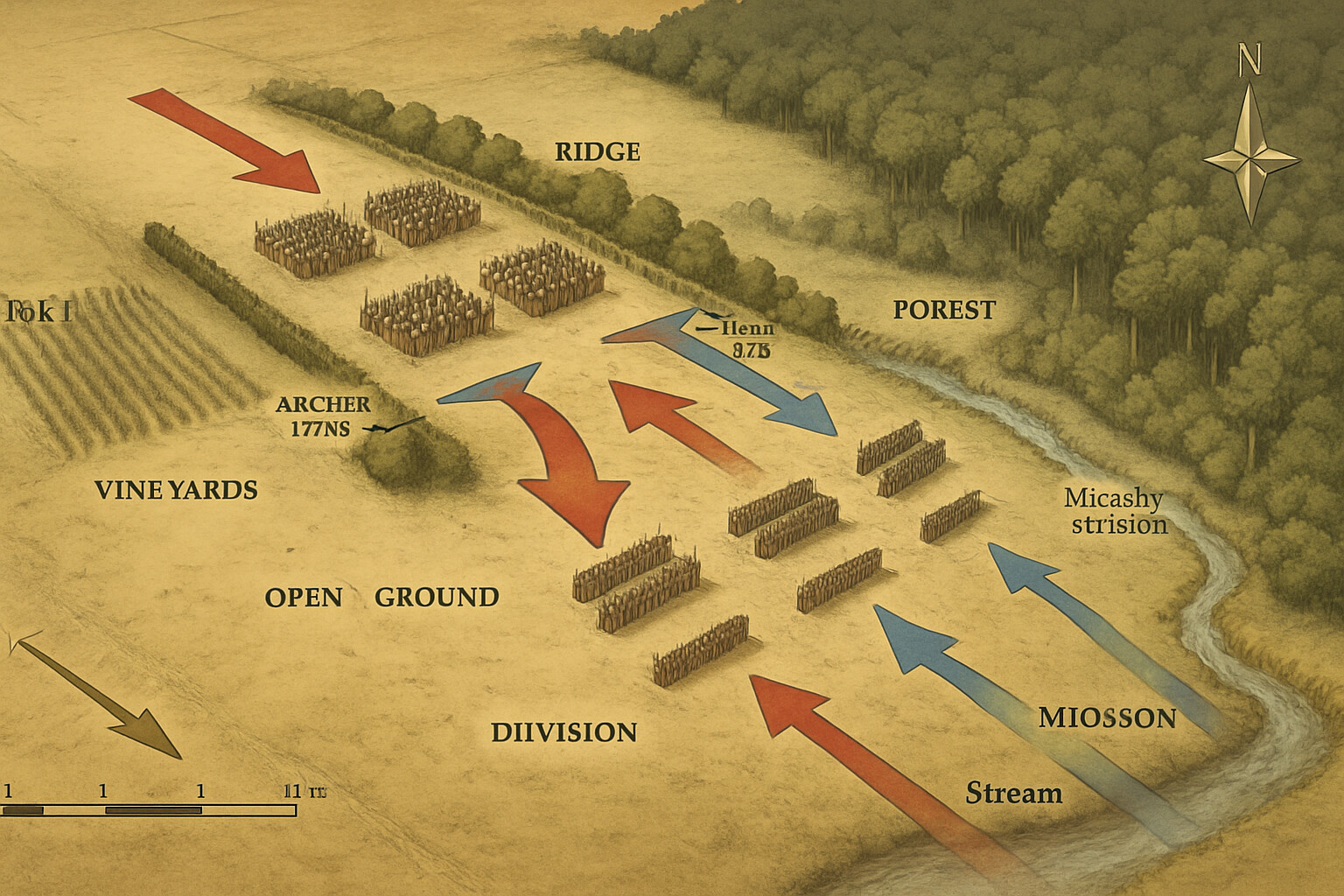
The battlefield that Edward selected—or more precisely, the battlefield that geography and pursuit had imposed on him while he worked to make the best of it—was a narrow corridor of cultivated land between the forest and the open plain. The ridge ran roughly north to south. The English right flank was anchored by a marshy stream, the Miosson, and thick woodland. The left flank was covered by vineyards and boggy ground. A dense hedge dominated the center of the position, reinforced by dismounted men-at-arms dug in behind it. A sunken lane ran along part of the front, adding another obstacle for any attacker. These terrain features are drawn from chronicle descriptions and later site studies; the exact ground configuration may have changed across seven centuries.
Edward organized his force into three divisions, called battles in the terminology of the period. The vanguard was commanded by the Earls of Warwick and Oxford. The rearguard was under the Earls of Salisbury and Suffolk. Edward himself commanded the center. A small mounted reserve—perhaps three hundred cavalry—was kept concealed behind the ridge. The Gascon contingent, fighting for the English crown as vassals of the Duchy of Aquitaine, was integrated throughout the force alongside English, Welsh, and other soldiers.
The archers were positioned in advance of the main line on the flanks, angled to create overlapping fields of fire that could strike an attacker from two directions simultaneously. This was not improvised. It was the standard English battle formation proven at Morlaix in 1342 and at Crécy in 1346, and it would prove effective again at Agincourt in 1415. The longbow archers needed open ground with clear sightlines and flanks protected enough that cavalry could not simply ride around and cut them down. The terrain at Poitiers provided exactly those conditions.
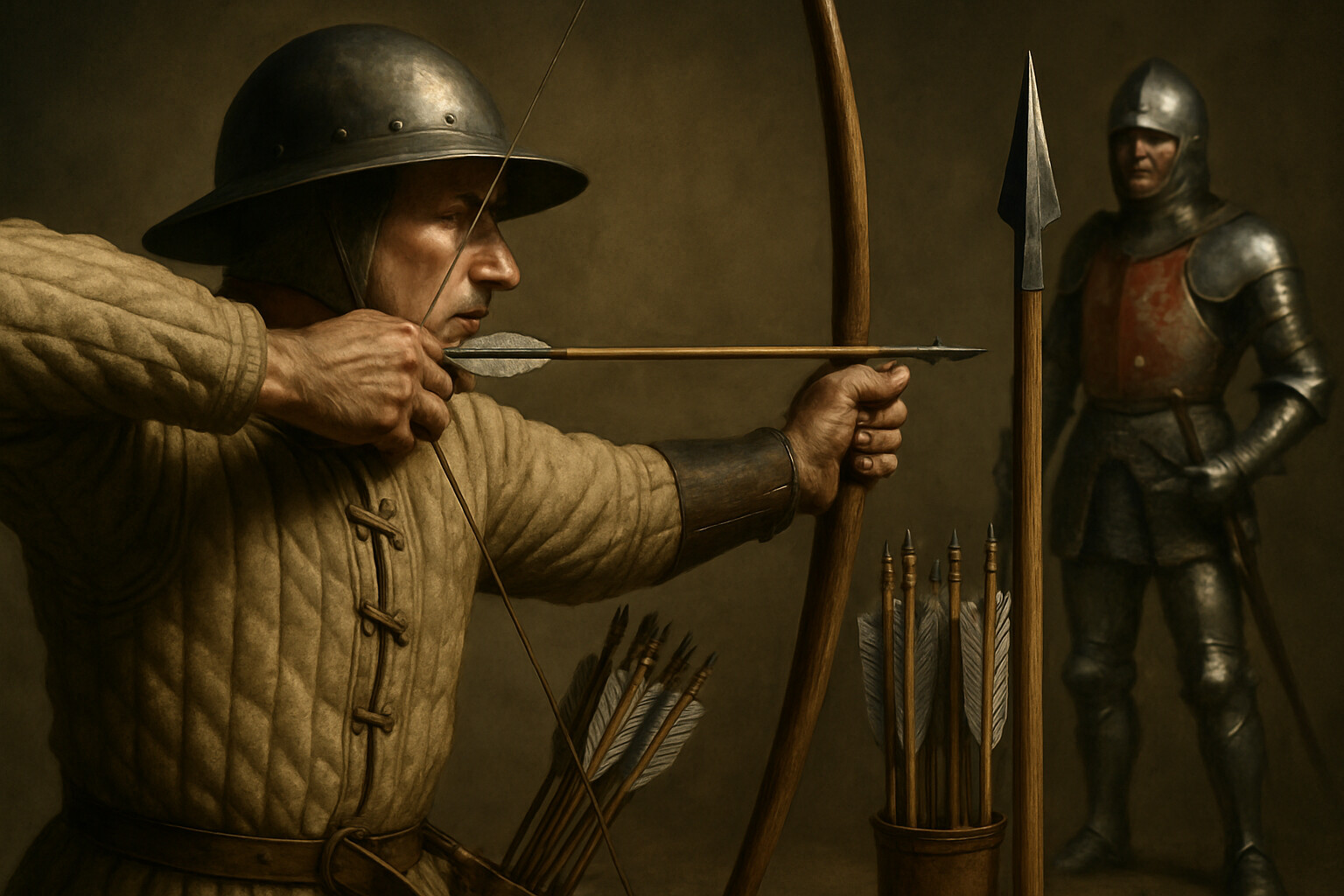
The longbow—the primary English battlefield weapon of the period—deserves careful description, because its effect on what followed was decisive. The English war bow of the mid-fourteenth century was a self bow, almost always fashioned from yew, standing between five and six feet in length. Modern analysis of surviving bows from the wreck of the Mary Rose, sunk in 1545, suggests draw weights ranging from roughly 100 to 185 pounds—substantially heavier than most modern sporting bows. Sustained use of such a weapon across a battle required men trained from boyhood, and the physical evidence is visible: excavated medieval archers' remains show asymmetric bone growth in the left arm and shoulder and stress markers consistent with years of heavy conditioning.
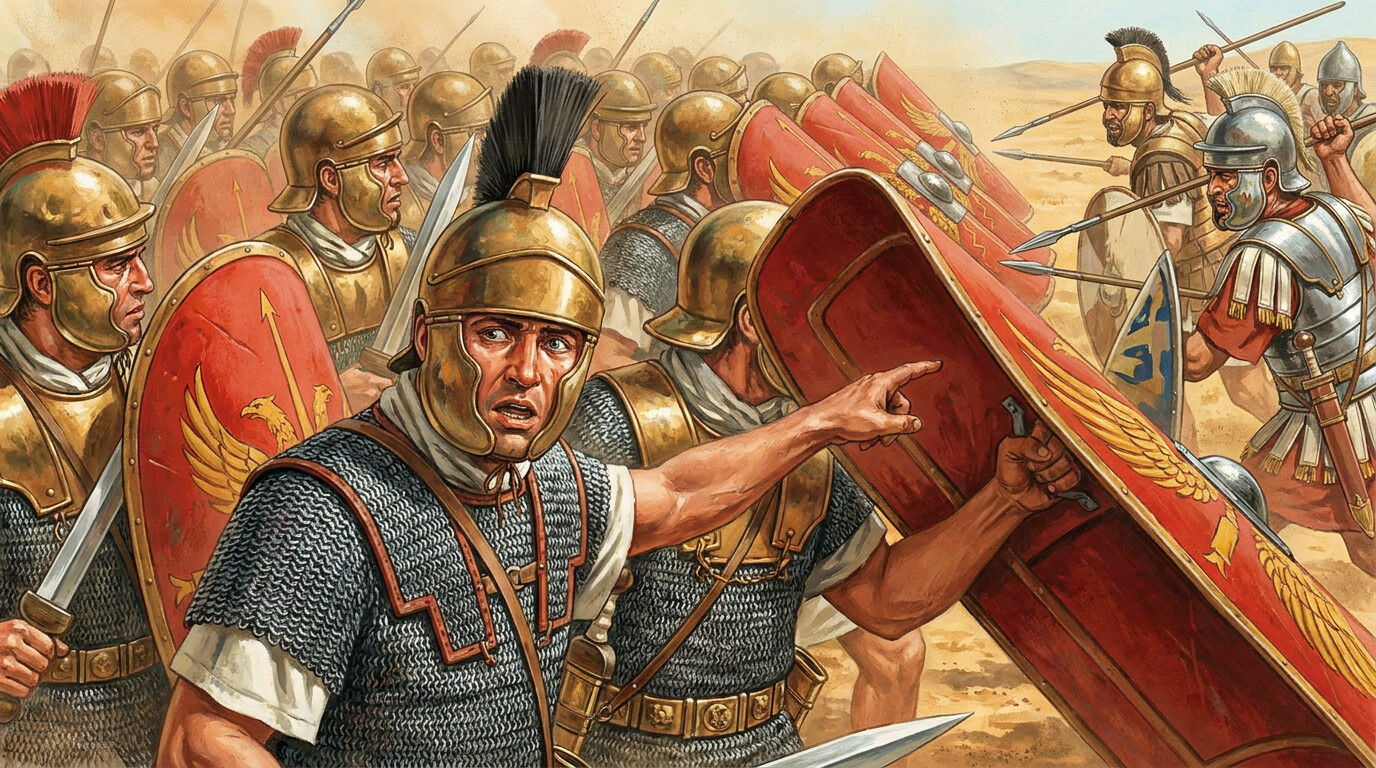
At battle ranges of roughly 50 to 250 yards, arrows tipped with iron bodkin points could not reliably punch through the plate armor of a well-equipped man-at-arms. That distinction matters. The English longbow did not kill armored knights by defeating their plate. It killed and incapacitated horses. It found gaps in armor: visors, armpits, the backs of knees. It struck lightly armored servants and foot soldiers. It produced wounds that accumulated across a formation under sustained fire, disrupting cohesion, panicking horses, and forcing men to dismount or seek cover. The psychological effect of thousands of arrows descending on advancing cavalry was significant and is well documented in narrative sources of the period.
The French knew about the longbow. They had been on the losing end of it at Crécy. Jean II's response was to learn from that experience, at least in part. His plan at Poitiers was to dismount a substantial portion of his men-at-arms and advance on foot, removing the vulnerability of horses to arrow fire. He organized his army into four divisions: the first under the Constable of France and the Marshals, the second under the Dauphin Charles, the third under the Duke of Orléans, and the fourth under Jean II himself.
---
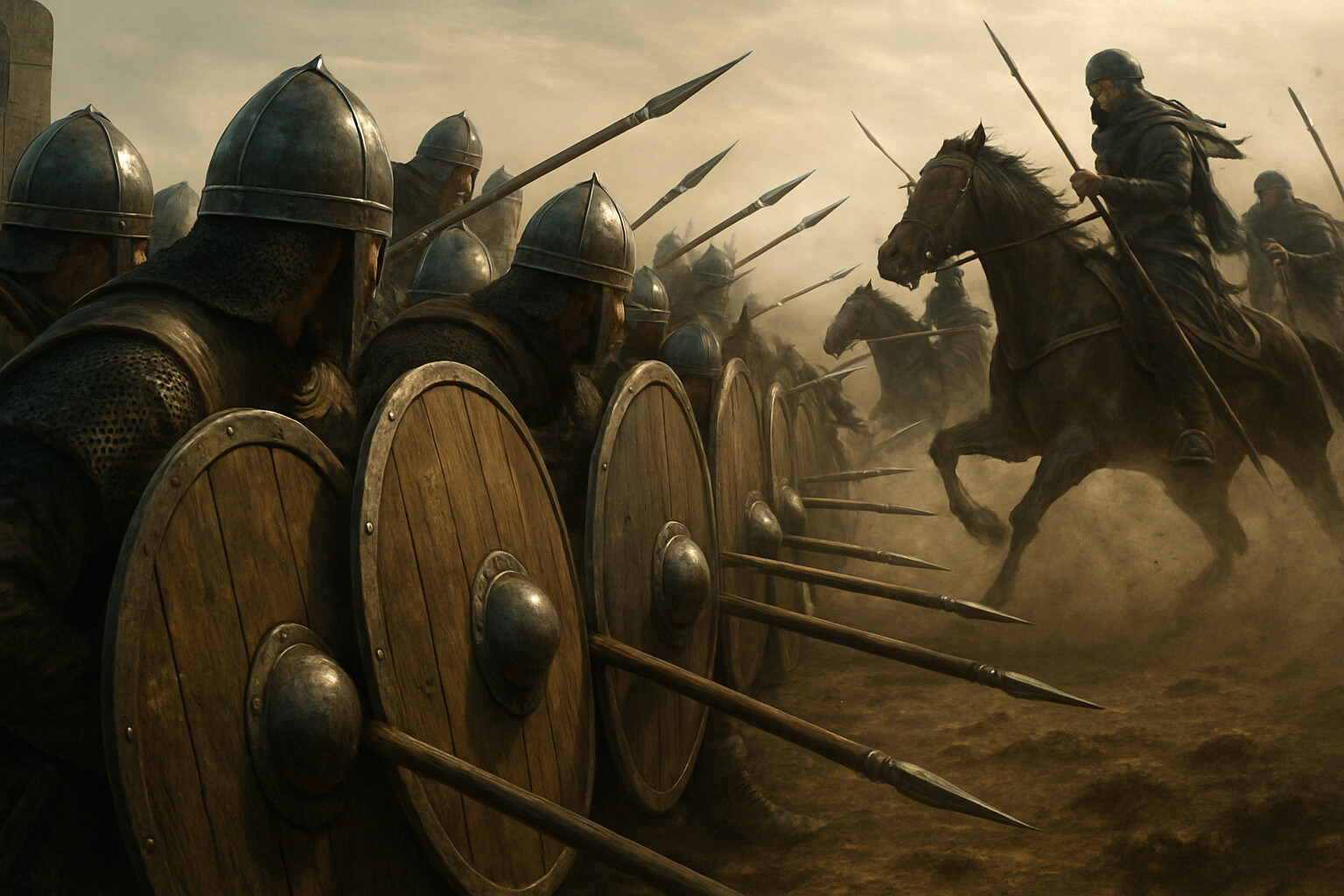
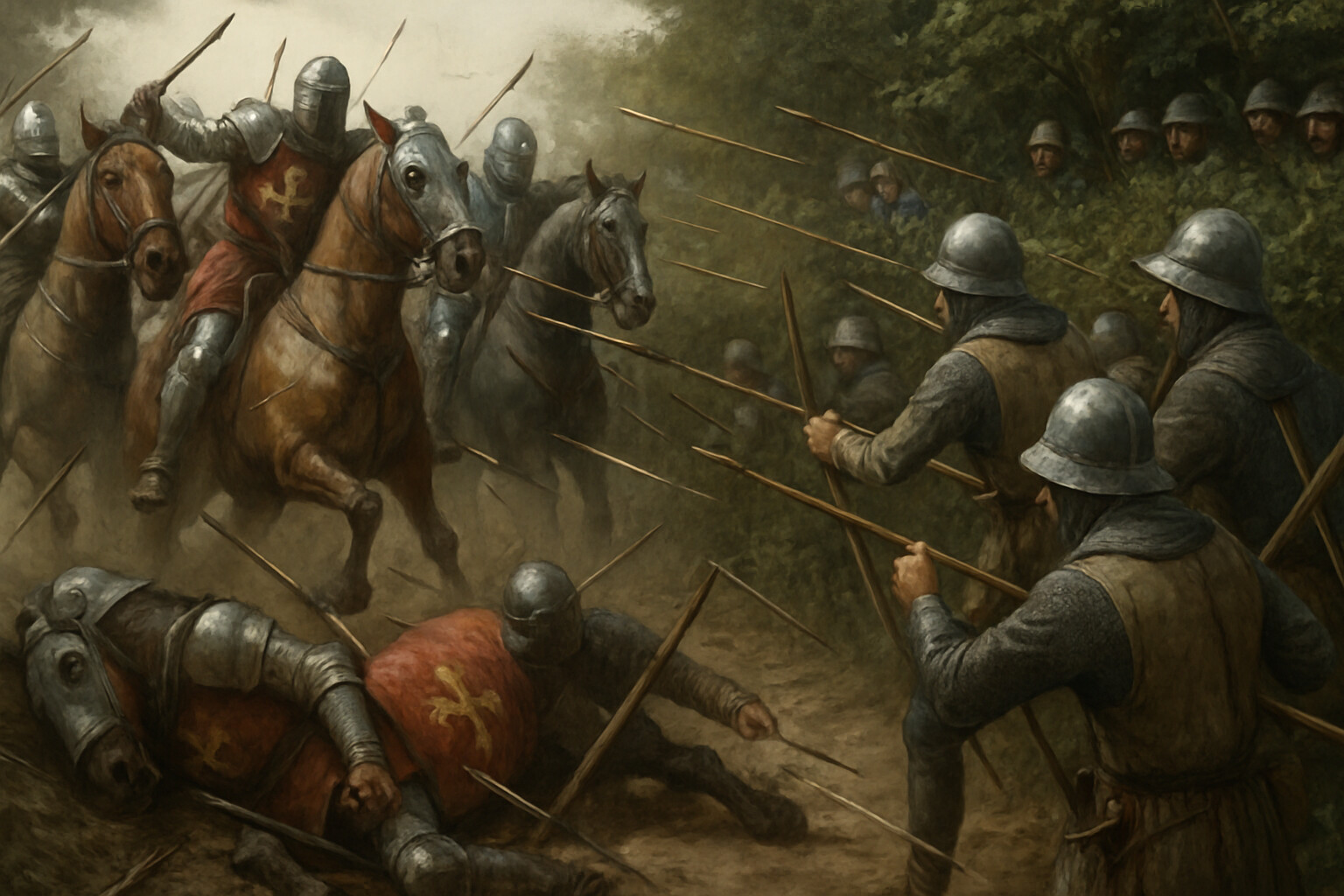
The battle opened with a French cavalry charge by the vanguard division under the marshals—perhaps three hundred mounted men-at-arms attempting to clear the lane and break the hedge. The longbowmen on both flanks, particularly those under the Earl of Oxford on the English right, poured fire into the flanks of the advancing column. The lane was narrow enough that the cavalry could not deploy into line; they came forward in a compressed mass that concentrated the targets. The charge was broken. Contemporary sources, including the Anonimalle Chronicle and Froissart's later account, agree that the survivors fell back in disorder.
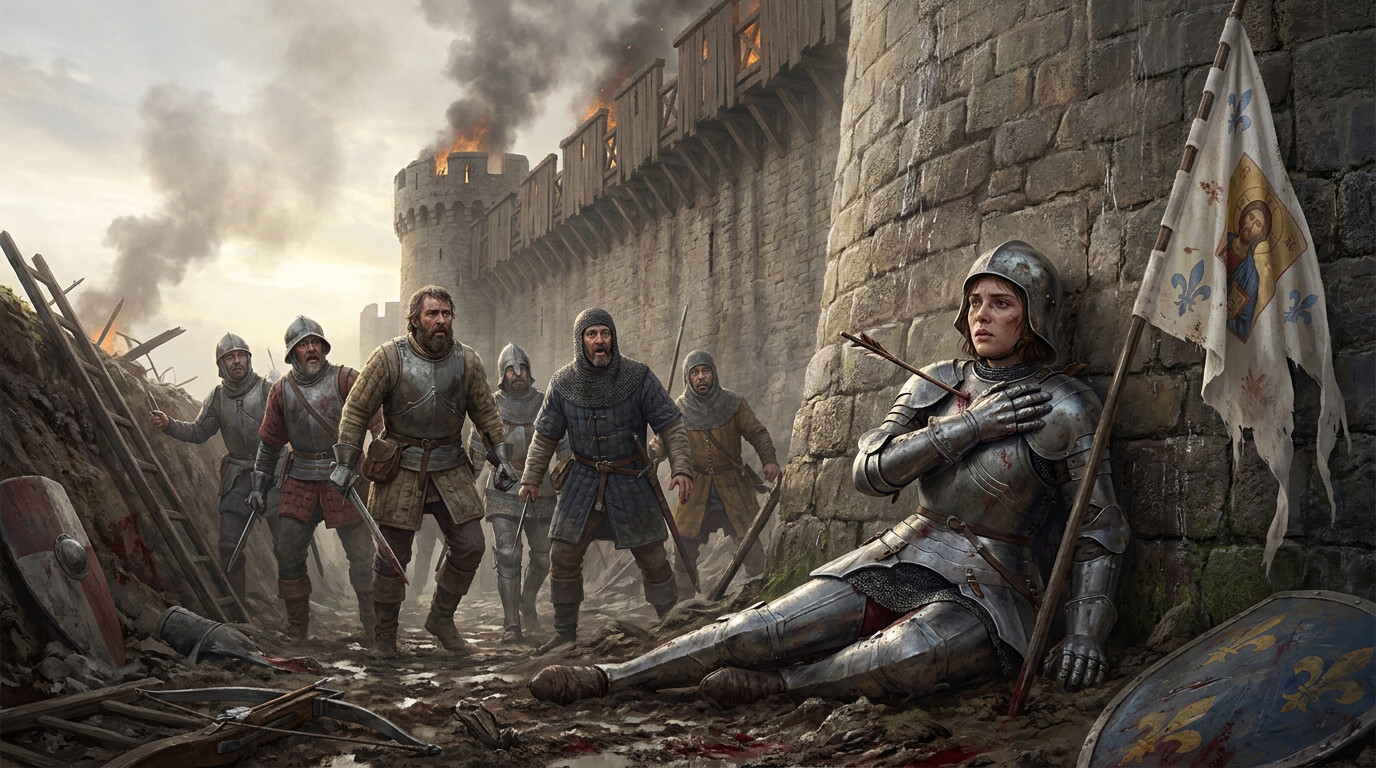
The Dauphin's division—the largest of the French battles—then advanced on foot. Dismounted men-at-arms in full plate armor, moving forward across contested ground under arrow fire, presented a different and more serious challenge than cavalry. Arrow impact on plate was reduced. But the advance was slow: men in full harness covering several hundred yards of uneven ground arrived at the hedge already fatigued, and the cumulative effect of arrow wounds to horses, servants, and lightly armored retainers degraded the division before it struck the English line. When it did strike, hard fighting followed. The Anonimalle Chronicle describes intense close-quarters combat at the hedge. The Dauphin's division eventually pulled back, battered and disorganized.
Then something occurred that has puzzled historians for more than six centuries: the division under the Duke of Orléans quit the field before engaging. Whether this was panic, misread orders, a deliberate withdrawal by Orléans, or the result of leadership losing cohesion in the confusion of the Dauphin's retreat is not clearly established in the sources. Froissart presents it as a rout. Other accounts are less certain. What is documented is that the third French division effectively ceased to exist as a fighting force without making contact with the English line. This left Jean II's own division—the largest remaining formation—to continue the battle alone.
At this moment, Edward made the decision that defined the engagement. His archers were running low on arrows—a recurrent and serious logistical problem for English forces of the period, noted in chronicle sources though exact quantities are not recorded. The Gascon captain Jean de Grailly, the Captal de Buch, commanding cavalry on the English left, had been held in reserve. Edward now ordered a general advance: the dismounted men-at-arms would push forward from the hedge, and the Captal's cavalry would swing wide around the French flank and strike from the rear.
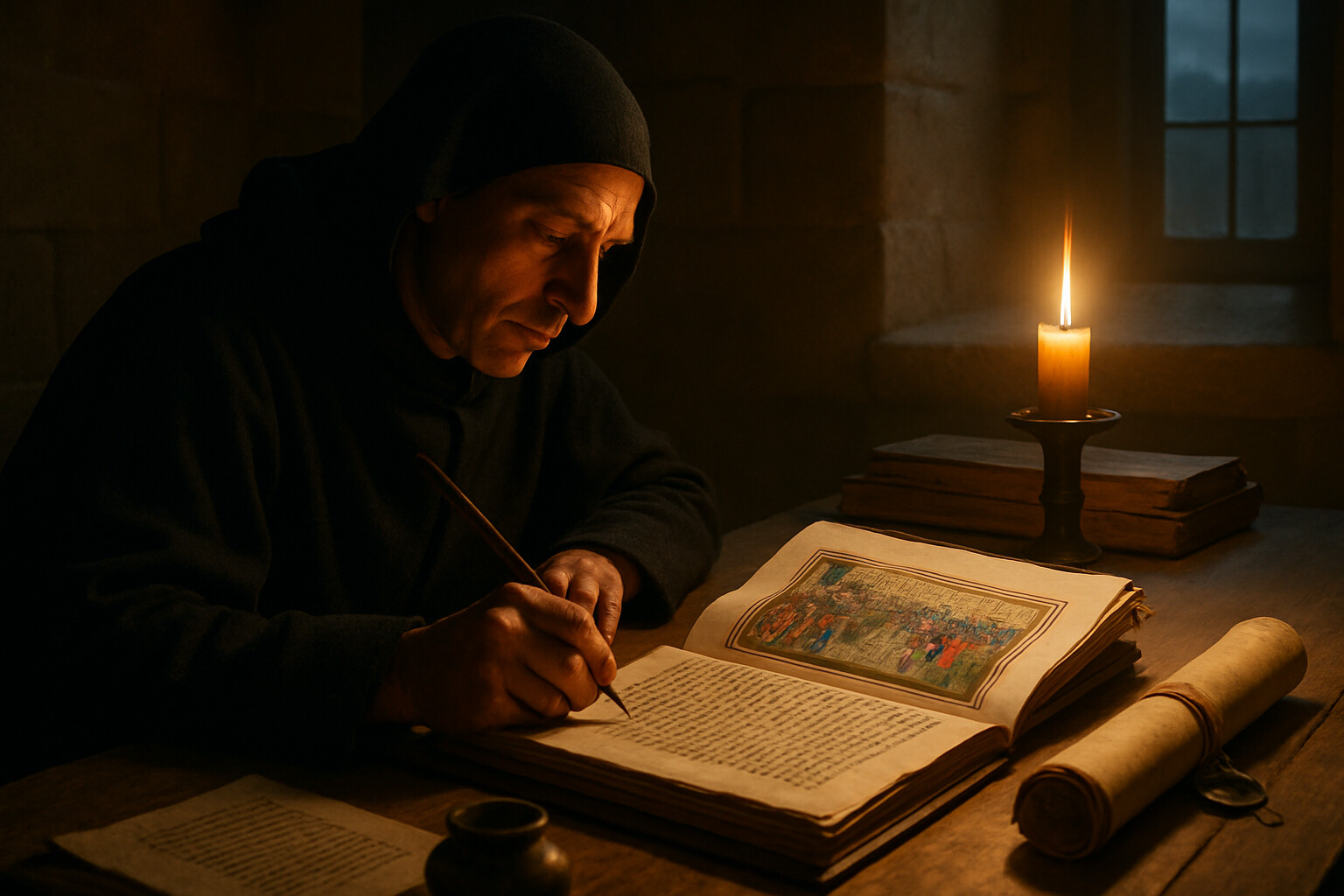
This was the tactical pivot of the battle. It required coordination under pressure and confidence that the French formation, though still formidable, was sufficiently disrupted to be broken by a combined counterattack. Jean Froissart, writing several decades after the battle and working from accounts gathered across multiple sources of varying reliability, describes the advance with dramatic detail. The Anonimalle Chronicle and the later verse biography of the Black Prince composed by the Herald of Sir John Chandos provide additional accounts, though each source carries its own limitations and biases.
The French rearguard met the advancing English with determined resistance. Jean II fought personally. The Chronicle of Jean de Venette, a French source, acknowledges the king's courage. Jean II was surrounded by his personal retainers and his youngest son Philippe—later Philippe the Bold, Duke of Burgundy—who fought at his side. The French line held for a time. Then it was struck from multiple directions simultaneously: English men-at-arms pressing from the front, Gascon cavalry hitting from the flank and rear. The formation broke.
Jean II was taken prisoner. The specific circumstances of his capture are contested across the sources. A knight named Denis de Morbecque—a nobleman from Artois who had entered English service after exile from France—appears in several French sources as the man who accepted the king's surrender, though his status in the people records for this story is noted as inferred rather than fully verified. English accounts and the Herald of Chandos emphasize the role of Anglo-Gascon forces more generally. What is established, without dispute, is that King Jean II of France, along with his son Philippe and a large number of French nobles, was in English custody by the end of the day.
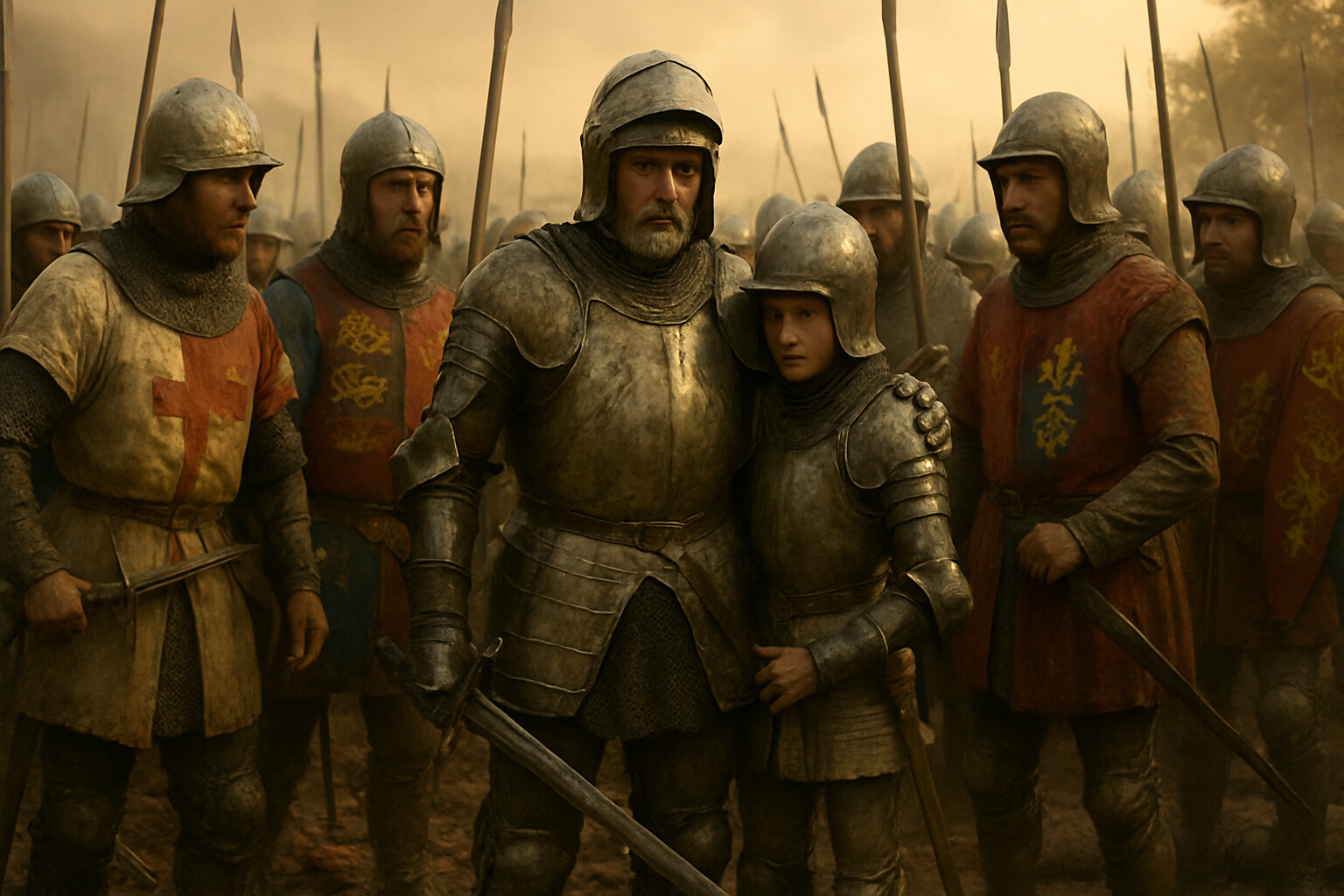
The prisoners taken at Poitiers were so numerous and so valuable that the sources describe considerable disorder in the Anglo-Gascon army as individual soldiers and knights competed to claim captives and the ransoms attached to them. The Prince had to impose order to ensure the most valuable prisoners were secured. Jean II and his son were eventually escorted to the Prince's tent. Froissart and other chroniclers record that Edward received his royal prisoner with ceremonial courtesy, attending to him personally. These accounts may reflect genuine events or may have been shaped by the literary and diplomatic conventions that governed how chroniclers of the period described the treatment of royal prisoners. They appear consistently enough across sources that historians generally accept them as broadly accurate in character, if not in precise detail.
---
The cost of the battle fell most heavily on the French. Chronicle sources and modern scholarly estimates indicate severe losses among the French nobility: the Constable of France, two marshals, and large numbers of knights and men-at-arms were killed or captured. Precise death tolls are not reliably established. English and Gascon losses were substantially lighter, consistent with the general pattern of defensive engagements where the attacker absorbs the damage of advancing under fire, but no reliable figure for Anglo-Gascon casualties appears in any source consulted. The ordinary soldiers—the Welsh and English archers, the Gascon sergeants-at-arms—are largely anonymous in the surviving record.
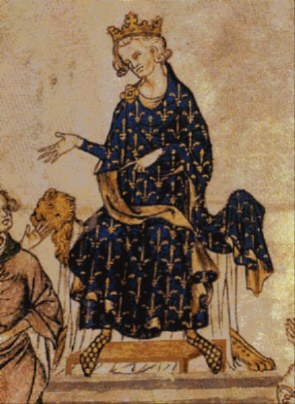
For the prisoners, the financial stakes were immense. Jean II's ransom was eventually set at three million gold écus under the Treaty of Brétigny in 1360—a sum so large that France spent years struggling to raise even a significant portion of it. Jean II ultimately returned to English custody voluntarily after a substitute hostage escaped, reportedly on grounds of personal honor. He died in English captivity in April 1364.
The plunder from Poitiers and the ransoms that followed made the chevauchée of 1356 one of the most financially productive military operations of the Hundred Years' War for the English crown. Edward returned to England in May 1357 with the French king in train, was received with public celebrations in London, and entered a period of heightened prestige that significantly strengthened his father's negotiating position with France.
---
The tactical lessons of Poitiers were absorbed into English military thinking in ways that shaped subsequent campaigns. The combination of defensive positioning, dismounted men-at-arms, flanking archers, and a timed counterattack had worked at Crécy and worked again at Poitiers. The French drew their own lessons—though the application was inconsistent, and at Agincourt in 1415, under very different circumstances, the same pattern produced similarly catastrophic French results.
Edward continued to command in France in subsequent years, including the campaigns that produced his most controversial military action: the sack of Limoges in 1370, during which, by Froissart's account, a large number of civilians were killed. Modern historians have debated the scale and nature of that event extensively. More recent archaeological and documentary research has complicated the traditional narrative, and the chronicle accounts may significantly overstate the massacre. It does not alter the record at Poitiers, but it belongs in any complete accounting of Edward's career.
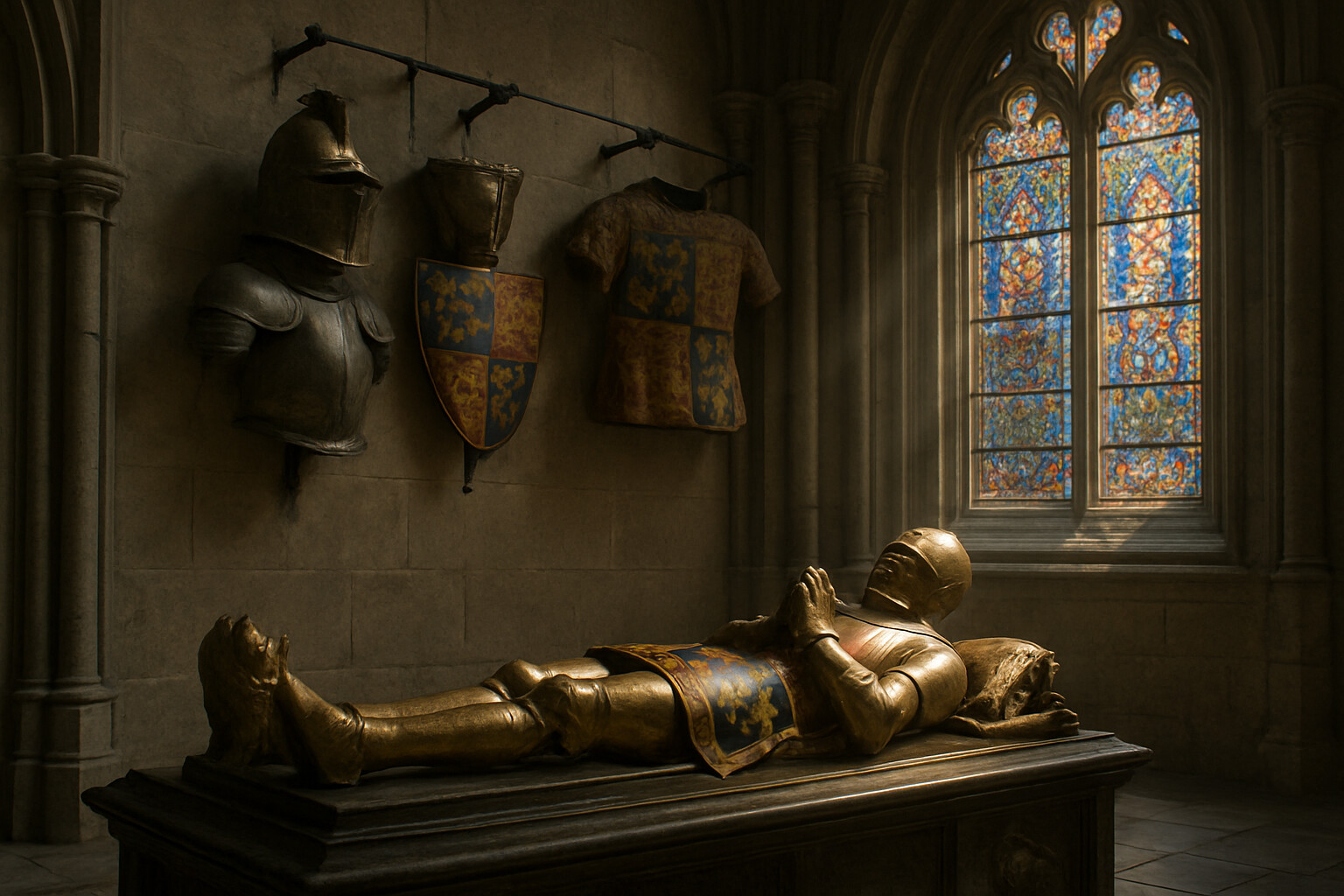
His health declined seriously in the late 1360s and early 1370s, possibly from dysentery contracted during the Castilian campaign of 1367 at Nájera. He was effectively an invalid for much of his final decade, predeceased his father by one year, and never became king. He died on 8 June 1376 at Westminster Palace. His tomb and effigy survive in Canterbury Cathedral, and replicas of his battle achievements—the helmet, gauntlets, shield, and jupon—are displayed there; the originals were moved for conservation.
He was, by the evidence of his own record, a commander of considerable tactical ability and a skilled administrator of his Gascon domains. His reputation was shaped as much by his proximity to the throne and his early death as by battlefield performance alone. The Battle of Poitiers remains the action most closely associated with his name.
---
The primary sources for Poitiers are rich by medieval standards and complicated by exactly the problems that make medieval military history difficult: partisan authorship, retrospective composition, diplomatic shaping, and the fundamental gap between what witnesses experienced and what chroniclers were told. Jean Froissart's Chronicles are the most widely cited source for the battle and are invaluable as a record of the culture and language of fourteenth-century chivalric warfare, but Froissart wrote decades after the event, drew on multiple informants of varying reliability, and was not himself present. The Anonimalle Chronicle, an English source, provides an earlier and in some respects more sober account. The Herald of Sir John Chandos composed a verse biography of the Black Prince that contains significant narrative of Poitiers. French chronicle sources, including Jean de Venette, offer the view from the other side of the hedge.
Modern scholarly treatments include Richard Barber's biography of the Black Prince, which engages seriously with primary sources; Clifford Rogers's work on English military strategy under Edward III, which provides essential context for the chevauchée doctrine; and Jonathan Sumption's multi-volume narrative history of the Hundred Years' War, the most comprehensive modern synthesis in English. David Green's study of the Black Prince is also relevant. Readers seeking the most reliable accounts should approach the chronicles as evidence to be weighed rather than narratives to be accepted.
What the day at Maupertuis actually meant in the long chain of the Hundred Years' War can be stated plainly. An English prince, outnumbered, laden with plunder, his archers running short of arrows, chose his ground, held it, and then—at the moment when the French formation showed its first real crack—drove forward and captured the King of France. It did not end the war. Nothing ended that war quickly; it ran for another ninety-seven years after Poitiers, through truces, treaties, reversals, and the campaigns that eventually drove the English from France altogether. But on that September morning on a ridge south of Poitiers, the arithmetic of power shifted across two kingdoms for a generation. The hedge held. The arrows flew. And a king walked off a battlefield as a prisoner.