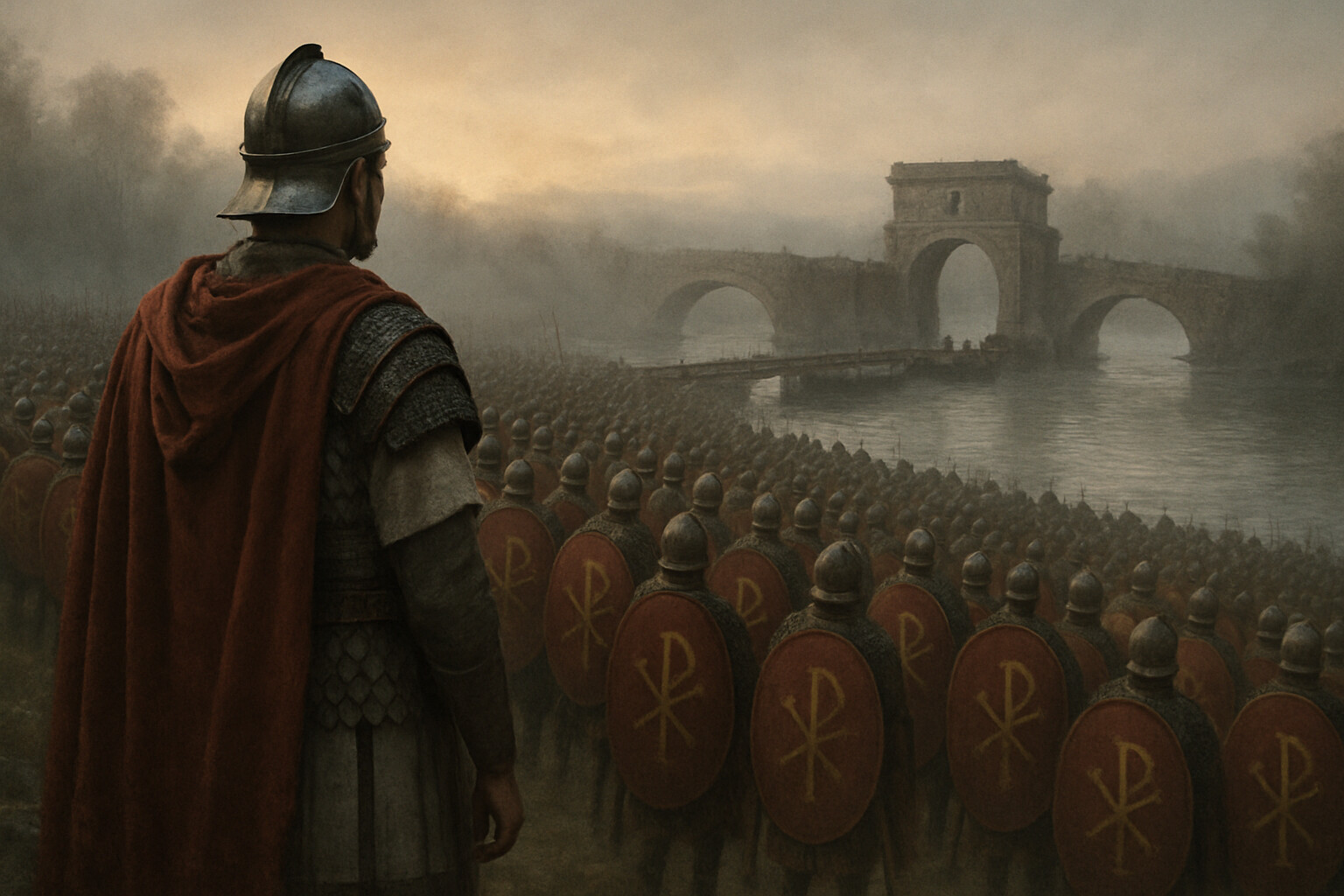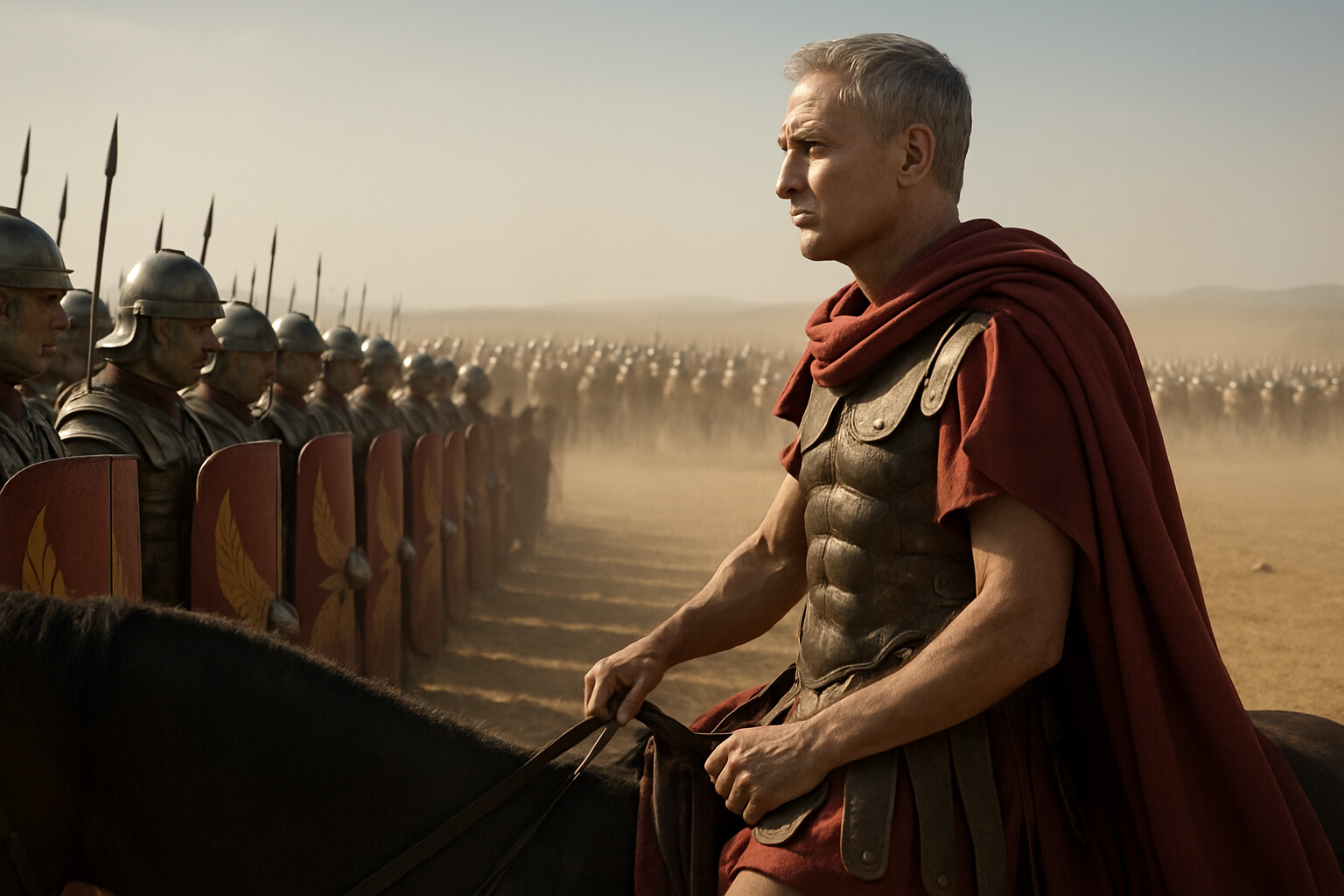
The dust came first.
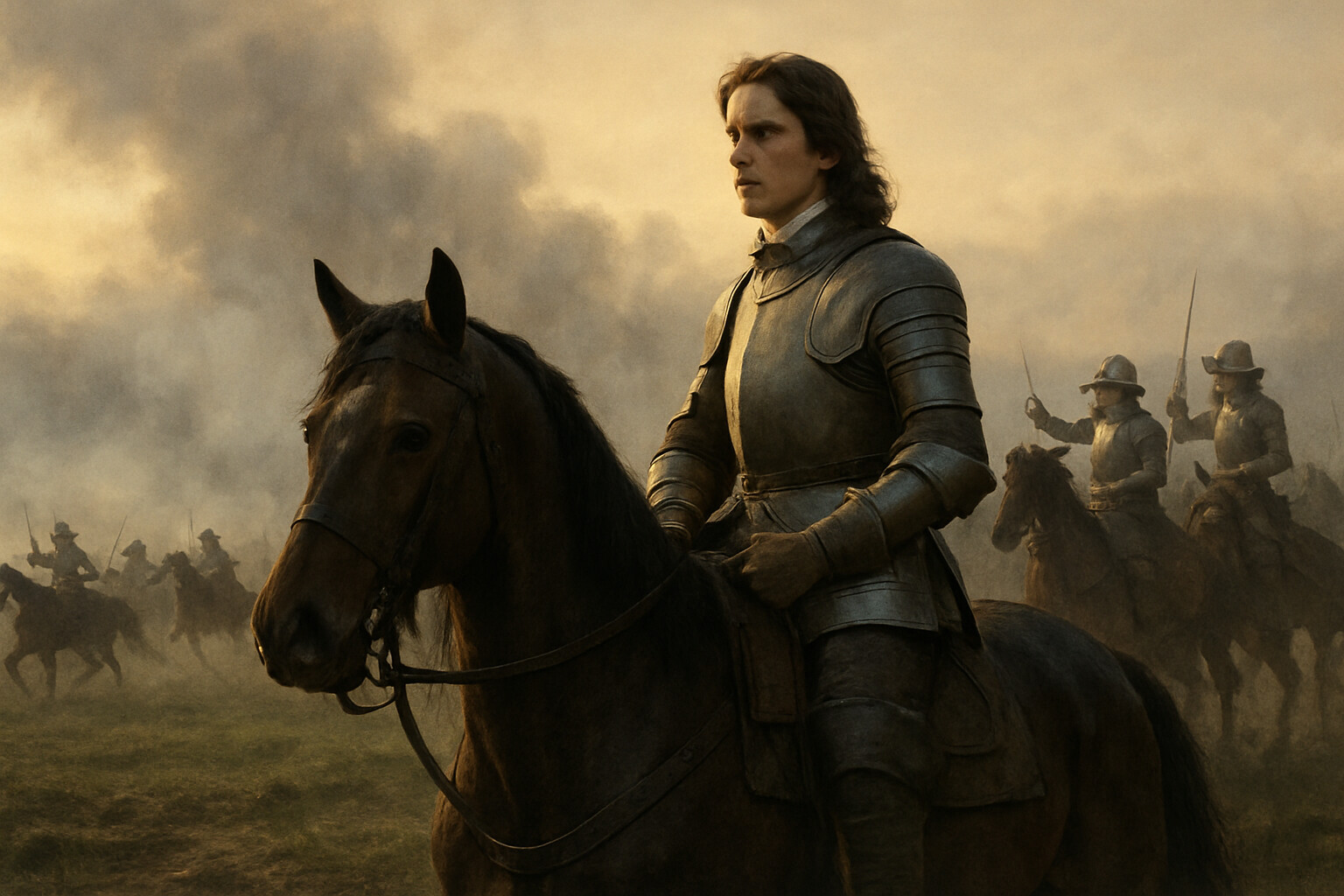
Before the trumpets, before the war cry, before the first pilum left a Roman hand, the dust rose above the plain of Pharsalus like a curtain drawn across the Thessalian sky. It was the morning of August 9, 48 BC, and the dust belonged to Pompey the Great's cavalry — thousands of riders massing on Caesar's right flank, moving with the unhurried confidence of men who believed the battle was already decided.
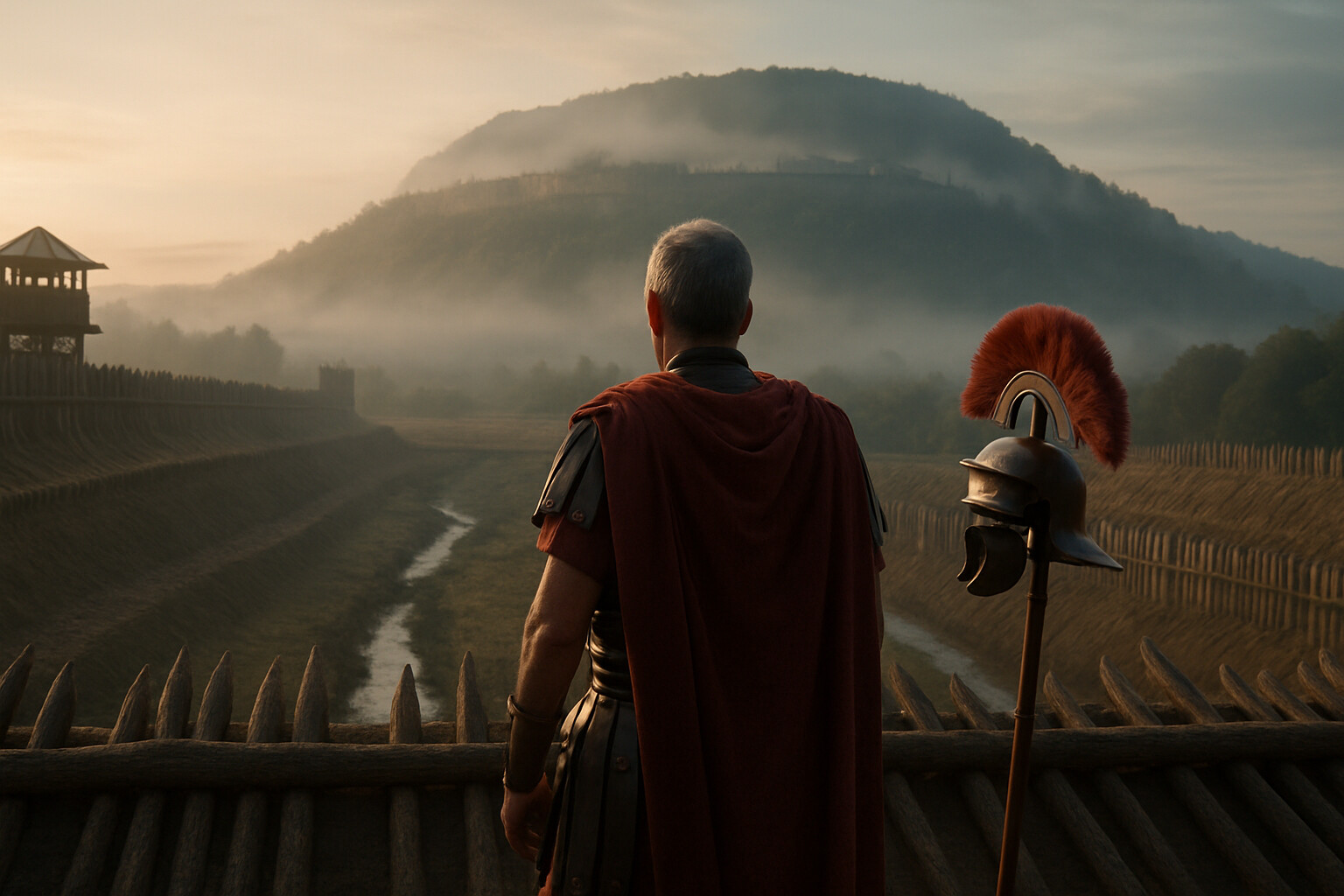
From his position behind the cohorts of his right wing, Caesar watched them come. He had been preparing for this moment for months.
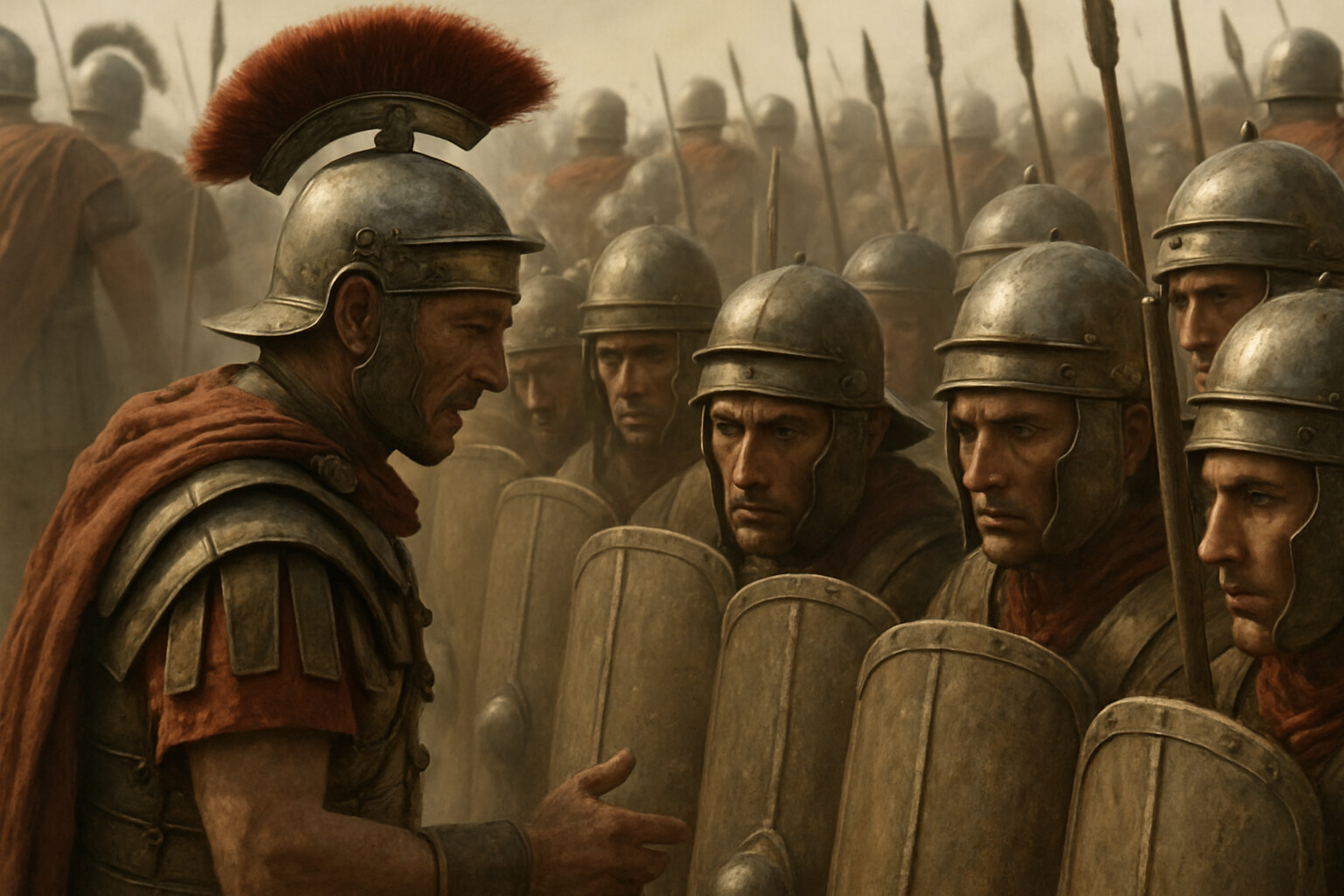
Concealed behind his third line, standing in formation under strict orders not to move until he gave the signal, were six cohorts — roughly two to three thousand veteran legionaries drawn from his best available infantry, repositioned at an oblique angle to the main battle line. They were invisible to the approaching cavalry. They were the answer to a question Pompey had not yet finished asking.
What happened in the next hour would be studied by military historians, tacticians, and strategists for two thousand years.
---
**A War Nobody Wanted to Call a War**
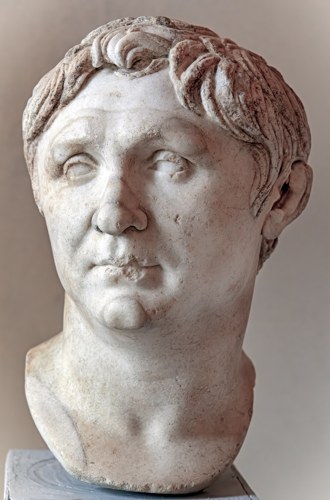
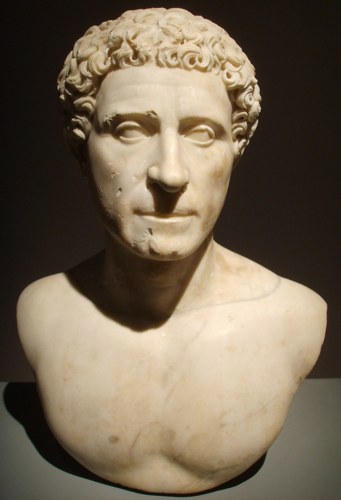
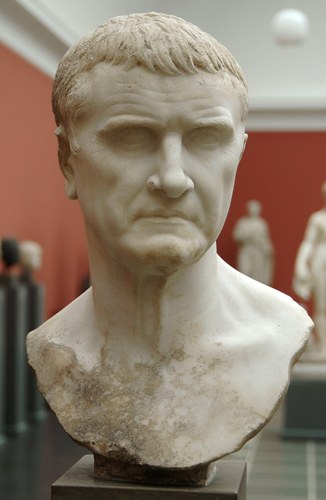
The conflict that brought Caesar and Pompey to the plains of Thessaly had been building since at least 60 BC, when the two men — along with Marcus Licinius Crassus — formed the political alliance later known as the First Triumvirate. The arrangement was practical rather than warm. Caesar needed political cover and military command. Pompey needed legislative ratification of his Eastern settlement and land grants for his veterans. Crassus needed tax-farming contracts. Together, they controlled Rome without holding a formal monopoly on it.
The arrangement began to crack when Crassus was killed at Carrhae in 53 BC, removing the third leg of a difficult stool. The death of Pompey's wife Julia — Caesar's daughter — in 54 BC had already stripped away the personal bond that softened their rivalry. By 49 BC, the Senate, largely aligned with Pompey, ordered Caesar to lay down his command and return to Rome as a private citizen. Caesar would face prosecution the moment he crossed the city boundary without his army.
On January 10 or 11, 49 BC, Caesar crossed the Rubicon with a single legion. The civil war had begun.
In the campaigning that followed, Caesar proved himself the more aggressive and adaptable commander. He seized Italy rapidly while Pompey withdrew to Greece to reorganize and gather forces. Caesar eliminated Pompeian armies in Spain, secured his western flank, then crossed the Adriatic in winter — a season when the passage was supposed to be impossible — with a force too small but committed. He besieged Pompey at Dyrrachium (modern Durrës, Albania) in a campaign of extraordinary engineering and attrition. The siege eventually failed. In late July of 48 BC, Pompey's forces broke through Caesar's lines at Dyrrachium in a serious tactical defeat. Caesar's own account in the Commentarii de Bello Civili places his losses at around two thousand men, though ancient casualty figures must be treated with caution throughout.
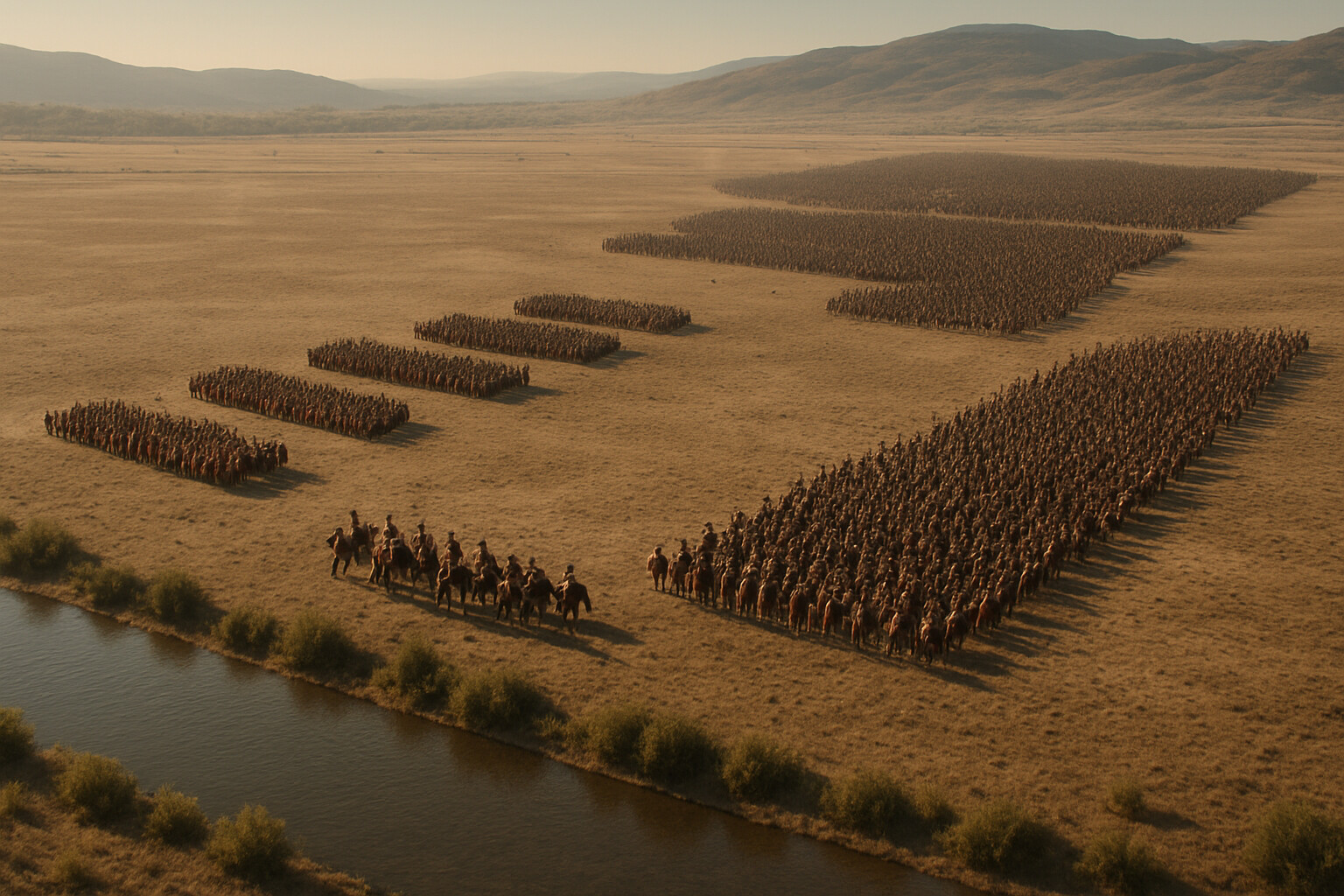
Caesar retreated southeast into Thessaly. Pompey followed, pressed by his senators and allies to finish the campaign before winter. The Pompeian camp was already speaking of peace settlements, political offices, the distribution of Caesar's wealth. Caesar noted later, with characteristic acidity, that his enemies were quarreling over rewards before the battle had been fought.
By early August, both armies were encamped near Pharsalus, a town on the Enipeus River in Thessaly. The ground was roughly flat, bounded to the south by the river and to the north by low hills. It was here that Pompey chose to give battle.
---
**The Armies on the Plain**
The numbers recorded by ancient sources vary, and all must be treated with appropriate caution. Modern historians generally work with ranges rather than precise figures, and the sources themselves — Caesar, Plutarch, Appian, and others — diverge on specifics.
For Caesar's forces, the scholarly consensus suggests approximately 22,000 to 30,000 legionary infantry, organized into eight understrength legions. Caesar's legions had been in continuous service for years. They were experienced and hardened but had suffered significant losses in Spain, at Dyrrachium, and on the march. He fielded roughly 1,000 cavalry, drawn largely from Germanic and Gallic auxiliaries.
For Pompey's forces, ancient sources suggest a substantially larger army. Appian places Pompey's infantry at around 45,000 and his cavalry at approximately 7,000, though modern historians treat these as upper estimates. The broadly accepted modern reading is that Pompey held a roughly two-to-one advantage in infantry and an overwhelming advantage in cavalry — perhaps six or seven to one on horseback. His army included veterans of the Eastern campaigns, Spanish legions, and substantial allied contingents.
Pompey's battle plan was straightforward and, on paper, sound. He would anchor his right on the Enipeus, where the terrain constrained movement. On his left, where the ground opened up, he massed his cavalry under the command of Titus Labienus — Caesar's own former legate, who had defected to Pompey's cause at the outbreak of the war. The cavalry, supported by archers and light infantry, would sweep Caesar's small Gallic and Germanic horse off the field, then wheel right and strike Caesar's infantry in the flank and rear. The legions, pressed from front and rear simultaneously, would break.
It was exactly the kind of encircling blow that had ended Roman armies before. At Cannae in 216 BC, Hannibal had used a double envelopment to destroy eight Roman legions and kill somewhere between fifty thousand and seventy thousand Roman soldiers. The memory of Cannae never left Roman military thinking. Pompey's cavalry wing was the instrument of a similar destruction.
Caesar understood this. His Commentarii make clear that he recognized the cavalry threat as the decisive factor. What he did about it is the core of the story.
---
**The Hidden Line**
Roman legions at the height of the late Republic typically deployed in three lines — the triplex acies. The first line carried the youngest soldiers. The second and third lines were progressively more experienced. The third line was held in reserve and committed only when the battle required their weight. By Caesar's era, the older distinctions between troop categories — hastati, principes, triarii — had largely blurred into a cohort system, but the three-line deployment remained standard.
Caesar deviated from this arrangement with deliberate calculation.
According to his own account in the Commentarii de Bello Civili, Caesar selected six cohorts from his best available infantry and positioned them at an oblique angle behind his right wing, concealed from Pompey's cavalry by the mass of his main formation. Their orders were explicit: hold position, do not engage, and wait for the signal. Caesar's account records that he addressed each cohort individually before the battle began, telling them that the day's outcome depended on their conduct. The Commentarii is the primary source for this detail, and it must be read with the awareness that Caesar was also writing his own justification and monument. The broad account, however, is corroborated by later tactical writers.
The tactical logic was elegant. Caesar's 1,000 cavalry on his right could not stop Labienus's mass of horsemen. They were not supposed to. They were supposed to create the appearance of a conventionally defended flank, draw the cavalry forward, and absorb enough of the first charge to allow the hidden cohorts to engage on favorable terms.
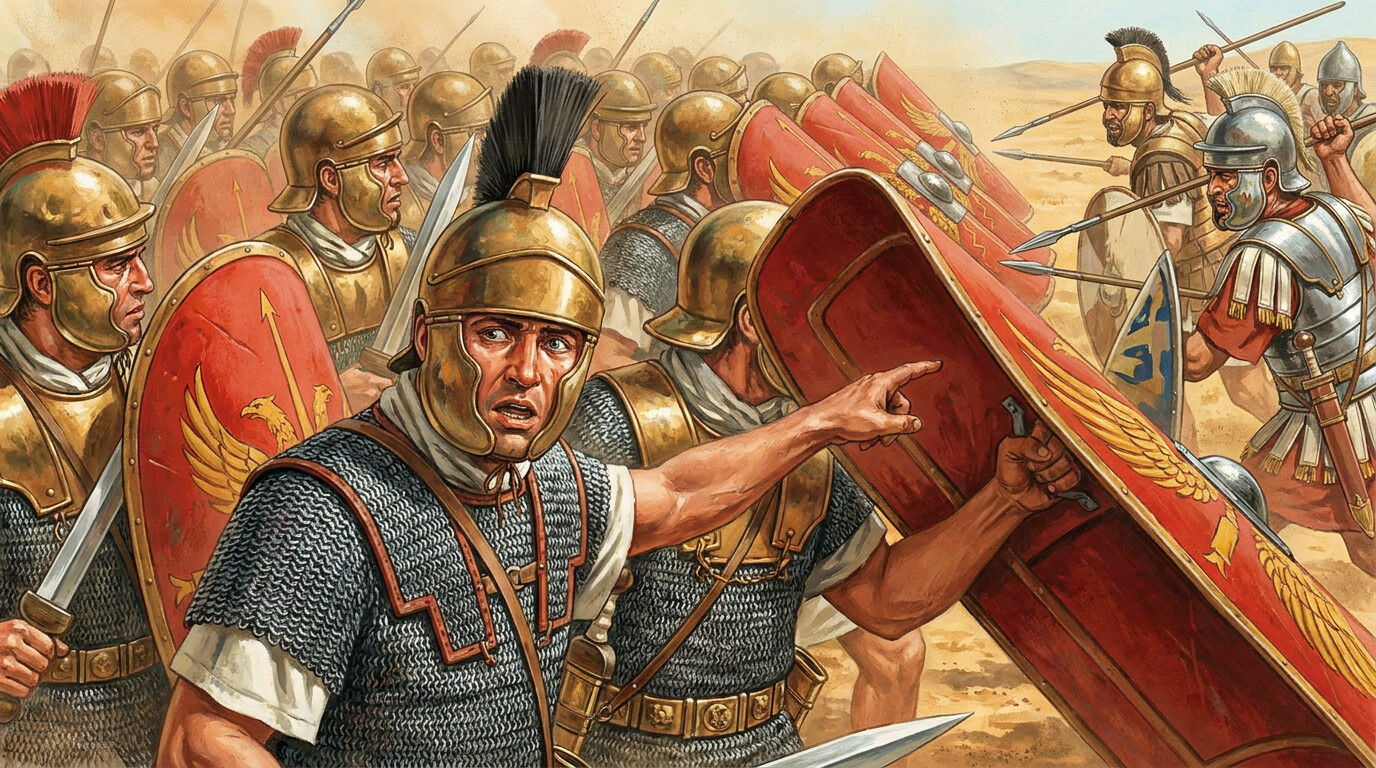
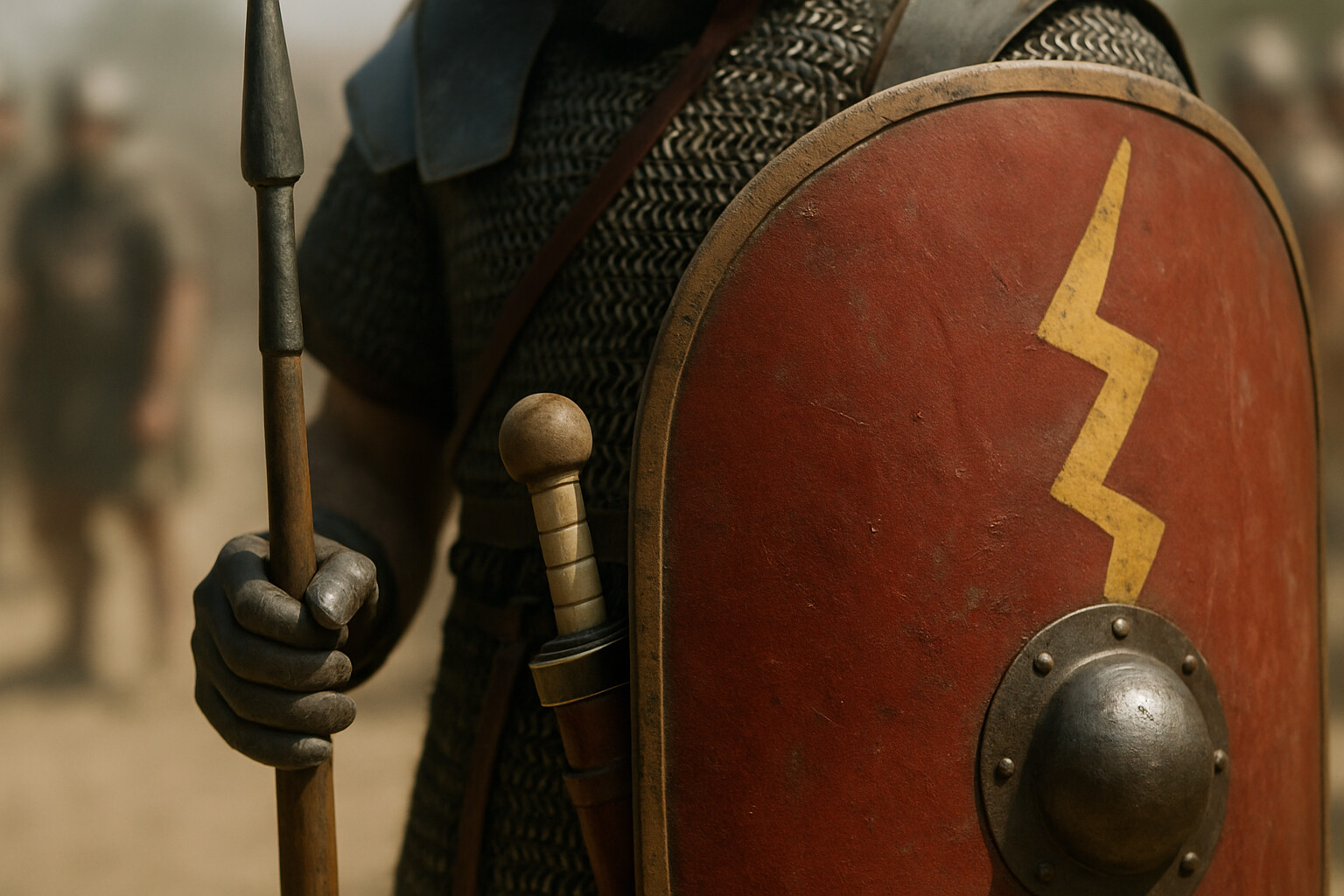
The six cohorts were armed as standard legionaries: large oval shields, two heavy javelins, and the short stabbing sword. Caesar also gave them a specific tactical instruction about how to use their javelins against the cavalry — one that, as ancient sources describe it, would prove decisive.
---
**The Weapons of the Roman Legionary**
Understanding the equipment carried by Caesar's soldiers matters for understanding how the battle unfolded — and why his instructions about the javelins changed the nature of the engagement.
The pilum was the signature heavy throwing javelin of the Roman legionary. In Caesar's era, it consisted of a wooden shaft approximately four to five feet long, topped by a thin iron shank roughly two feet in length, terminating in a pyramidal or barbed iron head. The full weapon weighed approximately two to four kilograms depending on the variant. It was designed to be thrown at close range — ideally within fifteen to twenty meters — with enough force to punch through a shield. The iron shank was specifically engineered to bend on impact, making the weapon impossible to throw back and leaving the enemy's shield unwieldy with a heavy, bent javelin embedded in it.
Against cavalry, the pilum had an additional effect. A horse moving at speed toward a line of infantry presenting pila at head and chest height faced a stark choice: stop, swerve, or absorb impact. Cavalry charges in the ancient world depended almost entirely on psychological momentum — on the willingness of horses and riders to close the distance against a solid, resistant mass. Pila held upright like a hedge of iron points, aimed at the faces and chests of riders and horses, could disrupt the coherence of a charge before contact was made.
Ancient sources describe Caesar's hidden cohorts using their pila in exactly this fashion: not thrown at approaching infantry in the standard manner, but thrust upward into the faces of horsemen. Whether this detail reflects a specific pre-battle order from Caesar or an adaptation by his centurion commanders in the moment is a point of scholarly discussion, but the tactical principle is consistent with what the sources describe happening in the engagement.
The gladius — the short, double-edged stabbing sword that was the legionary's primary close-combat weapon — carried a blade of roughly 40 to 55 centimeters in the late Republican period. It was not a slashing weapon. It was designed for close-in work, for the press of bodies in melee, for short powerful thrusts into gaps in armor. Against cavalry attempting to wheel after a failed charge, against riders who had lost momentum and cohesion, the gladius in the hands of a steady, disciplined infantry line was devastatingly effective.
The scutum — the large oval or semi-cylindrical legionary shield — was a physical and psychological instrument as much as a defensive one. In Caesar's era, it measured roughly 120 to 130 centimeters in height and 60 to 65 centimeters in width, constructed from laminated wood, covered in canvas or linen, and faced in leather. A central iron or bronze boss allowed it to be used offensively, and its curved shape enabled the overlapping wall of shields that made a Roman infantry line so difficult to break from the front. Against cavalry, a wall of scuta advancing steadily presented a surface that horses instinctively shied from.
---
**The Battle: Phase One**
Pompey's infantry did not advance. This was a deliberate tactical choice. Pompey reportedly told his commanders he intended to let Caesar's line walk forward while his own men stood firm — the idea being that Caesar's soldiers would exhaust themselves covering the open ground and arrive at the Pompeian line already breathing hard. The logic was sound on paper.
Caesar's legionaries noticed that Pompey's line was not moving. According to his account, the veterans stopped of their own accord at mid-field, rested briefly, dressed their ranks, and then resumed the advance. Whether this detail is precisely accurate in its particulars or somewhat idealized in a self-authored account, it reflects the standard of discipline that made Caesar's veteran legions formidable. They had done this before. They knew the rhythms of Roman battle.
When the two infantry lines closed, the initial exchange of pila was followed almost immediately by sword work. The lines locked together in the grinding close combat that Roman battle usually became: shield against shield, gladius seeking any gap in armor or formation, men dying inches from one another in the summer heat of a Thessalian plain.
On Caesar's left, anchored near the Enipeus, the fighting was hard but the terrain constrained Pompey's options. His numerical advantage in infantry mattered less where the ground restricted frontage.
On Caesar's right, everything moved according to Pompey's plan — for a time.
---
**The Cavalry Sweep**
Labienus launched the cavalry.
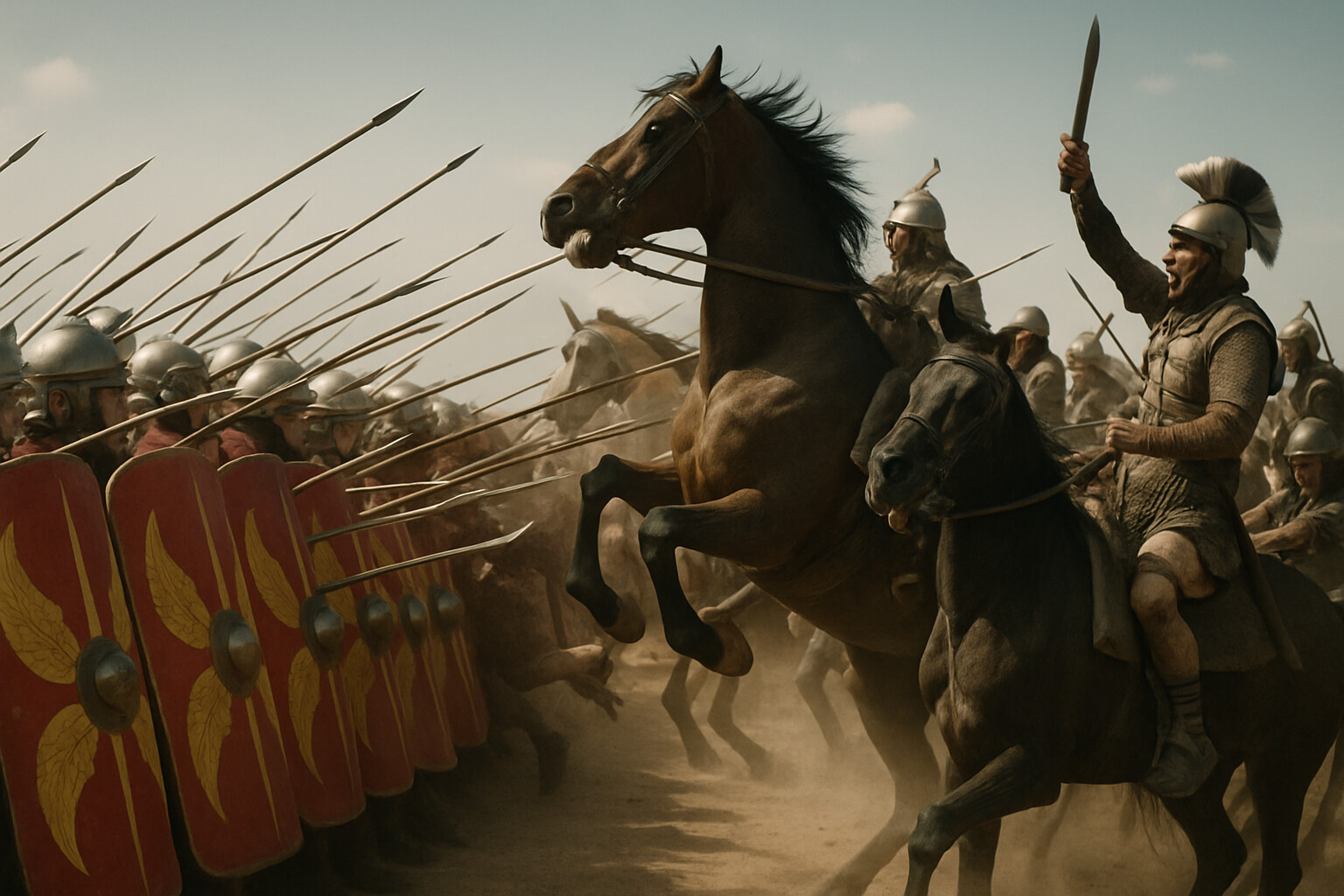
The exact sequence of the cavalry engagement is described differently in different ancient sources — Caesar's own account, Plutarch's Life of Caesar, Appian's Civil Wars, and other texts all offer variations, and modern historians weigh these against one another carefully. What the sources broadly agree on is the following: Pompey's cavalry advanced in force against Caesar's right wing; Caesar's Gallic and Germanic horsemen fought but were outnumbered and eventually gave ground; and the Pompeian cavalry began to sweep around Caesar's open flank.
At this moment, or shortly before it, Caesar gave the signal to his hidden cohorts.
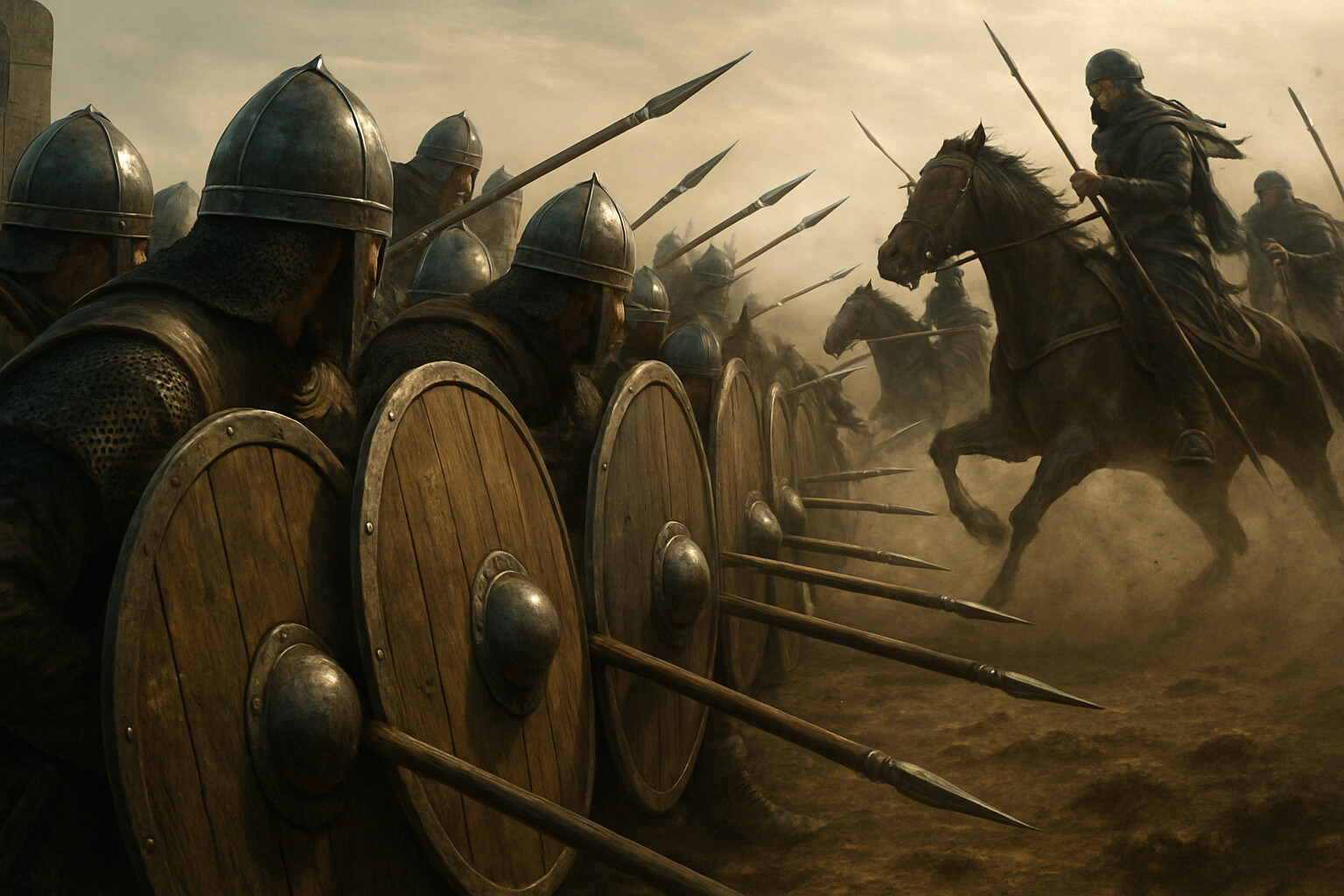
The six cohorts stepped out from behind the third line and wheeled to face the oncoming horsemen. They presented a solid front of shields and pila. Caesar's account, and Frontinus's later tactical treatise Strategemata — which uses the engagement as an illustrative example — both describe the cohorts advancing against the cavalry with their pila directed upward toward the faces of the riders. The effect, as Caesar describes it, was immediate. Pompey's cavalry — many of them, according to Plutarch, young men of the nobility without experience of heavy infantry at close quarters — recoiled from the wall of iron points aimed at their faces and their horses' heads.
The psychological calculus of cavalry versus infantry is worth pausing on. A cavalry charge against steady infantry is not the automatic victory it might appear. Horses do not naturally run into solid obstacles. They must be driven into it by riders, and riders must believe their momentum will break the infantry before the infantry can work on them. Caesar's cohorts were not running. They were steady, disciplined, advancing — and they were holding iron points at eye level. The charge faltered.
Once the cavalry broke contact and began to mill in confusion, the tactical advantage reversed entirely. Caesar's cohorts pressed forward, now on the offensive, driving into the disordered horsemen. Labienus's cavalry — which had begun the morning as Pompey's war-winning asset — dissolved. Some fled the field entirely. The archers and light infantry who had been positioned to support the cavalry were left exposed and cut down.
The six cohorts, having destroyed Pompey's cavalry arm, wheeled left and struck Pompey's main infantry line in the flank.
At approximately the same moment, Caesar committed his third line — held in reserve throughout the infantry engagement — into the Pompeian front. Pompey's infantry was now struck from two directions simultaneously: fresh troops pressing the front and Caesar's victorious cohorts driving into the flank.
---
**The Collapse**
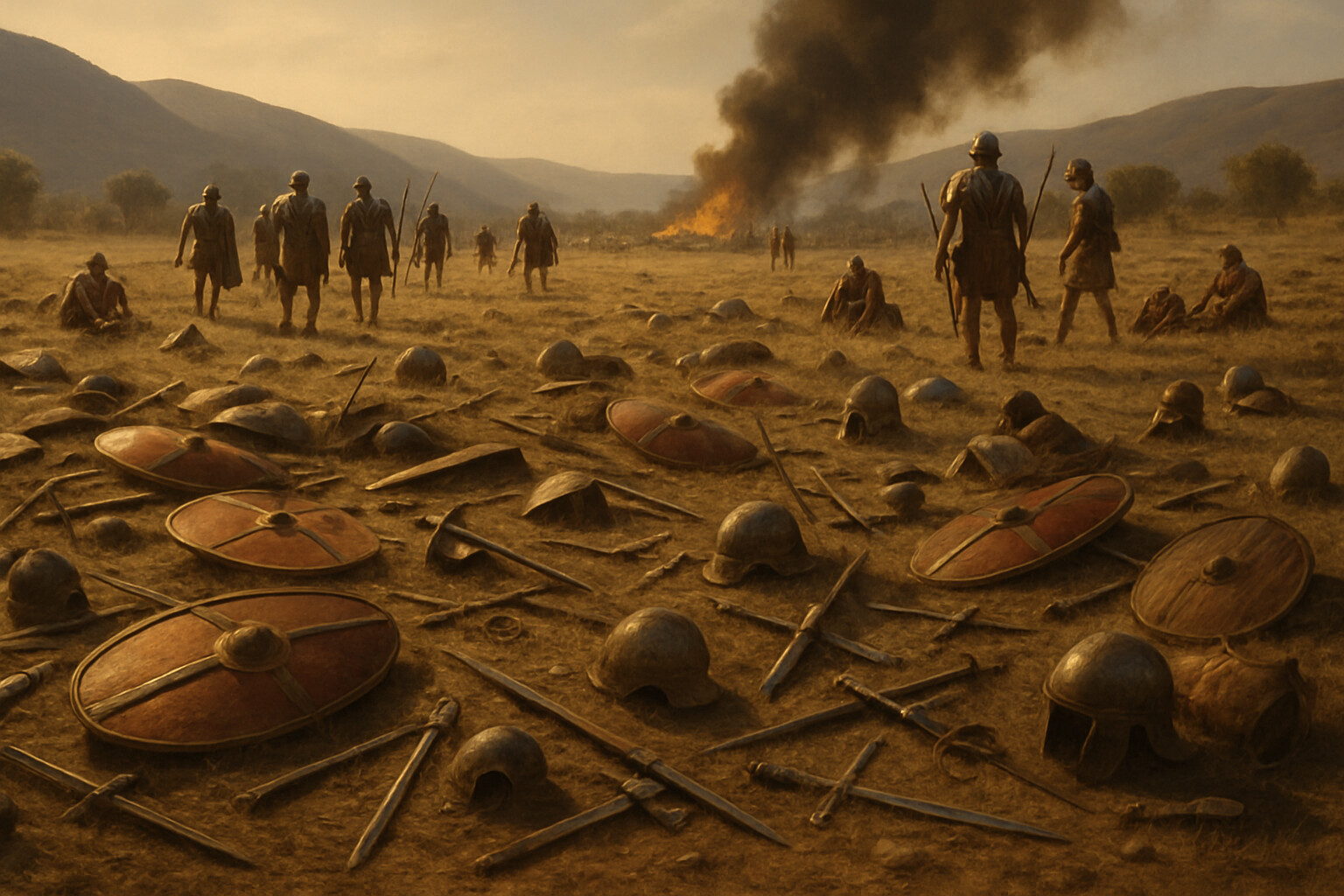
Pompey's army broke.
The sources describe Pompey himself, watching from a position near his cavalry wing, recognizing the catastrophe unfolding and withdrawing toward his camp before the rout was complete. This sequence appears in Plutarch, Appian, and other accounts, though the precise timing and movements vary across sources. What the accounts agree on is that once the cavalry collapsed and the flank strike hit, the Pompeian infantry's cohesion failed rapidly.
Caesar, according to his Commentarii, urged his men not to stop at the Pompeian camp's outer fortifications but to press the assault immediately, before the defenders could organize resistance. The camp fell the same afternoon. Pompey's men fled into the surrounding hills and toward the town of Larissa.
The following day, having surrounded the fugitives on a waterless hill, Caesar reportedly offered terms. The men surrendered. He accepted their surrender and offered clemency to Roman citizens — a political calculation as much as a personal value, and one Caesar had practiced consistently since crossing the Rubicon.
Ancient sources give widely varying casualty figures for Pharsalus, and all such numbers from antiquity must be treated with extreme caution. Caesar's own account — which has an obvious interest in magnifying the scale of victory — claims fifteen thousand Pompeian dead and twenty-four thousand prisoners, against approximately two hundred Caesarian dead and thirty centurions. Modern historians view Caesar's figures for his own side as almost certainly underestimates, and the Pompeian figures as likely exaggerated, while accepting that the defeat was genuinely catastrophic for Pompey's cause.
---
**After the Field**
Pompey fled to the coast, took a ship, and made for Egypt, where he believed he retained influence with the young king Ptolemy XIII. He was killed on the shoreline as he stepped from his boat, on September 28, 48 BC, on the orders of Ptolemy's advisors, who had calculated that sheltering a Roman loser was more dangerous than eliminating him. When Caesar arrived in Egypt days later, he was reportedly presented with Pompey's head. Plutarch and other sources record that he wept, or at least turned away. What he felt is beyond historical recovery. The political reality was plain: he could not be seen to exult over the death of a man who had been a Roman consul and his former son-in-law.
Pharsalus did not end the civil war. Pompeian forces continued to fight in Africa and Spain. Caesar would spend the next four years in campaigns across the Mediterranean before his assassination on the Ides of March, 44 BC. But Pharsalus was the decisive break — the moment when Pompey's organized political and military resistance collapsed, and when the center of gravity of Roman power shifted irrevocably in Caesar's direction.
The aftermath also illustrates what made the battle so consequential beyond its tactical dimensions. Pompey had controlled the sea lanes, the eastern provinces, the bulk of Roman senatorial legitimacy, and a substantially larger army. He had, in the conventional calculus of ancient warfare, every reason to expect victory. That he lost — and lost so completely in a single afternoon — demonstrated something about the gap between institutional advantage and tactical execution that military analysts have returned to ever since.
---

**The Record and Its Problems**
The primary narrative source for Pharsalus is Caesar's own Commentarii de Bello Civili, written in the third person and completed, or substantially completed, during the war itself, probably in 47 or 46 BC. It is, in modern terms, both a primary source and a piece of political literature. Caesar wrote with clarity and apparent precision, but he was also constructing a justification for civil war and a monument to his own generalship. His casualty figures, his descriptions of enemy incompetence, and his account of his own foresight must all be read with this in mind.
Plutarch's Life of Caesar, written in the early second century AD — roughly 150 years after the battle — draws on earlier sources, some of which have not survived. Plutarch is valuable for anecdotal detail and for preserving accounts from writers closer to the events, but he is not a military historian, and his tactical descriptions require careful comparison with other sources.
Appian of Alexandria, writing his Civil Wars in the mid-second century AD, provides another account that differs in details from Caesar and Plutarch. Frontinus's Strategemata, probably composed around 84 to 96 AD, preserves the engagement as a tactical case study and is useful for understanding how the hidden cohorts were interpreted by Roman military writers.
The exact number of cohorts in Caesar's hidden fourth line, the precise sequence of the cavalry engagement, and the exact moment at which Pompey withdrew from the field all have some ambiguity in the source tradition. Modern historians including Adrian Goldsworthy (Caesar: Life of a Colossus, 2006), Robin Seager (Pompey the Great: A Political Biography, 2002), and Tom Holland (Rubicon: The Last Years of the Roman Republic, 2003) have synthesized these sources with archaeological evidence and geographic analysis to construct the most plausible reconstruction of the battle. The scholarly consensus on the broad strokes — the hidden cohorts, the cavalry defeat, the flank strike, the rapid Pompeian collapse — is strong. The precise details remain subjects of ongoing discussion.
The coordinates identified with Pharsalus are based on the area near the modern town of Farsala in Thessaly. The exact site of the battlefield within that general area has been debated by scholars, and no definitive archaeological confirmation of the precise field location has been established. The ancient town of Old Pharsalus sat on a ridge overlooking the plain; the engagement took place on the flat ground to the north, near or between the Enipeus River and the hills.
---
**The Tactical Legacy**
The hidden fourth line at Pharsalus became one of the most studied tactical decisions in Western military history — not because it was conceptually unprecedented, but because of the clarity and decisiveness with which it was executed under pressure.
Caesar had anticipated Pompey's plan. He had identified the cavalry as the decisive arm, assessed his own cavalry as insufficient to counter it directly, and devised a solution that used infantry in the cavalry-counter role — a role infantry could fill if positioned correctly and if they held their discipline under the shock of a mounted charge. He had prepared the solution before the battle, concealed it from the enemy, and delivered the signal at the right moment.
Frontinus included the engagement in his Strategemata under the heading of tactical deceptions and surprise movements. Medieval commentators on Caesar, Renaissance military writers, and early modern European commanders studied Pharsalus as a case study in the use of reserves and in the value of a concealed force positioned to counter a specific anticipated threat. Napoleon Bonaparte, who read and annotated Caesar's Commentarii, counted Caesar among the greatest commanders in history, and Pharsalus figured in his analysis of Caesar's method.
Beyond the tactical lesson, Pharsalus matters because of the scale of its consequences. The battle ended organized resistance to Caesar's dominance of the Roman world at its most critical juncture. Had Pompey's cavalry swept Caesar's flank and driven into his rear, the Caesarian legions would likely have collapsed. Caesar himself, positioned behind the right wing, might not have escaped. The subsequent shape of the Roman world — the principate, the long centuries of imperial rule across Europe, North Africa, and the Near East — depended in some meaningful measure on six hidden cohorts holding their discipline on a summer morning in Thessaly.
That is not a claim that one battle determines all history. But Pharsalus was a genuine hinge. When the dust cleared and the counting was done, Rome had one master. He would rule for four more years before senators with daggers decided that the Republic was worth more than the man who had broken it.
The plain of Thessaly still exists. The Enipeus River, diminished now to little more than a seasonal stream in places, still runs near the modern town of Farsala. Farmers work the ground where two Roman armies spent their lives in a single afternoon. There is no monument to the six cohorts. There is no inscription recording what they did behind the third line while Pompey's cavalry swept forward.
There is only the record — partial, self-interested, mediated through centuries of copying and commentary — and the plain itself, which keeps its secrets in the summer dust.