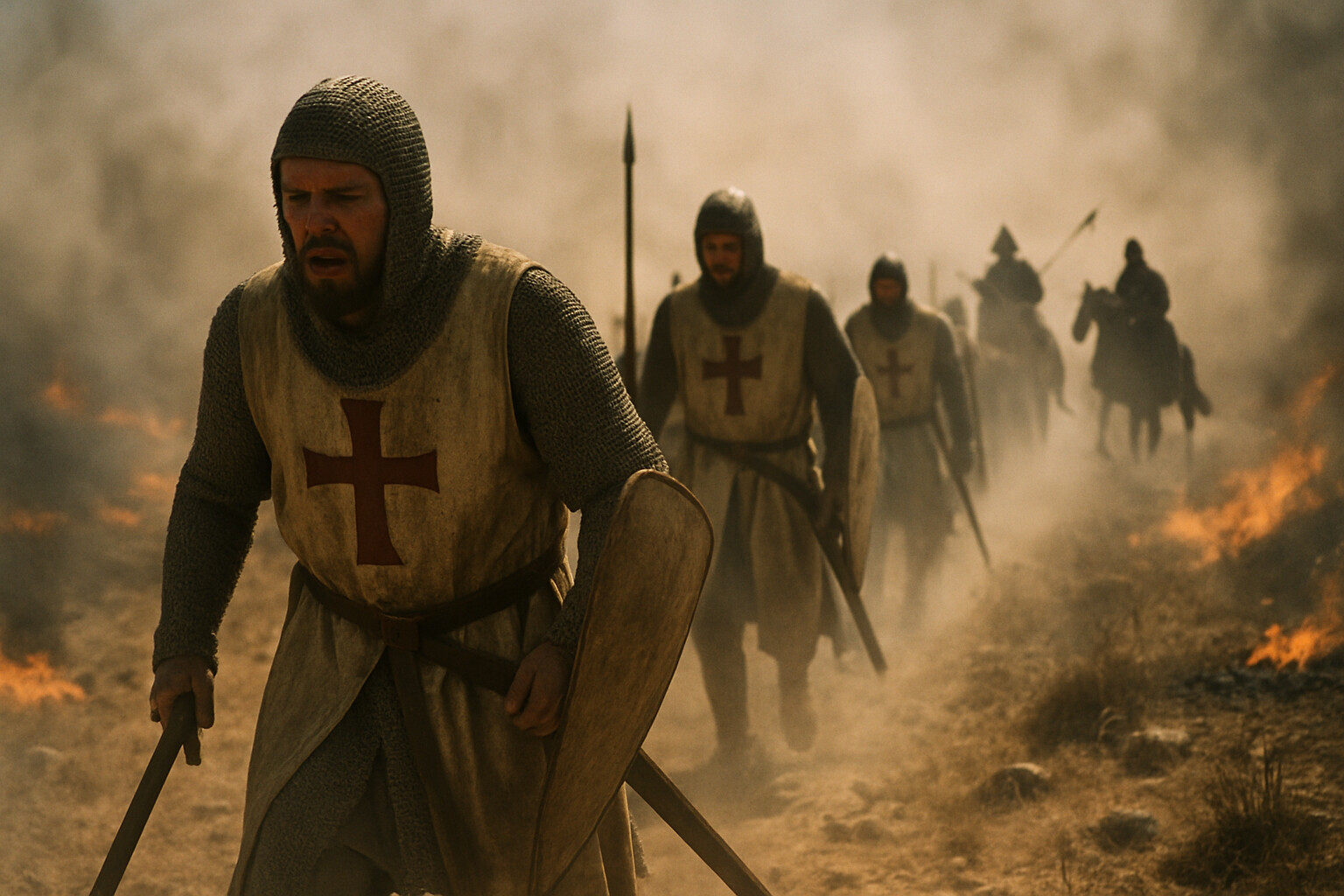
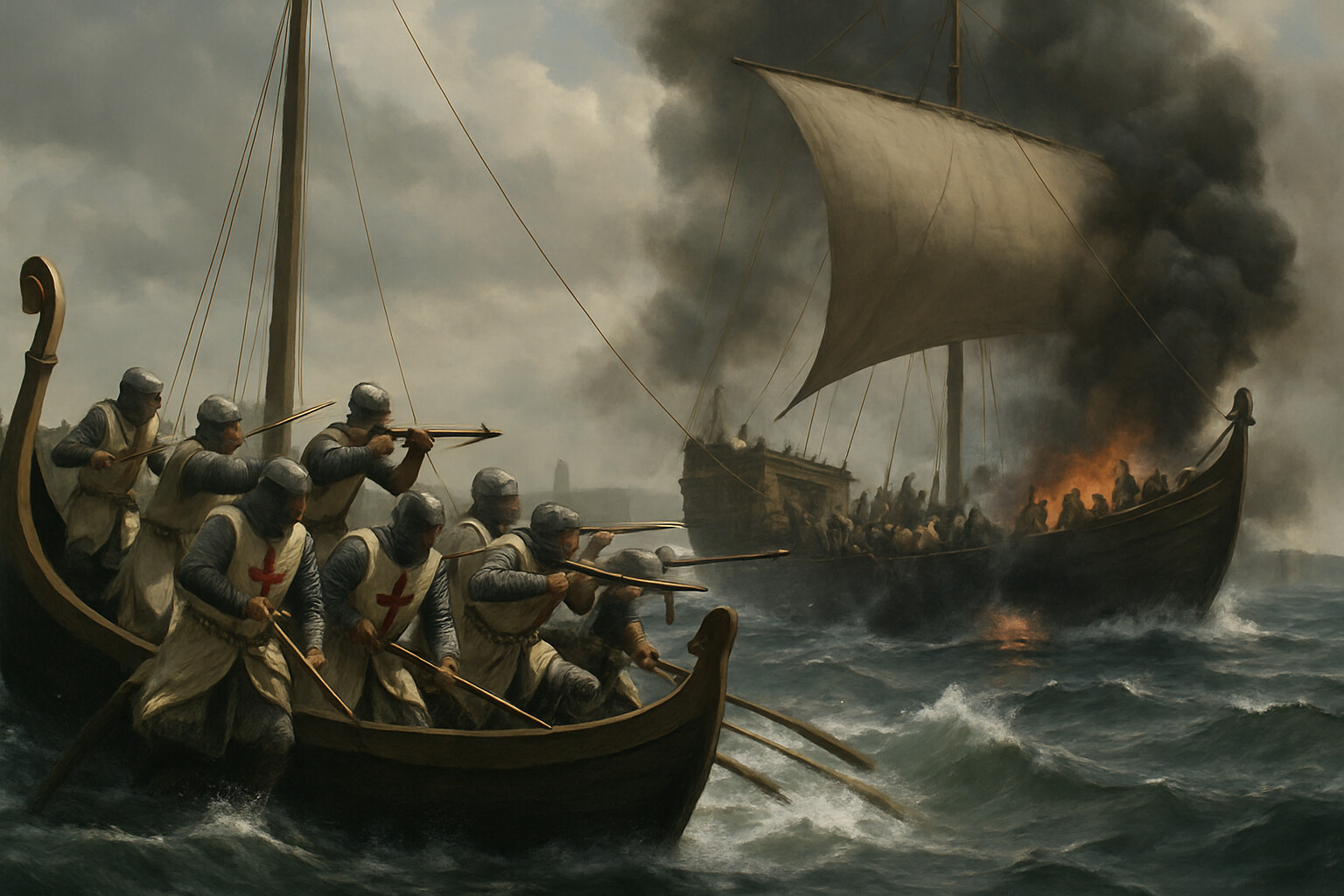
The harbor mouth was clogged with fire.
Crusader galleys attempting to land supplies through the narrow approach to Acre's port had met Greek fire — a clinging, petroleum-based incendiary that floated on water and burned on wood and flesh alike. The men watching from the siege lines on the landward side could do nothing but observe the orange columns rising over the city walls and the black smoke drifting out to sea. Acre had been under siege since August 1189. It had not fallen. The soldiers digging those trenches had been there long enough to bury their comrades by the thousands.
That was the situation Richard I of England inherited when his fleet rounded the coast of the Levant in the early summer of 1191. Not a promising battle about to be won — a catastrophe slowly in progress, in a place most of Western Europe had already concluded was too costly to save.
He came anyway. He was thirty-three years old.
---
**The Long Road to Acre**
The siege of Acre did not begin with Richard. It began with a disaster.
On July 4, 1187, at the Horns of Hattin — a plateau above the Sea of Galilee — Saladin's forces annihilated the Crusader field army of the Kingdom of Jerusalem. The battle was less a fight than an execution. The Crusader force had been maneuvered into waterless terrain in midsummer heat; Saladin's cavalry encircled them, set the dry grass alight, and waited. King Guy of Lusignan was captured. Reynald of Châtillon was killed. The True Cross, the most sacred relic the Crusader army carried into battle, was taken. Within months, Saladin had retaken Jerusalem.
The shock in Western Europe was profound. Pope Gregory VIII issued the papal bull Audita tremendi, attributing the disaster to the moral failures of Christians and calling for a new Crusade. By 1189, three of the most powerful rulers in Europe had taken the cross: Frederick Barbarossa of the Holy Roman Empire, Philip II of France, and Richard I of England.
But before the great kings arrived, a smaller and more desperate force had already moved.
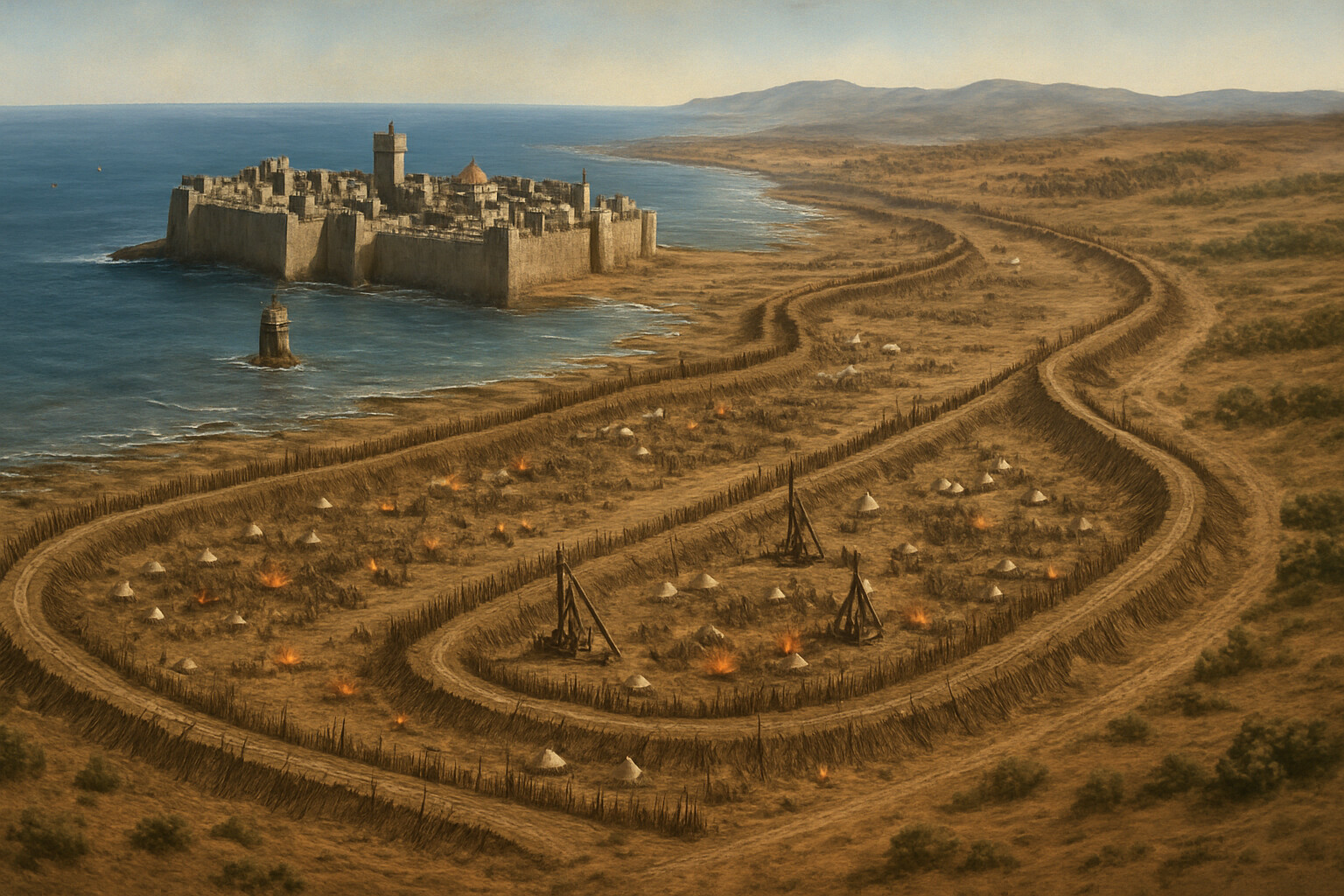
In August 1189, Guy of Lusignan — released by Saladin on parole and honor-bound not to fight again, a promise he set aside on the grounds that Saladin had broken the terms first — led roughly 9,000 soldiers to the coast north of Acre and began laying siege to the city. It was, on its face, an audacious act. Guy's army was too small to surround Acre completely. Saladin's relieving force held the hills to the east, large enough to threaten the Crusader lines from the rear. The Crusaders were besieging the city while being threatened from behind simultaneously. They built a double line of fortifications: an inner wall facing Acre, an outer line — a contravallatation — facing Saladin's army. In military terms, they were the besiegers and the besieged at once.
The next two years ground the army down. Disease — dysentery, typhoid, fevers of uncertain type — moved through the camps with regularity. The chronicler Ambroise, who accompanied the Third Crusade and left one of its most detailed accounts, described men dying in their tents faster than they could be buried. Queen Sibylla of Jerusalem died in the camp in October 1190, along with two of her daughters. Her death nullified Guy's legal claim to the throne of Jerusalem under the laws of the kingdom, opening a succession dispute that fractured Crusader political unity at exactly the wrong moment. Frederick Barbarossa drowned during a river crossing in Anatolia in June 1190, and most of his large German force dissolved and turned for home.
Acre held. Saladin probed the Crusader lines, launched sorties from the city, and managed to run supply ships through the blockade on several occasions by disguising them — a ruse that worked at least twice, according to multiple sources. The Crusaders built siege engines and the defenders knocked them down. They dug mines toward the walls; the garrison countermined. The stalemate became a war of attrition that neither side could win quickly enough to matter.
When Philip II of France arrived at Acre in April 1191, the siege was already a graveyard with flags in it.
---
**The Man Who Changed the Weight of the Siege**
Richard Plantagenet was born on September 8, 1157, the third son of Henry II of England and Eleanor of Aquitaine. He grew up in the French-speaking nobility of the Angevin Empire, which stretched from Scotland's border to the Pyrenees. He was not, in the way modern readers might imagine, primarily an Englishman. He spoke Occitan and French; he spent perhaps six months of his ten-year reign actually in England. His identity was that of a great feudal magnate and warrior-king of the French tradition.
He had fought his first significant campaign at fifteen, suppressing a rebellion in Aquitaine. By the time he took the cross in 1187 — before his father Henry II formally committed to the Crusade — Richard had spent years campaigning in Poitou and Gascony, besieging castles, suppressing nobles, and learning the mechanics of medieval warfare from the ground up. Contemporary accounts, including those of the chronicler Roger of Hoveden, consistently describe him as personally brave to the point of recklessness, a competent military organizer, and a man who understood logistics and siege engineering in ways that many of his contemporaries did not.
He was also politically difficult — persistently contentious with Philip of France, quick to anger, prone to dramatic gestures that created enemies he did not need. But he arrived at Acre in June 1191 with something the stalled siege desperately required: ships, supplies, money, and momentum.
His fleet had not come directly. Richard spent the winter of 1190–1191 in Sicily, negotiating the release of his sister Joan — widowed queen of Sicily, who had been imprisoned by the island's new king — and extracting a substantial sum as compensation. He then moved to Cyprus, where the island's ruler, Isaac Komnenos, had seized survivors and cargo from ships wrecked in a storm, including the vessel carrying Richard's betrothed, Berengaria of Navarre. Richard conquered Cyprus in roughly three weeks — a campaign whose speed impressed contemporaries and secured a critical supply base for the Crusade. He sold the island to the Knights Templar for 100,000 dinars, a transaction that would later prove complicated when the Templars attempted to return it.
He arrived off Acre on June 8, 1191.
---
**The Siege Geometry**
Acre sits on a small peninsula on the eastern coast of the Mediterranean, in what is now northern Israel. In 1191, it held the finest natural harbor on the Levantine coast — which was precisely why it mattered. Whoever held Acre held the principal port of entry into the Holy Land. Saladin understood this. The Crusaders understood it. The city's Muslim garrison had reinforced its sea walls and fortified the harbor entrance during the two years under siege.
The landward approaches were dominated by the Tower of Flies guarding the harbor mouth, the Accursed Tower at a critical salient in the city's circuit wall, and a network of towers and curtain wall that the defenders had worked steadily to strengthen. Outside, the Crusader siege lines were themselves fortified — ditches, palisades, and earthworks thrown up against Saladin's army in the hills.
Between the Crusader siege lines and the city walls lay a killing ground of variable width. Both sides had tried to cross it repeatedly. Neither had held it.
Philip of France had brought substantial forces and intensified the bombardment before Richard arrived. French trebuchets and mangonels had made some progress against the walls, but the masonry was thick and the defenders repaired damage quickly. Richard's arrival shifted the balance in several ways at once.
First, his fleet effectively sealed the sea approaches. Saladin had resupplied the garrison by ship more than once, running galleys through the Crusader naval screen at night or under disguise. Richard's naval force — larger, better organized, and pressed with more aggression — tightened that cordon. A significant engagement occurred shortly before Acre's surrender when Crusader galleys intercepted a large Ayyubid supply vessel attempting to run supplies into the harbor. Multiple accounts, including the Itinerarium Peregrinorum, describe the ship as carrying siege equipment, provisions, and reinforcements. Some sources add Greek fire equipment and hundreds of soldiers aboard, though the figures and details vary considerably between accounts and cannot be fully reconciled. The Crusader galleys attacked; when it became clear the ship would be taken or was lost, it went to the bottom — whether by its own crew or through Crusader action, the sources disagree. The loss was significant for the garrison.
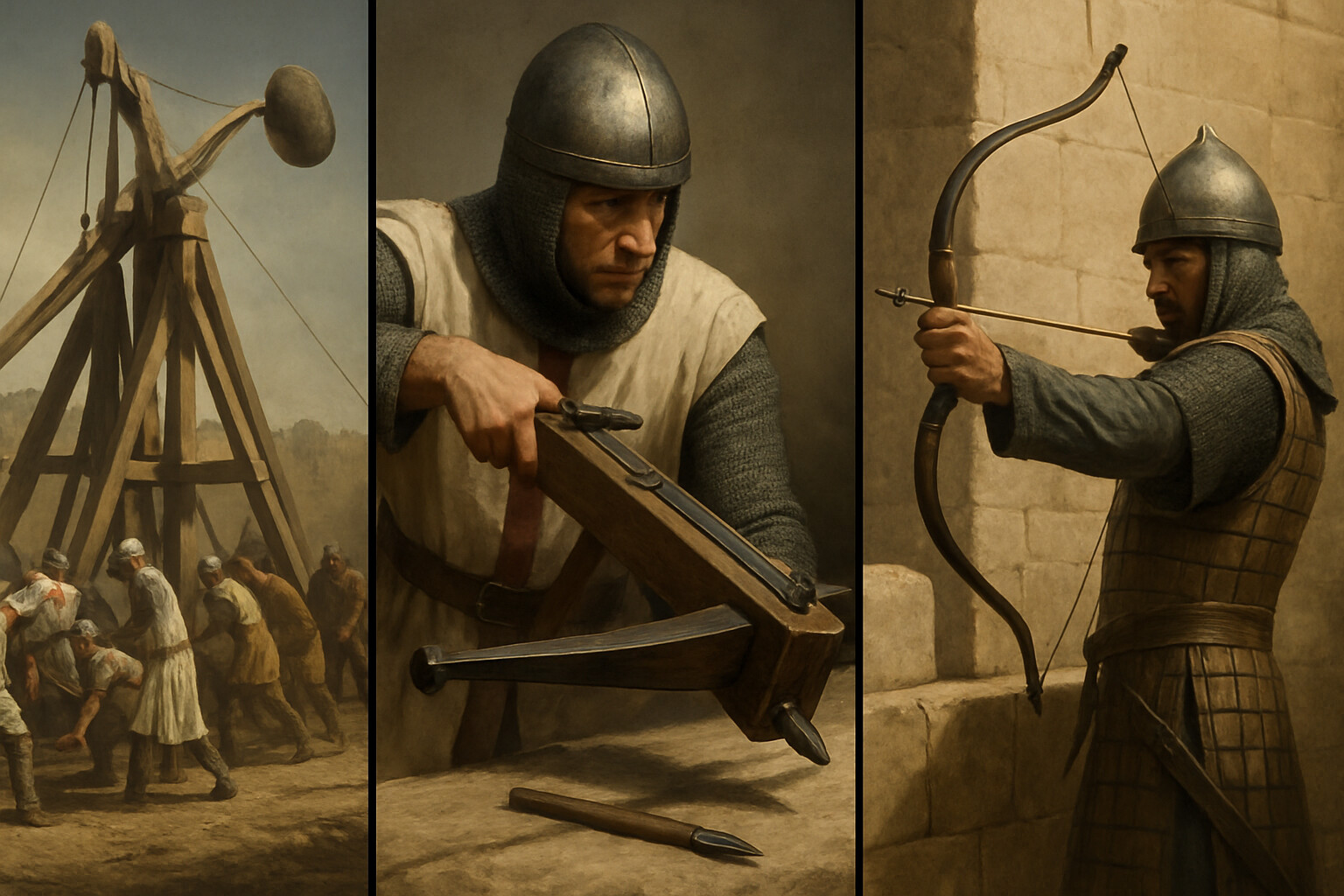
Second, Richard brought or rapidly assembled new siege engines. Medieval siege engines at Acre fell into three broad categories: the trebuchet, counterweight-powered and capable of consistent accuracy with heavy stone; the mangonel, tension- or torsion-powered, lighter and faster to reset; and the ballista, tension-powered and firing bolts rather than stones, useful against personnel on the walls. Richard, like Philip, operated trebuchets. The Itinerarium names two of Richard's engines — one called Mal Voisin, or Bad Neighbor, and another called God's Own Sling. Whether these names are historically precise or reflect later embellishment is debated among scholars; the practice of naming large siege engines was documented in other accounts of the era, which lends the tradition some plausibility without confirming the specific names.
Third, and perhaps most importantly, Richard appears to have reorganized the Crusader army's rotating schedule of labor and watch. The Itinerarium describes a breakdown of discipline in the camp — men abandoning forward positions, supply details left unmaintained, and the general exhaustion of two years in the field producing a fragmented command structure in which the military orders, the various national contingents, and the remnant kingdom forces each operated with significant independence. Whether Richard imposed the clearer operational rhythm the chronicler describes, or whether the Itinerarium's pro-Richard framing overstates the transformation, cannot be determined from the sources alone. But the improvement in siege tempo after his arrival is consistent across accounts.
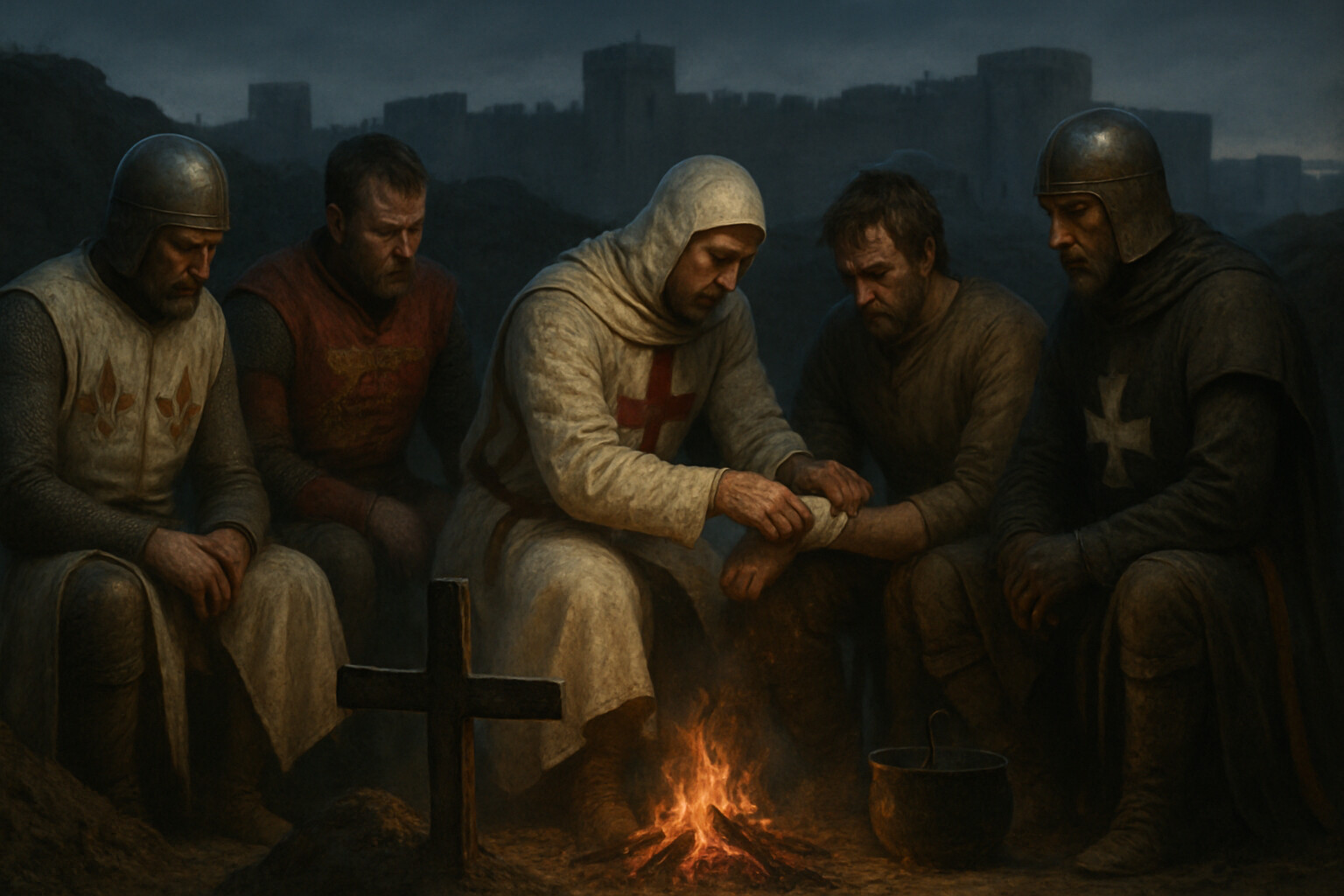
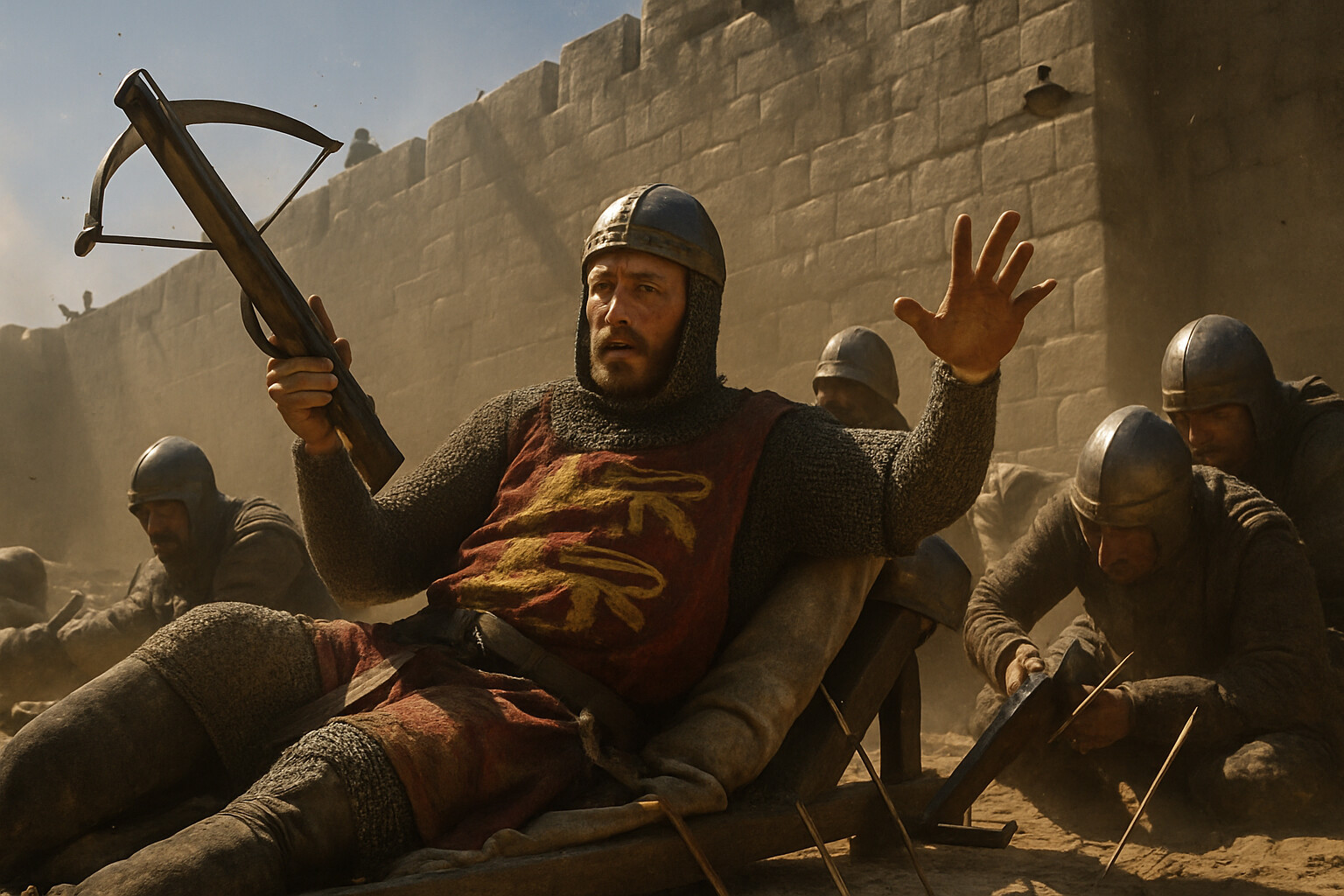
He was also sick. Most accounts agree that Richard arrived at Acre already weakened by a fever, identified in period sources by the terms arnaldia or leonardie — conditions some later historians have tentatively associated with scurvy or a scorbutic illness combined with other disease, though no diagnosis can be confirmed at this distance. He directed the siege from a litter on certain days. He also, according to Ambroise and the Itinerarium — both sources that explicitly admire him — personally operated a crossbow during at least one engagement on the siege lines. This detail cannot be independently verified but is consistent across the two main Western accounts.
---
**The Crossbow and the Wall**
The weapon Richard is most consistently associated with — in the sources and in the siege itself — is the crossbow.
By the late twelfth century, the crossbow was the dominant ranged weapon in siege warfare on both sides. It offered higher projectile velocity and greater armor penetration than the composite bow available to most Western European troops, and it required substantially less training to use effectively — a competent crossbowman could be prepared in weeks where a skilled archer required years. Its disadvantage was rate of fire: a practiced crossbowman with a lever or stirrup system might deliver two bolts per minute under combat conditions. A skilled archer could loose six to ten arrows in the same interval.
In siege conditions, this tradeoff favored the crossbow. Rate of fire mattered less when targets were men appearing briefly in crenellations. Penetrating power mattered more when those men wore mail or sheltered behind heavy timber. The crossbows at Acre — on both sides — were primarily lever-spanned, using a stirrup at the tip and a waist hook or simple goat's foot lever to draw bows in the 150–250 pound range. The bolts they fired were short, heavy, and thick-shafted, designed for penetration over distance.
A king standing on a siege ramp and shooting at a city wall was not expected behavior. Richard apparently did it more than once, according to Ambroise and the Itinerarium. Whether this was tactically effective or primarily a demonstration of shared risk with the men in the lines is impossible to determine — but its effect on the soldiers watching was noted in both accounts.
On the defending side, the Acre garrison operated composite bows of the Ayyubid tradition — recurved, horn-and-sinew laminated bows capable of high arrow velocity and long range, well suited to shooting down from wall walks onto exposed attackers. The defenders also had access to naphtha projectors — devices for launching Greek fire — and catapult engines within the city. They were not passive. They sortied repeatedly during the siege to destroy Crusader siege equipment, and on at least one occasion managed to burn a significant quantity of Crusader scaling materials.
---
**The Walls Break**
By early July 1191, the pressure on the garrison had become untenable.
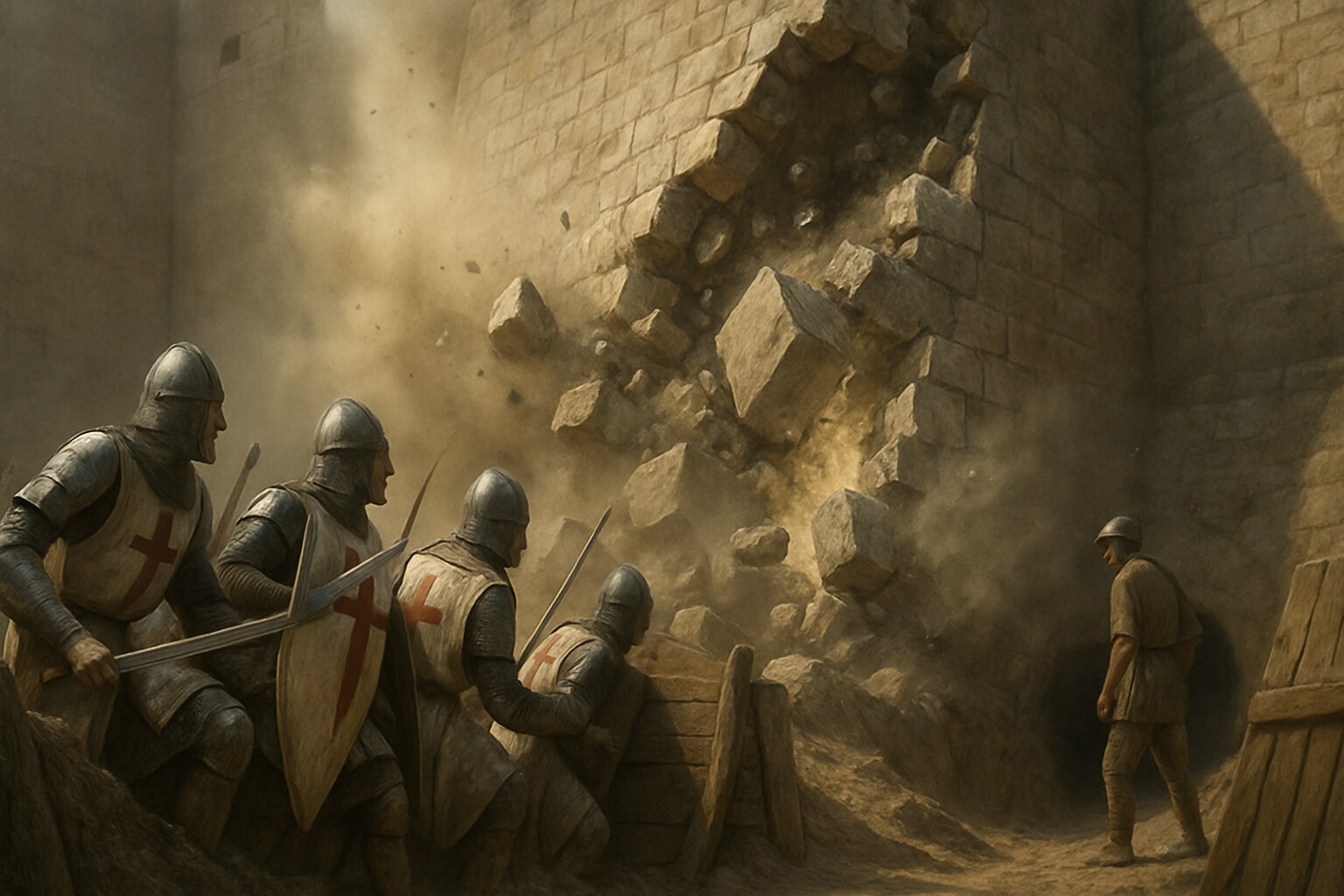
The mining operations that both sides had conducted throughout the siege began to tell. Medieval siege mining worked by digging a tunnel beneath a wall or tower, shoring it with timber props, and packing the chamber with combustible material — straw, rendered fat, anything that would burn hot and long. When the props were fired, the tunnel collapsed, and the ground above it — including the wall footing — dropped with it. Done correctly, it produced a breach in seconds. Done incorrectly, it killed the miners.
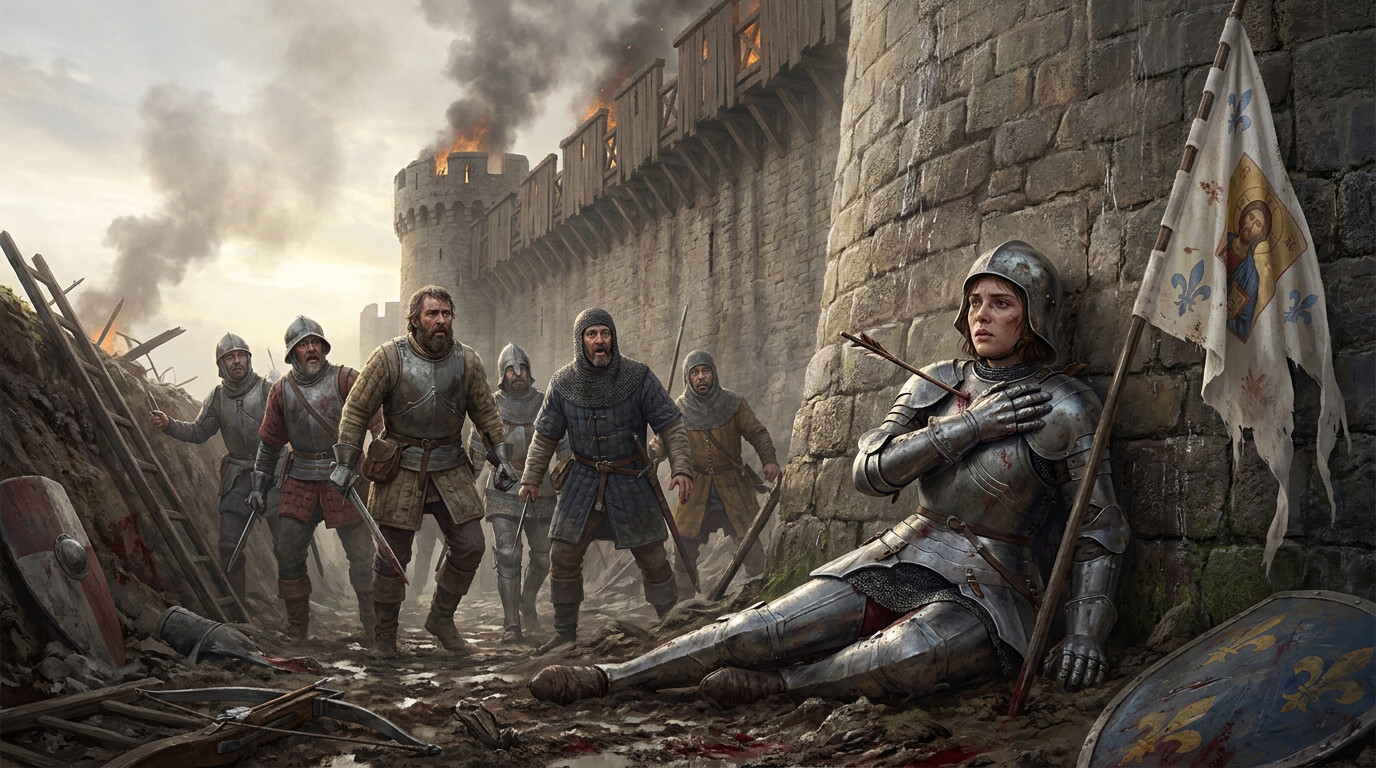
Crusader miners had worked beneath the Accursed Tower, the critical salient in Acre's landward wall. The precise date of the collapse varies slightly between sources, but the general timeline places the critical breach in the first or second week of July 1191. Philip's forces had already made progress against other sections of the wall. When the Accursed Tower fell — or was sufficiently damaged that the adjoining wall section could no longer be held — the tactical situation inside the city changed.
The garrison's commander, al-Mashtub, entered negotiations. He sent word to Saladin requesting permission to surrender on terms. Saladin, according to the account preserved in Baha' ad-Din ibn Shaddad's biography of Saladin — one of the most important Arabic-language sources for the Third Crusade, written by a man present in Saladin's camp — was reluctant. He attempted to mount a major relief attack on the Crusader lines. The attack was repulsed. The garrison could not hold.
On July 12, 1191, Acre surrendered.
The terms were negotiated: the garrison would yield the city, return the True Cross, and secure the release of approximately 1,600 Crusader prisoners held by Saladin. In exchange, the lives of the garrison and the Muslim civilians in the city would be spared. Saladin would pay a ransom of 200,000 gold pieces, in installments, to secure the garrison's freedom.
The Crusaders entered the city. After two years, Acre's gates opened.
---
**The Cost, and the Massacre**
What followed the surrender is one of the most debated and disturbing episodes of the Third Crusade.
Saladin did not make the first installment of the ransom payment on schedule. Whether the delay was deliberate, logistical, or a negotiating tactic is contested in the sources and cannot be determined with certainty. Richard, facing an army that needed to move south toward Jerusalem and an agreement he believed was being stalled, gave an order that no contextual framing can soften: on August 20, 1191, approximately 2,700 Muslim prisoners — the majority of Acre's garrison — were executed outside the city walls, in full view of Saladin's army.
Baha' ad-Din ibn Shaddad, an eyewitness on Saladin's side, recorded the event. The Itinerarium Peregrinorum records it from the Crusader side. Both agree on the basic fact. The numbers vary across sources — some accounts give figures as high as 3,000 — but the event itself is not disputed.
Richard's reasoning, as reconstructed from the sources, was pragmatic in the narrowest military sense: he could not march south with thousands of prisoners requiring guards, food, and security, and he had concluded — rightly or wrongly — that Saladin would not fulfill the agreement. Whether this judgment was strategically sound or morally defensible was a question medieval chroniclers themselves began to argue about immediately, and the argument has not ended. Arabic sources used the massacre as a defining characterization of Richard's conduct. Western chronicles varied: some defended the act as military necessity, others recorded it without justification. His actual reasoning cannot be known with certainty.
It is part of the record. A full accounting of Acre cannot omit it.
The cost of the two-year siege was severe by any measure. Estimates of Crusader dead from combat, disease, and privation run into the tens of thousands, though precise figures cannot be established from surviving records. Among the notable dead: Queen Sibylla of Jerusalem, the Patriarch Heraclius of Jerusalem, and the great mass of common soldiers whose names fill no chronicle and whom no poet commemorated. For Saladin, the fall of Acre was a strategic blow of the first order. He had held the city for four years. Its port was now the operating base for the Crusader push toward Jerusalem.
---
**The Record and the Sources**
The siege of Acre is unusually well-documented by the standards of medieval military history — a consequence, in part, of the extraordinary international attention the Third Crusade attracted and the number of literate participants who later wrote about it.
The Itinerarium Peregrinorum et Gesta Regis Ricardi is the central Latin source. It survives in multiple manuscript versions and was likely compiled from earlier materials, possibly including an account by a participant. The version associated with the chronicler Richard de Templo appears to have been composed in the 1220s, drawing on earlier records. It is explicitly pro-Richard and must be read with that bias in mind.
Ambroise's L'Estoire de la Guerre Sainte is an Old French verse account written by a Norman poet who accompanied the Crusade. It is considered a near-contemporary source of high value, though it shares the Itinerarium's broadly Crusader perspective — and the relationship between the two texts, including whether the Itinerarium drew directly on Ambroise or on a shared source, remains debated among scholars.
Baha' ad-Din ibn Shaddad's Sirat Salah al-Din provides the most detailed Arabic account. He was a member of Saladin's court and an eyewitness to much of the campaign. His account is indispensable for the Ayyubid perspective and for events visible from Saladin's side of the lines.
Imad ad-Din al-Isfahani, another member of Saladin's chancery, wrote a more rhetorically elaborate account that supplements Baha' ad-Din and provides additional detail on some tactical episodes.
Modern historians who have drawn critically on these and other sources include John Gillingham, whose biography Richard I (1999) remains a standard scholarly treatment; Malcolm Barber, whose work on the military orders provides essential context for the Templars and Hospitallers at Acre; and David Nicolle, whose studies of medieval Islamic and Crusader military equipment and tactics bear on the technical record. Jonathan Phillips's Holy Warriors (2009) and Thomas Asbridge's The Crusades (2010) provide accessible narrative syntheses that have largely held up to scrutiny.
All of these sources require careful handling. The Itinerarium and Ambroise exaggerate, idealize, and in places simply invent in Richard's favor. The Arabic sources have their own political and rhetorical contexts. The massacre, for example, is treated very differently in each tradition. Researchers working from any single source tradition will produce a distorted account.
---
**Why It Mattered**
The fall of Acre on July 12, 1191, did not win the Third Crusade. Jerusalem was not retaken. Richard fought south along the coast to Jaffa, won the battle of Arsuf in September 1191, and twice came within striking distance of Jerusalem — but never committed to a final assault that his commanders judged could not be sustained. In September 1192, he and Saladin concluded the Treaty of Jaffa, which left Jerusalem in Muslim hands while guaranteeing Christian pilgrims access to the holy sites. Richard sailed home. Saladin died the following March, in 1193.
But Acre mattered — for what it made possible and for what it demonstrated.
As a port, Acre anchored Crusader presence on the Levantine coast for another century. The city became the capital of the rump Kingdom of Jerusalem after the loss of Jerusalem itself and remained in Crusader hands until 1291, when the Mamluks took it after a brutal siege — a fall generally considered the definitive end of the Crusader states.
As a military episode, the siege demonstrated something that the preceding two-year stalemate had obscured: that a medieval port city, even a heavily garrisoned one, could be reduced by a combined-arms force that controlled the sea, maintained consistent bombardment, coordinated mining with suppressive fire, and — critically — prevented resupply. What Richard brought to Acre was not a single stroke of tactical genius. It was the organizational mass and naval weight to close the last remaining gap in the siege.
Richard returned to Europe, was captured by Duke Leopold of Austria — who carried a grievance stemming in part from events at Acre, where Richard had ordered Leopold's banner thrown from the walls during a dispute over the city's spoils — and spent more than a year as a prisoner before being ransomed for approximately 150,000 marks. He died at Châlus-Chabrol in France on April 6, 1199, from a crossbow wound to the shoulder that turned gangrenous. He was forty-one.
The weapon that had served him on the walls of Acre killed him.
Ambroise's account of Richard at the siege — directing the engines from a litter when too sick to stand, manning a crossbow on the ramp, his fleet cutting off Saladin's supply ships — is shaped by admiration and proximity. It is not a neutral document. But it describes, in its partisan way, a man who understood what the moment required and delivered it with considerable organizational force under conditions of personal illness and political friction.
The two years before Richard arrived at Acre were not wasted. The men who held those lines, whose names fill no chronicle and whom no later poets commemorated, built the framework that made a successful siege possible. They dug the trenches, held the contravallatation against Saladin's relief attacks, and endured conditions that killed them in numbers the records cannot fully capture. Richard arrived into a siege that was already a monument to other men's suffering.
He finished it. And in the history of the Third Crusade, that distinction — between finishing and enduring — has shaped how the siege has been remembered ever since.