HomeStoriesWeaponsBattlesPeopleWarbirdsAbout
All Stories

The King at the Burn: Robert the Bruce and the Battle of Bannockburn

Date: June 23-24, 1314 Location: Bannockburn, Scotland Unit: Army of the Kingdom of Scotland
~21 minutes min read
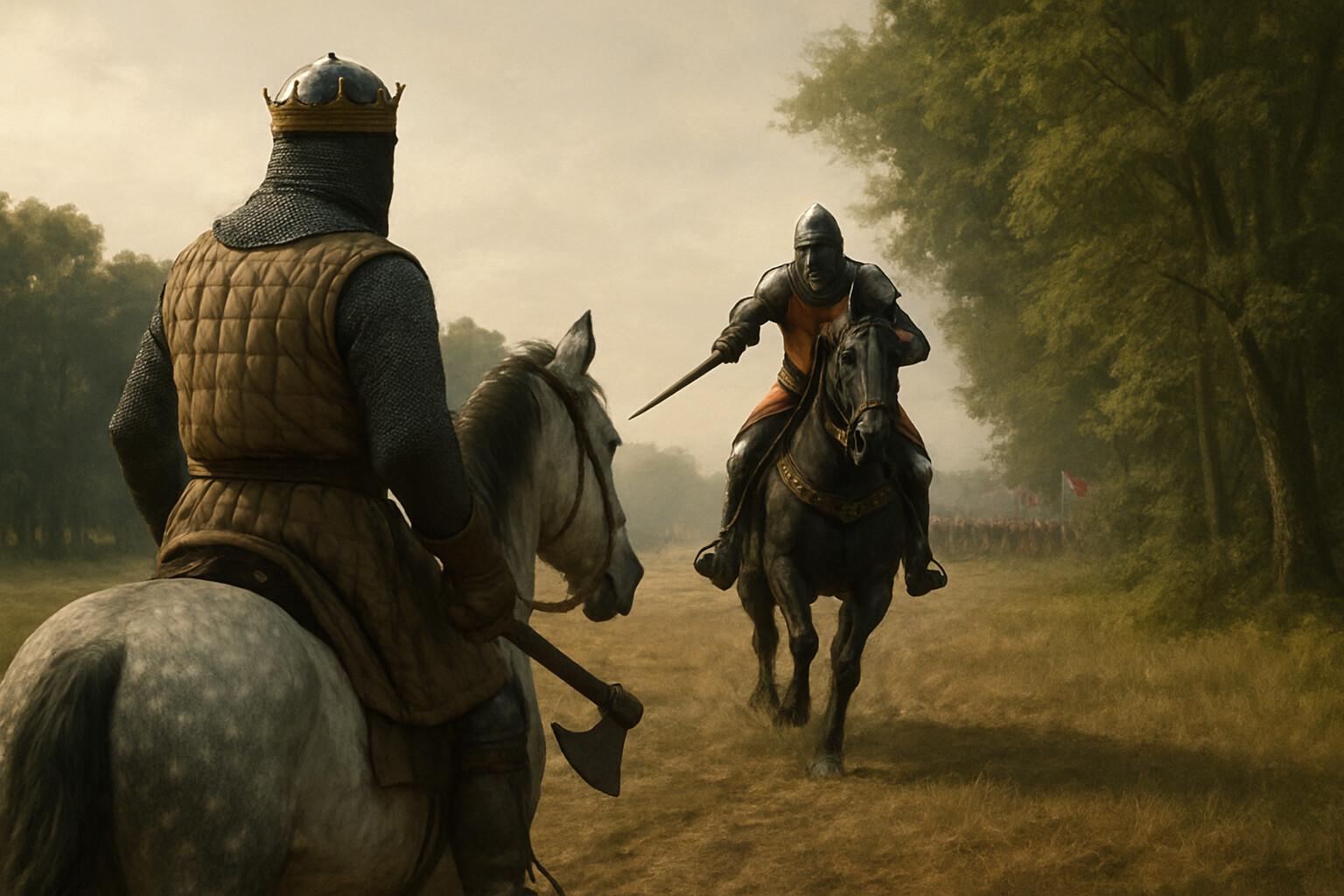
The cold open: Robert the Bruce on his small grey palfrey, alone at the edge of the New Park tree line, watching Henry de Bohun's destrier charge toward him at full gallop with lance couched. The gap between them is closing fast. The Scottish tree line visible behind Bruce; English banners in the far distance.

The warhorse came fast.

Henry de Bohun had spotted Robert the Bruce riding alone at the edge of his own lines, conspicuous on a small grey palfrey, carrying only a light axe. De Bohun was a young English knight of good family, mounted on a heavy destrier bred for exactly this kind of charge. He couched his lance, spurred forward, and chose in one moment to end the war himself.

Bruce saw him coming. He did not retreat. He waited, let the horse and lance close on him at full gallop, then sidestepped at the last moment, rose in his stirrups, and brought the axe down onto de Bohun's helmeted head with enough force to cleave through the iron and kill him outright. The axe haft shattered from the blow. According to John Barbour's account, written roughly sixty years later, Bruce rode back to his commanders and expressed regret only about the broken axe. Whether that detail is authentic recollection or literary characterization at this distance cannot be determined, but the broad outline of the duel is consistent across multiple sources.

It was June 23, 1314. The Battle of Bannockburn had not yet begun. What followed the next day was a two-part engagement that would determine whether Scotland survived as a kingdom at all.

---

To understand what was at stake at Bannockburn, you have to understand what Scotland had already endured.

Edward I of England had pressed his claim to feudal overlordship over Scotland beginning in 1296, deposing King John Balliol, seizing the Stone of Destiny from Scone, and garrisoning Scottish castles with English troops. What followed was eighteen years of grinding, intermittent war. William Wallace's rising and his destruction at Falkirk in 1298. The capture and execution of Wallace himself in 1305. The slow compression of Scottish resistance into something that looked, by 1304 or 1305, like permanent subjugation.

Robert Bruce, Earl of Carrick, was not a straightforward patriot. He came from a powerful Anglo-Norman family with landholdings on both sides of the border. He had changed sides more than once during the long wars, serving Edward I when calculation demanded it, supporting the Scottish cause when opportunity permitted. He killed his chief Scottish rival, John Comyn, in a Franciscan church at Dumfries in February 1306 — a killing that forced his hand definitively and led, within months, to his coronation as King of Scots at Scone.
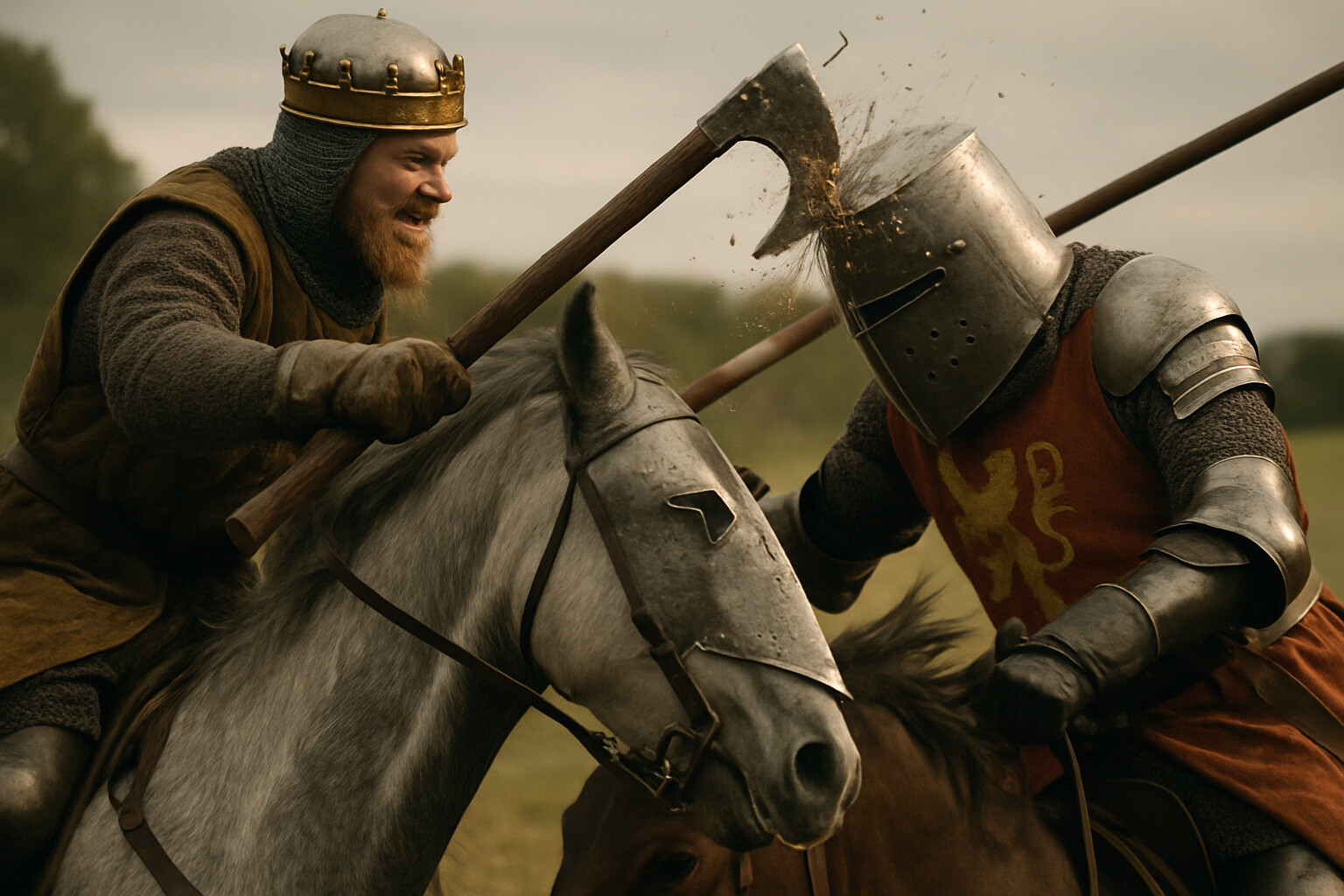
The kill: Bruce rising in his stirrups as de Bohun's lance misses by inches, the axe already in its downward arc, the blow landing on de Bohun's great helm with enough force to split it. De Bohun already going sideways. The axe haft in the process of shattering.

The years that followed his coronation were desperate. His small force was routed by the English at Methven in June 1306. He became a fugitive, sheltering in the western isles, losing family members to English captivity. The story of the spider — Bruce watching a spider repeatedly attempt to spin its web, drawing inspiration from the creature's persistence — is a much later tradition that cannot be verified from contemporary records and does not appear in print until centuries after the events. What can be said is that he survived, rebuilt, and returned.

By 1307, Edward I was dead. His son Edward II was a capable tournament knight but a poor commander, weakened by his reliance on royal favorites and chronically unable to hold his barons together for sustained campaigns. Bruce moved quickly. Between 1307 and 1314, he recaptured castle after castle across Scotland, not by siege but by assault and systematic demolition. He did not want garrisoned fortresses that could be retaken. He wanted broken walls the English could not use. Perth fell. Aberdeen fell. Linlithgow fell. By early 1314, only Stirling, Bothwell, and a handful of other strongholds remained in English hands.

Stirling Castle was the crisis point.

Stirling sat on a volcanic rock commanding the principal crossing of the River Forth. Whoever held Stirling controlled movement between northern and southern Scotland. In the spring of 1313, Bruce's brother Edward Bruce had besieged the castle and made an agreement with its constable, Sir Philip de Mowbray: if an English relief army did not arrive by midsummer 1314, Stirling would surrender. It was a chivalric compact that forced Edward II's hand. The English king could not afford to let Stirling fall without a fight. His own military culture required him to come north in force.

Edward II assembled one of the largest English armies to enter Scotland since his father's campaigns. Modern estimates of its size vary considerably. Contemporary chronicles quote figures that most scholars now discount as exaggerated — some suggest totals in the range of 20,000 men. More cautious modern estimates place the force at somewhere between 15,000 and 20,000, with perhaps 2,000 to 2,500 heavy cavalry and a substantial contingent of Welsh and English longbowmen. Against this, Bruce commanded a Scottish army estimated at perhaps 6,000 to 8,000 men, the great majority of them infantry organized into schiltrons — dense formations of spearmen carrying twelve-foot pikes, capable of presenting a wall of points that cavalry could not easily break if the ground were chosen well.

At Falkirk in 1298, Wallace's schiltrons had held against English cavalry only to be destroyed by Edward I's archers once the horsemen withdrew. Bruce had spent years considering that lesson. At Bannockburn, he would choose ground that negated the English advantages.

The terrain south of Stirling in 1314 was not what it appears on modern maps. The carse — the low-lying ground between the Bannock Burn and the Forth — was boggy, cut by drainage streams and soft with the early summer water table. Careful modern surveys and the work of historians including Aryeh Nusbacher and David Cornell have refined the understanding of where the battle was actually fought, though the precise location of the main engagement on June 24 remains under scholarly debate. What is agreed is that Bruce selected and prepared his position deliberately, placing his army where approaching cavalry would be channeled, slowed, and denied room to operate.

He also had his men dig pit traps — camouflaged holes in the turf, roughly a foot deep and the circumference of a man's leg — in the likely approaches, designed to trip horses and break formations. These are mentioned in several contemporary accounts and represent deliberate battlefield engineering rather than a lucky natural advantage.
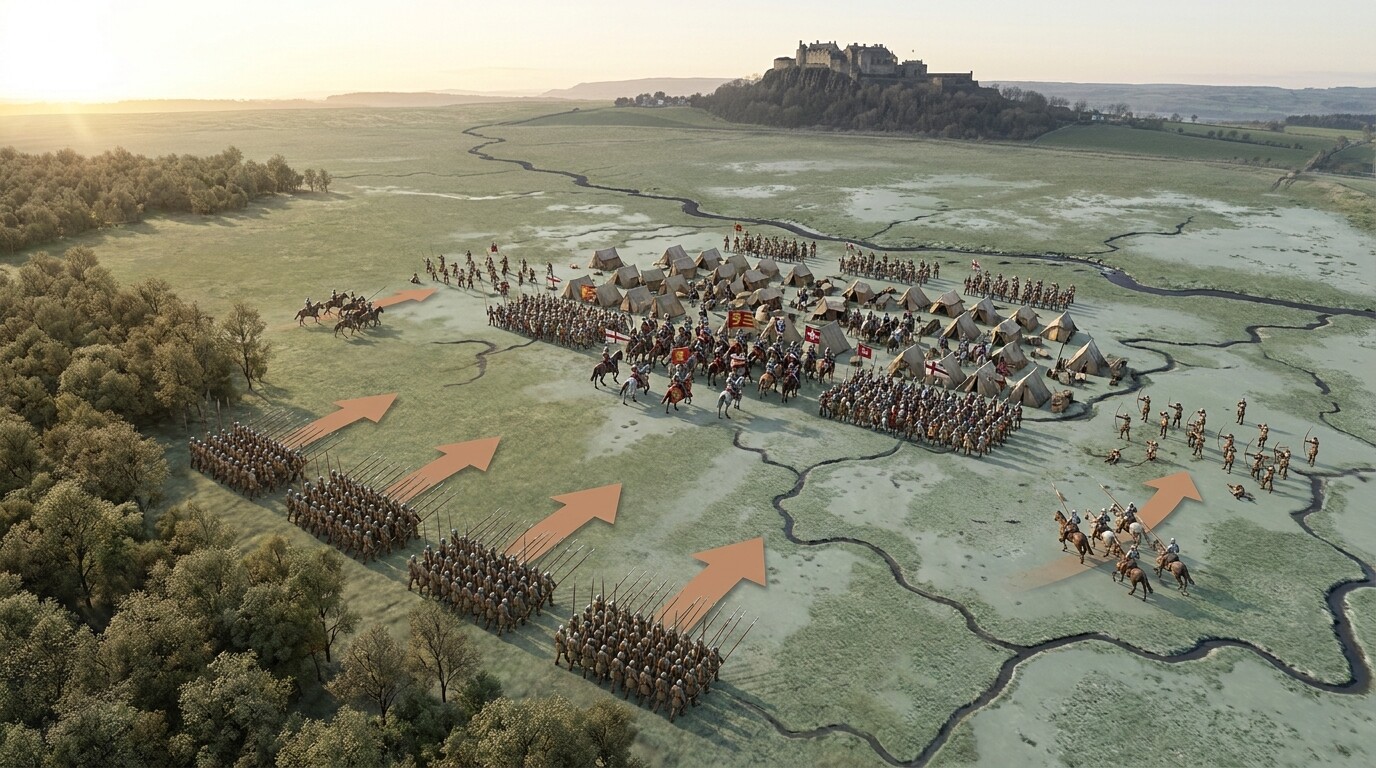
Aerial or elevated map view illustration of the Bannockburn battlefield showing the New Park tree line, the carse, the Bannock Burn, the English army encampment, and directional arrows for the Scottish advance on June 24.

The English army marched north from Berwick in mid-June, covering roughly twenty miles a day to arrive before Stirling in time. Edward's commanders knew the broad outline of the Scottish position. What they apparently did not fully appreciate was how carefully it had been prepared.

---

June 23 opened the battle.

The English advance guard, under the Earls of Gloucester and Hereford, pushed forward along the Roman road toward Stirling. Somewhere near the entry to the New Park — a wooded royal hunting ground that Bruce had positioned himself within — Hereford's men encountered the Scottish outposts.

Henry de Bohun was riding with the English van. When he saw Bruce — identifiable by the gold crown on his helm — separated from his main body, the opportunity must have seemed decisive. A single charge. A lance through the Scottish king. The war ended before it properly started.

What actually happened next is one of the most attested single combat episodes in medieval Scottish history. It is described in John Barbour's The Brus, composed in the 1370s roughly sixty years after the events, drawing on oral tradition and earlier sources now lost. It appears in the chronicle of the Monk of Malmesbury and in other roughly contemporary English accounts. The broad outline — Bruce on a small horse, de Bohun on a destrier, the lance miss, the axe blow — is consistent across sources, though individual accounts differ in detail. Barbour frames it as a deliberate display of courage by Bruce; some historians note that Bruce may not have had much choice once de Bohun committed to the charge at close range.

Whatever Bruce's calculation in those seconds, the effect was immediate and visible. De Bohun was dead. The English van had failed its opening move. Every Scottish soldier in the tree line had watched their king ride back alive after killing an English knight in single combat with what amounted to a hand axe. The psychological weight of that moment cannot be precisely measured, but it is reasonable to treat it as significant for morale on both sides.

The rest of June 23 did not go well for the English. A second English column, attempting to reach Stirling by a route east of the New Park, was intercepted by Robert Keith's Scottish cavalry and driven back before it could reach the castle. English horsemen who pressed into the Scottish lines in the New Park found the schiltrons solid and the ground against them. Gloucester's horse reportedly went down in the pits. The English drew back.
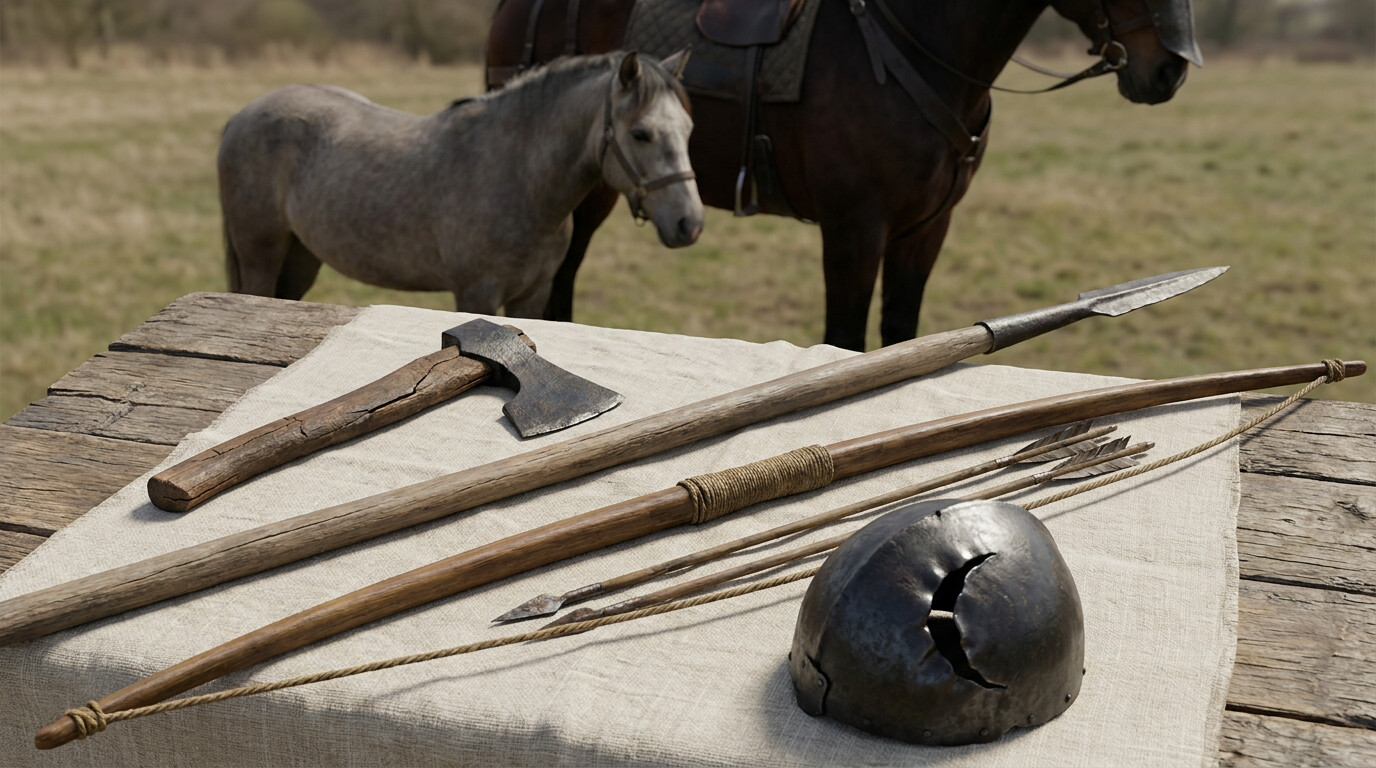
Equipment detail panel: the weapons of Bannockburn laid out or shown in use — the hand axe, schiltron spear, English longbow, and the contrast between Bruce's light palfrey and the English destrier. A craftsman's or historian's close examination of the tools of the battle.

By evening, the English army crossed the Bannock Burn and moved onto the carse to camp for the night. There was open ground there, and the army needed to concentrate — but the decision placed them with the burn behind them and soft ground compressing their flanks. Some English commanders apparently recognized the problem. Chronicle sources record that Sir Alexander Seton, a Scottish knight then serving the English who defected to Bruce's camp during the night, reported to the Scottish king that the English were demoralized, their cavalry cramped on bad ground, and that an aggressive dawn attack would catch them off-balance. Whether this account is precise or a later embellishment on what Bruce could already have inferred from observation, the broad assessment of English vulnerability on the carse is consistent with what happened next. That Seton's intelligence was decisive in Bruce's decision cannot be independently confirmed; the account rests on chronicle tradition.

---

The morning of June 24 was a Sunday.

Several chronicle sources describe the Scottish army coming forward before dawn to prayers, kneeling in the early light. An exchange reported in the chronicle tradition — in which an English observer remarks on the Scots kneeling and Edward II responds that they are asking mercy from God, not from him — has entered historical memory but cannot be verified as direct quotation and should be understood as a reported tradition, not a documented exchange.

Bruce organized his army into four main divisions of schiltrons. Edward Bruce commanded one on the right. Thomas Randolph, Earl of Moray, commanded another. James Douglas, perhaps Bruce's most capable battlefield commander, led a third. Bruce himself commanded a reserve division and managed the battle overall. Robert Keith's light cavalry, a few hundred horsemen at most, screened the flanks. A body of infantry sometimes called the Small Folk — levies, camp followers, and additional reserves — waited behind Coxet Hill.

The Scottish advance onto the carse was aggressive and, by English accounts, unexpected. The heavy English cavalry attempted to deploy, but the ground confined them. The carse channeled horses into narrow frontages where the Scottish spear walls could hold. English knights pushing into the schiltrons found the packed spearheads unanswerable by direct frontal assault. Medieval cavalry doctrine required open ground and momentum; the boggy carse stripped both.

The English longbowmen were the real danger. At Falkirk, it had been the archers who broke Wallace's schiltrons after the cavalry failed. Edward II's army carried a large archer contingent, and if they had been able to deploy to the flanks and pour arrows into the packed Scottish formations, the outcome could have been different. Robert Keith's cavalry was apparently sent against the English archers specifically to break them up before they could settle into effective flanking fire. Several accounts, including Barbour's, describe Keith's horsemen sweeping across the English position and scattering the bowmen. Without sustained archery support, the English cavalry found themselves fighting the spear walls alone on ground they could not use.

The English position compressed. Cavalry unable to deploy properly, infantry pressing from behind, and the schiltrons advancing methodically — the combination produced what medieval accounts describe as a catastrophic crush. Horses and men went down together. The Bannock Burn, narrow but steep-banked, trapped those trying to flee or reorganize behind the army.
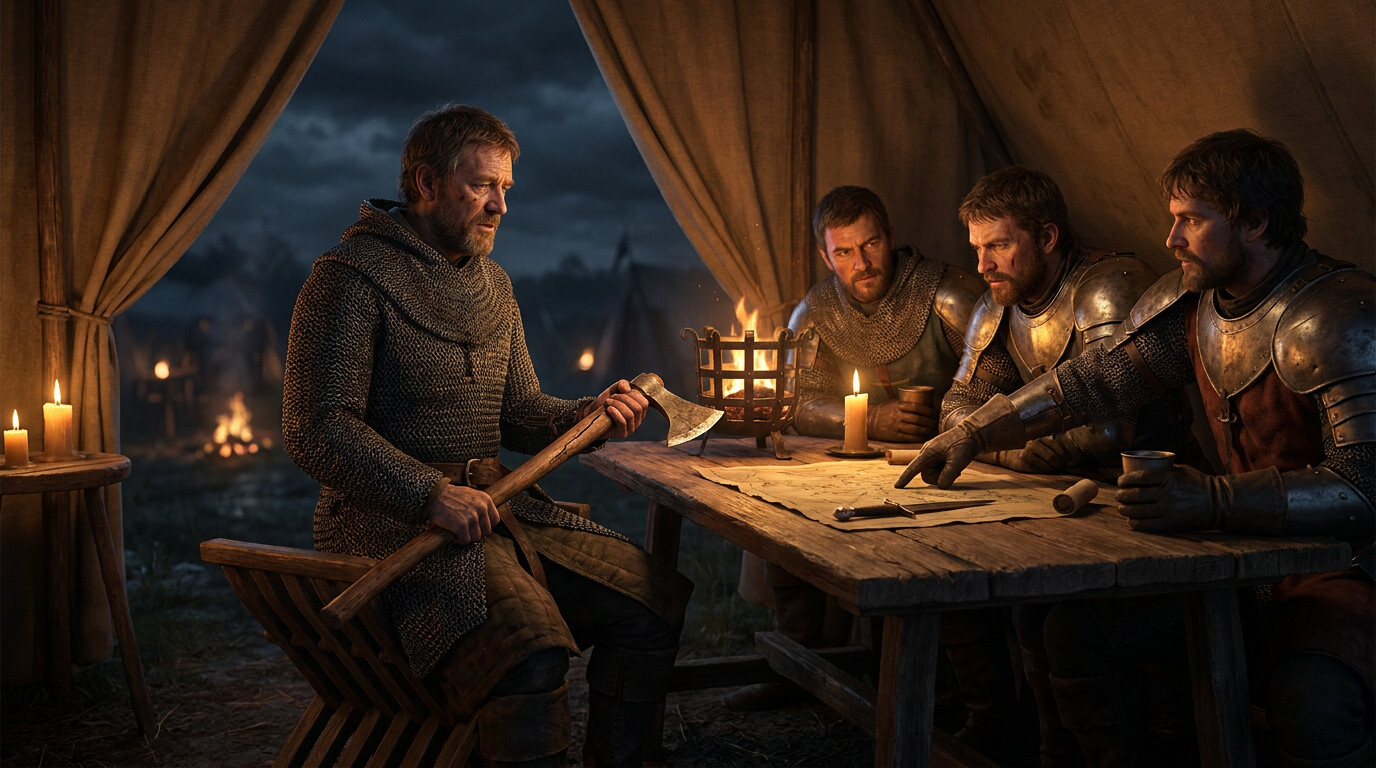
The intimate human scene: the night of June 23. Robert the Bruce in a commander's tent or at a fire, surrounded by his senior commanders — Douglas, Randolph, Edward Bruce. One man is describing the ground. Bruce sits with the broken axe haft in his hands, turning it over. The firelight is low. The mood is focused, not celebratory.

At some point during the fighting — the exact timing is uncertain — the body of infantry known as the Small Folk appeared over Coxet Hill behind the Scottish main line, carrying makeshift standards and moving toward the battle. Some accounts suggest their appearance convinced portions of the English army that a new Scottish reserve had arrived, accelerating the collapse of morale. Whether the English read them as fresh troops or simply as an additional mass of enemies, the tactical effect appears to have been the same. The English formation, already cramped and losing cohesion, began to break. The role of the Small Folk in triggering that collapse is documented in some sources but cannot be established with confidence; the timing and precise psychological impact are inferred.

Edward II was led from the field by his household knights. He attempted to reach Stirling Castle but was turned away by Philip de Mowbray, who told him the castle would have to surrender under the agreed terms and could not shelter him. Edward fled south and east, reaching Dunbar by ship and eventually making his way back to England. The English rout stretched for miles. Fugitives were cut down on the roads, at the burns, and in the surrounding countryside.

The Earl of Gloucester — one of the senior English commanders — was killed in the fighting, reportedly while charging the Scottish spear wall without his surcoat over his armor, meaning he was not identified in time for ransom, which was the standard fate for captive nobility. The death of Gloucester was a significant loss for the English command. Scores of English knights were captured; their ransoms would fund years of Scottish governance. The scale of English material losses — horses, armor, weapons, the royal baggage — was enormous.

---

The human cost of Bannockburn is, like almost all medieval casualty figures, deeply uncertain.

English losses were certainly severe, though precise numbers cannot be established. The campaign chronicle tradition and the scale of ransoms paid afterward both suggest that a significant proportion of the heavy cavalry was killed or captured. For the infantry — many of them Welsh or English levies with no means of ransom — the toll may have been worse proportionally, though they receive less attention in the sources. Modern historians regard English losses as heavy without being able to assign reliable numbers.

Scottish losses are even less well documented. The schiltrons took casualties — pushing forward into armed cavalry and fighting in close quarters means men died — but Bruce's tactical preparation appears to have kept Scottish losses substantially below English ones. The relative silence of contemporary sources on Scottish senior-officer deaths is itself an inferential argument, not a precise count.

For the prisoners, Bannockburn created a diplomatic asset that Bruce used carefully over the following years. The ransom of captured English nobles — including the Earl of Hereford, taken in the immediate aftermath — was exchanged in some cases for Scottish prisoners held in England, among them Bruce's own wife, daughter, and sister, who had been in English captivity since 1306.
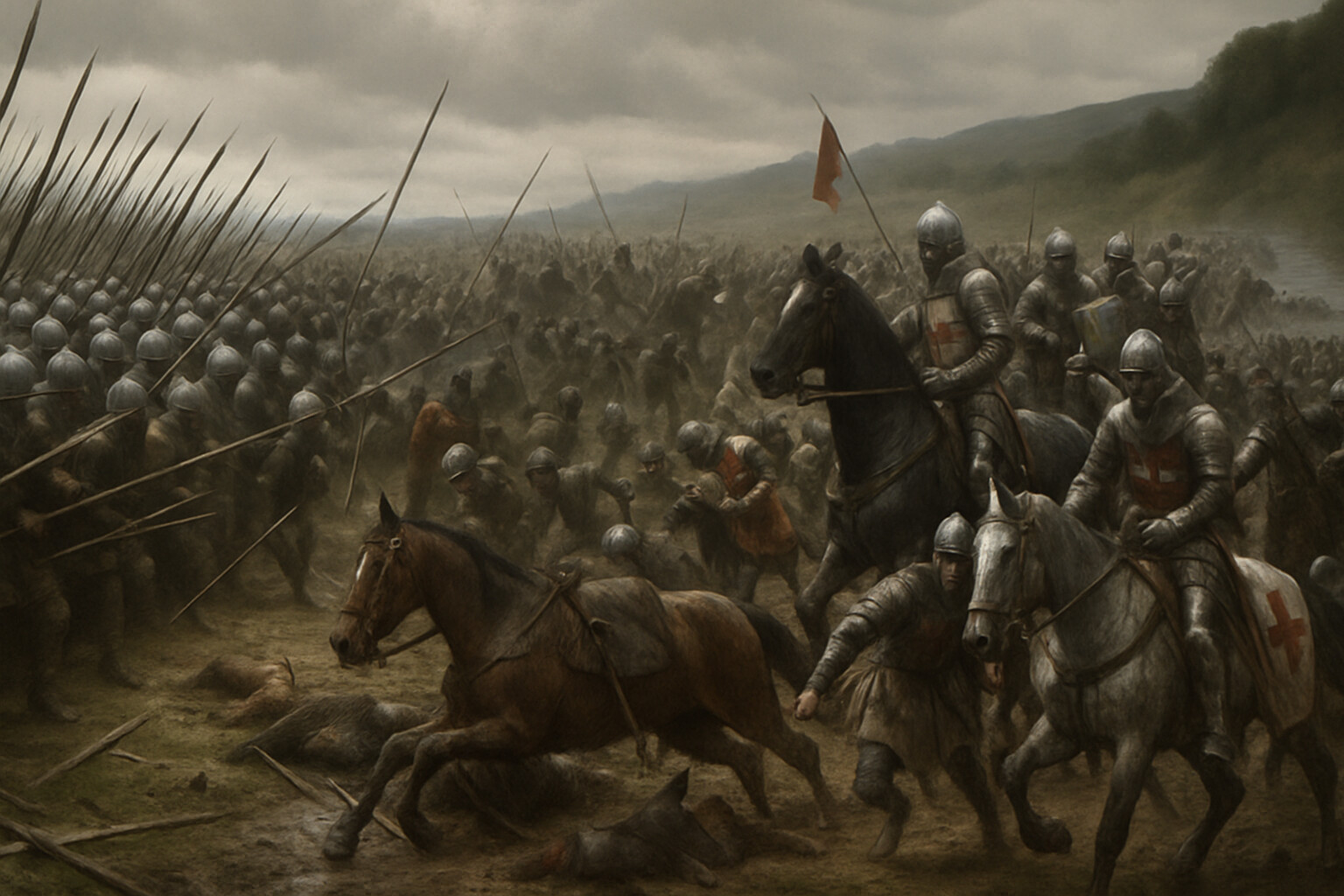
The rout: June 24 afternoon. The English formation breaking apart on the carse. Horses going down in soft ground. Schiltrons pressing from the left. The Bannock Burn in the background trapping the fleeing English. Edward II's household knights pulling him away from the collapsing center.

---

Bannockburn did not by itself end the First War of Scottish Independence. The English did not recognize Scottish sovereignty for another fourteen years. Edward II refused to acknowledge what the battle had made militarily obvious. The war continued — raids, sieges, and negotiations — until the Treaty of Edinburgh-Northampton in 1328, which formally recognized Robert the Bruce as King of Scots and Scotland as a sovereign kingdom independent of England. Edward II had been deposed and was dead by then; it was his young son Edward III who signed the treaty, though he would eventually repudiate it and renew the war.

Bruce himself died on June 7, 1329, probably of a disease that contemporary sources describe in ways later commentators have associated with leprosy, though that diagnosis is debated by medical historians. He was 54 or 55 years old. He had reigned for twenty-three years, the first fourteen of them with English armies seeking his destruction. He was buried at Dunfermline Abbey. A skull found at Dunfermline in 1818 shows an anomaly consistent with the disease described in the sources, though formal identification of it as Bruce's remains has not been confirmed by published forensic or DNA analysis as of current knowledge.

By longstanding tradition, Bruce's heart was removed after his death and carried toward Jerusalem by Sir James Douglas, who died fighting the Moors in Spain before completing the journey; the heart was returned to Scotland and buried at Melrose Abbey. This tradition is supported by Scottish chronicle sources and is regarded by historians as plausible, though some specific details of the journey cannot be fully verified.

The Declaration of Arbroath, written in 1320 by the Scottish nobility to Pope John XXII, drew explicitly on the political and military reality that Bannockburn had created. Its assertion that the Scottish people would fight to preserve their freedom under any king who upheld it — and would replace any king who did not — is sometimes described as an early statement of popular sovereignty. Whether it influenced later constitutional thinking is a matter of historical debate. What it clearly represents is the confidence of a nobility that had, six years earlier, watched their king kill an English knight with a hand axe and then break an English army on the banks of a burn most of the world had never heard of.

---

The sources for Bannockburn are both rich and complicated.

The most extensive single narrative is John Barbour's The Brus, a vernacular Scots poem composed around 1375 and dedicated to Robert II, Bruce's grandson. Barbour had access to participants or their direct descendants and to earlier written sources now lost, but he was also writing a celebratory national epic and must be read critically. His account is the primary narrative source for the de Bohun single combat and for many tactical details, but its dramatic framing and occasional inconsistencies require careful handling.
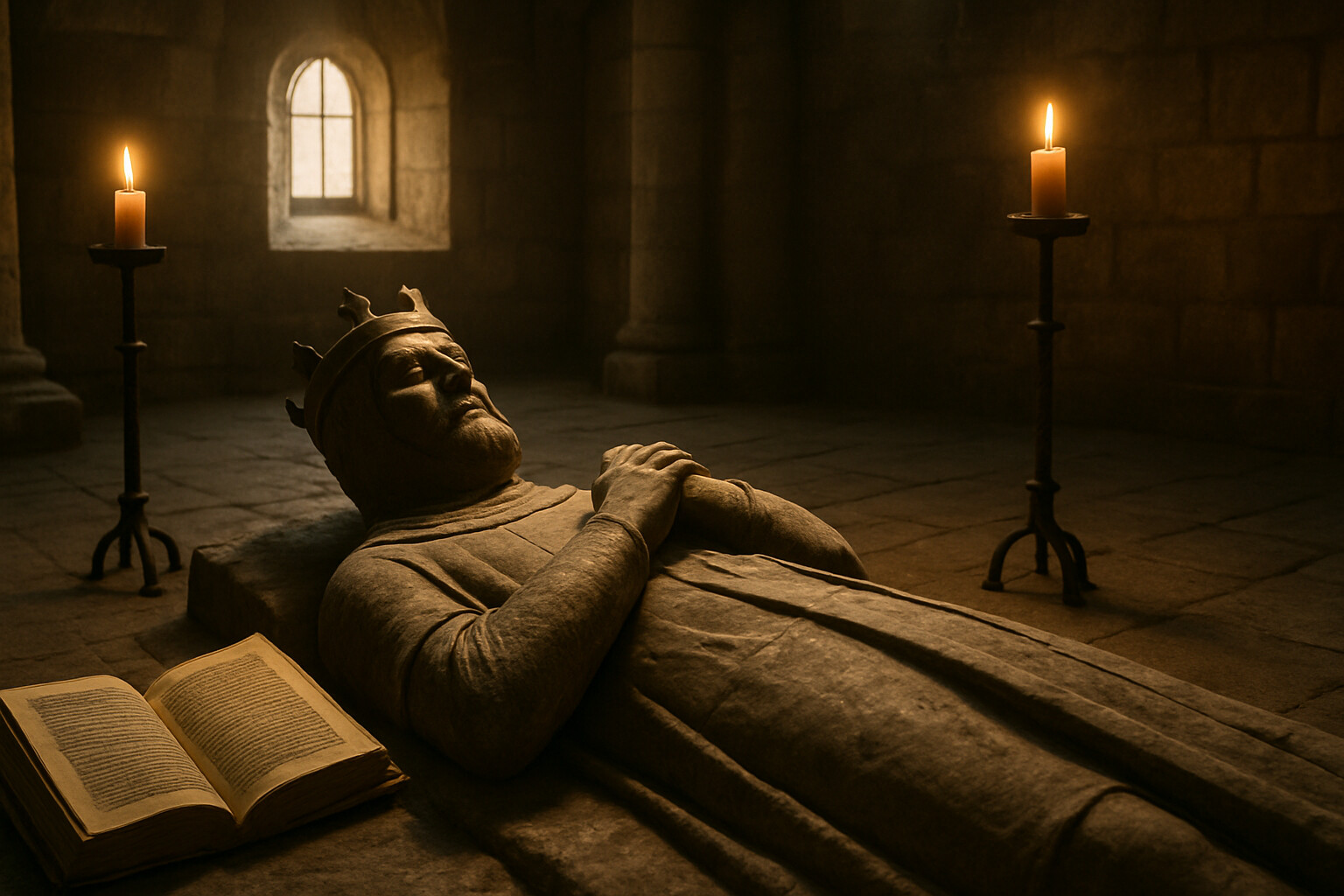
Legacy and record: Dunfermline Abbey, where Bruce is buried. The stone floor of the Abbey nave, a carved effigy of a king, warm candlelight. In the corner or foreground, an open page of a medieval chronicle — Barbour's The Brus — showing the dense Scots vernacular text, the kind of source from which history pieces together what happened. A historian's quiet moment of record and memory.

Contemporary English sources — the Vita Edwardi Secundi, the chronicle attributed to the Monk of Malmesbury, and several other annalistic records — give the defeated side's perspective, acknowledge the scale of the defeat, and provide some tactical detail, though they naturally minimize or obscure the extent of the English failure. These sources are valuable precisely because they are not partisan toward Bruce.

Modern historical scholarship on Bannockburn is substantial. Clifford Rogers, David Cornell, Aryeh Nusbacher, and others have contributed detailed analyses of the battlefield, the tactical problem, and the source criticism necessary to reconstruct the engagement. The exact site of the main June 24 engagement remains under discussion; archaeological survey work in the early twenty-first century, including metal detector surveys and ground-penetrating radar around the Bannockburn Heritage Centre, has not produced the concentrations of battle debris that would definitively locate the fighting. Medieval battles often leave thin archaeological signatures, and medieval iron rusts to near-invisibility over seven centuries.

The National Trust for Scotland operates the Bannockburn Heritage Centre near Stirling. The site preserves the general area and provides interpretation, but the monument's location at the Borestone — traditionally claimed as Bruce's command post — is itself considered uncertain by most modern historians.

---

Bannockburn matters not because it was a clean, decisive end to a war — it was not — but because of what it demonstrated and what it forced.

It demonstrated that a Scottish army, carefully prepared and intelligently led, could break a substantially larger English force in the field. Edward I had beaten Wallace at Falkirk with cavalry, archers, and weight of numbers. His son arrived at Bannockburn with a comparable combination and was beaten anyway, because Bruce had studied what had destroyed Wallace's army and removed the conditions that made those weapons decisive. The pit traps neutralized cavalry momentum. Keith's attack on the archers neutralized the longbow. The chosen ground neutralized the English numerical advantage by compressing their frontage.

What it forced was English recognition, however reluctant and delayed, that Scotland could not be absorbed by military pressure alone. The treaty of 1328 came fourteen years after Bannockburn and largely because Scotland had made itself too costly to conquer.

The single combat on June 23 has taken on symbolic weight in Scottish national memory that probably exceeds its tactical importance. De Bohun's charge did not determine the battle; the preparation of the ground, the training of the schiltrons, and the careful use of terrain on June 24 did that. But the image of a king refusing to yield, on the eve of a fight that would determine whether his kingdom survived, is not an invented or exaggerated one. It happened. The axe broke. The king rode back.
Scottish War Axe (Hand Axe / Battle Axe)

The hand axe Bruce carried on June 23, which he used to kill Henry de Bohun in single combat and which shattered its haft from the force of the blow.

Caliber
N/A
Weight
Approximately 1–2 kg for a hand axe of this period; heavier poll axes could reach 3–4 kg
Range
Close quarters; effective reach roughly 60–90 cm including haft
Rate Of Fire
N/A — single-blow weapon
Crew
1
Ammunition
N/A
Manufacturer
Unknown; likely a Scottish or Anglo-Norman smith
Years Produced
Axes of this form were produced throughout the 12th–14th centuries
Nickname
Unknown

Scottish Pike / Spear (Schiltron Weapon)

The twelve-foot or longer spear carried by Scottish infantry in schiltron formations, the primary weapon of the Scottish foot soldiers at Bannockburn.

Caliber
N/A
Weight
Approximately 2–4 kg depending on shaft length and tip weight
Range
Effective reach approximately 3–4 meters; first rank could engage at roughly 2 meters while rear ranks overlapped
Rate Of Fire
N/A — thrusting weapon
Crew
1 per spear; effective in mass formation
Ammunition
N/A
Manufacturer
Produced by Scottish craftsmen; spear tips were simple socketed iron points requiring basic smithing
Years Produced
Spears of this form used throughout the medieval period; schiltron doctrine developed in Scotland specifically in the late 13th–early 14th century
Nickname
The schiltron spear; later Scottish equivalents were called Jedburgh staffs or Lochaber axes, but at Bannockburn the weapon was a long thrusting spear

English Longbow

The primary English ranged weapon at Bannockburn, potentially decisive if allowed to operate on the flanks of the Scottish schiltrons but disrupted by Robert Keith's cavalry charge.

Caliber
N/A — arrow diameter approximately 9–11 mm
Weight
Bow: approximately 1–1.5 kg; draw weight 80–160 lbs (modern reconstructions of period bows suggest 100–160 lbs for war bows)
Range
Maximum range approximately 200–300 meters; effective aimed range against formed troops approximately 100–180 meters; point-blank effective range against armor approximately 50–70 meters
Rate Of Fire
Trained archer: 10–12 arrows per minute sustained; up to 15–20 per minute in short bursts
Crew
1 per bow
Ammunition
Bodkin point arrows (long, narrow points for armor penetration) and broadhead arrows for unarmored targets; approximately 24–60 arrows carried per archer in a battle context
Manufacturer
English and Welsh craftsmen; yew was the preferred wood, with Spanish and Italian yew imported when English supplies were insufficient
Years Produced
The war longbow as a primary English military weapon: approximately 1280s through the mid-15th century
Nickname
The English longbow; Welsh longbow (the Welsh were major contributors to English archer forces)

Destrier (English Armored Warhorse)

The heavy warhorse ridden by English knights at Bannockburn, bred and trained for shock cavalry action but critically vulnerable to the boggy carse ground and the Scottish schiltron spear walls.

Caliber
N/A
Weight
Estimated 500–700 kg for a typical 14th-century destrier; some larger animals may have exceeded this
Range
Combat effective charge: approximately 150–300 meters at canter/gallop before fatigue; sustainable trot much longer
Rate Of Fire
N/A
Crew
1 rider
Ammunition
N/A
Manufacturer
Bred from continental European stock, often imported from Lombardy, Andalusia, or Flanders; English and Scottish breeders maintained herds
Years Produced
The destrier as a military type: approximately 10th–15th centuries; declined as plate armor increased and mounted tactics changed
Nickname
Great horse; destrier (from Old French, meaning 'right-hand horse,' as the groom led it by the right hand)

Knight's Lance (English)

The primary shock weapon of English knights at Bannockburn, couched underarm for the charge and used by Henry de Bohun in his single combat attempt against Bruce.

Caliber
N/A
Weight
Approximately 3–5 kg for a couched lance of this period; varied with length and wood type
Range
Effective only in the final few meters of a cavalry charge; typical 14th-century war lance approximately 3.5–4.5 meters in length
Rate Of Fire
N/A — single-use in a charge; could be retained for repeated use in tournament conditions but often lost or broken in battle
Crew
1
Ammunition
N/A
Manufacturer
Produced by specialist craftsmen; ash was common, with the tip iron-shod or fitted with a steel point
Years Produced
Couched lance technique in European knightly combat: approximately 11th–15th centuries
Nickname
The lance; 'spear' in earlier usage
Photo
Pending

Robert I (Robert the Bruce)

King of Scots

Unit: Army of the Kingdom of Scotland

Held the title King of Scots (1306–1329); no formal military decorations applicable to medieval kingship in the modern sense

Robert Bruce was born on July 11, 1274, the eldest son of Robert de Brus, 6th Lord of Annandale, and Marjorie, Countess of Carrick. His family was of Norman origin, holding lands in both Scotland and England, and he grew up in a political environment where Anglo-Scottish noble identity was fluid and loyalty to the Scottish crown was not a given. He was formally educated, spoke Norman French and probably Latin, and was trained in the military arts expected of a great nobleman — horsemanship, lance work, sword, the management of men. His path to kingship was neither straightforward nor heroic in a simple sense. During the first years of the Scottish resistance to Edward I, Bruce changed sides multiple times — supporting the English when calculation demanded it, joining the Scottish cause when opportunity or pressure pushed him. His killing of John Comyn in the Greyfriars Church at Dumfries in February 1306 is documented in both Scottish and English sources. The killing was likely premeditated or at least the product of a violent confrontation over their competing claims to leadership of Scotland; it forced Bruce to commit fully to the Scottish cause or face destruction. He was crowned at Scone in March 1306 within weeks of the killing. The subsequent years of exile and recovery — being driven to the western islands, rebuilding support, returning and systematically demolishing English-held Scottish castles — are documented in Barbour and partially in other sources. The period 1307 to 1314 represents the most successful phase of Bruce's military career: a consistent operational strategy of denying the English fortified positions, avoiding pitched battle until the conditions were right, and maintaining the loyalty of Scottish magnates and churchmen. At Bannockburn, his personal conduct on June 23 — the single combat with de Bohun — is attested in multiple sources and is treated by historians as historically credible in its broad outline. His overall command performance on June 24 is regarded by military historians as tactically sophisticated for the period. Bruce reigned until his death on June 7, 1329, probably at his manor of Cardross near Dumbarton. The nature of his illness is uncertain; contemporaries described symptoms that later commentators have associated with leprosy, but this diagnosis is debated. He was 54 years old. He is buried at Dunfermline Abbey; a skull found at Dunfermline in 1818, now held by the National Museum of Scotland, shows an anomaly consistent with the disease described in the sources, though formal identification is uncertain.

Photo
Pending

Henry de Bohun

Knight

Unit: English van under the Earls of Gloucester and Hereford

Henry de Bohun was a nephew of Humphrey de Bohun, 4th Earl of Hereford, one of the senior English commanders at Bannockburn. He was therefore of good family and connected to the highest English nobility. He was riding with the English advance guard on June 23 when he reportedly identified Bruce riding alone near the Scottish lines on a small palfrey. His decision to charge and attempt to kill the Scottish king in single combat is attested in several chronicle sources. His death — killed by a single axe blow to the helm — is documented in both Barbour's The Brus and in English chronicle accounts. Little else is known about him independently of the duel. His family connection to Hereford is established; his personal biography before June 23, 1314, is not well documented in surviving records.

Photo
Pending

Edward II

King of England

Unit: English Army

Edward II (born April 25, 1284; died September 21, 1327) was the fourth son of Edward I and succeeded to the English throne in 1307. Unlike his father, he was not primarily a war king. He was a capable tournament knight but showed persistent difficulties managing his great magnates and a tendency to govern through unpopular favorites — first Piers Gaveston, executed by the barons in 1312, later Hugh Despenser. His campaigns in Scotland never achieved the sustained results of Edward I's early years. At Bannockburn he commanded a very large army and failed to achieve the relief of Stirling in any strategic sense. He was led from the field by his household knights, attempted to reach Stirling Castle and was refused, and escaped to Dunbar and thence to England by ship. He was eventually deposed by a coalition led by his wife Isabella and her paramour Roger Mortimer, imprisoned at Berkeley Castle, and died there in September 1327 in circumstances that have been described as murder, though the specific manner of his death is contested in the historical record.

Photo
Pending

Thomas Randolph, 1st Earl of Moray

Earl of Moray

Unit: Scottish Army, commanding one division

Earl of Moray (created by Robert I, date uncertain but prior to 1314)

Thomas Randolph was Bruce's nephew and one of his most trusted and capable commanders. He had at one point been captured by the English and served with them briefly before returning to the Scottish cause. Bruce appointed him Earl of Moray as a reward for his service. At Bannockburn he commanded one of the four schiltron divisions. He is also associated with the capture of Edinburgh Castle in 1314 by a daring night escalade. He remained a central figure in Scottish government after Bannockburn and served as Guardian of Scotland following Bruce's death in 1329. He died in 1332.

Photo
Pending

Edward Bruce

Earl of Carrick

Unit: Scottish Army, commanding one division

Earl of Carrick (by right of the Bruce family inheritance)

Edward Bruce was Robert the Bruce's younger brother and one of the most aggressive Scottish commanders of the independence war. His pact with Philip de Mowbray in 1313 — that Stirling would surrender if not relieved by midsummer 1314 — is the direct cause of the Battle of Bannockburn; it forced Edward II's hand. Edward Bruce commanded one of the four divisions on June 24. After Bannockburn, he pursued an aggressive strategy in Ireland, claiming the High Kingship of Ireland and leading a Scottish-Irish army in a series of campaigns. He was killed at the Battle of Faughart in 1318.

Photo
Pending

James Douglas

Lord of Douglas

Unit: Scottish Army, commanding one division

Lord of Douglas (granted or confirmed by Robert I)

James Douglas (c.1286–1330), known to the English as 'the Black Douglas,' was the son of Sir William Douglas. He became one of Robert Bruce's earliest and most loyal supporters and his most feared raider, conducting devastating raids into northern England. At Bannockburn he commanded one of the four main Scottish divisions. After Bruce's death he was chosen to carry the king's heart toward Jerusalem. He was killed fighting the Moors at the Battle of Teba in Spain in 1330 before completing the journey. His reputation as a commander was extraordinarily high among contemporaries on both sides of the border.

Photo
Pending

Robert Keith

Marischal of Scotland

Unit: Scottish light cavalry

Robert Keith held the hereditary office of Marischal of Scotland. At Bannockburn he commanded the small Scottish cavalry contingent — a few hundred light horse, not the armored destrier cavalry of the English. His charge against the English longbowmen, breaking their formation before they could deliver sustained flanking fire on the advancing schiltrons, is cited in chronicle sources including Barbour and is treated by military historians as a tactically decisive intervention. Little is known of his individual biography beyond his role at Bannockburn and his office.

Photo
Pending

Gilbert de Clare, 8th Earl of Gloucester

Earl of Gloucester

Unit: English Army, commanding the van with the Earl of Hereford

Gilbert de Clare (1291–1314) was one of the highest-ranking English nobles at Bannockburn, commanding the English van alongside the Earl of Hereford. He was 23 years old at the time of the battle. Chronicle sources describe his death in the fighting on June 24; one tradition holds that he charged the Scottish lines without his surcoat covering his armor, meaning he was not recognized as a high-value prisoner who should be taken alive. His body was recovered and returned to England for burial. His death was a significant blow to English prestige and to the emotional impact of the defeat.

Battle of Bannockburn

June 23–24, 1314

The Battle of Bannockburn was the largest and most consequential pitched battle of the First War of Scottish Independence. It was fought in two phases: an opening engagement on June 23, 1314, in which Scottish forces repulsed two English attempts to advance — one including the single combat in which Robert the Bruce killed the English knight Henry de Bohun — and the main battle on June 24, in which the Scottish army under Bruce attacked the larger English army deployed on the boggy carse south of Stirling and broke it after several hours of fighting.

The battle was triggered by a pact made in 1313 between Edward Bruce and Philip de Mowbray, constable of Stirling Castle, which required an English relief army to reach Stirling by midsummer 1314 or the castle would surrender. Edward II assembled one of the largest English armies to enter Scotland since his father's reign and marched north from Berwick in mid-June. Bruce selected and prepared ground south of Stirling that would neutralize English cavalry superiority: the boggy carse between the Bannock Burn and the River Forth, reinforced with pit traps and approached across narrow frontages.

The English were defeated comprehensively. Edward II fled the field and Stirling Castle surrendered. Although formal recognition of Scottish independence did not come until the Treaty of Edinburgh-Northampton in 1328, Bannockburn made clear that Scotland could not be absorbed by English military power and effectively secured Bruce's position as an unchallengeable king within Scotland.

Positions are approximate, based on published accounts.

Sources & Further Reading

BOOK

Barbour, John. The Brus. Composed c.1375. The primary vernacular Scots narrative source for the Battle of Bannockburn and the de Bohun single combat. Multiple modern editions; see Archibald A.H. Douglas edition (1964) and the Scottish Text Society editions. Written approximately 60 years after the events and drawing on earlier sources and oral tradition; must be read critically as a celebratory national epic.

BOOK

Vita Edwardi Secundi (Life of Edward II). Anonymous chronicle, c.1326. Primary English source providing the defeated side's perspective on Bannockburn. Translated and edited by Wendy R. Childs, Oxford Medieval Texts, 2005.

BOOK

Nusbacher, Aryeh. The Battle of Bannockburn 1314. Stroud: Tempus Publishing, 2000. Modern scholarly analysis of the tactical and operational course of the battle.

BOOK

Cornell, David. Bannockburn: The Triumph of Robert the Bruce. New Haven and London: Yale University Press, 2009. Detailed modern analysis of the battle, the sources, and the tactical geography.

BOOK

Barrow, G.W.S. Robert Bruce and the Community of the Realm of Scotland. 4th edition. Edinburgh: Edinburgh University Press, 2005. The standard modern scholarly biography of Robert I; essential for the political and military context of Bruce's career.

BOOK

Brown, Michael. Bannockburn: The Scottish War and the British Isles 1307–1323. Edinburgh: Edinburgh University Press, 2008. Broadens the context of Bannockburn to include the wider British Isles political and military situation.

BOOK

Duncan, A.A.M. The Nation of Scots and the Declaration of Arbroath. London: Historical Association, 1970. Context for the political consequences of Bannockburn and the 1320 Declaration.

MUSEUM

National Trust for Scotland. Bannockburn Heritage Centre, Stirling, Scotland. Holds interpretation, scale model, and site access for the Bannockburn area. The Borestone monument site, though traditional, is noted by the Trust as not confirmed by archaeology.

ARCHIVE

National Records of Scotland, Edinburgh. Primary documents relating to the reign of Robert I, including the Treaty of Edinburgh-Northampton (1328) and associated diplomatic correspondence.

RESEARCH

Penman, Michael. Robert the Bruce: King of the Scots. New Haven and London: Yale University Press, 2014. Recent comprehensive scholarly biography drawing on the full range of documentary sources.