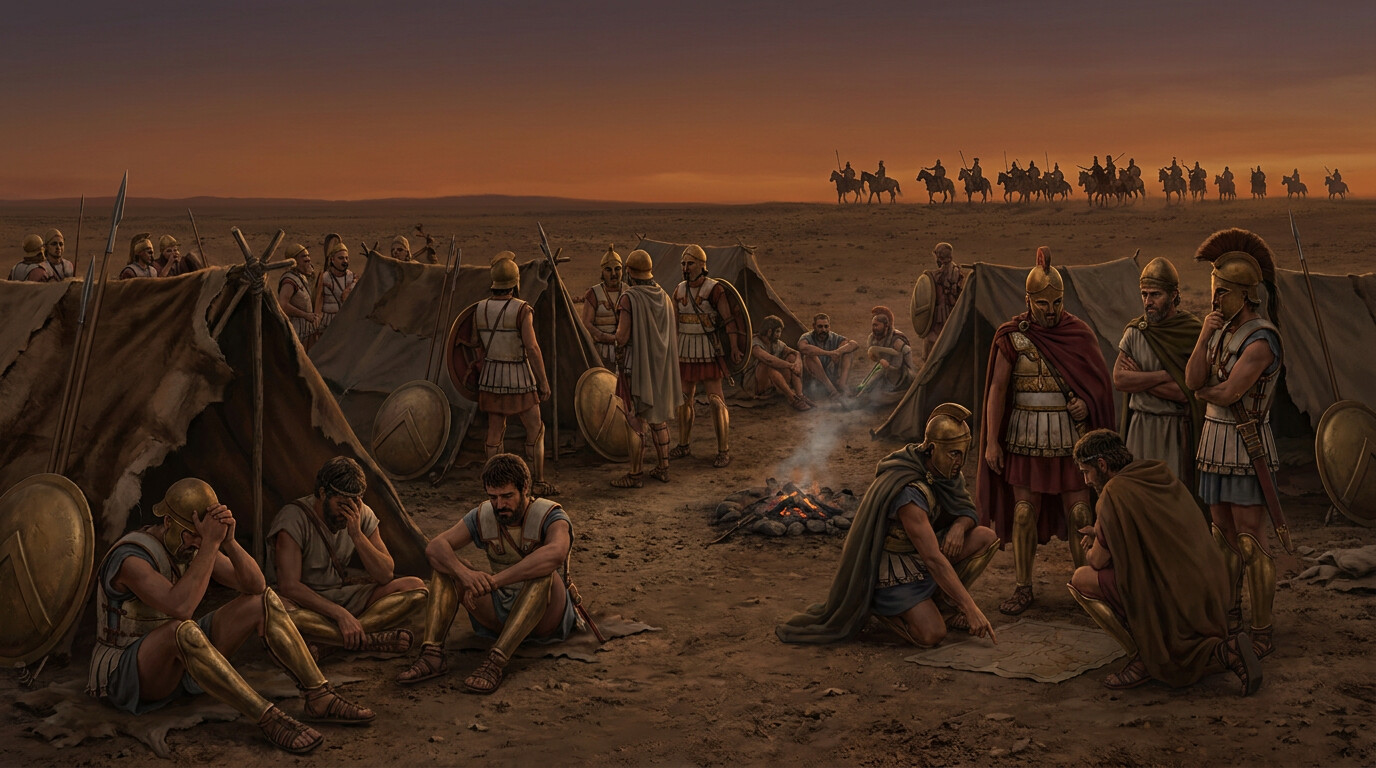
The messenger arrived at dusk with blood on his sandals and a story that could not be taken back.
Cyrus was dead. The prince who had recruited them, paid them, and promised them the throne of Persia had ridden too far forward at the Battle of Cunaxa and taken a fatal wound — ancient sources place it as a javelin to the eye or a spear thrust to the temple, and they do not agree — and with him died every promise that had brought ten thousand Greeks from their cities to the far interior of the Persian Empire. The year was 401 BC. The nearest Greek-held coast was over a thousand miles away. Between the mercenaries and the sea lay mountains, deserts, rivers in flood, and a Persian army that now had every reason to destroy them.
This is the story of how they walked out anyway.
---
To understand what the Ten Thousand faced, it is necessary to understand what they were and how they got there.
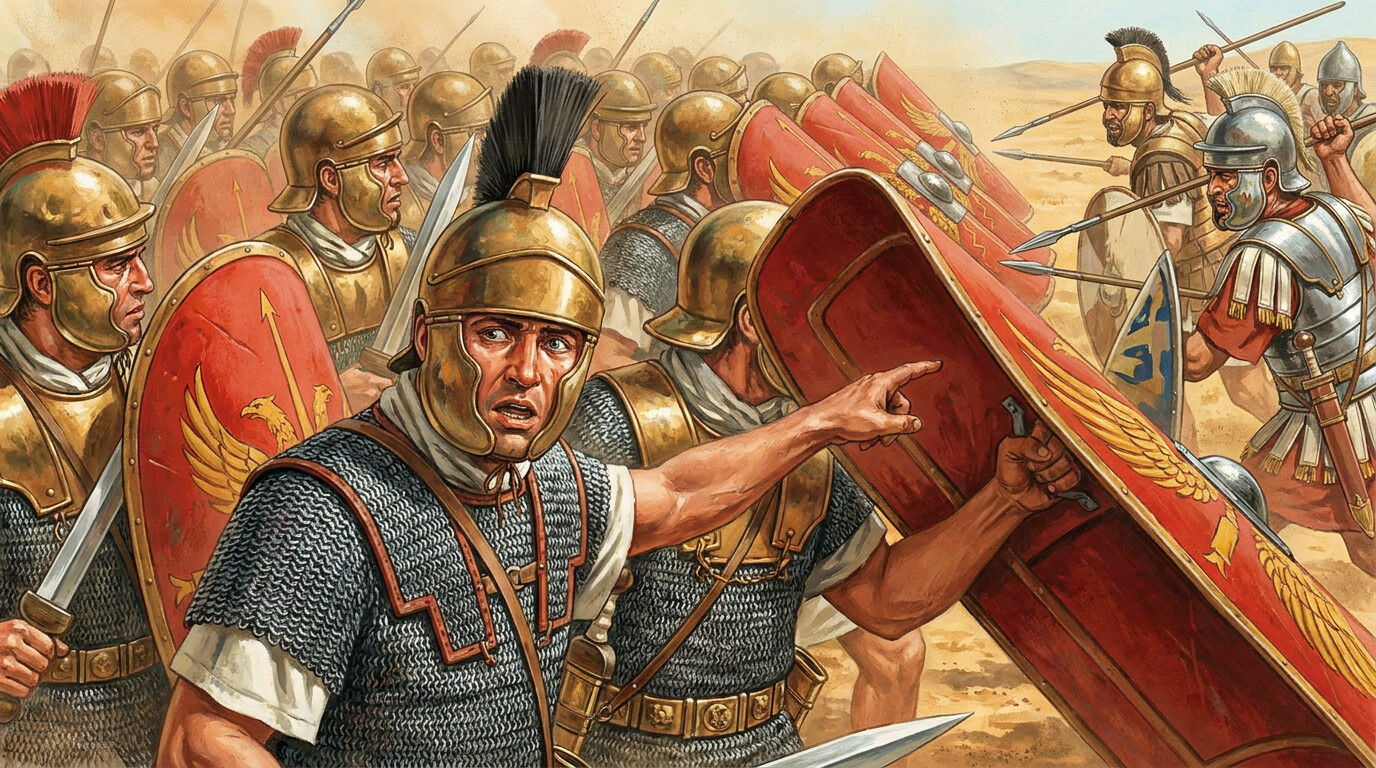
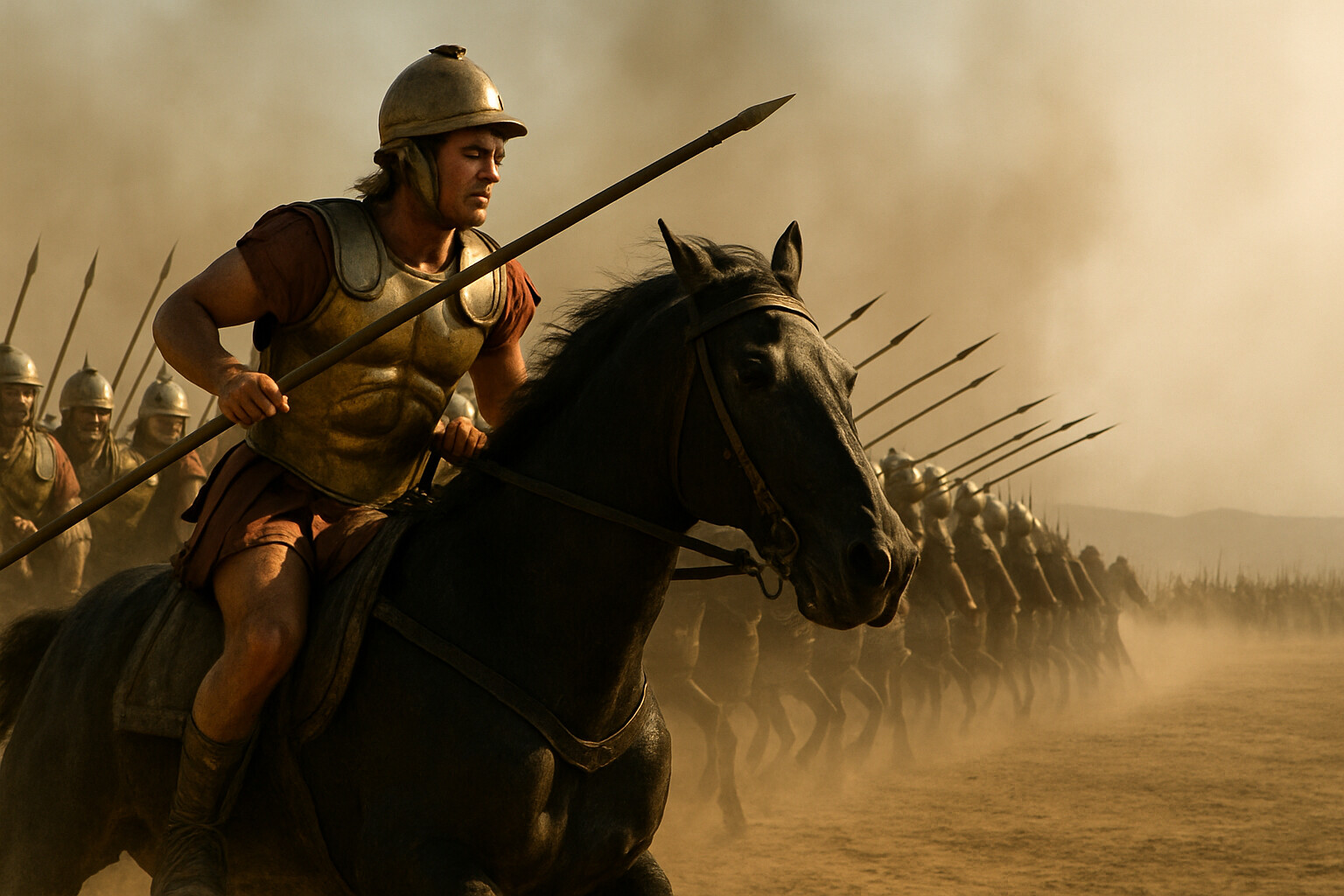
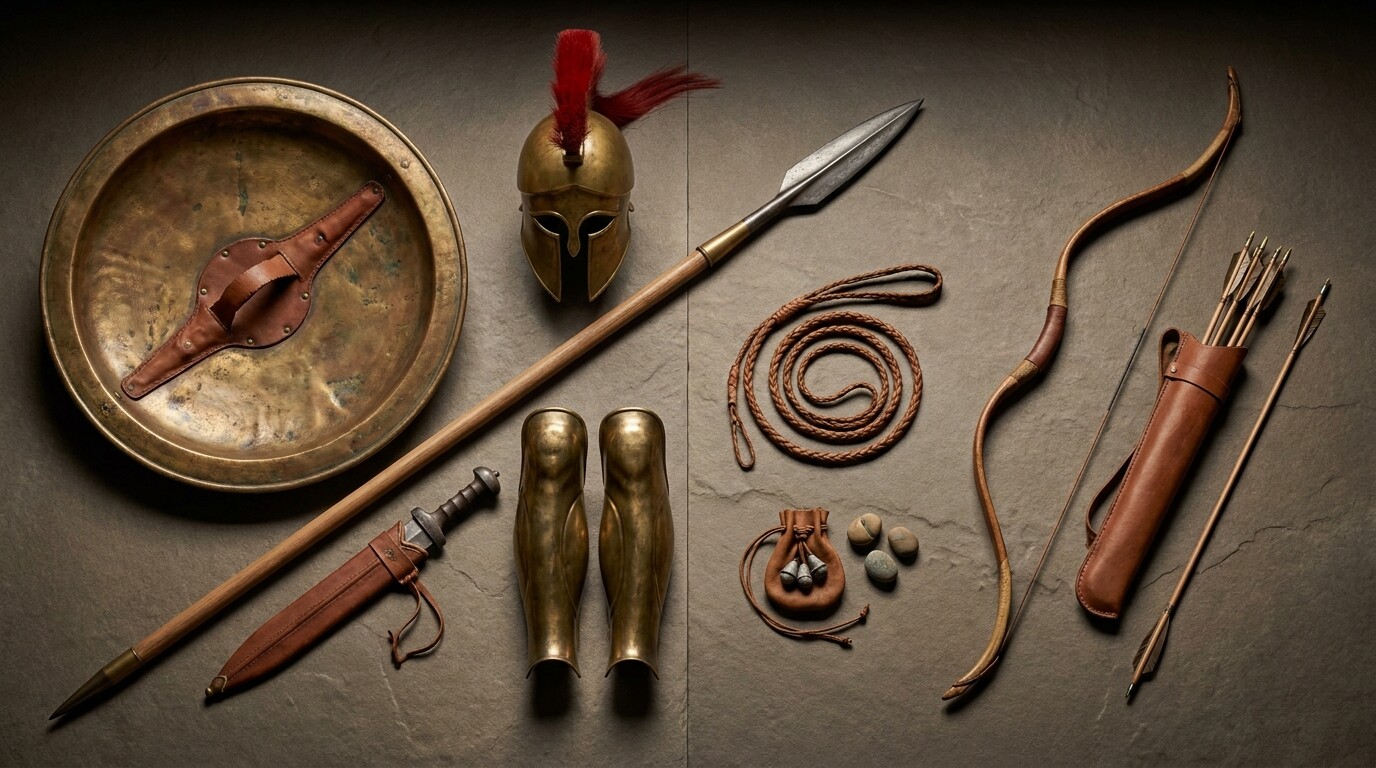
By the late fifth century BC, the Greek world had produced a military culture organized around the hoplite: a heavily armed citizen-soldier who fought in a tight formation called the phalanx. The hoplite carried a large round shield — the aspis, roughly three feet across, built from wood and faced with bronze — and wore a helmet, a corselet of bronze or stiffened linen, and bronze greaves on his shins. His primary weapon was an eight-foot thrusting spear called a doru; when the spear broke or the press grew too close, he drew a short iron sword, the xiphos. In formation, overlapping shields formed a continuous wall and the spears projected in dense rows from behind it. The formation was called the phalanx, and against other infantry in a frontal engagement it was devastating. Against cavalry on open ground, a well-drilled phalanx was nearly impossible to break.
The Greeks had proved this against Persian forces in the wars of 490 and 480–479 BC. Marathon, Thermopylae, and Plataea had embedded themselves in both cultures' military memory. Persian commanders understood that Greek hoplites in formation were dangerous. What the Persians had in abundance was numbers, cavalry, archers, and logistics.
Cyrus the Younger, younger brother of the Persian king Artaxerxes II, assembled his mercenary force under a legal fiction: the Greeks were officially hired to deal with a troublesome Pisidian hill tribe. The real purpose was to march on Babylon and seize the throne. The Greek commanders knew what was actually happening — or most of them suspected — but the pay was good, the adventure was real, and Cyrus was a patron who inspired personal loyalty. The general commanding the entire mercenary force was Clearchus of Sparta, an experienced, technically skilled soldier who had spent much of his career in military exile after being condemned to death in Sparta for exceeding his orders in Thrace, though ancient sources describe those circumstances differently.
The army assembled at Sardis in western Anatolia and marched east and south through the spring and summer of 401 BC, covering ground through what is now Turkey, Syria, and toward the Euphrates. Cyrus kept his mercenaries fed, paid, and moving, and managed the long approach with sufficient ambiguity that Persian governors along the route could not assemble effective resistance in time. By the time Artaxerxes fully understood what was happening, his brother's army was approaching Babylonia.
The two forces met at Cunaxa, roughly fifty miles north of Babylon, in September 401 BC. The exact date within that month is not established in surviving sources, but the month and year are consistent across ancient accounts. On the Greek right wing, the hoplites performed exactly as designed: they routed the Persian left so completely that their opponents did not stop running. The problem was Cyrus himself. Spotting his brother's position in the battle line, he rode directly at him. In the melee that followed, Cyrus struck Artaxerxes — ancient sources disagree on whether he wounded the king — but was killed almost immediately afterward. With the commanding general dead, his Persian and Asiatic troops broke and fled. The Greeks had won their part of the battle. They had also, without knowing it yet, lost the war.
When the full situation became clear the following morning — Cyrus dead, his Persian supporters scattered or defected, the king's army still intact in the field — the Greek commanders faced a stark calculation. They were tactically victorious and strategically stranded. Negotiations opened with the Persian satrap Tissaphernes, who had commanded the Persian forces opposite the Greek hoplites and now represented Artaxerxes's interests. Tissaphernes offered to escort the Greeks back toward the coast. The arrangement sounded like coexistence for the duration of the march.
It was a trap.
Some weeks later — the precise timing is approximate, drawn from Xenophon's account in the Anabasis — Tissaphernes invited the Greek generals and senior officers to a parley. Clearchus and four other generals, along with roughly twenty captains, attended. They were seized, bound, and executed. The Ten Thousand had lost their experienced command structure in a single afternoon's treachery.
What happened next is where Xenophon enters the record in a way that can be traced directly.
---
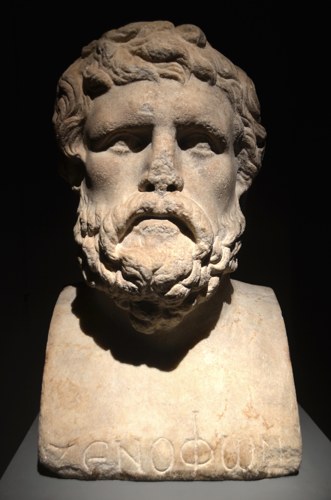
Xenophon was not a general when the crisis broke. He was an Athenian of good family, a student of the philosopher Socrates, a man with military experience but no formal command authority among the Ten Thousand. He had come on the expedition as a personal guest of the Greek officer Proxenus of Boeotia — one of the executed generals, and a man Xenophon describes in the Anabasis with evident personal affection. By his own account, Xenophon spent a sleepless night after the murders working through the situation. The Anabasis is a firsthand memoir that historians treat as a primary source while noting its inherent self-justifying tendencies; what follows in it is Xenophon's version of events, and that distinction matters throughout.
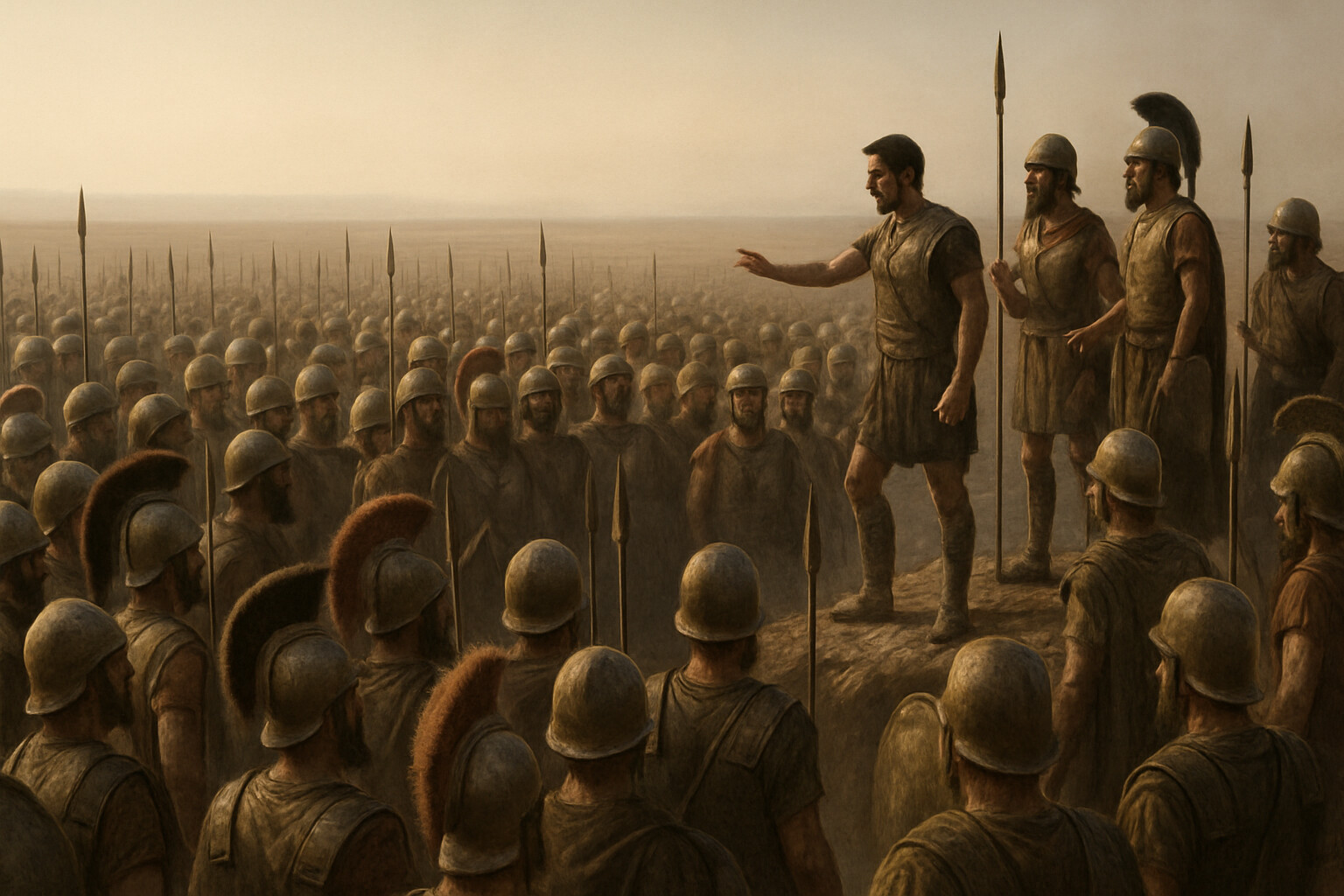
The surviving officers held an assembly. New generals were elected. Xenophon was chosen to command the rearguard — the most dangerous position in a retreating army. He was at the time probably in his late twenties or early thirties, though his exact birth year is uncertain; modern scholars place it variously between 430 and 425 BC.
The army now facing its march home numbered roughly ten thousand hoplites — hence the name — plus several hundred Cretan archers, a small cavalry contingent, and a train of camp followers, servants, and dependents that added thousands more mouths and complications. They were deep in Mesopotamia, in a flat alluvial plain crossed by the Tigris and Euphrates, surrounded by a Persian force that could not afford to let them march home intact. Every Greek soldier who walked back to his city would carry with him the knowledge that Greek hoplites had shattered a Persian army and that Persian treachery, not Persian arms, had accomplished what Persian arms could not.
Tissaphernes followed the retreating column with cavalry and light infantry, harassing flanks and rear continuously. The flat plains of Mesopotamia were ideal cavalry country. Persian horsemen could close to javelin range, release, and wheel away before the hoplites could close with them. The phalanx was a decisive instrument in a stand-up frontal fight. Against mobile mounted harassment, it was a formation of heavily burdened men who could not catch their attackers.
The Greeks adapted. The Anabasis describes tactical modifications made on the march: the small Greek cavalry force was concentrated to provide some counter to Persian horse; Cretan archers, whose composite bows had longer effective range than the Persian bows they faced, were used to suppress harassment at distance. Slingers recruited from the Rhodian contingent proved particularly effective — Rhodian slingers using cast lead shot could, according to Xenophon's account, outrange Persian archers, giving the column a stand-off capability that helped suppress the most aggressive Persian pressure. The same passage notes that the Greeks actively sought to recruit additional slingers once they recognized the problem, suggesting the weapon's importance had not been fully anticipated at the outset. These tactical details are recorded in the Anabasis and treated as credible by modern military historians, though the precise comparative ranges of slings versus Persian bows cannot be quantified from surviving evidence alone.
The march north up the Tigris was demanding by its nature even without enemy pressure. The Mesopotamian plain offered little cover. Water had to be secured and guarded. The army could not live easily off the land without foraging parties, and foraging parties could be cut off by cavalry. Discipline was essential, and discipline required command authority, and command authority required the men to believe their generals were competent. Every decision Xenophon and his colleagues made was partly tactical and partly political — performed before ten thousand armed men who could always vote with their feet.
They could not go back south toward Babylon; Persian forces blocked that direction. The most direct route west, back through Syria and Anatolia, was blocked by Tissaphernes. The route chosen — or forced upon them by circumstance — ran north along the Tigris into what is now Kurdistan and then across the Armenian highlands toward the Black Sea coast. It was longer and harder, but it offered something the plains could not: terrain that would neutralize Persian cavalry and force any pursuit onto ground where hoplites could fight at advantage.
The Tigris crossing was one of the early crises. Without boats, the army had to locate a fordable stretch and cross it under cavalry observation while maintaining unit cohesion. The exact details are drawn from the Anabasis and cannot be independently verified, but the general picture — the column working along the riverbank to find crossing points while fending off harassment — is consistent with the terrain.
---
The mountains saved them and nearly killed them.
As the Ten Thousand moved north into the Kurdish highlands — the territory of the Carduchi — Persian cavalry became irrelevant. The Carduchi had no interest in helping Artaxerxes, but they had equally little interest in letting ten thousand armed foreigners cross their territory unmolested. They were skilled mountain fighters and made that skill count. Working from heights the heavy infantry could not quickly reach, they harassed the column with slings, arrows, and rocks rolled from above, attacking the rearguard in the passes and denying rest to men already exhausted and running short of supplies.
The warfare in the Carduchian mountains, which Xenophon describes in considerable detail, was unlike anything on the Mesopotamian plain. The phalanx was nearly useless in broken terrain. The Greeks had to fight in small groups, scrambling for high ground before the enemy took it, securing ridgelines so the main body could pass through the valleys below. The rearguard suffered repeatedly. The Cretan archers and Rhodian slingers came into their own here, but the supply of arrows and lead shot was finite and impossible to replenish reliably.
Xenophon, commanding the rearguard through the worst of this, appears in the Anabasis as a man making decisions under continuous pressure. He describes sending officers ahead to secure hilltops, rotating units to prevent any single company from becoming too depleted or demoralized, and maintaining the discipline of structured movement even when the terrain made formation impossible. These are his own words about his own actions, and must be read with awareness that he is the author as well as the subject. Modern historians generally find the tactical descriptions broadly reliable while acknowledging that Xenophon had obvious reasons to present his role favorably.
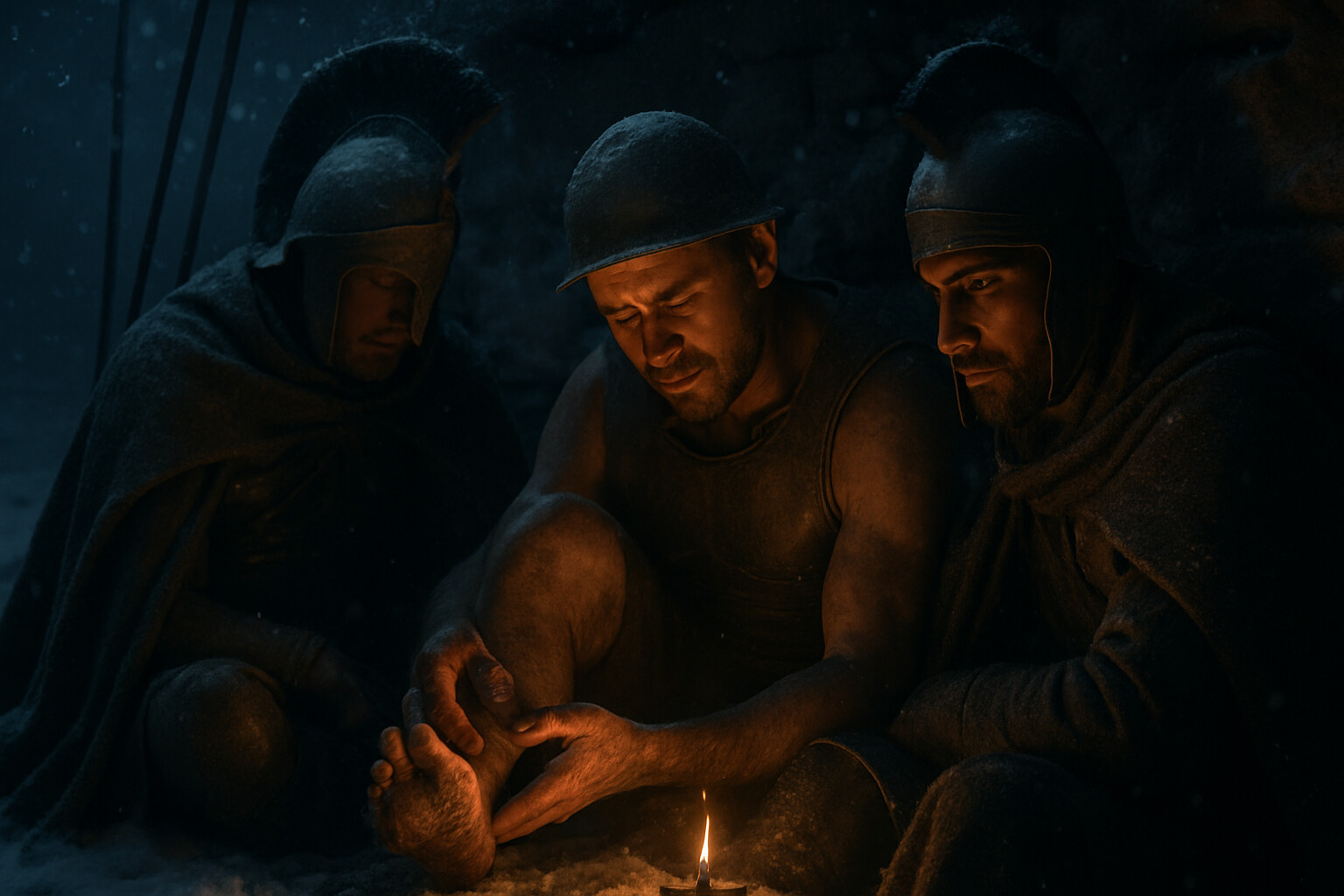
After the Carduchian mountains came Armenia, which brought a different kind of suffering. The army arrived in winter. The Armenian plateau at altitude, in December and January, is a landscape of deep snow, severe cold, and inadequate shelter. The Greeks had been marching and fighting for months. Their sandals — standard footwear, wholly inadequate for snow — were giving out. The Anabasis describes men losing toes to frostbite, soldiers going snow-blind, individuals too exhausted to rise found dead in the morning. The army continued to shrink, not only from battle but from cold, hunger, and cumulative attrition.
The Armenian satrap — the territory nominally under Persian authority — could not stop the Greeks in open engagement, but the population withdrew into fortified positions and stripped the countryside of supplies wherever possible. The Greeks had to negotiate, raid, and press on. Xenophon describes one episode in which the column found a village with underground storage rooms full of grain, wine, and livestock, and the soldiers spent several days recovering. Such moments of relief punctuate a narrative otherwise defined by hardship.
The precise identification of specific locations named in the Anabasis is an ongoing scholarly project. The general route — north along the Tigris, through the Kurdish mountains, across the Armenian plateau, and toward the Black Sea — is broadly established. Specific passes, river crossings, and villages named in the text remain contested in the academic literature, and any map of the march involves a degree of scholarly reconstruction.
---
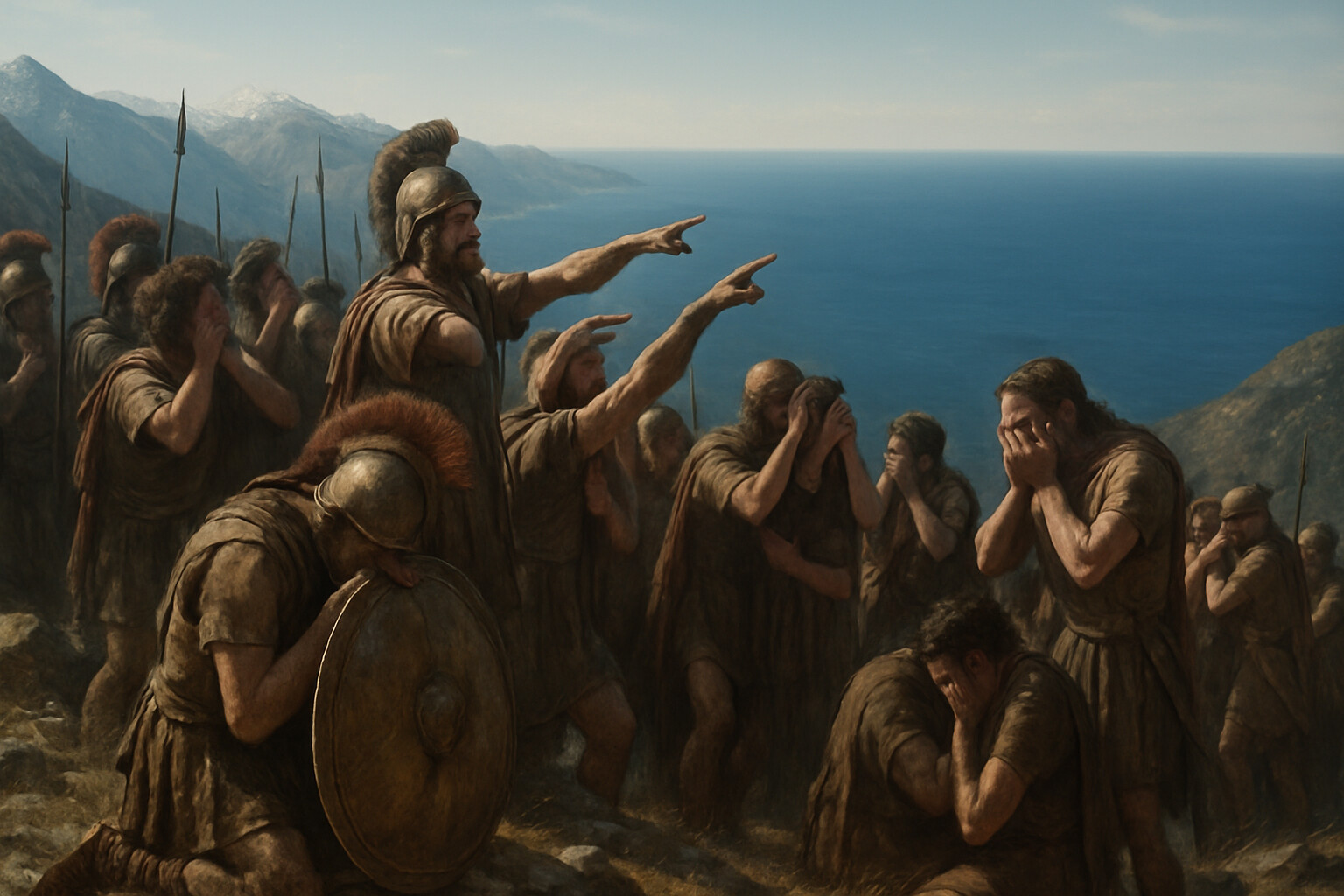
The moment the army had been marching toward for months came without announcement, as such moments often do.
It was the vanguard — the lead elements, not Xenophon's rearguard — that heard it first: a sound carrying back down the column, growing louder as more voices joined in. Men calling the same word over and over, with an intensity that sent those behind running toward the sound before they understood what it meant.
Thalatta. Thalatta. The sea. The sea.
Xenophon, back with the rearguard and still managing a rearguard action against pursuing forces, heard it and initially feared an attack. He rode forward and found his army weeping. The date was approximately February 400 BC, though the exact timing is uncertain. The location was a height in the Pontic mountains near or in the vicinity of the Greek colony of Trapezus — modern Trabzon on Turkey's Black Sea coast — from which the Black Sea was visible for the first time.
The cry of Thalatta is reported in the Anabasis and has become one of the most cited moments in ancient military literature. Whether it happened precisely as described, whether the emotional response was as universal as the account suggests, and whether Xenophon's rendering captures or amplifies the event are questions scholars continue to debate. What is not disputed is that the Ten Thousand did reach the Black Sea coast, made contact with Greek coastal settlements, and eventually returned to Greek territory. Whatever its precise character, the emotion attached to that moment had been earned across months of extraordinary hardship.
The Anabasis account has the generals weeping alongside their men at the sight of the sea, then turning back to drive off the pursuing enemy before the emotional moment could become a tactical disaster. That detail — the discipline required to interrupt relief for the necessities of security — is characteristic of the practical quality that makes the Anabasis read as a soldier's account rather than a purely literary construction.
---
Reaching the coast did not end the march.
Trapezus was a friendly port, but it could not absorb ten thousand armed men indefinitely. The army needed transport ships to continue home. Ships were not immediately available in sufficient numbers. The Greeks wintered on the coast, raiding local territory for supplies in ways that made them unwelcome guests even among nominally Greek communities. Internal politics that had been suppressed by the urgency of the march reasserted themselves — arguments about command, direction, and whether to seek permanent settlement or press on. These tensions are documented in the Anabasis and must be read with awareness that Xenophon is once again describing a situation in which he was a participant and a party.
Xenophon, by his own account, was offered command of the entire army and declined, at least initially — in part because his status as an Athenian who had served in a mercenary force fighting against Persia complicated Athens's diplomatic dealings with Persia at the time. He eventually became involved in negotiations with Spartan military commanders in the region, reflecting the broader Greek political landscape in which Sparta, having defeated Athens in the Peloponnesian War, was now the dominant power attempting to manage Greek military activity in Anatolia.
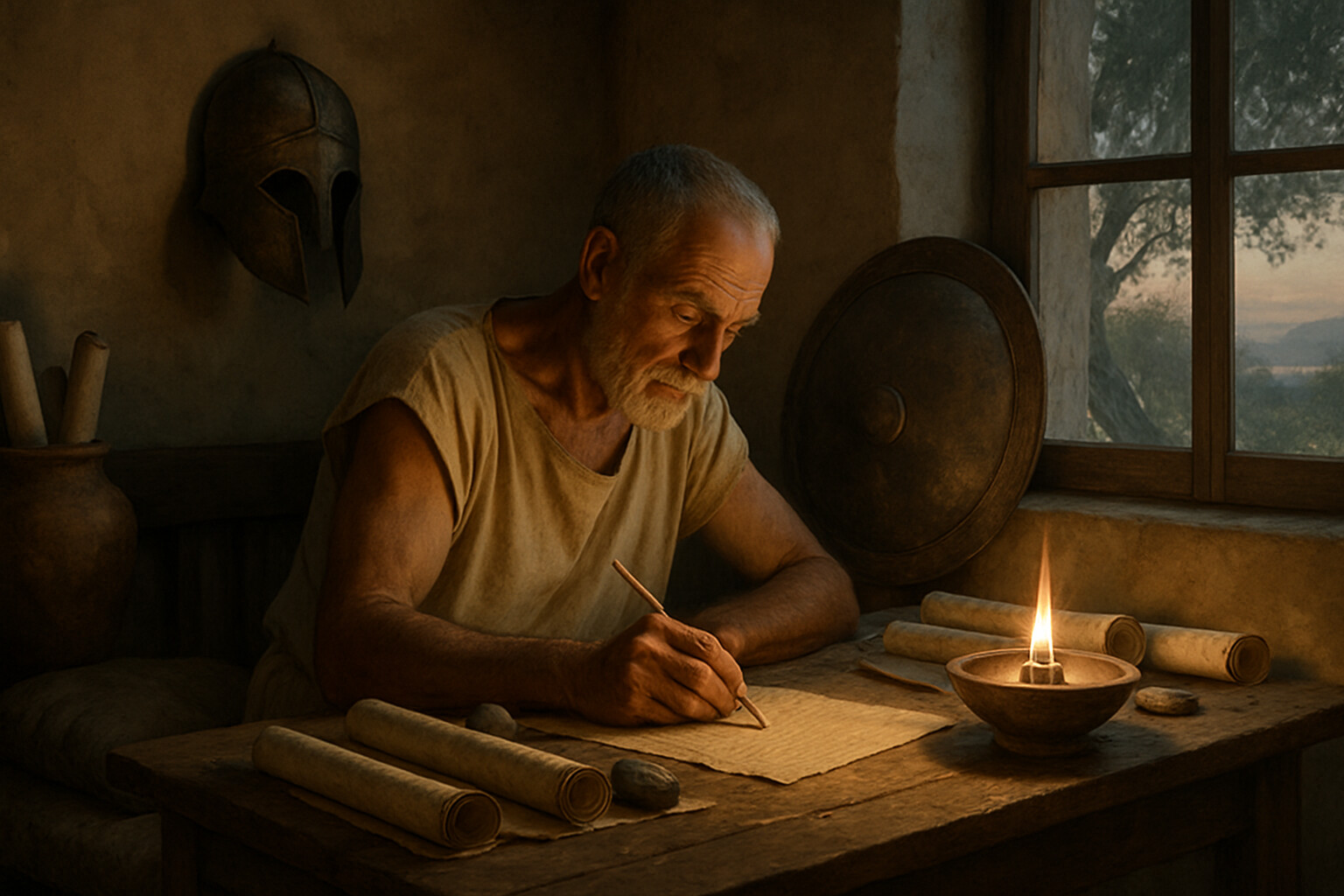
The army eventually fragmented. Some units entered service with a Thracian ruler named Seuthes. Others were absorbed into Spartan expeditionary forces. Xenophon, eventually exiled from Athens — the precise legal and political circumstances are not fully documented in surviving sources — went on to serve under the Spartan king Agesilaus and was settled by the Spartans at an estate at Scillus near Olympia. He lived there for some years, apparently writing much of his surviving work, before political changes forced another move. His death date is uncertain; estimates range between approximately 355 and 354 BC.
The Anabasis was written years after the events it describes, likely in the 370s or 360s BC, though the precise composition date is debated. It circulated initially under a pseudonym — ancient sources, including the biographer Diogenes Laertius, report that it appeared under the name Themistogenes of Syracuse before being correctly attributed to Xenophon. The reasons for the pseudonym were presumably political; the account covered actions that were, from an Athenian standpoint, diplomatically awkward.
The number of Greeks who completed the march is uncertain. The Anabasis gives figures at various points — approximately 8,600 hoplites are mentioned crossing into Pontus, down from roughly 10,000 at Cunaxa — but ancient numerical reporting requires the same caution it does in any pre-modern source. The figures are broadly consistent with a force that suffered significant attrition through combat, cold, hunger, and desertion over a march estimated at roughly 1,500 miles in total distance, across approximately eight months.
---
What the Ten Thousand left behind was more than footprints.
Xenophon wrote the Anabasis as a record and as an argument: that Greek soldiers were capable of extraordinary endurance, self-governance, and tactical adaptability, and that the Persian Empire, for all its size, was not invulnerable. The account was widely read in antiquity. Scholars have made a plausible case that Alexander the Great read it carefully before his own Persian campaign, which began in 334 BC — the strategic insight embedded in the Anabasis, that a relatively small Greek army could penetrate to the heart of Persia and fight its way back out, may have been one of the intellectual foundations on which Alexander's ambitions rested. This connection is widely discussed in scholarship but cannot be confirmed with documentary certainty; it rests on probability rather than explicit ancient testimony.
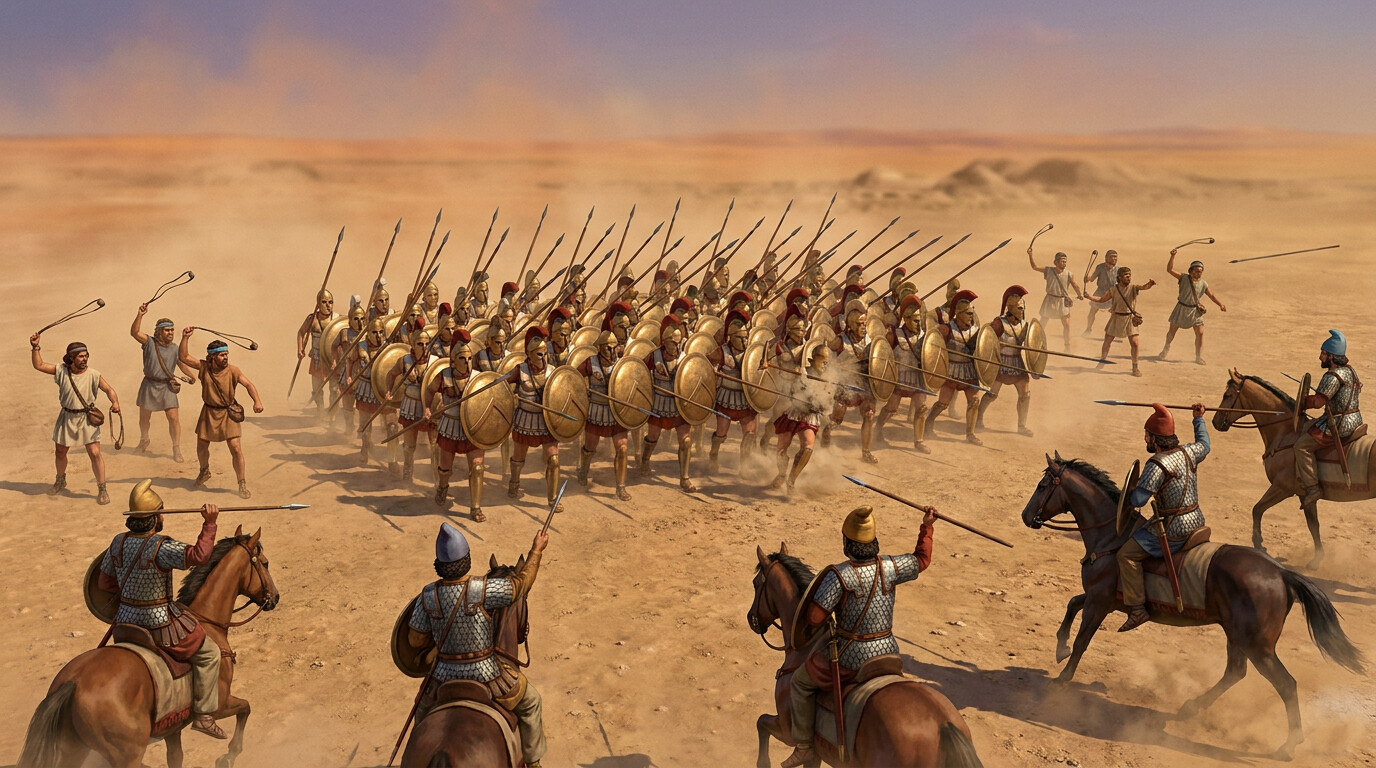
Military historians have used the Anabasis as a case study in small-unit leadership, logistics under stress, coalition command, and the limits of light cavalry against disciplined infantry. The army's improvised solutions — the deployment of Rhodian slingers to contest Persian cavalry at range, the deliberate use of terrain to negate mounted harassment, the rotation of units under fire to prevent exhaustion from accumulating in the same formation — were arrived at through experimentation under pressure, and they reflect an adaptive quality that the rigid hierarchy of a state army might have suppressed.
The phalanx itself is worth understanding in this context. A formation of close-packed men behind interlocking shields, advancing at a measured pace with spears leveled, was psychologically as well as physically formidable. The noise of it — thousands of bronze shield-rims striking together, thousands of feet moving in near-unison on hard ground — was designed to be heard. The visual mass of it, crests swaying above locked shields, was designed to be seen. Against foot soldiers in open terrain, it worked in ways that individual fighting could not replicate. The Ten Thousand used it when they could and adapted when they could not, and the fact that they held the formation together through months of march and attrition is itself a record of training, discipline, and leadership that operated through persuasion as much as authority — because in a mercenary army, persuasion was always the ultimate foundation of command.
Xenophon was not the sole commander of the Ten Thousand and should not be presented as such. He was one general among several elected after the massacre of the original commanders. His colleagues — Cheirisophus the Spartan, who commanded the vanguard; Timasion; Cleanor; and others — appear in the Anabasis and in secondary scholarship. Cheirisophus, as the senior Spartan officer, carried significant authority, and his working relationship with Xenophon was occasionally tense as well as cooperative, as the Anabasis itself acknowledges. The march is a collective achievement even if Xenophon is the one who wrote it down.
The march also included thousands of people whose names did not survive. Camp followers, local guides hired and released, servants and dependents who had accompanied the army from Sardis, soldiers who died in the mountains whose names Xenophon does not record individually. The Ten Thousand were not ten thousand identical hoplites; they were an army embedded in the social world of the fifth century BC, and the humanity of that world — the specific weight of grief when a unit loses its officers in a single afternoon, the specific relief of water after a desert crossing, the specific fear of a night march through mountain passes where the enemy holds the high ground — is present in the Anabasis for those who read it as a soldier's account rather than a classical text.
That combination — the tactical and the human — is what has kept the story alive for twenty-four centuries. Not many military operations from the ancient world survive in a firsthand account written by a participant. Not many operations from any era leave behind a document that functions simultaneously as military history and as a personal reckoning with what it costs to bring men home from a place where no one expected them to survive.
Xenophon brought them home. Most of them. Through mountains and cold and harassment and treachery and hunger and the accumulated weight of months in hostile country. He did it through argument and example and the kind of leadership that must be re-earned every day, before men who carry spears and can always vote with their feet.
The sea was waiting. They walked to it.
Thalatta. Thalatta.